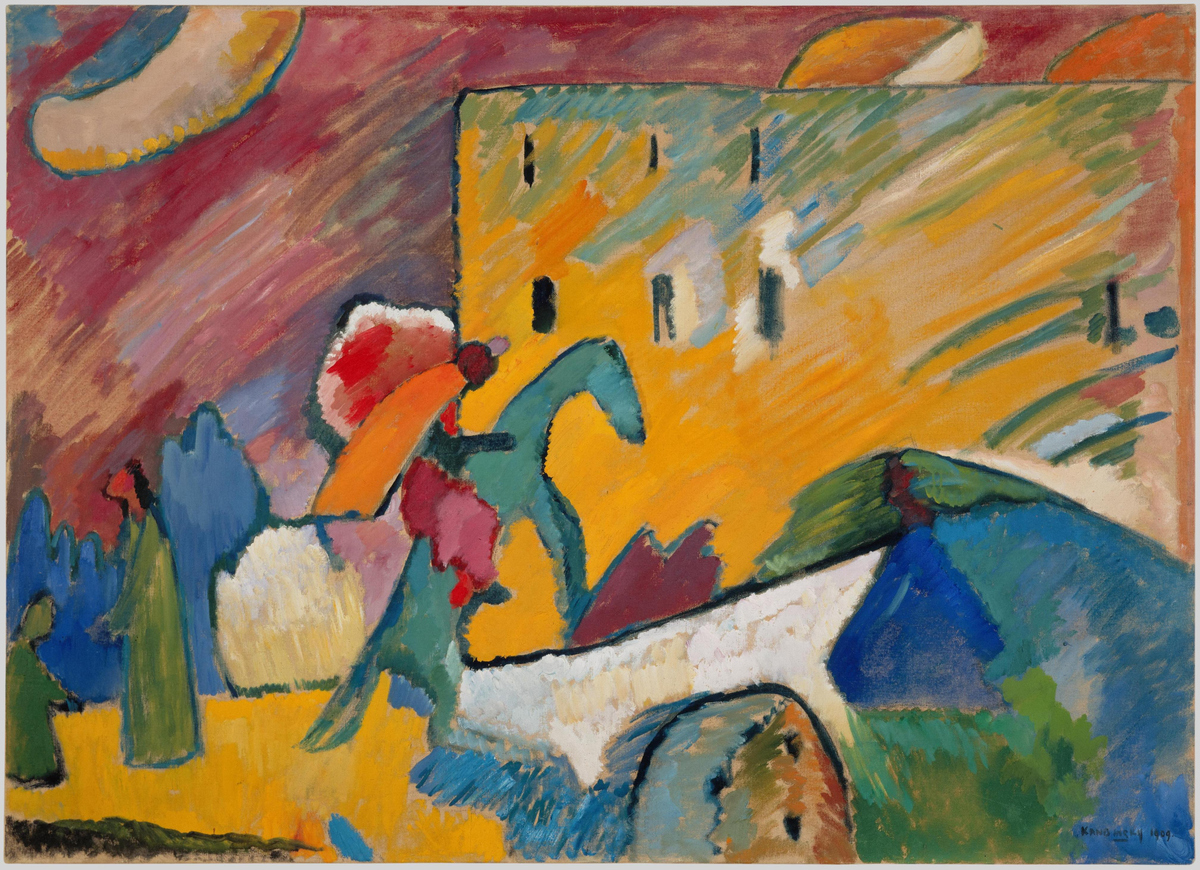
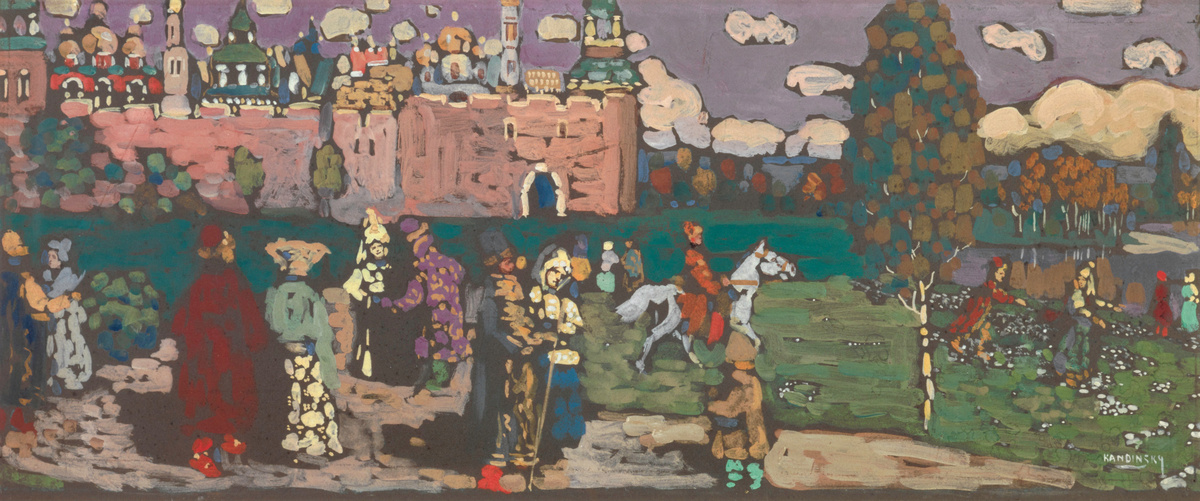
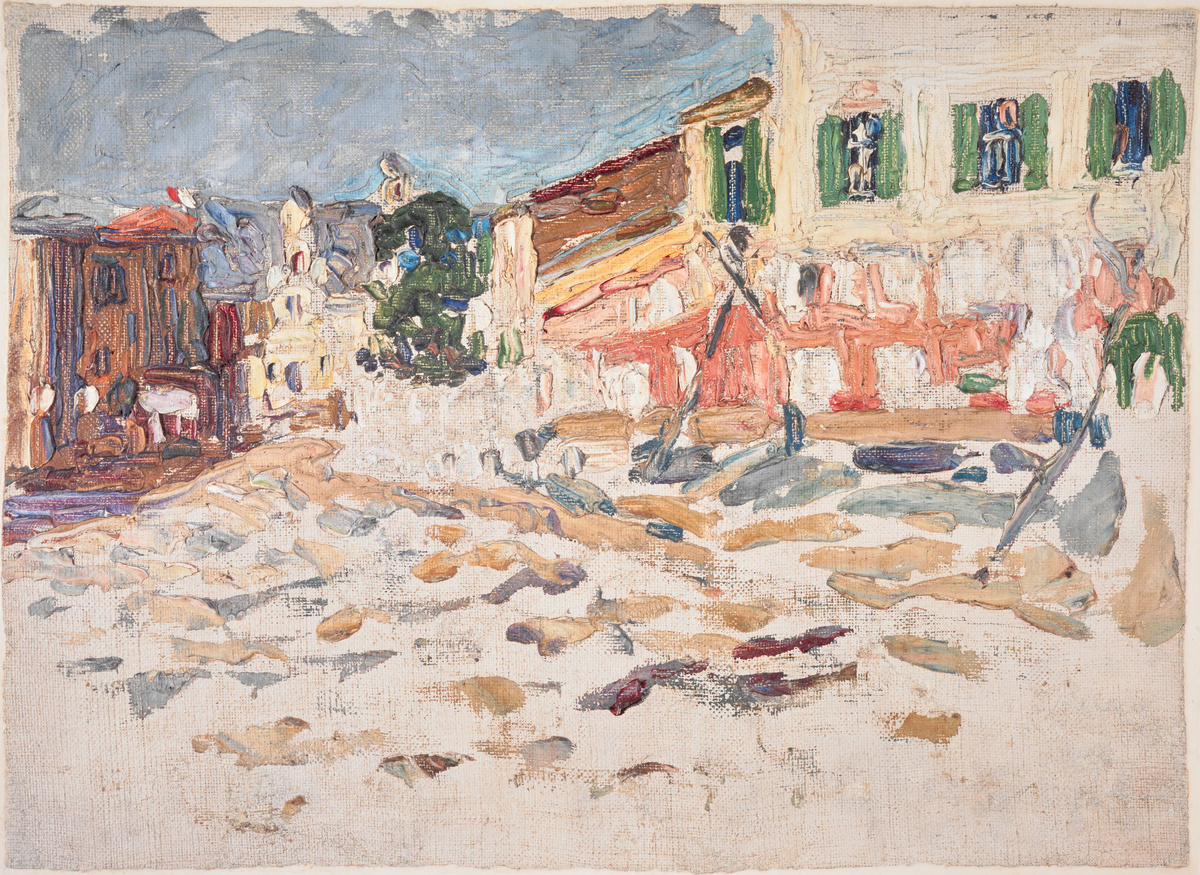
Das bunte Leben (Colorful Life)
Artist: Wassily Kandinsky · 1907

Das bunte Leben (Colorful Life): high-resolution image
The original file is hosted by Wikimedia Commons, available without payment or an account.
Open high-resolution image on Wikimedia CommonsThe complete story
The story About 3 minutes to read
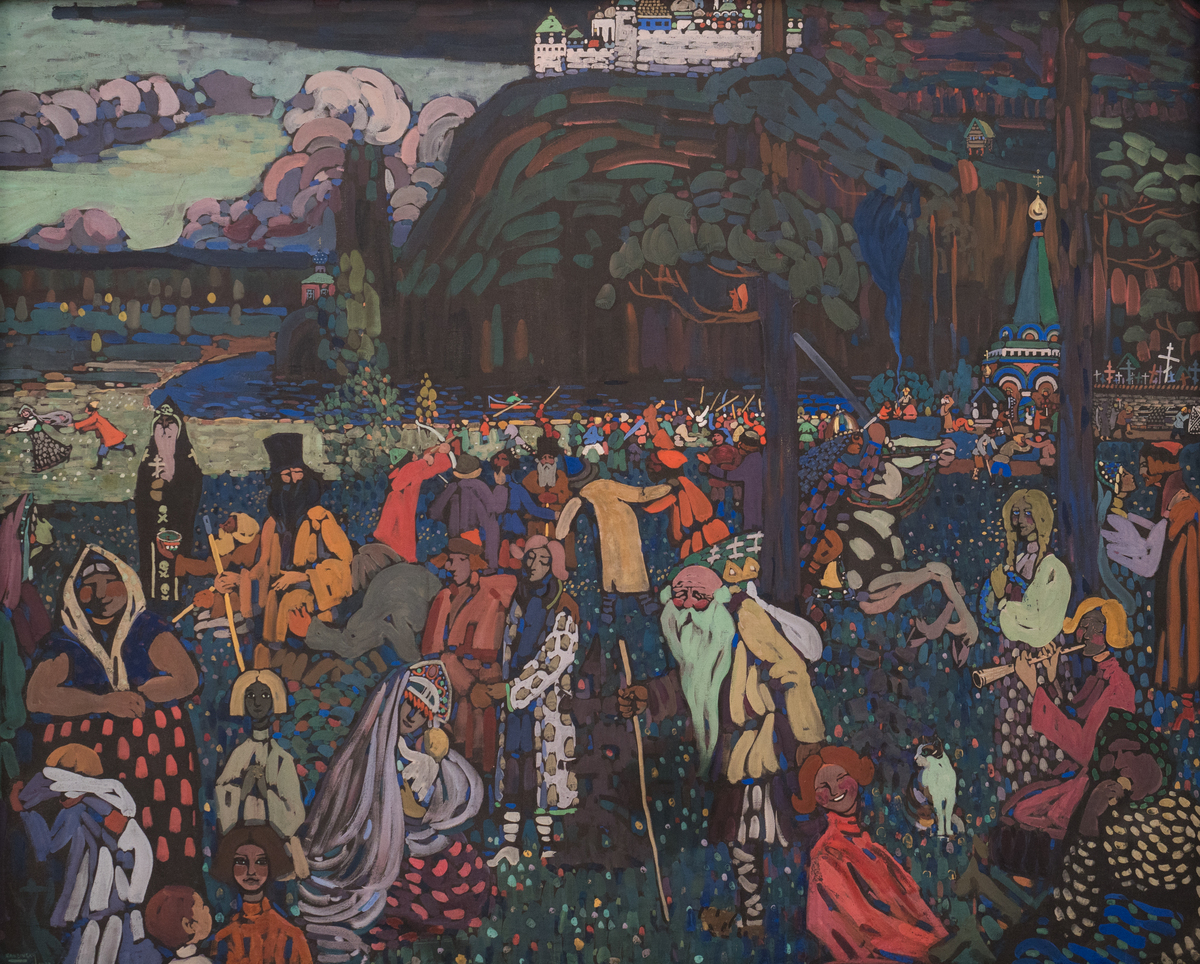
Kandinsky painted this crowded festival scene in 1907. Small figures dance, gesture and raise sticks beneath dark trees, between a river and a white-walled monastery. The scene is packed with activity. Yet standing low at the centre is an old man with a long pale green beard, a fur hat and a patterned staff.
Look at how the crowd moves. The dancers are small and quick, their gestures scattered across the middle band of the painting. Against that restlessness, the bearded elder stands still. His age and his staff set him apart from the figures around him.
At the right edge, two musicians play. One is long-haired and dressed in pale green, playing a flute. A red-clad companion with yellow hair sounds a smaller pipe. At the left stands a tall figure in a black robe and cylindrical hat, holding a chalice-like vessel. The painting holds solemnity and festivity at once.
In the lower foreground, a woman in a patterned shawl and long white veil bends over an infant. It's a quiet moment of care inside the crowd. Above them all, a white-walled monastery with green roofs sits against the dark hill. It fixes the scene in a Russian religious landscape.
So the painting sets different kinds of life side by side. There is dance and music, and there is the priest and the monastery. There is old age in the bearded elder, and infancy in the child below. That range is what the title points to. A colorful life, in this reading, means many kinds of experience held in one frame.
Return to the old man at the centre. Around him the festival keeps moving, but his stillness gives the crowd something to gather round. What stays with you is that balance. A busy, bright world, held together by a quiet figure and a white monastery on the hill.
The story and its sources
Historical claims are linked to the records below. Close looking and interpretation are identified in the passage notes.
- Passage 1Close lookingWikimedia Commons: The Colourful Life
- Passage 2Close lookingWikimedia Commons: The Colourful Life
- Passage 3Close lookingWikimedia Commons: The Colourful Life
- Passage 4Close lookingWikimedia Commons: The Colourful Life
- Passage 5InterpretationWikimedia Commons: The Colourful Life
- Passage 6Close lookingWikimedia Commons: The Colourful Life
Details to notice
About 2 minutes to readBlack-robed priest
At left, a tall figure in a black robe and cylindrical hat holds a chalice-like vessel, his dark vertical form and ritual object introducing a solemn note amid the festivity.
Musicians at right
At the right edge, a long-haired figure in pale green plays a flute while a red-clad companion with yellow hair sounds a smaller pipe, adding music to the gathering.
Hilltop white monastery
A white walled monastery with green roofs sits against the dark hill at the top center, fixing the scene in a Russian religious landscape and dominating the horizon.
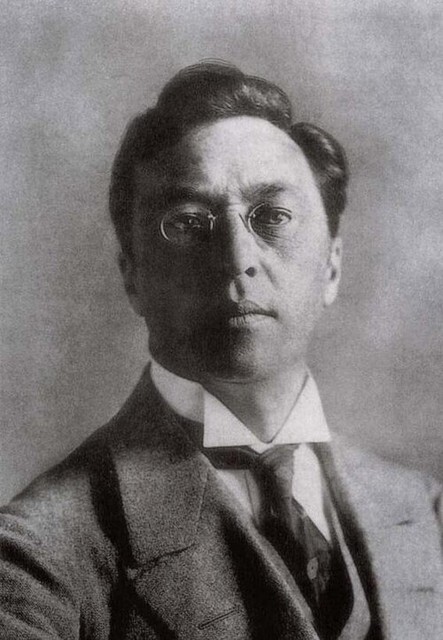
Artist portrait Image credit
未知上傳者. Image source · Public domain
About the artist
Wassily Kandinsky
1866 to 1944
Wassily Kandinsky was an avant-garde painter of Russian origin (1866–1944). Their work is associated with Expressionism; Symbolism; Bauhaus. Their recorded places of work include Paris; Munich; Weimar; Rapallo; The Hague; Russia; Stockholm; Switzerland; Tunis.
- Born
- 1866
- Died
- 1944
- Nationality
- Russian Empire; Russian Soviet Federative Socialist Republic; Soviet Union; France; Germany
- Birthplace
- Moscow
- Died in
- Neuilly-sur-Seine
Biography sources
The research & record
Study the work.
Follow the evidence.
Find catalogue details, historical context, technical research and the literature behind this artwork.
The artwork record
Research catalogue
Catalogue information and detailed research, with references that link to the bibliography.
Updated .
Identity and catalogue
Link- Title
- Das bunte Leben (Colorful Life)
- Artist or attribution
- Wassily Kandinsky(Wikimedia Commons: The Colourful Life, n.d.)
- Object date
- 1907
- Medium and support
- Oil on canvas(Wikimedia Commons: The Colourful Life, n.d.)
- Dimensions
- Height 130 cm; width 162.5 cm
- Movement or period
- Expressionism
- Country or culture
- Russian, made in Germany context
- Depicted subject
- A large, crowded festival scene: a dense band of small figures gestures, dances and raises sticks beneath dark trees, between a river and a white-walled monastery. A long-bearded elder with a patterned staff anchors the lower centre; at right, two musicians play pipes; at left, a black-robed priest holds a chalice-like vessel; in the foreground a veiled woman bends over an infant.(Wikimedia Commons: The Colourful Life, n.d.)
- Title variants
- Colorful Life; La Vie colorée; La vita variopinta; Красочная жизнь; Шарен живот; A Vida Colorida; Das Bunte Leben
- Support
- canvas
Read valuation records and their limitations
Catalogue identity
The catalogue identity of this work rests on a Wikimedia Commons file record rather than an official museum catalogue. That record names Wassily Kandinsky as the artist and gives the title Das bunte Leben, with the English rendering Colorful Life, and dates the painting to 1907. The same record supplies the physical description: oil on canvas, 130 cm in height and 162.5 cm in width. Because the annotation describes the Commons page as a discovery record and explicitly not an official museum record, these particulars should be cited as catalogued information transmitted through that file page, not as data verified against an institutional object file. The date 1907 belongs to the making of the painting; later dates that attach to the object concern its ownership and legal history and must be kept distinct from the object date.(Wikimedia Commons: The Colourful Life, n.d., File description)
The depicted scene
Interpretation
The scene the record describes is a dense festival crowd beneath dark trees, with small figures gesturing, dancing and raising sticks, set between a river and a church. Several figures are singled out in the description. A standing old man with a long pale green beard, fur hat, crutch and patterned leggings anchors the lower centre, and the record characterises his age and staff as a contrast to the busy crowd. At the right edge a long-haired figure in pale green plays a flute while a red-clad companion with yellow hair sounds a smaller pipe. At the left a tall figure in a black robe and cylindrical hat holds a chalice-like vessel, which the record reads as introducing a solemn note amid the festivity. In the lower foreground a woman in a patterned shawl and long white veil bends over an infant, described as a quiet moment of care within the crowded scene. Above, a white-walled monastery with green roofs sits against the dark hill at top centre, which the record treats as fixing the scene in a Russian religious landscape and as dominating the horizon. These are the visual facts the description establishes; the reading of them as a deliberate balance of festivity and solemnity is the account's interpretation, not an independent finding.(Wikimedia Commons: The Colourful Life, n.d., File description)
Wassily Kandinsky painted Das bunte Leben (Colorful Life) in 1907.(Wikimedia Commons: The Colourful Life, n.d.)
Subject and iconography
LinkRead valuation records and their limitations
The recorded composition
Visual observation
The painting is described as a crowded festival scene set beneath dark trees, with small figures gesturing, dancing and raising sticks across the middle of the composition; the crowd is bracketed spatially between a river and a church. The description treats this band of activity as dense and dispersed rather than organized around a single central action, so that movement is carried by many small gestures scattered through the middle ground rather than by one commanding figure. The picture is oil on canvas and measures 130 cm in height by 162.5 cm in width, a broad horizontal format that accommodates the lateral spread of the crowd and the landscape features that frame it.(Wikimedia Commons: The Colourful Life, n.d., Vision-derived focus candidate: central_festival_crowd; File description)
Within that crowded band, the lower centre is anchored by a standing old man with a long pale green beard, a fur hat, a crutch and patterned leggings. The description emphasizes his age and his staff as elements that contrast with the busy crowd, presenting him as a still, aged counterweight to the surrounding movement. This is an account of what is visible in the depicted scene: the beard colour, the fur headwear, the support and the patterned leg covering are recorded as seen, not as identifications of a specific person or type.(Wikimedia Commons: The Colourful Life, n.d., Vision-derived focus candidate: green_bearded_elder)
Figures at the edges
At the right edge of the composition, two musicians are described: a long-haired figure dressed in pale green who plays a flute, and a red-clad companion with yellow hair who sounds a smaller pipe. Their placement at the edge, and the pairing of two instruments, gives the festival its audible dimension as recorded in the description, and the distinct colours of the two figures separate them from the darker mass of the crowd. At the left, by contrast, stands a tall figure in a black robe and a cylindrical hat holding a chalice-like vessel, which the description characterizes as introducing a solemn note amid the festivity. The vessel is described as chalice-like rather than identified as a chalice, and the figure is characterized by robe and headwear rather than named as a priest in the observation itself.(Wikimedia Commons: The Colourful Life, n.d., Vision-derived focus candidate: right_side_musicians; Vision-derived focus candidate: black_robed_priest)
In the lower foreground a woman in a patterned shawl and a long white veil bends over an infant, described as a quiet moment of care within the crowded scene. This detail places infancy and nurture at the bottom of the picture, near the viewer, while the aged man with the crutch stands at the lower centre, so that the extremes of age are distributed across the near foreground of the composition. The shawl is recorded as patterned and the veil as long and white; the relationship between the woman and the child is described as bending over and care, an observation of posture rather than a named narrative subject.(Wikimedia Commons: The Colourful Life, n.d., Vision-derived focus candidate: veiled_mother_and_infant)
Landscape and horizon
Against the dark hill at top centre sits a white-walled monastery with green roofs. The description presents it as fixing the scene in a Russian religious landscape and as dominating the horizon, so that the built religious structure and the natural hill together close the upper part of the composition. The monastery is recorded by wall colour and roof colour, and the landscape identification as Russian is offered as part of the scene's setting rather than as a documented location for a specific monastery.(Wikimedia Commons: The Colourful Life, n.d., Vision-derived focus candidate: hilltop_white_monastery)
Interpretation
Read together, the described elements set different kinds of life side by side within one frame: dance and music in the crowd and at the right edge, a black-robed figure with a vessel and a walled monastery as solemn religious presences, old age in the bearded man with the crutch, and infancy in the child in the lower foreground. This is a synthesis of the recorded observation rather than a claim about the painter's intention, and it depends on the contrast the description itself draws between the stillness of the elder and the activity around him. The horizontal canvas and the placement of the monastery on the horizon allow the eye to move from the near foreground of care and age, through the middle band of dancers and musicians, to the religious landscape above.(Wikimedia Commons: The Colourful Life, n.d., Vision-derived focus candidate: central_festival_crowd; Vision-derived focus candidate: green_bearded_elder; Vision-derived focus candidate: right_side_musicians; Vision-derived focus candidate: black_robed_priest; Vision-derived focus candidate: veiled_mother_and_infant; Vision-derived focus candidate: hilltop_white_monastery; File description)
Visual observation
The depicted scene is a dense festival crowd beneath dark trees, with small figures gesturing, dancing and raising sticks, set between a river and a church.(Wikimedia Commons: The Colourful Life, n.d.)
A standing old man with a long pale green beard, fur hat, crutch and patterned leggings anchors the lower centre; his age and staff contrast with the busy crowd.(Wikimedia Commons: The Colourful Life, n.d.)
At the right edge, a long-haired figure in pale green plays a flute while a red-clad companion with yellow hair sounds a smaller pipe.(Wikimedia Commons: The Colourful Life, n.d.)
At left, a tall figure in a black robe and cylindrical hat holds a chalice-like vessel, introducing a solemn note amid the festivity.(Wikimedia Commons: The Colourful Life, n.d.)
In the lower foreground, a woman in a patterned shawl and long white veil bends over an infant, a quiet moment of care within the crowded scene.(Wikimedia Commons: The Colourful Life, n.d.)
A white-walled monastery with green roofs sits against the dark hill at top centre, fixing the scene in a Russian religious landscape and dominating the horizon.(Wikimedia Commons: The Colourful Life, n.d.)
Materials and technique
LinkRead valuation records and their limitations
Documented Support and Format
The only physical description of the object supported by the supplied record is concise: the work is an oil painting on canvas, measuring 130 cm in height and 162.5 cm in width. This is a documentary statement of medium and support rather than a technical analysis. It establishes that the picture is a single oil-on-canvas image of considerable scale, wide in format relative to its height, but the record says nothing about the fabric's weave or thread count, the presence or absence of a preparatory ground, the number or order of paint layers, the pigments employed, the brushes or other tools used, or any conservation treatment, lining, stretcher or frame. Those questions remain open on the supplied evidence and should not be filled in from assumption.(Wikimedia Commons: The Colourful Life, n.d., File description)
Composition and the Canvas Surface
Interpretation
Reading the description of the composition alongside the documented oil medium suggests why the painting's crowded, many-figured design matters for a history of materials and technique, but only as a qualified inference. The scene is organised across the full width and height of the canvas: figures occupy the middle band as a scattered festival crowd, a single elder anchors the lower centre, a veiled woman bends over an infant in the lower foreground, musicians frame the right edge and a robed figure the left, while the monastery fixes the horizon at top centre. A composition of this density and span implies deliberate planning of the picture surface before and during painting, yet the supplied evidence does not document any drawing, underdrawing, squared transfer or other preparatory method. The observation supports the claim that the canvas format was used to hold a wide, multi-figured scene; it does not establish how that scene was laid in.(Wikimedia Commons: The Colourful Life, n.d., File description; Vision-derived focus candidate: central_festival_crowd; Vision-derived focus candidate: green_bearded_elder; Vision-derived focus candidate: hilltop_white_monastery)
The painting is oil on canvas, with a height of 130 cm and a width of 162.5 cm.(Wikimedia Commons: The Colourful Life, n.d.)
Provenance and ownership
LinkRead valuation records and their limitations
Documented Ownership
The documented provenance of Das bunte Leben, as recorded in the Wikimedia Commons discovery record for the painting, begins with a private collection in 1919, when the work was in the collection of Paul Citroen. By 1927 it had passed into the collection of Emanuel Lewenstein, and then to Hedwig Lewenstein (Weyermann). The record does not state how the painting moved between these collections, nor whether the transfers were sales, gifts, inheritances or other arrangements; it records only the collections in which the painting is found at those dates. The succession from Emanuel Lewenstein to Hedwig Lewenstein (Weyermann) is likewise given as a sequence of ownership without a documented instrument of transfer in the supplied evidence. These 1919 and 1927 points are the earliest collection affiliations the evidence establishes.(Wikimedia Commons: The Colourful Life, n.d., Object history)
The record next states that the painting was auctioned in 1940, and that by 1972 it was in the collection of BayernLB and Bayerische Vereinsbank. The auction is given as an event without the auction house, lot number, sale date within the year, consignor, purchaser or price. The 1972 location is given as an institutional collection shared between two banks, again without a documented acquisition date or instrument. Between the 1940 auction and the 1972 institutional holding the evidence records no intermediate owner, so the interval is an unrecorded one rather than a documented chain; the account should treat the two endpoints as established and the intervening passage as unknown, not as a proven change of ownership. The same caution applies between 1927 and 1940, where no transaction is documented before the auction itself.(Wikimedia Commons: The Colourful Life, n.d., Object history)
Restitution Claim
The provenance record extends into a restitution process: on 6 March 2017 a claim for restitution of the artwork was made, and in June 2023 an advisory committee on Nazi looted art issued a recommendation. The evidence identifies the claim, its date, the committee's subject matter and the date of its recommendation, but it does not name the claimant, the committee, the parties against whom the claim was brought, the grounds relied upon or the content and effect of the recommendation. Those particulars cannot be supplied from the supplied units, and the 1940 auction and the 2017 claim should not be linked as cause and consequence without evidence that the sources do not provide.(Wikimedia Commons: The Colourful Life, n.d., Object history)
Interpretation
Read together, the units describe a provenance that is documented at discrete points rather than as a continuous chain: a 1919 private collection, a 1927 collection and its successor, a 1940 auction, an institutional holding by 1972, and then a 2017 claim followed by a 2023 advisory recommendation. The value of this record for the object's place in material culture lies in that structure. The painting is documented as moving through private collections, a public sale and bank collections before becoming the subject of a looted-art restitution claim. The gaps are as consequential as the recorded points, because a later account cannot assume a transfer where the record shows only a change of location between dated observations. Distinguishing the dated holdings from the undocumented intervals is the evidential basis on which any fuller history of the work's ownership would have to be built.(Wikimedia Commons: The Colourful Life, n.d., Object history)
In 1919 the painting was in the collection of Paul Citroen; in 1927 it was in the collection of Emanuel Lewenstein, and then Hedwig Lewenstein (Weyermann); it was auctioned in 1940; by 1972 it was in the collection of BayernLB and Bayerische Vereinsbank.(Wikimedia Commons: The Colourful Life, n.d.)
On 6 March 2017 a claim for restitution of the artwork was made; in June 2023 an advisory committee on Nazi looted art issued a recommendation.(Wikimedia Commons: The Colourful Life, n.d.)
Provenance timeline
- 1919
The painting is recorded in the collection of Paul Citroen.(Wikimedia Commons: The Colourful Life, n.d., Object history)
- 1927
The painting is recorded in the collection of Emanuel Lewenstein, and subsequently of Hedwig Lewenstein (Weyermann).(Wikimedia Commons: The Colourful Life, n.d., Object history)
- 1940
The painting was auctioned.(Wikimedia Commons: The Colourful Life, n.d., Object history)
- by 1972
The painting is recorded in the collection of BayernLB and Bayerische Vereinsbank.(Wikimedia Commons: The Colourful Life, n.d., Object history)
- 6 March 2017
A claim for restitution of the artwork was made.(Wikimedia Commons: The Colourful Life, n.d., Object history)
- June 2023
An advisory committee on Nazi looted art issued a recommendation.(Wikimedia Commons: The Colourful Life, n.d., Object history)
Documented values and qualified estimates
LinkRead valuation records and their limitations
Recorded values
Interpretation
The only value figure recorded for Wassily Kandinsky's Das bunte Leben is explicitly a working calculation rather than a valuation. The Wikimedia Commons discovery record behind it identifies the work as oil on canvas, 130 by 162.5 cm, painted in 1907: a large early Expressionist figural composition. The calculated insurance bracket of US$30M to US$90M was generated on 2026-10-30 as a broad conservative range derived from that confirmed context alone. The record states plainly that no public appraisal, insurance schedule or comparable sale was supplied, so the bracket is a high-value insurance planning range for a major museum-caliber Kandinsky, anchored to the artist's canonical status and to the work's large scale and historical importance. No figure here should be read as a market price, an auction estimate, or a professional appraisal.(Wikimedia Commons: The Colourful Life, n.d.)
The calculation's own qualifications explain what the numbers do and do not measure. Its lower bound reflects uncertainty arising from medium-confidence identification of the work and the absence of a current condition or title assessment; its upper bound is described as a conservative ceiling for manual review, not a market prediction, and the range rests on neither comparable sales nor private insurance records. The record goes further, stating that actual insurance placement would require a qualified appraiser, confirmed title and condition, and a current professional valuation. The object history cited as context includes prominent private collections, an auction in 1940 and later corporate ownership, together with a 2017 restitution claim and a 2023 advisory recommendation, but the valuation record treats these as background rather than as price evidence. The gap between a documented ownership history and an undocumented market value is the central point of the entry: the range quantifies uncertainty, not worth.(Wikimedia Commons: The Colourful Life, n.d.)
Working estimate
Calculated working insurance estimate, not a sale price: Estimated value: US$30M to US$90M Recorded date: Working calculation, generated 2026-10-30. Methodology: Broad conservative working range derived from confirmed context only: Wassily Kandinsky, Das bunte Leben, 1907, oil on canvas, 130 x 162.5 cm, a large early Expressionist figural composition. The documented provenance includes prominent private collections, an auction in 1940, and later corporate ownership, with a 2017 restitution claim and 2023 advisory recommendation noted in the Wikimedia Commons record. No public appraisal, insurance schedule, or comparable sale is supplied, so the range is calculated as a high-value insurance planning bracket for a major museum-caliber Kandinsky, anchored to the artist's canonical status and the work's large scale and historical importance. The lower bound reflects uncertainty from the medium confidence identification and absence of a current condition or title assessment. The upper bound is a conservative ceiling for manual review, not a market prediction. Qualification: This is a model-generated working range for manual review only, not an official insurance value, appraisal, auction estimate, or sale price. It is not based on comparable sales or private insurance records. Actual insurance placement requires a qualified appraiser, confirmed title and condition, and a current professional valuation.(Wikimedia Commons: The Colourful Life, n.d.)
Further reading
Books for a closer look
Paid links. As an Amazon Associate I earn from qualifying purchases.

Open Library Vasily Kandinsky: a colorful life : the collection of the Lenbachhaus, Munich
DuMont; Distributed by Harry N. Abrams
Catalogue record lists Wassily Kandinsky as author with Vivian Endicott Barnett, and subject terms covering the Städtische Galerie im Lenbachhaus München and the period c 1900 to c 1914, the years around Das bunte Leben (1907). Recorded subjects also include Kandinsky's Russian context, which relates to the painting's Russian monastery setting and festival subject. This is an object-adjacent artist catalogue record, not a claim about specific chapters.
ISBN 0810963191

Open Library Kandinsky: Russian and Bauhaus years, 1915-1933.
Solomon R. Guggenheim Museum
Kandinsky-authored/exhibition catalogue record whose subjects include Russian Painting, Expressionism (Art), Städtische Galerie im Lenbachhaus München, Catalogues raisonnés, and criticism and interpretation. These recorded subjects correspond to the artist, his Russian-period imagery, and catalogue-based study of his paintings, making it relevant to a 1907 Russian festival scene.
ISBN 0892070447

Open Library Concerning the spiritual in art
Dover Publications
Kandinsky's own writing on aesthetics, art and painting, with subjects including Kandinsky, Art, themes, motives, etc. Relevant through the artist and his documented theoretical framework rather than through the specific iconography of Das bunte Leben; the record is cited only by its title and subjects.
ISBN 0486234118
Bibliography
Sources and further reading
References are arranged by author or organisation, with links to the original publications. Where no publication date is recorded, n.d. means no date.
Source notes updated .
No recorded sources match these filters. Reset the filters to see the full bibliography.
- 02
Book
Vasily Kandinsky: a colorful life : the collection of the Lenbachhaus, Munich. DuMont; Distributed by Harry N. Abrams.
Catalogue record lists Wassily Kandinsky as author with Vivian Endicott Barnett, and subject terms covering the Städtische Galerie im Lenbachhaus München and the period c 1900 to c 1914, the years around Das bunte Leben (1907). Recorded subjects also include Kandinsky's Russian context, which relates to the painting's Russian monastery setting and festival subject. This is an object-adjacent artist catalogue record, not a claim about specific chapters.
- ISBN
- 0810963191
Citation text
- 04
Book
Concerning the spiritual in art. Dover Publications.
Kandinsky's own writing on aesthetics, art and painting, with subjects including Kandinsky, Art, themes, motives, etc. Relevant through the artist and his documented theoretical framework rather than through the specific iconography of Das bunte Leben; the record is cited only by its title and subjects.
- ISBN
- 0486234118
Citation text
- 03
Book
Kandinsky: Russian and Bauhaus years, 1915-1933. Solomon R. Guggenheim Museum.
Kandinsky-authored/exhibition catalogue record whose subjects include Russian Painting, Expressionism (Art), Städtische Galerie im Lenbachhaus München, Catalogues raisonnés, and criticism and interpretation. These recorded subjects correspond to the artist, his Russian-period imagery, and catalogue-based study of his paintings, making it relevant to a 1907 Russian festival scene.
- ISBN
- 0892070447
Citation text
- 01
Secondary · About this artwork
Wikimedia Commons: The Colourful Life (n.d.). Wikimedia Commons file: Kandinsky Das bunte Leben PA291001.jpg. Wikimedia Commons.
Wikimedia Commons discovery record providing artist, title, date, medium, dimensions and object history for this painting. Not an official museum record.
Citation text
Art to live with
Bring this painting
home.
A piece of the archive, made yours. Explore Das bunte Leben (Colorful Life) in a size and finish that fits your space.
Your text and annotations appear on these editions. Adding to cart saves that design for printing.
Combine this painting with your favourites01 / Find your edition
Made for you
Suggested from your location. Change it if you're sending elsewhere or using a VPN. Prices and delivery are shown in GBP.
1 product
Choose an edition to make it yours
iPhone 12 Mini ? Glossy ? back view
iPhone 12 Mini · Glossy

iPhone 12 Mini ? Glossy ? back view

iPhone 12 Mini ? Glossy ? back view

iPhone 12 Mini ? Glossy ? back view
Tough phone case
GBP 16.34
Delivery GBP 4.22 / Total GBP 20.56
A two-layer phone case with a printed polycarbonate shell and a shock-absorbing inner liner.
Two layers with a shock-absorbing TPU liner
Case & print details
- Device
- Apple · iPhone 12 Mini
- Material
- Polycarbonate shell with a TPU inner liner
- Artwork
- Outer back and wrapped edges from one template
- Finish
- Glossy
- Version
- Standard version
- Printing
- Dye sublimation
- Print file
- 1,122 × 1,831 px · 95 × 155 mm · PNG · 300 dpi recommended
Rear outline and camera openings follow this variant's Printify template. Case depth and small hardware remain illustrative.
Supplier product detailsFit and fill keep the painting’s proportions. Stretch changes them.
Move and zoom the painting on your tough phone case.
Made to order with your design
Made to order
US delivery only
The 30 cm ruler is scaled alongside your selected print. Keep the painting’s proportions with a black background, or stretch it to fill. Frame width, material texture and screen colours are illustrative.
Keep exploring