Improvisation 3
Artist: Wassily Kandinsky · 1909

Improvisation 3: high-resolution image
The original file is hosted by Wikimedia Commons, available without payment or an account.
Open high-resolution image on Wikimedia CommonsThe complete story
The story About 4 minutes to read
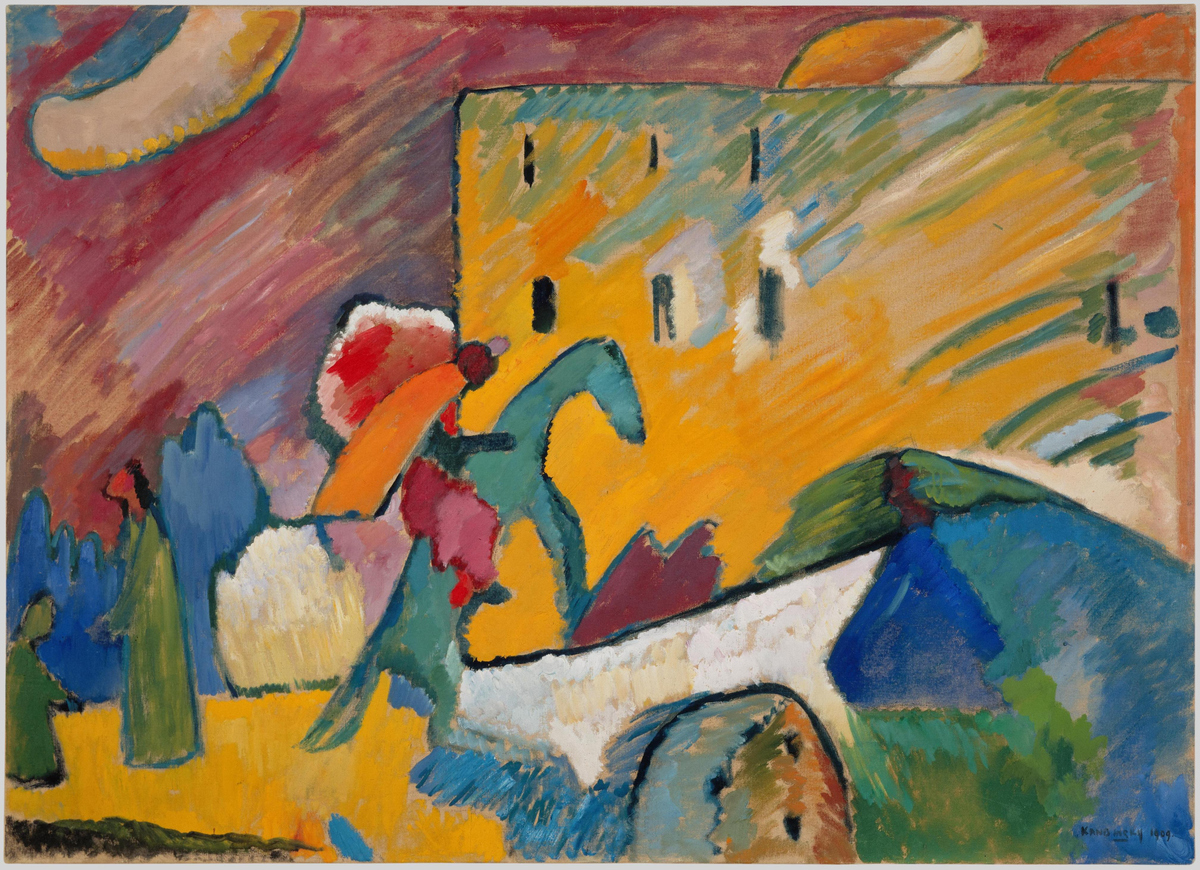
Look first for a small rider on a bridge. The Centre Pompidou describes him as a knight just beginning the ascent, set inside a dreamlike landscape likely inspired by Tunis, which Kandinsky had visited in 1904. The museum identifies the knight as an evocation of the valiant Saint George. It also calls him the artist's alter ego, a spiritual guide within the scene.
The Centre Pompidou points to the long strokes and the arbitrary colours as what makes this landscape feel dreamed rather than observed. Those sweeping marks let forms slide into one another instead of settling into firm edges. The sky contributes too. The museum describes it as flaming, and that heat above the scene changes how we read the rider below.
Tunis is not simply a decorative reference. Kandinsky had travelled there in 1904, and the museum offers the city as the likely source of this landscape's dreamlike character. The work belongs to his Improvisations, and an older German title for this one was Reiter über die Brücke, Bild mit gelber Wand. That earlier name places the rider and the bridge at the very centre of how the picture was understood.
Why a knight, and why Saint George? The museum's reading gives the figure a role beyond scenery. As an alter ego, the rider carries the artist's own aspiration, and as a spiritual guide he leads through the painted world. That interpretation comes from the institution, not from anything the painting states outright. It is a reading of the figure, and it matters because it turns a small traveller into the picture's guiding presence.
Notice how the bridge matters here. The knight is only beginning the ascent, so the crossing is unfinished, held at its starting point rather than completed. Set against a flaming sky and strokes that blur the landscape, that first step reads as a departure into uncertain ground. The composition keeps the rider small and the world around him large and restless.
So this is a landscape with a journey inside it. The dreamlike terrain, the flaming sky, and the rider starting up the bridge all work together to make an inner vision visible. The Centre Pompidou's reading of the knight as Saint George and as Kandinsky's alter ego gives that journey its point. What we watch is a spiritual guide setting out through a world the artist has imagined.
The story and its sources
Historical claims are linked to the records below. Close looking and interpretation are identified in the passage notes.
- Passage 1Documented historyInstitutional record for Improvisation No. 3
- Passage 2InterpretationInstitutional record for Improvisation No. 3
- Passage 3Documented historyInstitutional record for Improvisation No. 3Institutional record for Improvisation No. 3
- Passage 4InterpretationInstitutional record for Improvisation No. 3
- Passage 5InterpretationInstitutional record for Improvisation No. 3
- Passage 6InterpretationInstitutional record for Improvisation No. 3
Details to notice
About 3 minutes to readBlue triangular form
A deep blue triangular mass rises beneath the green hillside at lower right, anchoring the composition with a sharp geometric counterweight to the sweeping bridge.
Green and blue figures at left
Small, simplified standing figures at the left edge, including a green form and taller blue-red forms, act as subsidiary witnesses within the vivid landscape.
Ochre facade with windows
The luminous yellow-orange wall with dark rectangular windows and streaked brushwork forms a dominant architectural plane behind the central figures.
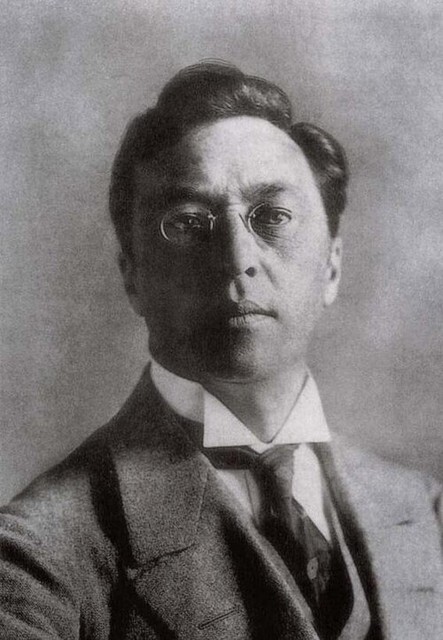
Artist portrait Image credit
未知上傳者. Image source · Public domain
About the artist
Wassily Kandinsky
1866 to 1944
Wassily Kandinsky was an avant-garde painter of Russian origin (1866–1944). Their work is associated with Expressionism; Symbolism; Bauhaus. Their recorded places of work include Paris; Munich; Weimar; Rapallo; The Hague; Russia; Stockholm; Switzerland; Tunis.
- Born
- 1866
- Died
- 1944
- Nationality
- Russian Empire; Russian Soviet Federative Socialist Republic; Soviet Union; France; Germany
- Birthplace
- Moscow
- Died in
- Neuilly-sur-Seine
Biography sources
The research & record
Study the work.
Follow the evidence.
Find catalogue details, historical context, technical research and the literature behind this artwork.
The artwork record
Research catalogue
Catalogue information and detailed research, with references that link to the bibliography.
Updated .
Identity and catalogue
Link- Title
- Improvisation 3
- Artist or attribution
- Wassily Kandinsky
- Object date
- 1909
- Medium and support
- Oil on canvas
- Dimensions
- 94 x 130 cm
- Current collection or location
- Musée National d'Art Moderne, Centre Pompidou, Paris, France
- Movement or period
- Expressionism
- Country or culture
- Russia / France
- Depicted subject
- A dreamlike landscape, likely inspired by Tunis, in which a knight begins to ascend a bridge; the knight evokes Saint George and serves as the artist's alter ego and a spiritual guide.
- Title variants
- Improvisation 3; Reiter über die Brücke Bild mit gelber Wand
- Accession number
- AM 1976-850
- Support
- canvas
- Inscriptions
- S.D.B.DR. : KANDINSKY i909.
Read valuation records and their limitations
Catalogue identity
The painting is catalogued as Improvisation 3, made by Wassily Kandinsky in 1909. That date is written into the work itself: the inscription reads S.D.B.DR. : KANDINSKY i909, so the year of execution is carried by the artist's own hand as well as by the institutional record. Two official Centre Pompidou entries, one a resources page and one the Musée National d'Art Moderne collection record, agree on the title, the attribution and the 1909 date; the collection record further classifies the work under the Expressionism movement and gives its subject as landscape. The title belongs to the series of Improvisations, and a former title is recorded as Reiter über die Brücke Bild mit gelber Wand, a German name that foregrounds the rider, the bridge and a yellow wall. The existence of that earlier name shows that the picture's descriptive emphasis was once phrased differently in the catalogue, even though the current title and attribution are consistently given by both institutional sources.(www.centrepompidou.fr, n.d.)(collection.centrepompidou.fr, n.d.)
Interpretation
The catalogue date of 1909 should be kept distinct from the dates attached to the documentation and display of the work. The inscription supplies 1909 as the year of execution; the painting's donation by Nina Kandinsky in 1976 belongs to its later history of ownership and entry into a public collection, and the two should not be conflated. The institution's descriptions of subject and meaning, including the reading of the knight as an evocation of Saint George and as the artist's alter ego, are attributed interpretations offered by the Centre Pompidou rather than statements the painting makes outright, and they stand alongside, not in place of, the documented title, author, date and inscription record.(www.centrepompidou.fr, n.d.)(collection.centrepompidou.fr, n.d.)
The painting is titled Improvisation 3 and was made by Wassily Kandinsky in 1909.(www.centrepompidou.fr, n.d.)
The painting is inscribed with the signature and date: S.D.B.DR. : KANDINSKY i909.(www.centrepompidou.fr, n.d.)(collection.centrepompidou.fr, n.d.)
A former title for the painting is Reiter über die Brücke Bild mit gelber Wand.(www.centrepompidou.fr, n.d.)(collection.centrepompidou.fr, n.d.)
Subject and iconography
LinkRead valuation records and their limitations
The recorded composition
Visual observation
The visual evidence for Improvisation No. 3 is anchored in the Centre Pompidou's published description of the canvas. The museum describes a dreamlike landscape, likely inspired by Tunis, which Kandinsky had visited in 1904. Within that landscape a knight is just beginning the ascent of a bridge. These are the two load-bearing elements the institution's account isolates: a terrain given a plausible geographic origin in the artist's own travels, and a small human figure caught at the opening of a crossing rather than at its completion. The wording matters for how the picture should be approached. The landscape is characterised as dreamlike, not as a record of a place, and the Tunis reference is offered as a likelihood rather than a documented source for specific motifs. The knight, similarly, is described as just beginning the ascent, an observation about where the figure stands in relation to the bridge rather than a claim about what the journey means.(www.centrepompidou.fr, n.d.)
The museum's reading of the knight goes beyond description. The Centre Pompidou describes the figure as an evocation of the valiant figure of Saint George and as the artist's alter ego, a spiritual guide. Two things should be kept distinct here. That a rider appears on a bridge is a matter of what the painting shows; that the rider evokes Saint George, embodies Kandinsky himself and functions as a spiritual guide is an interpretation advanced by the institution. The account does not state that the painting declares this identity outright, and the identification of Saint George rests on the museum's reading of the figure rather than on an attribute or inscription in the work that the evidence sets out. Presenting the knight as alter ego turns a small traveller into the picture's guiding presence, and the evidence makes clear that this is the institution's interpretation of the figure's role.(www.centrepompidou.fr, n.d.)
Colour, stroke and sky
The Centre Pompidou connects the dreamlike quality of the scene to specific pictorial means: long strokes, arbitrary colours and a flaming sky all contribute to the work's dreamlike vision. The three are named together as what produces the effect, so the visual argument runs through handling and colour as much as through subject. Arbitrary colour is a description of colour used independently of naturalistic appearance, and the flaming sky is described as sitting above the scene, affecting how the rider below is read. The evidence stops at naming these means; it does not specify pigments or particular hues, and no technical imaging or conservation record is supplied for this painting. Any account of how the surface has changed over time would therefore have to remain outside what these units establish.(www.centrepompidou.fr, n.d.)
Interpretation
Taken together, the units support a reading of the painting as a landscape with a journey inside it, in which the dreamlike terrain, the flaming sky and the rider starting up the bridge cooperate to make an inner vision visible. The bridge matters precisely because the crossing is unfinished: the knight is only beginning the ascent, held at the starting point of the passage. Set against a flaming sky and strokes that blur the landscape, that first step reads as departure into uncertain ground, with the rider kept small against a world rendered large and restless by the museum's description. This synthesis depends on the institution's account of the painterly means and of the figure's role, and it should be weighed as an interpretation built on that account rather than as something the picture states directly.(www.centrepompidou.fr, n.d.)
Visual observation
The painting depicts a dreamlike landscape, likely inspired by Tunis, which Kandinsky had visited in 1904; within it, a knight is just beginning the ascent of a bridge.(www.centrepompidou.fr, n.d.)
Historical context
LinkRead valuation records and their limitations
The object and its institutional record
Interpretation
Improvisation 3 is an oil on canvas by Wassily Kandinsky, dated 1909 by its inscribed signature, measuring 94 by 130 centimetres. The painting is held in the Musée National d'Art Moderne, Centre Pompidou, Paris, under inventory number AM 1976-850. Institutional cataloguing classifies the work under the Expressionism movement and names its subject as landscape, while an earlier German title recorded for the picture, Reiter über die Brücke, Bild mit gelber Wand (Rider over the Bridge, Picture with Yellow Wall), foregrounds the two motifs that organize the scene. That former title is preserved as a title variant in the collection record rather than as a separate work, and it is useful because it shows how the picture was named around its rider and bridge before the present French institutional title fixed it within the numbered Improvisations.(collection.centrepompidou.fr, n.d.)(www.centrepompidou.fr, n.d.)
The Centre Pompidou's account of the subject describes a dreamlike landscape likely inspired by Tunis, which Kandinsky had visited in 1904, with a knight just beginning the ascent of a bridge. The same source reads the knight as an evocation of the valiant figure of Saint George and as the artist's alter ego, a spiritual guide. These identifications are the institution's interpretation, not inscriptions or statements within the painting, and they should be weighed as such, while still shaping how the small rider is understood within the landscape. The source's formal remarks belong to the same interpretive layer: it attributes the dreamlike quality to the long strokes, arbitrary colours and flaming sky, so that the visual choices and the hagiographic and autobiographical reading of the figure are presented as mutually reinforcing rather than as documented facts about the artist's intention.(collection.centrepompidou.fr, n.d.)(www.centrepompidou.fr, n.d.)
Transmission and exhibition
Brought together, the record allows a qualified synthesis. The title, dating and collection history establish the work's identity and movement through public and private hands; the Petrograd, Odessa and Paris references belong to exhibition and provenance lists rather than to narrative reconstruction. The subject reading, by contrast, is attributed interpretation, offered by the museum and consistent with the long strokes, arbitrary colours and flaming sky that it also describes. That reading gives the small rider a role larger than scenery, as a figure of spiritual departure, but it remains a reading. What the evidence supports is that a landscape with a rider at the start of a bridge was made by Kandinsky in 1909, was exhibited early in Odessa, was eventually donated to the French national collection by the artist's widow and continues to be shown; the identification of the rider with Saint George and with the artist himself is the institutional account that gives those facts their interpretive frame.(collection.centrepompidou.fr, n.d.)(www.centrepompidou.fr, n.d.)
The work is classified under the Expressionism movement and its subject is landscape.(collection.centrepompidou.fr, n.d.)
Materials and technique
LinkRead valuation records and their limitations
Recorded support and medium
The documented material description of Improvisation 3 is brief but definite. The work is an oil painting on canvas, and it measures 94 by 130 centimetres. These are the physical terms the institutional record provides for the object: a horizontal canvas of moderate scale, painted in oil, the medium with which Kandinsky worked in this period. The record does not describe a panel, a paper support or a mixed-medium construction, so within the supplied evidence the support and medium are canvas and oil respectively, and no further layer structure, ground, priming or varnish is documented.(www.centrepompidou.fr, n.d.)
The making of the picture cannot be separated from what the surface shows. The Centre Pompidou's account of the painting attends to its long strokes and its arbitrary colours, and it characterises the sky as flaming. Those descriptions are visual observations rather than results of technical analysis: they describe effects produced in the oil paint, the fluid handling of a brush across a prepared canvas, but the supplied record does not report a pigment analysis, a cross-section, a raking-light examination or a treatment history. What the evidence establishes is therefore the material class of the object and the visible character of its paint handling, not a laboratory profile of its pigments or layers.(www.centrepompidou.fr, n.d.)
Visual effect and its attribution
Interpretation
The visible facture and the landscape's subject matter are closely tied in the institutional reading. The landscape is described as dreamlike and as likely inspired by Tunis, which Kandinsky had visited in 1904, and within it a knight is just beginning the ascent of a bridge. The long strokes and arbitrary colours are presented as contributing to that dreamlike vision, so that the sweeping marks allow forms to slide into one another rather than settle into firm edges. The flaming sky works together with those strokes to shape how the small rider is read against the terrain around him. Because these are the museum's characterisations of the painted surface, they should be treated as attributed visual interpretation, while the oil-on-canvas description and the dimensions remain the documented material facts.(www.centrepompidou.fr, n.d.)
The work is oil on canvas, measuring 94 by 130 centimetres.(www.centrepompidou.fr, n.d.)
Provenance and ownership
LinkRead valuation records and their limitations
The documented ownership history of Improvisation 3, made by Wassily Kandinsky in 1909, culminates in a single recorded transfer: the painting was donated by Nina Kandinsky in 1976. Both the Centre Pompidou's resources page and its Musée national d'art moderne collection record state this gift, which brought the work into the national collection and gave it the inventory number AM 1976-850, the identifier under which it is now catalogued as part of the Musée National d'Art Moderne, Centre Pompidou, Paris. The inventory number itself preserves the year of the gift and a sequential position within that year's acquisitions, so the accession is legible in the object's official designation and not only in prose provenance notes.(www.centrepompidou.fr, n.d.)(collection.centrepompidou.fr, n.d.)
The 1976 Gift and the Unrecorded Interval
Interpretation
The donor is named as Nina Kandinsky, the artist's widow, and the evidence identifies her only in that capacity as donor in 1976. The sources consulted record no acquisition price, dealer, intermediary, auction or earlier private collection between the work's making in 1909 and the gift of 1976. That long span should be described as an unrecorded interval rather than as continuous family ownership, because the supplied evidence documents the 1976 donation but does not establish who held the painting before it. The distinction matters methodologically: a silence in the consulted records is not proof of an unbroken chain, and the archive should not infer a proven change of ownership where only an absence of recorded transfers exists.(www.centrepompidou.fr, n.d.)(collection.centrepompidou.fr, n.d.)
Two administrative facts anchor the work's identity across its documented life. The painting carries the inventory number AM 1976-850 in the Musée National d'Art Moderne, and it also preserves a former title, Reiter über die Brücke Bild mit gelber Wand, that predates or accompanies its present designation as Improvisation 3. The former title names the rider and the bridge together with a yellow wall, showing that the motif central to the museum's current reading of the picture was already prominent in how the work was titled. Title variants in a collection record function as provenance evidence of a kind, since they register the names under which the object circulated before entering the national collection.(www.centrepompidou.fr, n.d.)(collection.centrepompidou.fr, n.d.)
Exhibition and Collection Context
Interpretation
The larger art-historical setting in which the 1976 gift is best understood is supplied by the collection classification: the work is listed under the Expressionism movement with landscape as its subject. That classification, together with its signature and date inscription, fixes the object within Kandinsky's own catalogue and within a recognized movement, giving the accession a context beyond a bare transfer of title. Within a history of material culture, the significance of the 1976 donation is that a painting made in 1909, exhibited in Odessa in 1911, and later known under an alternative German title entered a French national collection as a documented Expressionist landscape, where its inventory number now ties the physical canvas to a verifiable institutional record.(collection.centrepompidou.fr, n.d.)(www.centrepompidou.fr, n.d.)
The painting was donated by Nina Kandinsky in 1976.(www.centrepompidou.fr, n.d.)(collection.centrepompidou.fr, n.d.)
Provenance timeline
- 1911
The painting was exhibited at the Izdebski Salon in Odessa, an early documented public showing.(www.centrepompidou.fr, n.d.)(collection.centrepompidou.fr, n.d.)
- 1976
Nina Kandinsky donated the painting; the museum records this gift as the source of the work now held in the collection.(www.centrepompidou.fr, n.d.)(collection.centrepompidou.fr, n.d.)
- 15 September 2026 to 14 February 2027
The painting is scheduled to be on view at Palazzo Bonaparte in Rome in the exhibition Kandinsky.(www.centrepompidou.fr, n.d.)
Exhibition history
LinkRead valuation records and their limitations
Exhibition history
The exhibition record for Improvisation No. 3 is thin in the sources consulted but precise where it speaks. Both institutional records consulted, the Centre Pompidou resources page and the Musée national d'art moderne collection record, state that the work was shown in 1911 at the Izdebski Salon in Odessa. The two accounts agree on the venue and the year, so this is not a disputed point but a shared documented fact, and it places the painting in a Russian exhibition context two years after the date inscribed on the canvas. The records examined for this section are described as only partially consulted, so the 1911 entry should be understood as the securely documented exhibition rather than as an exhaustive list; the collection record is further described as carrying a full exhibition and bibliography list that has not been fully read here, which is the most likely place for additional showings to be recorded.(www.centrepompidou.fr, n.d.)(collection.centrepompidou.fr, n.d.)
The painting's current display is separate from that historical showing and is documented by the Centre Pompidou resources page: the work is on view at Palazzo Bonaparte in Rome in the exhibition Kandinsky, running from 15 September 2026 to 14 February 2027. Recording this as a current display rather than folding it into the 1911 history matters, because the two events belong to different phases of the object's public life, one before the painting entered a French national collection and one after. The Roman exhibition is also the only future-dated venue supplied by the evidence, and its dates should be retained exactly as given: 15 September 2026 to 14 February 2027.(www.centrepompidou.fr, n.d.)
The exhibition history is best read alongside the object's custodial history, since the two shape what a viewer sees in each venue. The painting belongs to the Musée National d'Art Moderne, Centre Pompidou, Paris, under inventory number AM 1976-850, and it was donated by Nina Kandinsky in 1976. The 1911 Odessa showing therefore predates the donation by sixty-five years and belongs to an earlier, pre-museum phase of the work's life, while the Rome presentation of 2026 to 2027 is a loan from the Paris collection in which the painting now sits. Keeping the inventory number with the exhibition data allows the 1911 and 2026 showings to be tied to the same documented object rather than to a title alone.(www.centrepompidou.fr, n.d.)(collection.centrepompidou.fr, n.d.)
Titles and cataloguing in exhibition contexts
Title variants bear directly on how the work has been labelled in exhibition and catalogue contexts. The collection record gives a former title, Reiter über die Brücke Bild mit gelber Wand, and the resources page supplies a closely related form, Reiter über die Brücke Bild mit gelber Wand, describing it as a former title. Both records use the German rider-and-bridge formulation, which foregrounds the figure and the crossing, while the present title, Improvisation 3, places the work within Kandinsky's Improvisations series. The collection record also classifies the work under the Expressionism movement with the subject landscape. Any exhibition list that cites the painting under an older German name is therefore referring to the same object recorded today as Improvisation 3, and the changing titles are part of the work's documented history rather than evidence of separate pictures.(www.centrepompidou.fr, n.d.)(collection.centrepompidou.fr, n.d.)
What the painting presents in a gallery can be related to the documented physical object. It is oil on canvas measuring 94 by 130 centimetres, and it carries the inscribed signature and date S.D.B.DR. : KANDINSKY i909. The Centre Pompidou describes the subject as a dreamlike landscape, likely inspired by Tunis, which Kandinsky had visited in 1904, with a knight just beginning the ascent of a bridge; the museum reads the knight as an evocation of the valiant figure of Saint George and as the artist's alter ego, a spiritual guide, and it notes that the long strokes, arbitrary colours and flaming sky contribute to the dreamlike vision. These are the institution's attributions and readings, not claims the painting states outright, and they belong in an exhibition account because they explain what viewers are asked to look for when the canvas is on the wall. The inscribed 1909 date sits between the 1904 Tunis visit named as a likely inspiration and the 1911 Odessa showing, which anchors both the subject interpretation and the exhibition chronology to the same documented object.(www.centrepompidou.fr, n.d.)(collection.centrepompidou.fr, n.d.)
The work was shown in 1911 at the Izdebski Salon in Odessa.(www.centrepompidou.fr, n.d.)(collection.centrepompidou.fr, n.d.)
The painting is currently on view at Palazzo Bonaparte, Rome, in the exhibition Kandinsky, 15 September 2026 to 14 February 2027.(www.centrepompidou.fr, n.d.)
Interpretations and debates
LinkRead valuation records and their limitations
Attributed Readings of the Rider
Interpretation
The Centre Pompidou's record for Improvisation 3 offers a reading of the small rider that goes well beyond description of the scene. The museum identifies the knight as an evocation of the valiant figure of Saint George, and at the same time calls him the artist's alter ego, a spiritual guide within the painted world. Two distinct interpretive moves are folded into that formulation. The first invokes a saintly prototype whose valour the figure is said to evoke; the second treats the rider as a stand-in for Kandinsky himself, carrying the artist's aspiration into the landscape. The record presents these as the institution's own characterisation, not as something the painting states or documents, and the distinction matters for how the work is discussed. The saintly evocation and the alter ego reading are related but not identical claims, and the museum does not set out the evidence on which either rests.(www.centrepompidou.fr, n.d.)
A second strand of the museum's account concerns how the picture produces its dreamlike character. The Centre Pompidou notes that the long strokes, arbitrary colours and flaming sky contribute to the work's dreamlike vision. These are named as visual means rather than as narrative content: the length of the strokes, the freedom of the palette from descriptive colour, and the heat of the sky above the scene are what the record treats as doing the work of making the landscape feel dreamed rather than observed. The flaming sky in particular changes how the rider below is read, since the heat above the small figure places him in a restless rather than a settled world. This is a reading of pictorial effect attributed to the institution, and it complements rather than duplicates the account of the knight, since one concerns the figure's meaning and the other the painted means by which the scene is estranged from ordinary landscape.(www.centrepompidou.fr, n.d.)
Taken together, the evidence supports a qualified synthesis: the institutional reading of the knight as Saint George and as Kandinsky's alter ego, combined with the named pictorial means of long strokes, arbitrary colours and a flaming sky, makes the painting legible as an inner vision made visible through a landscape and a journey inside it. That synthesis belongs to the present account, not to the museum, and it should not be confused with a claim about what Kandinsky privately intended. The record establishes that the Centre Pompidou characterises the figure in these terms; it does not establish the artist's own stated purpose for the rider, and the alter ego description should be attributed to the institution wherever it is repeated. The value of the reading lies in what it explains about the composition, namely why a small traveller at the foot of a bridge can be treated as the picture's guiding presence rather than as incidental scenery.(www.centrepompidou.fr, n.d.)
The collection record adds a further frame around these interpretations by classifying the work under the Expressionism movement and giving its subject as landscape. That classification situates the rider and the dreamlike terrain within a category the institution applies to the painting, and it is consistent with the museum's reading of the landscape as imagined rather than observed. The classification and the subject heading are catalogue information, and they stand alongside the interpretive account of the knight rather than replacing it. Read together, they show an object that the institution treats both as a landscape and as a carrier of a figure whose meaning is supplied by interpretation, which is precisely why the distinction between documented description and attributed reading needs to be kept clear in any discussion of the work.(collection.centrepompidou.fr, n.d.)(www.centrepompidou.fr, n.d.)
The Centre Pompidou describes the knight as an evocation of the valiant figure of Saint George and as the artist's alter ego, a spiritual guide.(www.centrepompidou.fr, n.d.)
The Centre Pompidou notes that the long strokes, arbitrary colours and flaming sky contribute to the work's dreamlike vision.(www.centrepompidou.fr, n.d.)
Collection and display
LinkRead valuation records and their limitations
Institutional holding and provenance
The painting now known as Improvisation 3 is held by the Musée National d'Art Moderne, Centre Pompidou, Paris, under inventory number AM 1976-850. Both institutional records agree on that number and on the route by which the work entered the national collection: it was donated by Nina Kandinsky in 1976, the same year encoded in the inventory prefix. The provenance established by these records is therefore a gift rather than a purchase, and it places the canvas within the group of works transferred from the artist's widow to the French national modern art museum. The catalogue record additionally classifies the work under the Expressionism movement with landscape as its subject, while preserving an earlier German title, Reiter über die Brücke Bild mit gelber Wand, that names the rider and the bridge directly.(www.centrepompidou.fr, n.d.)(collection.centrepompidou.fr, n.d.)
The painting belongs to the Musée National d'Art Moderne, Centre Pompidou, Paris, with inventory number AM 1976-850.(www.centrepompidou.fr, n.d.)(collection.centrepompidou.fr, n.d.)
Documented values and qualified estimates
LinkRead valuation records and their limitations
Valuation and its limits
Interpretation
A calculated working insurance estimate records a range of US$40M to US$120M, dated as a working calculation generated 2026-10-30. The methodology describes this as a broad conservative range prepared for manual insurance review, based only on the confirmed context: a highly important 1909 oil on canvas by Kandinsky in a pivotal Expressionist period, large at 94 by 130 centimetres, with a documented title history, inscriptions, catalogue raisonné reference number 276, extensive exhibition history, and permanent collection status at the Musée National d'Art Moderne, Centre Pompidou, accession AM 1976-850, donation of Nina Kandinsky in 1976.(www.centrepompidou.fr, n.d.)(collection.centrepompidou.fr, n.d.)(Wikimedia Commons: Improvisation No. 3, n.d.)
The same record is explicit that the supplied sources include no valuations, auction results or insurance records, so the range is a modelled order-of-magnitude estimate reflecting the artist's museum-level importance, early date, scale and institutional provenance, not a transaction-derived figure. It is intentionally broad and should be narrowed only after qualified appraisal review. The qualification is repeated and should be preserved in substance: this is a model-generated working range for manual review only, not an official insurance value, appraisal, auction estimate, auction result or sale price; no comparable sales or private insurance records were used or claimed; and actual insurance values must be determined by a qualified professional appraiser or insurer. The figure therefore belongs in the record as an explicitly provisional working instrument, not as evidence of market value.(www.centrepompidou.fr, n.d.)(collection.centrepompidou.fr, n.d.)(Wikimedia Commons: Improvisation No. 3, n.d.)
Taken together, the evidence establishes an object whose importance is documented institutionally rather than financially. The museum records supply the verifiable core: a signed and dated 1909 canvas, a former German title, an early Odessa showing in 1911, a 1976 gift from the artist's widow, and a current Roman exhibition. The valuation record, by contrast, is transparently a modelled working range that cites those same documentary facts as its basis while disclaiming any reliance on sales. Read carefully, the two kinds of record reinforce the same point: the painting's standing rests on its date, scale, documented title and exhibition history, and permanent public ownership, and any monetary figure remains a provisional administrative construction to be superseded by professional appraisal.(www.centrepompidou.fr, n.d.)(collection.centrepompidou.fr, n.d.)(Wikimedia Commons: Improvisation No. 3, n.d.)
Working estimate
Calculated working insurance estimate, not a sale price: Estimated value: US$40M to US$120M Recorded date: Working calculation, generated 2026-10-30. Methodology: Broad conservative working range calculated for manual insurance review, based only on the confirmed context: a highly important 1909 oil on canvas by Wassily Kandinsky in a pivotal Expressionist period, large at 94 x 130 cm, with a documented title history, inscriptions, catalogue raisonné reference number 276, extensive exhibition history, and permanent collection status at the Musée National d'Art Moderne, Centre Pompidou (accession AM 1976-850, donation of Nina Kandinsky in 1976). Because the supplied sources do not include valuations, auction results, or insurance records, this range is a modeled order-of-magnitude estimate reflecting the artist's museum-level importance, early date, scale, and institutional provenance, not a transaction-derived figure. It is intentionally broad and should be narrowed only after qualified appraisal review. Qualification: This is a model-generated working range for manual review only. It is not an official insurance value, appraisal, auction estimate, auction result, or sale price. No comparable sales or private insurance records were used or claimed. Actual insurance values must be determined by a qualified professional appraiser or insurer.(www.centrepompidou.fr, n.d.)(collection.centrepompidou.fr, n.d.)(Wikimedia Commons: Improvisation No. 3, n.d.)
Further reading
Books for a closer look
Paid links. As an Amazon Associate I earn from qualifying purchases.

Open Library Kandinsky: Russian and Bauhaus years, 1915-1933.
Solomon R. Guggenheim Museum
Catalogue record for a Kandinsky volume whose listed subjects include Expressionism (Art), the Centre Georges Pompidou and the Musee national d'art moderne, themes and motives, and catalogues raisonnes. These subjects connect directly to Improvisation 3, an Expressionism-classified landscape held at the Centre Pompidou, and to the question of its imagery and context.
ISBN 0892070447

Open Library Concerning the spiritual in art
Dover Publications
Kandinsky's own text on the spiritual in art, listed under aesthetics and themes and motives. The artwork evidence describes the knight as the artist's alter ego and a spiritual guide, so this record is relevant to the spiritual and symbolic reading the museum attaches to the figure.
ISBN 0486234118

Open Library Kandinsky, complete writings on art
G.K. Hall
A record of Kandinsky's complete writings on art, whose subjects include modern art and early twentieth-century art. It is relevant as documented primary writing by the artist of a 1909 work, useful for the artist's own formulations rather than as a study of this specific canvas.
ISBN 0805799508
Bibliography
Sources and further reading
References are arranged by author or organisation, with links to the original publications. Where no publication date is recorded, n.d. means no date.
Source notes updated .
No recorded sources match these filters. Reset the filters to see the full bibliography.
- 03
Official · About this artwork
Institutional record for Improvisation No. 3. Improvisation 3, Musée national d'art moderne collection record.
Official collection catalogue entry listing title variants, keywords, provenance, inventory number and a full exhibition and bibliography list.
- Language
- French
Citation text
- 05
Book
Concerning the spiritual in art. Dover Publications.
Kandinsky's own text on the spiritual in art, listed under aesthetics and themes and motives. The artwork evidence describes the knight as the artist's alter ego and a spiritual guide, so this record is relevant to the spiritual and symbolic reading the museum attaches to the figure.
- ISBN
- 0486234118
Citation text
- 06
Book
Kandinsky, complete writings on art. G.K. Hall.
A record of Kandinsky's complete writings on art, whose subjects include modern art and early twentieth-century art. It is relevant as documented primary writing by the artist of a 1909 work, useful for the artist's own formulations rather than as a study of this specific canvas.
- ISBN
- 0805799508
Citation text
- 04
Book
Kandinsky: Russian and Bauhaus years, 1915-1933. Solomon R. Guggenheim Museum.
Catalogue record for a Kandinsky volume whose listed subjects include Expressionism (Art), the Centre Georges Pompidou and the Musee national d'art moderne, themes and motives, and catalogues raisonnes. These subjects connect directly to Improvisation 3, an Expressionism-classified landscape held at the Centre Pompidou, and to the question of its imagery and context.
- ISBN
- 0892070447
Citation text
- 01
Secondary · Background reading
Wikimedia Commons: Improvisation No. 3 (n.d.). Wikimedia Commons file: Improvisation 3. Wikimedia Commons.
Discovery source confirming the object type, artist, date, medium, dimensions and collection; institutional record takes precedence for interpretation.
- Language
- Russian / English
Citation text
- 02
Official · About this artwork
Institutional record for Improvisation No. 3. Improvisation 3, Centre Pompidou resources page.
Official museum page giving subject interpretation, materials, dimensions, provenance, inscriptions and exhibition history for this exact painting.
- Language
- English
Citation text
Art to live with
Bring this painting
home.
A piece of the archive, made yours. Explore Improvisation 3 in a size and finish that fits your space.
Your text and annotations appear on these editions. Adding to cart saves that design for printing.
Combine this painting with your favourites01 / Find your edition
Made for you
Suggested from your location. Change it if you're sending elsewhere or using a VPN. Prices and delivery are shown in GBP.
19 products
Choose an edition to make it yours
6 × 8 in · Printed cover · 118 lined pages
6 × 8 in · Printed cover · 118 lined pages
6 × 8 in · Printed cover · 118 lined pages
Notebook
GBP 11.87
Delivery GBP 5.27 / Total GBP 17.14
A 6 × 8 inch spiral notebook with 118 ruled pages (59 sheets), a printed front cover, dark grey back cover and metal spiral binding.
Fit and fill keep the painting’s proportions. Stretch changes them.
Move and zoom the painting on your notebook.
Made to order with your design
Made to order
US delivery only
17.8 × 12.7 cm / 7 × 5 in · Standard
17.8 × 12.7 cm / 7 × 5 in · Standard

7 × 5 in / 17.8 × 12.7 cm · Standard

7 × 5 in / 17.8 × 12.7 cm · Standard

7 × 5 in / 17.8 × 12.7 cm · Standard

7 × 5 in / 17.8 × 12.7 cm · Standard

7 × 5 in / 17.8 × 12.7 cm · Standard
Metal art sign
GBP 19.57
Delivery GBP 17.65 / Total GBP 37.22
A printed aluminium sign with rounded corners and mounting holes.
Fit and fill keep the painting’s proportions. Stretch changes them.
Move and zoom the painting on your metal art sign.
Made to order with your design
Printed aluminium · mounting holes included
US delivery only
iPhone 12 Mini ? Glossy ? back view
iPhone 12 Mini · Glossy

iPhone 12 Mini ? Glossy ? back view

iPhone 12 Mini ? Glossy ? back view

iPhone 12 Mini ? Glossy ? back view
Tough phone case
GBP 16.34
Delivery GBP 4.22 / Total GBP 20.56
A two-layer phone case with a printed polycarbonate shell and a shock-absorbing inner liner.
Two layers with a shock-absorbing TPU liner
Case & print details
- Device
- Apple · iPhone 12 Mini
- Material
- Polycarbonate shell with a TPU inner liner
- Artwork
- Outer back and wrapped edges from one template
- Finish
- Glossy
- Version
- Standard version
- Printing
- Dye sublimation
- Print file
- 1,122 × 1,831 px · 95 × 155 mm · PNG · 300 dpi recommended
Rear outline and camera openings follow this variant's Printify template. Case depth and small hardware remain illustrative.
Supplier product detailsFit and fill keep the painting’s proportions. Stretch changes them.
Move and zoom the painting on your tough phone case.
Made to order with your design
Made to order
US delivery only
40.6 × 30.4 cm / 16 × 12 in · Black
40.6 × 30.4 cm / 16 × 12 in · Black

16 × 12 in / 40.6 × 30.4 cm · Black

16 × 12 in / 40.6 × 30.4 cm · Black

16 × 12 in / 40.6 × 30.4 cm · Black

16 × 12 in / 40.6 × 30.4 cm · Black
Framed art print
GBP 53.10
- 1 framed print
- GBP 53.10
- Delivery to United States
- GBP 14.11
- Total
- GBP 67.21
A ready-to-hang wooden frame with a clear Perspex cover and a semi-gloss printed insert.
Delivery is quoted for all selected copies together.
Fit and fill keep the painting’s proportions. Stretch changes them.
Move and zoom the painting on your framed art print.
Made to order with your design
Wooden frame & protective clear front included
US delivery only
38.1 × 40.6 cm / 15 × 16 in · Natural
38.1 × 40.6 cm / 15 × 16 in · Natural

15 × 16 in / 38.1 × 40.6 cm · Natural

15 × 16 in / 38.1 × 40.6 cm · Natural

15 × 16 in / 38.1 × 40.6 cm · Natural

15 × 16 in / 38.1 × 40.6 cm · Natural

15 × 16 in / 38.1 × 40.6 cm · Natural
Canvas tote bag
GBP 14.20
Delivery GBP 4.32 / Total GBP 18.52
A sturdy cotton canvas tote with reinforced handles and artwork on the front panel.
Fit and fill keep the painting’s proportions. Stretch changes them.
Move and zoom the painting on your canvas tote bag.
Made to order with your design
Front print · reinforced cotton handles
US delivery only
22.9 × 20.3 cm / 9 × 8 in · Standard
22.9 × 20.3 cm / 9 × 8 in · Standard

9 × 8 in / 22.9 × 20.3 cm · Standard

9 × 8 in / 22.9 × 20.3 cm · Standard

9 × 8 in / 22.9 × 20.3 cm · Standard

9 × 8 in / 22.9 × 20.3 cm · Standard
Mouse mat
GBP 7.28
Delivery GBP 4.81 / Total GBP 12.09
A rectangular fabric mouse mat with a rubber backing and rounded corners.
Fit and fill keep the painting’s proportions. Stretch changes them.
Move and zoom the painting on your mouse mat.
Made to order with your design
Made to order
US delivery only
See more13 more products
43.2 × 45.7 cm / 17 × 18 in · Artwork
43.2 × 45.7 cm / 17 × 18 in · Artwork

17 × 18 in / 43.2 × 45.7 cm · Artwork

17 × 18 in / 43.2 × 45.7 cm · Artwork

17 × 18 in / 43.2 × 45.7 cm · Artwork
Woven tote bag
GBP 46.69
Delivery GBP 5.86 / Total GBP 52.55
A woven tote with cotton webbing handles and the painting translated into a woven design.
Fit and fill keep the painting’s proportions. Stretch changes them.
Move and zoom the painting on your woven tote bag.
Made to order with your design
Made to order
US delivery only
25.4 × 25.4 cm / 10 × 10 in · Standard
25.4 × 25.4 cm / 10 × 10 in · Standard

10 × 10 in / 25.4 × 25.4 cm · Standard

10 × 10 in / 25.4 × 25.4 cm · Standard

10 × 10 in / 25.4 × 25.4 cm · Standard

10 × 10 in / 25.4 × 25.4 cm · Standard

10 × 10 in / 25.4 × 25.4 cm · Standard
Matte art print
GBP 11.27
Delivery GBP 7.19 / Total GBP 18.46
An unframed matte poster with archival inks, ready for a frame of your choice.
Fit and fill keep the painting’s proportions. Stretch changes them.
Move and zoom the painting on your matte art print.
Made to order with your design
Unframed · frame it your way
US delivery only
iPhone 12 Mini ? Standard ? back view
iPhone 12 Mini · Standard

iPhone 12 Mini ? Standard ? back view

iPhone 12 Mini ? Standard ? back view

iPhone 12 Mini ? Standard ? back view
Flexible phone case
GBP 15.55
Delivery GBP 4.22 / Total GBP 19.77
A flexible TPU phone case with a frosted finish, a printed back and precise port openings.
Flexible TPU with a frosted, matte finish
Case & print details
- Device
- Apple · iPhone 12 Mini
- Material
- Semi-transparent thermoplastic polyurethane (TPU)
- Artwork
- Back print; rim stays unprinted
- Finish
- Standard
- Version
- Standard version
- Printing
- Dye sublimation
- Print file
- 791 × 1,586 px · 67 × 134.3 mm · PNG · 300 dpi recommended
Rear outline and camera openings follow this variant's Printify template. Case depth and small hardware remain illustrative.
Supplier product detailsFit and fill keep the painting’s proportions. Stretch changes them.
Move and zoom the painting on your flexible phone case.
Made to order with your design
Made to order
S · Standard
S · Standard

S · Standard

S · Standard

S · Standard

S · Standard

S · Standard
Crew socks
GBP 10.63
Delivery GBP 4.42 / Total GBP 15.05
Crew-length polyester and spandex socks with a ribbed cuff, cushioned sole and sublimated artwork.
Fit and fill keep the painting’s proportions. Stretch changes them.
Move and zoom the painting on your crew socks.
Made to order with your design
One pair · design repeated on both socks
US delivery only
12" · Standard
12" · Standard

12" · Standard

12" · Standard

12" · Standard
Laptop sleeve
GBP 26.00
Delivery GBP 4.89 / Total GBP 30.89
A polyester laptop sleeve with a fleece lining, top zip, printed front and black reverse.
Fit and fill keep the painting’s proportions. Stretch changes them.
Move and zoom the painting on your laptop sleeve.
Made to order with your design
Made to order
US delivery only
11oz · single image
11oz · White
11oz · single image
Mug
GBP 7.32
Delivery GBP 6.14 / Total GBP 13.46
A glossy white ceramic mug with a C-shaped handle, available in 11oz and 15oz sizes.
single layout · choose single, double or a repeating pattern in Customise.
Repeat, fit, fill and position your artwork around the mug.
Made to order with your design
Made to order
iPhone 12 Mini ? Standard ? back view
iPhone 12 Mini · Standard

iPhone 12 Mini ? Standard ? back view

iPhone 12 Mini ? Standard ? back view

iPhone 12 Mini ? Standard ? back view

iPhone 12 Mini ? Standard ? back view

iPhone 12 Mini ? Standard ? back view
Biodegradable phone case
GBP 20.89
Delivery GBP 4.22 / Total GBP 25.11
A matte phone case made from plant polymers and bamboo fibre, with the artwork printed on the back.
Flexible plant-polymer shell with a matte finish
Case & print details
- Device
- Apple · iPhone 12 Mini
- Material
- PLA and PBAT polymers with bamboo fibre
- Artwork
- Back print; rim stays unprinted
- Finish
- Standard
- Version
- Standard version
- Printing
- Dye sublimation
- Print file
- 777 × 1,553 px · 65.8 × 131.5 mm · PNG · 300 dpi recommended
Rear outline and camera openings follow this variant's Printify template. Case depth and small hardware remain illustrative.
Supplier product detailsFit and fill keep the painting’s proportions. Stretch changes them.
Move and zoom the painting on your biodegradable phone case.
Made to order with your design
Made to order
40.6 × 30.5 cm / 16 × 12 in · Standard
40.6 × 30.5 cm / 16 × 12 in · Standard

16 × 12 in / 40.6 × 30.5 cm · Standard

16 × 12 in / 40.6 × 30.5 cm · Standard

16 × 12 in / 40.6 × 30.5 cm · Standard
Fine art poster
GBP 17.30
Delivery GBP 7.58 / Total GBP 24.88
A gallery paper print with a smooth art-paper surface. Choose a size that suits the painting.
Fit and fill keep the painting’s proportions. Stretch changes them.
Move and zoom the painting on your fine art poster.
Made to order with your design
Unframed · frame it your way
iPhone 12 Mini ? Standard ? back view
iPhone 12 Mini · Standard

iPhone 12 Mini ? Standard ? back view

iPhone 12 Mini ? Standard ? back view

iPhone 12 Mini ? Standard ? back view
Clear phone case
GBP 15.05
Delivery GBP 4.22 / Total GBP 19.27
A clear phone case with artwork on the back. Leave areas transparent to show the phone underneath.
Clear shell with shock-absorbing TPU sides
Case & print details
- Device
- Apple · iPhone 12 Mini
- Material
- Polycarbonate back and clear TPU sides
- Artwork
- Back print; clear sides stay unprinted
- Finish
- Standard
- Version
- Standard version
- Printing
- Dye sublimation
- Print file
- 732 × 1,527 px · 62 × 129.3 mm · PNG · 300 dpi recommended
Rear outline and camera openings follow this variant's Printify template. Case depth and small hardware remain illustrative.
Supplier product detailsFit and fill keep the painting’s proportions. Stretch changes them.
Move and zoom the painting on your clear phone case.
Made to order with your design
Made to order
15oz · single image
15oz · Standard

15oz · single image

15oz · single image

15oz · single image

15oz · single image

15oz · single image
Travel mug
GBP 31.88
Delivery GBP 5.66 / Total GBP 37.54
A stainless-steel travel mug with a black lid, a tapered base and a printed white exterior.
single layout · choose single, double or a repeating pattern in Customise.
Repeat, fit, fill and position your artwork around the mug.
Made to order with your design
Made to order
US delivery only
2.5 × 3.4 cm / 1 × 1.4 in · Glossy
2.5 × 3.4 cm / 1 × 1.4 in · Glossy

1 × 1.4 in / 2.5 × 3.4 cm · Glossy

1 × 1.4 in / 2.5 × 3.4 cm · Glossy

1 × 1.4 in / 2.5 × 3.4 cm · Glossy

1 × 1.4 in / 2.5 × 3.4 cm · Glossy
Photo keyring
GBP 10.16
Delivery GBP 5.37 / Total GBP 15.53
A rectangular zinc-alloy photo keyring with a glossy insert and a swivel split ring.
Fit and fill keep the painting’s proportions. Stretch changes them.
Move and zoom the painting on your photo keyring.
Made to order with your design
Photo insert · zinc frame & swivel ring
US delivery only
iPhone 15 Pro ? Glossy ? back view
iPhone 15 Pro · Glossy

iPhone 15 Pro ? Glossy ? back view

iPhone 15 Pro ? Glossy ? back view

iPhone 15 Pro ? Glossy ? back view

iPhone 15 Pro ? Glossy ? back view

iPhone 15 Pro ? Glossy ? back view
Slim phone case
GBP 16.31
Delivery GBP 5.76 / Total GBP 22.07
A slim printed phone shell with open ports and a lightweight profile.
Slim, lightweight polycarbonate shell
Case & print details
- Device
- Apple · iPhone 15 Pro
- Material
- Polycarbonate
- Artwork
- Outer back and wrapped edges from one template
- Finish
- Glossy
- Version
- Standard version
- Printing
- Dye sublimation
- Print file
- 1,278 × 1,971 px · 108.2 × 166.9 mm · PNG · 300 dpi recommended
Rear outline and camera openings follow this variant's Printify template. Case depth and small hardware remain illustrative.
Supplier product detailsFit and fill keep the painting’s proportions. Stretch changes them.
Move and zoom the painting on your slim phone case.
Made to order with your design
Made to order
US delivery only
36.6 × 30.7 cm / 14.4 × 12.1 in · Standard
36.6 × 30.7 cm / 14.4 × 12.1 in · Standard

14.4 × 12.1 in / 36.6 × 30.7 cm · Standard

14.4 × 12.1 in / 36.6 × 30.7 cm · Standard

14.4 × 12.1 in / 36.6 × 30.7 cm · Standard
Desk mat
GBP 15.23
Delivery GBP 7.11 / Total GBP 22.34
A smooth polyester desk mat with a natural rubber non-slip base and anti-fray edges, available in three sizes.
Fit and fill keep the painting’s proportions. Stretch changes them.
Move and zoom the painting on your desk mat.
Made to order with your design
Made to order
The 30 cm ruler is scaled alongside your selected print. Keep the painting’s proportions with a black background, or stretch it to fill. Frame width, material texture and screen colours are illustrative.
Keep exploring