Binz auf Rügen (Twilight)
Artist: Wassily Kandinsky · 1901-1905 (catalogue raisonné dates it 1901)

Binz auf Rügen (Twilight): high-resolution image
The original file is hosted by Wikimedia Commons, available without payment or an account.
Open high-resolution image on Wikimedia CommonsThe complete story
The story About 3 minutes to read
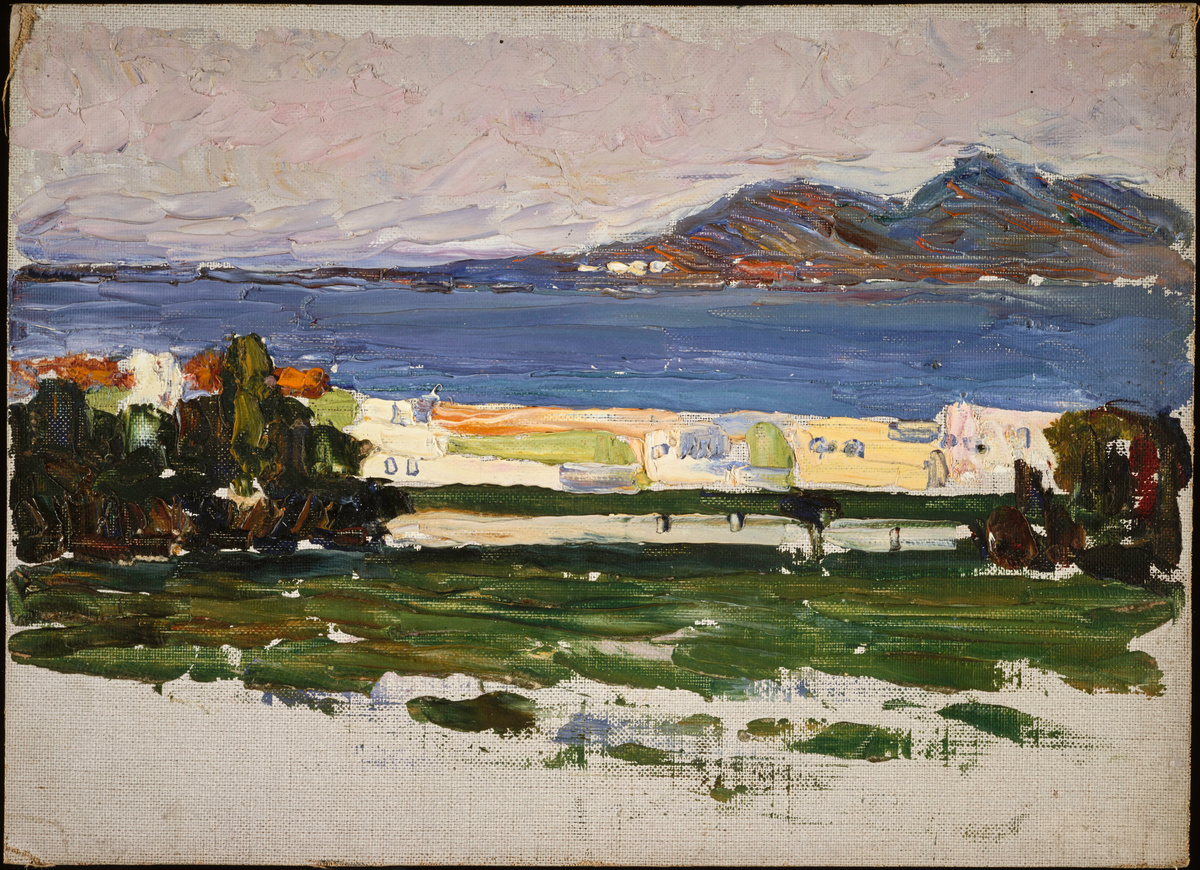
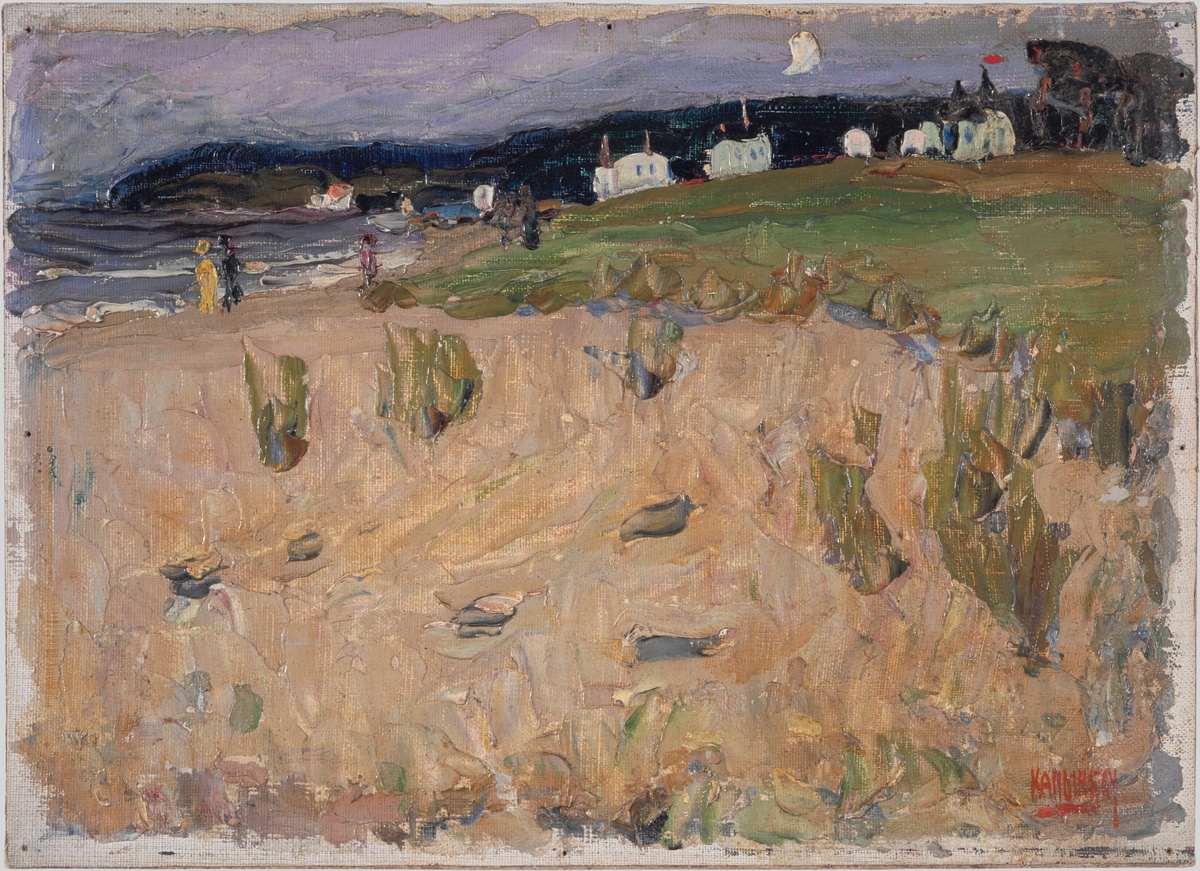
This is Wassily Kandinsky's Binz auf Rügen, a twilight view of the Baltic coast on the island of Rügen. The painting shows the sea, the shoreline and the resort settlement of Binz. It belongs to Kandinsky's early landscape work, made before the abstraction he later became famous for. The museum dates it between 1901 and 1905, while the catalogue raisonné dates it to 1901.
The painting is small, just over twenty by thirty centimetres, and painted in oil on canvas board. That modest scale suits a work made for close looking rather than public display. Across the surface, the sea and shore are suggested through broad areas of colour. The twilight hour softens the scene, so the landscape reads as a mood as much as a map of the coast.
Kandinsky was born in Russia and worked in Germany during these years. Binz, on Rügen, was a Baltic resort, and the painting records a specific coastal place rather than an imaginary landscape. The museum's record identifies the subject as the shore and sea at Binz. The reverse of the canvas board bears a pencil inscription naming the artist, Munich, and the title, which helps confirm the identification.
What makes this small painting worth pausing over is how much the twilight does. The light is not dramatic; it is the quiet, even light of evening, when colour becomes more important than detail. Kandinsky builds the shore and sea from simplified shapes rather than fine description. That choice makes the scene feel still, and it also shows a young painter testing how far he can reduce a landscape while keeping it recognisable.
So this is not a grand statement but a close study of a place at a particular hour. It records Binz and the Baltic coast, and it does so through colour and atmosphere rather than precise topography. Seen in Kandinsky's career, it is an early landscape that already values the expressive power of colour. The twilight is the subject, and the painting's quiet restraint is what stays with you.
The story and its sources
Historical claims are linked to the records below. Close looking and interpretation are identified in the passage notes.
- Passage 1Documented historyInstitutional record for Binz auf Rügen (Twilight)Institutional record for Binz auf Rügen (Twilight)
- Passage 2Close lookingInstitutional record for Binz auf Rügen (Twilight)
- Passage 3Documented historyInstitutional record for Binz auf Rügen (Twilight)
- Passage 4InterpretationInstitutional record for Binz auf Rügen (Twilight)
- Passage 5InterpretationInstitutional record for Binz auf Rügen (Twilight)
Details to notice
About 2 minutes to readArtist signature
The red painted signature in the lower right corner, visible as KAMPF, which is the key internal evidence for the attribution.
Twilight moon
The pale moon suspended in the violet, clouded sky, establishing the twilight mood and the subdued tonal key of the scene.
Foreground dune grasses
Thickly painted tufts of marram grass rising from the sandy dunes, an important textural and compositional feature that leads the eye toward the village and water.
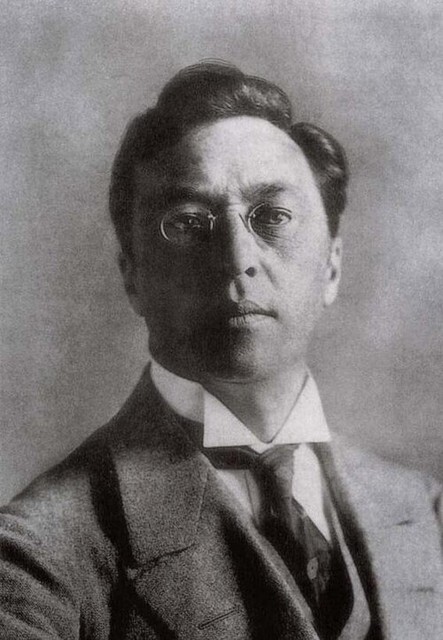
Artist portrait Image credit
未知上傳者. Image source · Public domain
About the artist
Wassily Kandinsky
1866 to 1944
Wassily Kandinsky was an avant-garde painter of Russian origin (1866–1944). Their work is associated with Expressionism; Symbolism; Bauhaus. Their recorded places of work include Paris; Munich; Weimar; Rapallo; The Hague; Russia; Stockholm; Switzerland; Tunis.
- Born
- 1866
- Died
- 1944
- Nationality
- Russian Empire; Russian Soviet Federative Socialist Republic; Soviet Union; France; Germany
- Birthplace
- Moscow
- Died in
- Neuilly-sur-Seine
Biography sources
The research & record
Study the work.
Follow the evidence.
Find catalogue details, historical context, technical research and the literature behind this artwork.
The artwork record
Research catalogue
Catalogue information and detailed research, with references that link to the bibliography.
Updated .
Identity and catalogue
Link- Title
- Binz auf Rügen (Twilight)(www.centrepompidou.fr, n.d.)
- Artist or attribution
- Wassily Kandinsky
- Object date
- 1901-1905 (catalogue raisonné dates it 1901)(www.centrepompidou.fr, n.d.)
- Medium and support
- Oil on canvas board(www.centrepompidou.fr, n.d.)
- Dimensions
- 23.2 x 32.8 cm
- Current collection or location
- Musée National d'Art Moderne, Centre Pompidou, Paris, France(www.centrepompidou.fr, n.d.)(collection.centrepompidou.fr, n.d.)
- Movement or period
- Early twentieth-century landscape painting
- Country or culture
- Russian-born artist working in Germany; German Baltic subject
- Depicted subject
- A twilight landscape of Binz on the island of Rügen, showing the Baltic coast, with the sea, shoreline and resort settlement, painted in oil on canvas board.(www.centrepompidou.fr, n.d.)
- Title variants
- Binz auf Rügen (Dämmerung); Binz auf Rügen (Crépuscule)
- Accession number
- AM 81-65-7
- Support
- Canvas board
- Inscriptions
- Signed lower right in red: KANDINSKY; Inscribed on the reverse in pencil: "Kandinsky (München)-Binz auf Rügen(oel)/ n°71"(www.centrepompidou.fr, n.d.)
Read valuation records and their limitations
Title, attribution and support
The Musée National d'Art Moderne, Centre Pompidou, records the work under the title Binz auf Rügen (Dämmerung), with the French equivalent Binz auf Rügen (Crépuscule) also in use, and attributes it to Vassily Kandinsky. The German word Dämmerung and the French Crépuscule both denote twilight, so the two title forms name the same subject and hour rather than indicating distinct works or alternative identifications. The record establishes the object as oil on canvas board measuring 23.2 by 32.8 centimetres, and gives its inventory number as AM 81-65-7. The pairing of a German place name and pictorial title with a French catalogue equivalent reflects the bilingual documentation conventions of a French national collection holding a German-titled work by an artist long associated with Germany.(www.centrepompidou.fr, n.d., Title and artist fields; Date de création; Bibliography cat. n° 28; Inscriptions; Acquisition: Legs de Nina Kandinsky, 1981)
The dating of the work is not uniform across the sources. The museum gives a creation period of 1901 to 1905, while the catalogue raisonné by Roethel and Benjamin dates the painting to 1901; the catalogue places it as cat. no. 28 in volume 1 covering 1900 to 1915, reproduced on page 69. The two positions should be kept distinct rather than merged: the narrower year comes from the scholarly catalogue, whereas the wider range is the museum's own formulation. A five-year span leaves open when within Kandinsky's early landscape activity the board was painted, and the difference is a matter of cataloguing attribution rather than evidence of a revised or contested dating of a specific documented event. What can be seen on the object does not by itself resolve which of these dates applies.(www.centrepompidou.fr, n.d., Date de création; Bibliography cat. n° 28; Title and artist fields)
Inscriptions and identifying marks
Two inscriptions on the object support its identification and connect it to a body of work. The painting is signed in red at the lower right with the name KANDINSKY. On the reverse it bears a pencil inscription reading "Kandinsky (München)-Binz auf Rügen(oel)/ n°71". The pencil text names the artist, associates him with Munich, gives the title with the qualifier oel (oil), and assigns a number, 71, in a sequence distinct from the catalogue raisonné number 28. These inscriptions are documented features of the physical object, not later annotations by the museum, and they corroborate the place, medium and artist recorded in the catalogue while leaving the relationship between the reverse number 71 and the published catalogue numbering unexplained in the supplied evidence.(www.centrepompidou.fr, n.d., Inscriptions; Title and artist fields)
The object's documented life in a public collection begins with the bequest of Nina Kandinsky in 1981, the year the museum records as its acquisition and from which the AM series inventory number derives. The reverse inscription naming Munich and the title therefore documents an earlier stage in the work's history than its arrival in Paris, though the evidence supplied does not detail the intervening ownership. Reading the catalogue entry, the signature and the reverse inscription together shows how an object's identity is established across several kinds of record: the painted mark of the artist, the handwritten note on the support, and the institutional catalogue that fixes title, date, medium and number.(www.centrepompidou.fr, n.d., Acquisition: Legs de Nina Kandinsky, 1981; Inscriptions; Date de création; Bibliography cat. n° 28)
The painting is titled Binz auf Rügen (Dämmerung), also known as Binz auf Rügen (Crépuscule), and was painted by Vassily Kandinsky.(www.centrepompidou.fr, n.d.)
The museum dates the painting to the period 1901-1905, while the catalogue raisonné by Roethel and Benjamin dates it to 1901.(www.centrepompidou.fr, n.d.)
The painting is signed in red lower right with the name KANDINSKY, and bears a pencil inscription on the reverse: "Kandinsky (München)-Binz auf Rügen(oel)/ n°71".(www.centrepompidou.fr, n.d.)
Subject and iconography
LinkRead valuation records and their limitations
The recorded subject
Visual observation
The subject recorded for this painting is the Baltic Sea coast at Binz, on the island of Rügen: a landscape combining shore and sea. That identification is stated in the institutional subject keywords as the represented place, so the work is framed in the record as a view of a specific coastal locality rather than an invented or generic landscape. The same record gives the title as Binz auf Rügen (Dämmerung), also known as Binz auf Rügen (Crépuscule), which couples the place name with the twilight hour. The evidence establishes the place and the time of day named in the title; it does not describe the arrangement of the shoreline, the forms of the settlement, or the palette in any further detail, and those elements should not be specified beyond what the record supports.(www.centrepompidou.fr, n.d., Mots clés iconographiques: rivage, mer, Rügen (île) (représentée); Mots clés sujet: paysage, mer Baltique; Technique, Dimensions)
Physical description and visual account are closely tied in this case. The painting is oil on canvas board and measures 23.2 by 32.8 centimetres, a small support whose proportions are wider than they are tall, consistent with a landscape format. The record notes that the painting is signed in red in the lower right with the name KANDINSKY, and that a pencil inscription on the reverse reads "Kandinsky (München)-Binz auf Rügen(oel)/ n°71". The inscription on the reverse is documentary rather than pictorial evidence: it associates the artist with Munich, names the Rügen subject and identifies the medium as oil, and it supplies a number, 71, whose function the record does not explain. Taken together with the painted signature, these inscriptions support the identification of the work and its subject, while the visible composition itself is described in the record only at the level of shore and sea.(www.centrepompidou.fr, n.d., Technique, Dimensions; Mots clés iconographiques: rivage, mer, Rügen (île) (représentée); Mots clés sujet: paysage, mer Baltique)
Cataloguing and reproduction
Interpretation
The relationship between what the record states about the subject and what the literature establishes about the work's date should be kept distinct. The institutional record identifies the scene as the shore and sea at Binz on Rügen and the catalogue raisonné places the painting in 1901, within the early phase of Kandinsky's landscape work covered by the first volume of that catalogue. Identifying the place and dating the work are separate operations: the first rests on the subject keywords and on the reverse inscription naming Binz auf Rügen, the second on the catalogue raisonné's attribution. Neither source, as supplied here, describes the painting's colour structure, handling or atmospheric effects in detail, so any account of how the twilight is rendered visually would go beyond the evidence. What can be said is that the work is documented as a coastal landscape of a named Baltic resort, signed and inscribed, and published in two cataloguing contexts that situate it among Kandinsky's early landscapes.(www.centrepompidou.fr, n.d., Mots clés iconographiques: rivage, mer, Rügen (île) (représentée); Mots clés sujet: paysage, mer Baltique; Bibliographie; Technique, Dimensions)(collection.centrepompidou.fr, n.d., Bibliographie)
Visual observation
The painting depicts the Baltic Sea coast at Binz on the island of Rügen, a landscape with shore and sea.(www.centrepompidou.fr, n.d.)
Materials and technique
LinkRead valuation records and their limitations
Documented materials and dimensions
The institutional record for Binz auf Rügen (Dämmerung) gives the painting's support and medium as oil on canvas board, with dimensions of 23.2 by 32.8 centimetres. This is a documented technical description supplied by the Centre Pompidou record, not an inference from an image: it specifies both the paint type and the distinctive rigid support, and it provides measured height and width. The choice of canvas board rather than stretched canvas is a material fact the record establishes, and the small dimensions are likewise recorded rather than estimated. Any account of the work's making that goes beyond this statement, such as speculation about how the board was prepared or which brushes were used, would exceed what the source actually attests.(www.centrepompidou.fr, n.d., Technique, Dimensions)
Visual observation
The record's subject indexing identifies the image as the Baltic Sea coast at Binz on the island of Rügen, described in landscape terms as shore and sea. Read together with the documented medium, this connects the physical object to a specific coastal place: the landscape subject is attested by the institutional entry's iconographic keywords rather than reconstructed by the writer. The technical description and the subject description therefore come from the same record and describe the same small oil painting, one of them accounting for its material constitution and the other for what it depicts. The evidence does not, however, document how the shore and sea were actually painted, so the appearance of the scene should be treated as a matter of subject identification rather than of technical analysis.(www.centrepompidou.fr, n.d., Mots clés iconographiques: rivage, mer, Rügen (île) (représentée); Mots clés sujet: paysage, mer Baltique; Technique, Dimensions)
The painting is executed in oil on canvas board and measures 23.2 by 32.8 centimetres.(www.centrepompidou.fr, n.d.)
Provenance and ownership
LinkRead valuation records and their limitations
Documented ownership
The documented ownership history of Binz auf Rügen (Dämmerung), also known as Binz auf Rügen (Crépuscule), is short and begins with a single recorded transfer. The painting entered the collection of the Musée National d'Art Moderne, Centre Pompidou, Paris, as a bequest from Nina Kandinsky in 1981, and it is held there under the inventory number AM 81-65-7. Both institutional records that describe the work give the same inventory number and the same 1981 bequest, so the two accounts agree rather than offering competing versions of the acquisition.(www.centrepompidou.fr, n.d., Acquisition: Legs de Nina Kandinsky, 1981; Bibliographie)(collection.centrepompidou.fr, n.d., Bibliographie)
The evidence supports no chain of owners before Nina Kandinsky. Nothing in the supplied units records a purchase, sale, gift, inheritance or intermediate transfer between the painting's making and the 1981 bequest, and no earlier collection, dealer or private holder is named. The honest form of the statement is therefore that the interval before 1981 is unrecorded in these sources. An unrecorded interval is not evidence of a change of ownership, and the absence of intermediate names should not be read as a hidden or suppressed history; it simply marks where the documentation drawn on here stops.(www.centrepompidou.fr, n.d., Acquisition: Legs de Nina Kandinsky, 1981)
A qualification attaches to the acquisition itself. The museum's dating of the work to the period 1901-1905 differs from the catalogue raisonné by Roethel and Benjamin, which dates the painting to 1901 and catalogues it as cat. no. 28, reproduced on page 69 of volume 1 (1900-1915). That disagreement concerns dating, not ownership, but it matters for provenance because the bequest of 1981 fixes only when the painting reached the public collection, not how long it had existed or passed through other hands beforehand. The two dates should be kept distinct: 1901 as the catalogue raisonné's date of execution, 1901-1905 as the museum's range, and 1981 as the documented moment of entry into the collection.(www.centrepompidou.fr, n.d., Bibliographie; Acquisition: Legs de Nina Kandinsky, 1981)
Interpretation
Later documentation of the work sits alongside the ownership record without altering it. The painting is catalogued as cat. no. 9 and reproduced on page 34 of the 1984-1985 exhibition catalogue Kandinsky: oeuvres de Vassily Kandinsky (1866-1944), Collections du Musée national d'art moderne, edited by Christian Derouet and Jessica Boissel, and it was included in the exhibition Schöne Aussichten. Der Blaue Reiter und der Impressionismus at the Franz Marc Museum, Kochel am See, from 22 March to 19 July 2015. Both events fall after the 1981 bequest and are consistent with a work already in the Paris collection, but cataloguing and exhibition are not themselves transfers of title and should not be presented as changes of ownership.(www.centrepompidou.fr, n.d., Bibliographie; Acquisition: Legs de Nina Kandinsky, 1981)(collection.centrepompidou.fr, n.d., Bibliographie; Expositions)
The painting entered the collection as a bequest from Nina Kandinsky in 1981.(www.centrepompidou.fr, n.d.)
Provenance timeline
- 1981
The painting entered the public collection as a bequest from Nina Kandinsky.(www.centrepompidou.fr, n.d., Acquisition: Legs de Nina Kandinsky, 1981)
- 22 March to 19 July 2015
The painting was included in the exhibition Schöne Aussichten. Der Blaue Reiter und der Impressionismus at the Franz Marc Museum, Kochel am See.(collection.centrepompidou.fr, n.d., Expositions)
Exhibition history
LinkRead valuation records and their limitations
Exhibition History
The documented exhibition history of Binz auf Rügen (Dämmerung) includes its inclusion in the exhibition "Schöne Aussichten. Der Blaue Reiter und der Impressionismus" at the Franz Marc Museum, Kochel am See, which ran from 22 March to 19 July 2015. The museum's collection record for the painting preserves this title and these dates, placing the work in a presentation devoted to the relationship between the Blue Rider and Impressionism. The painting had entered the Musée National d'Art Moderne, Centre Pompidou, Paris, as a bequest from Nina Kandinsky in 1981, under inventory number AM 81-65-7, and it was from that collection that the work travelled to Kochel am See for the 2015 exhibition.(collection.centrepompidou.fr, n.d., Expositions)(www.centrepompidou.fr, n.d., Acquisition: Legs de Nina Kandinsky, 1981)
Exhibition history should be distinguished from the catalogue literature attached to the same object. In the 1984-1985 exhibition catalogue "Kandinsky: oeuvres de Vassily Kandinsky (1866-1944), Collections du Musée national d'art moderne", edited by Christian Derouet and Jessica Boissel, the painting was catalogued as cat. no. 9 and reproduced on page 34. That entry belongs to the catalogue record of the Paris collection publication, and the supplied evidence does not state whether the 2015 Kochel exhibition produced its own catalogue entry for the work. The supplied evidence also does not record any other exhibition venue, loan, or display beyond the 2015 Franz Marc Museum showing and the 1984-1985 catalogue.(collection.centrepompidou.fr, n.d., Bibliographie; Expositions)
Cataloguing and Dating Across Records
The painting is a small oil on canvas board, measuring 23.2 by 32.8 centimetres, signed in red lower right with the name KANDINSKY, and bearing a pencil inscription on the reverse: "Kandinsky (München)-Binz auf Rügen(oel)/ n°71". Its subject is identified in the museum record as the Baltic Sea coast at Binz on the island of Rügen, a landscape with shore and sea. These documented features support the work's standing in exhibition contexts as an early, place-specific landscape rather than an abstract composition, and they explain why it could be shown in 2015 alongside Impressionist and Blue Rider material: the reverse inscription names Munich as well as the Rügen resort, tying the object's own documentation to the German artistic milieu in which it was made.(www.centrepompidou.fr, n.d., Acquisition: Legs de Nina Kandinsky, 1981)(collection.centrepompidou.fr, n.d., Expositions)
The painting was included in the exhibition "Schöne Aussichten. Der Blaue Reiter und der Impressionismus" at the Franz Marc Museum, Kochel am See, from 22 March to 19 July 2015.(collection.centrepompidou.fr, n.d.)
Reception and literature
LinkRead valuation records and their limitations
The Object and Its Documentation
Two distinct dating accounts are documented. The museum dates the painting to the period 1901-1905, while the catalogue raisonné by Roethel and Benjamin dates it to 1901. The museum record notes this divergence explicitly rather than resolving it. This matters for reception because the painting's place in Kandinsky's chronology has been presented with a range by one institution and a single year by the standard catalogue, a difference that affects how the object is situated relative to his other early landscapes.(www.centrepompidou.fr, n.d., Bibliographie)
Scholarly Cataloguing and Reproduction
The painting's scholarly documentation has accumulated through two key catalogues. It is catalogued in Roethel and Benjamin's catalogue raisonné of Kandinsky's paintings, volume 1, covering 1900-1915, as cat. no. 28, reproduced on page 69 and dated 1901. Separately, it was catalogued as cat. no. 9 and reproduced on page 34 in the 1984-1985 exhibition catalogue "Kandinsky: oeuvres de Vassily Kandinsky (1866-1944), Collections du Musée national d'art moderne", edited by Christian Derouet and Jessica Boissel. The two entries show the painting entering the literature both as a catalogued work in the standard raisonné and as a reproduced collection piece in a major exhibition publication, with different numbering and publication placements in each context.(www.centrepompidou.fr, n.d., Bibliographie)(collection.centrepompidou.fr, n.d., Bibliographie)
Accumulated Meanings and Evidence Limits
Interpretation
Read together, these records describe successive layers of reception: a secured identity through signature and reverse inscription, a collection entry through the 1981 Nina Kandinsky bequest, a standard chronological place in Roethel and Benjamin dated 1901 (with the museum's broader 1901-1905 range noted), reproduction in the 1984-1985 Derouet and Boissel collection catalogue, and a 2015 exhibition at the Franz Marc Museum. None of these stages depends on a single dramatic discovery; instead, the object's standing rests on the cumulative work of cataloguing, reproduction and display, each adding a locator, a date, or an interpretive frame. The evidence does not supply further literary readings, critical biographies or artistic appropriations of this painting, so its reception account remains grounded in these institutional and bibliographic records rather than in unrecorded narratives.(www.centrepompidou.fr, n.d., Acquisition: Legs de Nina Kandinsky, 1981; Bibliographie)(collection.centrepompidou.fr, n.d., Bibliographie; Expositions)
The painting is catalogued in Roethel and Benjamin's catalogue raisonné of Kandinsky's paintings (volume 1, 1900-1915), as cat. no. 28, reproduced on page 69 and dated 1901.(www.centrepompidou.fr, n.d.)
The painting was catalogued as cat. no. 9 and reproduced on page 34 in the 1984-1985 exhibition catalogue "Kandinsky: oeuvres de Vassily Kandinsky (1866-1944), Collections du Musée national d'art moderne", edited by Christian Derouet and Jessica Boissel.(collection.centrepompidou.fr, n.d.)
Collection and display
LinkRead valuation records and their limitations
The object in the national collection
The painting treated in this section is held in the collection of the Musée National d'Art Moderne, Centre Pompidou, Paris, where it carries the inventory number AM 81-65-7. Both institutional records consulted for the work agree on this identification, so the object's current public location and registration number can be stated as documented facts of the collection rather than as reported tradition. The inventory number is the stable anchor that connects the museum's online resource and its collection database entry to one and the same canvas board, and every other fact about display, publication and physical description in this account attaches to that single registered object.(www.centrepompidou.fr, n.d., N° d'inventaire)(collection.centrepompidou.fr, n.d., Inv. : AM 81-65-7)
The two institutional records do not simply duplicate one another: they divide the object's documentation between them. The object record establishes the full material and bibliographic profile of the painting, while the collection database entry adds the exhibition history and a separate catalogue reference. The object is catalogued as Binz auf Rügen (Dämmerung), also known under the French title Binz auf Rügen (Crépuscule), and is attributed to Vassily Kandinsky. It is executed in oil on canvas board and measures 23.2 by 32.8 centimetres. It entered the collection as a bequest from Nina Kandinsky in 1981, which is consistent with the AM 81 prefix of the inventory number. The museum's subject description identifies the scene as the Baltic Sea coast at Binz on the island of Rügen, a landscape with shore and sea.(www.centrepompidou.fr, n.d., N° d'inventaire)(collection.centrepompidou.fr, n.d., Inv. : AM 81-65-7)
Date, inscriptions and cataloguing
The dating of the work is one point where the accounts diverge, and the divergence should be kept visible rather than resolved by preference. The museum dates the painting to the period 1901-1905, while the catalogue raisonné by Roethel and Benjamin dates it to 1901. That catalogue, the first volume covering 1900-1915, lists the work as cat. no. 28, reproduces it on page 69 and gives the date 1901. The two positions are therefore not a conflict over authorship or identity but a difference in precision and span: the museum's range is broader and the catalogue's date is a single year falling within it. A research account of the object can cite either without misrepresenting the other, provided the source of each date is named. The same institutional record supplies the physical inscriptions that bear on identification: the painting is signed in red lower right with the name KANDINSKY, and bears a pencil inscription on the reverse reading "Kandinsky (München)-Binz auf Rügen(oel)/ n°71". These inscriptions, the title, the medium and the catalogue entry together form the documentary basis on which the object's identity rests.(www.centrepompidou.fr, n.d., N° d'inventaire)(collection.centrepompidou.fr, n.d., Inv. : AM 81-65-7)
Exhibition and publication history
Beyond the collection itself, the object has a documented public and scholarly life. The painting was included in the exhibition "Schöne Aussichten. Der Blaue Reiter und der Impressionismus" at the Franz Marc Museum, Kochel am See, from 22 March to 19 July 2015. It also appeared in the 1984-1985 exhibition "Kandinsky: oeuvres de Vassily Kandinsky (1866-1944), Collections du Musée national d'art moderne", where it was catalogued as cat. no. 9 and reproduced on page 34; that catalogue was edited by Christian Derouet and Jessica Boissel. These two references show the work functioning in different contexts: a survey of Kandinsky's own oeuvre drawn from the national modern collection, and a later thematic exhibition placing the Blue Rider circle in relation to Impressionism. Both are documented facts of display and publication, and they indicate that the small canvas board has been treated as a loanable, discussable object rather than a fixed deposit.(www.centrepompidou.fr, n.d., N° d'inventaire)(collection.centrepompidou.fr, n.d., Inv. : AM 81-65-7)
Interpretation
Read together, the evidence explains how the object's identity is sustained across separate records and how its significance within a larger history of art has been constructed institutionally. The inventories and inscriptions fix what the object is and where it is; the catalogue raisonné fixes its place in the chronological corpus of Kandinsky's paintings, with a date the museum's broader range accommodates; the exhibition and catalogue references show the work brought into public comparison with other art of its period. The work's inclusion in a collection of modern art through a 1981 bequest, and its subsequent loan to exhibitions in 1984-1985 and 2015, situates it within the institutional history of the Musée National d'Art Moderne as well as within Kandinsky's early output. Nothing in the supplied evidence supports claims beyond these documented matters of collection, description, dating, inscription, exhibition and bibliography.(www.centrepompidou.fr, n.d., N° d'inventaire)(collection.centrepompidou.fr, n.d., Inv. : AM 81-65-7)
The painting is in the collection of the Musée National d'Art Moderne, Centre Pompidou, Paris, with the inventory number AM 81-65-7.(www.centrepompidou.fr, n.d.)(collection.centrepompidou.fr, n.d.)
Documented values and qualified estimates
LinkRead valuation records and their limitations
Object and documentation
Interpretation
The date of the painting is not stated identically in all accounts. The museum dates the work to the period 1901 to 1905, while the catalogue raisonné by Roethel and Benjamin dates it to 1901. The same catalogue entry is cited precisely: volume 1, covering 1900 to 1915, cat. no. 28, reproduced on page 69 and dated 1901. The five-year spread in the institutional dating and the single year assigned by the catalogue raisonné are both documented positions, not an error to be resolved here; the working insurance estimate supplied for review describes the object as dated circa 1901 to 1905 while also recording the catalogue raisonné date of 1901, holding the two dating statements together rather than choosing between them.(Wikimedia Commons: Binz auf Rügen (Twilight), n.d.)(www.centrepompidou.fr, n.d.)(collection.centrepompidou.fr, n.d.)
Valuation status
The only monetary figures supplied are a calculated working insurance estimate of US$2M to US$6M, recorded as a working calculation generated on 2026-10-30. Its stated methodology builds the range from the confirmed identity of the object: an authenticated early Kandinsky oil landscape dated circa 1901 to 1905, small in scale on canvas board, signed and inscribed on the reverse, museum-held at the Musée National d'Art Moderne under accession AM 81-65-7, acquired through the 1981 Nina Kandinsky bequest, and catalogued by Roethel and Benjamin as cat. no. 28, dated 1901. The model applied a conservative high-value bracket because early pre-abstract Kandinsky landscapes are described as scarce and this example is museum-held and well documented, with upward latitude for the small format, the minor support of canvas board and the absence of a public sale record. The same evidence states that no comparable sales or private insurance records were accessed and that the figures form a broad planning envelope rather than a valuation.(Wikimedia Commons: Binz auf Rügen (Twilight), n.d.)(www.centrepompidou.fr, n.d.)(collection.centrepompidou.fr, n.d.)
That figure must be kept strictly separate from the documented record. The evidence qualifies it as model-generated, for manual review only, and explicitly not an official insurance value, an appraisal, an auction estimate or result, or a sale price, with no evidentiary weight; actual insurance scheduling would require a qualified appraiser and current market data. The supplied institutional and discovery sources document the painting's identity and collection status only and contain no valuation figure at all. Reading the two kinds of material together, the object's documented value in the supplied evidence is historical and museological rather than financial: its place in the Nina Kandinsky bequest, its catalogue raisonné citation, its publication and exhibition history, and its signed and inscribed reverse are what the sources establish, while the monetary bracket remains a planning construct that cannot be cited as a fact about the work.(Wikimedia Commons: Binz auf Rügen (Twilight), n.d.)(www.centrepompidou.fr, n.d.)(collection.centrepompidou.fr, n.d.)
Working estimate
Calculated working insurance estimate, not a sale price: Working insurance range: US$2M to US$6M Recorded date: Working calculation, generated 2026-10-30. Methodology: Model-generated working range for manual review only, built from the confirmed context: an authenticated early Wassily Kandinsky oil landscape, dated circa 1901 to 1905, small in scale at 23.2 x 32.8 cm on canvas board, signed and inscribed on the reverse, held in the Musee National d'Art Moderne, Centre Pompidou, under accession AM 81-65-7 and acquired through the 1981 Nina Kandinsky bequest, with catalogue raisonne citation (Roethel and Benjamin, cat. no. 28, dated 1901). Because Kandinsky's early pre-abstract works are scarce and this example is museum-held and well documented, a conservative high-value bracket is applied, with upward latitude for the small format, the minor medium of canvas board, and the absence of a public sale record. No comparable sales or private insurance records were accessed; figures are a broad planning envelope, not a valuation. Qualification: This is a model-generated working range for manual review only. It is not an official insurance value, an appraisal, an auction estimate or result, or a sale price, and it has no evidentiary weight. Actual insurance scheduling requires a qualified appraiser and current market data. The supplied sources document the artwork's identity and collection status only and do not contain any valuation figure.(Wikimedia Commons: Binz auf Rügen (Twilight), n.d.)(www.centrepompidou.fr, n.d.)(collection.centrepompidou.fr, n.d.)
Further reading
Books for a closer look
Paid links. As an Amazon Associate I earn from qualifying purchases.

Open Library Kandinsky: Russian and Bauhaus years, 1915-1933.
Solomon R. Guggenheim Museum
Catalogue with subjects including Centre Georges Pompidou, Musée national d'art moderne (Paris), Collections publiques, Expositions and Catalogues raisonnés, matching this painting's home collection and its presence in the 1984-1985 MNAM exhibition catalogue. The overlapping Kandinsky collection focus makes it the closest object-adjacent candidate among those returned.
ISBN 0892070447
Bibliography
Sources and further reading
References are arranged by author or organisation, with links to the original publications. Where no publication date is recorded, n.d. means no date.
Source notes updated .
No recorded sources match these filters. Reset the filters to see the full bibliography.
- 03
Official · About this artwork
Collection database entry for the same painting at the Musée national d'art moderne, Centre Pompidou, with exhibition history and bibliography.
- Language
- French
Citation text
- 04
Book
Kandinsky: Russian and Bauhaus years, 1915-1933. Solomon R. Guggenheim Museum.
Catalogue with subjects including Centre Georges Pompidou, Musée national d'art moderne (Paris), Collections publiques, Expositions and Catalogues raisonnés, matching this painting's home collection and its presence in the 1984-1985 MNAM exhibition catalogue. The overlapping Kandinsky collection focus makes it the closest object-adjacent candidate among those returned.
- ISBN
- 0892070447
Citation text
- 01
Secondary · About this artwork
Wikimedia Commons: Binz auf Rügen (Twilight) (n.d.). Wikimedia Commons.
Wikimedia Commons file page used as a discovery source for the digital image and basic identification details.
- Language
- English
Citation text
- 02
Official · About this artwork
Official Centre Pompidou object record for Binz auf Rügen (Dämmerung), providing title, date, medium, dimensions, collection, provenance, inscriptions, exhibition and bibliography.
- Language
- French
Citation text
Art to live with
Bring this painting
home.
A piece of the archive, made yours. Explore Binz auf Rügen (Twilight) in a size and finish that fits your space.
Your text and annotations appear on these editions. Adding to cart saves that design for printing.
Combine this painting with your favourites01 / Find your edition
Made for you
Suggested from your location. Change it if you're sending elsewhere or using a VPN. Prices and delivery are shown in GBP.
1 product
Choose an edition to make it yours
iPhone 12 Mini ? Glossy ? back view
iPhone 12 Mini · Glossy

iPhone 12 Mini ? Glossy ? back view

iPhone 12 Mini ? Glossy ? back view

iPhone 12 Mini ? Glossy ? back view
Tough phone case
GBP 16.34
Delivery GBP 4.22 / Total GBP 20.56
A two-layer phone case with a printed polycarbonate shell and a shock-absorbing inner liner.
Two layers with a shock-absorbing TPU liner
Case & print details
- Device
- Apple · iPhone 12 Mini
- Material
- Polycarbonate shell with a TPU inner liner
- Artwork
- Outer back and wrapped edges from one template
- Finish
- Glossy
- Version
- Standard version
- Printing
- Dye sublimation
- Print file
- 1,122 × 1,831 px · 95 × 155 mm · PNG · 300 dpi recommended
Rear outline and camera openings follow this variant's Printify template. Case depth and small hardware remain illustrative.
Supplier product detailsFit and fill keep the painting’s proportions. Stretch changes them.
Move and zoom the painting on your tough phone case.
Made to order with your design
Made to order
US delivery only
The 30 cm ruler is scaled alongside your selected print. Keep the painting’s proportions with a black background, or stretch it to fill. Frame width, material texture and screen colours are illustrative.
Keep exploring