Bacchus
Artist: Michelangelo Merisi, known as Caravaggio · c. 1598

Bacchus: high-resolution image, free to copy
The original file is hosted by Wikimedia Commons, available without payment or an account.2,628 × 2,989 pixels.
Open high-resolution image on Wikimedia CommonsCaravaggio. [1]
Free to copy. Reuse terms: Public domain. Image source and credits.
The complete story
The story About 4 minutes to read
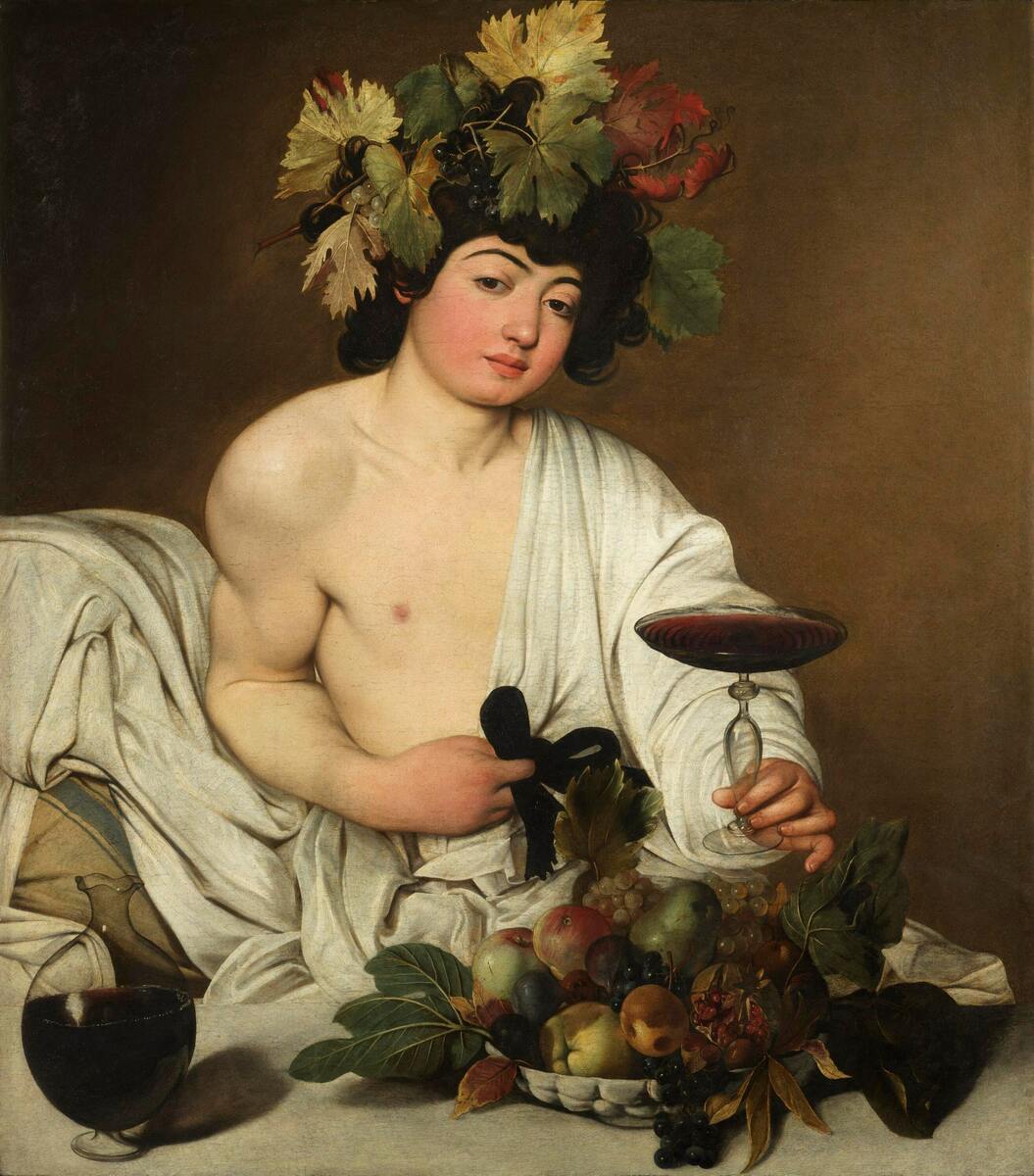
A youth crowned with vine leaves and clusters of grapes offers you a glass of red wine. His skin is warm with colour, his eyes heavy, his expression dazed. The basket of fruit in front of him looks so real you could almost reach out and take a peach. This is Bacchus, the god of wine, and he seems to be inviting you to join him.
Look closely at the glass he holds. The wine inside is dark, and the glass itself is round-bowled, catching the light. Beside the fruit basket, a glass carafe of wine sits at the lower left. The Uffizi describes the figure's expression as stunned from inebriation, and his pose as languid and sensual. The still life of fruit and wine is painted with such naturalism that some critics have seen in it a Horatian invitation to frugality, conviviality and friendship.
Caravaggio painted this Bacchus around 1598, early in his Roman career, when he was under the patronage of Cardinal Francesco Maria del Monte. The Uffizi notes that it belongs to a series of half-length portraits painted 'in chiaro', in a clear light. The sculpted figure of Bacchus reproduces classical models, in particular portraits of Antinous, the young favourite of the emperor Hadrian. So the god of wine is also a quotation of ancient art.
The painting's early history is tied to Cardinal del Monte. According to the Uffizi, he donated this Bacchus, together with Caravaggio's Medusa, to Ferdinando I de' Medici in 1608, on the occasion of the wedding of his son Cosimo II. So the painting entered the Medici collections as a gift, a diplomatic gesture that placed Caravaggio's work in the heart of Florentine power.
But then the trail goes cold. For centuries, the painting was forgotten, hidden away in the Uffizi's storerooms. It was only in 1913 that it was rediscovered, and the art historian Roberto Longhi attributed it to Caravaggio. This was a time when Caravaggio's reputation was being rebuilt; many of his works had been misattributed or overlooked. The Bacchus that had once been a gift to a grand duke had become a dusty object in storage, its authorship uncertain.
Now the god of wine looks out again, his glass raised, his gaze meeting ours. The painting is no longer a forgotten canvas but a key to Caravaggio's early years, a moment when he was experimenting with light, naturalism and classical quotation. The fruit and the wine are not just symbols; they are invitations to think about pleasure, friendship and the passage of time. And the youth who offers the glass, with his flushed face and heavy eyes, remains as enigmatic as the god he portrays.
The story and its sources
Guide sources checked 9 October 2026.
Historical claims are linked to the records below. Close looking and interpretation are identified in the passage notes.
- Passage 1Close lookingInstitutional record for Bacchus
- Passage 2Close lookingInstitutional record for Bacchus
- Passage 3Documented historyInstitutional record for Bacchus
- Passage 4Documented historyInstitutional record for Bacchus
- Passage 5Documented historyInstitutional record for Bacchus
- Passage 6InterpretationInstitutional record for Bacchus
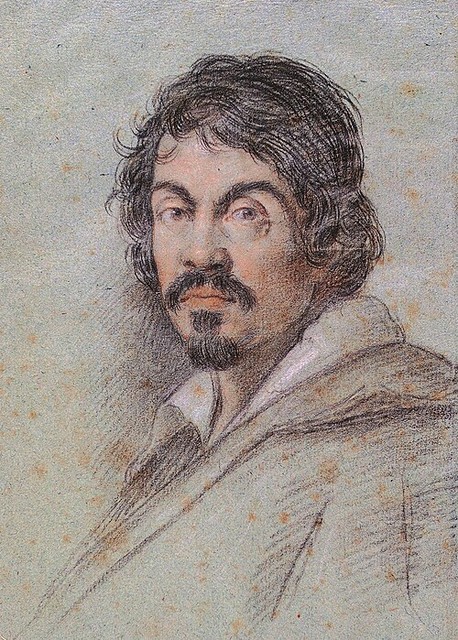
Artist portrait Image credit
Ottavio Leoni. Image source · Public domain
About the artist
Caravaggio
1571 to 1610
Caravaggio was an Italian painter whose dramatic lighting and direct treatment of religious subjects transformed European painting. Born Michelangelo Merisi, he moved to Rome in 1592 and gained major public commissions through Cardinal Francesco del Monte. His influence spread through artists who adapted his strong contrasts of light and shadow.
- Born
- 1571
- Died
- 1610
- Nationality
- Italian
Biography sources
The research & record
Study the work.
Follow the evidence.
Find catalogue details, historical context, technical research and the literature behind this artwork.
The artwork record
Research catalogue
Catalogue information and detailed research, with references that link to the bibliography.
Identity and catalogue
Link- Title
- Bacchus
- Artist / attribution
- Michelangelo Merisi, known as Caravaggio
- Date
- c. 1598
- Medium and support
- Oil on canvas
- Dimensions
- 95 x 85 cm
- Culture / place
- Italian
- Period
- Baroque, early Roman period
- Current location
- The Uffizi, Florence, Italy
Read valuation records and their limitations
Bibliography
Sources and further reading
References are arranged by author or organisation, with links to the original publications. Where no publication date is recorded, n.d. means no date.
Source notes updated .
No recorded sources match these filters. Reset the filters to see the full bibliography.
- 01
Secondary
Wikimedia Commons: Bacchus (n.d.). Wikimedia Commons.
Citation text
- 02
Official
Citation text
Art to live with
Bring this painting
home.
A piece of the archive, made yours. Explore Bacchus in a size and finish that fits your space.
Your text and annotations appear on these editions. Adding to cart saves that design for printing.
Combine this painting with your favourites01 / Find your edition
Made for you
Suggested from your location. Change it if you're sending elsewhere or using a VPN. Prices and delivery are shown in GBP.
1 product
Choose an edition to make it yours
iPhone 12 Mini ? Glossy ? back view
iPhone 12 Mini · Glossy

iPhone 12 Mini ? Glossy ? back view

iPhone 12 Mini ? Glossy ? back view

iPhone 12 Mini ? Glossy ? back view
Tough phone case
GBP 16.56
Delivery GBP 4.28 / Total GBP 20.84
A two-layer phone case with a printed polycarbonate shell and a shock-absorbing inner liner.
Two layers with a shock-absorbing TPU liner
Case & print details
- Device
- Apple · iPhone 12 Mini
- Material
- Polycarbonate shell with a TPU inner liner
- Artwork
- Outer back and wrapped edges from one template
- Finish
- Glossy
- Version
- Standard version
- Printing
- Dye sublimation
- Print file
- 1,122 × 1,831 px · 95 × 155 mm · PNG · 300 dpi recommended
Rear outline and camera openings follow this variant's Printify template. Case depth and small hardware remain illustrative.
Supplier product detailsFit and fill keep the painting’s proportions. Stretch changes them.
Move and zoom the painting on your tough phone case.
Made to order with your design
Made to order
US delivery only
The 30 cm ruler is scaled alongside your selected print. Keep the painting’s proportions with a black background, or stretch it to fill. Frame width, material texture and screen colours are illustrative.
Keep exploring