Identity and catalogue
Link- Title
- Judith Beheading Holofernes
- Artist or attribution
- Artemisia Gentileschi
- Object date
- c. 1620
- Dimensions
- 146.5 x 108 cm
- Current collection or location
- Gallerie degli Uffizi, Florence, Italy
- Movement or period
- Baroque
- Country or culture
- Italian
- Depicted subject
- The biblical episode from the Book of Judith in which the Jewish widow Judith beheads the Assyrian general Holofernes in his tent after he has fallen into a drunken sleep, freeing the people of Israel from the siege of Bethulia. The painting shows the moment of the killing, with Judith grasping Holofernes by the hair and plunging her scimitar into his neck, while her maidservant Abra waits with a cloth.
- Accession number
- 1890 n. 1567
- Support
- canvas
Catalogue identity
The Gallerie degli Uffizi catalogue the canvas as Judith Beheading Holofernes by Artemisia Gentileschi, painted in Rome around 1620. The catalogue record also supplies the physical description of the work: it is oil on canvas, measures 146.5 x 108 cm, and carries inventory number 1890 n. 1567. It is displayed in the Uffizi in the room devoted to Caravaggio and Artemisia, location D29. The date given for the work, around 1620, belongs to the period of its making; the inventory number 1890 belongs instead to a later moment of cataloguing, so the two dates answer different questions and should not be conflated. The recorded title, artist, medium, dimensions and inventory number together constitute the object's catalogue identity as the holding institution currently states it.(Gallerie degli Uffizi, n.d.)
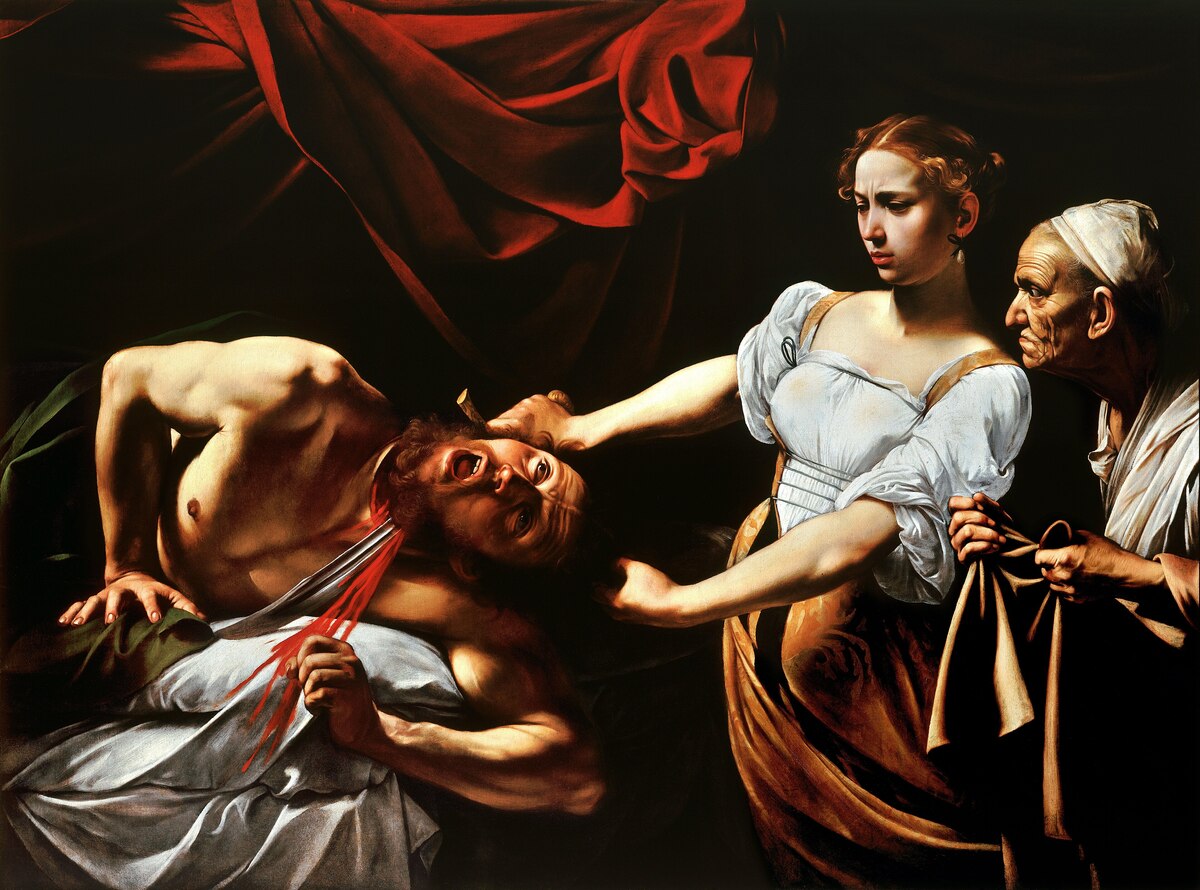
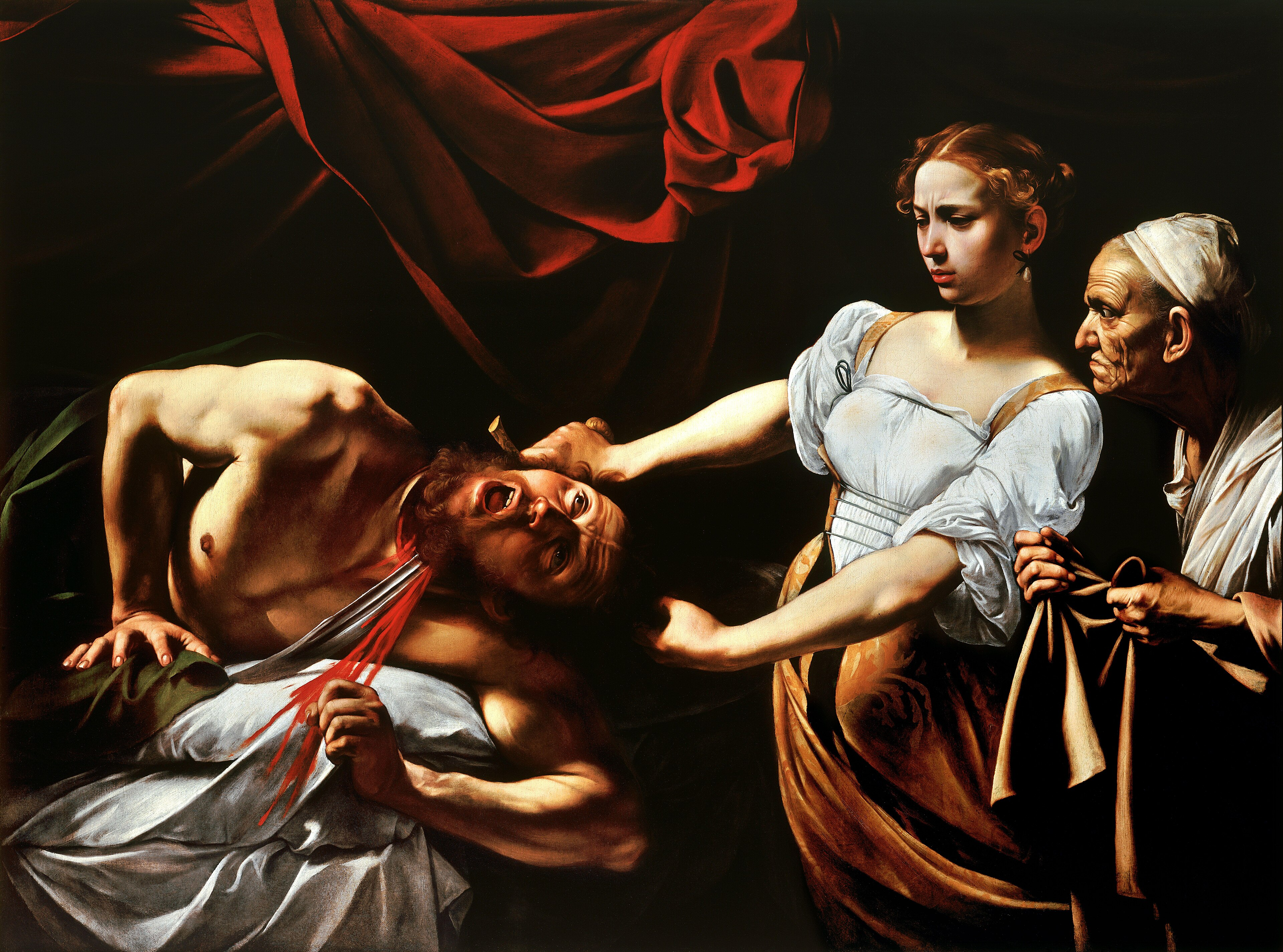
The subject of the Uffizi canvas should be distinguished from a separate painting of the same biblical episode. Caravaggio's Judith Beheading Holofernes, dated about 1598 to 1599, measures 145 x 195 cm, is oil on canvas, and is held in the Galleria Nazionale d'Arte Antica at Palazzo Barberini in Rome under accession number 2533. That work is larger in width than the Uffizi canvas and predates it by roughly two decades. Both paintings treat the same narrative, but they are different objects by different artists in different collections, and the identity of the Artemisia canvas depends on keeping the two records separate.(Wikimedia Commons contributors, n.d.)
The Uffizi identifies the painting as Judith Beheading Holofernes by Artemisia Gentileschi, painted in Rome around 1620.(Gallerie degli Uffizi, n.d.)
A separate painting of Judith Beheading Holofernes by Caravaggio, dated about 1598 to 1599 and measuring 145 x 195 cm, oil on canvas, is held in the Galleria Nazionale d'Arte Antica at Palazzo Barberini in Rome, with accession number 2533.(Wikimedia Commons contributors, n.d.)
Subject and iconography
LinkThe composition and its described effect
Visual observation
The Uffizi's object record describes the canvas as portraying the exact moment in which Holofernes is killed by the hand of the determined and powerful Judith. In that account the drunk and corpulent general lies on the bed, his head grasped by his hair while the sword is plunged into his neck. The museum frames the composition around a single narrated instant rather than a sequence, so the picture is read as an action caught in progress, with the general's helplessness on the bed and Judith's grip and thrust defining the whole field of the scene. The same record expands this description by noting that Artemisia did not shy away from adding the gory detail of blood spurting so profusely that it stains Judith's breast, and that the overall effect of the work is both powerful and frightening. The Uffizi therefore attaches two distinct claims to the visible surface: a precise account of posture and weapon, and an account of an excessive naturalistic detail whose stated consequence is an emotional effect on the viewer. Both descriptions are the museum's characterizations of what the painting shows, and they should be kept as such rather than treated as neutral measurements.(Gallerie degli Uffizi, n.d.)
The Uffizi describes the painting as portraying the moment Holofernes is killed by the hand of the determined and powerful Judith, with the drunk and corpulent general lying on the bed, his head grasped by his hair and the sword plunged into his neck.(Gallerie degli Uffizi, n.d.)
The Uffizi states that Artemisia did not shy away from adding the gory detail of blood spurting so profusely as to stain Judith's breast, and that the overall effect of the work is both powerful and frightening.(Gallerie degli Uffizi, n.d.)
The object and its making
The Uffizi identifies the canvas as Artemisia Gentileschi's Judith Beheading Holofernes, an oil painting on canvas measuring 146.5 by 108 cm, carrying the inventory number 1890 n. 1567 and displayed in the room devoted to Caravaggio and Artemisia at location D29. The museum's account places its completion in Rome, where Artemisia returned after spending seven years in Florence and where, in the Uffizi's phrase, she was able to appreciate Caravaggio's works once more. That sequence matters for reading the picture because it describes an artist moving back into the orbit of the naturalism she had absorbed earlier, at the same time as she was producing work for a Florentine patron. The evidence establishes where the painting was made and what it is materially, but it does not by itself settle the terms on which it was commissioned.(Gallerie degli Uffizi, n.d.)
The biblical subject
The Uffizi states that the subject is drawn from the biblical account of Judith, a young Jew from Bethulia who freed the people of Israel from the siege by Nebuchadnezzar's army. According to the museum, Judith went to the encampment of the Assyrian general Holofernes feigning a wish to forge an alliance, and he invited her to a banquet in his tent. After eating and drinking, the Uffizi notes, Holofernes fell asleep drunk on his bed, allowing Judith to seize her scimitar and strike the deadly blow. The Uffizi also quotes the line spoken by Judith in describing her act: The Lord has struck him down by the hand of a woman. This is the narrative frame within which the institution reads the action, and it supplies the theological language of divine agency that the scene is understood to carry.(Gallerie degli Uffizi, n.d.)
Interpretation
Read together, the units describe a painting whose identity is secure while its commissioning history remains partial. The Uffizi's narrative of Judith, the description of the strike and the spurting blood, the record of completion in Rome, and the Florentine aftermath of adverse reaction and delayed payment each address a different aspect of the same canvas. The secure identification as Artemisia's Judith Beheading Holofernes does not settle the terms agreed with Grand Duke Cosimo II de' Medici, which the evidence reports only through the difficulty of extracting payment and the intervention of Galileo. Claims about the artist's motives or about why the work was withheld from exhibition are not established by these units; what is established is the biblical subject, the specific instant depicted, the medium and dimensions, the Roman completion, and the documented Florentine response and payment dispute.(Gallerie degli Uffizi, n.d.)
The Uffizi states that the subject is drawn from the biblical account of Judith, a young Jew from Bethulia, who freed the people of Israel from the siege by Nebuchadnezzar's army.(Gallerie degli Uffizi, n.d.)
According to the Uffizi, Judith went to the encampment of the Assyrian general Holofernes feigning a wish to forge an alliance, and he invited her to a banquet in his tent.(Gallerie degli Uffizi, n.d.)
The Uffizi notes that after eating and drinking Holofernes fell asleep drunk on his bed, allowing Judith to seize her scimitar and strike the deadly blow.(Gallerie degli Uffizi, n.d.)
The Uffizi records that the painting was completed in Rome, where Artemisia returned after spending seven years in Florence, and where she was able to appreciate Caravaggio's works once more.(Gallerie degli Uffizi, n.d.)
The Uffizi quotes the biblical line spoken by Judith in describing her act: The Lord has struck him down by the hand of a woman.(Gallerie degli Uffizi, n.d.)
Provenance and ownership
LinkThe provenance of Artemisia Gentileschi's Judith Beheading Holofernes begins with a commission tied to the Medici court, though the Uffizi's account records only the difficult conclusion of that transaction rather than its negotiation. According to the Uffizi, the painting was completed in Rome, where Artemisia had returned after spending seven years in Florence, and where she was able to appreciate Caravaggio's works once more. That Roman completion is the anchor for the commission's chronology: the canvas was made for Grand Duke Cosimo II de' Medici, and the Uffizi states that the Grand Duke died in 1621 shortly after the canvas was completed. The evidence does not set out the date of the commission's granting, the terms of the agreement, or the delivery of the finished work to Florence; those intervals remain unrecorded in the supplied account. The payment claim is the one provenance transaction the Uffizi narrates in detail, and it is the pivot from creation to collection: it documents a patron, a painter, a debt, and a delay, while leaving the stages before and after those events outside the record.(Gallerie degli Uffizi, n.d.)
On payment, the Uffizi reports that it was only with great difficulty and the help of her friend Galileo Galilei that the painter managed to extract the payment, with a significant delay, that had been agreed with Grand Duke Cosimo II de' Medici, who died in 1621 shortly after the canvas was completed. The evidence attributes the intervention to Artemisia's friendship with Galileo and frames the collection of the fee as a struggle rather than a routine settlement. Two distinct facts sit inside that single statement and should be kept apart: the agreed payment existed and was eventually extracted, and the extraction followed a significant delay rather than occurring on schedule. The evidence does not specify the sum, the payment schedule, the legal or courtly mechanism by which the debt was pressed, or the exact year in which the money changed hands. Nor does it record who authorized payment after Cosimo II's death, or whether the delay arose from the Grand Duke's death, from administrative friction at the Florentine court, or from some other cause. What the Uffizi establishes is the outcome, an extraction achieved with difficulty and assistance; what it leaves unrecorded is the sequence of demands, refusals and settlements that produced that outcome.(Gallerie degli Uffizi, n.d.)
The Uffizi's account of the painting's arrival in Florence supplies the only evidence in this material bearing on where the work was seen or shown and how it was received at its destination. The Uffizi states that the naturalistic virility of the work provoked strong reactions on its arrival in Florence and the painting was denied the honor of being exhibited in the Gallery. That claim bears directly on provenance because it distinguishes the work's physical presence in Florence from its admission into the Gallery's display: the canvas was in the city, and evidently known there, but the evidence says it was not granted the honor of exhibition in the Gallery at that point. The Uffizi does not state in the supplied text where the painting was kept during that withheld interval, who held it, or on what later occasion and by what means it entered the Gallery collection. The inventory number the Uffizi records for the canvas is 1890 n. 1567, a nineteenth-century inventory designation that locates the work in the Gallery's holdings by 1890 but does not by itself document when or how the transfer into that collection occurred. The interval between the painting's Florentine arrival and its registration under that 1890 inventory number is therefore an unrecorded span in the supplied evidence, not a documented sequence of owners. The distinction matters: an inventory number is evidence of institutional possession at the time of registration, while the earlier refusal of exhibition is evidence of reception and placement, and the gap between them should not be filled with owners or transfers the evidence does not supply.(Gallerie degli Uffizi, n.d.)
According to the Uffizi, it was only with great difficulty and the help of her friend Galileo Galilei that the painter managed to extract the payment, with a significant delay, that had been agreed with Grand Duke Cosimo II de' Medici, who died in 1621 shortly after the canvas was completed.(Gallerie degli Uffizi, n.d.)
Provenance timeline
- 1621
Grand Duke Cosimo II de' Medici, with whom the payment had been agreed, died shortly after the canvas was completed.(Gallerie degli Uffizi, n.d.)
- significant delay, after Cosimo II's death in 1621
Only with great difficulty and with the help of her friend Galileo Galilei did the painter manage to extract the agreed payment, which arrived with a significant delay.(Gallerie degli Uffizi, n.d.)
Reception and literature
LinkEarly Florentine Reception
Visual observation
The documented Florentine reception of Artemisia Gentileschi's Judith Beheading Holofernes turns on a rejection rather than an acclaim. The Uffizi states that the naturalistic virility of the work provoked strong reactions on its arrival in Florence and that the painting was denied the honor of being exhibited in the Gallery. This is a specific institutional outcome, not a general mood: the same museum that now displays the canvas records that it was once kept out of the display it would later occupy, and the ground it gives for that reaction is the picture's naturalistic force rather than its subject or its authorship. The refusal therefore belongs to the object's documented history alongside its present place in the collection, and the two should be read together rather than as a corrected myth in which early hostility is simply reversed by later fame.(Gallerie degli Uffizi, n.d.)
Accumulated Meanings
Interpretation
The Uffizi offers a present-day reading that is explicitly interpretive rather than documentary: it states that today the painting represents the human and professional tale of a woman who chose to be an artist in an era dominated by men, working in the courts of Rome, Florence and Naples, traveling to England and finally becoming the first woman to enter the Academy of Art and Design in Florence. The same source, in its account of the subject, supplies the textual line the figure speaks about her act, and the museum's framing therefore sets a biblical deliverance narrative beside a professional biography. Because the Uffizi attributes this reading to the present, it belongs to the history of the object's meanings rather than to the circumstances of its making. The earlier documented reception supplies a necessary qualification to that reading: the work arrived in Florence to strong reactions and was denied the honor of being exhibited in the Gallery, and the payment was extracted only with great difficulty and the help of Galileo Galilei. The meanings the painting now carries accumulated across distinguishable stages, and the honor of its present display was not the condition of its first Florentine life.(Gallerie degli Uffizi, n.d.)
The Uffizi states that the naturalistic virility of the work provoked strong reactions on its arrival in Florence and the painting was denied the honor of being exhibited in the Gallery.(Gallerie degli Uffizi, n.d.)
Collection and display
LinkThe museum record
The Gallerie degli Uffizi record this canvas under inventory number 1890 n. 1567, with dimensions of 146.5 x 108 cm. The museum identifies the medium as oil on canvas, and states that it is displayed in the Uffizi in the room devoted to Caravaggio and Artemisia, at location D29. These are the administrative and physical particulars through which the institution tracks and presents the work: a number assigned in the 1890 inventory sequence, a recorded measurement of the support, a declared medium, and a current gallery position. They establish the object as a documented museum holding rather than a free-floating image, and they anchor any discussion of its form and history to a specific, locatable canvas.(Gallerie degli Uffizi, n.d.)
Rome, Florence and the question of display
According to the Uffizi, the painting was completed in Rome, where Artemisia returned after spending seven years in Florence, and where she was able to appreciate Caravaggio's works once more. The same source states that the naturalistic virility of the work provoked strong reactions on its arrival in Florence, and that the painting was denied the honor of being exhibited in the Gallery. The institutional account thus separates two moments and two cities: a Roman execution and a Florentine reception that was, on this testimony, resistant. The denial of exhibition is presented by the Uffizi as a consequence of the work's naturalistic force, which is an attributed interpretation of the reaction rather than a documented record of motive, and it should be weighed as such.(Gallerie degli Uffizi, n.d.)
The Uffizi further records that it was only with great difficulty, and with the help of her friend Galileo Galilei, that the painter managed to extract the payment, with a significant delay, that had been agreed with Grand Duke Cosimo II de' Medici, who died in 1621 shortly after the canvas was completed. This connects the object to a documented patronage and payment dispute, and it places the completion of the canvas in the immediate vicinity of the grand duke's death. The account attributes the eventual extraction of payment to Artemisia's persistence and to Galileo's assistance. Because the museum presents this as the history of the commission, it belongs to the object's administrative afterlife as much as to its making: the painting arrived in Florence, was not, on this account, exhibited in the Gallery, and was settled only with difficulty.(Gallerie degli Uffizi, n.d.)
The depicted action and its scriptural source
The Uffizi describes the painting as portraying the moment Holofernes is killed by the hand of the determined and powerful Judith, with the drunk and corpulent general lying on the bed, his head grasped by his hair and the sword plunged into his neck. The museum states that Artemisia did not shy away from adding the gory detail of blood spurting so profusely as to stain Judith's breast, and that the overall effect of the work is both powerful and frightening. The subject is drawn, on the same account, from the biblical story of Judith, a young Jew from Bethulia who freed the people of Israel from the siege by Nebuchadnezzar's army: she went to the encampment of the Assyrian general Holofernes feigning a wish to forge an alliance, he invited her to a banquet in his tent, and after eating and drinking he fell asleep drunk on his bed, allowing Judith to seize her scimitar and strike the deadly blow. The Uffizi quotes the line spoken by Judith in describing her act: The Lord has struck him down by the hand of a woman.(Gallerie degli Uffizi, n.d.)
Reception then and now
The Uffizi states that today the painting represents the human and professional tale of a woman who chose to be an artist in an era dominated by men, working in the courts of Rome, Florence and Naples, traveling to England and finally becoming the first woman to enter the Academy of Art and Design in Florence. This is the institution's present-day reading of the work's significance, and it is explicitly framed as such rather than as a claim about the painter's intention. The same record supplies the biographical geography that the reading rests on: Rome, Florence, Naples, England, and the academy in Florence. Set beside the account of the work's difficult Florentine reception and delayed payment, this modern framing shows how the object has been made to carry a career narrative in addition to its scriptural subject.(Gallerie degli Uffizi, n.d.)
Interpretation
Read together, the documentation sustains two stories that the object holds at once. It shows the biblical deliverance of Israel through Judith's hand, and it also records the determination of a woman who built a professional life as a painter. The museum's inventory data, its account of the Roman completion after seven years in Florence, its report of the work's difficult arrival, non-exhibition and delayed payment, and its identification of the depicted moment all pertain to the same canvas. That convergence is what gives the work its place in a larger history of art and material culture: it is at once a dated, measured, oil-on-canvas object with a known institutional location, a commission entangled with Medici patronage and a documented payment dispute, and, in the Uffizi's own contemporary account, a touchstone for the history of women artists in early modern Europe.(Gallerie degli Uffizi, n.d.)
The painting is oil on canvas and is displayed in the Uffizi in the room devoted to Caravaggio and Artemisia, location D29.(Gallerie degli Uffizi, n.d.)
Documented values and qualified estimates
LinkRecorded values
Interpretation
On the specific question of recorded values, the only value figure supplied is a model-generated working insurance range, estimated at US$50M to US$150M and recorded as a working calculation generated on 2026-10-16. The methodology is explicitly described as a broad, conservative order-of-magnitude bracket derived from the work's confirmed context, meaning its securely identified status as a Baroque masterpiece by a major artist, the scale and medium recorded by the Uffizi, its holding in a major public collection, and the absence of any recent sale or public appraisal. The range is not derived from comparable auction records, private insurance data or a formal valuation, and it is intended only to trigger manual review. The source states plainly that it is not an official insurance value, appraisal, auction result or sale price, and that actual insurance coverage should be determined by a qualified appraiser and the insurer.(Gallerie degli Uffizi, n.d.)(Wikimedia Commons contributors, n.d.)
Because the confirmed facts about the object are its identification, date, medium, dimensions, inventory number, display location and collection, those are precisely the facts on which any value bracket must rest. That is why the working range is framed as an order-of-magnitude estimate keyed to art-historical importance, scale and museum status rather than to market transactions. Read together, the evidence supports a distinction between what the object is documented to be and what anyone might be willing to pay for it: the former is supplied by the Uffizi record, while the latter is supplied only as a provisional, modeled figure that awaits qualified appraisal.(Gallerie degli Uffizi, n.d.)(Wikimedia Commons contributors, n.d.)
Working estimate
Calculated working insurance estimate, not a sale price: Estimated value: US$50M to US$150M Recorded date: Working calculation, generated 2026-10-16. Methodology: Broad working insurance range calculated from confirmed context: Artemisia Gentileschi, Judith Beheading Holofernes, c. 1620, oil on canvas, 146.5 x 108 cm, Uffizi collection, inventory 1890 n. 1567. The work is a securely identified Baroque masterpiece by a major artist, held in a major public collection, with no recent sale or public appraisal. The range is a conservative order-of-magnitude bracket derived from the work's art-historical importance, scale, and museum status, not from comparable auction records or access to private insurance data. It is intended only to trigger manual review. Qualification: Model-generated working range for manual review only. This is not an official insurance value, appraisal, auction result, or sale price. It is not based on comparable sales, private insurance records, or a formal valuation. Actual insurance coverage should be determined by a qualified appraiser and the insurer.(Gallerie degli Uffizi, n.d.)(Wikimedia Commons contributors, n.d.)