Secondary · About this artwork
Wikimedia Commons: Narcissus (n.d.). Wikimedia Commons.
Wikimedia Commons file page for Caravaggio's Narcissus, providing title, artist, date, medium, dimensions, collection, exhibition history, and references.
Artwork record / 199 of 331
Artist: Caravaggio (Michelangelo Merisi da Caravaggio)
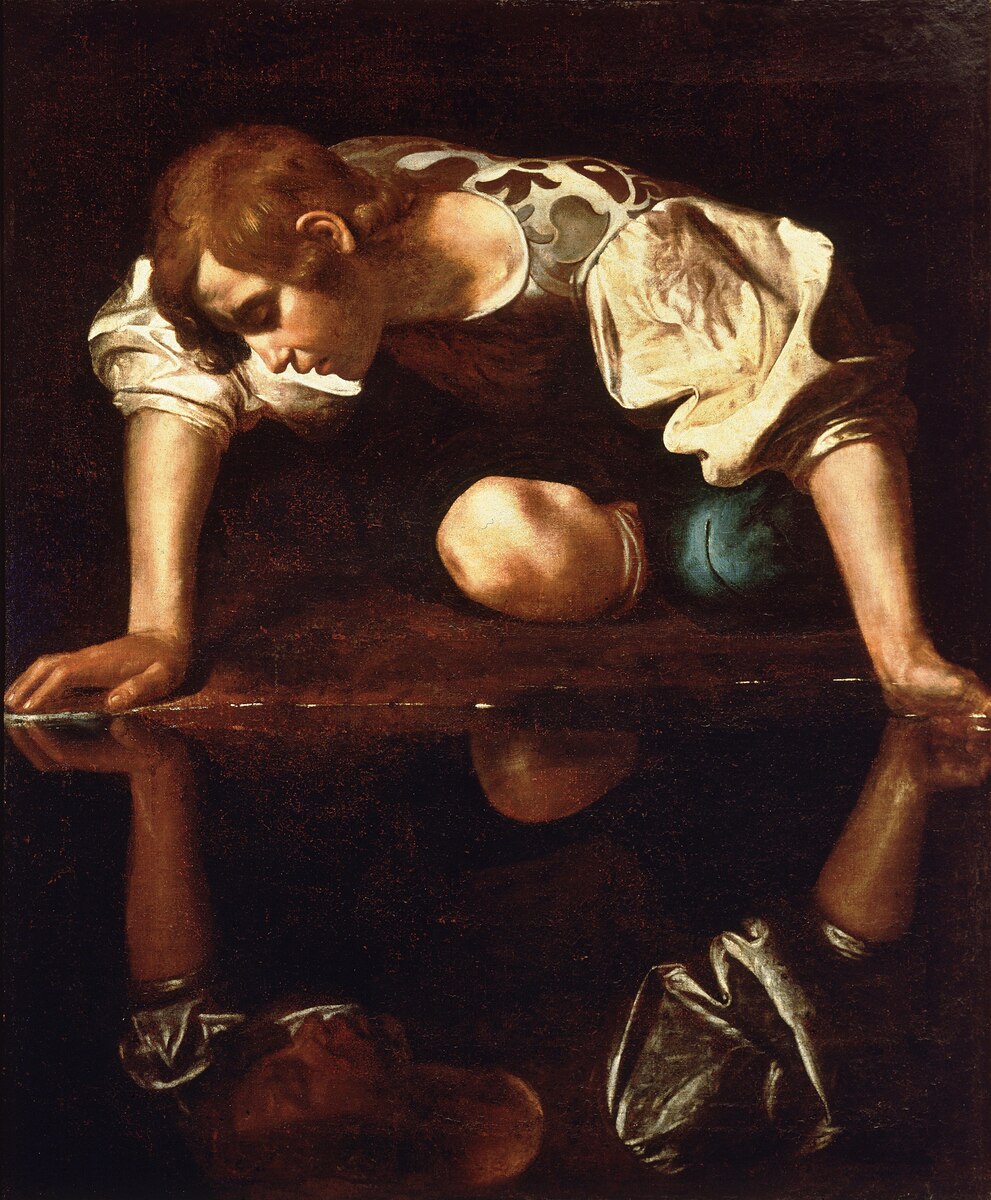
A mythological painting by Caravaggio, made around 1600, showing Narcissus fixed on his own reflection in a dark pool. The account draws on the supplied object record and stays close to what it supports, distinguishing the visible scene from documentable facts and curatorial interpretation.
Read the story ↓ About the artist ↓ Research and record ↓ Literature and sources ↓ Listen to the article ↓Your browser could not copy automatically. Select the research text below, then copy it.
Open the complete research text
The highest-resolution file we hold, available without payment or an account.3,840 × 4,649 pixels.
Download highest-resolution imageThe gilded white sleeve with dark foliate embroidery over the shoulder and the heavy gathered cuff on the extended arm, showing the costly dress that underlines the youth's noble beauty.
The sharply lit round knee emerging between the gathered white stocking and the blue-green breeches, marking the precarious kneeling pose that lowers him toward the water.
The boy's two hands, one at each side, press flat on the polished rim of the pool exactly at the horizontal waterline; the low leading hand and the long reaching arm define the physical barrier between body and reflection.
Your gallery guide
A mythological painting by Caravaggio, made around 1600, showing Narcissus fixed on his own reflection in a dark pool. The account draws on the supplied object record and stays close to what it supports, distinguishing the visible scene from documentable facts and curatorial interpretation.
Editorial review by Artifact Archive automated publishing
Explore the researchThe story About 4 minutes to read
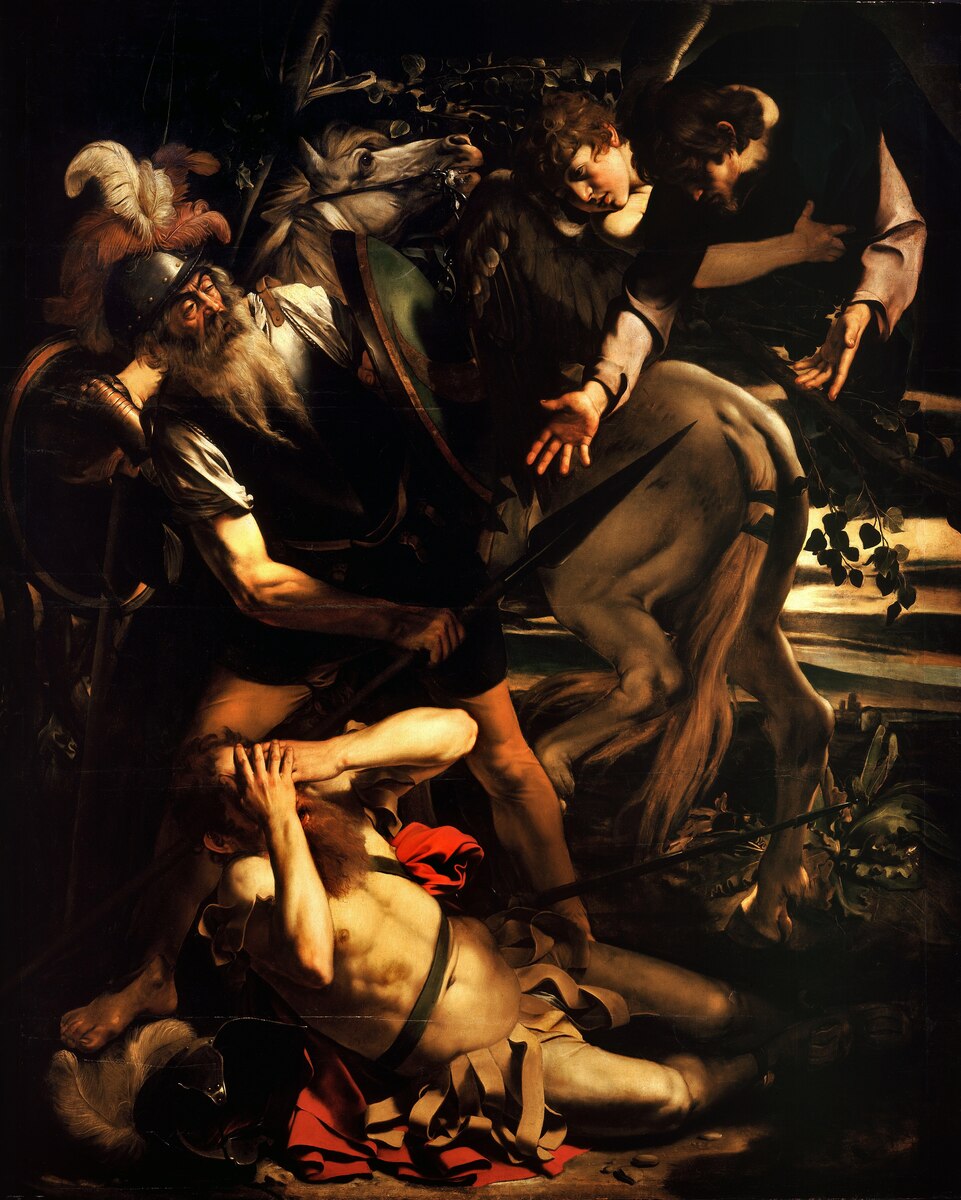
What you're looking at is a mythological painting by Caravaggio, made around 1600. It shows Narcissus, the figure from classical mythology who fell in love with his own reflection. Caravaggio gives us the youth bent over a dark pool, held there by his own mirrored face. The subject is that moment of self-absorbed fixation, the story the title names.
Look at how little the picture gives you. The pool takes up the lower half of the canvas, and the figure leans into it from the top, so the composition turns on a single downward gaze. The body folds over itself at the waist. One arm reaches toward the water, close to the reflected arm, so the real Narcissus and his reflection almost meet at the surface.
The light is narrow and strong. It picks out the knee, the shoulder, the back, and the forearm, then falls away into a deep brown darkness behind him. Against that darkness, the pale skin and the pale reflection are the brightest things in the painting. The effect is to make the two faces the whole event of the picture.
The medium itself is part of the point here. Oil and chiaroscuro, the strong contrast between light and dark, is what lets Caravaggio build a scene from so few elements. Chiaroscuro is worth naming plainly. It means modelling the picture with sharp shifts between lit areas and shadow, rather than filling the frame with evenly described detail.
We're secure about the basics. The painting is titled Narcissus, the artist is Caravaggio, and the date is around 1600, in the Baroque period. The genre is mythological painting, so the subject comes from classical story rather than from the Bible or from daily life, the two territories Caravaggio worked in constantly.
Notice what the composition does that a straightforward illustration wouldn't. The top and bottom of the canvas are not two separate figures; they are one shape folding back on itself. By arranging the reflection almost as a partner facing up, Caravaggio turns the myth into a closed circuit. The youth looks, and is looked at, by someone who is only himself.
That's the understanding to carry away. The painting isn't really about water or even about vanity as a lesson; it's about a gaze that has nowhere to travel because it always arrives back at the same face. The darkness around Narcissus isn't empty decoration. It seals the exchange in, so the only two figures in the picture are the youth and his own reflection.
Editorial review by Artifact Archive automated publishing.
Historical claims are linked to the records below. Close looking and interpretation are identified in the passage notes.
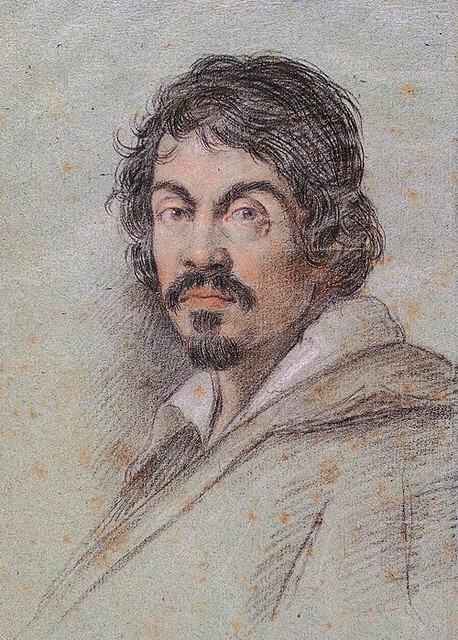
Ottavio Leoni. Image source · Public domain
About the artist
1571 to 1610
Caravaggio was an Italian painter (1571–1610). Their work is associated with Baroque; Counter-Reformation. Their recorded places of work include Rome; Zagarolo; Naples; Valletta; Syracuse; Genoa; Messina; Milan; Palermo; Paliano.
The research & record
Find catalogue details, historical context, technical research and the literature behind this artwork.
Your browser could not copy automatically. Select the research text below, then copy it.
Open the complete research textThe artwork record
Catalogue information and detailed research, with references that link to the bibliography.
Updated .
The painting is catalogued as Narcissus, a title that circulates in several language variants. The same reference gives the alternatives Narciso, Narcisse, Narziss, Narcis and Narcissuss, so the names under which the work is known vary with the language of the catalogue or the institution doing the listing rather than marking distinct objects or versions. The subject is taken from classical mythology: Narcissus is the figure who fell in love with his own reflection. That subject matter places the picture in the genre of mythological painting, as distinct from the devotional and everyday subjects that also occupied its author. The work carries the Wikidata authority identifier Q746716, a modern control number that links the painting's catalogue entry to structured data across collections and reference systems, and it is one of the identifiers by which the object can be traced independently of any single publication.(Wikimedia Commons: Narcissus, n.d., Title; Genre; Title, Genre; Authority file)
The artist is Caravaggio, born Michelangelo Merisi da Caravaggio, whose documented activity runs from 1593 to 1610. The catalogue date is circa 1600, which places the painting near the turn of the seventeenth century and within the period usually described as the Baroque. Two qualifications belong together here. First, the date is approximate as given, so the catalogue establishes a moment rather than a fixed year of execution. Second, the artist's activity span is a range for the whole career, not a date for this canvas; the career range is broader than the painting's own approximate date, and the two should not be conflated. Nothing in the supplied record assigns the picture to a specific month, commission or patron.(Wikimedia Commons: Narcissus, n.d., Artist; Date)
The canvas measures 110 centimetres in height and 92 cm in width, a vertical format slightly taller than it is wide. The recorded medium is oil and chiaroscuro on canvas, so the support is cloth rather than panel and the paint is oil. In the catalogue entry, chiaroscuro appears alongside the medium as a description of the handling, naming the strong modelling of forms through sharply contrasted light and shadow. Read together, the support, the paint and the tonal method describe both the physical object and the manner in which its image is built up. The entry does not record a frame, an inscription, a signature or a date painted on the work itself, and no such inscription is supplied in this evidence.(Wikimedia Commons: Narcissus, n.d., Dimensions)
The painting's title is Narcissus (also known as Narciso, Narcisse, Narziss, Narcis, Narcissuss).(Wikimedia Commons: Narcissus, n.d.)
The artist is Caravaggio (Michelangelo Merisi da Caravaggio), active 1593–1610.(Wikimedia Commons: Narcissus, n.d.)
The date is circa 1600.(Wikimedia Commons: Narcissus, n.d.)
The dimensions are 110 cm in height and 92 cm in width.(Wikimedia Commons: Narcissus, n.d.)
The genre is mythological painting.(Wikimedia Commons: Narcissus, n.d.)
The painting depicts Narcissus, a figure from classical mythology who fell in love with his own reflection.(Wikimedia Commons: Narcissus, n.d.)
The painting has a Wikidata identifier Q746716.(Wikimedia Commons: Narcissus, n.d.)
The material record for Caravaggio's Narcissus is thin but exact. The Wikimedia Commons file record supplies the medium as oil and chiaroscuro on canvas, a formulation that names both the physical paint system and the tonal method that the canvas carries. The dimensions are recorded as 110 cm in height and 92 cm in width, a vertically oriented support that is taller than it is wide. The same source gives the date as circa 1600 and the artist as Caravaggio, active 1593 to 1610, and classifies the work as a mythological painting. What the written record establishes, then, is a canvas of oil paint, deliberately modelled through strong contrast between light and dark, executed at the turn of the seventeenth century and sized so that its composition could be organized around a single vertical axis. The evidence does not specify the ground, the priming, the weave or weight of the canvas, the binding medium, or any individual pigment, and no technical analysis is cited in the supplied units. Claims about layered preparation, drying times, brush type or workshop procedure therefore cannot be carried by this record and are left out here.(Wikimedia Commons: Narcissus, n.d., Medium)
Interpretation
Within the larger history of European painting, the choice of canvas rather than wood panel belongs to a period in which portable, large-format oil painting on cloth was becoming a normal support for ambitious figure subjects, and Caravaggio's practice is one of the best-known examples of that shift. The supplied evidence does not itself compare this canvas with panel supports of the same date, nor does it identify the maker of the canvas or the type of cloth, so the comparison must remain a matter of broad context rather than a documented statement about this particular object. What can be stated from the record is the combination: oil as the painting medium, chiaroscuro as the working method, canvas as the support, and a height and width that together produce a tall rectangular field. This combination matters because it in part determines what the image can do. A tonally driven oil picture on a tall canvas allows the painter to build a figure from a limited number of lit passages against dark ground, rather than describing every surface in even detail.(Wikimedia Commons: Narcissus, n.d., Medium)
The same source record notes that chiaroscuro is part of the medium as described, not a separate layer added afterwards. Read literally, the record treats the extreme play of light and shadow as a defining technical characteristic of the picture, alongside the oil paint that makes such modelling possible. The evidence for this description comes from a Wikimedia Commons file page, which itself is a secondary repository entry rather than a conservation report or a scientific examination. It is therefore strong evidence for how the work is catalogued and described, and for the medium and dimensions of the object, but it is not a substitute for direct technical analysis of the paint surface. Distinguishing the two is important: that the picture is oil on canvas and that it is described through chiaroscuro are documented in the record; how the layers were built up, in what order, and with which materials, is not documented here at all.(Wikimedia Commons: Narcissus, n.d., Medium)
Interpretation
The image used for this research is described in the source as a self-scanned reproduction of the painting, released into the public domain as a faithful photographic reproduction of a two-dimensional public domain work of art. That provenance matters for any claim about colour, surface or brushwork drawn from the reproduction. A photograph, even a careful one, is an intermediary: it records the appearance of the painting under particular lighting and camera conditions, not the physical layers of the object. Nothing in the supplied evidence describes the conditions of photography, any colour target, or any post-processing applied to the scan. Descriptions of tone, value or the fall of light drawn from the image are therefore visual inferences from a reproduction, and they should be separated from the documented facts of oil, canvas, chiaroscuro and dimensions.(Wikimedia Commons: Narcissus, n.d., Medium)
The medium is oil and chiaroscuro on canvas.(Wikimedia Commons: Narcissus, n.d.)
The provenance record for this painting rests almost entirely on institutional and bibliographic documentation rather than on a documented sequence of owners. The only evidence unit supplied for the provenance section is the file description for the reproduction used in this research: the image is a self-scanned reproduction of the painting, released into the public domain as a faithful photographic reproduction of a two-dimensional public domain work of art. That statement concerns the status and origin of the digital file, not the ownership history of the canvas, and it implies a two-dimensional original but records no chain of custody, transfer, sale, dealer, price, inventory number or date of acquisition. Any account of how the painting moved from the artist's hands to a public collection therefore falls in an unrecorded interval, and the evidence does not permit that interval to be filled in or mistaken for a proven change of ownership.(Wikimedia Commons: Narcissus, n.d., Source/Photographer, Permission)
The image used for this research is a self-scanned reproduction of the painting, released into the public domain as a faithful photographic reproduction of a two-dimensional public domain work of art.(Wikimedia Commons: Narcissus, n.d.)
The painting was exhibited in the exhibition 'Caravaggio and Bernini' at the Rijksmuseum, Amsterdam, from 14 February 2020 to 13 September 2020.(Wikimedia Commons: Narcissus, n.d.)
Documented exhibition history records a loan of Narcissus to the exhibition 'Caravaggio and Bernini' at the Rijksmuseum, Amsterdam, running from 14 February 2020 to 13 September 2020. The pairing in that exhibition title places the work in a comparative context with Bernini, a framing that extends the painting's reception beyond monographic treatments of Caravaggio alone. The same exhibition history stands as the supplied evidence for a documented public display of the picture outside its Roman collection setting.(Wikimedia Commons: Narcissus, n.d., Exhibition history)
Narcissus also circulates in reference and popular literature. It is discussed in '1001 Paintings You Must See Before You Die' on page 203, a venue that casts the picture within a canon of must-see works and addresses a general readership rather than a specialist one. Alongside that populist listing, the picture is referenced in 'Art in the Christian Tradition' with ID 58435 and in the Web Gallery of Art with work ID c/caravagg/03/21narcis, two reference resources that index it for scholarly and educational retrieval. The difference in address is significant: one reference frames the painting as a destination for viewers, while the others frame it as an object to be located, cited and studied.(Wikimedia Commons: Narcissus, n.d., References)
The painting's standing in the specialist literature is attested by its inclusion in several Caravaggio catalogue raisonnés: Ottino Della Chiesa (1967), Cinotti (1991), Schütze (2009) and Vodret (2010). Cataloguing across four such publications, issued over more than four decades, shows repeated scholarly attention to the work and successive stages of documentation rather than a single decisive act of authentication. Each of these catalogues belongs to a distinct generation of Caravaggio scholarship, and the sequence of dates itself records how the picture has been revisited and re-entered into the scholarly record over time.(Wikimedia Commons: Narcissus, n.d., File usage on Commons)
Interpretation
Taken together, these reception records mark a trajectory in which Narcissus moves between several frames at once: an object in a Roman national collection, a loan in a 2020 Rijksmuseum exhibition, an entry in mass-market canons and online reference projects, and a repeatedly catalogued work in the Caravaggio literature. The evidence supplied does not establish one dramatic event as the source of the painting's renown, but rather an accumulation of cataloguing, exhibition, reproduction and reference that has kept the picture in view. It also does not document the painting's original function or first setting, so the later cultural roles recorded here should be kept distinct from whatever purpose the canvas served when it was made.(Wikimedia Commons: Narcissus, n.d., Exhibition history; References; File usage on Commons; Source/Photographer, Permission)
The painting is discussed in the book '1001 Paintings You Must See Before You Die' on page 203.(Wikimedia Commons: Narcissus, n.d.)
The painting has been catalogued in several Caravaggio catalogue raisonnés: Ottino Della Chiesa (1967), Cinotti (1991), Schütze (2009), and Vodret (2010).(Wikimedia Commons: Narcissus, n.d.)
The painting is referenced in 'Art in the Christian Tradition' with ID 58435, and in the Web Gallery of Art with work ID c/caravagg/03/21narcis.(Wikimedia Commons: Narcissus, n.d.)
Caravaggio's Narcissus belongs to the collection of the Galleria Nazionale d'Arte Antica, the Roman national gallery founded in 1893 and occupying two historic sites, Palazzo Barberini and Palazzo Corsini. Published accounts of the work locate it specifically at Palazzo Barberini in Rome, one of the two buildings that together house the institution's holdings. The collection data thus place the painting within a public national museum whose identity is bound to those two palace complexes rather than to a single building, while the more specific attribution to Palazzo Barberini records where the work is seen within that divided institution.(Wikimedia Commons: Narcissus, n.d., Collection)
Interpretation
Read together, the two collection statements are complementary rather than conflicting: both identify the Galleria Nazionale d'Arte Antica as the holding institution, and the account naming Palazzo Barberini supplies the particular site, while the account of the gallery's 1893 foundation and its two locations supplies the institutional frame. Both statements come from the same Wikimedia Commons file page for the painting, which is recorded as only partially consulted, so the collection information rests on that page's cataloguing rather than on a fully examined museum record. Because that page is a reproduction source rather than the museum's own documentation, the collection facts should be understood as reported by that catalogue entry, with the physical site at Palazzo Barberini established by the same source that establishes the gallery's broader two-palace structure.(Wikimedia Commons: Narcissus, n.d., Collection)
The painting is in the collection of the Galleria Nazionale d'Arte Antica, housed at Palazzo Barberini, Rome, Italy.(Wikimedia Commons: Narcissus, n.d.)
The painting is part of the collection of the Galleria Nazionale d'Arte Antica, which was founded in 1893 and is located at Palazzo Barberini and Palazzo Corsini, Rome.(Wikimedia Commons: Narcissus, n.d.)
Interpretation
The Wikimedia Commons file page for Caravaggio's Narcissus supplies the object's baseline identification and physical record, and the working insurance calculation in this section depends on exactly that record. The source names the artist as Caravaggio, that is Michelangelo Merisi da Caravaggio, active between 1593 and 1610, and gives the title as Narcissus, also rendered Narciso, Narcisse, Narziss, Narcis and Narcissuss. The date is put at circa 1600, the period is the Baroque, and the genre is mythological painting: the subject is the classical figure Narcissus, who fell in love with his own reflection. The medium is recorded as oil and chiaroscuro on canvas, and the dimensions as 110 centimetres in height by 92 centimetres in width. The painting is held by the Galleria Nazionale d'Arte Antica, the collection founded in 1893 and housed at Palazzo Barberini and Palazzo Corsini in Rome, with this canvas at Palazzo Barberini. The same record notes that the image used for this research is a self-scanned reproduction released into the public domain as a faithful photographic reproduction of a two-dimensional public domain work of art, which matters because it identifies the reproduction basis rather than a direct examination of the canvas. Identifier infrastructure is also recorded: a Wikidata identifier Q746716, a reference in Art in the Christian Tradition with ID 58435, and a Web Gallery of Art work ID of c/caravagg/03/21narcis.(Wikimedia Commons: Narcissus, n.d.)
The supplied record establishes a reception and literature footprint in addition to the object's physical facts. The painting was exhibited in the exhibition Caravaggio and Bernini at the Rijksmuseum, Amsterdam, from 14 February 2020 to 13 September 2020, which is the only exhibition history present in the evidence. It is also discussed in the book 1001 Paintings You Must See Before You Die on page 203, and it has been catalogued in several Caravaggio catalogue raisonnés: Ottino Della Chiesa in 1967, Cinotti in 1991, Schütze in 2009 and Vodret in 2010. Those four catalogues are the scholarly apparatus through which the attribution has been transmitted, and naming them separately records that the attribution rests on a sequence of cataloguing acts rather than on a single statement. Because the file page is recorded as only partially consulted, the evidence here is the locator and reference set rather than the full catalogue entries, so the specific arguments made in those volumes cannot be reconstructed from what was supplied.(Wikimedia Commons: Narcissus, n.d.)
The valuation unit is an interpretation, not a transaction record. It records a calculated working insurance estimate with an estimated value of US$80M to US$300M, under a recorded date described as a working calculation generated on 2026-10-16. The methodology is stated plainly: a broad conservative working insurance range calculated for manual review, derived from a model-based order-of-magnitude bracket for a museum-quality Old Master painting of this artist, period, medium and scale. The stated basis for that bracket is the confirmed high-confidence identification of a large-scale 110 by 92 cm Baroque oil on canvas by Caravaggio, dated circa 1600, held in the Galleria Nazionale d'Arte Antica at Palazzo Barberini, Rome, together with the exhibition history confirmed by the excerpt, meaning the Caravaggio and Bernini exhibition at the Rijksmuseum in 2020. The bracket was inferred only from the supplied institutional record and public-domain reproduction context, not from any market evidence about this canvas.(Wikimedia Commons: Narcissus, n.d.)
The qualifications attached to the figure are as consequential as the figure itself. The excerpt states that no confirmed sale, auction, appraisal or official insurance figure is present in the supplied excerpts, which is why the range is intentionally wide and conservative, and why the unit insists it must be reviewed manually against institutional records and qualified professional counsel. The unit further states that it is a model-generated working range for manual review only; that it is not an official insurance value, not an appraisal, not an auction result and not a sale price; and that it is not based on confirmed comparable sales, private insurance records or a formal condition assessment. No public monetary figure for this artwork was supplied, and the unit adds that actual insurance requirements depend on confirmed valuation, provenance, condition, exhibition and loan history, and institutional policy, and should be set by a qualified appraiser or insurer. A wide two-part bracket bounded by those disclaimers should be treated as an order-of-magnitude working note whose only documented inputs are artist, title, approximate date, medium, dimensions, collection and the 2020 exhibition, not as an attributed market value.(Wikimedia Commons: Narcissus, n.d.)
Working estimate
Calculated working insurance estimate, not a sale price: Estimated value: US$80M to US$300M Recorded date: Working calculation, generated 2026-10-16. Methodology: Broad conservative working insurance range calculated for manual review. Basis: confirmed high-confidence identification of a large-scale (110 x 92 cm) Baroque oil on canvas by Caravaggio, dated circa 1600, held in the Galleria Nazionale d'Arte Antica (Palazzo Barberini), Rome. The range reflects a model-derived order-of-magnitude bracket for a museum-quality Old Master painting of this artist, period, medium, and scale, inferred only from the supplied institutional record and public-domain reproduction context. The excerpt confirms artist, title, date, medium, dimensions, collection, and exhibition history (Caravaggio and Bernini, Rijksmuseum, 2020). No confirmed sale, auction, appraisal, or official insurance figure is present in the supplied excerpts, so the range is intentionally wide and conservative and must be reviewed manually against institutional records and qualified professional counsel. Qualification: This is a model-generated working range for manual review only. It is not an official insurance value, not an appraisal, not an auction result, and not a sale price. It is not based on confirmed comparable sales, private insurance records, or a formal condition assessment. No public monetary figure for this artwork was supplied. Actual insurance requirements depend on confirmed valuation, provenance, condition, exhibition and loan history, and institutional policy, and should be set by a qualified appraiser or insurer.(Wikimedia Commons: Narcissus, n.d.)
Bibliography
References are arranged by author or organisation, with links to the original publications. Where no publication date is recorded, n.d. means no date.
Source notes updated .
No recorded sources match these filters. Reset the filters to see the full bibliography.
Secondary · About this artwork
Wikimedia Commons: Narcissus (n.d.). Wikimedia Commons.
Wikimedia Commons file page for Caravaggio's Narcissus, providing title, artist, date, medium, dimensions, collection, exhibition history, and references.
Art to live with
A piece of the archive, made yours. Explore Narcissus in a size and finish that fits your space.
Choose your edition Combine this painting with your favourites
10 × 8 in / 25.4 × 20.3 cm · Standard

10 × 8 in / 25.4 × 20.3 cm · Standard

10 × 8 in / 25.4 × 20.3 cm · Standard

10 × 8 in / 25.4 × 20.3 cm · Standard
A gallery paper print with a smooth art-paper surface. Choose a size that suits the painting.
Choose size and finish
10 × 8 in / 25.4 × 20.3 cm · Black frame

10 × 8 in / 25.4 × 20.3 cm · Black frame

10 × 8 in / 25.4 × 20.3 cm · Black frame

10 × 8 in / 25.4 × 20.3 cm · Black frame

10 × 8 in / 25.4 × 20.3 cm · Black frame
A ready-to-hang wooden frame with a clear Perspex cover and a semi-gloss printed insert, made in the UK.
Choose size and finish


11oz · 2 image repeats
11oz · Standard


11oz · 2 image repeats


11oz · 2 image repeats


11oz · 2 image repeats


11oz · 2 image repeats


11oz · 2 image repeats
An 11oz white ceramic mug with AAA+ ORCA coating and a C-shaped handle. Dishwasher and microwave safe, printed and dispatched in the UK.
Choose size and finish
15 × 16.5 in / 38 × 42 cm · Black

15 × 16.5 in / 38 × 42 cm · Black

15 × 16.5 in / 38 × 42 cm · Black

15 × 16.5 in / 38 × 42 cm · Black

15 × 16.5 in / 38 × 42 cm · Black

15 × 16.5 in / 38 × 42 cm · Black
A cotton tote with reinforced handles and artwork on the front, printed and dispatched in the UK.
Choose size and finish
8.7 × 8.7 in / 22 × 22 cm · Standard

8.7 × 8.7 in / 22 × 22 cm · Standard

8.7 × 8.7 in / 22 × 22 cm · Standard
A rectangular PU leather mouse mat with a non-slip base, printed locally for your delivery country.
Choose size and finish
A5 · Glossy cover · Lined pages

A5 · Glossy cover · Lined pages

A5 · Glossy cover · Lined pages

A5 · Glossy cover · Lined pages

A5 · Glossy cover · Lined pages

A5 · Glossy cover · Lined pages
An A5 notebook with 150 lined pages, a glossy laminated front cover carrying your artwork, black wire-o binding and a white back cover.
Choose size and finish