Identity and catalogue
Link- Artist or attribution
- Albert Bierstadt
- Object date
- 1868
- Medium and support
- Oil on canvas
- Dimensions
- 180 cm × 305.12 cm (72 in × 120 1/8 in)
- Movement or period
- Hudson River School
- Country or culture
- American
- Depicted subject
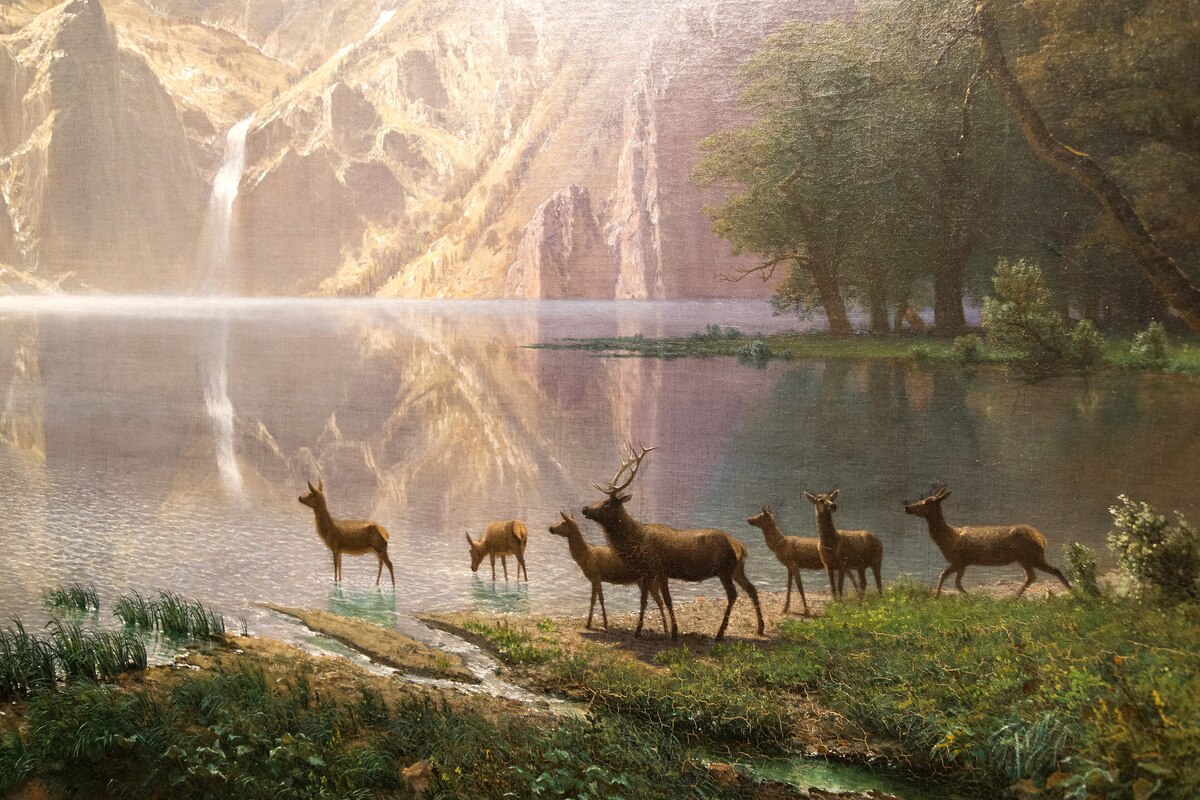
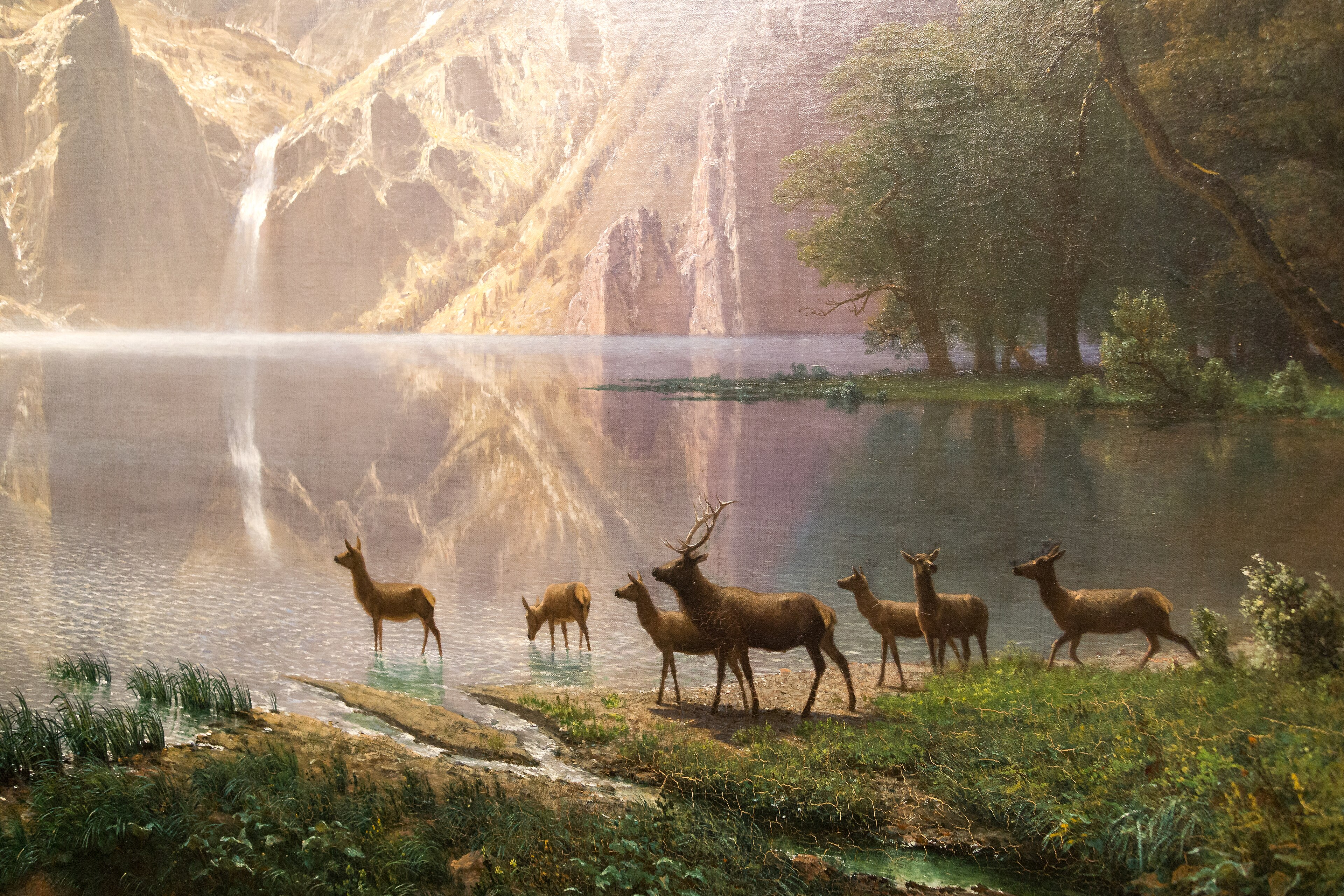
- An 1868 oil landscape depicting a Sierra Nevada mountain scene with rugged cliffs, a calm lake, elk and waterfowl at the water's edge, and sun rays breaking through clouds. Painted in Rome four years after Bierstadt's 1863 journey to the Sierra Nevada.(Wikipedia fallback: Among the Sierra Nevada, California, n.d.)
- Title variants
- Among the Sierra Nevada Mountains
- Support
- canvas
Catalogue identity and the date of making
The catalogue identity of this work is compact but consequential: Among the Sierra Nevada, California is recorded as an 1868 oil-on-canvas painting by Albert Bierstadt, identified in the metadata as a German-American artist. Every qualifying term in that sentence does work. The date 1868 attaches to the finished object, while the evidence separately establishes that the painting was created in Bierstadt's studio in Rome in the winter of 1867 to 1868. The object date and the period of making are therefore not identical, and the Rome studio location matters because it places the execution of a California subject in Europe, at a remove from the landscape depicted. The medium, oil on canvas, and the identification of the author are the kind of core catalogue facts that later interpretation, however elaborate, cannot displace: whatever the painting means or was used for, the archive's baseline is an 1868 oil by Bierstadt on canvas.(Wikipedia fallback: Among the Sierra Nevada, California, n.d., Infobox; Description)
Frame, conservation and the object's scale
Interpretation
The evidence allows a synthesis of what this object is, provided the different kinds of claim are kept distinct. As documented catalogue fact, it is an 1868 oil on canvas by Bierstadt. As documented circumstance, it was painted in Rome in the winter of 1867 to 1868, four years after a journey to the Sierra Nevada on which the artist may have seen what he later depicted. As documented reception, it was shown in London, Berlin, Paris, Moscow and Saint Petersburg, earning a gold medal in Berlin, and was associated with promotional practices attributed to the artist. As documented provenance, it moved from Bierstadt to Adams in 1869, to Dinsmore in 1873, down the family to Hull, onto a wall after 1941, and to the Smithsonian as a bequest after her death in 1976. As documented conservation, it was retrieved with its disassembled frame, cleaned for about 600 hours, and remounted. The unresolved element is the precise relationship between the painted scene and any specific place or vantage point, which the evidence states only as a possibility. What the record firmly establishes is a picture whose identity was repeatedly remade by its settings, from Roman studio to European exhibition hall to Boston and Hudson Valley collections, to a private interior wall, and finally to a museum frame.(Wikipedia fallback: Among the Sierra Nevada, California, n.d., Infobox; Description; Background; Exhibition and provenance)
Subject and iconography
LinkWhat the painting shows
Visual observation
The recorded composition of the painting places rugged mountains on the left and in the background, rising toward a bright sky in which the Sun's rays break through clouds; below them lies a calm lake with a group of elk and waterfowl at its edge, and trees border the scene on the right. The description also notes a single trout in the water on the viewer's left, under the shadow of the rocks, visible only on very close viewing. This enumeration is the object's basic visual inventory as recorded in the supplied description, and it fixes the scene's components before any question of identification, convention or meaning is raised. The elements it names, mountains, sunlit sky, calm water, grazing and water-dwelling animals, and flanking trees, are what the visual evidence in these units establishes about the picture's contents; the description itself does not assign the scene to a specific identifiable place.(Wikipedia fallback: Among the Sierra Nevada, California, n.d., Description)
Scale, light and shadow
Interpretation
The scene's calm lake and small animals sit beneath towering rock faces, and sunlight falls across the water while dark shadows gather under the cliffs. The contrast between still water and monumental stone is what the description conveys as the scene's sense of vastness, and the elk and waterfowl are small but clear signs of life within it. The trout noted on the left, tucked under the rocks and legible only at close range, belongs to the same economy of scale: a detail the viewer must hunt for rather than a feature that announces itself. The relative sizes recorded in the description, monumental rock masses against small living creatures, are part of the visible evidence of the painting and not an inference from its title.(Wikipedia fallback: Among the Sierra Nevada, California, n.d., Description)
Visual observation
The painting depicts rugged mountains on the left and in the background reaching toward a bright sky with the Sun's rays peeking through the clouds, above a calm lake with a group of elk and waterfowl at its edge, bordered by trees on the right.(Wikipedia fallback: Among the Sierra Nevada, California, n.d.)
Creation in Rome and the Western Journeys
Albert Bierstadt made this painting in his studio in Rome during the winter of 1867 to 1868, four years after his 1863 journey to the Sierra Nevada. The Rome studio setting establishes the picture as a work of recollection and synthesis rather than an on-site record, and it places a California subject at the center of a European working practice. The supplied evidence dates the journey that may stand behind the imagery, and the dating of the studio execution, but it does not specify which sketches or studies, if any, were consulted in Rome, nor does it describe the studio's other occupants or assistants.(Wikipedia fallback: Among the Sierra Nevada, California, n.d., Description; Background)
The painter's biography underpins the subject. Bierstadt immigrated from Germany to New Bedford, Massachusetts, as an infant, later studied at the Düsseldorf Academy in Germany, and became part of the Hudson River School. That sequence matters for reading the painting because it joins European academic training to an American landscape movement, and it explains why a German-born, Düsseldorf-trained artist would treat the American West as a subject for a grand studio composition. The evidence establishes the training and affiliation; it does not detail what he studied at Düsseldorf or which Hudson River School figures he knew.(Wikipedia fallback: Among the Sierra Nevada, California, n.d., Background)
Bierstadt's access to the West came through sponsored travel. After the gold rush to California, he joined an 1859 survey expedition led by Frederick W. Lander to scout a railroad route across the Rockies, and over the following decade made several more sponsored trips, painting California scenes with the goal of attracting visitors and investors to the region. The evidence names Lander as expedition leader and gives the 1859 date, placing the artist within the survey culture that mapped and promoted western routes. The sponsorship structure and the promotional aim of the resulting paintings are documented; whether Bierstadt himself held investment interests in the region is not stated.(Wikipedia fallback: Among the Sierra Nevada, California, n.d., Background)
Visual observation
The specific western journey behind this subject is qualified in the evidence: it was on a journey to the Sierra Nevada in 1863 that Bierstadt may have seen what he later depicted. The word may is integral, since the evidence does not fix a site, a vantage point or a date within that journey. Combined with the Rome studio execution, this means the painting's relationship to the Sierra Nevada is one of possible visual experience filtered through later studio invention, not of verified transcription. The mountains, lake and wildlife belong to the picture's own constructed space, described in the supplied account as rugged mountains on the left and in the background reaching toward a bright sky with the Sun's rays peeking through the clouds, above a calm lake with a group of elk and waterfowl at its edge, bordered by trees on the right. That scene should be treated as the painting's content rather than as a surveyed location.(Wikipedia fallback: Among the Sierra Nevada, California, n.d., Background; Description)
Recovery, Conservation and Reframing
Interpretation
Read across the documented record, this painting is less a report of a place than an object engineered for movement and attention. It was painted in Rome in the winter of 1867 to 1868, four years after a Sierra Nevada journey on which the artist may have seen what he later depicted, and its subject was shaped by an 1859 survey expedition under Frederick W. Lander and a decade of sponsored western travel aimed at drawing visitors and investors to California. Bierstadt's Düsseldorf training and Hudson River School affiliation gave that project its pictorial language, while his demonstrated practice of planting newspaper stories and selling tickets to unveilings tied the picture to a commercial audience. Its subsequent life, from a Boston collector to a Dutchess County villa to a wall in a rebuilt house to a Smithsonian bequest and a conservation campaign, shows how rapidly a grand landscape could be reclassified as decoration and then recovered as a framed work. The evidence supports this reading of circulation, promotion and changing function; it does not settle the painting's precise relationship to any identifiable Sierra Nevada site, and it leaves the artist's private intentions to inference.(Wikipedia fallback: Among the Sierra Nevada, California, n.d., Description; Background; Exhibition and provenance)
The painting was created in Bierstadt's studio in Rome in the winter of 1867 to 1868, four years after his 1863 trip to the Sierra Nevada.(Wikipedia fallback: Among the Sierra Nevada, California, n.d.)
Albert Bierstadt immigrated from Germany to New Bedford, Massachusetts, as an infant, later studied at the Düsseldorf Academy in Germany, and became part of the Hudson River School.(Wikipedia fallback: Among the Sierra Nevada, California, n.d.)
After the gold rush to California, Bierstadt joined an 1859 survey expedition led by Frederick W. Lander to scout a railroad route across the Rockies, and over the following decade made several more sponsored trips, painting California scenes with the goal of attracting visitors and investors to the region.(Wikipedia fallback: Among the Sierra Nevada, California, n.d.)
It was on a journey to the Sierra Nevada in 1863 that Bierstadt may have seen what he later depicted in Among the Sierra Nevada.(Wikipedia fallback: Among the Sierra Nevada, California, n.d.)
Materials and technique
LinkSupport, medium and scale
Among the Sierra Nevada, California is an 1868 oil-on-canvas painting by the German-American artist Albert Bierstadt, today a centerpiece of the nineteenth-century landscape collection at the Smithsonian American Art Museum in Washington, D.C., where it was placed in 1985. The documented medium and support, oil on canvas, frame the technical questions this section addresses: how the canvas was prepared and later mounted, what the painted surface contains, and how the physical object was altered and recovered across more than a century. The painting's scale and its elaborate original frame establish that it was conceived as an exhibition machine, not a private sketch, and the evidence for its making and treatment is correspondingly public and institutional.(Wikipedia fallback: Among the Sierra Nevada, California, n.d., Description)
The painting's monumental format is fixed by its elaborate original frame, which measures 96 1/4 by 144 3/8 by 7 1/4 inches, that is 244 by 367 by 18 centimeters. Because the frame is documented as original and was recovered with the canvas, its dimensions are the most concrete surviving measurement of the work as Bierstadt presented it. The depth of 18 centimeters indicates a deep, projecting construction rather than a simple molding, which is consistent with the account that describes the frame as ornate and gilded. The frame is therefore not an accessory but part of the documented fabric of the object, and its survival is what allows the painting to be discussed as a single constructed ensemble of canvas, paint and carved, gilded wood.(Wikipedia fallback: Among the Sierra Nevada, California, n.d., Description)
The painted surface and its observed details
Interpretation
The documented making history is that the painting was created in Bierstadt's studio in Rome in the winter of 1867 to 1868, four years after his 1863 trip to the Sierra Nevada, and that it was on that 1863 journey that he may have seen what he later depicted. The word may is important: the evidence does not establish that he stood at the exact site shown. What it does establish is a studio method, working from sketches and memory rather than on the spot, which is the central technical fact about the picture's making. It also means the visible mountain forms, water and animals cannot be read as a transcript of a specific view; they are a composed scene assembled at a distance from the terrain. The painting's materials belong to that studio context in Rome, not to a field campaign in California.(Wikipedia fallback: Among the Sierra Nevada, California, n.d., Description)
Alteration and conservation
Hull died in 1976, leaving the painting as a bequest to the Smithsonian Institution. Smithsonian curator William Truettner retrieved the painting from Hull's house and found the original ornate gilded frame, in four pieces but in good condition, in a barn on the property. The condition report embedded in this account is specific and limited: the frame was disassembled into four pieces but otherwise sound, while the painting itself had been adhered to a wall. Conservators then spent about 600 hours cleaning the painting, including removing glue from the back of the canvas, before remounting it on the original frame. The treatment therefore addressed both the recto and the verso of the canvas, and the remounting reconstituted the canvas, paint and gilded frame as the single object Bierstadt had presented.(Wikipedia fallback: Among the Sierra Nevada, California, n.d., Exhibition and provenance; Description)
Interpretation
Taken together, the evidence separates three kinds of knowledge about this object's materials. The frame dimensions and the canvas medium are documented facts. The cleaning, glue removal and remounting are recorded conservation actions, with an approximate duration rather than a full treatment report. The appearance of the sky, water, rocks, animals and the small hidden trout is visual observation, useful for describing what the painted surface does but not proof of pigment, binding medium, ground or application technique. Distinguishing these categories is not pedantic here: because the source of the description is a general object account rather than a technical examination, no pigment analysis, canvas weave identification or layer build-up can be asserted, and the account should say so.(Wikipedia fallback: Among the Sierra Nevada, California, n.d., Description; Exhibition and provenance)
Condition and conservation
LinkConservation history
The condition record for Albert Bierstadt's Among the Sierra Nevada, California begins with the dispersal of the object's physical components rather than with the painted surface itself. According to the supplied account, after Helen Huntington Hull died in 1976 and left the painting as a bequest to the Smithsonian Institution, curator William Truettner retrieved the painting from Hull's house. At that time he found the original ornate gilded frame in a barn on the property. The frame was in four pieces but was described as being in good condition despite its separate storage. This initial finding establishes a key fact for any condition assessment: the painting and its frame had become physically separated, and the frame survived in a disassembled but recoverable state.(Wikipedia fallback: Among the Sierra Nevada, California, n.d., Exhibition and provenance)
The documented conservation intervention that followed the 1976 bequest is the most substantial treatment recorded in the evidence. Conservators spent about 600 hours cleaning the painting, a figure that indicates a prolonged and labor-intensive campaign rather than a routine surface cleaning. That work included removing glue from the back of the canvas, an operation made necessary by the 1941 mounting. After cleaning, the painting was remounted on the original frame. The account does not specify which solvents, mechanical methods or adhesives were used in the cleaning, nor does it record whether the canvas required lining, consolidation or inpainting. It also does not date the treatment precisely beyond its occurrence after Truettner's retrieval. The 600-hour figure and the glue removal are the only treatment specifics the evidence establishes.(Wikipedia fallback: Among the Sierra Nevada, California, n.d., Exhibition and provenance)
The decision to remount the painting on the original frame is significant because the frame itself is documented as an elaborate object in its own right. The frame measures 96 1/4 by 144 3/8 by 7 1/4 inches (244 by 367 by 18 cm), dimensions that describe a substantial architectural surround rather than a simple border. The frame's survival in four pieces but in good condition meant that the museum could reunite painting and frame as a single ensemble. The evidence does not record whether the frame received its own conservation treatment, such as gilding restoration or structural repair, before the painting was remounted. What is established is that the original frame was recovered, retained and reused, so that the work's presentation today depends on a frame that was never documented as lost or replaced.(Wikipedia fallback: Among the Sierra Nevada, California, n.d., Description; Exhibition and provenance)
Interpretation
What the conservation record shows, taken together, is a sequence of physical states rather than a single static condition. The painting was created and first exhibited as a framed oil painting. It was later removed from its frame and glued to a wall in a private house, a condition in which the canvas functioned as interior decoration rather than as a transportable easel painting. After the 1976 bequest it entered the Smithsonian, was retrieved together with its disassembled frame, underwent roughly 600 hours of cleaning including glue removal from the back, and was remounted on that frame. The evidence does not establish exactly when the glue was applied, whether the canvas was damaged during removal, or whether any later treatment has occurred since the remounting. The conservation account should therefore be read as a record of documented interventions, not as a continuous condition report covering the whole life of the object.(Wikipedia fallback: Among the Sierra Nevada, California, n.d., Exhibition and provenance)
Provenance and ownership
LinkFrom Studio to Boston
The documented ownership history of Among the Sierra Nevada, California begins with the artist himself. Albert Bierstadt, who had created the painting in his studio in Rome in the winter of 1867 to 1868, took it to the United States in 1869 and sold it to Alvin Adams, an art collector in Boston. Adams was not a casual purchaser of Bierstadt's work: the evidence records that he had also owned another Bierstadt painting, Lake Lucerne of 1858. That earlier ownership is the only detail the sources give about Adams's collecting habits, but it establishes that the 1869 sale placed the canvas with a buyer already familiar with the artist's European subjects, not merely with his western ones. The movement of the painting from a Roman studio to a Boston collection also came after its first showing in London in the summer following its creation, and after the artist had exhibited it in several European cities, so the American sale was the culmination of a deliberate campaign rather than an isolated transaction. The evidence does not record the price Adams paid, the terms of the sale, or whether any intermediary was involved, and no document is cited for the period between the London exhibition and the 1869 transfer.(Wikipedia fallback: Among the Sierra Nevada, California, n.d., Exhibition and provenance; Description)
The Dinsmore Villa
In 1873 the painting was acquired by William Brown Dinsmore (1810 to 1888), a businessman who wanted it for his country villa, Locusts on Hudson, in Dutchess County, New York. This transfer, four years after the Adams sale and five years after the painting's creation, marks its move from a Boston collection into a Hudson Valley estate, where it remained for generations. The evidence identifies the buyer by name, dates and occupation and names the house for which the work was intended, which distinguishes this acquisition from a speculative purchase: the painting was bought for a specific domestic setting. What the evidence does not supply is the channel of the 1873 acquisition, whether by direct purchase from Adams, through a dealer, or by some other means, nor any price. Dinsmore's dates frame the period of ownership: born in 1810, he died in 1888, and the painting then passed down within the family rather than appearing on the market again. The account of the villa's later fate shows how long that family tenure lasted. After Locusts on Hudson was demolished and a new home was built on the property in 1941, Dinsmore's great-granddaughter, Helen Huntington Hull, had the painting removed from its frame and glued to an interior wall as part of the interior decoration. The generational distance between Dinsmore and Hull is stated directly, and the 1941 demolition and rebuilding provide the date after which the painting's condition and display changed materially.(Wikipedia fallback: Among the Sierra Nevada, California, n.d., Exhibition and provenance)
Bequest and Recovery
Helen Huntington Hull died in 1976, leaving the painting as a bequest to the Smithsonian Institution, and the bequest is the last transfer the evidence records. The circumstances of the painting's condition at that point are documented through the recovery: Smithsonian curator William Truettner retrieved the painting from Hull's house and found the original ornate gilded frame, in four pieces but in good condition, in a barn on the property. The frame is described and measured as 96 1/4 by 144 3/8 by 7 1/4 inches (244 by 367 by 18 cm), which makes it an elaborate surround for a very large canvas and confirms that the work had originally been presented in a substantial carved and gilded setting before its years as wall decoration. Conservation followed: conservators spent about 600 hours cleaning the painting, including removing glue from the back of the canvas, before remounting it on the original frame. The six hundred hours and the treatment of the canvas verso are the only conservation figures given, and the account establishes that the glue applied in 1941 was reversed in the course of preparing the painting for renewed display. The Smithsonian installation is described elsewhere as its placement in the museum in 1985, which gives an end date for the process that began with Truettner's recovery.(Wikipedia fallback: Among the Sierra Nevada, California, n.d., Exhibition and provenance)
The painting passed down to Dinsmore's great-granddaughter, Helen Huntington Hull; after Locusts on Hudson was demolished and a new home was built on the property in 1941, she had the painting removed from its frame and glued to an interior wall as part of the interior decoration.(Wikipedia fallback: Among the Sierra Nevada, California, n.d.)
Provenance timeline
- winter of 1867 to 1868
The painting is created in Bierstadt's studio in Rome.(Wikipedia fallback: Among the Sierra Nevada, California, n.d., Description)
- 1869
Bierstadt takes the painting to the United States and sells it to Alvin Adams, an art collector in Boston.(Wikipedia fallback: Among the Sierra Nevada, California, n.d., Exhibition and provenance)
- 1873
The painting is acquired by William Brown Dinsmore for his country villa, Locusts on Hudson, in Dutchess County, New York.(Wikipedia fallback: Among the Sierra Nevada, California, n.d., Exhibition and provenance)
- 1941
After Locusts on Hudson is demolished and a new home is built on the property, Helen Huntington Hull, Dinsmore's great-granddaughter, has the painting removed from its frame and glued to an interior wall as interior decoration.(Wikipedia fallback: Among the Sierra Nevada, California, n.d., Exhibition and provenance)
- 1976
Hull dies, leaving the painting as a bequest to the Smithsonian Institution.(Wikipedia fallback: Among the Sierra Nevada, California, n.d., Exhibition and provenance)
Exhibition history
The exhibition record for Albert Bierstadt's Among the Sierra Nevada, California begins in London, where the painting was shown in the summer following its creation, in the company of two other works by the artist. That first showing places the canvas in a European venue almost immediately after it left the studio, rather than holding it back for an American debut.(Wikipedia fallback: Among the Sierra Nevada, California, n.d., Exhibition and provenance)
From London the painting travelled to the Royal Academy in Berlin, where it earned a gold medal, and it was later exhibited in Paris, Moscow and Saint Petersburg. The two supplied statements describe these venues as an interconnected European tour rather than isolated appearances: the Berlin award is recorded in the same account that carries the painting on to Paris, Moscow and Saint Petersburg. Taken together they establish a sequence of publicly recognized showings across several European cities, but the evidence does not supply the years, catalogue numbers, page references, or the specific pictures shown alongside it at those venues.(Wikipedia fallback: Among the Sierra Nevada, California, n.d., Exhibition and provenance)
The European showings are connected in the evidence to a wider effect: the painting was exhibited throughout Europe, creating interest in immigration to the United States. This is an attributed claim rather than a measured outcome, and it sits alongside the documented account of Bierstadt as a consummate promoter of his own work, who presumably hoped to raise the price of the painting by exhibiting it around Europe, planted stories in newspapers, and sold tickets to his exhibitions, turning the unveiling of his work into a theatrical event. The promotional apparatus and the immigration interest attributed to the tour therefore belong to the same exhibition history, but the evidence presents the first as documented practice and the second as a reported consequence.(Wikipedia fallback: Among the Sierra Nevada, California, n.d., Exhibition and provenance; Lead)
Interpretation
Read together, the units show a single object passing through distinct phases: an initial London showing with two other works by the artist, a Berlin award followed by Paris, Moscow and Saint Petersburg, emigration to the United States in 1869, sale to Adams, acquisition by Dinsmore for Locusts on Hudson in 1873, removal from its frame and gluing to an interior wall after 1941, bequest to the Smithsonian on Hull's death in 1976, and conservation involving the recovery of the original gilded frame from a barn and about 600 hours of cleaning before remounting. What the evidence does not establish is equally important for the exhibition section: no catalogue numbers, page references, plate numbers, installation dates within each city, or gallery labels are supplied, and the reasons for the Berlin award and the later European stops are attributed to the promotional account rather than documented in the technical record. Interest in immigration to the United States is likewise a reported effect of the European exhibitions, not a measured result. The exhibition history of this painting is therefore best treated as a set of connected movements, documented in sequence, with a persistent gap between the public showings and the private and institutional life that followed them.(Wikipedia fallback: Among the Sierra Nevada, California, n.d., Exhibition and provenance; Lead)
Reception and literature
LinkEuropean Exhibition and Self-Promotion
The painting's public life began close to its making. It was first shown in London in the summer after its creation, together with two other works by the artist. It was then shown at the Royal Academy in Berlin, where it earned a gold medal, and was later exhibited in Paris, Moscow and Saint Petersburg. This sequence establishes a European tour rather than a single unveiling, and it places the Berlin recognition, a gold medal, as the documented high point of that circuit. The painting was exhibited throughout Europe, creating interest in immigration to the United States. That claim about immigration interest belongs to the supplied account and should be weighed as a reported cultural effect of the exhibitions rather than as a measured outcome. Behind the tour stood a deliberate promotional operation: Bierstadt was a consummate promoter of his own work and presumably hoped to raise the price of the painting by exhibiting it around Europe; he planted stories in newspapers and sold tickets to his exhibitions, turning the unveiling of his work into a theatrical event. The word presumably marks the price-raising motive as inference rather than documented intent, while the newspaper stories and ticketed exhibitions are stated as fact. Read together, the London debut, the Berlin medal and the further European showings describe reception that was manufactured as much as received: the artist controlled the conditions of viewing and the press surrounding it, so the admiration and imitation the work attracted cannot be separated from the machinery that produced its visibility.(Wikipedia fallback: Among the Sierra Nevada, California, n.d., Exhibition and provenance; Lead; Description)
Recovery, Conservation and Reinstallation
The condition in which the painting re-entered public view is part of its reception history. Smithsonian curator William Truettner retrieved the painting from Hull's house and found the original ornate gilded frame, in four pieces but in good condition, in a barn on the property. The frame's survival, disassembled and stored apart from the canvas, is what made a reunion possible. Conservators spent about 600 hours cleaning the painting, including removing glue from the back of the canvas, before remounting it on the original frame. The glue removal addresses the physical residue of the 1941 decision to adhere the canvas to a wall, so the conservation treatment can be understood as undoing a specific episode of domestic reuse as well as cleaning the surface. The elaborate original frame measures 96 1/4 by 144 3/8 by 7 1/4 inches (244 by 367 by 18 cm), dimensions that establish the intended scale of the framed object and underscore how much the painting's presentation depended on an elaborate gilded setting that was, for decades, absent. The documented labor of roughly 600 hours and the retrieval of the frame from a barn together describe a reception stage that is often invisible in accounts of fame: the curatorial and conservation work that reassembled the object so it could once again be seen as its maker first presented it.(Wikipedia fallback: Among the Sierra Nevada, California, n.d., Exhibition and provenance)
What the Image Carries Into Its Reception
Visual observation
Later readings of the painting depend on what the canvas actually shows, and the observed content is specific. The painting depicts rugged mountains on the left and in the background reaching toward a bright sky with the Sun's rays peeking through the clouds, above a calm lake with a group of elk and waterfowl at its edge, bordered by trees on the right. The composition thus sets monumental stone against still water, with the animals small within the scene, and the light breaking from above rather than falling evenly. On the viewer's left, in the water under the shadow of the rocks, there is a single trout, only visible when viewed very closely. That near-invisible detail matters for reception because it rewards close looking and suggests the canvas was built to sustain inspection as well as to impress from a distance, a quality consistent with a work designed for exhibition as a theatrical event. These are observations of the object as it is seen, not reports of what Bierstadt intended, and they should be kept distinct from the promotional and provenance claims. The painting was created in Bierstadt's studio in Rome in the winter of 1867 to 1868, four years after his 1863 trip to the Sierra Nevada, and it was on a journey to the Sierra Nevada in 1863 that Bierstadt may have seen what he later depicted in Among the Sierra Nevada. The may in that statement preserves uncertainty about direct observation. It was Albert Bierstadt who immigrated from Germany to New Bedford, Massachusetts, as an infant, later studied at the Düsseldorf Academy in Germany, and became part of the Hudson River School. After the gold rush to California, Bierstadt joined an 1859 survey expedition led by Frederick W. Lander to scout a railroad route across the Rockies, and over the following decade made several more sponsored trips, painting California scenes with the goal of attracting visitors and investors to the region. This background explains why the painting's European tour could be framed as a bid for attention on behalf of a western region: the artist's documented practice already joined landscape painting with the promotion of settlement and investment, so the exhibition strategy around this canvas was continuous with his wider campaign rather than an isolated stunt.(Wikipedia fallback: Among the Sierra Nevada, California, n.d., Description; Background; Lead; Exhibition and provenance)
Accumulated Meanings
Interpretation
The documented record shows meanings accumulating in layers rather than a single origin. In the winter of 1867 to 1868 the canvas was a studio product made in Rome, four years after the artist's 1863 western journey, and it was shown in London the following summer alongside two other works. It then earned a gold medal in Berlin and traveled to Paris, Moscow and Saint Petersburg, a sequence that converted a studio painting into a European exhibition object and, on the supplied account, an agent of interest in immigration to the United States. In 1869 it crossed to the United States and entered a Boston collection, then in 1873 a Hudson Valley villa, then family inheritance, then in 1941 an interior wall, and finally in 1976 a Smithsonian bequest. Each transition recoded the work: exhibition attraction, collector's prize, estate furnishing, architectural surface, museum object. Interpretively, the fame of this painting is best understood as the cumulative effect of these documented roles, sustained by an artist who managed his own publicity through planted newspaper stories and ticketed unveilings, rather than as the product of one dramatic moment. The evidence does not establish a single decisive event that made the work famous, and the promotional machinery, the medal, the successive owners and the eventual conservation each contributed a distinct chapter. Within a larger history of art and material culture, the painting is instructive precisely because its monumental scale and elaborate gilded frame, measuring 96 1/4 by 144 3/8 by 7 1/4 inches (244 by 367 by 18 cm), were once reduced to wall decoration and then recovered, showing how the cultural standing of a nineteenth-century landscape is negotiated through ownership, display and physical intervention over more than a century.(Wikipedia fallback: Among the Sierra Nevada, California, n.d., Description; Exhibition and provenance; Lead)
Bierstadt was a consummate promoter of his own work and presumably hoped to raise the price of the painting by exhibiting it around Europe; he planted stories in newspapers and sold tickets to his exhibitions, turning the unveiling of his work into a theatrical event.(Wikipedia fallback: Among the Sierra Nevada, California, n.d.)
Collection and display
LinkThe Painting and Its Place in the Smithsonian Collection
Among the Sierra Nevada, California is an 1868 oil-on-canvas painting by Albert Bierstadt, and it now serves as a centerpiece of the Smithsonian American Art Museum's 19th-century landscape collection in Washington, D.C. The museum placed the work in that collection in 1985, roughly nine years after it entered the Smithsonian through a bequest and nearly a century and a quarter after Bierstadt completed it. Its position as a centerpiece is not simply a curatorial preference; it reflects the painting's scale, its subject, and its documented exhibition history. Bierstadt was a German-American artist who immigrated from Germany to New Bedford, Massachusetts, as an infant, later studied at the Düsseldorf Academy in Germany, and became part of the Hudson River School. That biography and training matter for how the painting is understood in a collection of American landscape: the artist's European academic formation and his American subject matter are both present in the canvas, and the Smithsonian's acquisition of the work offers a way to trace the movement of a European-made American landscape back into an American institutional setting.(Wikipedia fallback: Among the Sierra Nevada, California, n.d., Exhibition and provenance)
The painting's journey to the Smithsonian is inseparable from its earlier life as private property. Following the artist's death, the painting passed down to Dinsmore's great-granddaughter, Helen Huntington Hull, and after Locusts on Hudson was demolished and a new home was built on the property in 1941, she had the painting removed from its frame and glued to an interior wall as part of the interior decoration. Hull died in 1976, leaving the painting as a bequest to the Smithsonian Institution. Smithsonian curator William Truettner retrieved the painting from Hull's house and found the original ornate gilded frame, in four pieces but in good condition, in a barn on the property. Conservators spent about 600 hours cleaning the painting, including removing glue from the back of the canvas, before remounting it on the original frame. The elaborate original frame measures 96 1/4 by 144 3/8 by 7 1/4 inches (244 by 367 by 18 cm). Those measurements and the condition report together document both the work's monumental physical scale and the fact that its survival in the Smithsonian depended on the recovery of a disassembled frame from a barn.(Wikipedia fallback: Among the Sierra Nevada, California, n.d., Exhibition and provenance)
Within the larger history of American landscape painting, the Smithsonian's placement of the work in its 19th-century collection is significant because the painting is a studio construction rather than a plein-air record. It was created in Bierstadt's studio in Rome in the winter of 1867 to 1868, four years after his 1863 trip to the Sierra Nevada. Bierstadt may have seen what he later depicted in Among the Sierra Nevada on that 1863 journey to the Sierra Nevada, but the painting itself was made in Rome, from sketches and memory rather than on the spot. The painting depicts rugged mountains on the left and in the background reaching toward a bright sky with the Sun's rays peeking through the clouds, above a calm lake with a group of elk and waterfowl at its edge, bordered by trees on the right. On the viewer's left, in the water under the shadow of the rocks, there is a single trout, only visible when viewed very closely. That small detail, like the elk and waterfowl, operates within a composition whose monumental rock faces and calm water were assembled in a European studio. The result is a constructed western view whose subject grew out of Bierstadt's journeys but whose making belonged to Rome.(Wikipedia fallback: Among the Sierra Nevada, California, n.d., Exhibition and provenance)
European Exhibition and Transatlantic Reception
Before the painting entered any American collection, it was exhibited in Europe. It was first shown in London in the summer after its creation, together with two other works by the artist. It was then shown at the Royal Academy in Berlin, where it earned a gold medal, and was later exhibited in Paris, Moscow and Saint Petersburg. The painting was exhibited throughout Europe, creating interest in immigration to the United States, according to the supplied account. Bierstadt was a consummate promoter of his own work and presumably hoped to raise the price of the painting by exhibiting it around Europe; he planted stories in newspapers and sold tickets to his exhibitions, turning the unveiling of his work into a theatrical event. The European tour therefore served at least two purposes at once: it built the artist's reputation and the work's market value, and it presented an image of the American West to audiences whose decisions about emigration the painting may have influenced. That the same canvas could function as a gold-medal exhibition piece in Berlin and as promotional material for westward immigration is central to its history.(Wikipedia fallback: Among the Sierra Nevada, California, n.d., Exhibition and provenance)
The painting's transatlantic movement continued when Bierstadt took the painting to the United States in 1869 and sold it to Alvin Adams, an art collector in Boston, who had also owned another Bierstadt piece, Lake Lucerne (1858). Adams's ownership connects this canvas to an existing pattern of American collecting of Bierstadt's European-painted work. In 1873 the painting was acquired by William Brown Dinsmore (1810 to 1888), a businessman who wanted it for his country villa, Locusts on Hudson, in Dutchess County, New York. The move from a Boston collector's holdings to a Hudson Valley villa marks a shift in the painting's setting from exhibition and collection to domestic display, and that domestic context later shaped its physical condition.(Wikipedia fallback: Among the Sierra Nevada, California, n.d., Exhibition and provenance)
From Studio to Interior Wall to Museum
Interpretation
The relationship between the painting's documented creation and its later museum presentation is best understood by holding several facts together. Bierstadt made the work in Rome in the winter of 1867 to 1868, four years after his 1863 trip to the Sierra Nevada, and he was a German-American artist who had immigrated as an infant, studied at the Düsseldorf Academy, and joined the Hudson River School. After the gold rush to California, he joined an 1859 survey expedition led by Frederick W. Lander to scout a railroad route across the Rockies, and over the following decade made several more sponsored trips, painting California scenes with the goal of attracting visitors and investors to the region. The painting therefore belongs to a career in which sponsored western travel, studio production in Europe, and promotional ambition were intertwined. Its later treatment as interior decoration, when Hull had it glued to a wall after 1941, is not a contradiction of that history so much as a continuation of it: a large landscape made to impress audiences became, in a private house, part of a decorative scheme. The Smithsonian's 600 hours of conservation, including the removal of glue from the back of the canvas and remounting on the original frame, restored the work to the condition in which it could again be seen as Bierstadt first presented it, and the 1985 placement in the 19th-century landscape collection gave it a permanent public setting.(Wikipedia fallback: Among the Sierra Nevada, California, n.d., Exhibition and provenance)
Documented values and qualified estimates
LinkRecorded values
Interpretation
The only valuation-type evidence supplied for Albert Bierstadt's Among the Sierra Nevada, California is a calculated working insurance estimate of US$20M to US$60M, recorded as a working calculation generated on 2026-10-16. The document states its own methodology: because the painting is in a public collection and because no official appraisal, public auction result, or documented private sale price for this work was supplied, the broad range was derived conservatively from confirmed artwork context, namely the artist, secure attribution, 1868 date, oil-on-canvas medium, monumental dimensions of 72 by 120 1/8 inches (183 by 305 cm), distinguished exhibition and provenance history, and Smithsonian American Art Museum collection status. The source explicitly disclaims inventing comparable sales or claiming access to private insurance records, and it states that the lower and upper bounds are intentionally wide in order to support manual review rather than to state a precise value. The document's own qualification is that it is a model-generated working range for manual review only, not an official insurance value, appraisal, auction result, or sale price, and that it should not be used as the basis for binding coverage, tax, estate, or financial decisions.(Wikipedia fallback: Among the Sierra Nevada, California, n.d.)
The object underlying that calculation is an 1868 oil on canvas by Albert Bierstadt, a German-American artist of the Hudson River School, with monumental dimensions of 72 by 120 1/8 inches, or 183 by 305 cm. It is a centerpiece of the 19th century landscape collection at the Smithsonian American Art Museum in Washington, D.C., where it was placed in 1985. Any value figure therefore attaches to a work that is not on the market and has no supplied public auction history, which is precisely why the working estimate had to be built from the artwork's documented attributes rather than from a sale record. The calculated range and the museum context are separate pieces of information: the museum status is a documented fact about the work's location and curatorial standing, while the dollar range is an attributed, qualified working construction that depends on that status as one of its inputs.(Wikipedia fallback: Among the Sierra Nevada, California, n.d.)
The catalogue facts the calculation relies upon are independently supported. Among the Sierra Nevada, California is an 1868 oil-on-canvas painting by Albert Bierstadt, and the museum record for title, date, medium, and dimensions is the source for that identification. Bierstadt immigrated from Germany to New Bedford, Massachusetts, as an infant, later studied at the Düsseldorf Academy in Germany, and became part of the Hudson River School. After the gold rush to California, he joined an 1859 survey expedition led by Frederick W. Lander to scout a railroad route across the Rockies, and over the following decade made several more sponsored trips, painting California scenes with the goal of attracting visitors and investors to the region. This background matters to valuation because it establishes a secure attribution and a major artist with a documented exhibition record, the factors the working estimate names as the basis for its conservative range.(Wikipedia fallback: Among the Sierra Nevada, California, n.d.)
The same evidence that supports the artist and date also supports the exhibition and provenance facts that the working estimate cites. The painting was first shown in London in the summer after its creation, together with two other works by the artist. It was shown at the Royal Academy in Berlin, where it earned a gold medal, and was later exhibited in Paris, Moscow, and Saint Petersburg. Bierstadt was a consummate promoter of his own work and presumably hoped to raise the price of the painting by exhibiting it around Europe; he planted stories in newspapers and sold tickets to his exhibitions, turning the unveiling of his work into a theatrical event. This is an attributed account of Bierstadt's promotional practice, not a documented statement of his private intent, and the word presumably in the supplied account should be retained as a qualification.(Wikipedia fallback: Among the Sierra Nevada, California, n.d.)
Provenance history forms another named input to the working estimate. Bierstadt took the painting to the United States in 1869 and sold it to Alvin Adams, an art collector in Boston, who had also owned another Bierstadt piece, Lake Lucerne (1858). In 1873 the painting was acquired by William Brown Dinsmore (1810 to 1888), a businessman who wanted it for his country villa, Locusts on Hudson, in Dutchess County, New York. The painting passed down to Dinsmore's great-granddaughter, Helen Huntington Hull; after Locusts on Hudson was demolished and a new home was built on the property in 1941, she had the painting removed from its frame and glued to an interior wall as part of the interior decoration. Hull died in 1976, leaving the painting as a bequest to the Smithsonian Institution. The chain from Adams to Dinsmore to Hull to the Smithsonian is documented, but it includes no sale price at any transfer, which is why the working estimate could not be anchored to a transaction and had to be described as broad and review-oriented.(Wikipedia fallback: Among the Sierra Nevada, California, n.d.)
Conservation history enters the valuation calculation as a condition and physical-history factor in the supplied methodology. Smithsonian curator William Truettner retrieved the painting from Hull's house and found the original ornate gilded frame, in four pieces but in good condition, in a barn on the property. Conservators spent about 600 hours cleaning the painting, including removing glue from the back of the canvas, before remounting it on the original frame. The elaborate original frame measures 96 1/4 by 144 3/8 by 7 1/4 inches (244 by 367 by 18 cm). These facts establish that the work survives with its original frame, that the canvas was at one point glued to a wall and subsequently cleaned, and that treatment occupied roughly 600 hours, all of which are relevant to condition assessment and to why a valuation exercise would be delegated to manual insurance review rather than settled by a formula.(Wikipedia fallback: Among the Sierra Nevada, California, n.d.)
The estimation document also carries internal guidance about its own limits as evidence. It states that the supplied Wikipedia excerpt confirms the work's status as a centerpiece of the 19th century landscape collection at the Smithsonian American Art Museum, a major public collection, and describes its European exhibition history, including a Royal Academy in Berlin gold medal, as well as its provenance through Alvin Adams, William Brown Dinsmore, and Helen Huntington Hull before her 1976 bequest to the Smithsonian Institution. It further states that the supplied source supports context but does not constitute a public valuation or appraisal. Read together, these statements separate two registers: the artwork's documented identity and history, which are supported, and the dollar range, which is a model-generated working construction resting on that history and explicitly not an official figure.(Wikipedia fallback: Among the Sierra Nevada, California, n.d.)
The gap between the object as documented and the object as priced is itself the central finding of this evidence. The documentation establishes an 1868 oil on canvas by a major Hudson River School artist, monumental in scale at 183 by 305 cm, held in a major public collection, with a Berlin Royal Academy gold medal and later exhibitions in Paris, Moscow, and Saint Petersburg, a traceable line of ownership ending in a 1976 bequest, and a conservation campaign of about 600 hours that preserved the original gilded frame. The valuation evidence supplies a 2026-10-16 working range of US$20M to US$60M built from exactly those attributes and disclaims any appraisal, auction result, or sale price. The two accounts are not in conflict; one describes the work, the other calculates a review range from that description. The responsible scholarly use of this material is to report the range with its date, methodology, and qualifications attached, to note that no official appraisal, public auction result, or documented private sale price for the work was supplied, and to avoid converting a manual-review estimate into a documented market value.(Wikipedia fallback: Among the Sierra Nevada, California, n.d.)
Working estimate
Calculated working insurance estimate, not a sale price: Estimated value: US$20M to US$60M Recorded date: Working calculation, generated 2026-10-16. Methodology: This broad working range is calculated for manual insurance review from the confirmed artwork context and supplied Wikipedia excerpt. The work is an 1868 oil on canvas by Albert Bierstadt, a major Hudson River School artist, with monumental dimensions of 72 by 120 1/8 inches (183 by 305 cm). The excerpt confirms its status as a centerpiece of the 19th century landscape collection at the Smithsonian American Art Museum, a major public collection, and describes its European exhibition history, including a Royal Academy in Berlin gold medal, as well as its provenance through Alvin Adams, William Brown Dinsmore, and Helen Huntington Hull before her 1976 bequest to the Smithsonian Institution. It also documents conservation of about 600 hours after the canvas had been glued to a wall. Because the painting is in a public collection and no official appraisal, public auction result, or documented private sale price for this work was supplied, the range is derived conservatively from the confirmed artist, secure attribution, date, medium, monumental scale, distinguished exhibition and provenance history, and museum collection status, without inventing comparable sales or claiming access to private insurance records. The lower and upper bounds are intentionally broad to support manual review rather than to state a precise value. Qualification: This is a model-generated working range for manual review only. It is not an official insurance value, appraisal, auction result, or sale price, and it should not be used as the basis for binding coverage, tax, estate, or financial decisions. The supplied source supports context but does not constitute a public valuation or appraisal.(Wikipedia fallback: Among the Sierra Nevada, California, n.d.)