Identity and catalogue
Link- Movement or period
- 19th-century American landscape painting
- Country or culture
- United States
- Depicted subject
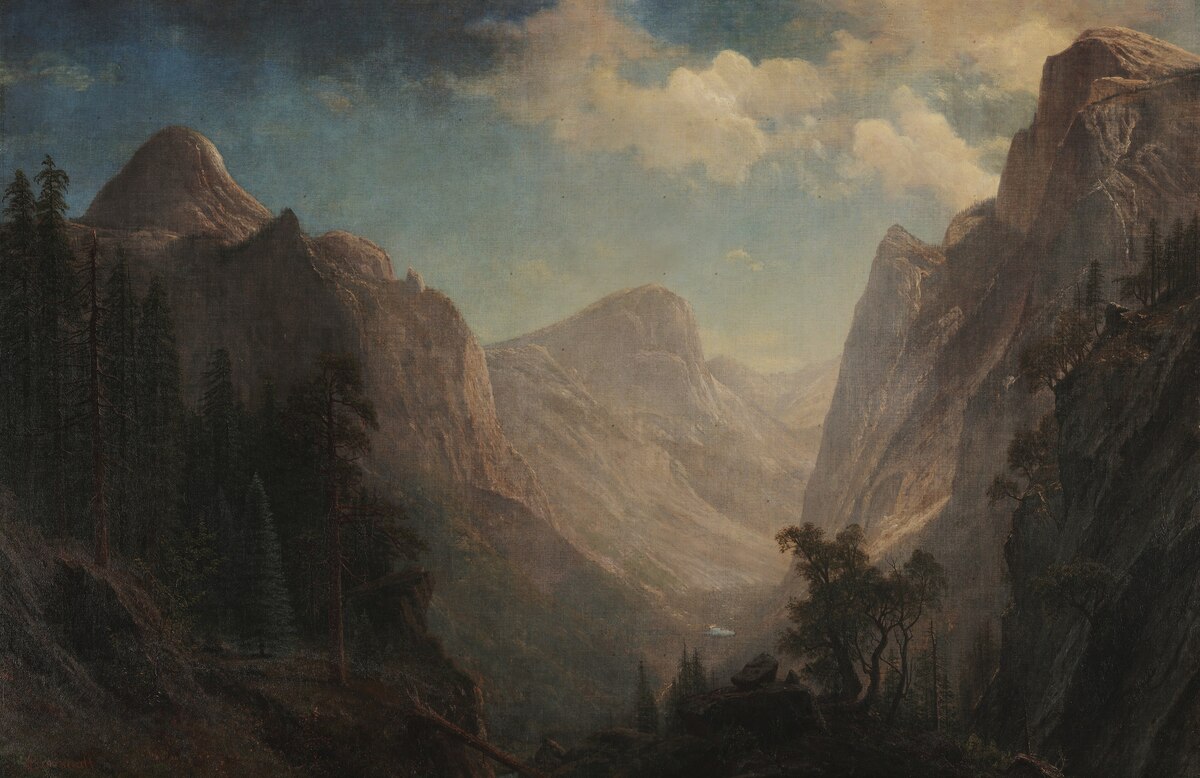
- A view of the Yosemite Valley, showing the valley floor with a lake or river reach, surrounded by towering granite cliffs and distant peaks under a dramatic sky. The painting presents the landscape as a vast, sublime spectacle, with dark foreground conifers framing the sunlit valley beyond.
- Title variants
- Valley of the Yosemite; View in the Yosemite Valley
- Support
- canvas
Catalogue identity and attribution
The institutional record for this painting names Albert Bierstadt (1830–1902), described in the record as a German-American painter, as its artist, and gives the title as View in the Yosemite Valley. The same record assigns the work a date of between 1850 and 1890, a span that should be read as a catalogue range rather than as a securely documented year of execution: it brackets the object's possible making within Bierstadt's broader career instead of fixing a single moment, and it therefore cannot by itself establish when the canvas was painted or to which phase of the artist's work it belongs. The title itself functions as a descriptive designation for a valley subject rather than as a unique title, and the record also associates the file with the title Valley of the Yosemite, so the object carries recorded title variants across its documentation.(Wikimedia Commons: Valley of the Yosemite, 2021, Artist: Albert Bierstadt (1830–1902); Title: View in the Yosemite Valley; Date: between 1850 and 1890)
Subject and iconography
LinkRecorded composition and visual anchors
Visual observation
The composition is organized around a sequence of distinct visual anchors recorded as observation rather than identification. A pale, rounded mountain rises at the center beyond a hazy valley, functioning as a focal vanishing point and evoking Yosemite's Half Dome. Deeper in the valley, a small bright lake or river reach draws the eye through the atmospheric perspective and gives scale to the surrounding cliffs. Dark, towering conifers at the left edge frame the view and produce deep tonal contrast, while a massive shadowed granite wall on the right, marked by vertical striations and sparse trees, emphasizes the valley's enclosure. A distinctly conical, sunlit peak on the left balances that right-hand cliff and anchors the middle distance. Above the valley, a billowing bank of clouds and blue sky carries the painting's dramatic light, with warm highlights suggesting sun breaking through. Read together, these elements describe a composition built on contrast between dark framing masses and a luminous, recessed center, with the small lake or river reach acting as the pivot of scale and depth.(Wikimedia Commons: Valley of the Yosemite, 2021, Visual focus candidate: Central distant peak; Visual focus candidate: Valley floor lake; Visual focus candidate: Left foreground conifers; Visual focus candidate: Right sheer granite cliff; Visual focus candidate: Left conical peak; Visual focus candidate: Storm light cloud bank)
Interpretation
The medium recorded for the object is oil on canvas, which grounds the observed tonal contrasts and atmospheric effects in a specific technical tradition. The deep shadows of the left foreground conifers, the pale luminosity of the distant peak, and the warm highlights in the cloud bank are all effects consistent with oil painting's capacity for layered glazing, scumbling, and tonal modulation. The observation units establish what is depicted and how the composition is structured, while the documented medium establishes the material basis through which those effects were achieved. The record does not supply pigment analysis, infrared imaging, or surface examination, so the relationship between the visible appearance and the paint layers beneath remains a matter of technical inference rather than documented fact. What the evidence does establish is that the painting is an oil on canvas depicting a composed valley scene with carefully distributed light and shadow.(Wikimedia Commons: Valley of the Yosemite, 2021, Medium: oil on canvas; Visual focus candidate: Central distant peak; Visual focus candidate: Left foreground conifers; Visual focus candidate: Storm light cloud bank)
Materials and technique
LinkDocumented materials and format
Technical descriptions of the object proceed from a compact but specific set of documented facts about its physical makeup. The painting is executed in oil on canvas, a medium that pairs a flexible, woven textile support with a drying oil binder capable of carrying both opaque, body-rich passages of paint and thin, translucent glazes. The recorded dimensions are 78.7 cm high by 120.6 cm wide, giving the work a horizontal, landscape-oriented format that suits a broad valley prospect rather than a vertical or intimate view. Its accession number in the holding collection is 83.48.1, and the work was a gift of Brandt Inc. in memory of Earl William and Eugenia Brandt Quirk. These are the concrete, checkable parameters of the object: medium, support, size, ownership history and registration. They establish what the painting is materially and institutionally, but they do not by themselves describe how the paint was applied, how the canvas was prepared, or what pigments were used, and none of those details is supplied. Any account of Bierstadt's handling therefore has to be distinguished sharply from what the record actually documents about the object's medium and format.(Wikimedia Commons: Valley of the Yosemite, 2021, Medium: oil on canvas)
The medium statement, oil on canvas, is the only material fact recorded in the supplied evidence, and it is worth separating that technical description from the visual inferences that accompany it. Knowing that a work is oil on canvas tells us the class of materials and support, but it does not establish a specific ground layer, priming colour, brush type, palette knife use, drying time or finish. The record offers no pigment analysis, no cross-section, no infrared or X-ray examination and no conservation report, so we cannot claim that any particular blue, yellow or earth was used in the sky, the granite or the conifers. What the evidence does establish is narrower and firmer: the work exists as an oil painting on a woven canvas support, of a stated size, by a named artist, and held in a named museum collection. Claims about making technique beyond that belong to the category of inference from appearance rather than to documented technical finding, and they should be labelled as such whenever they are made.(Wikimedia Commons: Valley of the Yosemite, 2021, Medium: oil on canvas)
Structure of the image
Interpretation
The relationship between the material support and the optical structure is instructive. An oil-on-canvas painting of roughly 79 by 121 cm gives an artist a surface wide enough to stage a full valley panorama and a support stable enough to carry dense, layered paint; the horizontal format and the composition of framed foreground, middle distance and distant peak work together as a single spatial construction. The dark conifers at the left and the shadowed granite wall at the right perform a framing function that presses the brighter central valley back into depth, and the small bright lake or river reach within that valley pins the recession and provides a scale reference for the cliffs. This reading connects what the medium makes possible, a broad, layered landscape surface, with what the image actually does, namely establish deep atmospheric space through tonal contrast and a sequence of receding planes. It remains an interpretation of visible arrangement rather than a report of documented process, since the evidence supplies no examination of paint layers or of the sequence in which the composition was built up.(Wikimedia Commons: Valley of the Yosemite, 2021, Medium: oil on canvas; Visual focus candidate: Valley floor lake; Visual focus candidate: Left foreground conifers; Visual focus candidate: Right sheer granite cliff; Visual focus candidate: Storm light cloud bank)
Attribution, date and context of making
Attribution and dating condition how the material evidence is read. The supplied record identifies the artist as Albert Bierstadt, a German-American painter, and dates the painting between 1850 and 1890. That broad range covers a long and varied period of Bierstadt's career and is therefore a qualification rather than a precise date; it means the object cannot be assigned to a single year on the present evidence. The title in the institutional record is View in the Yosemite Valley, and the painting is signed at the bottom left with the signature ABierstadt, an inscription that connects the canvas physically to the artist's hand or at least to his name. The work is in the collection of the Patrick and Beatrice Haggerty Museum of Art at Marquette University, Milwaukee, Wisconsin. Taken together, these facts place the object within a known artist's output and a specific museum context while leaving open the exact moment of execution, which the date range does not settle.(Wikimedia Commons: Valley of the Yosemite, 2021, Medium: oil on canvas)
Interpretation
The interpretation of the picture as a sublime landscape belongs to the record's reading of the artist's characteristic aims, not to a documented statement by Bierstadt himself. The supplied evidence notes that the dark foreground conifers and deep tonal contrast are characteristic of Bierstadt's sublime landscapes, in which the scale of nature overwhelms the viewer. That is an attributed interpretation, and its weight should be kept distinct from the documented material facts of medium, size and signature. It nevertheless helps explain why the composition is built as it is: the framed view, the immense enclosing walls on the right and the deep contrast between near shadow and far light together construct an experience of awe rather than a neutral survey of terrain. The painting is thus both a record of a place and a demonstration of proportion, showing how small a human vantage becomes against a valley of this scale, and it matters within a larger history of American landscape art because it shows oil painting being used to stage that experience of vastness through tonal structure and atmospheric depth.(Wikimedia Commons: Valley of the Yosemite, 2021, Medium: oil on canvas; Visual focus candidate: Central distant peak; Visual focus candidate: Left foreground conifers; Visual focus candidate: Right sheer granite cliff; Visual focus candidate: Storm light cloud bank)
Provenance and ownership
LinkThe documented ownership history of this painting begins with a single recorded transfer: the work entered its current collection as a gift of Brandt Inc. in memory of Earl William and Eugenia Brandt Quirk. The institutional record for the object carries this as its credit line, which is how the museum identifies the source of the gift and the persons it commemorates. That credit line is the only provenance event the supplied evidence establishes, and it identifies a corporate donor acting in memory of two named individuals rather than a purchase or an artist-to-institution transfer. It does not state when the gift was made, what terms attached to it, or how the painting reached Brandt Inc. before the gift, so the sequence from the painting's making to the moment of donation remains unrecorded in the available material.(Wikimedia Commons: Valley of the Yosemite, 2021, Credit line: Gift of Brandt Inc. in memory of Earl William and Eugenia Brandt Quirk)
The Object Record and Its Bearing on Provenance
Placing that gift in chronological relation to the rest of the object record depends on dates the record supplies independently of provenance. The painting is attributed to Albert Bierstadt, a German-American painter, and its date is given as between 1850 and 1890, a span of forty years rather than a fixed year. Its medium is oil on canvas, its dimensions are 78.7 cm high by 120.6 cm wide, and it is signed at the bottom left with the signature ABierstadt. It is held by the Patrick and Beatrice Haggerty Museum of Art at Marquette University, Milwaukee, Wisconsin, under accession number 83.48.1. The accession number and the date range are the two record elements that bear most directly on provenance reasoning: the number documents the institution's registration of the object, and the broad date range means the painting's creation cannot be pinned to a single year on the present evidence, which in turn leaves the length of any unrecorded ownership interval indeterminate.(Wikimedia Commons: Valley of the Yosemite, 2021, Credit line: Gift of Brandt Inc. in memory of Earl William and Eugenia Brandt Quirk)
It is important to distinguish what the evidence states from what it leaves open. The credit line documents a gift by Brandt Inc. in memory of Earl William and Eugenia Brandt Quirk; it does not establish that Brandt Inc. owned the painting for any particular period, that the Quirks themselves owned it, or that the gift was made at or near the accession date implied by the number 83.48.1. The memory formula can accompany either a donation from a family holding or a corporate gift honoring individuals who never possessed the work, and the record does not resolve which applies. The interval before the gift is therefore an unrecorded interval, not a proven chain of owners, and no sale, dealer, auction, or earlier collection is named in the supplied units. Any later account that assigns intermediate owners would be adding information this record does not contain.(Wikimedia Commons: Valley of the Yosemite, 2021, Credit line: Gift of Brandt Inc. in memory of Earl William and Eugenia Brandt Quirk)
Interpretation
Provenance here also frames how the painting is understood as a collection object. A German-American painter's Yosemite subject, made sometime between 1850 and 1890 and now in a university museum in Milwaukee, moved from the context of nineteenth-century American landscape painting into an institutional collection through a commemorative corporate gift. That path is typical of many museum holdings whose early ownership is undocumented and whose recorded history begins at donation. Because the evidence names no prior owner and no transaction before the gift, the object's place in a larger history of collecting rests on the credit line and accession record alone, and the painting's public identity is tied to the donor's memorial intention as much as to its authorship. The commemorative function of the gift is thus part of what the object now is within the collection, not a separate anecdote about it.(Wikimedia Commons: Valley of the Yosemite, 2021, Credit line: Gift of Brandt Inc. in memory of Earl William and Eugenia Brandt Quirk)
Interpretations and debates
LinkObject Record and Attribution
Interpretation
The supplied institutional record identifies the object as Albert Bierstadt's View in the Yosemite Valley, an oil on canvas measuring 78.7 cm high by 120.6 cm wide. The record gives a date range of 1850 to 1890 rather than a single year, which means the object's chronology remains imprecise in the available documentation. The painting is signed at the bottom left with the signature ABierstadt, a mark that connects the canvas to the artist's hand in the record's account. It belongs to the Patrick and Beatrice Haggerty Museum of Art at Marquette University, Milwaukee, Wisconsin, under accession number 83.48.1, and was a gift of Brandt Inc. in memory of Earl William and Eugenia Brandt Quirk. Those details of medium, support, dimensions, signature, repository and credit line are the documented facts on which any reading of the picture must rest; they do not by themselves explain what the picture means.(Wikimedia Commons: Valley of the Yosemite, 2021, Visual focus candidate note: typical of Bierstadt's sublime landscapes)
The Sublime Reading and Its Limits
The supplied record reads the dark foreground conifers and the deep tonal contrast as characteristic of Bierstadt's sublime landscapes, in which the scale of nature overwhelms the viewer. This is an attributed interpretation and it belongs to the record rather than to a private statement by the artist. Its explanatory value is that it connects several separate observations, the framed view, the deep shadows, the immense enclosing walls and the dramatic cloud bank, into a single account of how the picture is meant to be experienced. The record does not document any statement of intent by Bierstadt himself, so the sublime reading should be understood as a scholar's or institution's framework for the object's effects, not as evidence of what the painter privately meant.(Wikimedia Commons: Valley of the Yosemite, 2021, Visual focus candidate note: typical of Bierstadt's sublime landscapes)
Collection and display
LinkObject record and collection
The object is an oil painting on canvas measuring 78.7 cm high by 120.6 cm wide, signed at the bottom left with the signature "ABierstadt." The institutional record titles it View in the Yosemite Valley and attributes it to Albert Bierstadt, described as a German-American painter, with a date range of 1850 to 1890. It carries the accession number 83.48.1 and was a gift of Brandt Inc. in memory of Earl William and Eugenia Brandt Quirk. The painting belongs to the collection of the Patrick and Beatrice Haggerty Museum of Art at Marquette University, Milwaukee, Wisconsin. These particulars come from the supplied object record, which serves as the official institutional documentation for this exact work; the broad date span is what that record establishes, and it should be treated as such rather than narrowed to a specific year.(Wikimedia Commons: Valley of the Yosemite, 2021, Collection: Patrick and Beatrice Haggerty Museum of Art, Marquette University)
Composition and visual structure
The documented record extends beyond the collection line to describe the composition itself. A pale, rounded mountain rises at the center of the composition beyond the hazy valley, acting as a focal vanishing point and evoking Yosemite's Half Dome. A small bright lake or river reach sits deep in the valley, drawing the eye through the atmospheric perspective and giving scale to the surrounding cliffs. Dark, towering conifers at the left edge frame the view and create deep tonal contrast. A massive, shadowed granite wall occupies the right side, its vertical striations and sparse trees emphasizing the valley's enclosure. A distinctly conical, sunlit peak on the left balances the right-hand cliff and anchors the middle distance, while a billowing bank of clouds and blue sky above the valley carries the painting's dramatic light, with warm highlights suggesting sun breaking through. These visual observations, including the Half Dome evocation, belong to the record's own description of the work rather than to independent technical analysis.(Wikimedia Commons: Valley of the Yosemite, 2021, Collection: Patrick and Beatrice Haggerty Museum of Art, Marquette University)
Interpretation and why the object matters
Interpretation
The same record reads these choices as characteristic of Bierstadt's sublime landscapes, where the scale of nature overwhelms the viewer. That is an attributed interpretation rather than a private statement by the artist, and it is best understood as an explanatory frame for the deep contrast, the framed view, and the immense enclosing walls, which together construct an experience of awe rather than a neutral survey of terrain. Read alongside the compositional description, the interpretive claim helps account for why the small bright lake or river reach deep in the valley matters: it gives scale to the cliffs around it and draws the eye through the atmospheric haze, so that the painting becomes as much about proportion, and how small a human vantage becomes against a valley built at this scale, as it is about a particular place.(Wikimedia Commons: Valley of the Yosemite, 2021, Collection: Patrick and Beatrice Haggerty Museum of Art, Marquette University)
Documented values and qualified estimates
LinkThe object record
Interpretation
The single supplied record for this object is a Wikimedia Commons file page documenting View in the Yosemite Valley, attributed there to Albert Bierstadt, described as a German-American painter. The page gives the painting an institutional title, View in the Yosemite Valley, and dates it broadly to between 1850 and 1890. It records oil on canvas as the medium and dimensions of 78.7 cm high by 120.6 cm wide, and places the work in the collection of the Patrick and Beatrice Haggerty Museum of Art at Marquette University, Milwaukee, Wisconsin, under accession number 83.48.1. The credit line records that the painting was a gift of Brandt Inc. in memory of Earl William and Eugenia Brandt Quirk, and the inscription is given as a signature at the bottom left reading ABierstadt. These are the object-level facts on which any discussion of the painting's value must rest, and they come from a file page rather than a direct museum catalogue record.(Wikimedia Commons: Valley of the Yosemite, 2021)
Description and attributed reading
The Commons page also describes what is visible in the composition, and those descriptions are observations rather than artist's statements. Dark, towering conifers stand at the left edge and frame the view, creating strong tonal contrast against the brighter distance. A massive granite wall occupies the right side in shadow, its vertical striations and sparse clinging trees emphasizing the enclosure of the valley. On the left, a distinctly conical, sunlit peak balances the right-hand cliff and anchors the middle distance, while a pale, rounded mountain rises at the center beyond the hazy valley, described as acting as a focal vanishing point and evoking Yosemite's Half Dome. A small bright lake or river reach sits deep in the valley floor, drawing the eye through the atmospheric perspective and giving scale to the surrounding cliffs, and above it all a billowing bank of clouds and blue sky carries the painting's dramatic light, with warm highlights suggesting sun breaking through. The record reads the dark foreground conifers and deep tonal contrast as characteristic of Bierstadt's sublime landscapes, where the scale of nature overwhelms the viewer; that reading is an attributed interpretation supplied by the record, not a private statement by the artist.(Wikimedia Commons: Valley of the Yosemite, 2021)
Recorded values
The only valuation evidence supplied is a calculated working insurance estimate, generated 2026-10-16, giving a range of US$500,000 to US$2,000,000. Its stated methodology is important to reproduce exactly: the range was calculated for manual insurance review based only on the confirmed context and source excerpts, and it treats the attribution to Bierstadt as confirmed for the purposes of calculation while assigning only medium confidence, because the underlying record is a Wikimedia Commons file page rather than a direct museum catalogue record. Within that calculation, the oil on canvas medium and the dimensions of 78.7 by 120.6 cm are taken to indicate a substantial finished exhibition-scale painting, and the date range of 1850 to 1890, the Yosemite Valley subject, and the sublime landscape treatment are taken to support classification as a significant Bierstadt work. The documented institutional collection at the Haggerty Museum, together with the accession number 83.48.1, the credit line, and the inscription, are treated as supporting authenticity and provenance context. No official appraisal, auction result, sale price, or private insurance record is supplied, so the figure is deliberately broad and conservative and is offered as a starting point for manual review rather than a market determination.(Wikimedia Commons: Valley of the Yosemite, 2021)
The qualification attached to that estimate governs how it should be used here. It is a model-generated working range for manual review only, not an official insurance value, appraisal, auction result, or sale price, and it does not use comparable sales or private insurance records. Actual insurance values would require physical inspection, condition assessment, provenance verification, and review by a qualified appraiser or underwriter, and the source URL supports identification context only rather than constituting a public appraisal. The practical consequence is that the figure and the object record pull in different directions in terms of evidentiary weight: the attribution, title, medium, dimensions, collection, accession number, credit line, signature, and visual description are stated as facts of the record, whereas the confidence in the attribution, the classification of the work as significant, and the monetary range are all products of the calculation itself, conditioned on the record being a file page of medium reliability rather than a museum catalogue entry. Read together, they indicate a large finished Yosemite subject in oil on canvas, signed by the artist, held in a university museum collection, whose monetary value awaits inspection, provenance verification, and appraisal.(Wikimedia Commons: Valley of the Yosemite, 2021)
Working estimate
Calculated working insurance estimate, not a sale price: Estimated value: US$500K to US$2M Recorded date: Working calculation, generated 2026-10-16. Methodology: This broad working range is calculated for manual insurance review based only on the supplied confirmed context and source excerpts. The attribution to Albert Bierstadt, a major 19th-century American landscape painter, is treated as confirmed for calculation though confidence is medium because the record is a Wikimedia Commons file page rather than a direct museum catalogue record. The oil on canvas medium and dimensions of 78.7 by 120.6 cm indicate a substantial finished exhibition-scale painting. The date range of 1850 to 1890, the Yosemite Valley subject, and the sublime landscape treatment support classification as a significant Bierstadt work. The documented institutional collection at the Patrick and Beatrice Haggerty Museum of Art, Marquette University, accession number 83.48.1, credit line, and inscription support authenticity and provenance context. No official appraisal, auction result, sale price, or private insurance record is supplied, so the range is deliberately broad and conservative. It is intended as a starting point for manual review and should be refined by a qualified appraiser using physical inspection, condition, provenance, and current market evidence. Qualification: This is a model-generated working range for manual review only. It is not an official insurance value, appraisal, auction result, or sale price. It does not use comparable sales or private insurance records. Actual insurance values require physical inspection, condition assessment, provenance verification, and review by a qualified appraiser or underwriter. The source URL supports identification context only and does not constitute a public appraisal.(Wikimedia Commons: Valley of the Yosemite, 2021)