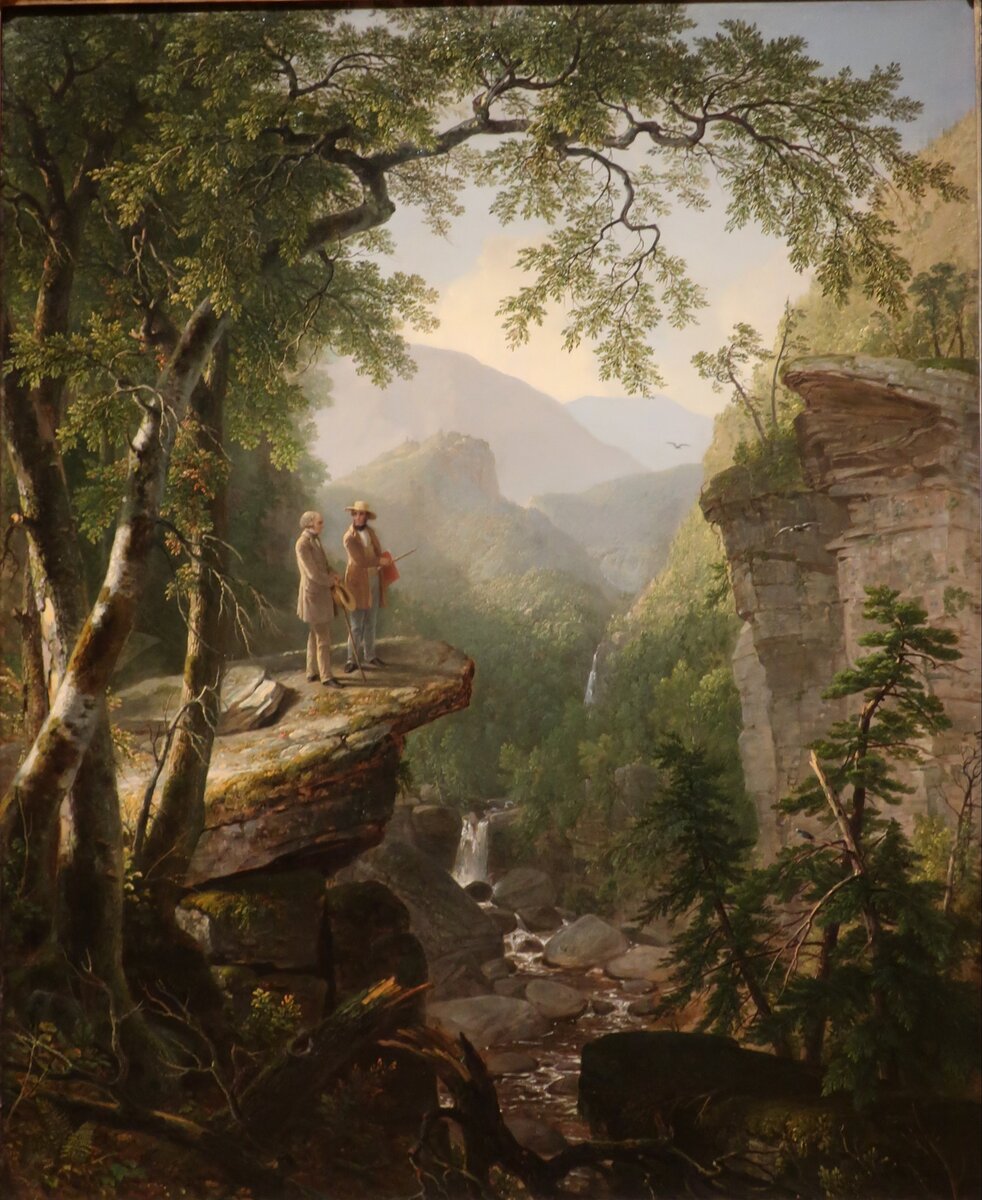
A landscape painting of 1849 in which Asher Brown Durand places two identified men, the painter Thomas Cole and the poet William Cullen Bryant, on a rocky ledge above a gorge and cascade, beneath arching trees and a towering palisade cliff.
The lichen-and-moss covered slabs of the foreground outcrop together with the fallen branches, dark stream boulders, and shadowed undergrowth at the bottom of the picture, whose rough texture anchors the composition and shows Durand's close study of rock and moss.
02
Hazy distant mountain
The pale, mist-softened mountain summit and layered ridges visible through the gap between the near slopes, marking the deep atmospheric recession toward the horizon that gives the scene its luminist stillness.
03
Arching tree canopy
The broad leafy crown and sinuous dark branches that sweep across the upper part of the canvas from the left trunk, forming a natural arch or proscenium over the valley and the two men.
Your gallery guide
Kindred Spirits by Asher Brown Durand (1849)
A landscape painting of 1849 in which Asher Brown Durand places two identified men, the painter Thomas Cole and the poet William Cullen Bryant, on a rocky ledge above a gorge and cascade, beneath arching trees and a towering palisade cliff.
Editorial review by Artifact Archive automated publishing
This is Kindred Spirits, painted by Asher Brown Durand in 1849.
It shows two identified men, Thomas Cole and William Cullen Bryant, standing together on a rocky ledge above a gorge with a cascade.
Above them an arching tree canopy opens toward a towering palisade cliff.
Look first at the two figures. They are small within the landscape and stand close together on the rock, facing the view rather than the visitor.
The ledge gives them a stage, and the gorge drops away in front of them. The cascade cuts a pale vertical line through the darker rock and trees.
The composition lifts the eye from that water, up through the canopy, to the cliff face above.
Durand lived from 1796 to 1886 and worked in New York as a painter, engraver and photographer.
The painting belongs to the Hudson River School, and it was made in the United States in 1849.
Cole and Bryant are not incidental staffage. The record identifies them as the two men depicted here.
Naming the figures changes how the landscape works. This is not a view chosen only for its scenery.
The scene honours a meeting of painter and poet, and the shared ground beneath them carries that idea.
Read this way, the gorge and the cliff are not just terrain. They frame a relationship between two kinds of American imagination, painting and poetry.
So the painting is a portrait, but not a conventional one. The two men are identified, yet the setting does much of the work.
The ledge, the falling water and the high rock together make their companionship legible.
That is what Durand gives us: two named figures held inside a landscape that answers them.
The story and its sources
Editorial review by Artifact Archive automated publishing.
Historical claims are linked to the records below. Close looking and interpretation are identified in the passage notes.
Asher Brown Durand was an American painter and engraver (1796-1886). Their work is associated with Hudson River school. Their recorded places of work include New York City.
A landscape painting made in 1849 depicting two identified men, Thomas Cole and William Cullen Bryant, standing on a rocky ledge above a gorge with a cascade, beneath an arching tree canopy and a towering palisade cliff.(Wmpearl, 2020)
The object is catalogued under the title Kindred Spirits and attributed to Asher Brown Durand. Durand is recorded as having lived from 1796 to 1886 and as having worked in New York as a painter, engraver and photographer, a combination of roles that places the making of this canvas within a career that moved between reproductive engraving and original painting. The work carries a date of 1849 and is classified as a landscape painting, with dimensions of 117 centimetres in height and 91.5 centimetres in width. The record identifies the two men depicted in the scene as Thomas Cole and William Cullen Bryant, so the picture is not anonymous scenery but a view populated by named historical figures whose presence the catalogue treats as part of the object's identity. The landscape genre classification and the identification of the sitters sit together in the same summary, which is worth noting: the catalogue does not resolve the work into a single category such as pure landscape or pure portrait, and the research account should preserve that double character rather than choosing between the two.(Wmpearl, 2020, Summary, Object; Summary, Artist; Summary, Date; Summary, Dimensions; Summary, Genre; Summary, Depicted people)
The place of creation is given as the United States, which locates the painting's making geographically without further specification of city or studio. This broad national attribution is consistent with the artist's recorded base in New York, though the evidence does not itself equate the two, and no narrower site of production is established in the supplied units. The date of 1849 attached to the work is the object date recorded in the catalogue summary; the sources consulted for this account are later records, including a Wikimedia Commons file page published in 2020, and that publication year belongs to the documentation rather than to the painting. Distinguishing the 1849 object date from the later dates at which the object was catalogued, photographed or described is necessary here, because the file history associated with the record contains an earlier description that misnamed Thomas Cole as the artist, a mistake corrected in the current structured data.(Wmpearl, 2020, Summary, Place of creation; Summary, Date)
Titles, Attribution and Corrected Records
The attribution history embedded in the documentation is itself part of what the evidence establishes about this object. The Wikimedia Commons record consulted here is annotated as an object record for this exact painting, covering artist, title, date, medium, dimensions, depicted people, collection and accession number, and its file history is noted to contain an earlier description that misnamed Thomas Cole as the artist, corrected in the current structured data. That annotation, together with the discrepancy it records, means the catalogue attribution to Durand is the state of the record as it now stands rather than an unbroken, uncontested transmission: at some point the same file described the work under Cole's name. The correction matters because Cole appears in the painting as a depicted person, and a record that collapses the sitter into the maker would confuse the object's subject with its author. The title Kindred Spirits is likewise carried in the structured summary, and no alternative title variant is established by the supplied units, so the catalogue title stands without a documented set of competing names in this evidence.(Wmpearl, 2020, Summary, Object; Summary, Depicted people)
The record's own history therefore illustrates a general problem in cataloguing nineteenth-century American landscape painting, where the fame of a depicted figure can overshadow the identity of the artist. Here the evidence resolves the question in Durand's favour while retaining Cole as a subject, and it also preserves the artist's multi-part professional identity as painter, engraver and photographer. Because the sources supplied for this section are summary-level records rather than the painting's own inscriptions, no inscription text, signature, accession label or dated canvas annotation is established in these units, and none should be supplied from outside them. What the evidence does establish is a stable core: title, attributed artist, artist dates and working city, object date, medium classification as landscape, metric dimensions, the two named sitters, national place of creation, and a documented correction of an earlier misattribution in the file's history.(Wmpearl, 2020, Summary, Object; Summary, Artist; Summary, Date; Summary, Dimensions; Summary, Genre; Summary, Depicted people; Summary, Place of creation)
The painting is titled Kindred Spirits and was made by Asher Brown Durand.(Wmpearl, 2020)
Asher Brown Durand lived from 1796 to 1886 and worked as a painter, engraver and photographer in New York.(Wmpearl, 2020)
The object under discussion is an oil painting on canvas, titled Kindred Spirits, painted by Asher Brown Durand and dated 1849. Its recorded dimensions are 117 centimetres in height and 91.5 centimetres in width, and it is classified as a landscape painting. Durand, who lived from 1796 to 1886, worked in New York as a painter, engraver and photographer. The work was made in the United States, and it is held at the Crystal Bridges Museum of American Art in Bentonville, in the United States, under museum accession number 2010.106. Those are the basic material and institutional facts that the object record establishes; the identity of the picture as a landscape by Durand is secure in the current structured data.(Wmpearl, 2020, Summary, Place of creation)
Interpretation
Crystal Bridges Museum of American Art, the institution that now holds the painting, was itself established on 11 November 2011. That date is considerably later than the painting's creation in 1849, and it means the work entered a collection formed in the twenty-first century rather than one assembled in the artist's own lifetime. The accession number 2010.106 falls before the museum's public establishment date, which is consistent with acquisition activity preceding the opening. Within the larger history of American art collecting, this places the picture in the migration of nineteenth-century Hudson River School landscapes from private and older institutional holdings into new public museums, extending the audience for works whose original viewing was contemporary with Durand and his circle.(Wmpearl, 2020, Summary, Place of creation)
Figures and scene
The painting depicts two identified men, Thomas Cole and William Cullen Bryant, standing together on a rocky ledge above a gorge with a cascade. Above them an arching tree canopy opens toward a towering palisade cliff. The record identifies these two men as the figures shown, so they are not anonymous staffage but named individuals. Treating the picture as a landscape and as a depiction of specific persons at once is supported by the evidence: it is classified as a landscape, and it also names the men it shows.(Wmpearl, 2020, Summary, Place of creation)
The file history for the object record contains an earlier description that misnamed Thomas Cole as the artist, corrected in the current structured data. This matters for how the object's documentation should be used. Attribution errors can persist in catalogue and file metadata, and the correction is itself part of the record's history. The current attribution to Asher Brown Durand, with the date 1849, is what the present structured data establishes, while the earlier erroneous description stands as a caution about relying on uncorrected file metadata for attribution questions.(Wmpearl, 2020, Summary, Place of creation)
Kindred Spirits is an oil painting on canvas, made by Asher Brown Durand in the United States in 1849. It measures 117 centimetres in height and 91.5 centimetres in width and is classified as a landscape painting. The object record identifies the two men depicted in it as Thomas Cole and William Cullen Bryant. The work is held by the Crystal Bridges Museum of American Art in Bentonville, United States, under accession number 2010.106.(Wmpearl, 2020, Summary, Medium)
Interpretation
The medium evidence for this painting is a single documented statement: it is oil on canvas. That establishes the support as canvas and the paint as oil, but it is a summary-level record and does not specify the type or weave of the canvas, any preparatory ground, the pigments used, the number or sequence of paint layers, the brushes or other tools employed, or any conservation treatment. Those details are not supplied by the available evidence, and the account here should not be read as asserting them. The technical description therefore rests on the documented medium line alone, while questions of preparation and making technique remain open in this record.(Wmpearl, 2020, Summary, Medium)
The artist named in the record, Asher Brown Durand, is documented as living from 1796 to 1886 and working in New York as a painter, engraver and photographer. The painting itself is dated 1849 and associated with the Hudson River School, and it was made in the United States. This matters for materials and technique because Durand's prior and concurrent work as an engraver and photographer belongs to the same professional biography as the oil painting, though the evidence here does not describe how, or whether, those practices affected the handling of paint in this particular canvas. Any claim about engraverly linearity or photographic composition in Kindred Spirits would be inference, not documentation, and is not supported by the supplied units.(Wmpearl, 2020, Summary, Medium)
The object record for this painting places it in the collection of the Crystal Bridges Museum of American Art, the museum in Bentonville, in the United States. Its accession number there is 2010.106, and the museum itself was established on 11 November 2011. The accession number and the founding date sit at an informative distance from one another: the number belongs to the year 2010, while the institution opened in November 2011, so the registration of the work precedes the public life of the museum that now holds it. Any account of the painting's display history therefore has to distinguish the moment of institutional accession from the moment the museum became an operating public collection, a distinction the record supports without supplying further detail about the intervening transfer.(Wmpearl, 2020, Summary, Collection; Summary, Location; Summary, Accession number; Summary, Established)
The painting is held in the collection of the Crystal Bridges Museum of American Art.(Wmpearl, 2020)
Crystal Bridges Museum of American Art is located in Bentonville, in the United States.(Wmpearl, 2020)
The museum accession number for the painting is 2010.106.(Wmpearl, 2020)
Crystal Bridges Museum of American Art was established on 11 November 2011.(Wmpearl, 2020)
The documentary record for this painting is unusually compact, and its central facts come from a single institutional object record. Kindred Spirits is an oil on canvas made by Asher Brown Durand, dated 1849, measuring 117 centimetres in height and 91.5 centimetres in width, and classified as a landscape. It depicts Thomas Cole and William Cullen Bryant, was made in the United States, and is held by the Crystal Bridges Museum of American Art in Bentonville, United States, under accession number 2010.106. The same record identifies Durand as living from 1796 to 1886 and working in New York as a painter, engraver and photographer, and it dates the museum's establishment to 11 November 2011. These are the coordinates from which any account of the work's value must proceed, because they are the facts the record actually establishes about the object rather than about its market.(Wmpearl, 2020)
Crucially, that record supplies no public appraisal, no sale price and no private insurance figure for the painting. The only monetary statement in the supplied evidence is therefore not a record of value at all but a working insurance estimate, calculated for manual review and generated on 16 October 2026, which brackets estimated value at US$500,000 to US$2,000,000. Its stated methodology is to apply the confirmed institutional context, namely the 1849 oil on canvas by a major Hudson River School painter, the 117 by 91.5 centimetre scale, and the Crystal Bridges holding under accession 2010.106, in order to model order-of-magnitude insurance exposure for a canonical museum-held American landscape. The same unit is explicit that this is a conservative, model-generated placeholder and not an official insurance value, appraisal, auction result or sale price, that it does not rely on comparable sales, private insurance records or any public appraisal, and that any insurance value must be confirmed with a qualified appraiser and the responsible museum or collection. The distinction matters for the object's history: the figure describes an exposure band inferred from institutional standing and scale, not a price the painting has ever commanded, and it should be reported with that qualification intact.(Wmpearl, 2020)
Treating the picture as institutionally significant is itself grounded in the object record rather than in the monetary estimate. The estimate's methodology reasons from the scale of the canvas, the identity of the artist as a major Hudson River School painter, and the museum accession, all of which are established by the Wikimedia Commons object record that supplies title, artist, date, medium, dimensions, depicted persons, collection and accession number. The two documents therefore relate to each other as derived and source: the estimate presupposes the record, and the record contains no valuation of its own beyond the fact of museum custody. The Commons file page's own annotation notes that its file history contains an earlier description that misnames Thomas Cole as the artist, a mistake corrected in the current structured data, which is a caution about the layered reliability of cataloguing information even where the corrected attribution is confirmed.(Wmpearl, 2020)
Working estimate
Calculated working insurance estimate, not a sale price: Estimated value: US$500K to US$2M Recorded date: Working calculation, generated 2026-10-16. Methodology: Broad working insurance range calculated for manual review using only the confirmed context from the supplied institutional record. The artwork is an 1849 oil on canvas by Asher Brown Durand, a major Hudson River School painter. The 117 x 91.5 cm scale and inclusion in the Crystal Bridges Museum of American Art, with accession number 2010.106, indicate an institutionally significant American landscape painting. The record confirms the subject and depicted figures but provides no public appraisal, sale price, or private insurance figure. Because no direct market or insurance valuation is available, this range is a conservative model-generated placeholder intended to bracket order-of-magnitude insurance exposure for a canonical museum-held work, not a precise valuation. Qualification: This is a model-generated working range for manual review only. It is not an official insurance value, appraisal, auction result, or sale price. It does not rely on comparable sales, private insurance records, or any public appraisal. Confirm all insurance values with a qualified appraiser and the responsible museum or collection.(Wmpearl, 2020)
Bibliography
Sources and further reading
References are arranged by author or organisation, with links to the original publications. Where no publication date is recorded, n.d. means no date.
Source notes updated .
No recorded sources match these filters. Reset the filters to see the full bibliography.
Wikimedia Commons file page providing the object record for this exact painting, including artist, title, date, medium, dimensions, depicted people, collection and accession number. The file history contains an earlier description that misnames Thomas Cole as the artist, corrected in the current structured data.
Advertising supports the archive. These preferences control aggregate page counting, reading activity and ad-delivery diagnostics. They use no visitor tracking cookie.