Identity and catalogue
Link- Artist or attribution
- Thomas Cole
- Object date
- 1836
- Country or culture
- United States
- Depicted subject
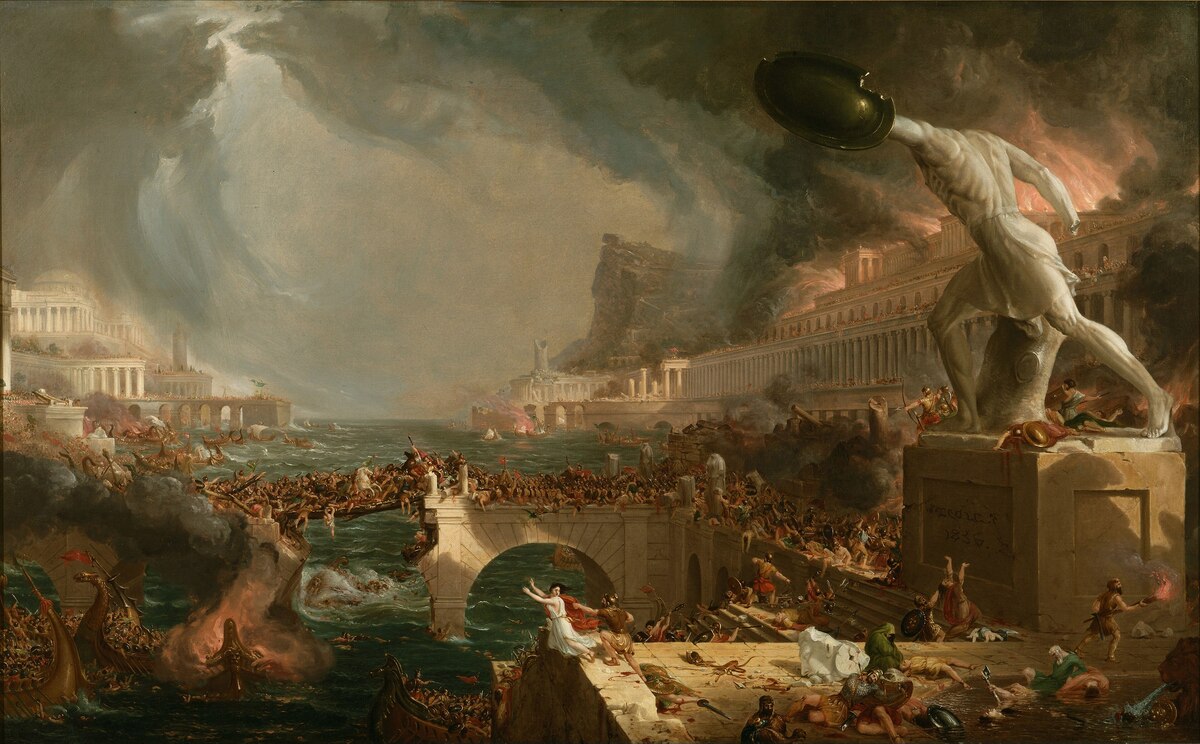
- A classical city is sacked and burned: crowds flee across a bridge, a colossal headless warrior statue with a shield stands amid the collapse, and armed men plunder and drag captives on the waterfront pavement.
- Title variants
- The Course of Empire - The Destruction
- Accession number
- the-course-of-empire-the-destruction-thomas-cole
- Dimensions
- Unknown
Catalogue identity
The painting is titled The Course of Empire - The Destruction and is attributed to Thomas Cole. The attribution is recorded as such in the supplied record rather than presented there as a signed statement by the artist, so the work's authorship rests on that attributed catalogue identification. The supplied Commons record dates the work to 1836 and describes it as executed in oil on canvas, establishing the medium and the year of execution as they appear in this catalogue entry.(Wikimedia Commons: The Course of Empire, 1836, Summary)
That date of 1836 belongs to the painting. The sources consulted for this account are considerably later and should not be conflated with it: the supplied Wikimedia Commons file record carries a publication year of 1836 but serves as a modern discovery aid rather than the owning institution's object record, and the source's relevance is identified as that of an artwork record. Distinguishing the object's execution date from the date of the catalogue or file describing it is essential here, because the Commons page is a derivative document whose own creation postdates the canvas by well over a century even though it repeats the 1836 date for the work.(Wikimedia Commons: The Course of Empire, 1836, Summary)
The file is catalogued under the Commons category The Course of Empire by Thomas Cole, which places the picture within that titled series of works. This cataloguing is the basis for understanding the canvas as one episode in a multi-part cycle rather than a stand-alone image; the record describes it as the series' moment of collapse rather than one of its earlier or later states. The Commons category therefore functions as series-level metadata, grouping this canvas with the other titled works in Cole's cycle.(Wikimedia Commons: The Course of Empire, 1836, Categories; Summary)
Subject and iconography
LinkThe recorded composition
Visual observation
The canvas records a classical city in the midst of destruction, organized around several distinct zones that can be described from the image itself. Near the center, a colossal white marble male nude leans out from a stone pedestal and thrusts a round shield forward; the statue's head is not visible within the canvas. An arched stone bridge is packed edge to edge with fleeing figures, riders and soldiers, some of whom spill into the water as the crowd surges. In the near foreground, armed men fight, drag captives and strip the dead among broken sculpture and discarded armor, and a woman is seized and carried in the melee. On the right, a long classical colonnade is consumed by orange flame and rolling black smoke, with tiny figures still on the balustrade. At the left harbor, galleys burn, boats wallow and figures struggle in the water. On the far left shore stands a white colonnaded temple complex with a dense crowd massed on its portico, its intact classical order contrasting with the fire and violence elsewhere. These are observations of the image, not yet identifications of its subject.(Wikimedia Commons: The Course of Empire, 1836, Vision-derived semantic focus)
Two compositional devices carry much of the scene's narrative weight, on the account supplied with the image. The headless colossal guardian statue functions in the painting as a symbol of an empire collapsing, its own broken condition mirroring the city it once protected. Separately, the bridge operates as the bottleneck where the city's panic is most legible, and the foreground pavement registers the human cost of the destruction. These are readings of how the visual elements work within the picture rather than documented statements of the painter's intention, and they should be weighed as attributed interpretation rather than as established fact.(Wikimedia Commons: The Course of Empire, 1836, Vision-derived semantic focus)
Looking, attribution and the limits of the record
Interpretation
Read together, the visual observations and the file documentation support a cautious account: the composition can be described in detail from the image, and the title, attribution to Thomas Cole, date of 1836, oil-on-canvas medium, Hudson River School association and membership in the titled Course of Empire series are documented in the supplied record, while the symbolic reading of the headless guardian and the narrative role of the bridge and foreground are interpretive claims attached to the image rather than documented facts about the painter's intent. Because the record supplies no owning institution, no dimensions and no condition history, questions about the painting's present location, scale and physical state remain open within this evidence, and the visible scene, its series position and its digital reproduction are the firmest points of departure for further research.(Wikimedia Commons: The Course of Empire, 1836, Vision-derived semantic focus; Summary; File information)
Visual observation
The scene shows a city being destroyed: a colossal white marble male nude leans out from a stone pedestal thrusting a round shield forward, and the statue's head is not visible in the canvas.(Wikimedia Commons: The Course of Empire, 1836)
Documented Attribution and Series Placement
The canvas is attributed to Thomas Cole, titled The Course of Empire: The Destruction, dated 1836 and executed in oil on canvas, and the file description records it as belonging to the Hudson River School. The Commons record also catalogues the work under the category The Course of Empire by Thomas Cole, which places this canvas within that titled series rather than treating it as an isolated picture; within the series it represents the moment of collapse, not an earlier or later state. This is the framework the surviving documentation establishes for the object, and it is also the limit of what the supplied record asserts about authorship, date, medium and movement.(Wikimedia Commons: The Course of Empire, 1836, Summary, Style; File history; Licensing)
Imagery and the Series' Moment of Collapse
Interpretation
What the record documents about the picture's subject is destruction: a city is being destroyed, with fire, smoke and armed men across the canvas. At the centre a colossal white marble male nude leans out from a stone pedestal thrusting a round shield forward, and the statue's head is not visible in the canvas. Read against the work's documented role as the series' moment of collapse, this broken guardian can be taken as figuring an empire in ruin, its own damaged condition mirroring the city it once protected; the bridge, packed edge to edge with fleeing figures, riders and soldiers, some spilling into the water, operates as the bottleneck where the city's panic is most legible, while the foreground pavement registers the human cost of the destruction. These are attributed interpretations of the imagery, not documentary facts about commission or patronage, and they should carry that qualification when the object's social world is reconstructed.(Wikimedia Commons: The Course of Empire, 1836, Summary, Style; Vision-derived semantic focus)
Limits of the Commissioning Evidence
The essential qualification running through the surviving evidence is that secure identification of the painting does not settle its commissioning history. The record supports title, attribution, date, medium and series membership, and it supports the imagery just described, but it does not name a patron, a commission, a purchaser, an intended setting or an original function, and it does not describe how the canvas was first displayed or received. Later accounts of the series, including the cataloguing on Commons, were compiled after the fact and can be compared to the 1836 attribution only as description of the artwork rather than as contemporaneous documentation of its making. Where the object matters within a larger history of art, it does so on the strength of its documented series placement and its imagery of an empire in collapse; the social world of its first audience, household setting and patronage remains for the supplied evidence an open question rather than a reconstructed fact.(Wikimedia Commons: The Course of Empire, 1836, Summary, Style; File history; Licensing; Vision-derived semantic focus)
The painting belongs to the Hudson River School as recorded in the file description.(Wikimedia Commons: The Course of Empire, 1836)
Materials and technique
LinkSupport and medium
The supplied record for this canvas identifies it as The Course of Empire: The Destruction, attributed to Thomas Cole, dated 1836 and executed in oil on canvas. The same record places the work within the Hudson River School and catalogues it under the Commons category for Cole's titled series The Course of Empire, so that this canvas corresponds to the series' moment of collapse rather than to its earlier or later states. The file description is an Internet Archive derived Commons record rather than the owning institution's object record; it does not state a present museum, collection or gallery location, dimensions, provenance or exhibition history, and it supplies no condition or conservation information about the painting. Any materials claim drawn from it therefore rests on the medium line oil on canvas alone, and the physical support, ground, preparatory layers, pigments, binders and varnish of the painting are not documented in the evidence supplied here.(Wikimedia Commons: The Course of Empire, 1836, Summary; Metadata)
The reproduction and its limits
Technical examination
The only explicitly technical unit supplied concerns the reproduction rather than the painting. The Commons record includes a full-resolution copy measuring 12,500 by 7,755 pixels, and the evidence is explicit that this is a digital file specification rather than a measurement of the painting. That distinction governs how the image can legitimately be used. High pixel counts support close reading of composition, modelling of the colossal figure, the fall of light across the pavement and the legibility of small figures on the balustrade, but they establish nothing about the physical size, scale or surface of the canvas itself. No dimensions of the painting are given anywhere in the supplied material.(Wikimedia Commons: The Course of Empire, 1836, File information)
The provenance of the digital file is described in terms that further separate it from the object: the file was uploaded to Commons from an Internet Archive scan of an early print, within a query covering prints dated 1650 to 1870, and is marked public domain. That is a statement about the reproduction file and its upload route, not about the painting's ownership history. The record lists an accession number, the-course-of-empire-the-destruction-thomas-cole, and cites the Internet Archive as source collection under opensource_image, yet it does not state a present museum, collection or gallery location for the painting. The record is best treated as a discovery aid rather than an owning institution's object record, and it does not document present location, dimensions, provenance or exhibition history. Given that an early print stands between the painting and the digital file, contrast, tone and fine detail in the reproduction should not be assumed to translate directly into the painted surface.(Wikimedia Commons: The Course of Empire, 1836, File information; Metadata)
What the image shows
Interpretation
The statue's missing head is the most technically suggestive feature in the composition, and the evidence constrains how far it can be taken. What is observed is that the statue's head is not visible in the canvas; the symbolism attached to that condition, that the headless colossal guardian functions in the painting as a symbol of an empire collapsing with its own broken condition mirroring the city it once protected, is an interpretation recorded in the source rather than a documented fact of the object. Nothing in the supplied units establishes whether the head is occluded, cropped by the composition, or represented as broken away, and no technical examination, raking light photograph, infrared image or cross-section is reported that could distinguish among those possibilities. The headlessness therefore belongs to the visible evidence and to attributed interpretation, not to a demonstrated physical history of the painted figure.(Wikimedia Commons: The Course of Empire, 1836, Vision-derived semantic focus; File information)
Absences in the technical record
Nothing in the supplied material reports underdrawing, pentimenti, revisions, transfers or changes of mind in the execution of this canvas. That silence should be stated rather than filled. The only unit that speaks to any technical process at all is the description of the digital file, which concerns imaging rather than painting, and the metadata caveat, which concerns software-added file data rather than artist's marks. Consequently the account of this object's making, as far as the evidence reaches, consists of the dated medium statement and the visual description of the finished composition. Any discussion of preparatory drawing, hidden forms or reworked passages in this picture would go beyond what the evidence supports.(Wikimedia Commons: The Course of Empire, 1836, File information; Metadata; Summary)
The painting's place within a larger history is documented in two connected ways. The file description records that it belongs to the Hudson River School and describes it as part of Cole's titled series The Course of Empire, catalogued under the Commons category for that series, so this canvas represents the series' moment of collapse rather than its earlier or later states. The date 1836 places the work within that series' span as given. What the record does not supply is the present collection, the painting's provenance, or its exhibition history, so the object's institutional afterlife and its display history remain undocumented here even as its position within a serial program and a movement is stated.(Wikimedia Commons: The Course of Empire, 1836, Summary; File information)
Technical examination
The supplied Commons record includes a full-resolution reproduction measuring 12,500 by 7,755 pixels, a digital file specification rather than a measurement of the painting.(Wikimedia Commons: The Course of Empire, 1836)
Condition and conservation
LinkThe limits of the record
Any account of the condition of The Course of Empire: The Destruction, attributed to Thomas Cole and dated 1836 in oil on canvas, has to begin with what the available record does not contain. The Wikimedia Commons file record from which the present evidence derives is a discovery aid rather than an owning institution's object record: it supplies title, artist, date, medium, movement, subjects, source collection and licensing, but the record states explicitly that no condition or conservation information about the painting is supplied. There is therefore no documented account of the canvas's support, stretcher, lining, varnish, losses, abrasion, previous treatments or examination history in this evidence. Statements about the painting's physical state, in any period, remain unreported here rather than confirmed, and the absence of such reporting should not be read as a claim that the work is or was undamaged.(Wikimedia Commons: The Course of Empire, 1836, Metadata)
Commons further cautions that file metadata may have been added by the camera, scanner or software used to digitise the work, and that timestamps may not reflect the original document. This qualification matters for condition research because it separates any dated stamp on the digital surrogate from the physical history of the painting: an apparatus-generated date cannot be treated as a condition observation, an examination date or a treatment date. In the same way, the full-resolution reproduction listed in the Commons record at 12,500 by 7,755 pixels is a digital file specification, not a measurement of the painting, so it carries no information about the scale at which surface condition, craquelure, retouching or losses could be assessed. The file was uploaded to Commons from an Internet Archive scan of an early print, within a query covering prints dated 1650 to 1870, and is marked public domain; as the record itself frames it, this describes the reproduction file and its upload, not the painting's ownership history, and by extension it documents nothing about the care, storage or treatment of the canvas itself. What the reproductions do establish is the painted design that any future condition account would have to be measured against: the destruction scene of 1836, oil on canvas, belonging to the Hudson River School and catalogued within Cole's titled series The Course of Empire as that series' moment of collapse. Within the composition, the colossal white marble male nude leaning from its stone pedestal with a round shield thrust forward is described as having no visible head in the canvas, a depicted incompleteness that belongs to the iconography of the scene rather than to the physical condition of Cole's canvas. The same distinction applies to the broken sculpture and discarded armor in the foreground, the burning galleys and struggling figures at the harbor, the flaming colonnade with tiny figures still on its balustrade, the crowded bridge and the intact white colonnaded temple complex on the far left shore, whose classical order contrasts with the fire and violence elsewhere. Reading any of these as evidence of damage to the painting would mistake painted destruction for material deterioration, and the headless guardian's function in the picture as a symbol of an empire collapsing, its own broken condition mirroring the city it once protected, is an interpretive device within the image, not a record of the object's state.(Wikimedia Commons: The Course of Empire, 1836, Metadata; File information; File history; Licensing; Summary)
Commons notes that file metadata may have been added by the camera, scanner or software used to digitise the work, and that timestamps may not reflect the original document. No condition or conservation information about the painting is supplied.(Wikimedia Commons: The Course of Empire, 1836)
Provenance and ownership
LinkThe Object and Its Record
The object is the canvas catalogued as The Course of Empire - The Destruction, attributed to Thomas Cole, dated 1836 and described as oil on canvas. The file description assigns it to the Hudson River School and places it within Cole's titled series The Course of Empire, so that the canvas is catalogued as the series' moment of collapse rather than one of its other states. The series title is the organising frame the record supplies: it groups this canvas with the other works under a single named cycle, and the descriptive metadata reproduces that grouping as the category under which the file is filed.(Wikimedia Commons: The Course of Empire, 1836, Summary, Style; File history; Licensing)
Provenance: What the Record Does and Does Not Document
What the supplied record documents about ownership is narrow, and the record itself marks the boundary. The digital file was uploaded to Commons from an Internet Archive scan of an early print, within a query covering prints dated 1650 to 1870, and it is marked public domain. That statement describes the reproduction file and its upload, not the painting's ownership history. No owner, transfer, sale or acquisition for the canvas appears in the record: the accession number it carries, the-course-of-empire-the-destruction-thomas-cole, belongs to the file, and the source collection named is the Internet Archive with the opensource_image tag. The record does not state a present museum, collection or gallery location for the painting. It therefore supplies no documented chain of custody, and the interval between the work's making and the file's upload remains unrecorded. An unrecorded interval is not evidence of a change of ownership, and the record should not be read as establishing either a continuous line of possession or a break in one.(Wikimedia Commons: The Course of Empire, 1836, File history; Licensing)
The file's own history is a separate matter from the painting's. The upload derives from an Internet Archive scan of an early print, and that print falls within a query covering prints dated 1650 to 1870, so the reproduction has a documentary life of its own whose dates are the dates of the print and of the digital capture, not of the 1836 canvas. Commons also notes that file metadata may have been added by the camera, scanner or software used to digitise the work, and that timestamps may not reflect the original document. The full-resolution reproduction measures 12,500 by 7,755 pixels, a specification of the digital file rather than a measurement of the painting. These qualifications delimit what the catalogue entry can support: it is a discovery aid and a reproduction record, and the record supplies no condition or conservation information about the painting and no exhibition history.(Wikimedia Commons: The Course of Empire, 1836, File history; Licensing)
The Painting as Described
The visible content that the record describes is what any provenance of the image would have to be reconciled with, and the description is detailed. A colossal white marble male nude leans out from a stone pedestal thrusting a round shield forward, and the statue's head is not visible in the canvas. An arched stone bridge is packed edge to edge with fleeing figures, riders and soldiers, some spilling into the water as the crowd surges. In the near foreground armed men fight, drag captives and strip the dead among broken sculpture and discarded armor, and a woman is seized and carried in the melee. On the right a long classical colonnade is consumed by orange flame and rolling black smoke, with tiny figures still on the balustrade, while at the left harbor galleys burn, boats wallow and figures struggle in the water. On the far left shore a white colonnaded temple complex stands with a dense crowd massed on its portico, its intact classical order contrasting with the fire and violence elsewhere. The record reads the headless colossal guardian as a symbol of an empire collapsing whose own broken condition mirrors the city it once protected, and reads the bridge as the bottleneck where the city's panic is most legible, with the foreground pavement registering the human cost of the destruction. These are attributed readings of the image within the supplied record, not findings about custody, and they matter here because the visual programme of collapse is the content that later owners, cataloguers and viewers would have been handling and describing.(Wikimedia Commons: The Course of Empire, 1836, File history; Licensing)
The digital file was uploaded to Commons from an Internet Archive scan of an early print, within a query covering prints dated 1650 to 1870, and is marked public domain. This describes the reproduction file and its upload, not the painting's ownership history.(Wikimedia Commons: The Course of Empire, 1836)
Interpretations and debates
LinkAttributed Readings and Their Evidential Basis
Interpretation
The reading of the headless colossal guardian is an attributed interpretation rather than a statement of the maker's private intent. On that account the statue functions in the painting as a symbol of an empire collapsing, its own broken condition mirroring the city it once protected. The interpretation is grounded in what the canvas shows: the figure is colossal, white marble and male, it leans out from a stone pedestal with a round shield thrust forward, and its head is not visible in the painting. The reading connects that visible brokenness to the surrounding destruction, treating the statue as a figure whose damage parallels the civic ruin around it. Because the evidence attributes this symbolic function to the image rather than documenting Cole's stated intention, it should be retained as a reading of the picture's semantic focus and not promoted into a claim about what the artist privately meant.(Wikimedia Commons: The Course of Empire, 1836, Vision-derived semantic focus)
A second attributed reading concentrates on the bridge and the foreground. The bridge operates as the bottleneck where the city's panic is most legible, and the foreground pavement registers the human cost of the destruction. Both parts of the reading track the described composition: the bridge is packed edge to edge with fleeing figures, riders and soldiers, with some spilling into the water as the crowd surges, and the foreground contains armed men fighting, dragging captives and stripping the dead among broken sculpture and discarded armor, alongside a woman seized and carried in the melee. The interpretation thus locates the scene's emotional and human weight in two zones rather than across the whole canvas, and like the reading of the guardian it is a scholar's or institution's attributed interpretation of the image's focus, not a documented statement of the artist's purpose.(Wikimedia Commons: The Course of Empire, 1836, Vision-derived semantic focus)
Relationship Between the Readings and the Evidence
The two attributed readings do not compete with the documentation so much as extend it. The guardian reading depends on a feature that the visual evidence records as a fact of the picture, namely that the statue's head is not visible in the canvas, and it converts that visible absence into a symbol of an empire collapsing. The bridge and foreground reading depends on described density and violence and converts them into a register of panic and human cost. Both readings are consistent with the same evidence base, and neither is contradicted by the record. What the record does not supply is any documentation of the maker's intention, any preparatory study, any inscription or any contemporary commentary that would confirm the symbolic programme; the interpretations remain attributed accounts of how the image works.(Wikimedia Commons: The Course of Empire, 1836, Vision-derived semantic focus)
Collection and display
LinkObject and series placement
The canvas is titled The Course of Empire: The Destruction and is attributed to Thomas Cole, dated 1836 and executed in oil on canvas. The Commons file description records it within the Hudson River School, and catalogues it under the Commons category for The Course of Empire by Thomas Cole, placing this canvas within that titled series of works. Within the series, this canvas presents the moment of collapse rather than the earlier or later states of the sequence.(Wikimedia Commons: The Course of Empire, 1836, Information)
The record and what it does not establish
The Commons record identifies the work by an accession number, the-course-of-empire-the-destruction-thomas-cole, and cites the Internet Archive as source collection under opensource_image. It does not state a present museum, collection or gallery location for the painting. That absence matters for how the record can be used: it is a discovery aid derived from an Internet Archive scan rather than the owning institution's object record, and it documents no present collection location, dimensions, provenance or exhibition history. The record's own accession-style string therefore functions as a file identifier, not as evidence of where the painting now hangs.(Wikimedia Commons: The Course of Empire, 1836, Information)
The digital file was uploaded to Commons from an Internet Archive scan of an early print, within a query covering prints dated 1650 to 1870, and is marked public domain. These facts describe the reproduction file and its upload rather than the painting's ownership history. The supplied record also notes that file metadata may have been added by the camera, scanner or software used to digitise the work, and that timestamps may not reflect the original document, so the file's descriptive apparatus carries its own reliability qualifications. The record includes a full-resolution reproduction measuring 12,500 by 7,755 pixels, a digital file specification rather than a measurement of the painting. No condition or conservation information about the painting is supplied.(Wikimedia Commons: The Course of Empire, 1836, Information)
The scene as described
What the canvas depicts can be stated at the level of the scene the record describes. A city is being destroyed: a colossal white marble male nude leans out from a stone pedestal thrusting a round shield forward, and the statue's head is not visible in the canvas. An arched stone bridge is packed edge to edge with fleeing figures, riders and soldiers, some spilling into the water as the crowd surges. In the near foreground, armed men fight, drag captives and strip the dead among broken sculpture and discarded armor, and a woman is seized and carried in the melee. On the right, a long classical colonnade is consumed by orange flame and rolling black smoke, with tiny figures still on the balustrade. At the left harbor, galleys burn, boats wallow and figures struggle in the water. On the far left shore stands a white colonnaded temple complex with a dense crowd massed on its portico, its intact classical order contrasting with the fire and violence elsewhere.(Wikimedia Commons: The Course of Empire, 1836, Information)
The record reads the headless colossal guardian statue as functioning in the painting as a symbol of an empire collapsing, its own broken condition mirroring the city it once protected. It reads the bridge as the bottleneck where the city's panic is most legible, and the foreground pavement as registering the human cost of the destruction. These are attributed interpretive claims about how the imagery works, not documentary findings about the object's making or history, and they sit alongside the more basic observation that the statue's head is simply not visible within the canvas. The intact temple complex on the far left is described in the same account as contrasting with the fire and violence elsewhere, a compositional counterweight to the destruction rather than a separate historical claim.(Wikimedia Commons: The Course of Empire, 1836, Information)
The record and what it does not establish
Interpretation
Read together, the record supports a distinction between three kinds of statement about this object: what is visible in the reproduction, what the file records about attribution, date, medium and series, and what it does not establish about present ownership, condition, provenance or exhibition. The 1836 date, the oil-on-canvas medium, the attribution to Thomas Cole and the placement within The Course of Empire are the record's descriptive claims; the accession string and Internet Archive source collection describe the digital item and its scan lineage; and the symbolic reading of the guardian statue and bridge is interpretive content within the record. Keeping these strata separate is what allows the file to be used as evidence for the painting's identification and depicted scene without overstating it as an institutional object record, while the unresolved question of present location remains open on the supplied evidence.(Wikimedia Commons: The Course of Empire, 1836, Information)
The supplied Commons record lists an accession number, the-course-of-empire-the-destruction-thomas-cole, and cites the Internet Archive as source collection, opensource_image. It does not state a present museum, collection or gallery location for the painting.(Wikimedia Commons: The Course of Empire, 1836)
Documented values and qualified estimates
LinkThe object and its documentation
Interpretation
The supplied record is a Wikimedia Commons file page titled "The Course of Empire - The Destruction," attributed to Thomas Cole, dated 1836 and executed in oil on canvas, and recorded as belonging to the Hudson River School. The file is catalogued under the Commons category "The Course of Empire by Thomas Cole," which indicates that the canvas belongs to that titled series: within the series, this canvas shows the moment of collapse rather than an earlier or later state. The record states that the painting is titled "The Course of Empire - The Destruction." The same page supplies a scene description whose details are set out separately below. It also lists an accession number, the-course-of-empire-the-destruction-thomas-cole, and cites the Internet Archive as the source collection under the tag opensource_image, but it does not state a present museum, collection or gallery location for the painting.(Wikimedia Commons: The Course of Empire, 1836)
What the file record is and is not
The evidence's own account of its status matters as much as its content. The Commons record is a file record derived from an Internet Archive upload rather than a museum object record. It functions as a discovery aid rather than the owning institution's object record, and it does not document a present collection location, dimensions, provenance or exhibition history. What it does carry is the title, artist, date, medium, movement, subjects, source collection and licensing. Commons further notes that file metadata may have been added by the camera, scanner or software used to digitise the work, and that timestamps may not reflect the original document. No condition or conservation information about the painting is supplied. The record is likewise a partially consulted, open-access description rather than a full object dossier, and the digital reproduction it carries measures 12,500 by 7,755 pixels, a specification of the file rather than a measurement of the painting.(Wikimedia Commons: The Course of Empire, 1836)
The scene the record describes
The record describes a city being destroyed. A colossal white marble male nude leans out from a stone pedestal and thrusts a round shield forward, and the statue's head is not visible in the canvas. An arched stone bridge is packed edge to edge with fleeing figures, riders and soldiers, some spilling into the water as the crowd surges. In the near foreground, armed men fight, drag captives and strip the dead among broken sculpture and discarded armor, and a woman is seized and carried in the melee. On the right, a long classical colonnade is consumed by orange flame and rolling black smoke, with tiny figures still on the balustrade. At the left harbor, galleys burn, boats wallow and figures struggle in the water. On the far left shore stands a white colonnaded temple complex with a dense crowd massed on its portico, its intact classical order contrasting with the fire and violence elsewhere.(Wikimedia Commons: The Course of Empire, 1836)
Reading the composition
The record itself offers readings of three elements. The headless colossal guardian statue functions in the painting as a symbol of an empire collapsing, its own broken condition mirroring the city it once protected. The bridge operates as the bottleneck where the city's panic is most legible. The foreground pavement registers the human cost of the destruction. These are interpretations carried by the same descriptive record, and the record's attribution of symbolic function to the statue and of narrative function to the bridge and pavement should be weighed as such rather than as documentary facts about the events depicted.(Wikimedia Commons: The Course of Empire, 1836)
Working valuation
A calculated working insurance estimate records an estimated value of US$500K to US$2M, with a recorded date of a working calculation generated 2026-10-17. The stated methodology is a broad working insurance range derived from confirmed context: a Thomas Cole oil on canvas dated 1836, from the Hudson River School, identified as one canvas from The Course of Empire series. Cole is characterised in that unit as a major American landscape painter of the period and the series as a landmark of American art. The range reflects major-work insurance exposure for a significant 19th century American oil, held conservatively at a low six-figure to low seven-figure level. No confirmed dimensions, current location, collection status, provenance, condition or acquisition data were supplied, so the calculation intentionally remains broad. The source material behind it is a Wikimedia Commons file record derived from an Internet Archive upload, not a museum object record, and no public appraisal, auction result or insurance schedule was available. The unit describes itself as an internal calculated_insurance placeholder for manual review only.(Wikimedia Commons: The Course of Empire, 1836)
The estimate carries explicit qualifications. It is a model-generated working insurance range for manual review, not an official insurance value, appraisal, auction result or sale price. It is based on limited context with medium confidence and a possible alternate identification. No comparable sales, private insurance records, condition reports, provenance, dimensions or current collection status were reviewed. A qualified fine art appraiser or insurer must confirm any coverage amount. In the context of this archive, the estimate is useful chiefly as an index of what the supplied record does and does not establish: it rests on the attributed artist, date, medium, movement and series membership, all of which the file record asserts, while the absence of dimensions, location, collection status, provenance and condition keeps the figure deliberately wide and subject to revision.(Wikimedia Commons: The Course of Empire, 1836)
Working estimate
Calculated working insurance estimate, not a sale price: Estimated value: US$500K to US$2M Recorded date: Working calculation, generated 2026-10-17. Methodology: Broad working insurance range derived from confirmed context: a Thomas Cole oil on canvas dated 1836, from the Hudson River School, identified as one canvas from The Course of Empire series. Cole is a major American landscape painter of the period and the series is a landmark of American art. The range reflects major-work insurance exposure for a significant 19th century American oil, held conservatively at a low six-figure to low seven-figure level. No confirmed dimensions, current location, collection status, provenance, condition, or acquisition data were supplied, so the calculation intentionally remains broad. Source material is a Wikimedia Commons file record derived from an Internet Archive upload, not a museum object record, and no public appraisal, auction result, or insurance schedule was available. This is an internal calculated_insurance placeholder for manual review only. Qualification: This is a model-generated working insurance range for manual review, not an official insurance value, appraisal, auction result, or sale price. It is based on limited context with medium confidence and a possible alternate identification. No comparable sales, private insurance records, condition reports, provenance, dimensions, or current collection status were reviewed. A qualified fine art appraiser or insurer must confirm any coverage amount.(Wikimedia Commons: The Course of Empire, 1836)