Akhtyrka, Park
Artist: Vassily Kandinsky · circa 1901-1903

Akhtyrka, Park: high-resolution image
The original file is hosted by Wikimedia Commons, available without payment or an account.
Open high-resolution image on Wikimedia CommonsThe complete story
The story About 3 minutes to read
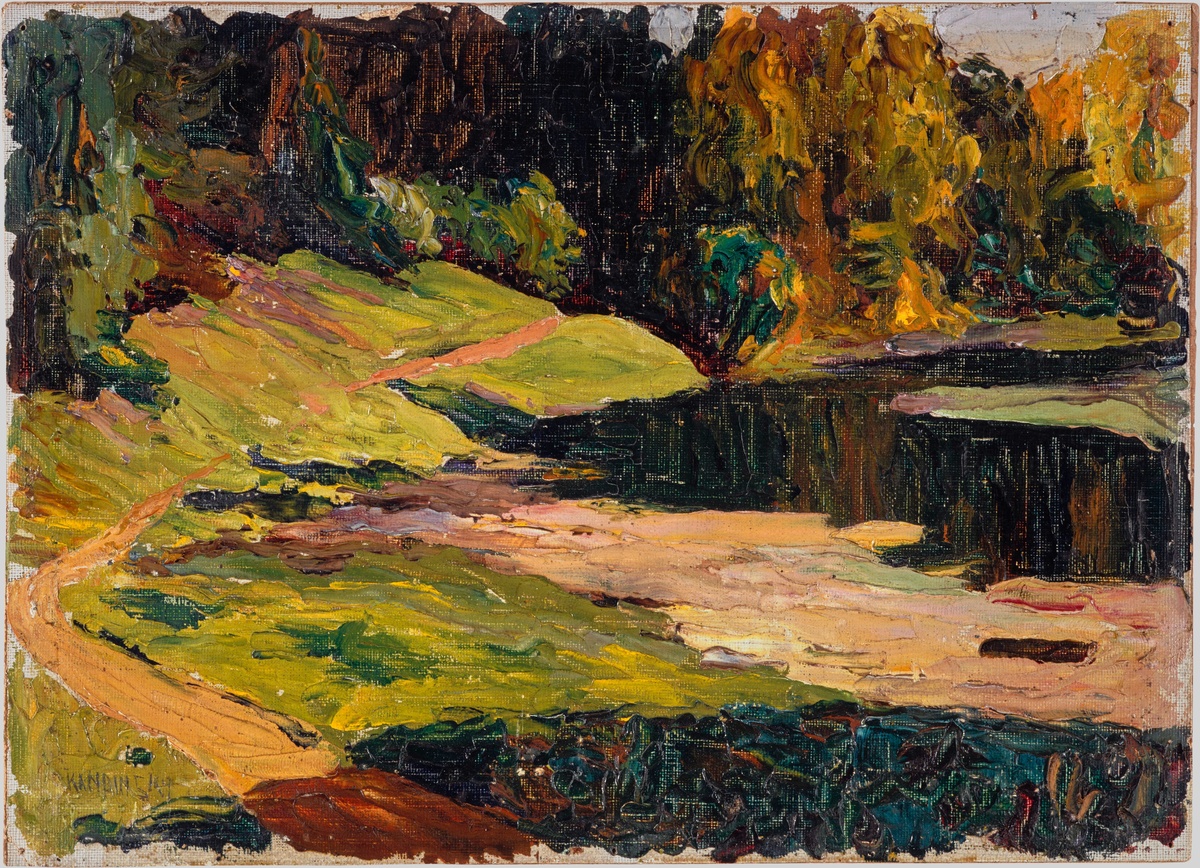
This is Vassily Kandinsky's Akhtyrka, Park, a small landscape in oil on canvas board. It shows a park at Akhtyrka, a town in Ukraine, with a path winding among trees. The Centre Pompidou dates the painting to around 1901 to 1903, so it belongs to Kandinsky's early landscape years, long before the abstractions he is best known for.
The record describes a path through the park, with a dark reflecting pond and sunlit grassy banks. The paint is laid on with thick, directional brushwork. Warm autumn yellows stand against the darker woodland tones. Those contrasts give the small scene its structure and its seasonal character.
The painting sits within a group of early landscapes. A catalogue raisonné by Roethel and Benjamin lists it as number 30 and dates it to 1901. The museum record gives the slightly broader span of around 1901 to 1903. The two datings are close but not identical, and it is worth keeping that small uncertainty in mind.
The work is signed in red at the lower left, with the name KANDINSKY. That signature places it firmly among his own landscapes of this period. It came to the museum through the bequest of Nina Kandinsky in 1981, which is how this early landscape entered a public collection devoted to modern art.
What this painting offers is a direct, close-up view of a place, built from thick strokes and a strong contrast between autumn light and dark trees and water. Seen as an early landscape, it shows Kandinsky working attentively with colour and brushwork in the observable world, before abstraction took over his art.
The story and its sources
Historical claims are linked to the records below. Close looking and interpretation are identified in the passage notes.
- Passage 1Documented historyInstitutional record for Akhtyrka, Park
- Passage 2Close lookingInstitutional record for Akhtyrka, Park
- Passage 3Documented historyInstitutional record for Akhtyrka, Park
- Passage 4Documented historyInstitutional record for Akhtyrka, Park
- Passage 5InterpretationInstitutional record for Akhtyrka, Park
Details to notice
About 2 minutes to readLower-left inscription
A painted signature or inscription is visible near the lower-left edge and is relevant to confirming the attribution and date.
Sunlit grassy bank
The bright yellow-green slope in the left middle ground introduces a vivid, almost acidic light that contrasts with the shadowed trees and water.
Golden autumn canopy
The upper-right trees carry the warmest yellows and oranges in the composition and establish the autumn season against the dark woodland.
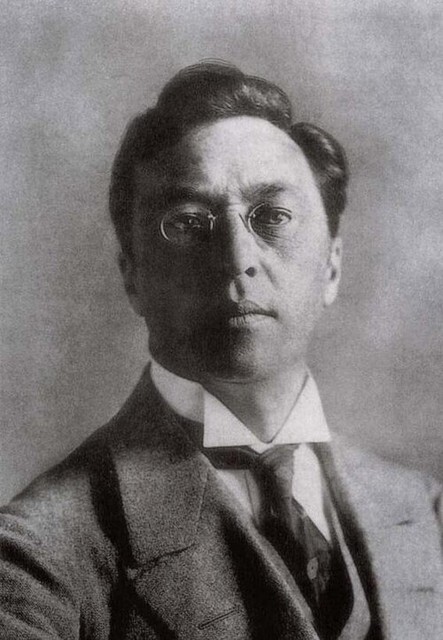
Artist portrait Image credit
未知上傳者. Image source · Public domain
About the artist
Wassily Kandinsky
1866 to 1944
Wassily Kandinsky was an avant-garde painter of Russian origin (1866–1944). Their work is associated with Expressionism; Symbolism; Bauhaus. Their recorded places of work include Paris; Munich; Weimar; Rapallo; The Hague; Russia; Stockholm; Switzerland; Tunis.
- Born
- 1866
- Died
- 1944
- Nationality
- Russian Empire; Russian Soviet Federative Socialist Republic; Soviet Union; France; Germany
- Birthplace
- Moscow
- Died in
- Neuilly-sur-Seine
Biography sources
The research & record
Study the work.
Follow the evidence.
Find catalogue details, historical context, technical research and the literature behind this artwork.
The artwork record
Research catalogue
Catalogue information and detailed research, with references that link to the bibliography.
Updated .
Identity and catalogue
Link- Title
- Akhtyrka, Park
- Artist or attribution
- Vassily Kandinsky
- Object date
- circa 1901-1903
- Medium and support
- Oil on canvas board
- Dimensions
- 23.7 x 32.8 cm
- Current collection or location
- Musée National d'Art Moderne, Centre Pompidou, Paris, France
- Movement or period
- Early twentieth-century landscape painting (pre-abstract period)
- Country or culture
- Russian born, later French
- Depicted subject
- A landscape painting depicting a park at Akhtyrka, a town in Ukraine. The work features a path winding through trees, with a dark reflecting pond and sunlit grassy banks. The scene is rendered with thick, directional brushwork and strong contrasts between warm autumn yellows and dark woodland tones.
- Title variants
- Akhtyrka, Parc
- Accession number
- AM 81-65-9
- Support
- canvas board
- Inscriptions
- S.B.G.en rouge : KANDINSKY
Read valuation records and their limitations
Catalogue identity
The object is catalogued as Akhtyrka, Park (Akhtyrka, Parc), attributed to Vassily Kandinsky and dated in the institutional record to around 1901 to 1903. The same record gives its support and dimensions as oil on canvas board, 23.7 by 32.8 cm. Its subject is identified as a park at Akhtyrka, a town in Ukraine. The work is signed in red at the lower left with the name KANDINSKY, an inscription that belongs to the painted surface rather than to the catalogue apparatus.(www.centrepompidou.fr, n.d.)
The dating carried by the object's own documentation is not the only date attached to it. The catalogue raisonné by Roethel and Benjamin lists the work as number 30 and dates it to 1901. The museum record's broader span of around 1901 to 1903 and the raisonné's year 1901 are close but not identical, and the difference should be kept visible: the catalogue number and its date are one authority's determination, while the institution's circa range is another's. Neither should be silently collapsed into the other, and the object date should not be confused with the accessions and bequest events that brought it into a public collection.(www.centrepompidou.fr, n.d., cat. n° 30)
The painting is titled Akhtyrka, Park (Akhtyrka, Parc) and was created by Vassily Kandinsky around 1901-1903.(www.centrepompidou.fr, n.d.)
The painting is signed in red, lower left: 'KANDINSKY'.(www.centrepompidou.fr, n.d.)
The painting is listed in the catalogue raisonné by Roethel and Benjamin as catalogue number 30, dated 1901.(www.centrepompidou.fr, n.d.)
Subject and iconography
LinkRead valuation records and their limitations
The recorded subject
Visual observation
The institutional record identifies the work as Akhtyrka, Park (Akhtyrka, Parc) by Vassily Kandinsky, depicting a park at Akhtyrka, a town in Ukraine, with a path, trees and a landscape. The description is an observation of subject rather than an interpretation of style: what the record establishes at this level is a recognizable outdoor scene organized around a route through planted ground and open terrain. The same record supplies the physical frame within which that scene is seen, noting oil on canvas board and dimensions of 23.7 by 32.8 cm. The small scale matters for how the park is read, since the composition has to carry path, trees and landscape within a modest support. The evidence supports the view of a topographical subject tied to a named place; it does not, on its own, establish the season, the hour or any symbolic program.(www.centrepompidou.fr, n.d.)
Interpretation
The record states that the painting is signed in red, lower left, with the name KANDINSKY. The signature is a visible inscription whose position and colour are documented, and it is the detail through which the surface can be tied to the artist's own hand rather than to later attribution alone. The dating requires care. The Centre Pompidou dates the work to around 1901 to 1903, while the catalogue raisonné by Roethel and Benjamin lists it as catalogue number 30, dated 1901. These are close but not identical positions. The single-year entry in the raisonné and the broader span in the museum record should be kept distinct rather than collapsed, since the present evidence does not explain why the two accounts differ in precision. Interpretively, the pairing of a red signature with a small, place-specific landscape places the object within Kandinsky's early work on observed terrain, but that framing is a synthesis from the identified subject, date range and inscription, not a claim the record itself makes.(www.centrepompidou.fr, n.d.)
Visual observation
The painting depicts a park at Akhtyrka, a town in Ukraine, featuring a path, trees, and a landscape.(www.centrepompidou.fr, n.d.)
Materials and technique
LinkRead valuation records and their limitations
Documented materials and support
The institutional record for Akhtyrka, Park (Akhtyrka, Parc) describes the work as oil on canvas board, measuring 23.7 by 32.8 cm. These two elements, the medium and the support, are the only material facts the supplied record documents. The use of canvas board rather than stretched canvas places the painting in a category of small, portable supports, and the dimensions confirm a modest scale consistent with a landscape study made on site or close to it. The record does not describe a ground layer, priming, varnish, stretcher or frame, and no technical imaging, cross-section or pigment analysis is reported, so the account below distinguishes throughout between what the record states, what the image shows and what can only be inferred.(www.centrepompidou.fr, n.d.)
Signature and dating
The record adds that the painting is signed in red at the lower left with the name KANDINSKY. The signature is the one element of pigment application the institution explicitly notes, and its position and colour are given as documented facts rather than inferred from reproduction. Read alongside the support and dimensions, the signature locates the work within Kandinsky's own output of this period, but the record does not say when the signature was applied, whether it belongs to the moment of execution or to a later signing, or what medium the red inscription uses beyond its colour. Those questions remain open in the evidence supplied.(www.centrepompidou.fr, n.d.)
Dating bears directly on any account of technique, because it frames the work within Kandinsky's early landscape years, before the abstractions for which he is best known. The source record states that the painting is listed in the catalogue raisonné by Roethel and Benjamin as catalogue number 30, dated 1901, while the same record gives the broader span of around 1901 to 1903. The two datings are close but not identical. The discrepancy does not resolve into a question of materials, since nothing in the evidence links a change of support, pigment or handling to either date; it is a difference between a catalogue raisonné entry and the museum's own dating range, and it should be preserved as such rather than used to date particular paint layers.(www.centrepompidou.fr, n.d.)
Interpretation
Within a larger history of materials, the object's importance lies less in any novelty of technique than in what its documentation permits: a small oil on canvas board, precisely measured, signed in red, catalogued, and preserved through the bequest of Nina Kandinsky in 1981 into the collection of the Musée National d'Art Moderne, Centre Pompidou, Paris, as accession AM 81-65-9. That combination of a portable support, a modest format and an early landscape subject situates it among the working pictures of Kandinsky's pre-abstract years, and the thinness of the technical record is itself instructive, since claims about his early pigment choices or layering would need examination evidence that the supplied units do not contain.(www.centrepompidou.fr, n.d.)
The medium is oil on canvas board, measuring 23.7 x 32.8 cm.(www.centrepompidou.fr, n.d.)
Provenance and ownership
LinkRead valuation records and their limitations
The Documented Transfer
The documented provenance of Akhtyrka, Park (Akhtyrka, Parc) in the public record begins with a single transfer: the painting entered the collection through the bequest of Nina Kandinsky in 1981. The institutional record of the Musée National d'Art Moderne, Centre Pompidou, Paris, states this acquisition plainly and associates it with the work's accession number, AM 81-65-9, an identifier whose 1981 segment corresponds to the year of the bequest. Within that record, 1981 is the only dated point of ownership change for the object; the evidence supplied does not document any earlier private owner, sale, dealer transaction, or intermediate transfer between the artist's hands and the bequest that brought the work to the museum.(www.centrepompidou.fr, n.d.)
Interpretation
The gap between the painting's making and its 1981 entry into the museum should be described as an unrecorded interval, not as a proven continuity of ownership. The same institutional record dates the work to around 1901 to 1903 and identifies it in the Roethel and Benjamin catalogue raisonné as number 30, dated 1901, so the documented record establishes creation around the turn of the century and a museum acquisition in 1981 but leaves the intervening roughly eight decades without a documented chain of possession in the supplied evidence. No owner, location, or transaction should be inferred for that period. The bequest is documented; the route by which the painting reached the bequest is not.(www.centrepompidou.fr, n.d.)
The accession number AM 81-65-9 is the concrete link between the bequest and the object's current institutional identity, and it can be read alongside the title and attribution that the museum record fixes for the work: Akhtyrka, Park (Akhtyrka, Parc), by Vassily Kandinsky, oil on canvas board, measuring 23.7 by 32.8 cm. These particulars belong to the same record as the bequest statement, which means the provenance fact and the descriptive identification of the painting derive from one institutional source rather than from independent corroboration. That shared origin is a qualification worth stating: the 1981 bequest is documented as the museum records it, but the supplied evidence does not offer a second, separate account against which the date or the terms of the transfer could be checked.(www.centrepompidou.fr, n.d.)
Collection Context and Later Display
The bequest also situates an early landscape within a public collection devoted to modern art. Nina Kandinsky's bequest placed this small park scene, made long before Kandinsky's abstractions, among the holdings of the Musée National d'Art Moderne, where the museum's own record treats it as part of the artist's early landscape production and catalogues it as number 30 in Roethel and Benjamin. The provenance and the later exhibition life of the object are distinct categories of evidence: the Centre Pompidou record notes that the work is currently on display at Palazzo Bonaparte, Rome, as part of the exhibition "Kandinsky" from 15 September 2026 to 14 February 2027. A loan for exhibition is not a change of ownership, and the record frames the Rome showing as a display of a work that remains in the Paris collection under accession AM 81-65-9.(www.centrepompidou.fr, n.d.)
The painting was acquired through the bequest of Nina Kandinsky in 1981.(www.centrepompidou.fr, n.d.)
Provenance timeline
- 1981
The painting entered the collection through the bequest of Nina Kandinsky.(www.centrepompidou.fr, n.d.)
- 15 September 2026 to 14 February 2027
The work is scheduled for display at Palazzo Bonaparte in Rome as part of the exhibition Kandinsky.(www.centrepompidou.fr, n.d.)
Exhibition history
LinkRead valuation records and their limitations
Exhibition History and Current Display
The exhibition record for Vassily Kandinsky's Akhtyrka, Park (Akhtyrka, Parc) is anchored by a single documented display: the institutional record for the painting states that it is currently on display at Palazzo Bonaparte, Rome, Italy, as part of the exhibition titled 'Kandinsky', running from 15 September 2026 to 14 February 2027. This is the only exhibition supplied by the evidence, and it should be distinguished carefully from the history of how the object entered public keeping. The painting belongs to the Musée National d'Art Moderne, Centre Pompidou, Paris, under accession number AM 81-65-9, and reached the museum through the bequest of Nina Kandinsky in 1981. The Roman showing is therefore a presentation of a Centre Pompidou collection work at a host venue rather than evidence of a different ownership or a separate collecting history, and the record does not give a checklist number, installation details, or any earlier venue for the exhibition.(www.centrepompidou.fr, n.d.)
Interpretation
The evidence does not document a fuller exhibition history for the work. Only the Palazzo Bonaparte presentation is recorded, and no previous exhibition, catalogue entry prepared for an exhibition, or checklist number is supplied. That gap matters for how the object can be used in an account of Kandinsky's early landscape years. The museum record does describe the painting's catalogue raisonné position, listing it in the Roethel and Benjamin catalogue as number 30, dated 1901, while the same institutional record gives a broader dating of around 1901 to 1903. That catalogue number and date belong to the scholarly apparatus of the raisonné, not to an exhibition catalogue, and they should not be conflated with the Roman display or treated as an exhibition reference. The distinction is worth preserving because it separates documentation of what the object is from documentation of where and when it has been shown.(www.centrepompidou.fr, n.d.)
The physical description in the institutional record provides the terms in which the Roman display can be understood: the work is a landscape depicting a park at Akhtyrka, a town in Ukraine, with a path, trees, and a landscape, painted in oil on canvas board and measuring 23.7 x 32.8 cm. It is signed in red, lower left, 'KANDINSKY'. These are the facts a viewer at Palazzo Bonaparte would encounter in the object itself, while the exhibition title 'Kandinsky' and its dates are facts about the presentation rather than about the painting. Keeping the two categories separate is what allows the entry to serve as an accumulating research account: the display is a dated, located event, and the object is a signed, measured, catalogued work now held in Paris.(www.centrepompidou.fr, n.d.)
The work is currently on display at Palazzo Bonaparte, Rome, Italy, as part of the exhibition 'Kandinsky' from 15 September 2026 to 14 February 2027.(www.centrepompidou.fr, n.d.)
Collection and display
LinkRead valuation records and their limitations
Institutional record and accession
The landscape known as Akhtyrka, Park (Akhtyrka, Parc) is recorded in the collection of the Musée National d'Art Moderne, Centre Pompidou, Paris, under accession number AM 81-65-9. The title and the identification of the subject as a park at Akhtyrka, a town in Ukraine, follow the institutional record for the work, which also gives the medium as oil on canvas board and the dimensions as 23.7 by 32.8 cm. These are modest measurements for a painting that belongs to the artist's early landscape years, and the support of canvas board is itself consistent with a small, portable study rather than a large exhibition canvas. The record attributes the work to Vassily Kandinsky and places its creation around 1901 to 1903, while noting that the painting is signed in red at the lower left with the name KANDINSKY.(www.centrepompidou.fr, n.d.)
The date of the painting is given in two closely related but not identical forms. The Centre Pompidou record offers a span of around 1901 to 1903, treating the work as belonging to a period rather than to a single documented year. The catalogue raisonné compiled by Roethel and Benjamin lists the painting as catalogue number 30 and dates it to 1901, a narrower attribution. The two accounts are near enough to be compatible, and the difference is small, but it matters for how the object is situated: the catalogue raisonné assigns a specific year, while the museum leaves a margin. Neither account should be collapsed into the other, since the catalogue dating represents a scholarly attribution within the reference work and the museum dating reflects the institution's own framing of the early landscape period.(www.centrepompidou.fr, n.d.)
The painting entered the public collection through the bequest of Nina Kandinsky in 1981. That provenance is the route by which an early landscape at Akhtyrka became part of a national modern art collection in Paris, and it connects the small canvas board to a larger history of how Kandinsky's estate was distributed to public institutions. The institutional record also places the work on display at Palazzo Bonaparte in Rome as part of the exhibition "Kandinsky" from 15 September 2026 to 14 February 2027. The exhibition history and the accession record together show an object that is both part of a permanent collection and periodically lent for display, which is how a small early work remains visible within a broader narrative of the artist's development.(www.centrepompidou.fr, n.d.)
The work is in the collection of the Musée National d'Art Moderne, Centre Pompidou, Paris, with accession number AM 81-65-9.(www.centrepompidou.fr, n.d.)
Documented values and qualified estimates
LinkRead valuation records and their limitations
The object and its documented record
Interpretation
The object under consideration is Vassily Kandinsky's Akhtyrka, Park (Akhtyrka, Parc), a small landscape in oil on canvas board measuring 23.7 x 32.8 cm, depicting a park at Akhtyrka, a town in Ukraine, with a path, trees and landscape. The Centre Pompidou, where the work is held in the Musée National d'Art Moderne under accession number AM 81-65-9, dates it to around 1901 to 1903. The painting is signed in red at the lower left with the name KANDINSKY, and it entered the museum through the bequest of Nina Kandinsky in 1981. These are the stable facts of identity, medium, scale, location and provenance that any valuation account must start from: a documented early Kandinsky oil, not a later abstraction, held in a major public collection.(Wikimedia Commons: Akhtyrka, Park, n.d.)(www.centrepompidou.fr, n.d.)(collection.centrepompidou.fr, n.d.)
The working insurance estimate
The working insurance estimate recorded in the archive sets an estimated value of US$1M to US$4M, generated on 2026-10-30 as a broad working range. Its stated methodology is explicitly derivative rather than transactional: the range is derived from confirmed catalog context rather than any public price. The factors cited as supporting a substantial figure are the status of a major artist, an early pre-abstract period, inclusion in the Roethel and Benjamin catalogue raisonné (cat. no. 30, dated 1901), and strong museum provenance through the 1981 Nina Kandinsky bequest, together with an extensive international exhibition and bibliography record. Against these, the modest dimensions of 23.7 x 32.8 cm and the canvas board support are treated conservatively, which is why the range is deliberately wide.(Wikimedia Commons: Akhtyrka, Park, n.d.)(www.centrepompidou.fr, n.d.)(collection.centrepompidou.fr, n.d.)
The estimate's own qualification is decisive for how it should be read: it is a model-generated working range for manual review only, not an official insurance value, appraisal, auction result or sale price, and no comparable sales or private insurance records were used in producing it. This means the figure is an interpretive instrument, useful for prompting further investigation of the work's market and insurance context, but it carries no authority as a market fact. The valuation also records a small but real dating nuance: the catalogue raisonné dates the work to 1901, while the museum record gives the slightly broader span of around 1901 to 1903. That difference does not alter the work's identity but qualifies any precision claimed for its earliest date.(Wikimedia Commons: Akhtyrka, Park, n.d.)(www.centrepompidou.fr, n.d.)(collection.centrepompidou.fr, n.d.)
Recorded values in context
Read as a whole, the valuation materials show how recorded values for such an object are constructed from documented attributes rather than from prices. Artist, period, catalogue raisonné inclusion, museum provenance, exhibition and bibliography record all push the range upward; scale and support pull it back. The absence of supplied comparable sales is the central gap the estimate acknowledges. Within a larger history of art and material culture, this small oil on board exemplifies how an early, modest landscape by a later canonical figure accrues institutional and scholarly value through bequest, cataloguing and exhibition, and how even a provisional monetary range is built on that documentary scaffolding rather than on the painting's actual appearance.(Wikimedia Commons: Akhtyrka, Park, n.d.)(www.centrepompidou.fr, n.d.)(collection.centrepompidou.fr, n.d.)
Working estimate
Calculated working insurance estimate, not a sale price: Estimated value: US$1M to US$4M Recorded date: Working calculation, generated 2026-10-30. Methodology: Broad working range derived from confirmed catalog context rather than any public price. It reflects a documented Kandinsky pre-abstract oil of circa 1901 to 1903 listed in the Roethel and Benjamin catalogue raisonne (cat. no. 30), small in scale (23.7 x 32.8 cm), on oil on canvas board, with a red signature, held in the Musee National d'Art Moderne and acquired through the 1981 Nina Kandinsky bequest, with an extensive international exhibition and bibliography record. These factors of major artist, early period, catalogue raisonne inclusion, and strong museum provenance support a substantial range, while the modest size and board support are treated conservatively. No comparable sales were supplied, so the range is deliberately wide and intended for manual review only. Qualification: Model-generated working range for manual review only. This is not an official insurance value, appraisal, auction result, or sale price, and no comparable sales or private insurance records were used.(Wikimedia Commons: Akhtyrka, Park, n.d.)(www.centrepompidou.fr, n.d.)(collection.centrepompidou.fr, n.d.)
Further reading
Books for a closer look
Paid links. As an Amazon Associate I earn from qualifying purchases.

Open Library Kandinsky: Russian and Bauhaus years, 1915-1933.
Solomon R. Guggenheim Museum
Catalogue record lists Kandinsky, Centre Georges Pompidou and Musée national d'art moderne, plus 'Catalogues raisonnés' and 'Themes, motives'. These subjects connect directly to this painting's documented collection at the Centre Pompidou and its inclusion in the Roethel and Benjamin catalogue raisonné, making it the most object-relevant candidate.
ISBN 0892070447

Open Library Vassily Kandinsky
Poligrafa; Polı́grafa; D.A.P./Distributed Art Publishers [distributor]
A study of Vassily Kandinsky with subject 'Criticism and interpretation', relevant through the named artist. It addresses his work critically rather than being fiction, a children's book or a calendar, though the record gives no indication it treats Akhtyrka specifically.
ISBN 9788434312135

Open Library Vassily Kandinsky: la revolucio del llenguatge pictoric
MACBA
Catalogue record for a multi-author volume on Vassily Kandinsky, relevant through the named artist of Akhtyrka, Park. No subjects are recorded, so the connection rests only on the artist and cannot be tied to this landscape or its Ukrainian setting.
ISBN 9788492098989
Bibliography
Sources and further reading
References are arranged by author or organisation, with links to the original publications. Where no publication date is recorded, n.d. means no date.
Source notes updated .
No recorded sources match these filters. Reset the filters to see the full bibliography.
- 05
Book
Vassily Kandinsky. Poligrafa; Polı́grafa; D.A.P./Distributed Art Publishers [distributor].
A study of Vassily Kandinsky with subject 'Criticism and interpretation', relevant through the named artist. It addresses his work critically rather than being fiction, a children's book or a calendar, though the record gives no indication it treats Akhtyrka specifically.
- ISBN
- 9788434312135
Citation text
- 03
Official · About this artwork
Institutional record for Akhtyrka, Park. Vassily KANDINSKY - Akhtyrka, Park (Akhtyrka, Parc) | Musée national d’art moderne – Centre Pompidou.
Online collection page with detailed object information and exhibition history.
- Language
- French
Citation text
- 06
Catalogue record for a multi-author volume on Vassily Kandinsky, relevant through the named artist of Akhtyrka, Park. No subjects are recorded, so the connection rests only on the artist and cannot be tied to this landscape or its Ukrainian setting.
- ISBN
- 9788492098989
Citation text
- 04
Book
Kandinsky: Russian and Bauhaus years, 1915-1933. Solomon R. Guggenheim Museum.
Catalogue record lists Kandinsky, Centre Georges Pompidou and Musée national d'art moderne, plus 'Catalogues raisonnés' and 'Themes, motives'. These subjects connect directly to this painting's documented collection at the Centre Pompidou and its inclusion in the Roethel and Benjamin catalogue raisonné, making it the most object-relevant candidate.
- ISBN
- 0892070447
Citation text
- 01
Secondary
Wikimedia Commons: Akhtyrka, Park (n.d.). Wikimedia Commons.
Citation text
- 02
Official · About this artwork
Institutional record for Akhtyrka, Park. Akhtyrka, Park (Akhtyrka, Parc) | Musée national d’art moderne – Centre Pompidou.
Official collection record providing title, artist, date, medium, dimensions, provenance, exhibition history, and bibliography.
- Language
- French
Citation text
Art to live with
Bring this painting
home.
A piece of the archive, made yours. Explore Akhtyrka, Park in a size and finish that fits your space.
Your text and annotations appear on these editions. Adding to cart saves that design for printing.
Combine this painting with your favourites01 / Find your edition
Made for you
Suggested from your location. Change it if you're sending elsewhere or using a VPN. Prices and delivery are shown in GBP.
1 product
Choose an edition to make it yours
iPhone 12 Mini ? Glossy ? back view
iPhone 12 Mini · Glossy

iPhone 12 Mini ? Glossy ? back view

iPhone 12 Mini ? Glossy ? back view

iPhone 12 Mini ? Glossy ? back view
Tough phone case
GBP 16.34
Delivery GBP 4.22 / Total GBP 20.56
A two-layer phone case with a printed polycarbonate shell and a shock-absorbing inner liner.
Two layers with a shock-absorbing TPU liner
Case & print details
- Device
- Apple · iPhone 12 Mini
- Material
- Polycarbonate shell with a TPU inner liner
- Artwork
- Outer back and wrapped edges from one template
- Finish
- Glossy
- Version
- Standard version
- Printing
- Dye sublimation
- Print file
- 1,122 × 1,831 px · 95 × 155 mm · PNG · 300 dpi recommended
Rear outline and camera openings follow this variant's Printify template. Case depth and small hardware remain illustrative.
Supplier product detailsFit and fill keep the painting’s proportions. Stretch changes them.
Move and zoom the painting on your tough phone case.
Made to order with your design
Made to order
US delivery only
The 30 cm ruler is scaled alongside your selected print. Keep the painting’s proportions with a black background, or stretch it to fill. Frame width, material texture and screen colours are illustrative.
Keep exploring