ArchiveWork

Artwork record / 290 of 331

Work by Ford Madox Brown (between 1852 and 1865; catalogue date 1863)

Artist: Ford Madox Brown

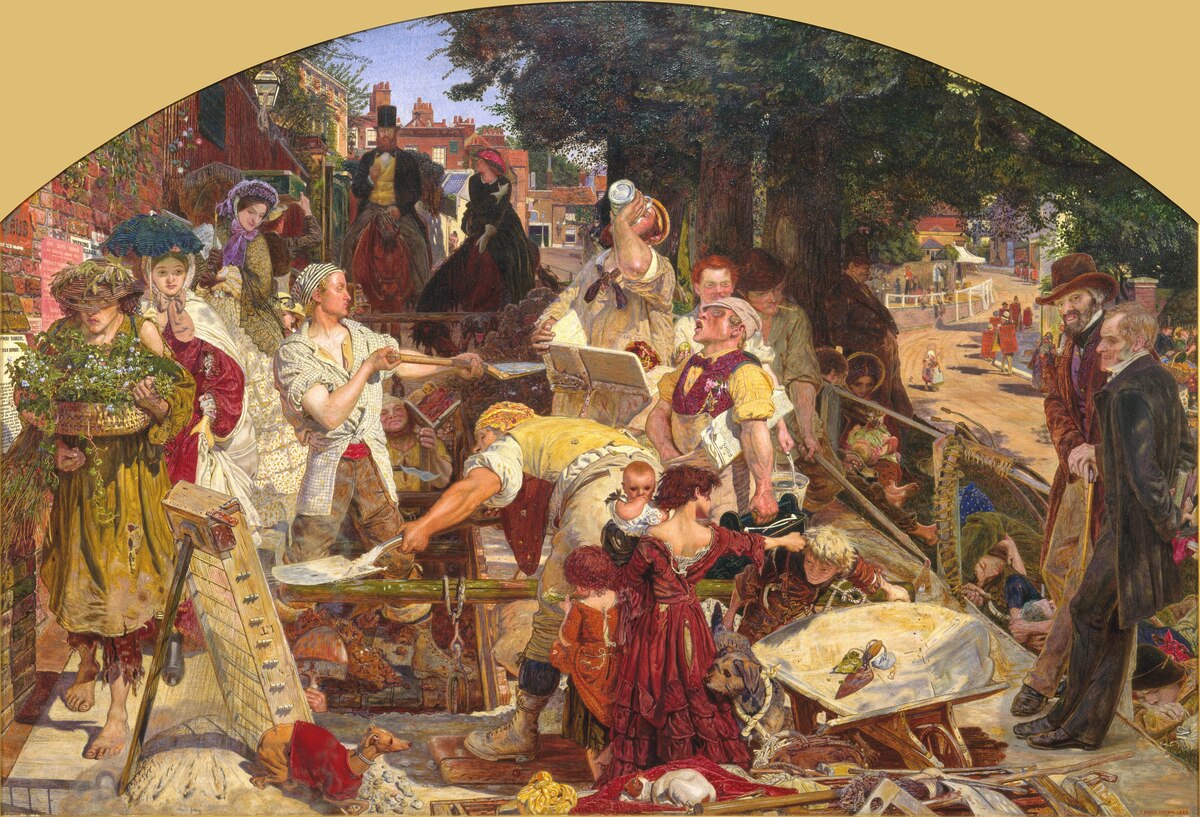
Ford Madox Brown's Work shows labourers digging a street while a girl with a baby, ragged flower sellers and two well-dressed gentlemen share the same space. This short tour follows what the supplied record establishes and what it leaves open.

Read the story ↓ About the artist ↓ Research and record ↓ Literature and sources ↓ Listen to the article ↓
Article text for AI
Shop this artwork ↓ 0 visits
Datebetween 1852 and 1865; catalogue date 1863CultureBritish PeriodPre-RaphaeliteCurrent locationBirmingham Museums Trust (collections data via Wikimedia Commons); captions also associate the work with Manchester Art Gallery
Listen to the article
100%
Work by Ford Madox Brown (between 1852 and 1865; catalogue date 1863)
Loading full-resolution artwork…
Scroll to zoom · drag to pan · double-click to focus Pinch to zoom · drag to explore · double-tap to focus FIELD VIEW / 290
Tools & download
Pixel colour Select a pixel with the eyedropper
No pixel selected

Choose the eyedropper, then click or tap the image. Scroll to zoom for finer selection.

Add text

Hand to pan · Select to move text and drawings · Add as many texts as you like · Scroll to zoom

Work: high-resolution image

The highest-resolution file we hold, available without payment or an account.3,840 × 2,613 pixels.

Download highest-resolution image

Details to notice

About 2 minutes to read
01

Brick wall of bills and tracts

The left-hand brick wall pasted with bills, leaflets and tracts (emigration and temperance notices alongside the 'Work' bill), a symbolic object commenting on the social options offered to the poor who stand in front of it.

02

Workman drinking from a can

The navvy in a pale shirt and straw hat tilted back as he drinks from a blue and white can raised to his lips, a moment of rest and refreshment that contrasts with the digging around him.

03

Two gentlemen onlookers

The two well-dressed men at the right, one in a brown top hat and one bareheaded with white hair (traditionally Carlyle and F. D. Maurice), standing apart from the labour; their appraising gaze sets up the painting's argument about work, class and social thought.

Artist portrait of Ford Madox Brown
Artist portrait Image credit

Unknown author Unknown author. Image source · Public domain

About the artist

Ford Madox Brown

1821 to 1893

Ford Madox Brown was a British painter (1821–1893). Their work is associated with Pre-Raphaelite Brotherhood.

Born
1821
Died
1893
Nationality
United Kingdom of Great Britain and Ireland; United Kingdom; France
Birthplace
Calais
Died in
London

The research & record

Study the work.
Follow the evidence.

Find catalogue details, historical context, technical research and the literature behind this artwork.

Article text for AI
Open research text

The artwork record

Research catalogue

Catalogue information and detailed research, with references that link to the bibliography.

Updated .

Identity and catalogue

Link
Artist or attribution
Ford Madox Brown
Object date
between 1852 and 1865; catalogue date 1863(Wikimedia Commons contributors, 2015)
Medium and support
Oil on canvas(Wikimedia Commons contributors, 2015)
Dimensions
990 x 684 mm
Current collection or location
Birmingham Museums Trust (collections data via Wikimedia Commons); captions also associate the work with Manchester Art Gallery(Wikimedia Commons contributors, 2015)
Movement or period
Pre-Raphaelite
Country or culture
British
Depicted subject
A modern-life scene of labour beside a street: labourers dig in the centre, observed by two well-dressed gentlemen on the right, while ragged flower sellers and a girl carrying a baby occupy the left and foreground edges. The supplied Commons record establishes the depicted labour and the presence of poverty and observation rather than describing a specific narrative episode.(Wikimedia Commons contributors, 2015)
Title variants
Work (painting); Le Travail (Brown); Trabajo (cuadro); 노동 (브라운)
Attribution qualification
Attribution to Ford Madox Brown is established in the supplied source; the object is a photographic reproduction of the painting, not the painting itself.
Accession number
1927P349
Support
Canvas
Identification and the record's dating

The catalogue record identifies this painting as Work by Ford Madox Brown, whose dates are given as 1821 to 1893. The artist's lifespan supplies the outer frame for the object's history, while the making of the picture is placed inside it. Beyond the title and attribution, the record's own accounting of when the painting was made is not uniform.(Wikimedia Commons contributors, 2015, File information, Summary)

The Commons caption dates the painting between 1852 and 1865, whereas the object data gives 1863. Read together, these statements describe a long span of making rather than a single moment: 1863 falls within the range the caption states, but the caption does not reduce the work to that year. The record therefore preserves both a broad period of execution and a narrower catalogue date, and the two should not be collapsed into one another.(Wikimedia Commons contributors, 2015, Captions and Summary, Date)

The painting is titled Work and is by Ford Madox Brown, who lived from 1821 to 1893.(Wikimedia Commons contributors, 2015)

The Commons caption dates the painting between 1852 and 1865, while the object data gives 1863, so the making spans a long period in the record's own accounting.(Wikimedia Commons contributors, 2015)

Subject and iconography

Link
The Composition and Its Subjects

Visual observation

The supplied record captions this painting Work and describes it as presenting the concept of collective labour; the Arabic caption on the same file describes the image as embodying the idea of collective work. That caption-level reading is attached to the file rather than to a scholarly catalogue entry, and it frames the subject as shared labour rather than as any single protagonist. The record also carries detail files that cut into the painting, including a detail showing the figures traditionally identified as Thomas Carlyle and F. D. Maurice, which indicates that these identified figures sit within the composition rather than outside it. Crucially, the record presents that identification as a tradition rather than as certain fact, so the named figures are a received attribution attached to particular painted bodies, not a documented identification established by the file itself.(Wikimedia Commons contributors, 2015, Captions, Arabic)

The supplied record captions the painting Work in a way that presents the concept of collective labour; the Arabic caption on the same file describes the image as embodying the idea of collective work.(Wikimedia Commons contributors, 2015)

Materials and technique

Link
Documented support and medium

The supplied object record describes Work as an oil painting on canvas measuring 990 by 684 millimetres, and attributes it to Ford Madox Brown, who lived from 1821 to 1893. The medium statement places the picture within the tradition of nineteenth-century British oil painting on a prepared textile support, and the dimensions establish it as a substantial easel painting rather than a small sketch or study. These are recorded facts about the object rather than observations drawn from looking at the image, and they set the physical parameters within which any account of Brown's making process has to operate. The same record lists the object in the collection of Birmingham Museum and Art Gallery, under Birmingham Museums Trust, with the accession number 1927P349. That accession information is part of the object's documented institutional history and is distinct from the caption material discussed below, which carries a different gallery name.(Wikimedia Commons contributors, 2015, Summary, Medium and Dimensions)

The making of the painting is not dated to a single year in the supplied record. The Commons caption dates it between 1852 and 1865, while the object data gives 1863, so the record's own accounting spans a long period of work rather than fixing one moment of completion. That discrepancy matters for materials and technique because a canvas painted across more than a decade can carry revisions, adjustments and repainting that a single-year attribution would obscure. The evidence does not describe any specific layer, pigment, ground or preparation, nor does it identify a particular tool or working method, so the technical account of how the surface was built up remains outside what these units establish. What can be said is that the recorded date range and the medium statement together frame the picture as a long-laboured oil on canvas, and that the difference between the caption date range and the object-data year is a qualification carried by the record itself, not a point resolved by it.(Wikimedia Commons contributors, 2015, Summary, Medium and Dimensions)

Reproduction and close looking

The supplied page records detail files that cut into the painting, including a detail showing the figures traditionally identified as Thomas Carlyle and F. D. Maurice. This indicates that these identified figures sit within the composition and that the record has chosen to isolate them photographically from the whole. The identification is given as a tradition rather than as certain fact, so the presence of the figures within the canvas is the documented element, while the names attached to them belong to an inherited account. For materials and technique, the existence of such detail files is evidence about how the object has been documented and reproduced rather than about how it was painted; it shows the picture being examined at close range through derived images. The file itself draws on a Google Cultural Institute photographic source identified as 1QG5Dp3Ti29BxA and is described as a faithful photographic reproduction of a two-dimensional public domain work of art, which places the available visual record at one remove from the physical canvas.(Wikimedia Commons contributors, 2015, Summary, Medium and Dimensions)

The Commons page records the painting in public domain because the artist died in 1893, which places its copyright status well outside the artist's lifetime. That licensing statement is not a statement about pigments or supports, but it explains why the object circulates in the form of a photographic reproduction and why detail files can be derived from it. The reproduction status and the public domain determination together define the conditions under which the materials and surface of the painting can currently be studied from the supplied record: through a faithful photographic reproduction of a two-dimensional work, supplemented by details that cut into the composition. No physical examination, sampling, imaging or conservation record is supplied here, so any claim about ground layers, pigment identification or later treatment would exceed the evidence.(Wikimedia Commons contributors, 2015, Summary, Medium and Dimensions)

Visual observation

The record also carries a caption that presents Work in a way that expresses the concept of collective labour, and the Arabic caption on the same file describes the image as embodying the idea of collective work. That reading gathers the figures in the street around one shared idea of labour. In relation to materials and technique, the caption is evidence of how the object has been framed for viewers on the supplied page rather than evidence of how it was made. It is an attributed interpretive caption, and it should not be promoted into a documented account of Brown's preparation, palette or method. Its value here is contextual: it shows that the same record that supplies the medium, dimensions and accession number also supplies a thematic interpretation of the subject, and the two kinds of statement need to be kept apart.(Wikimedia Commons contributors, 2015, Captions, Arabic; Summary, Medium and Dimensions)

The supplied record describes the work as oil on canvas measuring 990 by 684 millimetres.(Wikimedia Commons contributors, 2015)

Provenance and ownership

Link
Provenance

The object at the centre of this record is a two-dimensional work of art reproduced photographically through the Google Cultural Institute, whose source is identified as 1QG5Dp3Ti29BxA. The file itself is described as a faithful photographic reproduction of a two-dimensional public domain work, which distinguishes the surviving digital surrogate from the physical painting and establishes that what a viewer encounters through the record is a photographic transcription rather than the canvas itself. Because the source is a public domain two-dimensional work, the reproduction could be circulated without the licensing constraints that normally accompany photographic documentation of collection objects. The same Commons page, which records the painting in public domain because the artist died in 1893, places its copyright status well outside the artist's lifetime, so the statutory basis for free circulation rests on the age of the artist's death rather than on any permission granted by a holding institution. This licensing detail matters for provenance research because it explains how the image entered public circulation independently of the museum that owns it, and it means the record's own authority derives from the photographic source and the Commons metadata rather than from collection documentation issued at the point of ownership.(Wikimedia Commons contributors, 2015, Summary, Source/Photographer; Licensing)

The file draws on a Google Cultural Institute photographic source identified as 1QG5Dp3Ti29BxA and is a faithful photographic reproduction of a two-dimensional public domain work of art.(Wikimedia Commons contributors, 2015)

Reception and literature

Link
Reproduction, rights, and the public record

Reception of Ford Madox Brown's Work in the supplied record begins with the conditions under which the image itself circulates. The file is described as a faithful photographic reproduction of a two-dimensional public domain work of art, and it draws on a Google Cultural Institute photographic source identified as 1QG5Dp3Ti29BxA. The public domain status is recorded on the Commons page by reference to the artist's death in 1893, which places copyright status well outside the artist's lifetime. Two things are therefore being established at once: the legal availability of the painted image for reuse, and the dependence of that availability on a photographic intermediary rather than on the canvas alone. The reproduction is the vehicle of reception here. It is what allows the object to be captioned, indexed, translated, and re-read on a page whose primary purpose is not curation in a gallery but distribution across a wiki.(Wikimedia Commons contributors, 2015, Licensing; Summary, Source/Photographer)

Identifications and their evidentiary status

Detail files on the same record cut into the painting and isolate specific figures, including a detail showing the figures traditionally identified as Thomas Carlyle and F. D. Maurice. The record does not present these identifications as documented fact; it presents them as a tradition. That distinction matters for reception because it shows a later stage in which viewers and cataloguers have parsed the crowd into named individuals, and it shows the archive registering that parsing while withholding certainty. The identified figures sit within the composition rather than being appended to it, so the named identification is a reading of figures that are already present, not a claim about a separate document. Reception here takes the form of progressive specification: a group of watching men in the painting becomes, in tradition, two named Victorian thinkers, and the record preserves both the specification and its qualified status.(Wikimedia Commons contributors, 2015, Licensing)

Disputed date and unsettled location

The record leaves key questions open in ways that shape how the painting can be received. Its caption dates Work between 1852 and 1865, while the object data gives 1863, so the making spans a long period in the record's own accounting and the single year 1863 is one point within a wider span. The collection line names Birmingham Museum and Art Gallery, under Birmingham Museums Trust, with accession number 1927P349, yet the English caption to the file names Manchester Art Gallery. Both gallery names sit on the same page, and the present home is therefore not settled by this record. For reception, this means that even the institutional frame through which the object is normally encountered is unstable in the source. The painting is received simultaneously as a Birmingham-held object with a documented accession number and as an image whose caption points to Manchester. The accession number is the more specific institutional datum; the caption's gallery name is the more visible public label. Neither can be discarded without losing information the record actually contains.(Wikimedia Commons contributors, 2015, Licensing)

Why the object sustains multiple receptions

Interpretation

The reception history assembled from these units is not reducible to a single dramatic moment. Public domain licensing, photographic reproduction through a Google Cultural Institute source, multilingual captioning around the idea of collective labour, the traditional naming of Carlyle and Maurice, and the unresolved museum attribution all sit on one page. Each stage changes what the picture is taken to be: a legally reusable image, a reproducible document, an emblem of shared work, a portrait of identifiable thinkers, an object with a contested home. The painting's composition supports this accumulation because it holds labourers, ragged flower sellers, a girl carrying a baby, and watching gentlemen in one frame; that arrangement is what allows successive publics to attach different emphases to the same canvas. The record's qualifications are as consequential as its assertions: the date range against the single year, the tradition against the identification, and the two gallery names against each other. An accumulating account keeps those tensions visible rather than resolving them.(Wikimedia Commons contributors, 2015, Licensing; Captions, Arabic; Summary, Source/Photographer)

The Commons page records the painting in public domain because the artist died in 1893, which places its copyright status well outside the artist's lifetime.(Wikimedia Commons contributors, 2015)

Interpretations and debates

Link
The reproduction and its metadata

Reported tradition

The object under discussion is a painting titled Work, attributed on the supplied Commons record to Ford Madox Brown, who lived from 1821 to 1893. The record describes it as oil on canvas measuring 990 by 684 millimetres, which fixes both its medium and its modest scale in the documentation even though no physical examination is reported here. Crucially for this section, the file is not an original photograph of the object but a faithful photographic reproduction of a two-dimensional public domain work of art, drawing on a Google Cultural Institute photographic source identified as 1QG5Dp3Ti29BxA. That chain matters because the page is a discovery and reproduction record rather than an object file: the artist, medium, dimensions, collection and accession data, and the licensing statement all reach the reader through a photographic surrogate and a wiki description. The copyright status is stated to be public domain because the artist died in 1893, placing the work well outside the artist's lifetime. The page itself was published in 2015 by anonymous Commons contributors and is annotated by its compiler as a discovery aid for object-level identity data only, so it cannot carry the authority of a catalogue entry or a conservation report. The same page nevertheless carries more than one account of the object, and those differences are the subject of the paragraphs that follow.(Wikimedia Commons contributors, 2015, File usage on Commons)

Conflicting dating and collection lines on one page

The strongest internal disagreement concerns when the work was made and where it now belongs. The Commons caption dates the painting between 1852 and 1865, while the object data supplied with the same record gives 1863. These are not two independent testimonies from separate institutions; they sit on the same page, so the page contradicts itself about the making of the object. The same page repeats the problem for ownership: the collection line lists the object in the collection of Birmingham Museum and Art Gallery, under Birmingham Museums Trust, with the accession number 1927P349, yet the English caption names Manchester Art Gallery. Both names therefore sit on one record, and the present home of the painting is not settled by this evidence alone. Any account of the making or of the later location of Work has to hold these conflicting published strings apart from what the object itself can be shown to establish, because a caption and a data field on a wiki page are not the same class of evidence as an accession record or a gallery's own catalogue.(Wikimedia Commons contributors, 2015, File usage on Commons)

Identification of the watching figures

The page also records detail files that cut into the painting, and one of those details shows the figures traditionally identified as Thomas Carlyle and F. D. Maurice. The wording marks this as a tradition of identification rather than a documented fact, and the record does not supply any inscription, letter, sale document or artist's statement that would confirm the names. What the evidence does establish is compositional: because the detail is cut from the painting itself, the figures carrying those traditional identifications sit within the composition and are extractable as a discrete group. That is a modest but real gain for the reception history of the picture. The named identification has circulated attached to a pair of figures who occupy a particular place in the image, and both the identification and its placement can be traced in the supplied record, while the truth of the names remains attributed and unverified here.(Wikimedia Commons contributors, 2015, File usage on Commons)

Descriptive captions and the idea of collective work

The supplied record captions the painting in a way that presents the concept of collective labour, and the Arabic caption on the same file describes the image as embodying the idea of collective work. This is the record's interpretation of the picture's subject rather than a statement about its making, and it is presented in the supplied page's own voice. The description is compatible with the painting's placement in a public gallery and with its enduring use in discussions of nineteenth-century labour, and it is one of the few readings in the record that is stated positively rather than hedged. Even so, it belongs to the caption apparatus, not to the artist's own words, and the supplied evidence does not include any statement by Brown about collective work. The caption is therefore best treated as an attributed modern reading that the page attaches to the image, and one that coexists on the same page with the disputed dating and the split collection line described above.(Wikimedia Commons contributors, 2015, File usage on Commons)

What the evidence permits and what it does not

Taken together, the supplied evidence about Work supports several object-level facts and a smaller number of scholarly conclusions. It establishes that the work is titled Work, is attributed to Ford Madox Brown, is oil on canvas at 990 by 684 millimetres, and reaches this account through a Google Cultural Institute photograph reproduced on a 2015 Commons page. It establishes that the record carries conflicting dates, 1852 to 1865 in the caption and 1863 in the object data, and conflicting collection names, Birmingham Museum and Art Gallery under Birmingham Museums Trust with accession number 1927P349 against Manchester Art Gallery in the English caption. It establishes that a detail cut from the painting carries the traditional identification of Thomas Carlyle and F. D. Maurice, and that the page's captions read the image as embodying collective work. What it does not permit is any firm claim about the object's true date of execution, its current owner, the authorship of the Carlyle and Maurice identification, or the artist's intentions. Those remain open questions within this archive section, and the disagreement among the page's own fields is itself part of the record that any later account of the painting will have to address.(Wikimedia Commons contributors, 2015, File usage on Commons)

The supplied page records detail files that cut into the painting, including a detail showing the figures traditionally identified as Thomas Carlyle and F. D. Maurice, which indicates these identified figures sit within the composition.(Wikimedia Commons contributors, 2015)

Collection and display

Link
Collection and display

The primary record for this object is the Wikimedia Commons file page for Ford Madox Brown's painting Work, a discovery and reproduction record rather than a catalogue raisonné entry. It supplies the object-level identity data used throughout this account: it lists the painting in the collection of Birmingham Museum and Art Gallery, under Birmingham Museums Trust, with the accession number 1927P349. That accession line is the most specific institutional claim on the page, and it is the statement most useful for tracing the object's current administrative home.(Wikimedia Commons contributors, 2015, Summary, Collection and Accession number)

The same page does not speak with a single voice about where the painting belongs. Its English caption reads Work (between 1852 and 1865) and names Manchester Art Gallery, so the collection line and the caption disagree within one record. The two gallery names sit on the same file, and the supplied evidence does not resolve which is the present home; a researcher using this page should treat the ownership statement as unsettled in the record's own accounting rather than choosing one name and discarding the other.(Wikimedia Commons contributors, 2015, Captions, English)

The supplied record lists the object in the collection of Birmingham Museum and Art Gallery, under Birmingham Museums Trust, with the accession number 1927P349.(Wikimedia Commons contributors, 2015)

The English caption to the file reads Work (between 1852 and 1865) and names Manchester Art Gallery, so the same page carries more than one gallery name.(Wikimedia Commons contributors, 2015)

Documented values and qualified estimates

Link
Object identity and collection record

Interpretation

Any account of the values recorded for Ford Madox Brown's Work has to begin from what the supplied record does and does not document. The painting is identified as oil on canvas, measuring 990 by 684 mm, with the accession number 1927P349, held in a major UK public collection given as Birmingham Museums Trust, while the same record's collection line also carries the name Manchester Art Gallery. The date is likewise recorded in more than one form: the catalogue date is 1863, but the caption dates the work between 1852 and 1865, so the making spans a long period in the record's own accounting rather than a single documented year. The artist's dates are given as 1821 to 1893, and the page records the painting in the public domain because he died in that year. These identity details matter for value because they establish the object as a named, accessioned museum painting rather than an object with a market history in the supplied evidence.(Wikimedia Commons contributors, 2015)

The working insurance estimate and its method

The only valuation figure in the evidence is a calculated working insurance estimate of US$3M to US$12M, recorded as a working calculation generated 2026-10-16. Its stated methodology is a conservative model-based range derived from the confirmed artwork context: Ford Madox Brown, Work, dated between 1852 and 1865 with a catalogue date of 1863, oil on canvas, 990 x 684 mm, accession number 1927P349, in a major UK public collection, acknowledged as a prominent Pre-Raphaelite modern-life painting of British origin. The range is explicitly a broad bracket set by the assistant, intended only as a preliminary working figure for manual review before any official appraisal or insurance scheduling. It is qualified as not an official insurance value, appraisal, auction result, sale price or acquisition price, and no comparable sales, private insurance records or official valuations were used or are claimed.(Wikimedia Commons contributors, 2015)

Why no official value is recorded

The reason the estimate has to be presented as a working bracket rather than a value is set out in the record itself: the supplied excerpts show no official insurance valuation, no documented acquisition price, no last sale price and no auction result. That absence is not an incidental gap but the central fact about the object's recorded values, because it means the painting's financial standing cannot be reconstructed from the evidence at hand. The record adds that the artwork is a named public museum object and that any actual insurance figure should be set by a qualified professional appraiser or the responsible collection. Read alongside the collection and accession data, this places the object within public custodianship, where insurance and valuation decisions belong to the responsible institution and its appraisers rather than to a model-generated range.(Wikimedia Commons contributors, 2015)

Standing without transaction evidence

Several features of the object's documented history help explain why the estimate is framed as a preliminary figure for review rather than a settled sum. The painting is a prominent Pre-Raphaelite modern-life painting of British origin, which places it within a recognized movement and subject category, but prominence of that kind is asserted in the record rather than tied to any sale, commission or appraisal figure. The long making span recorded as 1852 to 1865, with the catalogue date given as 1863, and the public collection status with accession number 1927P349, together describe a work whose value is constituted by its place in a public collection and its art-historical standing rather than by transaction evidence. The range therefore functions as a placeholder, useful only until professional appraisal or insurance scheduling is carried out.(Wikimedia Commons contributors, 2015)

Working estimate

Calculated working insurance estimate, not a sale price: Estimated insurance range: US$3M to US$12M Recorded date: Working calculation, generated 2026-10-16. Methodology: Conservative model-based working insurance range calculated from the confirmed artwork context: Ford Madox Brown, Work, dated between 1852 and 1865 (catalogue date 1863), oil on canvas, 990 x 684 mm, accession number 1927P349, held in a major UK public collection (Birmingham Museums Trust, with caption text also associating it with Manchester Art Gallery). Acknowledged as a prominent Pre-Raphaelite modern-life painting of British origin. Because the supplied excerpts show no official insurance valuation, no documented acquisition price, no last sale price and no auction result, the range is a broad bracket set by the assistant, intended only as a preliminary working figure for manual review before any official appraisal or insurance scheduling. Qualification: This is a model-generated working insurance range for manual review only. It is not an official insurance value, appraisal, auction result, sale price or acquisition price. No comparable sales, private insurance records or official valuations were used or are claimed. The artwork is a named public museum object, and any actual insurance figure should be set by a qualified professional appraiser or the responsible collection.(Wikimedia Commons contributors, 2015)

Further reading

Books for a closer look

Paid links. As an Amazon Associate I earn from qualifying purchases.

  • Cover of Ford Madox Brown: and the Pre-Raphaelite circle
    Open Library

    Teresa Newman, 1991

    Ford Madox Brown: and the Pre-Raphaelite circle

    Chatto & Windus

    Catalogued with Teresa Newman and Ray Watkinson as authors and subjects including Ford Madox Brown, Painters, Pre-Raphaelitism, and Individual Painters - 19th Century. This is an object-specific monograph on the artist, the type of scholarly study that could discuss individual works by Brown, though the record alone does not confirm which paintings are covered.

    ISBN 0701131861

    Find book on Amazon.co.uk View reference
  • Cover of The diary of Ford Madox Brown
    Open Library

    Ford Madox Brown, 1981

    The diary of Ford Madox Brown

    Published for the Paul Mellon Centre for Studies in British Art by Yale University Press

    Recorded as the diary of Ford Madox Brown with subjects Diaries, Painters, Social life and customs, and Brown, Ford Madox, 1821-1893. A primary documentary source by the artist, useful for documented context and reception of his practice and works, without assuming any specific entry about the named artwork.

    ISBN 0300027435

    Find book on Amazon.co.uk View reference

Bibliography

Sources and further reading

References are arranged by author or organisation, with links to the original publications. Where no publication date is recorded, n.d. means no date.

Source notes updated .

  1. 03

    Book

    The diary of Ford Madox Brown. Published for the Paul Mellon Centre for Studies in British Art by Yale University Press.

    Recorded as the diary of Ford Madox Brown with subjects Diaries, Painters, Social life and customs, and Brown, Ford Madox, 1821-1893. A primary documentary source by the artist, useful for documented context and reception of his practice and works, without assuming any specific entry about the named artwork.

    ISBN
    0300027435
    Link to reference
    Citation text
  2. 02

    Book

    Ford Madox Brown: and the Pre-Raphaelite circle. Chatto & Windus.

    Catalogued with Teresa Newman and Ray Watkinson as authors and subjects including Ford Madox Brown, Painters, Pre-Raphaelitism, and Individual Painters - 19th Century. This is an object-specific monograph on the artist, the type of scholarly study that could discuss individual works by Brown, though the record alone does not confirm which paintings are covered.

    ISBN
    0701131861
    Link to reference
    Citation text
  3. 01

    Secondary · About this artwork

    Wikimedia Commons: Work. File:Ford Madox Brown - Work - Google Art Project.jpg. Wikimedia Commons.

    Discovery and reproduction record for the painting Work by Ford Madox Brown, giving artist, date, medium, dimensions, collection, accession number and licensing. Used as a discovery aid and for object-level identity data only.

    Language
    English
    Link to reference
    Citation text

Article text and sources · Reading and attribution

An unhandled error has occurred. Reload 🗙