A gallery tour of Waterhouse's 1888 painting, showing the Lady of Shalott at the moment she leaves her tower, with her tapestry and the river carrying her toward Camelot.
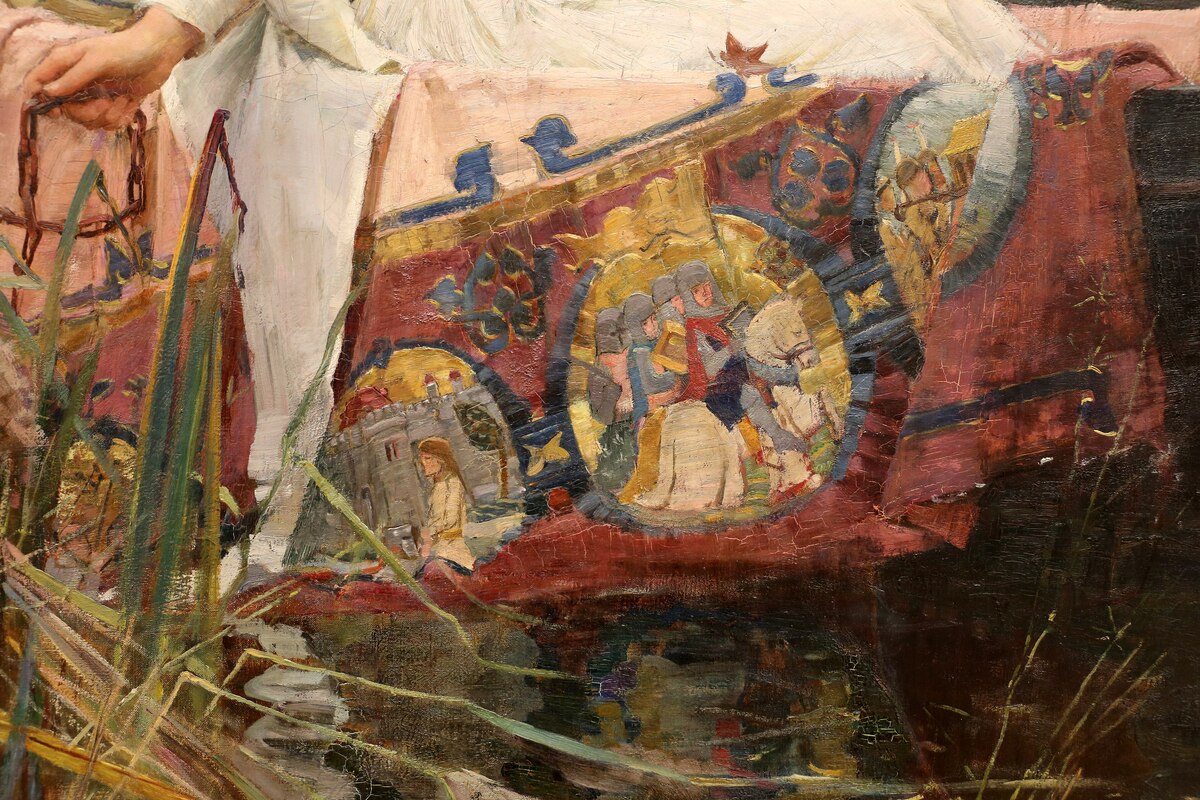
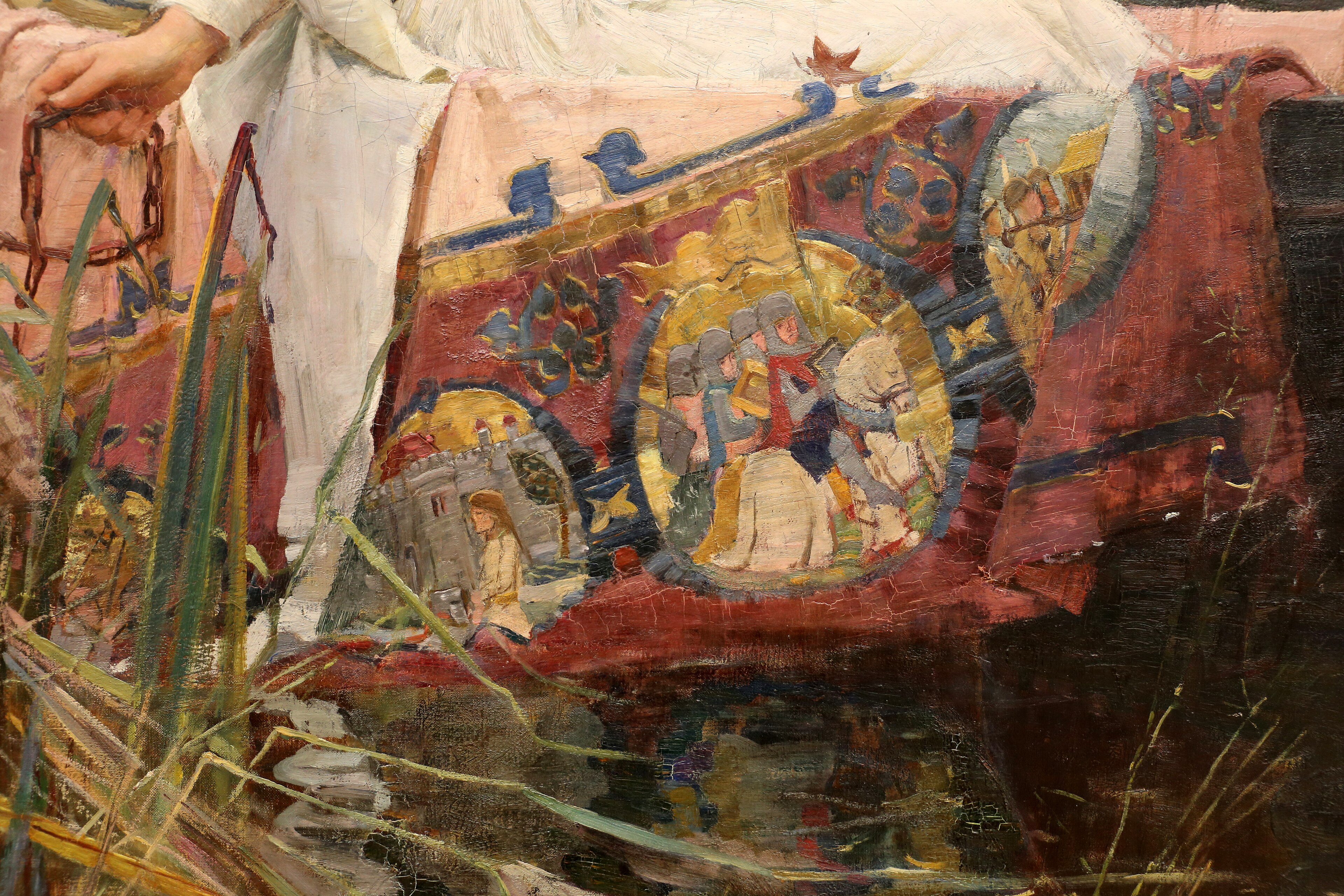
Upper right roundel with blue edging showing a figure and a white horse, the chivalric world whose approach precipitates the Lady's crisis.
02
Roundel with castle and figure
Left tapestry roundel enclosing a turreted castle and a pale seated or standing figure, evoking Shalott's tower and the enclosed life within it.
03
Reeds and river reflection
Green blade-like reeds and dark water carrying broken reflections of the tapestry, the river that will carry the Lady to Camelot.
Your gallery guide
The Lady of Shalott by John William Waterhouse (1888)
A gallery tour of Waterhouse's 1888 painting, showing the Lady of Shalott at the moment she leaves her tower, with her tapestry and the river carrying her toward Camelot.
Editorial review by Artifact Archive automated publishing
This is John William Waterhouse's The Lady of Shalott, painted in 1888. It shows the Lady at the moment she leaves her tower and sets out in a boat toward Camelot.
The subject comes from Alfred, Lord Tennyson's poem. In that story, the Lady is confined to a tower and may only view the world through a mirror. She leaves in a boat, and this painting captures that departure.
Look at her right hand, gripping a dark chain at the upper left. That chain ties her to the boat and to the journey she has begun.
Beneath her, green blade-like reeds and dark water carry broken reflections of the tapestry, placing the scene on a river. The reflections are not clear, but they tell you the boat is moving through water.
The tapestry draped over the boat's edge holds roundels that record the world she could only watch indirectly. In the center, a roundel on gold ground shows helmeted knights and a white horse.
To the left, another roundel encloses a turreted castle and a pale figure, evoking Shalott's tower and the enclosed life within it. An upper right roundel with blue edging shows a figure and a white horse, the chivalric world whose approach precipitates her crisis.
Together, the chain and the tapestry roundels connect her body to the boat and her art to the life she has left behind. The chain is a physical link, and the woven images are a record of what she saw only in the mirror.
Waterhouse gives us both the vessel and its cargo: a woman, her weaving, and the river carrying them away.
What stays with you is the moment of departure, when the Lady stops watching through the mirror and enters the world she has only woven. The painting holds that instant, with the chain in her hand and the tapestry at her side.
The story and its sources
Editorial review by Artifact Archive automated publishing.
Historical claims are linked to the records below. Close looking and interpretation are identified in the passage notes.
John William Waterhouse was an English painter (1849–1917). Their work is associated with Pre-Raphaelite Brotherhood; neo-Pompeian; Impressionism; Symbolism. Their recorded places of work include Rome; London.
A Pre-Raphaelite painting depicting the Lady of Shalott, a figure from Alfred, Lord Tennyson's poem, seated in a boat on a river, surrounded by reeds and water, with a tapestry draped over the boat's edge. She is depicted in the moment of her departure toward Camelot, her hand gripping a chain attached to the boat, while the woven roundels on the tapestry show knights and a white horse, the world she could only observe through a mirror.
The painting is titled The Lady of Shalott and was made by John William Waterhouse in 1888. The date belongs to the making of the work, not to any later catalogue or file record: the Wikimedia Commons file that carries the photograph of the canvas was published in 2018, and that later date describes the documentation of the object rather than the object itself. The work is catalogued as a painting, as recorded in the Wikimedia Commons structured data for the file. The Tate source page lists the artwork under the reference number N01543, the accession identifier by which the institution's holding is located, and the painting is in the collection of Tate Britain, as indicated by the Tate source page and the Commons file description. The Commons photograph of the painting is credited to Sailko, an author attribution that concerns the reproduction and not the canvas it records.(Tate, n.d.)(Sailko, 2018)
The painting is titled 'The Lady of Shalott' and was made by John William Waterhouse in 1888.(Tate, n.d.)
The work is a painting, as recorded in the Wikimedia Commons structured data for this file.(Sailko, 2018)
John William Waterhouse's painting of 1888, held in the collection of Tate Britain under the reference N01543, takes its subject from Alfred, Lord Tennyson's poem "The Lady of Shalott," in which a lady confined to a tower may view the world only through a mirror and who leaves in a boat toward Camelot. The canvas arrests her at the point of that departure, and the visual evidence is organised around two pieces of equipment she carries with her: the chain she grips and the woven cloth that trails from the vessel. Reading the composition means distinguishing what is plainly before the viewer, such as the hand and the dark chain at the upper left, from what those motifs are understood to signify in the poem's narrative, namely a physical link between her body and the boat that is carrying her away from the tower.(Sailko, 2018)(Tate, n.d.)
The tapestry roundels
The woven material draped over the boat's edge bears roundels that the institutional record describes as a record of the external world the Lady experienced only indirectly, through her mirror. At the centre of this textile, a roundel laid on gold ground shows helmeted knights together with a white horse; the gold ground and the armour place the scene in a chivalric register rather than in the domestic or natural world of the riverbank. A further roundel at the upper right, distinguished by blue edging, similarly shows a figure and a white horse, and is understood to stand for the chivalric world whose approach precipitates the Lady's crisis. The two roundels therefore do not merely decorate the cloth; within the account given for the painting, they carry the narrative weight of the events that led to her leaving the tower, presenting in woven form the very world she could previously see only in reflection.(Sailko, 2018)
A roundel on the left of the textile encloses a turreted castle with a pale figure who is seated or standing. The record associates this image with Shalott's tower and with the enclosed life led within it, so that the woven cloth carries both the world she desired and the architecture of her confinement. The description preserves an uncertainty about the small pale figure's posture that the evidence itself acknowledges: it is identified as seated or standing rather than resolved into one action. This is a useful reminder that the identification of such details within the painting's own depicted textiles rests on the institutional record's reading rather than on an unambiguous depiction of posture.(Sailko, 2018)
The river setting
Below the boat, green blade-like reeds and dark water carry broken reflections of the tapestry, a detail that establishes the river setting of the scene. The reflections are described as broken rather than clear, and this visual qualification is significant: the water does not return a stable mirror image of the woven cloth but fragments it. The painting thus stages two distinct modes of indirect vision, the Lady's mirror as recounted in the poem and the river's own distorting surface in the painted scene, and it is the second of these that the visual evidence directly documents at the level of the water and the reeds.(Sailko, 2018)
Interpretation
Taken together, the hand gripping the chain and the recorded roundels of the tapestry tie the figure's body to the vessel and her woven art to the life she has left. The chain is presented as a physical link, while the woven images function as a record of what she saw only in the mirror. This pairing gives the painting a double subject at the level of its visible evidence: the vessel and its cargo, a woman and her weaving, carried by the river. It is the convergence of these elements, rather than any single motif, that the evidence identifies as the substance of the composition, and any account of the work's place in the history of painting should attend to both the figure and the textile she brings with her.(Sailko, 2018)
Visual observation
The painting depicts a hand gripping a dark chain at the upper left, a gesture tying the figure to the boat and its departure.(Sailko, 2018)
A central tapestry roundel on gold ground shows helmeted knights and a white horse, representing the woven record of the world the Lady may only watch in the mirror.(Sailko, 2018)
Green blade-like reeds and dark water carry broken reflections of the tapestry, indicating the river setting.(Sailko, 2018)
A left tapestry roundel encloses a turreted castle and a pale seated or standing figure, evoking Shalott's tower and the enclosed life within it.(Sailko, 2018)
An upper right roundel with blue edging shows a figure and a white horse, representing the chivalric world whose approach precipitates the Lady's crisis.(Sailko, 2018)
The subject of this painting is taken from Alfred, Lord Tennyson's poem 'The Lady of Shalott', a narrative in which a lady is confined to a tower and may view the world only through a mirror, and who leaves in a boat toward Camelot. The painting itself is by John William Waterhouse, dated 1888, and is titled 'The Lady of Shalott'. It belongs to the collection of Tate Britain and is listed on the Tate source page under the reference number N01543. The work is recorded as a painting in the Wikimedia Commons structured data for the photographic file, whose description likewise places it in the Tate Britain collection. This identification of subject, maker, date, medium and holding institution is the secure documentary basis on which any account of the object's making and meaning must rest.(Tate, n.d.)
The literary source supplies the episode represented. Tennyson's poem tells of a lady confined to a tower who may only view the world through a mirror and who leaves in a boat toward Camelot; the painting takes its subject from that text. Because the poem's terms are those of enclosure, indirect vision and departure, they frame how the painted scene may be read without supplying the painting's own commissioning history. Nothing in the supplied evidence records who commissioned the work, what it cost, where it was first shown, or how Waterhouse arrived at the composition, so the documented circumstances of creation remain limited to authorship, date, title and the literary source. Secure identification of the subject does not by itself settle the circumstances of commissioning, and those circumstances should not be inferred from the poem's content.(Tate, n.d.)
Visual Evidence and Narrative Reading
Interpretation
The object matters within a longer history of art partly because it translates a modern poem into a medievalizing visual idiom. The gold ground of the central roundel and the turreted castle and white horse of the other roundels evoke the chivalric and enclosed world of the poem, while the river, the reeds, the dark chain and the reflections anchor that world in an observable present scene. The result is a picture whose historical interest lies in the crossing of a Victorian literary text with the visual conventions of tapestry and romance. The evidence supplied supports the elements of this crossing, but not claims about the painting's reception, exhibition or influence, which are not documented here.(Tate, n.d.)(Sailko, 2018)
The subject is drawn from Alfred, Lord Tennyson's poem 'The Lady of Shalott', which tells of a lady confined to a tower who may only view the world through a mirror and who leaves in a boat toward Camelot.(Tate, n.d.)
The interpretation of John William Waterhouse's The Lady of Shalott, painted in 1888 and held in the collection of Tate Britain, has been framed by a reading that treats two components of the composition as a paired statement about the Lady's relationship to the world she is leaving. Under this reading, the tapestry roundels within the painting function as a record of the external world the Lady experiences only indirectly, through her mirror, and the chain she grips at the boat's edge marks the physical link between her body and the vessel carrying her away. The reading therefore coordinates the woven images and the gripped chain: the textiles document what was seen at a remove, while the chain binds the figure physically to the boat and to her departure. This is an attributed interpretation. The evidence does not establish the maker's private intent, and it should not be restated as a claim about what Waterhouse himself consciously designed the chain and roundels to mean. The interpretation is advanced on the basis of the visible arrangement of the objects in the painting, and it stands or falls with that arrangement rather than with any external documentation of intention.(Sailko, 2018)
The evidence assembled here supports a reading of the tapestry roundels as a record of the external world the Lady experiences only indirectly, through her mirror, and of the chain as the physical link between her body and the vessel carrying her away. That reading is attributed, and its limits should be stated plainly. The evidence establishes what is depicted: a hand on a dark chain, roundels showing knights, horses, a castle and figures, reeds and dark water with broken reflections, and the painting's derivation from Tennyson's poem. The evidence does not establish the maker's private intent, does not record any statement by Waterhouse about the meaning of the chain or the roundels, and does not supply further documentation of how the interpretation was reached beyond the visible arrangement of the objects. The interpretation is therefore best understood as a coherent account of the painting's internal relationships rather than as a claim about authorial intention. The imperial and gendered dimensions of the subject, the poem's reception, the painting's exhibition history, its technique and its materials are not addressed by the supplied evidence and cannot be elaborated here without going beyond what the units support. What the evidence does sustain is the specific correspondence between the roundels and indirect sight, and between the chain and physical attachment to the boat, which is the interpretive core of the account. Within these limits the painting matters as a worked example of how a narrative painting can distribute its subject across separate depicted objects, so that a woven surface carries one aspect of the story and a grasped chain carries another, and so that the moment of departure is rendered as a set of material relationships within the picture rather than as a single depicted action.(Sailko, 2018)
The tapestry roundels within the painting function as a record of the external world the Lady experiences only indirectly, through her mirror, and the chain she grips at the boat's edge marks the physical link between her body and the vessel carrying her away.(Sailko, 2018)
Tate Britain, the object record and the poem behind the scene
The Lady of Shalott is a painting by John William Waterhouse, dated 1888, and it belongs to the collection of Tate Britain. Both the Tate collection page and the Wikimedia Commons file description record the work as being in that institution's holdings, and the Tate page gives the accession or reference number N01543 for the painting. The Commons structured data independently identifies the object as a painting, so the medium and the collecting institution are corroborated across a museum source and an institutional file record rather than resting on a single description. The Tate page also states the subject's literary origin: the painting draws on Alfred, Lord Tennyson's poem The Lady of Shalott, in which a lady is confined to a tower, may view the world only through a mirror, and leaves in a boat toward Camelot. These two records, the museum catalogue entry and the Commons file, therefore establish the core object data of title, artist, date, medium and location, while the Tennyson attribution explains why the scene takes the form it does.(Tate, n.d.)(Sailko, 2018)
The imagery recorded in the Commons file description is specific and can be set out in detail. At the upper left of the composition a hand grips a dark chain, a gesture that ties the figure to the boat and to its departure. Beneath her, green blade-like reeds and dark water carry broken reflections of the tapestry, which places the scene on a river and indicates the boat is moving through water; the reflections are described as unclear rather than mirror-clear. The tapestry draped over the boat's edge carries roundels that record the world the Lady could only watch indirectly. In the centre, a roundel on gold ground shows helmeted knights and a white horse. To the left, another roundel encloses a turreted castle and a pale seated or standing figure, evoking Shalott's tower and the enclosed life within it. An upper right roundel with blue edging shows a figure and a white horse, standing for the chivalric world whose approach precipitates the Lady's crisis. Read together, these elements connect her body to the vessel and her woven art to the life she has left behind: the chain is a physical link between figure and boat, while the woven images are a record of what she saw only in the mirror.(Tate, n.d.)(Sailko, 2018)
Interpretation
The Commons file description goes further in interpreting its own observations. It states that the tapestry roundels within the painting function as a record of the external world the Lady experiences only indirectly, through her mirror, and that the chain she grips at the boat's edge marks the physical link between her body and the vessel carrying her away. This reading of the roundels and the chain is an interpretation attached to the institutional record rather than a documented statement by the artist, and it should be weighed as such. It nonetheless explains how the two most prominent motifs in the visible composition, the grasped chain and the draped tapestry, relate to each other and to the Tennyson narrative: the chain is the physical connection to the journey, and the roundels are the pictorial residue of a life lived at one remove. The uncertain, broken reflections in the water reinforce that distance, since even the river surface returns the tapestry only imperfectly.(Tate, n.d.)(Sailko, 2018)
The painting is in the collection of Tate Britain, as indicated by the Tate source page and the Commons file description.(Tate, n.d.)(Sailko, 2018)
The Tate source page lists the artwork under the reference number N01543.(Tate, n.d.)
Tate's collection page records the work as The Lady of Shalott, painted by John William Waterhouse in 1888, and lists it under the reference number N01543. The institutional record on Wikimedia Commons likewise describes the object as a painting and places it in the collection of Tate Britain. Together these two sources establish the object's identity, maker, date, medium category and current institutional location, which is the documentary foundation for any question of what the picture is worth. The subject is drawn from Alfred, Lord Tennyson's poem of the same name, in which a lady is confined to a tower and may view the world only through a mirror before she leaves in a boat toward Camelot. The sources confirm the artwork's identity and location only, and they do not supply a public appraisal or market figure.(Tate, n.d.)(Sailko, 2018)
The working insurance calculation recorded on 2026-10-16 proposes an estimated value of US$50M to US$150M, and its methodology is stated explicitly as a calculated insurance working range rather than an official value. The calculation takes as its confirmed context that the object is Waterhouse's 1888 oil on canvas The Lady of Shalott, described as one of the most celebrated Pre-Raphaelite works and a highlight of Tate Britain's collection; it assumes an irreplaceable museum-level masterpiece by a major British artist, in oil on canvas, with iconic status within the Pre-Raphaelite movement. The range is deliberately broad, set to account for the lack of current market evidence, the work's permanent collection status and presumed non-market availability, and the difficulty of replacing such a unique object. The record states plainly that the range is intentionally wide for manual review and is not derived from an appraisal, an auction result, a sale record, or an internal insurance file.(Tate, n.d.)(Sailko, 2018)
The qualifications attached to that figure are as consequential as the figure itself. The record states that it is a model-generated working insurance range for manual review only, not an official insurance value, appraisal, auction result or sale price; that it neither uses nor claims access to private insurance records; and that it does not rely on verified comparable sales. It adds that actual insurance or market values can differ substantially and require review by qualified professionals with access to current market and specialist data. This is a necessary limit on the number: the same documentation that grounds the objects's identity and location also confirms that no public valuation exists in the supplied material, so the range stands as a stated working hypothesis for review, not as a documented market fact.(Tate, n.d.)(Sailko, 2018)
Read against the rest of the record, the valuation calculation clarifies how evidence about this object is layered. The confirmed context that the source material actually supports is the attribution, the 1888 date, the oil on canvas medium and the Tate Britain location; the valuation extrapolates from that confirmed context toward a monetary range. The record therefore separates what the sources establish from what a model infers on their basis, and it does not claim that the sources themselves provide an appraisal. The breadth of the range is itself an acknowledgment of how little market evidence attaches to a permanently held museum work, and the requirement for manual review by qualified professionals is presented as a condition of the number's use rather than a formality.(Tate, n.d.)(Sailko, 2018)
Working estimate
Calculated working insurance estimate, not a sale price: Estimated value: US$50M to US$150M Recorded date: Working calculation, generated 2026-10-16. Methodology: This is a calculated insurance working range, not an official value. It is based on the confirmed context that this is John William Waterhouse's 1888 oil on canvas painting The Lady of Shalott, one of the most celebrated Pre-Raphaelite works and a highlight of Tate Britain's collection. The calculation assumes an irreplaceable museum-level masterpiece by a major British artist, in oil on canvas, with iconic status within the Pre-Raphaelite movement. A broad, conservative range has been set to account for the lack of current market evidence, the work's permanent collection status and presumed non-market availability, and the difficulty of replacing such a unique object. The range is intentionally wide for manual review and is not derived from an appraisal, auction result, sale record, or internal insurance file. Qualification: This is a model-generated working insurance range for manual review only. It is not an official insurance value, appraisal, auction result, or sale price. It does not use or claim access to private insurance records, and it does not rely on verified comparable sales. Actual insurance or market values can differ substantially and require review by qualified professionals with access to current market and specialist data. The supplied sources confirm the artwork's identity and location only and do not provide a public appraisal.(Tate, n.d.)(Sailko, 2018)
Further reading
Books for a closer look
Paid links. As an Amazon Associate I earn from qualifying purchases.
A scholarly study of the Lady of Shalott figure in Victorian literature and culture. Its recorded subjects, including Arthurian romances, medievalism, women in literature and solitude in literature, document the Victorian reception and literary context that shaped Waterhouse's treatment of the subject, making it a relevant art-historical comparison even though it treats novels rather than paintings.
A scholarly study of the Lady of Shalott figure in Victorian literature and culture. Its recorded subjects, including Arthurian romances, medievalism, women in literature and solitude in literature, document the Victorian reception and literary context that shaped Waterhouse's treatment of the subject, making it a relevant art-historical comparison even though it treats novels rather than paintings.
The catalogue record title identifies this as a collection of paintings and drawings by John William Waterhouse, the painter of the named artwork. It is listed under his name as author and is likely an object-focused plate or study collection, so it is the closest candidate to an object-specific Waterhouse source. Contents beyond the recorded title are not assumed.
Advertising supports the archive. These preferences control aggregate page counting, reading activity and ad-delivery diagnostics. They use no visitor tracking cookie.