ArchiveThe Golden Stairs

Artwork record / 164 of 331

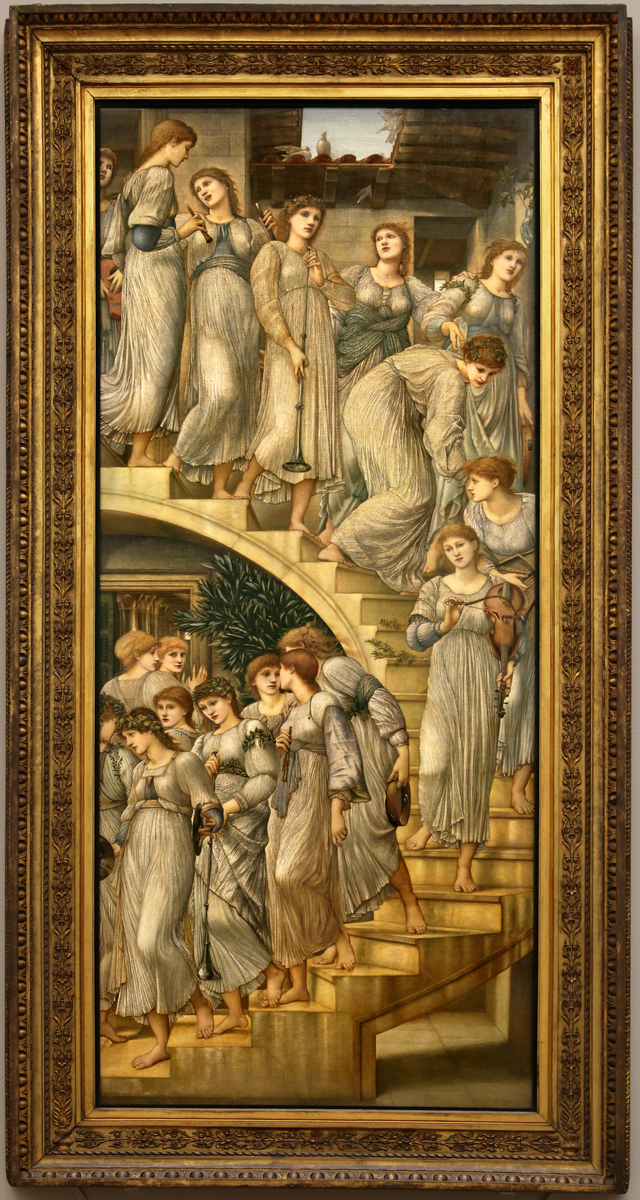
The Golden Stairs by Edward Coley Burne-Jones (1880)

Artist: Edward Coley Burne-Jones

A procession of pale-robed young women descends a curved spiral staircase, several carrying musical instruments, in Edward Coley Burne-Jones's The Golden Stairs. This docent tour looks at how the painting's composition, light and gesture turn that simple action into an image of continuous, trance-like movement. The evidence available comes from a Wikimedia Commons photograph of the painting in Tate Britain, not from the museum's own catalogue record, so the account stays close to what that source supports and no more.

Read the story ↓ About the artist ↓ Research and record ↓ Literature and sources ↓ Listen to the article ↓
Article text for AI
Shop this artwork ↓ 0 visits
Date1880CultureBritish PeriodPre-RaphaeliteCurrent locationTate Britain, London, United Kingdom
Listen to the article
100%
The Golden Stairs by Edward Coley Burne-Jones (1880)
Loading full-resolution artwork…
Scroll to zoom · drag to pan · double-click to focus Pinch to zoom · drag to explore · double-tap to focus FIELD VIEW / 164
Tools & download
Pixel colour Select a pixel with the eyedropper
No pixel selected

Choose the eyedropper, then click or tap the image. Scroll to zoom for finer selection.

Add text

Hand to pan · Select to move text and drawings · Add as many texts as you like · Scroll to zoom

The Golden Stairs: high-resolution image

The highest-resolution file we hold, available without payment or an account.2,658 × 4,986 pixels.

Download highest-resolution image

Details to notice

About 3 minutes to read
01

Doves and pitcher on the roof ledge

A small still life of a white pitcher and doves perched on the shadowed ledge above the staircase, a quiet symbolic note at the top edge of the scene.

02

Stooping woman leaning over the steps

The bending, heavily draped figure at mid-right leans forward over the curve of the balustrade, head lowered and wreath-crowned, creating the composition's main diagonal counter-movement and a moment of inward contemplation.

03

Woman playing a lute

A woman standing on the middle steps holds a small stringed instrument, her hands positioned on the neck and body of the lute, one of the few clearly played instruments in the procession.

Artist portrait of Edward Burne-Jones
Artist portrait Image credit

Frederick Hollyer. Image source · Public domain

About the artist

Edward Burne-Jones

1833 to 1898

Edward Burne-Jones was a British Pre-Raphaelite painter (1833-1898). Their work is associated with Pre-Raphaelite Brotherhood; Symbolism. Their recorded places of work include Birmingham; London.

Born
1833
Died
1898
Nationality
United Kingdom of Great Britain and Ireland; United Kingdom
Birthplace
Birmingham
Died in
London

The research & record

Study the work.
Follow the evidence.

Find catalogue details, historical context, technical research and the literature behind this artwork.

Article text for AI
Open research text

The artwork record

Research catalogue

Catalogue information and detailed research, with references that link to the bibliography.

Updated .

Identity and catalogue

Link
Title
The Golden Stairs(Sailko, 2018)
Artist or attribution
Edward Coley Burne-Jones(Sailko, 2018)
Object date
1880
Medium and support
Oil paint on canvas
Current collection or location
Tate Britain, London, United Kingdom(Sailko, 2018)
Movement or period
Pre-Raphaelite
Country or culture
British
Depicted subject
A procession of pale-robed young women descends a curved spiral staircase. Several hold musical instruments, and they move barefoot in a continuous, trance-like descent.
Dimensions
Unknown
Catalogue identity

The catalogue title supplied for this work is The Golden Stairs, with a date of 1880, and it is associated with Edward Coley Burne-Jones. The Commons file's Structured data section records the depicted subject as The Golden Stairs, so the recorded title and the recorded subject line up: the stairs and the figures upon them are what the file identifies the picture as being about. The file further lists the work under Paintings by Edward Burne-Jones and under Pre-Raphaelite paintings in Tate Britain, which places the object in a British movement and in a public collection in London. These are the title, attribution, date and collection category that the file establishes; nothing in the supplied units gives a support, medium, dimensions or inscription, so the identity account cannot be extended to those physical particulars.(Sailko, 2018, File title; Structured data, depicts)

The date 1880 belongs to the work as the file reports it; it is not the date of the file or of the photograph from which the image was taken. Those are separate dates and should not be collapsed. The file's own publication year, 2018, and the photograph's capture date of 28 February 2017 by the uploader are the circumstances of the image record, not of the painting. Distinguishing the object date from the catalogue date matters for any later use of this evidence, because only the painting's 1880 date belongs to the history of the work, while the 2017 and 2018 dates describe how the image came to exist and be published.(Sailko, 2018, File title; Summary and file history)

The attribution to Edward Coley Burne-Jones comes through as an association in the file title and categories, delivered by a Wikimedia Commons file page rather than by the museum's own catalogue record. That distinction is not a technicality. A Commons page is a discovery aid: it gathers a title, an attribution, a date and collection categories so that a viewer can find the object, but it does not carry the authority of the institution's full catalogue entry. The account here therefore stays within what the file can support, treating the title, the attribution, the 1880 date and the Tate Britain category as recorded associations rather than as a catalogue certificate with all its accompanying apparatus.(Sailko, 2018, File title; Structured data, depicts)

The source image and the object

Read against that qualification, the identity of the object and the identity of the record are two different things that happen to share a title. The file is titled for the painting and dated 1880 for the painting, but the file itself was published in 2018 by an uploader, and its image was captured in 2017. The file therefore documents the painting at a distance of more than a century, through a photograph made at a particular hour of a particular day. Keeping the object's date separate from the record's dates is what allows the file to be used responsibly as evidence for the painting at all.(Sailko, 2018, File title; Summary and file history)

Interpretation

Within a larger history of art and material culture, the value of this record is that it locates a single object at the intersection of three names: a title, an artist and an institution. The Golden Stairs appears in the file under Burne-Jones, under Pre-Raphaelite paintings, and under Tate Britain, so the same object is simultaneously a work by a named artist, a member of a movement, and a holding in a national collection. Those three frames are what make the object consequential beyond its own surface: they fix it in a lineage of British painting and in a public collection where its identity can be examined against other works in the same categories.(Sailko, 2018, File title; Structured data, depicts)

The painting is titled The Golden Stairs and is dated 1880.(Sailko, 2018)

The painting is associated with Edward Coley Burne-Jones.(Sailko, 2018)

The Structured data section of the Commons file records the depicted subject as The Golden Stairs.(Sailko, 2018)

Provenance and ownership

Link
Documentation and Its Limits

The available documentation for this object is discovery-level rather than a full museum catalogue record. The supplied source is a Wikimedia Commons file page, published in 2018 by the uploader Sailko, catalogued under the title The Golden Stairs and dated 1880 in association with Edward Coley Burne-Jones. The Commons description states plainly that the supplied image is a photograph of paintings in Tate Britain taken on 28 February 2017 by the uploader, not the painting itself. That distinction governs what the page can and cannot establish: it names a title, an attributed artist, a date and a collection category, but it is expressly not the museum's own catalogue record. The Commons file also records the depicted subject simply as The Golden Stairs, and lists the work under Paintings by Edward Burne-Jones and under Pre-Raphaelite paintings in Tate Britain, which situates the picture in a British movement and in a public collection in London. Because the file is a photograph made in 2017 for upload, it is evidence about the painting's location and identity at the moment of photography, and it is a discovery aid rather than a chain of title. Any full account of ownership, accession number, prior sale or bequest would have to come from the museum's records, which are not among the supplied units.(Sailko, 2018, Summary and file history)

The one firm transfer recorded in the evidence is photographic and recent: the image was taken on 28 February 2017 by the uploader inside Tate Britain, and that photograph is the thing the Commons file publishes. For provenance purposes this is a documented act of imaging in a named public collection on a stated date, and it is the only dated event the supplied unit supports. The 1880 date belongs to the painting's making, as given in the source, and the 2018 publication year belongs to the Commons file; neither is a transfer of ownership. The source supplies no acquisition date, no accession number, no dealer, no auction, no bequest and no previous owner. Where the record is silent, the correct scholarly statement is that the interval is unrecorded, not that ownership changed. An absence of documentation in this particular file must not be read as evidence of a break in possession, and it must not be filled with a presumed sequence of owners.(Sailko, 2018, Summary and file history)

Interpretation

Read together, the units allow a narrow but usable provenance statement. The painting is titled The Golden Stairs, dated 1880 and associated with Edward Coley Burne-Jones; by 28 February 2017 it was among the paintings photographed at Tate Britain, and it is listed there within the Pre-Raphaelite holdings and among Paintings by Edward Burne-Jones. That places the work in a public London collection at the time of photography, without telling us when or how it entered that collection. The Commons subject line, which records the depicted subject as The Golden Stairs, confirms that title and subject line up: the stairs and the women on them are what the picture is about. The provenance history therefore stands as a documented recent location inside a stated collection, set against an unrecorded earlier interval, and the boundary between the two is exactly where the evidence stops.(Sailko, 2018, Summary and file history)

The supplied source describes the image as a photograph of paintings in Tate Britain taken on 28 February 2017 by the uploader, not as the painting itself.(Sailko, 2018)

Provenance timeline
  1. 28 February 2017

    A photograph of paintings in Tate Britain, including this work, is taken by the uploader of the Commons file.(Sailko, 2018, Summary and file history)

Collection and display

Link
The Nature of the Evidence

The primary evidence for this entry is a Wikimedia Commons file page rather than a museum catalogue record, and the distinction governs what the following account can and cannot establish. The page supplies a title, The Golden Stairs; an association with Edward Coley Burne-Jones; a date of 1880; and a collection placement. Its structured data section records the depicted subject simply as The Golden Stairs, so the descriptive title and the recorded subject coincide. Beyond those particulars the file offers categories rather than catalogue apparatus: no accession number, medium description, dimensions, provenance, or curatorial note appears in the supplied material. Everything asserted here about the object's collection and display therefore rests on a discovery aid, and should be weighed as such rather than as institutional documentation.(Sailko, 2018, Categories)

Within the Commons file, the work is listed under two categories: Paintings by Edward Burne-Jones and Pre-Raphaelite paintings in Tate Britain. Taken together, these placements do two things at once. The first attaches the picture to an individual artistic career and identifies Burne-Jones as the maker to whom the work is attributed. The second attaches it to a movement designation and to a named public institution in London. The categories also imply that the work is held in Tate Britain's collection rather than merely lent, reproduced, or formerly owned there, although the file itself does not spell out the terms of that holding. The pairing is useful precisely because it is double: it locates the painting simultaneously in a single artist's output and in a broader British grouping whose institutional home is Tate Britain.(Sailko, 2018, Categories)

The Commons file page is dated to a 2018 publication and is attributed to an uploader named Sailko. This date belongs to the file page, not to the painting, whose supplied date is 1880. The two dates should not be conflated: 1880 attaches to the work as its stated date of creation or completion, while 2018 attaches to the digital documentation that reports it. Keeping these apart matters because the reliability of any given statement in the file depends on which layer it comes from. The 1880 date and the Burne-Jones attribution are claims the file transmits about the object; the 2018 publication date describes when that transmission was published online.(Sailko, 2018, Categories)

The image supplied through the source is described as a photograph of paintings in Tate Britain, taken on 28 February 2017 by the uploader, and not as the painting itself. That statement identifies the mediated nature of the visual record available for study: a visitor-made photograph of works on display, made on a specific day, rather than an official reproduction or a direct imaging of the surface. The photograph functions as a discovery aid. It can name the title, the artist, the date, and the collection category, and it can support observations about what is depicted, but it is not the museum's full catalogue record and cannot be treated as one. This qualification limits the evidentiary reach of any visual description that depends on it, including descriptions of the composition.(Sailko, 2018, Categories)

What the file supports, at the level of subject, is a procession: a line of pale-robed young women descending a curved spiral staircase, several of them holding musical instruments. The file does not supply a narrative source, a commissioning context, or a stated programme for the scene, and no such information appears among the supplied units. The recorded subject line, The Golden Stairs, aligns with this description, so title and depicted content agree. It is worth noting that the Commons record is the sole supplied unit for this section, and it is a file page rather than scholarship; statements about what the painting shows are therefore reported at the level of description rather than argued interpretation, and the absence of further documentation is itself part of the evidentiary picture rather than a gap to be filled by assumption.(Sailko, 2018, Categories)

The work is listed under Paintings by Edward Burne-Jones and Pre-Raphaelite paintings in Tate Britain.(Sailko, 2018)

Documented values and qualified estimates

Link
The object and its documentary basis

Interpretation

The supplied evidence identifies the work as The Golden Stairs, an 1880 painting associated with Edward Coley Burne-Jones, and lists it under Paintings by Edward Burne-Jones and Pre-Raphaelite paintings in Tate Britain. That places it within a British movement and within a public collection in London. The Commons file also records the depicted subject simply as The Golden Stairs, so the title and the subject line agree: the stairs and the women on them are what the picture is about. Everything that follows depends on the character of that description, which is a Wikimedia Commons file page rather than the museum's own catalogue record, and which supplies no dimensions, condition report, authenticity documentation, or provenance. Confirmed context, not a full catalogue entry, is therefore the working baseline for the object.(Sailko, 2018)

Working estimate

Calculated working insurance estimate, not a sale price: Estimated value: US$20M to US$60M Recorded date: Working calculation, generated 2026-10-16. Methodology: Conservative calculated insurance range derived from confirmed context only. The work is an 1880 oil on canvas by Edward Coley Burne-Jones, a leading Pre-Raphaelite figure, and is recorded as held at Tate Britain, London. The Wikimedia Commons evidence identifies the painting, artist, date, collection, and Pre-Raphaelite context, but supplies no dimensions, condition report, authenticity documentation, provenance, or institutional valuation. Given the artist's canonical status, the work's prominence within the Pre-Raphaelite movement, and its presence in a major national collection, a broad working range is used for manual review. The lower bound reflects uncertainty over scale and condition; the upper bound reflects the rarity and importance of a securely attributed Burne-Jones oil of this renown. This is a model-generated planning figure only and must be verified against a professional appraisal, condition survey, and institutional records. Qualification: This is a model-generated working insurance range for manual review only. It is not an official insurance value, appraisal, auction result, or sale price. It is not based on comparable sales, private insurance records, or any Tate valuation. Title, date, attribution, and collection rest on the supplied Wikimedia Commons description and should be confirmed against the owner's full catalogue record before any insurance or financial decision.(Sailko, 2018)

Bibliography

Sources and further reading

References are arranged by author or organisation, with links to the original publications. Where no publication date is recorded, n.d. means no date.

Source notes updated .

  1. 01

    Secondary · About this artwork

    Wikimedia Commons: The Golden Stairs. File:Edward coley burne-jones, the golden stairs, 1880.jpg. Wikimedia Commons.

    Wikimedia Commons file page providing discovery evidence for the painting's title, attributed artist, date, and collection category in Tate Britain. It documents a photograph of the painting taken by the uploader, not the painting's own catalogue record.

    Language
    English
    Citation text

Article text and sources · Reading and attribution

An unhandled error has occurred. Reload 🗙