Where Do We Come From? What Are We? Where Are We Going?
Artist: Paul Gauguin · 1897-98

Where Do We Come From? What Are We? Where Are We Going?: high-resolution image
The original file is hosted by Wikimedia Commons, available without payment or an account.
Open high-resolution image on Wikimedia CommonsThe complete story
The story About 4 minutes to read
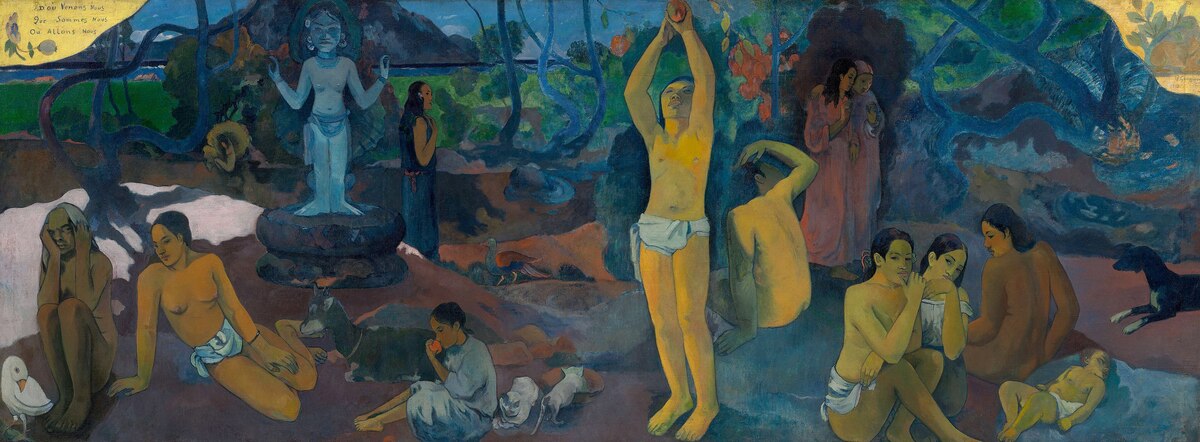
This is Paul Gauguin's Where Do We Come From? What Are We? Where Are We Going?, painted in 1897 and 1898. Gauguin worked in Tahiti, and the picture belongs to that setting. A wide landscape holds a gathered company of figures, animals and a statue, and the title itself is written into the upper left of the painting.
The painting sets a broad landscape before you and spreads its figures across it rather than crowding them into one knot. Among them are a mother and child, nude women in the natural surroundings, and animals. At the upper left, the three questions that give the work its name are painted onto a yellow band. So the title is not only a label beside the picture. It is part of what you see.
The work is oil on canvas, made during Gauguin's time in Tahiti. It is dated 1897 to 1898, which is when the painting was made, not a date for any event shown in it. The questions in the inscription are the picture's own frame. They ask about origins, identity and destination, and the scene has been composed to sit beneath them.
The figures are not arranged as a single action with a clear storyline, the way a history painting might be. Instead the landscape holds several separate presences at once: people, animals, and, in the record's terms, an idol. That spread is part of how the picture reads as a field of contemplation rather than a scene with one event. The painted questions sit above that field and give it direction.
It is tempting to read each figure as a fixed answer to one of the three questions. The supplied record does not give us that key. What it does confirm is an idol and a painted title within the image, which tells us the picture carries explicit symbolic material. The painting is asking its questions rather than tidily answering them. I would rather leave that open than make the figures say more than the evidence supports.
What stays with you is that a large landscape, full of figures and animals, has been given a title that is itself three questions, and that the questions are painted into the work. The subject of this picture is the asking. Gauguin built a Tahitian world on canvas and set those words above it, so the scene and the questions are meant to be taken together.
The story and its sources
Historical claims are linked to the records below. Close looking and interpretation are identified in the passage notes.
- Passage 1Documented historyWikimedia Commons: Where Do We Come From What Are We Where Are We Going
- Passage 2Close lookingWikimedia Commons: Where Do We Come From What Are We Where Are We Going
- Passage 3Documented historyWikimedia Commons: Where Do We Come From What Are We Where Are We Going
- Passage 4Close lookingWikimedia Commons: Where Do We Come From What Are We Where Are We Going
- Passage 5InterpretationWikimedia Commons: Where Do We Come From What Are We Where Are We Going
- Passage 6InterpretationWikimedia Commons: Where Do We Come From What Are We Where Are We Going
Details to notice
About 3 minutes to readTitle inscription corner
The yellow painted band in the upper-left corner carrying the artist's handwritten French title, with a small figure group beside it. This is the painted signature and title cartouche, explicitly naming the three questions that structure the entire picture.
Sleeping infant
The naked baby lying face down near the bottom-right corner, beside the seated figures and the black dog. The newborn is the painting's closing note, the untested future that answers the question of where we are going.
Seated young women
The pair of young women seated at the right, one turning to confide in the other while the nearer one wears a white cloth over her shoulders. Their close, quiet exchange of gesture and glance represents youth and companionship within the cycle of life shown across the canvas.
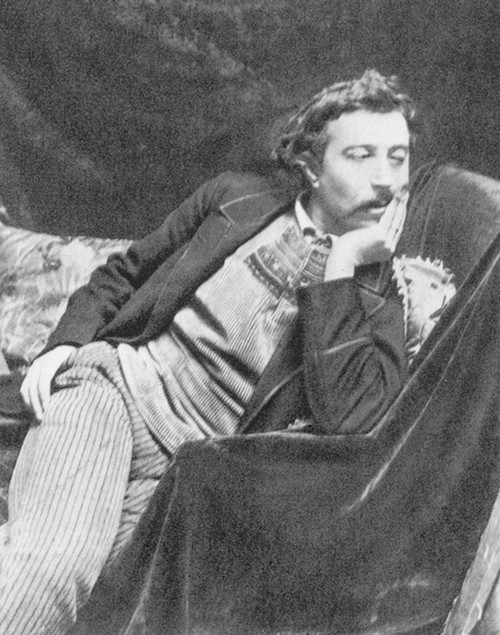
Artist portrait Image credit
Louis-Maurice Boutet de Monvel. Image source · Public domain
About the makers
Paul Gauguin
Individual life dates unrecorded
Biographical details and a verified portrait have not yet been recorded for this attribution.
The research & record
Study the work.
Follow the evidence.
Find catalogue details, historical context, technical research and the literature behind this artwork.
The artwork record
Research catalogue
Catalogue information and detailed research, with references that link to the bibliography.
Updated .
Identity and catalogue
Link- Title
- Where Do We Come From? What Are We? Where Are We Going?
- Artist or attribution
- Paul Gauguin(Sugana, 1972)
- Object date
- 1897-98
- Medium and support
- oil on canvas(Sugana, 1972)
- Current collection or location
- Museum of Fine Arts, Boston(Sugana, 1972)
- Movement or period
- Post-Impressionism
- Country or culture
- France
- Depicted subject
- A large Tahitian landscape with nude and draped figures, animals, and a blue idol, organized by the three questions painted at upper left. Gauguin made the picture in Tahiti in 1897-98.
- Title variants
- D'ou venons-nous? Que sommes-nous? Ou allons-nous?; Woher kommen wir? Wer sind wir? Wohin gehen wir?; Where Do We Come From? What Are We? Where Are We Going?
- Support
- canvas
- Inscriptions
- The title is painted at upper left on a yellow band.(Sugana, 1972)
- Dimensions
- Unknown
Read valuation records and their limitations
Catalogue identity
The work is catalogued as a painting by Paul Gauguin, who lived from 1848 to 1903, and it carries the title Where Do We Come From? What Are We? Where Are We Going?. The object is dated 1897-98, and that two-year range is the date assigned to the making of the painting. The supplied record does not attach the 1897-98 range to any depicted event, so the date identifies the period of execution rather than the time of the subject the picture presents.(Sugana, 1972, Summary, Artist: Paul Gauguin (1848-1903); File title and Summary, Title)
Title variants and supporting references
Beyond the title and artist, the Commons record categorizes the picture by the subjects it contains: a mother and child, animals, a landscape, and nude women in nature. The category list also identifies an idol and a painted title inscription among the work's subjects. Those categories are indexing terms rather than a curatorial essay, but together they indicate that the canvas sets figures, animals and an explicit symbolic statue within an outdoor setting, and that the title itself appears as writing within the image.(Sugana, 1972, File title and Summary, Title; Artist description: Work location Paris, Pont-Aven, Arles, Tahiti; Category: Tahiti by Paul Gauguin)
The record lists two catalogues as references: Gauguin's catalogue raisonné by Wildenstein, published in 1964, and a catalogue by Sugana, published in 1972. Neither is reproduced in the supplied excerpts, and the Commons annotation notes that the Sugana catalogue was not consulted for the record. These references establish that the painting has been catalogued in the scholarly literature, but the supplied excerpts do not record the painting's dimensions, its accession number, or a full institutional curatorial description of its subject and symbolic program. Those gaps should be treated as limits of the evidence at hand, not as negative findings about the object.(Sugana, 1972, File title and Summary, Title; Credit: Wildenstein Plattner Institute; License: Public domain)
Interpretation
The inscription of the three questions at the upper left, on a yellow band, means the title is not only an external label but a painted element of the composition. Read alongside the catalogue categories, the work can be described as a Tahitian landscape populated by figures, animals and an idol, over which the painted questions are set. Why the painting matters within a larger history of art cannot be settled from these units alone, since the record supplies no catalogue entry text, provenance narrative or critical reception; what the evidence does establish is an object date of 1897-98, an oil-on-canvas support, a Boston holding, a Tahitian association and a title that is visibly part of the picture.(Sugana, 1972, Summary, Artist: Paul Gauguin (1848-1903); File title and Summary, Title; Artist description: Work location Paris, Pont-Aven, Arles, Tahiti; Category: Tahiti by Paul Gauguin; Credit: Wildenstein Plattner Institute; License: Public domain)
The work is by Paul Gauguin, who lived from 1848 to 1903.(Sugana, 1972)
The work is dated 1897-98 and is titled Where Do We Come From? What Are We? Where Are We Going?(Sugana, 1972)
Subject and iconography
LinkRead valuation records and their limitations
Recorded composition and subjects
Visual observation
The most concrete visual evidence supplied for this painting comes from the subject categories attached to its Wikimedia Commons record. Taken together, they describe a composition containing a mother and child, animals, a landscape, and nude women in nature. These are descriptive terms for what the picture shows rather than an interpretation of what it means, and they establish the broad disposition of the scene: human figures and animals set within an outdoor setting rather than an interior. The same category list also records an idol and a painted title inscription among the work's subjects. That combination matters for how the object should be described. It indicates that the picture carries an explicit symbolic figure, in the form of a statue-like idol, and a written title integrated into the painted surface, so that text and image belong to the same visual field. What the categories do not provide is equally important: they do not supply dimensions, an accession number, or a full curatorial account of the subject and its symbolic program, and the supplied excerpts record that these were not available. Any reading of the picture's program therefore has to proceed from this comparatively thin descriptive base.(Sugana, 1972, Categories listing subject terms; Category list includes statue and title-related terms)
The picture is an oil on canvas dated 1897 to 1898 and is associated with Gauguin's time in Tahiti; the same record places the work in the Museum of Fine Arts, Boston. The Tahitian association is the frame in which the landscape, the figures and the idol should be understood, though the evidence supplied does not describe the specific topography, vegetation or architecture of the scene, and no building, furnishing or garment is itemised in these units. The date belongs to the making of the painting and not to any event depicted within it. Because the Commons categories are the only description of the imagery in this evidence set, the visible detail recoverable here is general: a landscape peopled by figures, including a mother and child and nude women, together with animals and an idol, and carrying a painted title. Claims about particular poses, costumes, objects or spatial arrangement would go beyond what these units establish.(Sugana, 1972, Categories listing subject terms; Category list includes statue and title-related terms; Artist description: Work location Paris, Pont-Aven, Arles, Tahiti; Category: Tahiti by Paul Gauguin; Category: 1898 oil on canvas paintings in the United States)
The painted title as visual element
Interpretation
The presence of a painted title inscription is the detail with the clearest consequence for how the object works visually. Because the title is written into the picture rather than carried only on a label beside it, the words are part of the composition and are seen together with the landscape, the figures and the idol. This supports describing the painting as one in which text and imagery are meant to be read jointly: the questions that name the work sit within the same field of vision as the scene they accompany. The Commons record establishes that such an inscription exists, but the supplied units do not transcribe its wording, describe its placement in detail beyond identifying it as a title, or specify its colour or lettering. The interpretive weight of the questions as a frame for the scene is a reasonable inference from the co-presence of inscription and imagery, but it remains an inference, not a documented curatorial statement in this evidence.(Sugana, 1972, Category list includes statue and title-related terms; Categories listing subject terms)
Visual observation
The idol singled out in the category list gives the picture an explicitly symbolic figure alongside its human and animal subjects. Within the supplied evidence it is identified only as an idol, a term of subject classification rather than a description of its form, material or iconographic ancestry. No predecessor, prototype or successor is named for it, and no source in this set establishes an influence running from any particular sculptural tradition into the painting, nor one running outward from the painting to later art. Resemblance between the painted idol and any external object would remain resemblance alone on this evidence, and should not be presented as a documented relationship. The same restraint applies to the mother and child and the nude women: they are recorded subjects, and the categories do not assign them fixed meanings or map them onto particular philosophical propositions. What the record does support is the more modest claim that the picture combines a symbolic statue, human figures and animals within a landscape under a written title.(Sugana, 1972, Category list includes statue and title-related terms; Categories listing subject terms; Artist description: Work location Paris, Pont-Aven, Arles, Tahiti; Category: Tahiti by Paul Gauguin)
Recorded composition and subjects
Connecting the visible subjects to the study of the object requires noting what the reference apparatus does and does not do. The Commons record lists Gauguin's catalogue raisonné by Wildenstein, published in 1964, and a catalogue by Sugana, published in 1972, as references; the Sugana catalogue is described as not consulted for this record, and the entry's consultation status is recorded as partial. These are pointers to the standard cataloguing literature, not evidence about the picture's appearance in themselves. The image file itself is credited to the Wildenstein Plattner Institute and is stated to be in the public domain, which identifies the photographic source of the reproduction. The supplied excerpts do not record technical imaging, conservation treatment, or changes in the painting's appearance over time, so no connection between visible detail and documented physical change can be made here. Where such technical evidence is absent, the visual account must rest on the categorical description and on the observation that composition and inscription belong together.(Sugana, 1972, Reference to Wildenstein 1964 and Sugana 1972; Categories listing subject terms)
The painted title as visual element
Interpretation
Read as a whole, the documented visual evidence describes a canvas in which a Tahitian landscape is populated by a mother and child, nude women, animals and an idol, and in which the title is painted into the work itself. The painting matters within a larger history of material culture because it exemplifies a picture that refuses the separation between image and text and between scene and question: the subject terms recorded for it are subjects of contemplation spread across a landscape rather than the incident of a narrative. That reading follows from the co-presence of landscape, symbolic figure and inscription, and it should be held with the qualifications the record imposes. The identification of individual figures with particular answers to the title's questions is not supported by the supplied units, and dimensions, accession data and a full curatorial account of the symbolic program remain unrecorded in this evidence. The object's importance can be stated firmly at the level of its documented composition; its detailed iconographic program awaits the fuller institutional description that these sources do not supply.(Sugana, 1972, Categories listing subject terms; Category list includes statue and title-related terms; Artist description: Work location Paris, Pont-Aven, Arles, Tahiti; Category: Tahiti by Paul Gauguin; Category: 1898 oil on canvas paintings in the United States; Reference to Wildenstein 1964 and Sugana 1972)
Visual observation
Commons labels the painting with a group of categories that describe the figures and subjects it contains, including mother and child, animals, a landscape, and nude women in nature.(Sugana, 1972)
The Commons category list identifies an idol and a painted title inscription among the work's subjects, which indicates the picture carries an explicit symbolic figure and a written title within the image.(Sugana, 1972)
Historical context
LinkRead valuation records and their limitations
Documented parameters of the work
The surviving record for this painting establishes a compact but firm set of facts. It is a work by Paul Gauguin, who lived from 1848 to 1903, dated 1897 to 1898, and titled Where Do We Come From? What Are We? Where Are We Going?. It is an oil on canvas, and it is held in the Museum of Fine Arts, Boston. The record also states that Gauguin worked in Tahiti and that the painting is associated with that setting; the location line for the artist's career includes Paris, Pont-Aven, Arles and Tahiti, so Tahiti is one station within a longer itinerary rather than a lifelong residence. These are the documented parameters within which any account of commission, function or status has to operate.(Sugana, 1972, Artist description: Work location Paris, Pont-Aven, Arles, Tahiti; Category: Tahiti by Paul Gauguin)
The date range 1897 to 1898 belongs to the making of the picture, and the record offers nothing about the circumstances of its commissioning: no patron, no intermediary, no purchase agreement, no exhibition at which it was first shown, and no statement of the artist's purpose at the moment of painting. The Commons record is explicit that the supplied excerpts do not include the painting's dimensions, accession number, or a full institutional curatorial description of its subject and symbolic program. Any claim about who asked for the work, who owned it first, or what Gauguin intended it to do in a specific room or market therefore falls outside this evidence and should not be supplied by inference from the title alone.(Sugana, 1972, Artist description: Work location Paris, Pont-Aven, Arles, Tahiti; Category: Tahiti by Paul Gauguin)
The painted surface and its written title
Visual observation
What the record does describe is the picture's own internal address to a viewer. The category terms attached to it name a mother and child, animals, a landscape, and nude women in nature, and they also identify an idol and a painted title inscription among its subjects. The inscription and the symbolic figure are thus features of the painted surface, not captions added by a cataloguer: the questions that give the work its name are written within the image, and a statue-like figure stands among the other presences. That combination lets the picture be described as carrying explicit symbolic material, while the record stops short of assigning each figure a fixed meaning or mapping the figures onto the three questions.(Sugana, 1972, Artist description: Work location Paris, Pont-Aven, Arles, Tahiti; Category: Tahiti by Paul Gauguin; Categories listing subject terms; Category list includes statue and title-related terms)
Cataloguing and photographic documentation
The later documentary apparatus shows how the painting has been catalogued rather than how it was made. The Commons record lists Gauguin's catalogue raisonne by Wildenstein, published in 1964, and a catalogue by Sugana, published in 1972, as references. These are twentieth-century reference works, and their role in the record is to identify and list the painting, not to describe its commissioning. The image file itself is credited to the Wildenstein Plattner Institute and marked as public domain, which identifies the photographic source of the reproduction. The catalogues and the photograph are therefore evidence of custodianship and documentation in the decades after the artist's death, and they should not be read back into the 1897 to 1898 moment as if they recorded contemporary transactions.(Sugana, 1972, Artist description: Work location Paris, Pont-Aven, Arles, Tahiti; Category: Tahiti by Paul Gauguin; Reference to Wildenstein 1964 and Sugana 1972; Credit: Wildenstein Plattner Institute; License: Public domain)
Limits of the social evidence
Visual observation
The record's most consequential limitation concerns the social world of the painting. Tahiti is named as the setting in which Gauguin worked and with which the picture is associated, but the evidence does not name a household, a patron, a sitter, a dealer or a recipient, and it does not state whether the work was made on speculation or on request. The presence of a mother and child, nude women in a landscape, an idol and animals can be described as the picture's subjects, yet the record does not establish that these figures correspond to particular individuals or to a documented local community. Reading them as portraits, as a record of a specific place, or as a commissioned celebration of a named household would exceed what the units support.(Sugana, 1972, Artist description: Work location Paris, Pont-Aven, Arles, Tahiti; Category: Tahiti by Paul Gauguin; Categories listing subject terms; Category list includes statue and title-related terms)
Interpretation
Taken together, the evidence supports a careful synthesis. The object is securely identified as a large oil painting of 1897 to 1898 by Gauguin, made during or in relation to his Tahitian period and now in Boston, and its formal character is established in outline: a landscape populated by figures and animals, an idol, and a painted title asking three questions. What is not established is the commissioning history, the identity of any patron, the painting's early ownership, its dimensions and accession details, or a curatorial explanation of its symbolic program. Within a larger history of art and material culture, the work can be situated as a Tahitian-period canvas whose meaning is carried partly by an inscription integral to the image, and whose documentation survives chiefly through mid- and late twentieth-century catalogues and a Wildenstein Plattner Institute photograph. Those are real and useful anchors for further research, and they should be kept distinct from the questions the painting itself poses.(Sugana, 1972, Artist description: Work location Paris, Pont-Aven, Arles, Tahiti; Category: Tahiti by Paul Gauguin; Categories listing subject terms; Category list includes statue and title-related terms; Reference to Wildenstein 1964 and Sugana 1972; Credit: Wildenstein Plattner Institute; License: Public domain)
Gauguin worked in Tahiti, and the painting is associated with that setting.(Sugana, 1972)
Materials and technique
LinkRead valuation records and their limitations
The documented medium
The only material fact recorded in the supplied documentation for this painting is its medium and support: it is an oil on canvas. The Commons record lists it among 1898 oil on canvas paintings in the United States, which places the work within that medium category while also locating the object in a United States collection; the same record states that it is held in the Museum of Fine Arts, Boston. Beyond medium and support, the supplied evidence does not describe a ground layer, priming, canvas weave, stretcher, dimensions, pigment analysis, brushwork, underdrawing, or any conservation treatment. Any account of preparation or layering would therefore exceed what the record establishes.(Sugana, 1972, Category: 1898 oil on canvas paintings in the United States)
The painting's making is dated 1897 to 1898 and is associated with Gauguin's time in Tahiti. The date belongs to the execution of the picture, not to any event depicted in it. The supplied record also lists two catalogue references, the Wildenstein catalogue raisonné of 1964 and a catalogue by Sugana of 1972, the latter not consulted for this record. Those references are cited as documentation of the work rather than as technical examinations; the record does not indicate that either catalogues pigments, supports, or condition in the supplied excerpts, so they cannot be used here as evidence about materials.(Sugana, 1972, Category: 1898 oil on canvas paintings in the United States)
Interpretation
Taken together, the evidence supports a narrow but firm material profile: an oil painting on canvas, made in 1897 and 1898 in Tahiti, carrying a painted inscription and an idol among its depicted subjects, and now in Boston. The distinction between the documented medium and the observed subject terms is the important one. The oil-on-canvas statement comes from the record's descriptive data; the presence of the inscription and the idol comes from cataloguing of what the picture shows. Neither source reports pigment identification, layer structure or condition, so the technical history of this object, as distinct from its iconography, remains unestablished in the supplied material.(Sugana, 1972, Category: 1898 oil on canvas paintings in the United States; Categories listing subject terms; Category list includes statue and title-related terms; Absent from supplied excerpts)
The painting is an oil on canvas.(Sugana, 1972)
Condition and conservation
LinkRead valuation records and their limitations
The limits of the record
The available evidence for the condition and conservation history of Paul Gauguin's Where Do We Come From? What Are We? Where Are We Going? (dated 1897-98, oil on canvas, held at the Museum of Fine Arts, Boston) is markedly thin. The supplied excerpts record no condition report, no treatment history, no examination under ultraviolet or raking light, no pigment analysis, no lining or stretcher history, and no environmental or display specifications. The Commons record itself is explicit on the limits of what it documents: the supplied excerpts do not record the painting's dimensions, accession number, or a full institutional curatorial description of its subject and symbolic program. Any account of the object's present physical state that went beyond these gaps would be unsupported by the evidence at hand, and the absence of a condition account should not be read as evidence that the painting is either well preserved or compromised.(Sugana, 1972, Absent from supplied excerpts; Category: 1898 oil on canvas paintings in the United States)
What the evidence does establish is the material baseline on which any future condition study would build: the work is an oil on canvas, dated 1897-98, and associated with Gauguin's time in Tahiti. These facts come from the Commons record rather than from a conservation file, and the record's own summary acknowledges the absence of an institutional curatorial description. It is worth distinguishing this documentary gap from a condition claim. The support and medium are documented; the current state of that canvas, its surface, edges, inscriptions or paint layers is not. The painted title inscription noted among the work's subjects is described as a feature of the image, not as a condition observation, and no evidence here speaks to its legibility, abrasion or stability.(Sugana, 1972, Category: 1898 oil on canvas paintings in the United States; Absent from supplied excerpts)
Photographic documentation and catalogues
The photographic record is the closest thing in the supplied evidence to a visual document of the object's state, and its terms matter for how it can be used. The Commons record credits the Wildenstein Plattner Institute for the supplied image and states that the photographic source derives from that institute and is in the public domain. Such a photograph documents an appearance at an unrecorded moment, not the painting's condition today, and the evidence supplies no date, negative number or comparison image that would allow change over time to be assessed. The same record lists Gauguin's catalogue raisonné by Wildenstein (1964) and a catalogue by Sugana (1972) as references; the Sugana catalogue is noted as listed but not consulted for this record, so it cannot be cited here for any condition or treatment detail.(Sugana, 1972, Credit: Wildenstein Plattner Institute; License: Public domain; Absent from supplied excerpts; Category: 1898 oil on canvas paintings in the United States)
Interpretation
Taken together, these units define a research agenda more than a history. A condition and conservation account of this painting would need dated examination records, treatment documentation and environmental history, none of which the supplied evidence contains. Until such records are assembled, the responsible statement is that the object is a documented oil on canvas of 1897-98 in the Museum of Fine Arts, Boston, whose material condition and conservation past remain outside this evidence base. This caution matters within the larger history of Gauguin's Tahitian work, because claims about survival, alteration or authenticity often rest on exactly the kind of technical documentation that is here missing.(Sugana, 1972, Absent from supplied excerpts; Category: 1898 oil on canvas paintings in the United States; Credit: Wildenstein Plattner Institute; License: Public domain)
The supplied excerpts do not record the painting's dimensions, accession number, or a full institutional curatorial description of its subject and symbolic program.(Sugana, 1972)
Provenance and ownership
LinkRead valuation records and their limitations
The Photographic Credit and the Limits of the Record
The provenance record available for this painting is unusually thin, and the single supplied evidence unit concerns the photograph rather than the ownership history of the object. The Commons file credits the Wildenstein Plattner Institute for the supplied image and marks it as in the public domain. That establishes the origin and rights status of the reproduction: the photographic source derives from the Wildenstein Plattner Institute, and the image itself is public domain. It does not establish who has owned the canvas, when it changed hands, or through which agents or dealers it passed. Those distinctions matter for a provenance section, because a documented photo rights credit is not a documented chain of ownership, and treating the one as evidence of the other would overstate what the record supports.(Sugana, 1972, Credit: Wildenstein Plattner Institute; License: Public domain)
The only dated scholarly anchors in the record are bibliographic rather than transactional. The Commons record lists Gauguin's catalogue raisonné by Wildenstein, published in 1964, and a catalogue by Sugana, published in 1972, as references. These citations indicate that the painting has been catalogued in the standard raisonné literature and in later catalogue scholarship, which is the kind of documentation through which works are usually tracked across collections. The record supplies no page numbers or entry numbers for either reference, and the Sugana catalogue is annotated as not consulted for this record; the Wildenstein reference is likewise only listed. Their presence should therefore be read as evidence that cataloguing exists, not as evidence of any specific owner, transfer, or sale, and the locators needed to connect them to a provenance chain are not in the supplied material.(Sugana, 1972, Reference to Wildenstein 1964 and Sugana 1972; Credit: Wildenstein Plattner Institute; License: Public domain)
The Commons record credits the Wildenstein Plattner Institute for the supplied image, indicating that the photographic source derives from the Wildenstein Plattner Institute and is in the public domain.(Sugana, 1972)
Reception and literature
LinkRead valuation records and their limitations
Catalogue Literature and the Photographic Record
The reception of Where Do We Come From? What Are We? Where Are We Going? is documented in the supplied record chiefly through its catalogue literature and its photographic reproduction. The Commons record lists Gauguin's catalogue raisonné by Wildenstein, published in 1964, and a catalogue by Sugana, published in 1972, as references. Taken together these entries show that the painting has been entered into the standard apparatus of Gauguin scholarship: a raisonné that establishes and enumerates the oeuvre, and a separate catalogue devoted to the artist. The record does not, however, preserve what either author argued about the picture, how they dated or titled it, or how their accounts may differ. The distinction matters for reception history, because it marks the point at which the work becomes a catalogued object with a fixed place in the artist's corpus, but it does not by itself document a critical reading or a change of interpretation.(Sugana, 1972, Reference to Wildenstein 1964 and Sugana 1972)
Gauguin's catalogue raisonne by Wildenstein, 1964, and a catalogue by Sugana, 1972, are listed as references in the Commons record.(Sugana, 1972)
Collection and display
LinkRead valuation records and their limitations
The Boston holding and its documentation
Where Do We Come From? What Are We? Where Are We Going? is held in the Museum of Fine Arts, Boston. That single institutional fact is what the supplied evidence establishes about the work's present location; the record gives no accession number, no date of acquisition, no donor or purchase history, and no information about how the painting came to Boston or where it was between Gauguin's studio and the museum. The absence is worth stating plainly, because questions of collection and display are precisely the ones this record cannot yet answer from the units at hand.(Sugana, 1972, Categories: Paintings by Paul Gauguin in the Museum of Fine Arts, Boston)
Limits of the present record
It is also important to register what the supplied excerpts explicitly do not record: the painting's dimensions, its accession number, and a full institutional curatorial description of its subject and symbolic programme. Because the museum's own account is absent from this evidence set, the most careful statement about collection and display is limited to the confirmed holding in Boston, supplemented by the descriptive and bibliographic data in the Commons record. Claims about gallery context, rotation, loan history, or conservation would exceed what these units support and should await primary institutional documentation.(Sugana, 1972, Categories: Paintings by Paul Gauguin in the Museum of Fine Arts, Boston)
Interpretation
Read together, the two units give a consistent but thin picture: an oil on canvas of 1897 to 1898, made in Tahiti, now in Boston, known through a public-domain photograph from the Wildenstein Plattner Institute and through citations to the Wildenstein and Sugana catalogues. For a history of collection and display, the object's significance lies in this documented trajectory from Tahiti to a major American museum, but the evidence establishes only the endpoints and the reference literature, not the intervening movement. The gaps are themselves a research finding: they mark where archival work in the museum's files and in the cited catalogues would be needed before any narrative of how the painting entered and has been shown in Boston could be written.(Sugana, 1972, Categories: Paintings by Paul Gauguin in the Museum of Fine Arts, Boston)
The work is held in the Museum of Fine Arts, Boston.(Sugana, 1972)
Documented values and qualified estimates
LinkRead valuation records and their limitations
The recorded valuation figure
Interpretation
The only recorded valuation associated with this object in the supplied evidence is a working insurance estimate, captured as a calculated range of US$200 million to US$400 million and dated to a working calculation generated on 2026-10-16. The document describes its own method: it is a broad range prepared for manual review, produced as what it calls a conservative model estimate rather than an appraisal. It states explicitly that it is not an official insurance value, not an appraisal, not an auction result and not a sale price, and that it does not rest on comparable sales or private insurance records. Anyone requiring an actual insurance figure is directed to a qualified appraiser or to the holding institution. That chain of qualifications is part of the record and should travel with the number wherever it is repeated.(Sugana, 1972)
The basis the calculation gives for its range is a set of object identifications rather than any market data. It describes the work as confirmed as Paul Gauguin (1848-1903), Where Do We Come From? What Are We? Where Are We Going?, 1897-98, oil on canvas, held by the Museum of Fine Arts, Boston. It states that the Commons record supports the artist, title, date, medium and museum collection association, and it reads the image file dimensions of 5400 by 1987 pixels as indicating a large, panoramic canvas consistent with a major Gauguin Tahiti period work. The justification for the high range is then given as the painting's status as one of Gauguin's best known works and its presence in a major public collection, not any transaction involving the object. Because the work is institutional and the supplied context contains no public sale, auction or appraisal record, the calculation says it anchored the range broadly at a high eight figure to low nine figure level, deliberately widening it to remain conservative for manual review without relying on undocumented comparable sales or private insurance data.(Sugana, 1972)
Read against the Commons source, the valuation document is careful about what it does and does not inherit. The Commons record is credited with the artist's dates, the title, the 1897-98 date, the oil on canvas medium and the Museum of Fine Arts, Boston association, and it supplies the image from which the pixel dimensions were read. The same source notes, however, that its supplied excerpts do not record the painting's dimensions, accession number, or a full institutional curatorial description of its subject and symbolic program. The valuation therefore rests on widely repeated identification and on a pixel measurement of a reproduction, and it is open about having no measured canvas size, no accession record and no curatorial statement of the symbolic program behind it. Prominence and public stewardship, not verified physical or commercial data, carry the whole of the calculated range.(Sugana, 1972)
Working estimate
Calculated working insurance estimate, not a sale price: Estimated value: US$200M to US$400M Recorded date: Working calculation, generated 2026-10-16. Methodology: This is a broad working insurance range for manual review. It is calculated as a conservative model estimate, not an appraisal. Basis: the object is confirmed as Paul Gauguin (1848-1903), Where Do We Come From? What Are We? Where Are We Going?, 1897-98, oil on canvas, held by the Museum of Fine Arts, Boston. The Commons record supports the artist, title, date, medium, and the museum collection association; the image file dimensions (5400 x 1987 pixels) indicate a large, panoramic canvas, consistent with a major Gauguin Tahiti period work. The work is one of Gauguin's best known paintings and is in a major public collection, factors that support a high calculated insurance range. Because the work is institutional and no public sale, auction, or appraisal record is present in the supplied context, the range is anchored broadly at a high eight figure to low nine figure level to reflect its combination of extreme art historical prominence and the scarcity of comparable market evidence. The range is deliberately wide to remain conservative for manual review and does not rely on undocumented comparable sales or private insurance data. Qualification: This is a model-generated working insurance range for manual review. It is not an official insurance value, appraisal, auction result, or sale price. It is not based on comparable sales or private insurance records. Actual insurance values should be determined by a qualified appraiser or the holding institution.(Sugana, 1972)
Further reading
Books for a closer look
Paid links. As an Amazon Associate I earn from qualifying purchases.

Open Library Paul Gauguin: Where Do We Come from? What Are We? Where Are We Going?
Museum of Fine Arts, Boston
Gauguin-titled record whose subjects include Gauguin, Symbolism in art, and the Boston Museum of Fine Arts, the documented holding institution of this painting. The symbolism and Boston subjects align with the work's symbolic figures and location.
ISBN 9780878467938
Bibliography
Sources and further reading
References are arranged by author or organisation, with links to the original publications. Where no publication date is recorded, n.d. means no date.
Source notes updated .
No recorded sources match these filters. Reset the filters to see the full bibliography.
- 02
Book
Paul Gauguin: Where Do We Come from? What Are We? Where Are We Going?. Museum of Fine Arts, Boston.
Gauguin-titled record whose subjects include Gauguin, Symbolism in art, and the Boston Museum of Fine Arts, the documented holding institution of this painting. The symbolism and Boston subjects align with the work's symbolic figures and location.
- ISBN
- 9780878467938
Citation text
- 01
Secondary · Background reading
Wikimedia Commons: Where Do We Come From What Are We Where Are We Going. Catalogue of Paul Gauguin. Wikimedia Commons.
Listed in the Commons record as a second catalogue reference. Not consulted for this record.
Citation text
Art to live with
Bring this painting
home.
A piece of the archive, made yours. Explore Where Do We Come From? What Are We? Where Are We Going? in a size and finish that fits your space.
Your text and annotations appear on these editions. Adding to cart saves that design for printing.
Combine this painting with your favourites01 / Find your edition
Made for you
Suggested from your location. Change it if you're sending elsewhere or using a VPN. Prices and delivery are shown in GBP.
16 products
Choose an edition to make it yours
6 × 8 in · Printed cover · 118 lined pages
6 × 8 in · Printed cover · 118 lined pages
6 × 8 in · Printed cover · 118 lined pages
Notebook
GBP 11.91
Delivery GBP 5.30 / Total GBP 17.21
A 6 × 8 inch spiral notebook with 118 ruled pages (59 sheets), a printed front cover, dark grey back cover and metal spiral binding.
Fit and fill keep the painting’s proportions. Stretch changes them.
Move and zoom the painting on your notebook.
Made to order with your design
Made to order
US delivery only
17.8 × 12.7 cm / 7 × 5 in · Standard
17.8 × 12.7 cm / 7 × 5 in · Standard

7 × 5 in / 17.8 × 12.7 cm · Standard

7 × 5 in / 17.8 × 12.7 cm · Standard

7 × 5 in / 17.8 × 12.7 cm · Standard

7 × 5 in / 17.8 × 12.7 cm · Standard

7 × 5 in / 17.8 × 12.7 cm · Standard
Metal art sign
GBP 19.63
Delivery GBP 17.71 / Total GBP 37.34
A printed aluminium sign with rounded corners and mounting holes.
Fit and fill keep the painting’s proportions. Stretch changes them.
Move and zoom the painting on your metal art sign.
Made to order with your design
Printed aluminium · mounting holes included
US delivery only
iPhone 12 Mini ? Glossy ? back view
iPhone 12 Mini · Glossy

iPhone 12 Mini ? Glossy ? back view

iPhone 12 Mini ? Glossy ? back view

iPhone 12 Mini ? Glossy ? back view
Tough phone case
GBP 16.40
Delivery GBP 4.25 / Total GBP 20.65
A two-layer phone case with a printed polycarbonate shell and a shock-absorbing inner liner.
Two layers with a shock-absorbing TPU liner
Case & print details
- Device
- Apple · iPhone 12 Mini
- Material
- Polycarbonate shell with a TPU inner liner
- Artwork
- Outer back and wrapped edges from one template
- Finish
- Glossy
- Version
- Standard version
- Printing
- Dye sublimation
- Print file
- 1,122 × 1,831 px · 95 × 155 mm · PNG · 300 dpi recommended
Rear outline and camera openings follow this variant's Printify template. Case depth and small hardware remain illustrative.
Supplier product detailsFit and fill keep the painting’s proportions. Stretch changes them.
Move and zoom the painting on your tough phone case.
Made to order with your design
Made to order
US delivery only
25.4 × 20.3 cm / 10 × 8 in · White
25.4 × 20.3 cm / 10 × 8 in · White

10 × 8 in / 25.4 × 20.3 cm · White

10 × 8 in / 25.4 × 20.3 cm · White

10 × 8 in / 25.4 × 20.3 cm · White

10 × 8 in / 25.4 × 20.3 cm · White
Framed art print
GBP 34.16
- 1 framed print
- GBP 34.16
- Delivery to United States
- GBP 9.64
- Total
- GBP 43.80
A ready-to-hang wooden frame with a clear Perspex cover and a semi-gloss printed insert.
Delivery is quoted for all selected copies together.
Fit and fill keep the painting’s proportions. Stretch changes them.
Move and zoom the painting on your framed art print.
Made to order with your design
Wooden frame & protective clear front included
US delivery only
22.9 × 20.3 cm / 9 × 8 in · Standard
22.9 × 20.3 cm / 9 × 8 in · Standard

9 × 8 in / 22.9 × 20.3 cm · Standard

9 × 8 in / 22.9 × 20.3 cm · Standard

9 × 8 in / 22.9 × 20.3 cm · Standard

9 × 8 in / 22.9 × 20.3 cm · Standard
Mouse mat
GBP 7.29
Delivery GBP 4.82 / Total GBP 12.11
A rectangular fabric mouse mat with a rubber backing and rounded corners.
Fit and fill keep the painting’s proportions. Stretch changes them.
Move and zoom the painting on your mouse mat.
Made to order with your design
Made to order
US delivery only
43.2 × 45.7 cm / 17 × 18 in · Artwork
43.2 × 45.7 cm / 17 × 18 in · Artwork

17 × 18 in / 43.2 × 45.7 cm · Artwork

17 × 18 in / 43.2 × 45.7 cm · Artwork

17 × 18 in / 43.2 × 45.7 cm · Artwork
Woven tote bag
GBP 46.87
Delivery GBP 5.88 / Total GBP 52.75
A woven tote with cotton webbing handles and the painting translated into a woven design.
Fit and fill keep the painting’s proportions. Stretch changes them.
Move and zoom the painting on your woven tote bag.
Made to order with your design
Made to order
US delivery only
See more10 more products
iPhone 12 Mini ? Standard ? back view
iPhone 12 Mini · Standard

iPhone 12 Mini ? Standard ? back view

iPhone 12 Mini ? Standard ? back view

iPhone 12 Mini ? Standard ? back view
Flexible phone case
GBP 15.62
Delivery GBP 4.25 / Total GBP 19.87
A flexible TPU phone case with a frosted finish, a printed back and precise port openings.
Flexible TPU with a frosted, matte finish
Case & print details
- Device
- Apple · iPhone 12 Mini
- Material
- Semi-transparent thermoplastic polyurethane (TPU)
- Artwork
- Back print; rim stays unprinted
- Finish
- Standard
- Version
- Standard version
- Printing
- Dye sublimation
- Print file
- 791 × 1,586 px · 67 × 134.3 mm · PNG · 300 dpi recommended
Rear outline and camera openings follow this variant's Printify template. Case depth and small hardware remain illustrative.
Supplier product detailsFit and fill keep the painting’s proportions. Stretch changes them.
Move and zoom the painting on your flexible phone case.
Made to order with your design
Made to order
S · Standard
S · Standard

S · Standard

S · Standard

S · Standard

S · Standard

S · Standard
Crew socks
GBP 10.66
Delivery GBP 4.43 / Total GBP 15.09
Crew-length polyester and spandex socks with a ribbed cuff, cushioned sole and sublimated artwork.
Fit and fill keep the painting’s proportions. Stretch changes them.
Move and zoom the painting on your crew socks.
Made to order with your design
One pair · design repeated on both socks
US delivery only
12" · Standard
12" · Standard

12" · Standard

12" · Standard

12" · Standard
Laptop sleeve
GBP 26.12
Delivery GBP 4.92 / Total GBP 31.04
A polyester laptop sleeve with a fleece lining, top zip, printed front and black reverse.
Fit and fill keep the painting’s proportions. Stretch changes them.
Move and zoom the painting on your laptop sleeve.
Made to order with your design
Made to order
US delivery only
11oz · single image
11oz · White
11oz · single image
Mug
GBP 7.36
Delivery GBP 6.17 / Total GBP 13.53
A glossy white ceramic mug with a C-shaped handle, available in 11oz and 15oz sizes.
single layout · choose single, double or a repeating pattern in Customise.
Repeat, fit, fill and position your artwork around the mug.
Made to order with your design
Made to order
iPhone 12 Mini ? Standard ? back view
iPhone 12 Mini · Standard

iPhone 12 Mini ? Standard ? back view

iPhone 12 Mini ? Standard ? back view

iPhone 12 Mini ? Standard ? back view

iPhone 12 Mini ? Standard ? back view

iPhone 12 Mini ? Standard ? back view
Biodegradable phone case
GBP 20.96
Delivery GBP 4.25 / Total GBP 25.21
A matte phone case made from plant polymers and bamboo fibre, with the artwork printed on the back.
Flexible plant-polymer shell with a matte finish
Case & print details
- Device
- Apple · iPhone 12 Mini
- Material
- PLA and PBAT polymers with bamboo fibre
- Artwork
- Back print; rim stays unprinted
- Finish
- Standard
- Version
- Standard version
- Printing
- Dye sublimation
- Print file
- 777 × 1,553 px · 65.8 × 131.5 mm · PNG · 300 dpi recommended
Rear outline and camera openings follow this variant's Printify template. Case depth and small hardware remain illustrative.
Supplier product detailsFit and fill keep the painting’s proportions. Stretch changes them.
Move and zoom the painting on your biodegradable phone case.
Made to order with your design
Made to order
30.5 × 20.3 cm / 12 × 8 in · Standard
30.5 × 20.3 cm / 12 × 8 in · Standard

12 × 8 in / 30.5 × 20.3 cm · Standard

12 × 8 in / 30.5 × 20.3 cm · Standard

12 × 8 in / 30.5 × 20.3 cm · Standard
Fine art poster
GBP 12.90
Delivery GBP 7.61 / Total GBP 20.51
A gallery paper print with a smooth art-paper surface. Choose a size that suits the painting.
Fit and fill keep the painting’s proportions. Stretch changes them.
Move and zoom the painting on your fine art poster.
Made to order with your design
Unframed · frame it your way
iPhone 12 Mini ? Standard ? back view
iPhone 12 Mini · Standard

iPhone 12 Mini ? Standard ? back view

iPhone 12 Mini ? Standard ? back view

iPhone 12 Mini ? Standard ? back view
Clear phone case
GBP 15.11
Delivery GBP 4.25 / Total GBP 19.36
A clear phone case with artwork on the back. Leave areas transparent to show the phone underneath.
Clear shell with shock-absorbing TPU sides
Case & print details
- Device
- Apple · iPhone 12 Mini
- Material
- Polycarbonate back and clear TPU sides
- Artwork
- Back print; clear sides stay unprinted
- Finish
- Standard
- Version
- Standard version
- Printing
- Dye sublimation
- Print file
- 732 × 1,527 px · 62 × 129.3 mm · PNG · 300 dpi recommended
Rear outline and camera openings follow this variant's Printify template. Case depth and small hardware remain illustrative.
Supplier product detailsFit and fill keep the painting’s proportions. Stretch changes them.
Move and zoom the painting on your clear phone case.
Made to order with your design
Made to order
15oz · single image
15oz · Standard

15oz · single image

15oz · single image

15oz · single image

15oz · single image

15oz · single image
Travel mug
GBP 32.00
Delivery GBP 5.68 / Total GBP 37.68
A stainless-steel travel mug with a black lid, a tapered base and a printed white exterior.
single layout · choose single, double or a repeating pattern in Customise.
Repeat, fit, fill and position your artwork around the mug.
Made to order with your design
Made to order
US delivery only
2.5 × 3.4 cm / 1 × 1.4 in · Glossy
2.5 × 3.4 cm / 1 × 1.4 in · Glossy

1 × 1.4 in / 2.5 × 3.4 cm · Glossy

1 × 1.4 in / 2.5 × 3.4 cm · Glossy

1 × 1.4 in / 2.5 × 3.4 cm · Glossy

1 × 1.4 in / 2.5 × 3.4 cm · Glossy
Photo keyring
GBP 10.19
Delivery GBP 5.39 / Total GBP 15.58
A rectangular zinc-alloy photo keyring with a glossy insert and a swivel split ring.
Fit and fill keep the painting’s proportions. Stretch changes them.
Move and zoom the painting on your photo keyring.
Made to order with your design
Photo insert · zinc frame & swivel ring
US delivery only
iPhone 15 Pro ? Glossy ? back view
iPhone 15 Pro · Glossy

iPhone 15 Pro ? Glossy ? back view

iPhone 15 Pro ? Glossy ? back view

iPhone 15 Pro ? Glossy ? back view

iPhone 15 Pro ? Glossy ? back view

iPhone 15 Pro ? Glossy ? back view
Slim phone case
GBP 16.37
Delivery GBP 5.79 / Total GBP 22.16
A slim printed phone shell with open ports and a lightweight profile.
Slim, lightweight polycarbonate shell
Case & print details
- Device
- Apple · iPhone 15 Pro
- Material
- Polycarbonate
- Artwork
- Outer back and wrapped edges from one template
- Finish
- Glossy
- Version
- Standard version
- Printing
- Dye sublimation
- Print file
- 1,278 × 1,971 px · 108.2 × 166.9 mm · PNG · 300 dpi recommended
Rear outline and camera openings follow this variant's Printify template. Case depth and small hardware remain illustrative.
Supplier product detailsFit and fill keep the painting’s proportions. Stretch changes them.
Move and zoom the painting on your slim phone case.
Made to order with your design
Made to order
US delivery only
The 30 cm ruler is scaled alongside your selected print. Keep the painting’s proportions with a black background, or stretch it to fill. Frame width, material texture and screen colours are illustrative.
Keep exploring