Identity and catalogue
Link- Title
- Victory Boogie Woogie
- Artist or attribution
- Piet Mondrian
- Movement or period
- Neoplasticism / De Stijl
- Country or culture
- Netherlands / United States
- Depicted subject
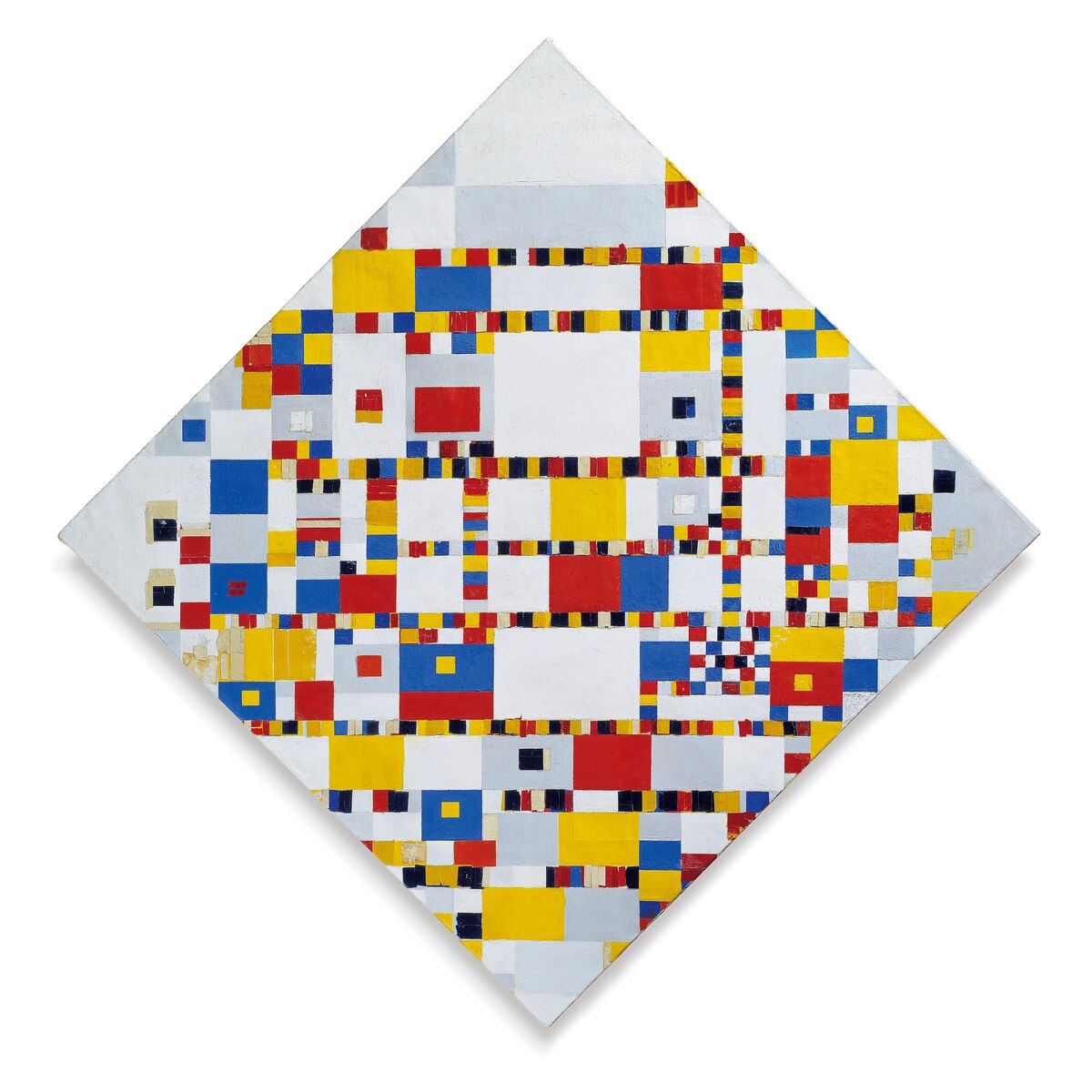
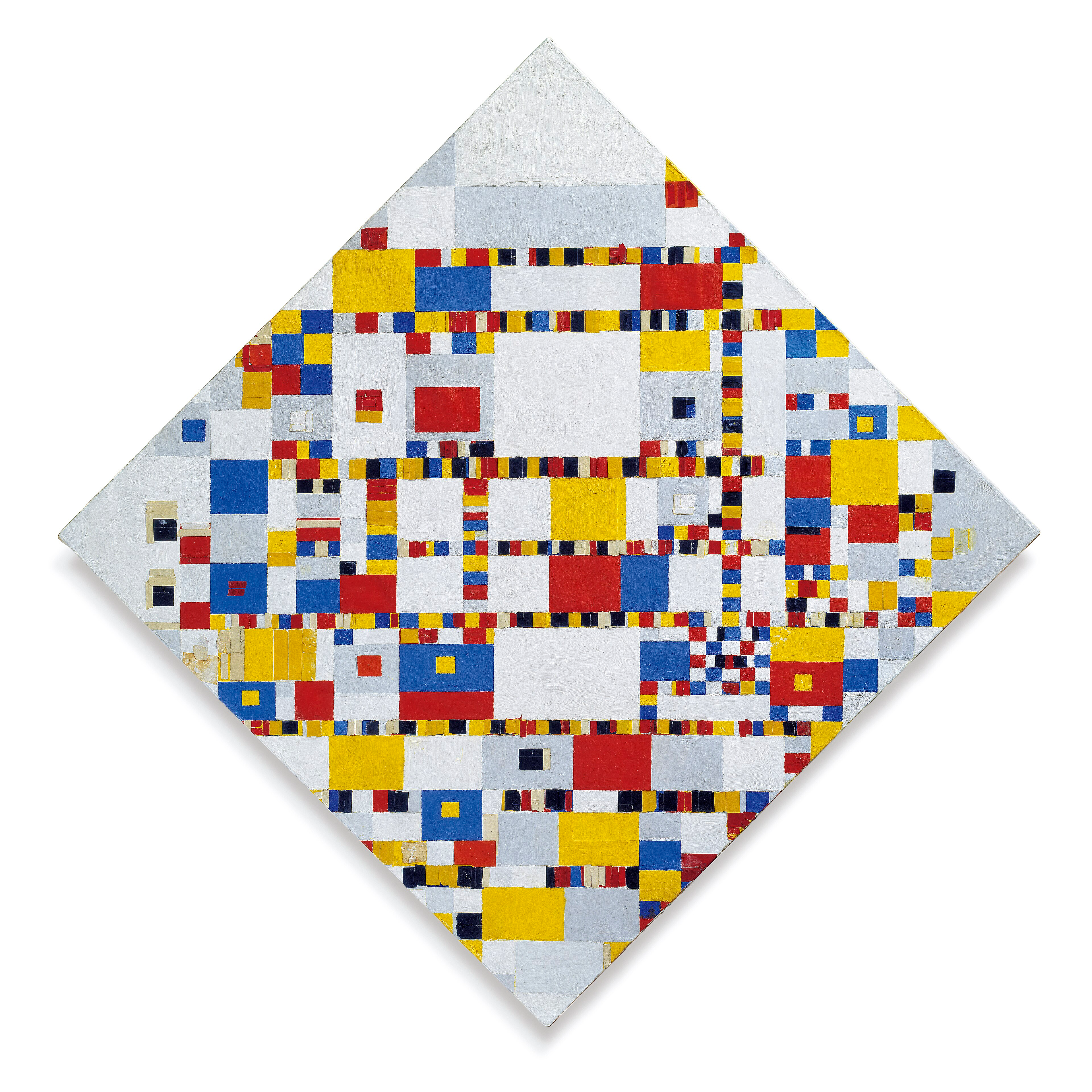
- Mondrian's final, unfinished painting, a large diamond-shaped canvas of coloured squares and banded lines that seeks to express the rhythm of New York, in which he aimed to unite chaos and order, light and dark, speed and slowness.
- Title variants
- Victory-painting; Boogie Woogie painting; Diamond
- Accession number
- 0810747
- Support
- canvas
Catalogue identity and dating
The object catalogued here is Victory Boogie Woogie, described in the museum record as Piet Mondrian's last work, painted between 1942 and 1944 and left unfinished at his death. The same record dates the beginning of the painting to June 1942, when Mondrian began a large diamond-shaped painting from which every black line had disappeared. The support is a diamond-shaped canvas whose stretcher measures 178.4 cm by 178.4 cm, measured diagonally. The materials recorded for the work are oil, tape, paper, charcoal and pencil on canvas, a combination that itself signals a picture built and rebuilt rather than smoothly finished. The 1998 entry of the work into Dutch public ownership is a much later event than the 1942 to 1944 execution dates, and the two chronological layers should not be conflated: the painting's making belongs to Mondrian's New York years, while its national acquisition belongs to the end of the twentieth century.(Kunstmuseum Den Haag, 2026)
Victory Boogie Woogie is Piet Mondrian's last work, painted between 1942 and 1944 and left unfinished at his death.(Kunstmuseum Den Haag, 2026)
Subject and iconography
LinkThe object and its making
Visual observation
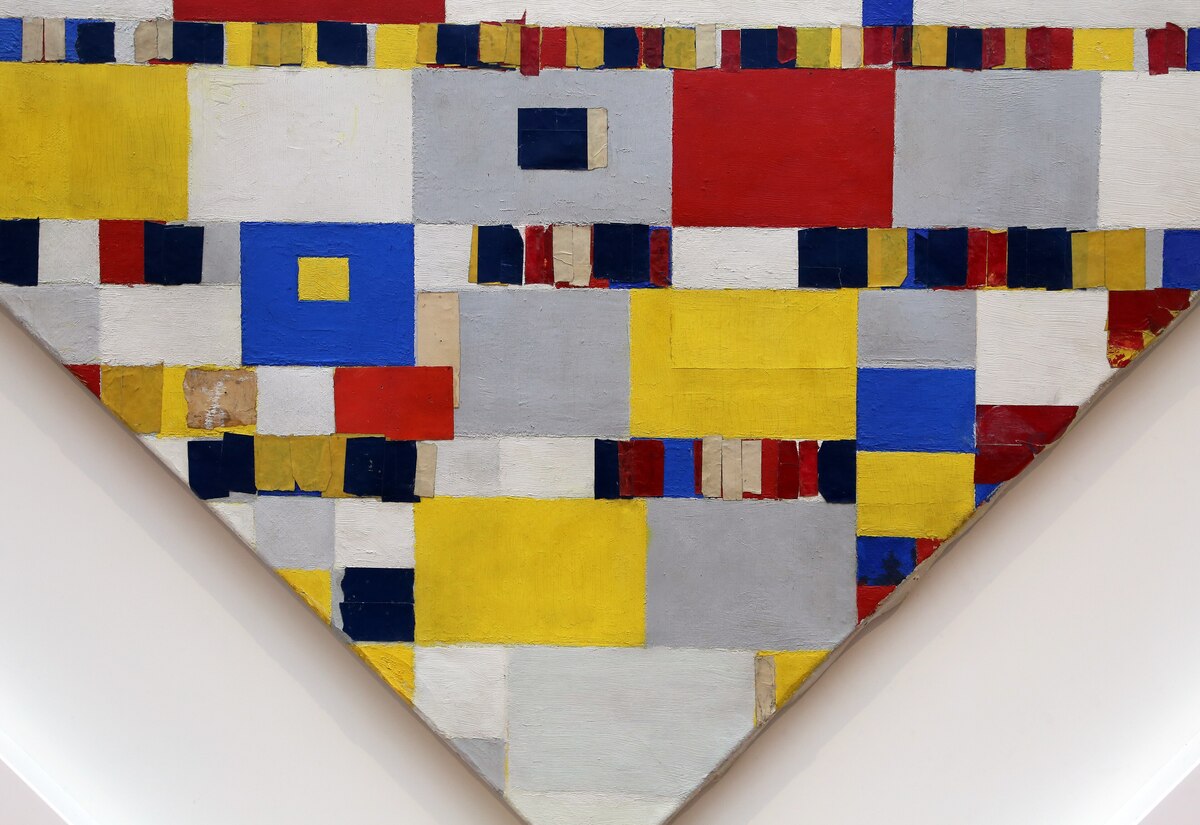
Against the restless revision that the materials and the museum's account describe, one small blue block, to the right of centre, is reported as the only part of the painting that Mondrian painted once and never changed. The museum states this twice in its own record, in nearly identical words, so the fact is presented as a settled observation about the object rather than as inference from style. Its evidentiary weight lies in what it does to the rest of the picture: if every other area was subject to reworking, that single untouched block is the one fixed point, and it allows a viewer to gauge how far the surrounding zones were altered. It should be treated as an observation about one specific passage of the canvas, not as a key to the whole composition or as a claim about Mondrian's intention for the block.(Kunstmuseum Den Haag, 2026)
Visual conventions and intended effects
The museum reports that Mondrian believed things would turn out well in June 1942, despite the war, and that this painting began then from that conviction; it also reports that he repeatedly told friends the painting was almost finished, and that when they came back he had reworked it entirely. These are reported traditions about the artist's state of mind and his statements to others rather than documented statements by Mondrian himself, and they should be weighted accordingly. Their usefulness to the visual evidence is limited but real: the pattern they describe, of a declared near-completion followed by wholesale reworking, matches what the surface itself shows in its non-crisp edges, its taped and overpainted passages, and the single untouched blue block standing against otherwise continuous change. The tradition illuminates the condition of the canvas without proving any particular sequence of decisions.(Kunstmuseum Den Haag, 2026)
Commission and creation
Interpretation
Victory Boogie Woogie is Piet Mondrian's last painting, begun in June 1942 as a large diamond-shaped canvas from which every black line had disappeared. The Kunstmuseum Den Haag record states that Mondrian began this painting then, and reports his conviction that things would turn out well in June 1942 despite the war. The decisive break with black line is thus not a gradual late adjustment but a premise of the commission: the painting started without the armature that had structured his earlier work. The museum's account further frames the picture as an attempt to express the rhythm of America, which Mondrian felt was totally different from Europe and glimpsed in boogie-woogie music. Those are attributed positions of the museum record rather than statements in Mondrian's own documented words, and the difference matters for how the picture's origin is described.(Kunstmuseum Den Haag, 2026)
The final documented phase is dated. On 23 January 1944 Mondrian was ill but worked on the painting, and that evening began a drastic revision, covering many coloured squares with tape of another colour and overpainting some larger squares completely. He was taken to hospital on 26 January 1944, and the painting remained unfinished in his studio. He died on 1 February 1944. The tape-over-tape and overpainting technique recorded for that evening gives a precise technical anchor to the revision the surface shows, and it establishes that the unfinished state was fixed by hospitalization rather than by Mondrian declaring the work complete.(Kunstmuseum Den Haag, 2026)
In June 1942 Mondrian began a large diamond-shaped painting from which every black line had disappeared.(Kunstmuseum Den Haag, 2026)
On 23 January 1944 Mondrian was ill but worked on the painting, and that evening began a drastic revision, covering many coloured squares with tape of another colour and overpainting some larger squares completely.(Kunstmuseum Den Haag, 2026)
Mondrian was taken to hospital on 26 January 1944, and the painting remained unfinished in his studio.(Kunstmuseum Den Haag, 2026)
Materials and technique
LinkDocumented support and materials
The museum record describes the work as oil, tape, paper, charcoal and pencil on canvas. That list of mediums is itself the clearest technical statement the documentation supports, and it places the painting in a mixed-material practice rather than a single-medium one. Tape and paper sit alongside oil paint, and charcoal and pencil are recorded as part of the surface as well. The record does not break these materials down by layer, does not specify where each occurs, and does not name individual pigments. The materials entry and the dimensions entry come from the same museum object record, which supports identity, materials and dimensions for the painting.(Kunstmuseum Den Haag, 2026)
The support is recorded as a stretcher measuring 178.4 cm by 178.4 cm, diagonally measured, which makes the canvas diamond-shaped. The diagonal dimension matters because it explains how a square canvas can read as a diamond: the equal measurement is taken across the diagonals rather than along the sides. This is a documented measurement rather than a visual impression, and it establishes the scale and orientation of the support on which the oil, tape, paper, charcoal and pencil were used. The evidence does not give the side lengths, the depth of the stretcher, or the precise geometry of the canvas beyond the diagonal measurement and the diamond form.(Kunstmuseum Den Haag, 2026)
The single untouched block
Visual observation
Against the multiple materials recorded for the painting, one element of the visual evidence stands out for what it did not undergo. A small blue block to the right of centre is described as the only part Mondrian painted once and never changed. A second unit gives the same observation in nearly identical terms. Whatever the painting's layered and repeatedly altered condition elsewhere, this single block is identified as unreworked. The claim is presented as an observation about the surface, not as a technical analysis of paint layers, so it establishes what can be seen about that block rather than what sampling or imaging would show. The added materials.(Kunstmuseum Den Haag, 2026)
Technique in the final working episode
The technical account of the painting's making centres on revision. The record states that on 23 January 1944, though ill, Mondrian worked on the painting, and that in the evening he began a drastic revision, covering many coloured squares with tape of another colour and overpainting some larger squares completely. This describes two distinct operations that match the materials list: tape applied over existing colour, and opaque paint laid over whole squares. It is also the clearest documented link between the medium of tape and the painting's final state, since the tape is described as a means of covering squares rather than as a preparatory guide alone. The record further states that Mondrian was taken to hospital on 26 January 1944 and that the painting remained unfinished in his studio. The account therefore connects a dated episode of making to the unfinished condition in which the work was left, without describing the underlying layers in detail.(Kunstmuseum Den Haag, 2026)
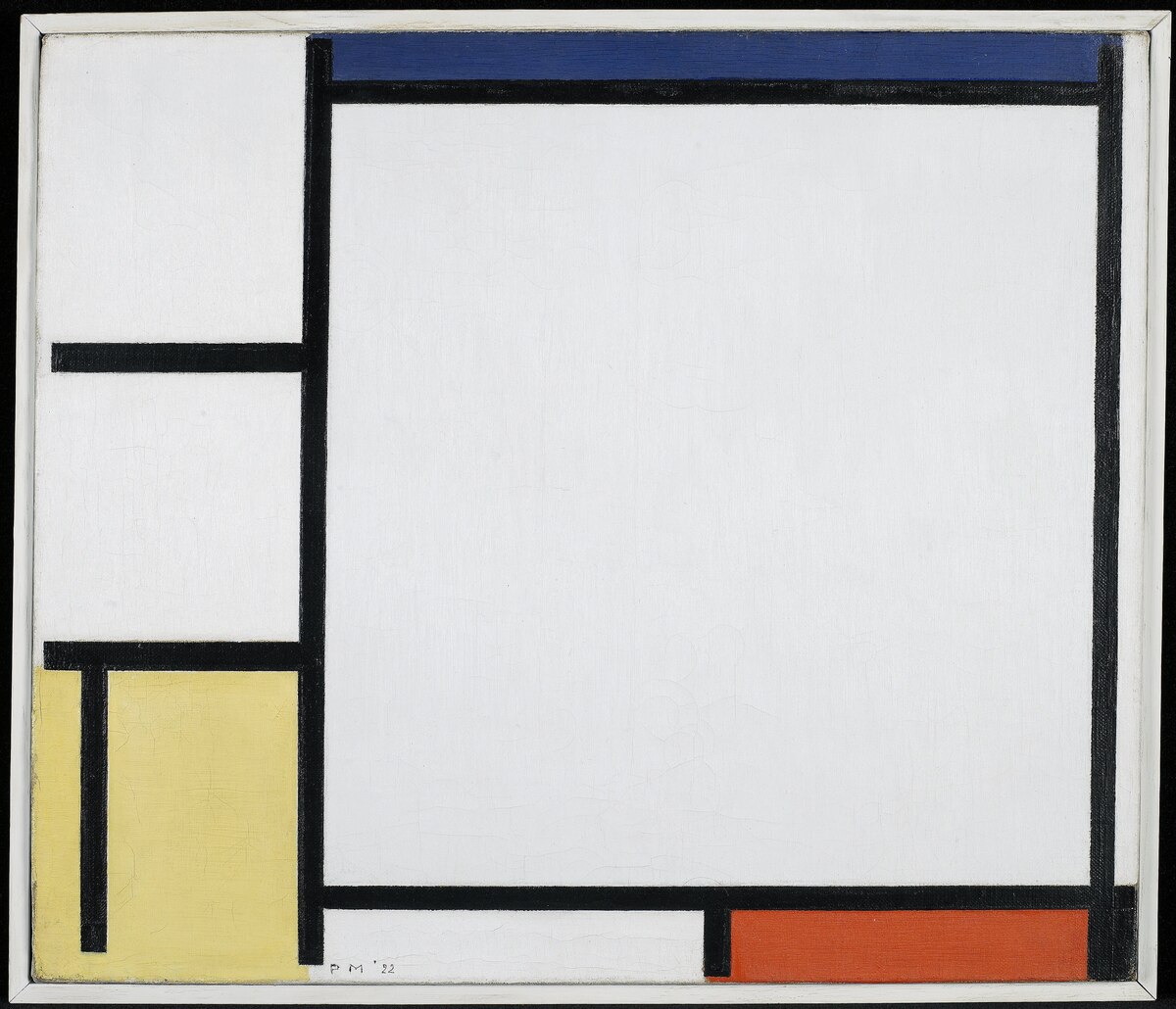
The painting is dated to 1942 to 1944 and described as Mondrian's last work, left unfinished at his death. Within that span, the same record states that in June 1942 he began a large diamond-shaped painting from which every black line had disappeared, and that he began it with a conviction, reported by the museum, that things would turn out well despite the war. The technical consequence of beginning without black lines is that the structure visible in the finished surface is carried by coloured blocks and banded lines rather than by the black grid associated with earlier work. The record reports the absence of black lines as a fact about the painting's inception in June 1942; it does not describe the sequence in which the later revisions were built up, nor does it specify how the banded lines were produced.(Kunstmuseum Den Haag, 2026)
Attributed aims and the visible surface
Interpretation
The stated aims of the painting are recorded as Mondrian's intentions rather than as technical findings. The museum reports that he wanted the painting to express the rhythm of America, which he felt was totally different from Europe and glimpsed in boogie-woogie music; that he wanted it free and asymmetrical, without the classical balance of much of his older work; and that it was intended to bring together opposing concepts identified with New York, including chaos and order, large and small, light and dark, fast and slow, static and dynamic, always different yet always the same, lively and sublime. The record also reports that he repeatedly told friends the painting was almost finished and then reworked it entirely when they returned, a report of what he said rather than a documented statement. These aims explain the visible restlessness of the surface, in which coloured squares and banded lines were subject to repeated change rather than fixed in an evenly balanced arrangement, but they are attributed intentions, not materials analysis.(Kunstmuseum Den Haag, 2026)
Provenance and standing
Visual observation
The painting's later history, as recorded, is distinct from its making. After Mondrian's death on 1 February 1944 the painting turned out to be the property of Francis Valentine Dudensing, who sold it to Emily Tremaine under the title Victory Boogie Woogie. It was acquired in 1998 through a gift from De Nederlandsche Bank, purchased by the Stichting Nationaal Fonds Kunstbezit and donated to the State of the Netherlands, and it is on long-term loan to Kunstmuseum Den Haag from the Cultural Heritage Agency of the Netherlands and the Ministry of Education, Culture and Science. In the museum's account it is the undisputed highlight of the Mondrian collection there, and it grew into an icon of the modern age and of the freedom of abstract art. These are institutional and art-historical characterizations of the work's standing, and they sit alongside, rather than replacing, the documented materials and making history.(Kunstmuseum Den Haag, 2026)
Provenance and ownership
LinkFrom the Artist's Death to the Tremaine Collection
The provenance of Victory Boogie Woogie begins with the painter's own estate, and the first documented fact about its ownership is a surprising one. After Piet Mondrian died on 1 February 1944, the painting turned out to be the property of Francis Valentine Dudensing, not of Mondrian's own estate in the way a reader might assume. Dudensing then sold the painting to Emily Tremaine under the title Victory Boogie Woogie. The sequence matters: the work that Mondrian had been revising in his New York studio until 26 January 1944 and left unfinished at his death, and which he had begun in June 1942 as a large diamond-shaped canvas from which every black line had disappeared, entered the market through Dudensing rather than through a dealer acting openly for the artist's estate. The title under which it changed hands, Victory Boogie Woogie, is established by that sale, and it is worth noting that the painting is made of oil, tape, paper, charcoal and pencil on canvas, with the stretcher measuring 178.4 cm by 178.4 cm diagonally, so the object Dudensing sold was already both a painting and a record of Mondrian's working method, including the drastic revision of 23 January 1944, when he covered many coloured squares with tape of another colour and overpainted some larger squares completely. Only one small blue block, to the right of centre, was painted once and never changed. The provenance therefore begins with an object whose documentary status as unfinished and provisional was fixed before any public owner acquired it.(Kunstmuseum Den Haag, 2026)(Wikipedia fallback: Victory Boogie Woogie, 2024)
The Tremaine and Newhouse Years
Between the Tremaine acquisition and the 1990s the record is thinner in the supplied evidence, and the source that carries the later figures is the Wikipedia fallback article rather than the museum's own object record. That account states that the painting was purchased at a cost of 80 million Dutch guilders, approximately 35 million euros or US$40 million, from the American collector Samuel Irving Newhouse, who had previously bought it from Emily and Burton Tremaine for US$12 million in the mid 1980s. The mid 1980s purchase from the Tremaines is the only documented link between the Dudensing sale to Emily Tremaine and the Newhouse ownership; no intermediate owner, dealer or transfer date is supplied, and the passage from Emily Tremaine alone to Emily and Burton Tremaine as sellers is itself a difference between the earlier and later accounts. The evidence does not record how the painting left the Tremaines, whether by private sale or through an intermediary, or any exhibition history during those years. What it does establish is that by the mid 1980s the work was in Newhouse's hands and that the price paid from him in the 1990s was on an entirely different scale from the mid 1980s transaction.(Wikipedia fallback: Victory Boogie Woogie, 2024)(Kunstmuseum Den Haag, 2026)
The Dutch Acquisition and Its Public Debate
The acquisition that brought the painting to the Netherlands is dated differently in the two accounts, and that discrepancy should be stated rather than smoothed over. The museum record says the painting was acquired in 1998 through a gift from De Nederlandsche Bank, purchased by the Stichting Nationaal Fonds Kunstbezit and donated to the State of the Netherlands. The Wikipedia fallback says the purchase in 1997 by the Stichting Nationaal Fonds Kunstbezit, through a gift from the Dutch Central Bank, was at the time the most expensive purchase ever for a Dutch museum, and that the amount raised questions in the Dutch House of Representatives and from other museums. The two sources agree on the institutional mechanism, a purchase by the Stichting Nationaal Fonds Kunstbezit funded by a gift from the Dutch central bank and then donated to the State, but they differ on the year, 1998 against 1997, and on the naming of the bank, De Nederlandsche Bank against the Dutch Central Bank. Both names refer to the same institution, so the substantive disagreement is the date. The evidence does not explain the discrepancy; it may reflect a purchase completed in one year and formalised or announced in the next, but that explanation is not supplied and should not be asserted.(Kunstmuseum Den Haag, 2026)(Wikipedia fallback: Victory Boogie Woogie, 2024)
Interpretation
The acquisition settled the painting in a public institutional setting, and its status there connects the provenance to its later reception. The museum record notes that the painting is on long-term loan to Kunstmuseum Den Haag from the Cultural Heritage Agency of the Netherlands, part of the Ministry of Education, Culture and Science, and that it is the undisputed highlight of the Mondrian collection at Kunstmuseum Den Haag. The same record states that the painting grew into an icon of the modern age and of the freedom of abstract art. Read together with the price and the parliamentary questions, these points show why the chain of ownership matters beyond a list of names: a work left unfinished in a New York studio in 1944, owned at Mondrian's death by Dudensing, sold to Emily Tremaine under the title it still carries, and later bought from Samuel Irving Newhouse at a figure that made it the most expensive purchase ever for a Dutch museum at the time, became a national collection object and, in the museum's account, an emblem of abstract art's freedom. The reception and the provenance are not separate stories; the public debate over the amount is part of how the painting entered Dutch cultural life.(Kunstmuseum Den Haag, 2026)(Wikipedia fallback: Victory Boogie Woogie, 2024)
Acquisition, Loan and Legacy
The provenance cannot be fully separated from the object's material condition, because the evidence about ownership repeatedly runs alongside evidence about unfinished work and continued revision. The museum record holds both that Mondrian began the painting in June 1942 from a conviction, reported by the museum, that things would turn out well despite the war, and that he repeatedly told friends the painting was almost finished and then reworked it entirely when they returned. That is reported tradition rather than a documented statement, and it should be weighted as such. It is, however, consistent with what the surface is documented to show: the tape, paper, charcoal and pencil worked into oil paint, and the evening revision of 23 January 1944 already described. A provenance account of this painting is therefore also an account of an object that was changing while it was owned and sold, and the single untouched blue block to the right of centre is the one fixed point in a history of repeated alteration. This makes the work unusual among museum acquisitions, since the evidence for its ownership and the evidence for its making are intertwined rather than sequential.(Kunstmuseum Den Haag, 2026)
After Mondrian's death on 1 February 1944, the painting turned out to be the property of Francis Valentine Dudensing.(Kunstmuseum Den Haag, 2026)
Victory Boogie Woogie was acquired in 1998 through a gift from De Nederlandsche Bank, purchased by the Stichting Nationaal Fonds Kunstbezit and donated to the State of the Netherlands.(Kunstmuseum Den Haag, 2026)
Provenance timeline
- June 1942
Mondrian began a large diamond-shaped painting from which every black line had disappeared.(Kunstmuseum Den Haag, 2026)
- 23 January 1944
Though ill, Mondrian worked on the painting and that evening began a drastic revision, covering many coloured squares with tape of another colour and overpainting some larger squares completely.(Kunstmuseum Den Haag, 2026)
- 26 January 1944
Mondrian was taken to hospital and the painting remained unfinished in his studio.(Kunstmuseum Den Haag, 2026)
- 1 February 1944
After Mondrian's death, the painting turned out to be the property of Francis Valentine Dudensing.(Kunstmuseum Den Haag, 2026)
- 1998
The painting was acquired through a gift from De Nederlandsche Bank, purchased by the Stichting Nationaal Fonds Kunstbezit and donated to the State of the Netherlands.(Kunstmuseum Den Haag, 2026)
Reception and literature
LinkInstitutional standing and public meaning
Interpretation
Within the Mondrian holdings of Kunstmuseum Den Haag, Victory Boogie Woogie occupies a position the museum itself describes as the undisputed highlight of the collection. That status is not simply a matter of curatorial preference: the museum presents the picture as the culmination of Mondrian's long pursuit of an abstract idiom, the last canvas he worked on and the one in which the conventions of his earlier practice were most radically put under pressure. The collection context matters because it frames the painting for visitors as a terminal, unresolved statement rather than a finished masterpiece, and because the museum's own account of the picture is the principal published reading through which most viewers now encounter it. In the museum's formulation the work grew into an icon of the modern age and of the freedom of abstract art, a claim about cultural reception as much as about aesthetic quality: the picture is presented as standing for a broader idea of what abstraction made possible in the twentieth century.(Kunstmuseum Den Haag, 2026)
The 1997 purchase and public debate
The reception of the painting is inseparable from the way it entered public ownership, because the terms of that acquisition made it a national event. According to the supplementary account, the purchase in 1997 by the Stichting Nationaal Fonds Kunstbezit, funded through a gift from the Dutch Central Bank, was at the time the most expensive purchase ever made for a Dutch museum, and the sum involved prompted questions in the Dutch House of Representatives and from other museums. This is a significant stage of reception in its own right: a work of abstract art became the subject of parliamentary scrutiny and of debate among institutions about the allocation of public and philanthropic resources. The same account states that the painting was acquired in 1997 for 80 million Dutch guilders, approximately 35 million euros, from Samuel Irving Newhouse. The cost was not merely a price but an argument about value, and it is a documented part of how the painting's public meaning was formed.(Wikipedia fallback: Victory Boogie Woogie, 2024)
The purchase in 1997 by the Stichting Nationaal Fonds Kunstbezit, through a gift from the Dutch Central Bank, was at the time the most expensive purchase ever for a Dutch museum, and the amount raised questions in the Dutch House of Representatives and from other museums.(Wikipedia fallback: Victory Boogie Woogie, 2024)
Interpretations and debates
LinkThe object and its making
Reported tradition
Victory Boogie Woogie is Piet Mondrian's last work, a painting made in New York between 1942 and 1944 and left unfinished at his death. The museum record identifies its materials as oil, tape, paper, charcoal and pencil on canvas, and gives the support's dimensions as 178.4 cm by 178.4 cm measured diagonally, which produces the diamond-shaped canvas that is the work's most immediately visible formal property. The record also states that the stretcher is the measured element, a technical detail that matters because it fixes the object's physical scale independently of how the painted surface is framed by the diagonal orientation. These facts establish what the object is before any account of what it means: an unfinished painting on a diamond-oriented support, built from a mixed set of media including tape and paper as well as conventional drawing and painting materials.(Kunstmuseum Den Haag, 2026)
The museum reports that in June 1942 Mondrian began a large diamond-shaped painting from which every black line had disappeared. It further reports that Mondrian believed things would turn out well in June 1942, despite the war, and that this painting began then. This is a reported tradition rather than a documented personal statement, and it should be weighed as such: the source is the holding institution's object record, not a contemporaneous document in Mondrian's hand. Read alongside the material evidence, however, the account gives the work a starting point and an emotional context. The absence of black lines is the feature the record singles out, and it is confirmed by what the surface shows, since the painting's structure is carried by coloured squares and banded lines rather than by the black grid associated with Mondrian's earlier work. The combination of a dated beginning, a stated conviction about the war, and a specific formal departure makes this unit the pivot between biography and visual description.(Kunstmuseum Den Haag, 2026)
Visual conventions and the problem of balance
Interpretation
The painting's subject matter, as the museum frames it, was the rhythm of America, which Mondrian felt was totally different from Europe and glimpsed in boogie-woogie music. Mondrian wanted the painting to be free and asymmetrical, without the classical balance of much of his older work, and he intended it to bring together opposing concepts identified with New York: chaos and order, large and small, light and dark, fast and slow, static and dynamic, always different yet always the same, lively and sublime. This is the institution's reading of the artist's aims, and it is worth separating two claims within it. The first concerns a source of rhythm outside painting, namely the music and the city. The second concerns a formal programme, the rejection of classical balance and the holding together of opposites. Both are interpretations attributed to Mondrian through the museum, not observations that the canvas can verify by itself; what the canvas can show is the asymmetry and the layering that such a programme would produce.(Kunstmuseum Den Haag, 2026)
Revision as working method
Reported tradition
The museum reports that Mondrian repeatedly told friends the painting was almost finished, then reworked it entirely when they returned. Only one small blue block, to the right of centre, was painted once and never changed. The record states this twice, once in the narrative account and once as a separate note, which gives the observation unusual emphasis within the source. The two pieces of information work together. If the whole canvas was subject to wholesale reworking, then a single block that escaped revision becomes the only stable reference point on the surface, and the institution's own account treats it that way, as the element against which the rest of the painting's provisionality can be seen. The reported habit of telling friends the work was nearly done is a report about the artist's conversation and cannot be documented here beyond the source's attribution; taken as reported tradition, it describes a working method in which completion was announced and then postponed rather than a single moment of finishing.(Kunstmuseum Den Haag, 2026)
On 23 January 1944 Mondrian was ill but worked on the painting, and that evening began a drastic revision, covering many coloured squares with tape of another colour and overpainting some larger squares completely. He was taken to hospital on 26 January 1944, and the painting remained unfinished in his studio; he died on 1 February 1944. This is the most concrete dated sequence in the record, and it connects the object's material appearance to a documented episode of illness and hospitalization. The tape appears here as an instrument of revision rather than as an incidental material, which helps explain why the museum's material list includes tape and paper alongside oil, charcoal and pencil. The account also supplies the terminus of the work: the painting did not stop because a design was completed but because the artist left the studio and did not return.(Kunstmuseum Den Haag, 2026)
Interpretation
The museum's reading resists treating the unfinished state as a failure or merely as a document of illness, on the ground that Mondrian wanted the painting to be free and asymmetrical, without the classical balance of much of his older work. On this account the asymmetry and the constant revision are not an accident of circumstance but part of what the painting is trying to be. The qualification is important. The evidence does not establish that Mondrian intended to leave the work unfinished, and the same record that reports his stated aim also reports his repeated claims that it was almost finished and his drastic reworking in January 1944. A defensible synthesis is therefore narrower than either extreme: the work's openness to revision is consistent with the freedom and asymmetry the museum attributes to the artist's aims, while the specific unfinished condition visible today results from his death. The interpretive claim is about the character of the painting's development, not about a deliberate final form.(Kunstmuseum Den Haag, 2026)
Provenance and public ownership
Reported tradition
After Mondrian's death on 1 February 1944, the painting turned out to be the property of Francis Valentine Dudensing, who sold it to Emily Tremaine under the title Victory Boogie Woogie. This provenance sequence is the source's basis for the work's title, and it shows that the name by which the object is now known entered its documented history through a sale after the artist's death rather than through a title recorded during his lifetime. The record then describes the later transfer: Victory Boogie Woogie was acquired in 1998 through a gift from De Nederlandsche Bank, purchased by the Stichting Nationaal Fonds Kunstbezit and donated to the State of the Netherlands. The painting is on long-term loan to Kunstmuseum Den Haag from the Cultural Heritage Agency of the Netherlands, that is, from the Ministry of Education, Culture and Science. Taken together, these facts trace the object from private ownership immediately after the artist's death to a public Dutch holding achieved through a layered transaction of purchase, donation and loan.(Kunstmuseum Den Haag, 2026)
Interpretation
The museum describes the painting as the undisputed highlight of the Mondrian collection at Kunstmuseum Den Haag and states that it grew into an icon of the modern age and of the freedom of abstract art. These are reception claims attributed to the institution, and they are best read as evidence of the work's status within a collection and a wider culture rather than as descriptions of the canvas. They nonetheless bear on how the object should be understood historically: a painting that was unfinished in the studio at the artist's death, and whose title arrived through a posthumous sale, has become a canonical image of abstraction and of modernity. The gap between those two states, the studio object and the cultural icon, is part of the object's history and explains why its reported traditions, its material traces of revision and its acquisition history all continue to be recounted together.(Kunstmuseum Den Haag, 2026)
Attributed Readings: Rhythm, Opposites, and Asymmetry
The interpretation of Victory Boogie Woogie that the Kunstmuseum Den Haag records is threefold, and each strand is attributed to the painter's stated aims rather than inferred from the surface alone. First, the painting seeks to express the rhythm of America, which Mondrian felt was totally different from Europe and glimpsed in boogie-woogie music. Second, Mondrian wanted the painting to be free and asymmetrical, without the classical balance of much of his older work. Third, the painting was intended to bring together opposing concepts identified with New York: chaos and order, large and small, light and dark, fast and slow, static and dynamic, always different yet always the same, lively and sublime. These are museum-attributed readings of intent and meaning; they are distinct from any claim about what Mondrian privately thought, and the source does not present them as quotations. Read together, they set the terms on which the rest of the object's evidence becomes legible: a work whose compositional freedom and accumulation of oppositions are treated as the content of the painting, not as incidental features.(Kunstmuseum Den Haag, 2026)
The painting seeks to express the rhythm of America, which Mondrian felt was totally different from Europe and glimpsed in boogie-woogie music.(Kunstmuseum Den Haag, 2026)
Mondrian wanted the painting to be free and asymmetrical, without the classical balance of much of his older work.(Kunstmuseum Den Haag, 2026)
The painting was intended to bring together opposing concepts identified with New York: chaos and order, large and small, light and dark, fast and slow, static and dynamic, always different yet always the same, lively and sublime.(Kunstmuseum Den Haag, 2026)
Reported tradition
The source reports that Mondrian believed things would turn out well in June 1942, despite the war, and began this painting then.(Kunstmuseum Den Haag, 2026)
Mondrian repeatedly told friends the painting was almost finished, then reworked it entirely when they returned.(Kunstmuseum Den Haag, 2026)
Collection and display
LinkA diamond without black lines
Victory Boogie Woogie is Piet Mondrian's last work, painted between 1942 and 1944 and left unfinished at his death. It is made of oil, tape, paper, charcoal and pencil on canvas, and the stretcher measures 178.4 cm by 178.4 cm, diagonally measured, making it a diamond-shaped canvas. In June 1942 Mondrian began a large diamond-shaped painting from which every black line had disappeared, and the museum reports that he believed things would turn out well in June 1942, despite the war, and began this painting then. The painting seeks to express the rhythm of America, which Mondrian felt was totally different from Europe and glimpsed in boogie-woogie music.(Kunstmuseum Den Haag, 2026)
A picture that refuses to settle
The museum states that Mondrian wanted the painting to be free and asymmetrical, without the classical balance of much of his older work, and that it was intended to bring together opposing concepts identified with New York: chaos and order, large and small, light and dark, fast and slow, static and dynamic, always different yet always the same, lively and sublime. The account also reports that Mondrian repeatedly told friends the painting was almost finished, then reworked it entirely when they returned, a reported tradition that fits the visible evidence of constant revision. Only one small blue block, to the right of centre, was painted once and never changed, giving a still point against which the rest of the canvas can be read.(Kunstmuseum Den Haag, 2026)
Provenance and public ownership
On 23 January 1944 Mondrian was ill but worked on the painting, and that evening began a drastic revision, covering many coloured squares with tape of another colour and overpainting some larger squares completely. He was taken to hospital on 26 January 1944, and the painting remained unfinished in his studio. He died on 1 February 1944. After his death the painting turned out to be the property of Francis Valentine Dudensing, who sold it to Emily Tremaine under the title Victory Boogie Woogie. It was acquired in 1998 through a gift from De Nederlandsche Bank, purchased by the Stichting Nationaal Fonds Kunstbezit and donated to the State of the Netherlands. It is on long-term loan to Kunstmuseum Den Haag from the Cultural Heritage Agency of the Netherlands / Ministry of Education, Culture and Science.(Kunstmuseum Den Haag, 2026)
Icon of the modern age
Interpretation
Within the museum's own account the painting is the undisputed highlight of the Mondrian collection at Kunstmuseum Den Haag, and it grew into an icon of the modern age and of the freedom of abstract art. That status is bound up with the specific history of its making: the unfinished, repeatedly revised surface records not only the illness of early 1944 but also a deliberate pursuit of freedom and asymmetry, so that the work's provisionality and its importance in a larger history of abstract art are difficult to separate.(Kunstmuseum Den Haag, 2026)
The painting is on long-term loan to Kunstmuseum Den Haag from the Cultural Heritage Agency of the Netherlands / Ministry of Education, Culture and Science.(Kunstmuseum Den Haag, 2026)
Documented values and qualified estimates
LinkAcquisition and price
The recorded value history of Victory Boogie Woogie is inseparable from its institutional acquisition, and the evidence for that transaction is narrower than the sum commonly repeated. The 1997 acquisition by the Stichting Nationaal Fonds Kunstbezit was made for 80 million Dutch guilders, approximately 35 million euros, paid to the American collector Samuel Irving Newhouse. Every element of that sentence needs a qualification. The figure is described in the evidence as a reported purchase price, not as an audited or contractually published one, and the methodology behind it is the Wikipedia fallback article rather than a primary financial record. The evidence explicitly states that this is a historical acquisition price and does not represent a current market value, which matters because the amount is frequently cited in later writing as though it were a standing valuation. No catalogue raisonné entry, invoice, or museum accession record is supplied here, so the price should be understood as a documented but secondhand acquisition datum attached to a specific year, buyer, and seller.(Wikipedia fallback: Victory Boogie Woogie, 2024)
Interpretation
The acquisition price makes sense as a cultural fact only if the object it bought is understood. Victory Boogie Woogie is Piet Mondrian's last painting, begun in June 1942 and left unfinished at his death in February 1944. It is a large diamond-shaped canvas painted in New York, where Mondrian had moved to escape the war in Europe. The museum describes it as an attempt to bring together opposites that Mondrian identified with the city: chaos and order, large and small, light and dark, fast and slow, static and dynamic, always different yet always the same, lively and sublime. He wanted the painting to express the rhythm of America, which he felt was completely different from Europe, and he glimpsed that rhythm in boogie-woogie music. The scale, the diamond format, and the ambition of the concept are part of why the 1997 purchase carried the weight it did; the price was paid for a landmark of twentieth-century abstraction, not for a conventional easel picture.(Wikipedia fallback: Victory Boogie Woogie, 2024)
The surface itself shows why the work is difficult to value on ordinary terms. Close up there are no black lines, unusual for Mondrian; he started the painting without them. The surface is built from coloured squares and banded lines, but the edges are not crisp throughout. In places tape, paper, charcoal and pencil are worked into oil paint, traces of a picture still being changed. One small blue block just to the right of centre is the only part of the painting Mondrian painted once and never changed. Everything else was revised, and that single untouched square gives a still point against which the restless provisionality of the rest of the canvas becomes visible. A market price measured in guilders sits in obvious tension with a physical object whose defining characteristic is incompletion, and the evidence records that tension rather than resolving it.(Wikipedia fallback: Victory Boogie Woogie, 2024)
The price and the public reaction to it belong together. The 1997 purchase by the Stichting Nationaal Fonds Kunstbezit, through a gift from the Dutch Central Bank, was at the time the most expensive purchase ever for a Dutch museum, and the amount raised questions in the Dutch House of Representatives and from other museums. The evidence also records that the purchase followed a chain of ownership: Newhouse had previously bought the work from Emily and Burton Tremaine for US$12 million in the mid 1980s. Those two figures, the mid-1980s private sale and the 1997 acquisition, are not equivalent and should not be merged. They are separate transactions at different dates between different parties, and only the 1997 figure is stated here in Dutch guilders with a euro approximation. The parliamentary and peer-institution questions show that the valuation was contested in the public sphere at the moment of acquisition, which is a distinct historical fact from any estimate of what the painting might be worth today.(Wikipedia fallback: Victory Boogie Woogie, 2024)
Final revision and unfinished state
What the money bought was a painting whose meaning is bound up with its unfinished state and with the artist's final working days. On 23 January 1944, already ill, Mondrian worked on the painting during the day; that evening he began a drastic revision, covering many coloured squares with tape of another colour and painting over some larger squares completely. He was taken to hospital on 26 January. The painting stayed unfinished in his studio, and he died on 1 February. The museum reports that Mondrian believed things would turn out well in June 1942, despite the war, and that the painting began then from that conviction. He also told friends repeatedly that the painting was almost finished, and when they came back he had reworked it entirely. That is reported tradition rather than a documented statement, but it fits what the surface shows. Because the sequence is documented only in this attributed form, the final session should be described as reported, while the January and February 1944 dates and the physical traces of revision are the firmer ground.(Wikipedia fallback: Victory Boogie Woogie, 2024)
Interpretation
The museum's reading of the unfinished state resists the obvious interpretation. It would be easy to see it as a failure, or simply as a document of illness. The museum's reading is different: Mondrian wanted the painting to be free and asymmetrical, without the classical balance of much of his older work. On that account the asymmetry and the constant revision are not an accident of circumstance but part of what the painting is trying to be. This is an attributed institutional interpretation, not a neutral description, and it should be presented as such. It also explains why the object can support a high acquisition value: the incompletion is not a defect to be discounted but the intended condition of the work, which is exactly the kind of argument that makes a museum purchase of this size defensible to a parliament and to peer institutions.(Wikipedia fallback: Victory Boogie Woogie, 2024)
It was purchased at a cost of 80 million Dutch guilders (approximately 35 million euros, US$40 million) from the American collector Samuel Irving Newhouse, who had previously bought it from Emily and Burton Tremaine for US$12 million in the mid 1980s.(Wikipedia fallback: Victory Boogie Woogie, 2024)
Historical acquisition value: Acquired in 1997 for 80 million Dutch guilders (approx. 35 million euros) from Samuel Irving Newhouse. Recorded date: 1997. Methodology: Reported purchase price in the Wikipedia fallback article for the 1997 acquisition by the Stichting Nationaal Fonds Kunstbezit. Qualification: This is a historical acquisition price and does not represent a current market value.(Wikipedia fallback: Victory Boogie Woogie, 2024)