Secondary · About this artwork
Wikimedia Commons: Composition with Red Blue and Yellow (n.d.). Wikimedia Commons.
Wikimedia Commons file record for the painting, providing identification, provenance, and a description of the geometric motifs.
Artwork record / 251 of 331
Artist: Piet Mondrian
A gallery guide's reading of Piet Mondrian's 1922 abstract painting: how its grid and primary colours work, and what the documented history of the object can and cannot tell us.
Read the story ↓ About the artist ↓ Research and record ↓ Literature and sources ↓ Listen to the article ↓Your browser could not copy automatically. Select the research text below, then copy it.
Open the complete research text
The highest-resolution file we hold, available without payment or an account.3,840 × 3,295 pixels.
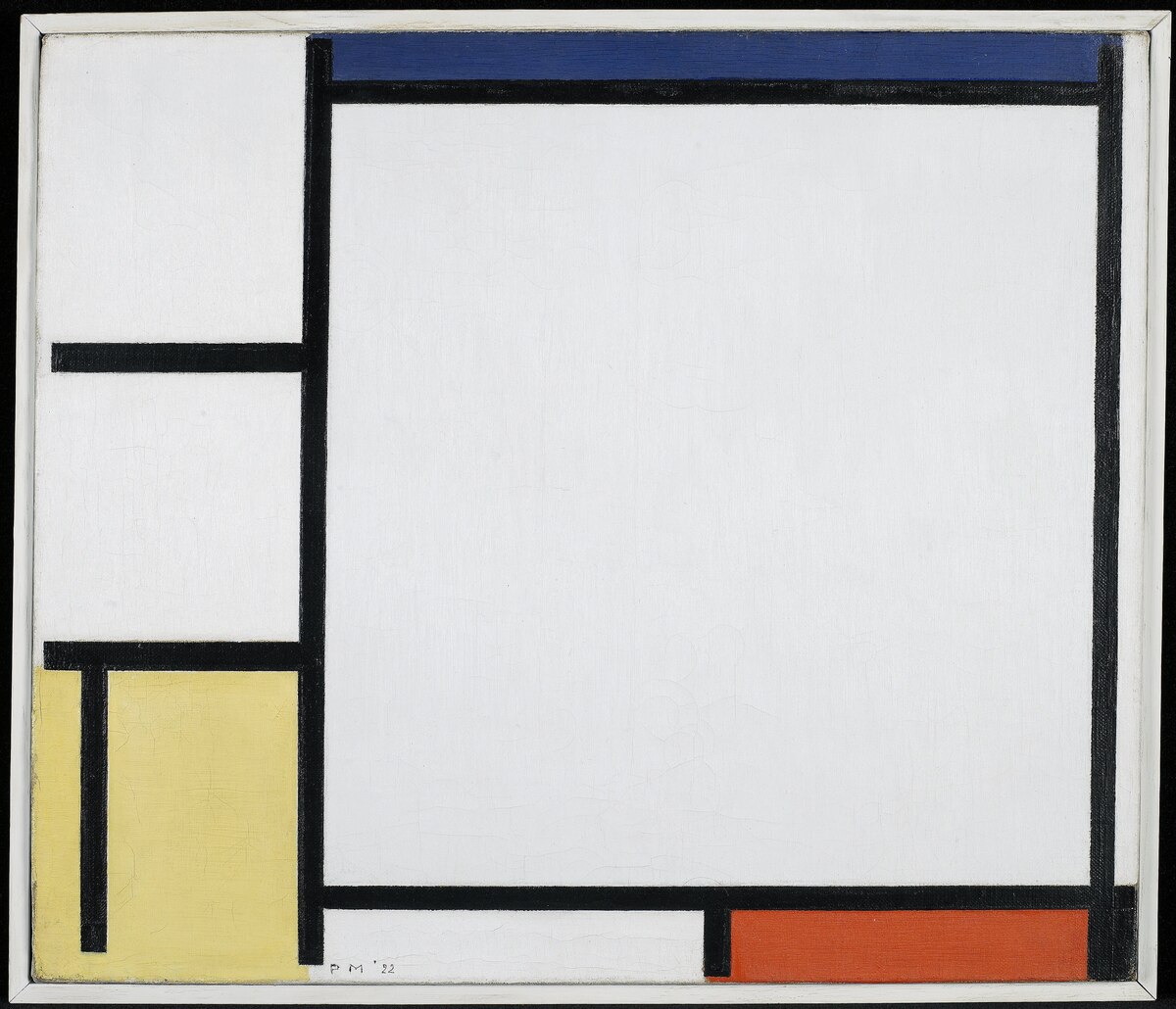
Download highest-resolution imageThe small painted signature and date set on the white plane near the bottom centre, left of the black upright, which documents the artist's hand and the year of execution.
The small red rectangle tucked under the bottom black line in the lower right corner, the only warm accent on the right half of the canvas and the counterweight to the yellow plane on the opposite side.
The yellow rectangle at the lower left, notable for the short black bar that descends into it and stops short of the bottom edge, a detail that makes the plane read as a field cut by structure rather than a colour swatch.
Your gallery guide
A gallery guide's reading of Piet Mondrian's 1922 abstract painting: how its grid and primary colours work, and what the documented history of the object can and cannot tell us.
Editorial review by Artifact Archive automated publishing
Explore the researchThe story About 4 minutes to read
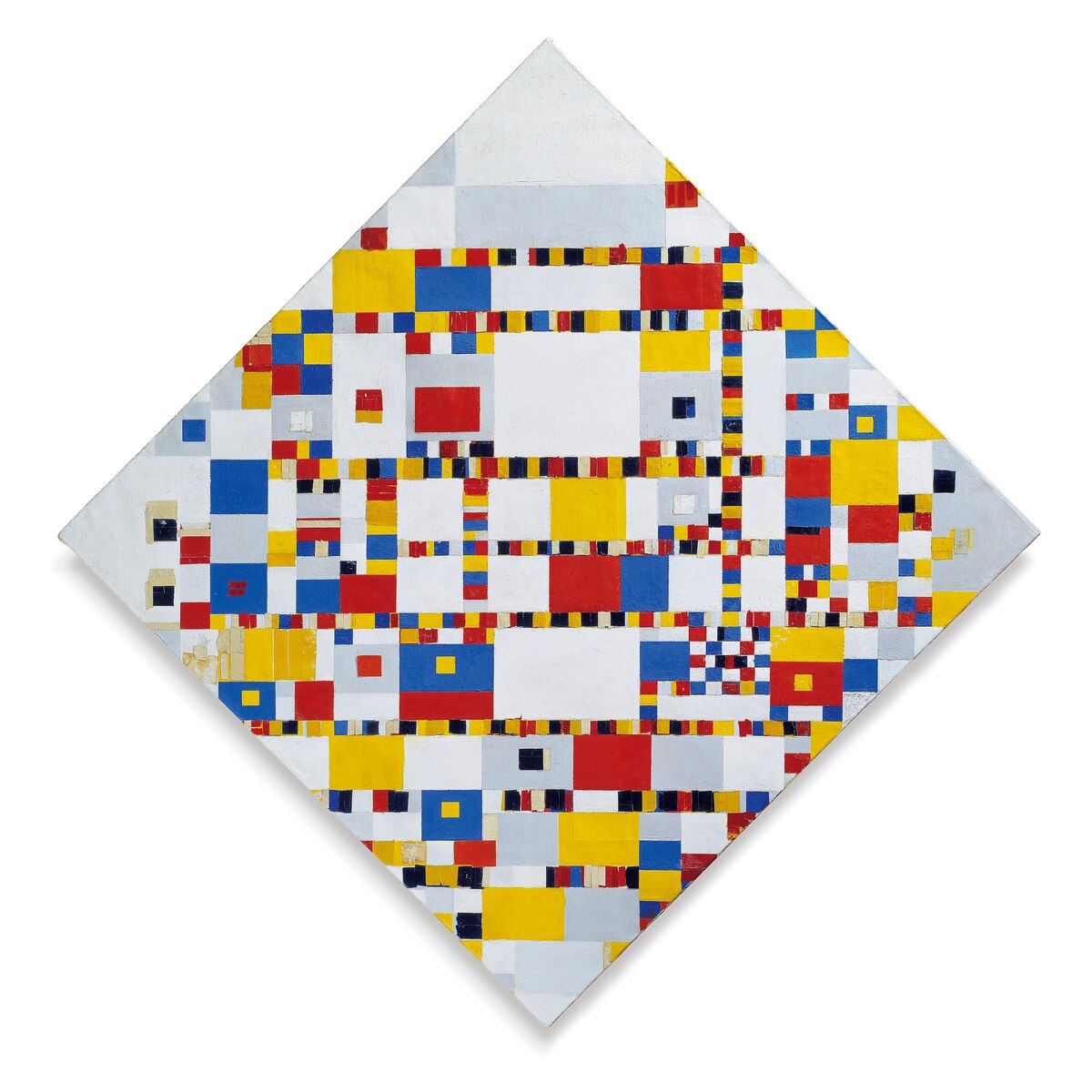
This is Piet Mondrian's Composition with Blue, Red, Yellow, and Black, painted in 1922. It's an abstract oil on canvas, so there's no scene, no figure and no story in the usual sense. Instead, Mondrian built the picture from geometric motifs: rectangles and lines of red, yellow, black and blue set against a white ground. What you're looking at is colour and proportion arranged as the subject itself.
The painting is small and square-ish, close to the size of a large book. Its surface is divided by straight black lines into a set of rectangles. Some of those rectangles are filled with flat red, yellow or blue. Others are left as white or near-white ground. The colours don't blend or shade; they sit as distinct, unmodulated planes.
Mondrian was a Dutch artist associated with the De Stijl movement. By the early 1920s he had moved far from depicting trees, dunes or buildings. He was after what he called pure geometric abstraction: a visual language reduced to straight lines, right angles and the primary colours. This painting belongs to that project.
Look at how the black lines vary in weight and how the coloured rectangles differ in size. A large red block might sit near a small blue one, or a yellow plane might be isolated against white. Because there's no shading or perspective, the picture reads as a flat field. The balance comes from the relationships between those unequal parts, not from symmetry.
The painting is catalogued as B141 in the Piet Mondrian Catalogue Raisonné. It entered the Minneapolis Institute of Art in 1965 as a gift from Bruce B. Dayton. Before that, its ownership passed through several hands: Til Brugman in the Netherlands, a private collection, Stiftung Scaletta in Vaduz, and Galerie Beyeler in Basel. So the work has a documented collecting history, though some gaps remain.
One part of that history is uncertain. A 1924 Vienna exhibition received a loan from Til Brugman, but according to the Mondrian scholar Joop Joosten, it isn't clear that the work she lent was this painting. He notes that, as far as he knows, Brugman owned only one Mondrian. The curatorial file also suggests the painting may have been in a private German collection at some point, but the sequence isn't firmly established.
So what is this painting about? It's about the relationships between colour, line and proportion, treated as ends in themselves. The absence of a subject asks you to look at how the composition holds together: how a red rectangle and a blue one balance across a black line, how white space lets each colour breathe. That's the experience the work offers.
Editorial review by Artifact Archive automated publishing.
Historical claims are linked to the records below. Close looking and interpretation are identified in the passage notes.
Anonymous Unknown author. Image source · Public domain
About the artist
1872 to 1944
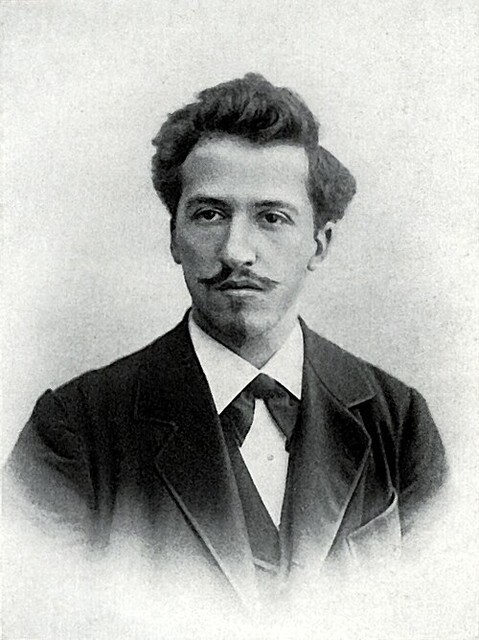
Piet Mondrian was a Dutch painter (1872–1944). Their work is associated with Post-impressionism; De Stijl; Symbolism. Their recorded places of work include Amsterdam; New York City; Paris; Domburg; Laren; Winterswijk; London.
The research & record
Find catalogue details, historical context, technical research and the literature behind this artwork.
Your browser could not copy automatically. Select the research text below, then copy it.
Open the complete research textThe artwork record
Catalogue information and detailed research, with references that link to the bibliography.
Updated .
The catalogue record identifies this painting as Composition with Blue, Red, Yellow, and Black by Piet Mondrian, dated 1922, and gives its dimensions as 42 centimeters in height by 48.5 centimeters in width. These are the object's working identifiers in the institutional record: the title used for the work, the authorship assigned to it, the year under which it is catalogued, and its physical size. The dimensions describe a small, roughly horizontal rectangle, and they are the figures attached to the painting in this catalogue entry rather than measurements established here by examination.(Wikimedia Commons: Composition with Red Blue and Yellow, n.d., Artist; Title; Date; Dimensions)
Beyond the title, artist, date and dimensions, the record supplies a set of cross-referenced catalogue numbers: the painting is catalogued as B141 in the Piet Mondrian Catalogue Raisonné, and it carries Minneapolis Institute of Art artwork ID 1595 and RKDimages ID 251268. These identifiers matter because they tie the object to the standard scholarly catalogue of Mondrian's work and to two persistent institutional databases, allowing the entry to be matched to the same painting across sources that may describe it differently or use variant titles. The catalogue raisonné number fixes the work's position within the larger corpus of Mondrian's production, while the museum and RKD numbers anchor it to the collection record and to the Netherlands-based image and documentation infrastructure for art historical research.(Wikimedia Commons: Composition with Red Blue and Yellow, n.d., References; artwork ID)
The work's presence in Minneapolis is bound to its acquisition history. The credit line is Gift of Bruce B. Dayton, and Dayton gifted the painting to the Minneapolis Institute of Art in 1965, the same year the object entered the museum under accession number 65.5. That accession number, the credit line and the catalogue numbers belong to the same catalogue entry, so the object can be traced as a single record across the museum's own identification, the Dayton gift and the wider Mondrian reference works. The credit line documents the mechanism of arrival in the collection rather than any judgment about the painting's quality or importance, and the accession number ties the work to that specific 1965 transaction.(Wikimedia Commons: Composition with Red Blue and Yellow, n.d., Credit line; References; artwork ID; Object history)
Interpretation
Taken together, the catalogue identity and the ownership record describe a painting whose authorship, date and size are stable in the record while parts of its twentieth-century movement between the Netherlands, Liechtenstein, Switzerland and the United States are documented only in fragments. The object is catalogued under a title that names four colors and is dated 1922, and it is identified in the catalogue raisonné and in two institutional databases; its credit line and accession number connect it to the 1965 Dayton gift. The disputed Brugman loan and the uncertain German private collection belong to the same object history and must be read as qualifications on the provenance rather than as separate, settled events. This is the evidential state of the entry: a firmly identified painting with a partially documented collecting history and at least one consequential open question about an early loan.(Wikimedia Commons: Composition with Red Blue and Yellow, n.d., Artist; Title; Date; Dimensions; References; artwork ID; Object history; Object history note 1; Credit line)
The artist of Composition with Blue, Red, Yellow, and Black is Piet Mondrian.(Wikimedia Commons: Composition with Red Blue and Yellow, n.d.)
The work is titled Composition with Blue, Red, Yellow, and Black.(Wikimedia Commons: Composition with Red Blue and Yellow, n.d.)
The painting is dated 1922.(Wikimedia Commons: Composition with Red Blue and Yellow, n.d.)
The dimensions are 42 centimeters in height and 48.5 centimeters in width.(Wikimedia Commons: Composition with Red Blue and Yellow, n.d.)
The painting is catalogued as B141 in the Piet Mondrian Catalogue Raisonné and has Minneapolis Institute of Art artwork ID 1595 and RKDimages ID 251268.(Wikimedia Commons: Composition with Red Blue and Yellow, n.d.)
Visual observation
The available documentation for this work describes a painting whose visible content is given as geometric motifs in red, yellow, black, and blue. That is the full extent of the descriptive statement attached to the file record; it identifies the motif vocabulary and the colours but does not specify individual rectangles, line weights, ground colour or placement. The description is best treated as an initial, coarse account of the picture's composition rather than a complete visual inventory. Evidence for the object's material constitution comes from separate catalogue fields: the medium is oil on canvas and the support is canvas, so the geometric motifs described are executed in an oil medium carried on a fabric support. The identification of the subject matter as geometry, without figures, landscape or narrative incident, follows from that description rather than from a fuller visual analysis in the record.(Wikimedia Commons: Composition with Red Blue and Yellow, n.d., Description; Medium)
The work is catalogued in the Piet Mondrian Catalogue Raisonné as B141 and carries identifying numbers in two further systems, Minneapolis Institute of Art artwork ID 1595 and RKDimages ID 251268. These numbers matter for the visual record because they link the description of geometric motifs to a specific, catalogued painting rather than to an unspecified or copy version, and because they allow the description to be checked against the standard reference literature. The catalogue entry does not, on the evidence supplied, document a fuller iconographic programme: nothing in the available units identifies figurative, architectural or symbolic content beyond geometric motifs. Whether the record's colour list of red, yellow, black and blue is exhaustive of the pigments or planes present is not established here.(Wikimedia Commons: Composition with Red Blue and Yellow, n.d., Description)
Interpretation
Bringing the descriptive and material evidence together, the geometric motifs in red, yellow, black and blue are described as the painting's characteristic feature while the physical facts place them in oil on canvas. This combination is what allows the work to be discussed as a painted composition rather than as a drawing, print or design on another support: the colour planes and line elements carry the whole visual interest, and the medium and support are the means by which that interest is physically realised. The record supplies no evidence about brushwork, surface texture, priming, varnish or the layering of the colours, so the account of how the oil medium contributes to the appearance of the motifs cannot be pushed further than the medium statement itself. Where the transcript narration describes flat, unmodulated colour planes and varying line weights, those are claims about appearance that the evidence gathered here does not independently document; they should be distinguished from the record's simple statement of geometric motifs in four colours.(Wikimedia Commons: Composition with Red Blue and Yellow, n.d., Description; Medium)
Visual observation
The painting depicts geometric motifs with red, yellow, black, and blue.(Wikimedia Commons: Composition with Red Blue and Yellow, n.d.)
The material record for this work, as supplied by the Wikimedia Commons file record, is short and unambiguous on its face: the medium is oil, and the support is canvas. Nothing further about the fabric, its weave, its weight or its preparation is stated in the available documentation. The identification matters because it places the picture within the ordinary craft practice of early twentieth-century European easel painting rather than within any exceptional technical category, and because it fixes the physical terms in which every other claim about surface, colour and facture has to be understood.(Wikimedia Commons: Composition with Red Blue and Yellow, n.d., Medium)
The medium is oil on canvas.(Wikimedia Commons: Composition with Red Blue and Yellow, n.d.)
The support is canvas.(Wikimedia Commons: Composition with Red Blue and Yellow, n.d.)
The documented ownership of Composition with Blue, Red, Yellow, and Black begins with the Dutch writer and artist Til Brugman, who is recorded in Reeuwijkdorp in the Netherlands and subsequently in The Hague, holding the work before 1924 and after 1955. This is an unusually long association for a single private owner, and it frames the painting's early history as one of domestic rather than institutional custody. Brugman's own career as a poet and visual artist places the canvas within a network of Dutch avant-garde activity rather than an aristocratic or museum collection, which is consistent with the painting's small scale, close to that of a large book. The work is dated 1922, so the first recorded owner acquired it within roughly two years of its making. Between Brugman's two recorded locations the evidence supplies dated boundaries but not the date of the move itself, so the transfer between Reeuwijkdorp and The Hague is bracketed rather than fixed: it occurred no earlier than some point and no later than 1955, and the sources do not state which.(Wikimedia Commons: Composition with Red Blue and Yellow, n.d., Object history)
Disputed account
The Brugman period carries a specific evidential problem that should not be smoothed over. A 1924 Vienna exhibition received a loan from Til Brugman, and that loan is sometimes connected to this painting. According to the Mondrian scholar Joop Joosten, however, it is uncertain whether the work Brugman lent was this canvas; Joosten notes that as far as he knows Brugman owned only one Mondrian. That statement cuts both ways. If Brugman owned a single Mondrian, the loan logically points to the canvas now in Minneapolis, but Joosten himself declines to identify them, which leaves the exhibition participation as a possibility rather than a documented fact about this object. The curatorial file adds a further element: it states that the work was in a private German collection following Brugman, possibly before or after the Hague entry. The phrase 'following Brugman' and the qualification about placement mean the German collection is an unsequenced interval, not a proven stage in a known order. The evidence therefore distinguishes clearly between Brugman's ownership, which is recorded, and the German private collection, which is asserted with unresolved position and no owner named.(Wikimedia Commons: Composition with Red Blue and Yellow, n.d., Object history note 1)
The record resumes with named institutional and commercial holders. Stiftung Scaletta in Vaduz is documented as holding the work by 1963, and Galerie Beyeler in Basel is documented from 1963 to 1965. The change of hands between the foundation in Liechtenstein and the Basel gallery falls within 1963, or the foundation's holding is simply the state of affairs recorded at that date and the gallery's acquisition follows; the evidence gives no sale date, no price, no intermediary and no consignment terms. Bruce B. Dayton of Minneapolis, Minnesota, acquired the painting from that sequence, and he gifted it to the Minneapolis Institute of Art in 1965, the year the museum's sequence closes. The credit line recorded for the work is Gift of Bruce B. Dayton, so Dayton's role is documented both as owner and as donor rather than as a purchaser whose gift was later formalized. Because the accession number 65.5 is tied to the museum's 1965 register, the entry into the public collection and the accession numbering are consistent, though the evidence does not state the precise date of the gift within the year.(Wikimedia Commons: Composition with Red Blue and Yellow, n.d., Object history; Credit line)
Interpretation
Read chronologically, the evidence establishes a chain with two different kinds of gap. The first gap is the interval between Brugman's association, bounded by before 1924 and after 1955, and Stiftung Scaletta's holding by 1963. The German private collection mentioned in the curatorial file may occupy part of this interval, but because the file places it only 'possibly before or after The Hague entry' and names no owner, it cannot be dated or ordered. The second gap is internal to the Brugman years: the move from Reeuwijkdorp to The Hague is located between two dates but not dated. Neither gap can be filled with a change of ownership that the evidence does not record. What the evidence does support is a set of holders and date boundaries, not a continuous deed-by-deed narrative. This matters for how the painting is used in scholarship, because the object's museum identity, catalogued as B141 in the Piet Mondrian Catalogue Raisonné and carrying Minneapolis Institute of Art artwork ID 1595 and RKDimages ID 251268, rests on an accession event whose preceding commercial history is documented in outline only.(Wikimedia Commons: Composition with Red Blue and Yellow, n.d., Object history; Object history note 1)
The provenance includes Til Brugman in Reeuwijkdorp, Netherlands, then The Hague before 1924 after 1955; Stiftung Scaletta, Vaduz, by 1963; Galerie Beyeler, Basel, 1963 to 1965; and Bruce B. Dayton, Minneapolis, Minnesota, who gifted it to the Minneapolis Institute of Art in 1965.(Wikimedia Commons: Composition with Red Blue and Yellow, n.d.)
The credit line is Gift of Bruce B. Dayton.(Wikimedia Commons: Composition with Red Blue and Yellow, n.d.)
Til Brugman is recorded in Reeuwijkdorp, Netherlands before this point in the provenance.(Wikimedia Commons: Composition with Red Blue and Yellow, n.d., Object history)
Til Brugman lent one work to a Vienna exhibition, though it may not have been this painting; Joop Joosten is uncertain, noting that as far as he knows Brugman only owned one Mondrian.(Wikimedia Commons: Composition with Red Blue and Yellow, n.d., Object history note 1)
Til Brugman is recorded in The Hague at this stage of the provenance.(Wikimedia Commons: Composition with Red Blue and Yellow, n.d., Object history)
The work is recorded in the collection of Stiftung Scaletta, Vaduz.(Wikimedia Commons: Composition with Red Blue and Yellow, n.d., Object history)
The work is recorded with Galerie Beyeler, Basel.(Wikimedia Commons: Composition with Red Blue and Yellow, n.d., Object history)
Bruce B. Dayton of Minneapolis, Minnesota, gifted the work to the Minneapolis Institute of Art.(Wikimedia Commons: Composition with Red Blue and Yellow, n.d., Object history)
The curatorial file states that the work was in a private German collection after Brugman, possibly before or after the The Hague entry, an uncertain interval.(Wikimedia Commons: Composition with Red Blue and Yellow, n.d., Object history note 1)
Disputed account
The 1924 Vienna exhibition to which Brugman lent one work may not be this painting; according to Joop Joosten, he is uncertain if this is the work, as far as he knows Til Brugman only owned one Mondrian. The curatorial file states that the work was in a private German collection following Brugman, possibly before or after The Hague entry.(Wikimedia Commons: Composition with Red Blue and Yellow, n.d.)
Composition with Blue, Red, Yellow, and Black is held by the Minneapolis Institute of Art in Minneapolis, Minnesota, United States, where it carries accession number 65.5. The same record assigns the work additional identifiers used for research and cataloguing: artwork ID 1595 at the Minneapolis Institute of Art and RKDimages ID 251268. Those numbers matter for the object's scholarly life because they tie the canvas to two distinct documentation systems, the holding museum's own registration and the Netherlands Institute for Art History's image and documentation archive, allowing the painting to be tracked across institutional records rather than only through its title. The work is also catalogued as B141 in the Piet Mondrian Catalogue Raisonné, the standard numbering system for Mondrian's oeuvre, so the painting has a stable place in the catalogue of the artist's work in addition to its museum accession identity. In the museum's own terms the object is a gift: the credit line reads Gift of Bruce B. Dayton.(Wikimedia Commons: Composition with Red Blue and Yellow, n.d., Collection; Accession number)
Before entering Minneapolis, the painting passed through a sequence of owners and dealers documented in the object record. Til Brugman, in Reeuwijkdorp, Netherlands, is the first named owner, and the work is recorded in The Hague before 1924 and after 1955. A German private collection is mentioned in the curatorial file following Brugman, possibly before or after the painting's Hague entry, but the record does not fix that sequence. Later the painting belonged to Stiftung Scaletta, Vaduz, by 1963, then to Galerie Beyeler, Basel, between 1963 and 1965, and finally to Bruce B. Dayton of Minneapolis, Minnesota, who gifted it to the Minneapolis Institute of Art in 1965. Read together, the provenance traces a route from a Dutch private owner through a Liechtenstein foundation and a Basel dealer to an American private collector and then a public museum, a pattern typical of the mid twentieth century movement of early abstract paintings into United States collections. The record nevertheless states plainly that some gaps remain, and the unresolved German private collection is the clearest instance of that uncertainty rather than a settled step in the chain.(Wikimedia Commons: Composition with Red Blue and Yellow, n.d., Collection; Accession number)
One episode in the object's history is explicitly contested. A 1924 Vienna exhibition received a loan from Til Brugman, but according to the Mondrian scholar Joop Joosten it is not certain that the work she lent was this painting; as far as he knows, Brugman owned only one Mondrian, which is the basis for considering the identification possible but not proven. The curatorial file's suggestion that the painting was in a private German collection at some point, possibly before or after the recorded Hague entry, carries a similar qualification: the sequence is not firmly established. These are different kinds of doubt. Joosten's concerns the identity of a lent work in an exhibition record, while the German collection note concerns the order and location of ownership intervals. Both should be preserved as open questions in any account of the painting's early history, particularly since the two uncertainties could interact if the German collection and the Vienna loan refer to overlapping periods of Brugman's ownership.(Wikimedia Commons: Composition with Red Blue and Yellow, n.d., Collection; Accession number)
The painting is in the collection of the Minneapolis Institute of Art, Minneapolis, Minnesota, United States, with accession number 65.5.(Wikimedia Commons: Composition with Red Blue and Yellow, n.d.)
Interpretation
Composition with Blue, Red, Yellow, and Black is an abstract oil painting on canvas made by Piet Mondrian in 1922, measuring 42 centimeters in height by 48.5 centimeters in width. It is held by the Minneapolis Institute of Art in Minneapolis, Minnesota, United States, where it carries accession number 65.5, and it is catalogued as B141 in the Piet Mondrian Catalogue Raisonné. The work is further identified by Minneapolis Institute of Art artwork ID 1595 and RKDimages ID 251268. Its imagery consists of geometric motifs in red, yellow, black, and blue, an arrangement of rectangles and lines rather than any depicted scene, figure, or narrative.(Wikimedia Commons: Composition with Red Blue and Yellow, n.d.)
The credit line for the painting is Gift of Bruce B. Dayton. Its recorded provenance runs through several distinct hands: Til Brugman, in Reeuwijkdorp, Netherlands, then The Hague before 1924 after 1955; Stiftung Scaletta, Vaduz, by 1963; Galerie Beyeler, Basel, from 1963 to 1965; and Bruce B. Dayton, Minneapolis, Minnesota, who gifted the work to the Minneapolis Institute of Art in 1965. This is a documented collecting history, though not a complete one.(Wikimedia Commons: Composition with Red Blue and Yellow, n.d.)
One episode in that history is explicitly uncertain rather than settled. A 1924 Vienna exhibition received a loan from Til Brugman, but according to the Mondrian scholar Joop Joosten it is not clear that the work she lent was this painting; he notes that, as far as he knows, Brugman owned only one Mondrian. The curatorial file adds that the work was in a private German collection following Brugman, possibly before or after the documented The Hague entry, so the sequence of owners around that moment is not firmly established. These are attributions of uncertainty to named scholarly and curatorial sources, not resolutions of the gaps.(Wikimedia Commons: Composition with Red Blue and Yellow, n.d.)
The painting's documented value exists today in a distinctive form: a calculated working insurance estimate of US$500,000 to US$2,000,000, generated on 2026-10-16. The methodology behind that range draws on confirmed context about the object (Mondrian, 1922, oil on canvas, 42 by 48.5 cm, a De Stijl abstract composition, accessioned at the Minneapolis Institute of Art as 65.5 and catalogued as B141) and applies general insurance underwriting logic for a fully documented, museum-held, well-published Mondrian of the classic 1920s period at modest scale. No public auction result or official insurance figure for this painting was supplied, and the range is described as deliberately wide and conservative, intended only as a starting point for manual review by a qualified fine art insurance specialist.(Wikimedia Commons: Composition with Red Blue and Yellow, n.d.)
The qualification attached to that figure matters as much as the figure itself: it is a model-generated working range for manual review only, not an official insurance value, not an appraisal, not an auction result, and not a sale price. It has not been reviewed by an appraiser, an insurer, or the Minneapolis Institute of Art, and it should not be used to bind coverage, settle a claim, or make a financial decision. Read against the provenance record, the estimate also reflects a structural condition of this object's documentation: ownership passed through several private and dealer hands before the 1965 gift, and the only recorded monetary value here is a derived working range rather than a market transaction. The painting's documented history is therefore rich in custody and attribution and empty of confirmed prices.(Wikimedia Commons: Composition with Red Blue and Yellow, n.d.)
Working estimate
Calculated working insurance estimate, not a sale price: Estimated value: US$500K to US$2M Recorded date: Working calculation, generated 2026-10-16. Methodology: The range is a broad working figure produced from confirmed context: Piet Mondrian, 1922, oil on canvas, 42 by 48.5 cm, De Stijl abstract composition, accessioned at the Minneapolis Institute of Art as 65.5 and catalogued in the Mondrian catalogue raisonne as B141. The work was gifted to the museum in 1965 after passing through several private and dealer hands. The estimate applies general insurance underwriting logic for a fully documented, museum-held, well-published Mondrian of the classic 1920s period at a modest scale. No public auction result or official insurance figure for this painting was supplied, so the range is deliberately wide and conservative. It is intended only as a starting point for manual review by a qualified fine art insurance specialist. Qualification: This is a model-generated working range for manual review only. It is not an official insurance value, not an appraisal, not an auction result, and not a sale price. It has not been reviewed by an appraiser, insurer, or the Minneapolis Institute of Art, and it should not be used to bind coverage, settle a claim, or make a financial decision.(Wikimedia Commons: Composition with Red Blue and Yellow, n.d.)
Bibliography
References are arranged by author or organisation, with links to the original publications. Where no publication date is recorded, n.d. means no date.
Source notes updated .
No recorded sources match these filters. Reset the filters to see the full bibliography.
Secondary · About this artwork
Wikimedia Commons: Composition with Red Blue and Yellow (n.d.). Wikimedia Commons.
Wikimedia Commons file record for the painting, providing identification, provenance, and a description of the geometric motifs.
Art to live with
A piece of the archive, made yours. Explore Composition with Blue, Red, Yellow, and Black in a size and finish that fits your space.
Choose your edition Combine this painting with your favourites