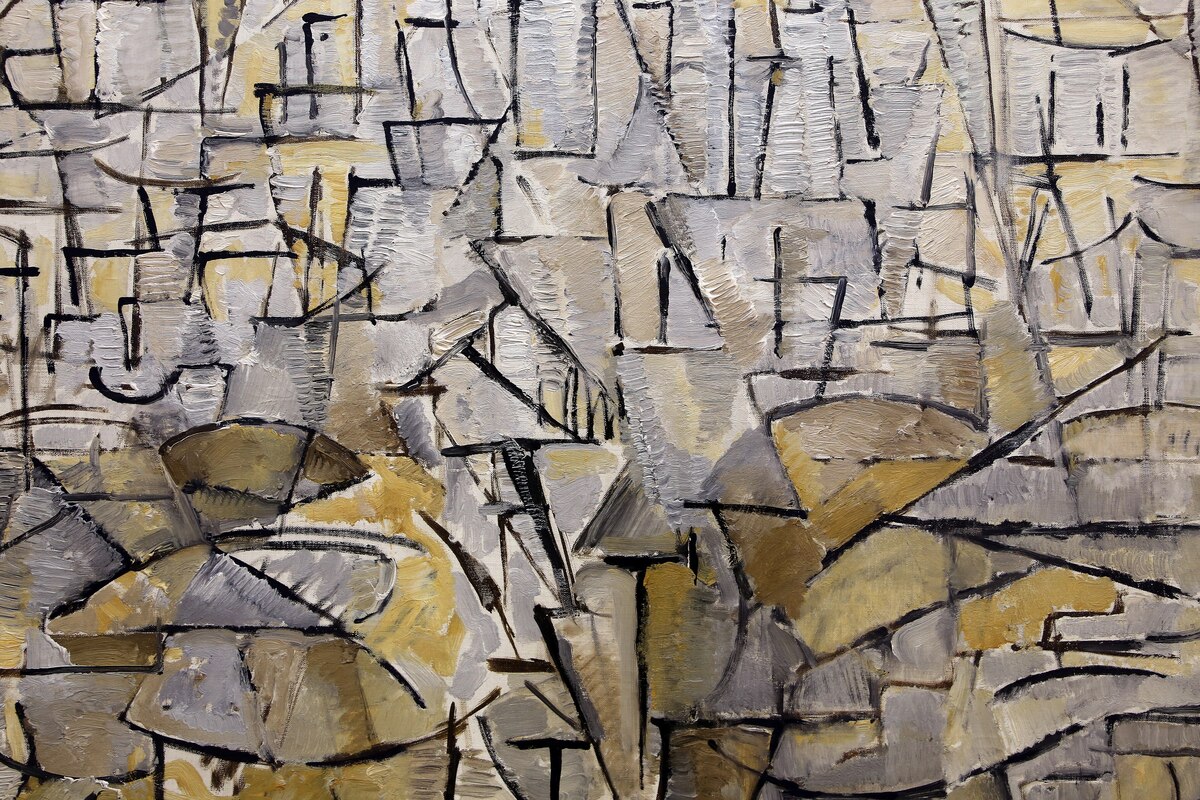
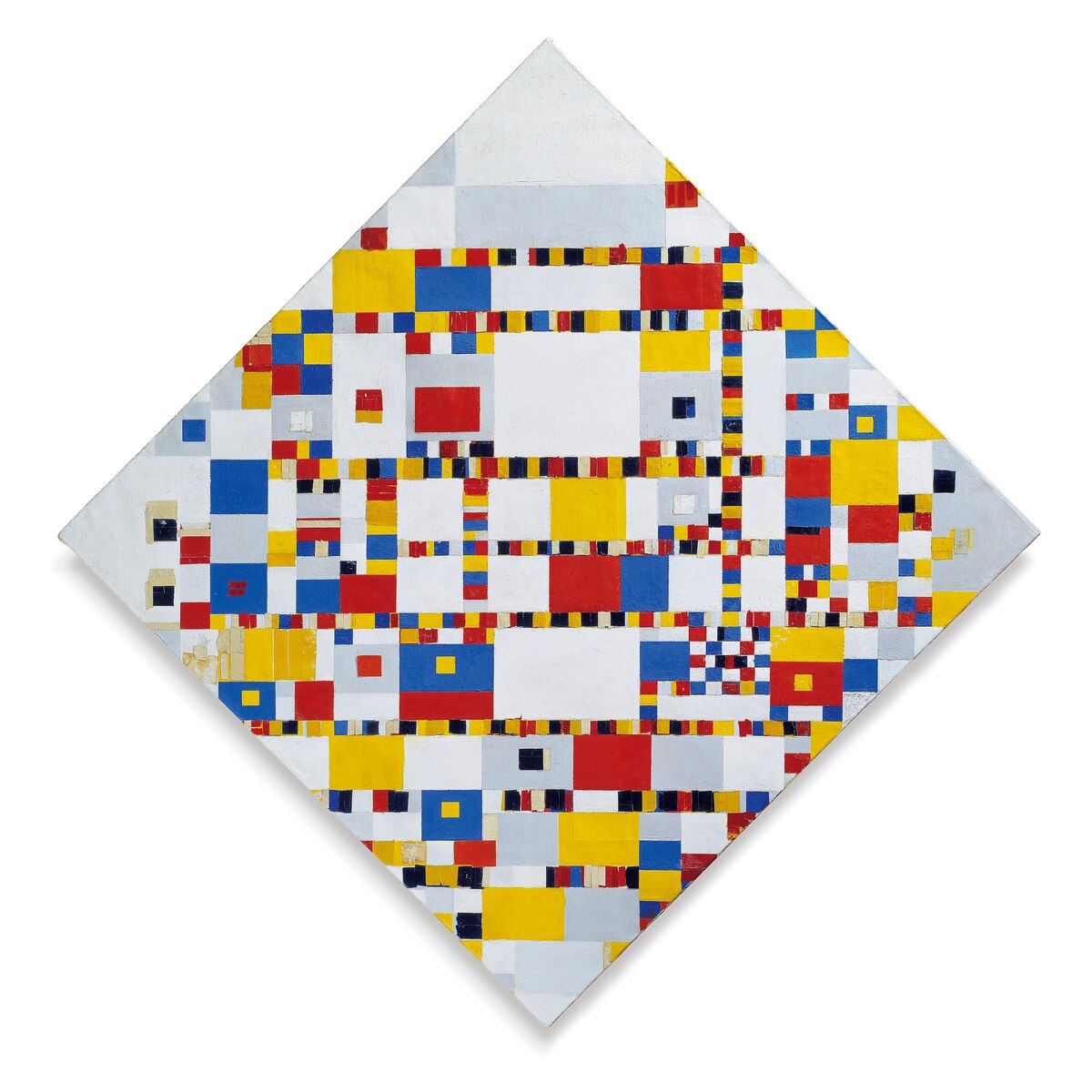
Piet Mondrian's Tableau I (1913) is a Cubist painting whose grid of black lines and coloured planes is described in the supplied object record. This article explores what the work shows, how its composition works, and the limits of the available evidence, with title variants and collection context noted.
A pale field of gray and white planes with fragmented black lines and small yellow accents. It establishes the cool tonal ground that makes the black lattice and ochre shapes read as distinct planes.
02
Lower-Right Ochre Plane
A broad ochre rectangle crossed by a black diagonal, balancing the lower-left cluster. Its chopped brush marks show the painterly facture beneath the geometric armature.
03
Upper-Right Black Lattice
The tightest concentration of black line work in the painting, laid over pale gray and yellow planes. It reveals how Mondrian fused drawing, surface texture, and architectural structure.
Your gallery guide
Tableau I by Piet Mondrian (1913)
Piet Mondrian's Tableau I (1913) is a Cubist painting whose grid of black lines and coloured planes is described in the supplied object record. This article explores what the work shows, how its composition works, and the limits of the available evidence, with title variants and collection context noted.
Editorial review by Artifact Archive automated publishing
This is Piet Mondrian's Tableau I, a painting from 1913. The object record identifies it as a Cubist work, an early step toward abstraction.
The record also links it to other titles, including Tableau No. 4 and Composition No. VIII. These variants reflect how Mondrian's works were catalogued and renamed over time.
The canvas shows an oval field of grey, ochre, pale yellow and white planes. Black vertical and horizontal lines cross these planes, building a grid.
Layered brushwork softens the edges and holds the Cubist scaffold together. The lines do not form a perfect grid; they shift and overlap, creating a sense of depth and movement.
The supplied record notes that works by Piet Mondriaan were seen at the Gemeentemuseum Den Haag in 2017, either in the collection or during an exhibition.
No further details about the painting's provenance, dimensions, or medium are given in the available record. The file itself is a photograph taken in 2017.
The photograph was taken on 14 March 2017 by Sailko and uploaded under a Creative Commons licence. It captures the painting with a Canon EOS 6D at a focal length of 62 millimetres, exposure time 0.02 second, f-number 5.6 and ISO speed 640.
These technical details describe the photograph, not the painting. The uploader is not the artist.
What we can say is that this is a Mondrian from 1913, a Cubist painting whose exact appearance is recorded in the photograph. Its title variants and collection history are part of its record.
The available evidence does not include an interpretive essay or detailed provenance, so our understanding rests on the object record and the visible image itself.
The story and its sources
Editorial review by Artifact Archive automated publishing.
Historical claims are linked to the records below. Close looking and interpretation are identified in the passage notes.
Piet Mondrian was a Dutch painter (1872–1944). Their work is associated with Post-impressionism; De Stijl; Symbolism. Their recorded places of work include Amsterdam; New York City; Paris; Domburg; Laren; Winterswijk; London.
Gemeentemuseum Den Haag, The Hague, Netherlands(Sailko, 2018)
Movement or period
Cubism / early abstraction
Country or culture
Dutch
Depicted subject
An oval field of gray, ochre, pale yellow and white planes crossed by black vertical and horizontal lines, with layered brushwork holding the Cubist scaffold together.
Attribution is taken from the supplied object record; the photographer and uploader are not the artist.
Dimensions
Unknown
Catalogue identity and date
The catalogue record supplied here identifies the painting Tableau I as the work of Piet Mondrian and dates it to 1913. That combination of artist, title and year is the core of the object's documented identity in the evidence. The object date belongs to the painting itself, not to the photograph or file through which it is now known, and it should be held separately from the later dates attached to the digital document discussed below.(Sailko, 2018, Object, Description)
The same record associates the painting with a group of further titles: Tableau No. 4 (Schilderij No. 4), Composition No. VIII, and Compositie 3. These are recorded title variants rather than a single uncontested name, and they indicate that the work has circulated under more than one designation within cataloguing practice. The presence of a Dutch form alongside English and numbered composition titles shows how Mondrian's paintings have been renamed and reorganised across catalogues and collections. The record gives the variants without explaining the sequence or authority behind them, so the relationship among Tableau I, Tableau No. 4, Composition No. VIII and Compositie 3 remains a matter of catalogue history rather than a resolved fact in the supplied evidence.(Sailko, 2018, Category)
Limits of the supplied record
Interpretation
Taken together, the supplied units sustain a layered account of identity rather than a single settled label. The primary object is a painting attributed to Piet Mondrian, dated 1913, catalogued under Tableau I and also recorded as Tableau No. 4 (Schilderij No. 4), Composition No. VIII and Compositie 3. The secondary document is a 2017 photograph by Sailko, licensed for reuse, made with a Canon EOS 6D under the settings noted above. The connection between them is documentary and institutional: a museum setting in The Hague in 2017 and a freely licensed file page. The accumulated record therefore establishes the work's place in a history of early twentieth-century abstraction through its catalogue data and its photographic circulation, while leaving its physical description, measurements and ownership to sources not supplied here. Where the evidence is silent, the account remains silent, and the title variants and the 2017 photograph are retained as part of the object's documented identity rather than treated as noise around the 1913 painting.(Sailko, 2018, Object, Description; Category)
The supplied object record lists Piet Mondrian as the artist of the painting Tableau I, dated 1913.(Sailko, 2018)
The painting is associated in the supplied record with the titles Tableau No. 4 (Schilderij No. 4), Composition No. VIII, and Compositie 3.(Sailko, 2018)
The only technical documentation supplied for this object concerns its photographic record, not the painting itself. The file is a photograph of a painting taken on 14 March 2017 and uploaded by Sailko (identified in the source's author field) under a Creative Commons Attribution 3.0 Unported licence, with the making of the document supported by Wikimedia CH. The camera data recorded for that photograph are a Canon EOS 6D at a focal length of 62 millimetres, exposure time 0.02 second, f-number 5.6 and ISO speed 640. These figures characterise the conditions under which the 2017 image was made, and they say nothing about the support, medium, pigments or preparation of the painted object depicted; separating the two is essential to any description of materials and technique, because conflating camera settings with painting practice would attribute to Mondrian decisions that belong to the photographer.(Sailko, 2018, Metadata)
The photograph was captured with a Canon EOS 6D at a focal length of 62 millimetres, exposure time 0.02 second, f-number 5.6 and ISO speed 640.(Sailko, 2018)
The surviving documentation for this painting is unusually thin on condition. The Wikimedia Commons file page that supplies the object record, the photograph, and the upload metadata does not describe the painting's visible composition, its dimensions, its medium details, its provenance, or any interpretive readings. That absence is itself the central condition of the evidence: there is no dated condition report, no record of examination under raking or ultraviolet light, no account of stretcher, tacking margins, craquelure, cupping, flaking, abrasion, varnish, lining, inpainting, or prior restorations in the units supplied here. Any statement about the physical state of the canvas would have to be inferred from the photograph, and the photograph is a document of appearance under one set of conditions, not a conservation record. The scope of what the Commons excerpts omit is therefore the first thing a condition history of this object has to state plainly.(Sailko, 2018, Full page)
The supplied Wikimedia Commons excerpts do not describe the visible composition of the painting, its dimensions, medium details, provenance, or interpretive readings.(Sailko, 2018)
Any account of the later life of this painting has to begin with what the supplied record actually documents, because the record is both sparse and specific. The Wikimedia Commons file is identified as a photograph of a painting, taken on 14 March 2017 and uploaded by Sailko under a CC BY 3.0 licence (fact-04). The same file is licensed under the Creative Commons Attribution 3.0 Unported licence, and the making of the document was supported by Wikimedia CH (fact-05). Those two facts describe the reproduction and its circulation, not the painting's creation: the uploader is a photographer of the work, not its author, and the licence governs the image file rather than the underlying canvas. Read together, the units establish that this object's most recent documented public life runs through an openly licensed digital surrogate, produced at a specific moment in 2017 and released for reuse. The same source record that carries these credits does not itself supply the painting's dimensions, medium details, provenance or interpretive readings, so the reproduction carries the object into circulation while leaving much of the object's own history undocumented in this evidence.(Sailko, 2018, Summary, Permission; Permission)
The supplied record identifies the file as a photograph of a painting, taken on 14 March 2017 and uploaded by Sailko under a CC BY 3.0 licence.(Sailko, 2018)
The file is licensed under the Creative Commons Attribution 3.0 Unported licence, with the making of the document supported by Wikimedia CH.(Sailko, 2018)
The supplied object record lists Piet Mondrian as the artist of Tableau I, dated 1913, and associates the painting with several further titles: Tableau No. 4 (Schilderij No. 4), Composition No. VIII, and Compositie 3. These title variants are cataloguing facts established by the record itself, not stylistic guesses, and they matter because Mondrian's early Cubist works circulated under multiple names in different publications and collection inventories. The file page consulted here is a Wikimedia Commons document whose structured data and description supply this identification and these alternate titles, while also supplying the metadata for the photograph of the work rather than an exhibition catalogue entry. The published transcript likewise treated the alternate titles as evidence of how Mondrian's works were catalogued and renamed over time, a claim supported by this same record. The record does not resolve which title was contemporary with the painting, which came later, or who introduced each variant.(Sailko, 2018, Description)
Museum location reported in the file
According to the supplied file record, works by Piet Mondriaan were seen at the Gemeentemuseum Den Haag, either in the collection or during an exhibition there in 2017. This places a Mondriaan presence at that institution in that year, but the record itself does not state which works were shown, whether Tableau I was among them, or whether the sighting relates to the permanent collection or a temporary exhibition. The record is framed as a 2017 photograph of the painting, which gives a plausible but unconfirmed link to the museum. The file page consulted here carries this statement in its description field, and it is the only collection or display information about the painting supplied. No dimensions, medium description, provenance history or interpretive reading appears in that record.(Sailko, 2018, Description)
The 2017 photograph as document
The photograph carrying this record was taken on 14 March 2017 by Sailko and uploaded under a Creative Commons Attribution 3.0 Unported licence, with the making of the document supported by Wikimedia CH. The same record notes a publication year of 2018 for the file page. The capture used a Canon EOS 6D at a focal length of 62 millimetres with an exposure time of 0.02 second, f-number 5.6 and ISO speed 640. These technical parameters describe the photographic act and the camera settings, not the painting's own materials, support or technique, and the uploader is not the artist. The evidence therefore supports statements about the reproduction and its licensing, and it supports the fact that a photograph of the painting existed by March 2017, but it does not by itself prove where the painting hung when the photograph was made.(Sailko, 2018, Description)
What the record does and does not establish
Interpretation
What the Commons excerpts consulted here do not describe is equally consequential for a research account: they do not describe the painting's visible composition, its dimensions, medium details, provenance, or interpretive readings. The photograph is a witness to appearance on a particular day, while the identification, date and alternate titles come from structured data and description fields whose editorial history is not laid out in the excerpts. A future account of Tableau I should therefore keep two registers separate: the documented creation date and titles, and the documented museum sighting reported for 2017, with the photograph's technical metadata read as evidence about the image file rather than about the pigment, canvas or brushwork. Where the published transcript described an oval field of grey, ochre, pale yellow and white planes crossed by shifting black lines, that description comes from viewing the image rather than from the consulted record, and it should be attributed accordingly. This distinction is what allows Tableau I to function as a secure anchor for Mondrian's 1913 Cubist moment without overstating what the file record can prove about its making or its movement between collections.(Sailko, 2018, Description)
According to the supplied file record, works by Piet Mondriaan were seen at the Gemeentemuseum Den Haag, either in the collection or during an exhibition there in 2017.(Sailko, 2018)
The section's single supplied primary evidence unit is not a market record, an auction result or an institutional appraisal. It is a model-generated working insurance range, recorded as a working calculation generated on 17 October 2026, estimating US$50 million to US$150 million for the painting identified in the underlying object context as Piet Mondrian, Tableau I, 1913, a painting in Cubism or early abstraction, Dutch, held at Gemeentemuseum Den Haag. The unit states its own methodology: the broad range is calculated for manual review only and is conservatively anchored to the confirmed artist, date, medium and museum collection status. It is explicitly designed as a wide band because the exact catalogue identity and title variants recorded in the supplied context are uncertain. Any use of the figure has to carry that wide range with it, because the width is not a failure of precision to be narrowed by assertion but a deliberate accommodation of the catalogue problem.(Sailko, 2018)
The evidence unit also states what the figure is not. It is not an official insurance value, an appraisal, an auction result or a sale price, and it does not rest on access to private insurance records or verified comparable sales. Its stated basis is the general insurance-scale significance of a confirmed 1913 Mondrian painting in a major public collection, not any transaction or policy document. The unit's qualification is therefore inseparable from its number: final valuation requires professional appraisal and confirmation of the exact catalogue identity. Preserving that qualification is part of recording the value accurately, since the number and the caveat were produced together and neither was supplied without the other.(Sailko, 2018)
The number is tied to an artwork identity that the wider evidence establishes only in qualified terms. The source record behind the object lists Piet Mondrian as the artist of the painting Tableau I, dated 1913, and associates the same work in the record with the titles Tableau No. 4 (Schilderij No. 4), Composition No. VIII and Compositie 3. Those alternative titles are exactly the kind of catalogue identity and title-variant uncertainty the valuation unit cites when it widens its range. The valuation paragraph and the Commons-derived record therefore reinforce each other on one point: the value attaches to a work whose exact catalogue designation is recorded in variants rather than settled by a single uncontested name.(Sailko, 2018)
The collection status that anchors the range is also only partly documented. According to the supplied file record, works by Piet Mondriaan were seen at the Gemeentemuseum Den Haag, either in the collection or during an exhibition there in 2017. That phrasing does not establish permanent collection custody, and it does not establish that this particular painting was among the works seen. The 2017 date belongs to the visit and to the photograph, not to a confirmed acquisition or accession. The working insurance range leans on the museum context and on confirmed 1913 Mondrian authorship; a reader should weigh how much of that anchor rests on a partially documented viewing rather than on a collection record.(Sailko, 2018)
The evidentiary asymmetry around the value is worth stating plainly. The valuation unit is explicit that it contains no official figures, while the Commons record is identified as only partially consulted and its supplied excerpts do not describe the visible composition of the painting, its dimensions, medium details, provenance or interpretive readings. There is consequently no independent price evidence, no provenance chain and no condition or size data in the supplied units against which the range could be tested. Treating the range as an assumption internal to the supplied record, held open for manual review, is the only reading the units support; treating it as a market fact would exceed them. This is a conclusion drawn from the limits of the supplied evidence rather than a claim advanced by either source on its own.(Sailko, 2018)
Working estimate
Calculated working insurance estimate, not a sale price: Estimated insurance range: US$50M to US$150M Recorded date: Working calculation, generated 2026-10-17. Methodology: This broad working insurance range is calculated for manual review only, using the confirmed artwork context: Piet Mondrian, Tableau I, 1913, painting, Cubism or early abstraction, Dutch, held at Gemeentemuseum Den Haag. The range is conservatively anchored to the confirmed artist, date, medium, and museum collection status. It reflects the general insurance-scale significance of a confirmed 1913 Mondrian painting in a major public collection, without claiming access to private insurance records, comparable sales, or official appraisals. The range is intentionally wide to accommodate uncertainty in exact catalogue identity and title variants noted in the supplied context. Qualification: This is a model-generated working insurance range for manual review only. It is not an official insurance value, appraisal, auction result, or sale price. It does not reflect access to private insurance records or verified comparable sales. Final valuation requires professional appraisal and confirmation of exact catalogue identity.(Sailko, 2018)
Bibliography
Sources and further reading
References are arranged by author or organisation, with links to the original publications. Where no publication date is recorded, n.d. means no date.
Source notes updated .
No recorded sources match these filters. Reset the filters to see the full bibliography.
Wikimedia Commons file page containing the uploaded photograph of the painting, upload metadata, licence and structured data. The description places the work in or around the Gemeentemuseum Den Haag during a 2017 exhibition, but does not itself provide catalogue analysis, dimensions or interpretation.
Advertising supports the archive. These preferences control aggregate page counting, reading activity and ad-delivery diagnostics. They use no visitor tracking cookie.