ArchiveThree Musicians

Artwork record / 319 of 331

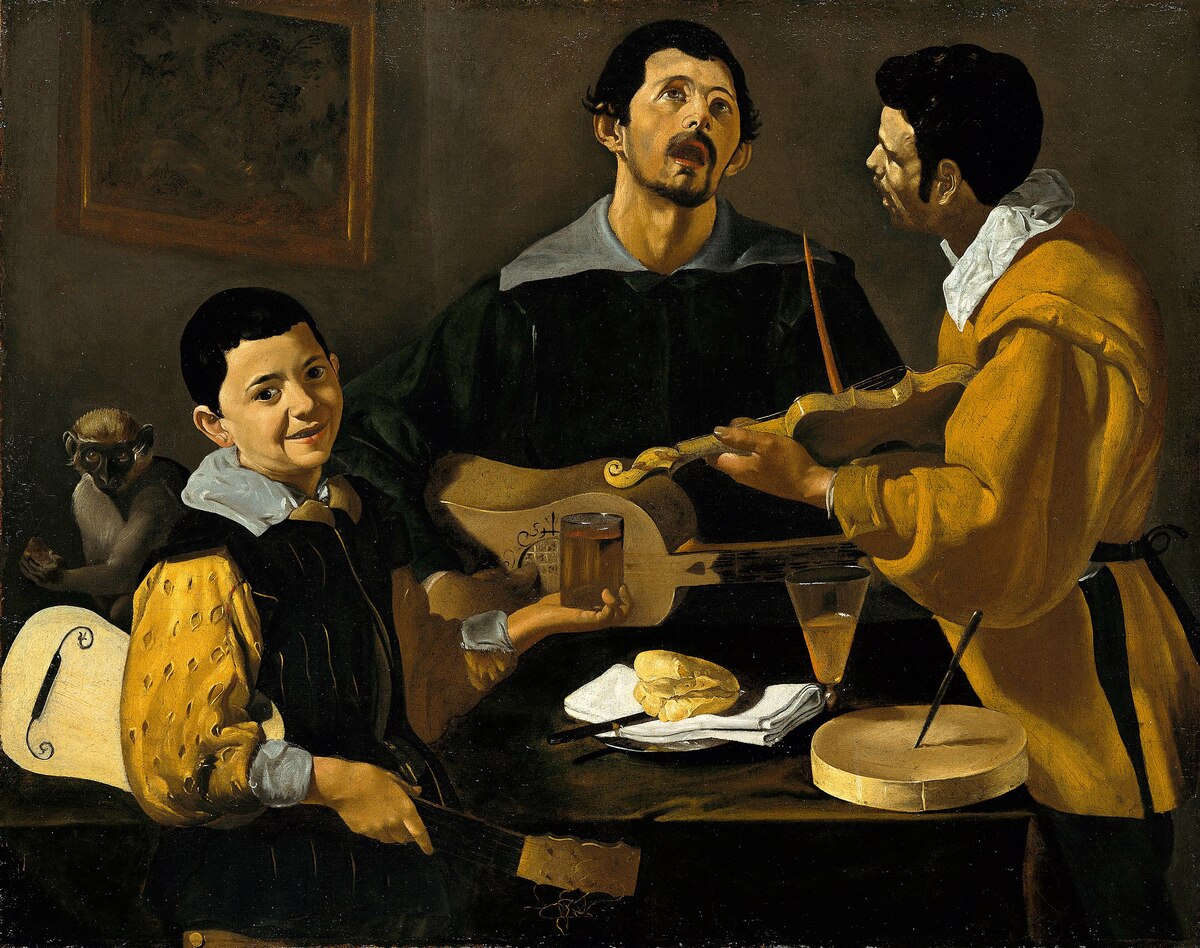
Three Musicians by Diego Velázquez (circa 1618)

Artist: Diego Velázquez

A docent-led reading of Velázquez's early Seville bodegón: three musicians around a table, a wine glass offered to the viewer, and the still life and monkey that anchor the scene in his hometown genre tradition. All claims follow the supplied Commons record, which is a discovery source, not the owning museum's catalogue.

Read the story ↓ About the artist ↓ Research and record ↓ Literature and sources ↓ Listen to the article ↓
Article text for AI
Shop this artwork ↓ 0 visits
Datecirca 1618CultureSpanish PeriodBaroqueCurrent locationGemäldegalerie, Staatliche Museen zu Berlin, Berlin, Germany
Listen to the article
100%
Three Musicians by Diego Velázquez (circa 1618)
Loading full-resolution artwork…
Scroll to zoom · drag to pan · double-click to focus Pinch to zoom · drag to explore · double-tap to focus FIELD VIEW / 319
Tools & download
Pixel colour Select a pixel with the eyedropper
No pixel selected

Choose the eyedropper, then click or tap the image. Scroll to zoom for finer selection.

Add text

Hand to pan · Select to move text and drawings · Add as many texts as you like · Scroll to zoom

Three Musicians: high-resolution image

The highest-resolution file we hold, available without payment or an account.3,840 × 3,034 pixels.

Download highest-resolution image

Details to notice

About 5 minutes to read
01

Monkey at left

Small monkey perched at far left behind the boy, holding a small object or morsel. It adds a witty, earthy presence typical of Velázquez's early Seville bodegones.

02

Tabletop still life

Tabletop still life at lower right with a loaf of bread, folded white napkin, glass of wine, round wooden board, and knife. These objects anchor the bodegón setting and echo themes of appetite and daily life.

03

Central plucked instrument

Large plucked string instrument held across the central musician's body, with a decorated soundhole and visible strings. It is a key object of the painting and demonstrates the artist's attention to musical still life.

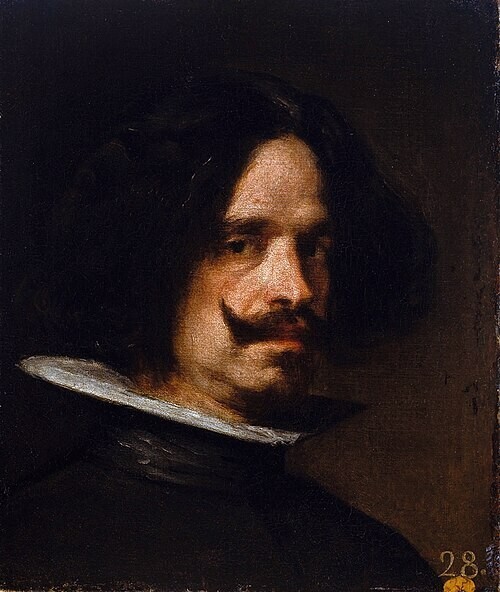
Artist portrait of Diego Velázquez
Artist portrait Image credit

Diego Velázquez. Image source · Public domain

About the artist

Diego Velázquez

1599 to 1660

Diego Velázquez was a Spanish painter (1599–1660). Their work is associated with Baroque. Their recorded places of work include Seville; Madrid; Venice; Rome; Naples; Italy.

Born
1599
Died
1660
Nationality
Spain
Birthplace
Seville
Died in
Madrid

The research & record

Study the work.
Follow the evidence.

Find catalogue details, historical context, technical research and the literature behind this artwork.

Article text for AI
Open research text

The artwork record

Research catalogue

Catalogue information and detailed research, with references that link to the bibliography.

Updated .

Identity and catalogue

Link
Artist or attribution
Diego Velázquez(Wikimedia Commons: The Three Musicians, n.d.)
Object date
circa 1618
Medium and support
oil on canvas(Wikimedia Commons: The Three Musicians, n.d.)
Dimensions
height: 88 cm (34.6 in); width: 111 cm
Current collection or location
Gemäldegalerie, Staatliche Museen zu Berlin, Berlin, Germany(Wikimedia Commons: The Three Musicians, n.d.)
Country or culture
Spanish
Depicted subject
A genre scene, described as a bodegón, showing three musicians making music together in a dark interior, with a tabletop still life of bread, a folded white napkin, a glass of wine, a round wooden board, and a knife at the lower right.
Title variants
The Three Musicians; Three Musicians; Tre musicisti; Trois musiciens; Три музыканта; Die drei Musikanten; Três músicos; Tre Muzikantët; سه نوازنده (ولاسکس); Cei trei muzicieni; 3人の音楽家 (ベラスケス); Tre musikanter; Tres músicos; שלושת המוזיקאים; Üç musiqiçi; Tri Muzikistoj; Три музики; الموسيقيون الثلاثه; الموسيقيون الثلاثة; Tri muzičara(Wikimedia Commons: The Three Musicians, n.d.)
Support
canvas
Catalogue identity and its limits

The supplied file record is a discovery and image-host record rather than the owning institution's object catalogue, and the account of the work's identity should be read with that distinction in view. The Wikimedia Commons file identifies the painting as 'The Three Musicians' by Diego Velázquez, dated circa 1618, oil on canvas, with dimensions 88 by 111 cm. Within the same record, the object type is listed as painting and the genre as genre art, a structured-data statement that classifies the picture as a scene of everyday life rather than a narrative drawn from scripture or classical myth. The medium and the support are both given as canvas, so the material description supplied here extends no further than oil on canvas. No provenance, acquisition history, sale, insurance valuation or exhibition history is recorded in the supplied excerpts, which means the object's passage into a public collection cannot be traced from this evidence.(Wikimedia Commons: The Three Musicians, n.d., Summary; structured data; Summary; Wikidata statement 'genre'; Whole supplied excerpt)

The Commons record gives the artist's alternative names, birth name and death date as Diego Rodríguez de Silva y Velázquez, before 6 June 1599 to 6 August 1660, and lists work locations including Seville, Madrid, Venice, Rome and Naples. Elsewhere in the same record the work locations are given more precisely as Seville from 1611 to 1622 and Madrid from 1622 to 1660, which places a painting of circa 1618 firmly within the artist's Seville years and makes him a young man at the time of its making. The date attached to the work is therefore approximate, and it belongs to the catalogue record rather than to any inscription, document or signature on the object itself; the evidence supplies no dated inscription or primary document fixing the year. The title is recorded in several languages: 'Tre musicisti' in Italian, 'Trois musiciens' in French, 'Die drei Musikanten' in German, 'Três músicos' in Portuguese and 'Tres músicos' in Spanish. These variants are translations of a single catalogued title, not competing titles for different works, and their presence reflects the multilingual indexing practices of the host platform rather than a documented history of the picture's naming.(Wikimedia Commons: The Three Musicians, n.d., Summary, artist template; Title template; Summary, artist template work location field)

The bodegón register

Interpretation

The record's account of the figures is descriptive and should be distinguished from any claim about what the painting means. The central musician is described as wearing a dark tunic with a broad white collar, his eyes turned upward and his mouth open, features the supplied record reads as suggesting singing; a large plucked string instrument lies across his body with a decorated soundhole and visible strings. At the left a smiling boy in a patterned yellow sleeve and dark vest extends a glass of wine forward with his right hand and looks directly out of the picture, while at the right a violinist in a yellow doublet and white collar is seen in profile, bowing a violin. The same material describes the central musician as the emotional and compositional hinge of the scene and the boy's direct gaze and offered drink as connecting the viewer to the music-making, but the record itself flags these as visual inferences in the supplied candidates, not established curatorial claims. The composition therefore presents a group absorbed in performance while also offering the viewer a point of contact through the boy's outward look and the proffered glass, and this dual address is a reading of the visible arrangement rather than a documented programme.(Wikimedia Commons: The Three Musicians, n.d., Summary; Wikidata statement 'genre')

The work has an afterlife in scholarship and in digital reception that is separate from the painting's own history. According to its file usage on Commons, the image is indexed on the catalogue raisonné pages of Bardi (1969), López-Rey (1996) and Sánchez Quevedo and Morán Turina (1999), which indicates that specialists compiling systematic listings of the artist's output have treated this canvas as part of his body of work. The Commons file itself was used on English Wikipedia's featured picture candidates, as its Picture of the Day for 10 February 2018 and in the Signpost of 17 June 2015. The Commons record also associates the digital image with the Gemäldegalerie, Staatliche Museen zu Berlin and categorises it under 'Google Art Project works in Gemäldegalerie, Staatliche Museen zu Berlin', while crediting the digital image to Google Arts & Culture and stating the licence as public domain. These are facts about the photograph and its circulation, not about the painting's hanging history, and the difference is worth keeping clear: the catalogue raisonné indexation documents scholarly attention to the object, whereas the featured-picture and Picture of the Day uses document the reception of a particular reproduction.(Wikimedia Commons: The Three Musicians, n.d., Summary; structured data)

The supplied Wikimedia Commons file identifies the work as a painting titled 'The Three Musicians' by Diego Velázquez, dated circa 1618, oil on canvas, 88 by 111 cm.(Wikimedia Commons: The Three Musicians, n.d.)

The Commons record lists the object type as painting and the genre as genre art.(Wikimedia Commons: The Three Musicians, n.d.)

The Commons record gives the artist's alternative names, birth name and death date: Diego Rodríguez de Silva y Velázquez, before 6 June 1599 to 6 August 1660, with work locations including Seville, Madrid, Venice, Rome and Naples.(Wikimedia Commons: The Three Musicians, n.d.)

The Commons record supplies the title in multiple languages, including 'Tre musicisti' (Italian), 'Trois musiciens' (French), 'Die drei Musikanten' (German), 'Três músicos' (Portuguese) and 'Tres músicos' (Spanish).(Wikimedia Commons: The Three Musicians, n.d.)

Subject and iconography

Link
The Figures and the Act of Music-Making

Visual observation

The supplied visual focus candidates give a figure-by-figure description of the canvas. At the centre stands a musician in a dark tunic with a broad white collar; his eyes are upturned and his mouth is open, features the supplied record reads as singing. Across his body lies a large plucked string instrument, its soundhole decorated and its strings plainly visible. To the right a violinist appears in profile, wearing a yellow doublet and a white collar, drawing his bow across a violin. On the left a boy smiles; he wears a dark vest and a patterned yellow sleeve, extends a glass of wine forward with his right hand, and looks directly out of the picture. These are descriptions of what is visible, recorded as semantic focus candidates rather than as an institutional curatorial statement.(Wikimedia Commons: The Three Musicians, n.d., Semantic focus candidate: central_singer_upward_gaze; Semantic focus candidate: violinist_in_yellow; Semantic focus candidate: central_plucked_instrument; Semantic focus candidate: boy_offering_wine_glass)

The same candidates offer two further readings that should be separated from the observations above. They describe the central musician as the emotional and compositional hinge of the scene, and describe the boy's direct gaze and offered drink as a device connecting the viewer to the music-making. The supplied material is explicit that these are visual inferences within the candidates, not established curatorial claims. In practical terms, the visible arrangement (a central figure flanked by two others, a still life below, one figure addressing the viewer) is what can be observed; the account of that arrangement as a compositional hinge and as viewer address is an interpretation built on the observation.(Wikimedia Commons: The Three Musicians, n.d., Semantic focus candidate: central_singer_upward_gaze; Semantic focus candidate: boy_offering_wine_glass)

Still Life, Bodegón and the Monkey

At the lower right the candidates describe a tabletop still life: a loaf of bread, a folded white napkin, a glass of wine, a round wooden board and a knife. At the far left, behind the boy, a small monkey perches holding some small object or morsel. The record describes the monkey as adding an earthy presence typical of Velázquez's early Seville bodegones, and characterises the scene as a bodegón setting for the tabletop still life. The supplied material states plainly that this framing is descriptive within the candidates rather than an institutional curatorial statement. The term bodegón names a Spanish picture of ordinary life, often set around food, drink and rough interiors; here it organises the tabletop group as a bodegón element within a scene that is also about music.(Wikimedia Commons: The Three Musicians, n.d., Semantic focus candidate: table_still_life; Semantic focus candidate: monkey_with_morsel)

Reading the Whole

Interpretation

Taken together, the described components support a reading of the canvas as doing two things at once: it shows a group absorbed in making music, and it presents a careful arrangement of ordinary things for the viewer to look at. The central singer with the plucked instrument, the profiled violinist and the boy with the offered glass form the musical group; the bread, napkin, wine, board and knife anchor the lower right; the monkey at the far left belongs, on the record's account, to the earthy register of the early Seville bodegones rather than to any refined allegory the source establishes. This synthesis is my own qualified reading of the supplied descriptions, and it stays within them: it does not attribute a documented intention to the painter, and it treats the hinge and viewer-address language as inference rather than as curatorial fact.(Wikimedia Commons: The Three Musicians, n.d., Semantic focus candidate: central_singer_upward_gaze; Semantic focus candidate: boy_offering_wine_glass; Semantic focus candidate: violinist_in_yellow; Semantic focus candidate: central_plucked_instrument; Semantic focus candidate: table_still_life; Semantic focus candidate: monkey_with_morsel)

Visual observation

The supplied visual focus candidates describe the central musician as wearing a dark tunic with a broad white collar, with upturned eyes and an open mouth that suggest singing.(Wikimedia Commons: The Three Musicians, n.d.)

The supplied visual focus candidates describe a smiling boy at the left in a patterned yellow sleeve and dark vest, extending a glass of wine forward with his right hand and looking directly out of the picture.(Wikimedia Commons: The Three Musicians, n.d.)

The supplied visual focus candidates describe a violinist in a yellow doublet and white collar, seen in profile at the right, bowing a violin.(Wikimedia Commons: The Three Musicians, n.d.)

The supplied visual focus candidates describe a large plucked string instrument held across the central musician's body, with a decorated soundhole and visible strings.(Wikimedia Commons: The Three Musicians, n.d.)

The supplied visual focus candidates describe a tabletop still life at the lower right with a loaf of bread, a folded white napkin, a glass of wine, a round wooden board and a knife.(Wikimedia Commons: The Three Musicians, n.d.)

The supplied visual focus candidates describe a small monkey perched at the far left behind the boy, holding a small object or morsel, adding an earthy presence typical of Velázquez's early Seville bodegones.(Wikimedia Commons: The Three Musicians, n.d.)

Historical context

Link
The recorded object and its metadata

The supplied Wikimedia Commons record identifies the object as a painting titled The Three Musicians by Diego Velázquez, dated circa 1618, executed in oil on canvas, with canvas given as the support, and measuring 88 by 111 cm. The record classifies the object type as painting and the genre as genre art, meaning a depiction of everyday figures rather than a narrative from scripture or classical myth. The same record preserves the artist's alternative names along with his birth name and death date, Diego Rodríguez de Silva y Velázquez, before 6 June 1599 to 6 August 1660, and gives the title in several languages, including Tre musicisti, Trois musiciens, Die drei Musikanten, Três músicos and Tres músicos. These are the basic identifying terms that the file supplies, and they define the object that the rest of the account concerns. The Commons record associates the digital image with the Gemäldegalerie, Staatliche Museen zu Berlin, and categorises it under Google Art Project works in that collection, while the supplied excerpts credit the digital image to Google Arts & Culture and state the licence as public domain. That association concerns the image file and its host collection category; the file is a discovery record and image host rather than the owning institution's own object record.(Wikimedia Commons: The Three Musicians, n.d., Summary, artist template work location field)

Date and the Seville years

The date of circa 1618 acquires its meaning from the artist's documented movements. The Commons record lists Velázquez's work locations as Seville from 1611 to 1622 and Madrid from 1622 to 1660, so a work of about 1618 falls within his Seville years, before the move to the court city. Because the record's summary confines itself to those location fields, the painting's place in the Seville period is established by the overlap of the approximate date with the documented residence, not by a commission document. That distinction matters for how the object is described: the Commons summary places a work of circa 1618 in the artist's Seville years, which is a statement about the artist's whereabouts, not about who ordered the picture or for what setting. The material evidence supplied extends to the medium stated as oil on canvas and the support stated as canvas; no pigment analysis, condition report or technical imaging is offered, so claims about surface, materials or later treatment cannot be carried further than the record allows.(Wikimedia Commons: The Three Musicians, n.d., Summary, artist template work location field)

The Commons record lists the artist's work locations as Seville from 1611 to 1622 and Madrid from 1622 to 1660, which places a work of circa 1618 in the artist's Seville years.(Wikimedia Commons: The Three Musicians, n.d.)

Materials and technique

Link
Medium and support

The supplied file record gives the material facts of the picture's construction at the level of medium and support: it lists the medium as oil on canvas and the support as canvas. This is a documented statement in the file record rather than the result of a reported technical examination, and within the supplied evidence it is the whole of the material evidence for the object's making. Nothing in the supplied units describes a ground or priming layer, a preparatory drawing, an underdrawing, a coloured sketch, a varnish, a lining, a stretcher, a panel, a copper support, a signature, a date inscription, a pigment analysis, a cross-section, an X-radiograph, an infrared reflectogram or a conservation treatment. The account of materials and technique therefore has to be written at exactly this level: the file record establishes the medium and the support, and the visual focus candidates describe what the finished surface shows, but no supplied unit establishes how the paint was laid on, in what order, or with what tools. Distinguishing those two registers is the first requirement of this section, because the visual descriptions of figures, objects and textiles are observations of a completed image, not technical findings about its fabrication.(Wikimedia Commons: The Three Musicians, n.d., Artwork template)

The file record identifies the work as a painting titled The Three Musicians by Diego Velázquez, dated circa 1618, oil on canvas, measuring 88 by 111 cm, and lists the object type as painting and the genre as genre art. It gives the artist's alternative names, birth name and death date as Diego Rodríguez de Silva y Velázquez, before 6 June 1599 to 6 August 1660, and lists his work locations as including Seville, Madrid, Venice, Rome and Naples. The dated locations matter for the material and technical account because they place a work of circa 1618 within the artist's Seville years: the record lists Seville from 1611 to 1622 and Madrid from 1622 to 1660. The dimensions, 88 by 111 cm, describe a horizontal canvas of moderate scale, which is part of the physical description of the object even though no supplied unit discusses its format, seam structure or edge preparation. The record also supplies the title in multiple languages, including Tre musicisti, Trois musiciens, Die drei Musikanten, Três músicos and Tres músicos, and associates the digital image with the Gemäldegalerie, Staatliche Museen zu Berlin, categorising it under Google Art Project works in Gemäldegalerie, Staatliche Museen zu Berlin, with the digital image credited to Google Arts & Culture and the licence stated as public domain. These are record-level descriptions attached to the file, and the file page itself is not the owning institution's object record.(Wikimedia Commons: The Three Musicians, n.d., Artwork template)

Evidence boundaries

Interpretation

The file record's catalogue raisonné associations, indexed on the pages of Bardi from 1969, López-Rey from 1996, and Sánchez Quevedo and Morán Turina from 1999, according to its file usage on Commons, establish that specialists compiling comprehensive listings of the artist's work have treated this canvas as part of that body of work. That is a statement about scholarly cataloguing, not about materials or technique, and it does not supply a technical study, a condition report or a treatment record. Similarly, the Commons file's use on English Wikipedia's featured picture candidates, as its Picture of the Day for 10 February 2018, and in the Signpost of 17 June 2015, is reception of the digital photograph rather than documentation of the physical painting. The file record supplies no provenance, acquisition history, sale, insurance valuation or exhibition history, so no argument in this section can rest on a documented chain of ownership, on a known examination campaign or on a dated intervention in the object's physical state.(Wikimedia Commons: The Three Musicians, n.d., Artwork template)

Pulling the supplied units together, the material account of this object is thin but precise, and its precision lies in the distinction between what is documented and what is seen. One documented unit fixes the medium as oil and the support as canvas, together with the title, attribution, approximate date of circa 1618, dimensions of 88 by 111 cm, genre classification and the Seville and Madrid working locations that situate a circa 1618 painting in the artist's Seville years. Six observational units describe the finished picture: the singing central musician with his dark tunic, broad white collar, upturned eyes and open mouth, and the large plucked instrument with decorated soundhole and visible strings held across his body; the violinist in yellow doublet and white collar bowing in profile; the smiling boy in patterned yellow sleeve and dark vest offering wine and looking out; the tabletop still life of bread, napkin, wine, board and knife; and the monkey with its morsel. Read together, the documented medium and the described surface support a careful formulation: the evidence establishes that the picture is an oil painting on canvas of circa 1618 and establishes in detail what its surface depicts, including textiles, tableware, an instrument and animal, but it does not establish the preparation of the canvas, the sequence of painting, the tools used, the pigments employed or any subsequent physical history of the work.(Wikimedia Commons: The Three Musicians, n.d., Artwork template; Semantic focus candidate: central_singer_upward_gaze; Semantic focus candidate: boy_offering_wine_glass; Semantic focus candidate: violinist_in_yellow; Semantic focus candidate: central_plucked_instrument; Semantic focus candidate: table_still_life; Semantic focus candidate: monkey_with_morsel)

The supplied file record lists the medium as oil on canvas with the support as canvas.(Wikimedia Commons: The Three Musicians, n.d.)

Provenance and ownership

Link
Provenance

The most consequential fact for a provenance section on this painting is a negative one, and it needs to be stated plainly at the outset: the supplied excerpts do not record a provenance, acquisition history, sale, insurance valuation or exhibition history for this work. That absence is a property of the evidence consulted, not a finding that no such records exist. The Wikimedia Commons file page for Diego Velázquez, The Three Musicians was the record supplied, and it functions as a discovery record and image host rather than the owning institution's object record, so a documented chain of owners, transactions or loans may well exist elsewhere without being contradicted here. The distinction matters for how the object is described: the evidence establishes no transfer, no dated change of hands, and no unbroken or broken chain that could be reconstructed from these units.(Wikimedia Commons: The Three Musicians, n.d., Whole supplied excerpt; File usage on Commons list)

What the supplied record does establish is an association between the digital image and a named holding institution. The Commons record associates the digital image with the Gemäldegalerie, Staatliche Museen zu Berlin and categorises it under Google Art Project works in Gemäldegalerie, Staatliche Museen zu Berlin; the supplied excerpts credit the digital image to Google Arts & Culture and state the licence as public domain. This is evidence about the photograph and its host collection, and it locates the image's documentation at the Berlin Gemäldegalerie. It is not the same as a documented acquisition by that institution, because no acquisition date, mode of transfer, vendor or intermediate owner is supplied, and the record is explicitly not the owning institution's object catalogue entry.(Wikimedia Commons: The Three Musicians, n.d., Whole supplied excerpt)

Two documentary anchors bear on how the painting has been handled by scholarship, though neither is a provenance event in the strict sense. According to its file usage on Commons, the file is indexed on the catalogue raisonné pages of Bardi (1969), López-Rey (1996) and Sánchez Quevedo and Morán Turina (1999). A catalogue raisonné is a scholar's attempt to list a given artist's output, so inclusion in those three compilations indicates that specialists have treated this canvas as part of the artist's body of work. The Commons file was also used on English Wikipedia's featured picture candidates, as its Picture of the Day for 10 February 2018, and in the Signpost of 17 June 2015. Both are forms of documented afterlife, but they concern the reproduction and its circulation rather than the physical object's custody; they should not be read as exhibition or collection history.(Wikimedia Commons: The Three Musicians, n.d., Whole supplied excerpt; File usage on other wikis, English Wikipedia; File usage on Commons list)

Interpretation

Dating provides the only chronological frame the supplied evidence gives for the work's place in the artist's career, and it therefore conditions any provenance narrative. The Commons record lists the artist's work locations as Seville from 1611 to 1622 and Madrid from 1622 to 1660, which places a work of circa 1618 in the artist's Seville years. The artist is given as Diego Rodríguez de Silva y Velázquez, with dates of before 6 June 1599 to 6 August 1660. Because the supplied evidence records no owner, sale or transfer at any point after that, the interval between the painting's making and its present documented location is simply unrecorded in these units; an unrecorded interval of this kind must not be converted into an implied change of ownership. What can be said is bounded: a painting titled The Three Musicians by Diego Velázquez, dated circa 1618, oil on canvas, with the support recorded as canvas, associated with the Gemäldegalerie in Berlin, and indexed in three catalogues raisonnés, with no provenance, acquisition, sale, valuation or exhibition history supplied.(Wikimedia Commons: The Three Musicians, n.d., Whole supplied excerpt; Summary, artist template work location field)

The supplied excerpts do not record a provenance, acquisition history, sale, insurance valuation or exhibition history for this work.(Wikimedia Commons: The Three Musicians, n.d.)

Provenance timeline
  1. circa 1618

    The painting is dated to about this year, which falls within the artist's documented Seville working years of 1611 to 1622.(Wikimedia Commons: The Three Musicians, n.d., Summary, artist template work location field)

Reception and literature

Link
Documented Stages of Reception

Interpretation

The record of reception supplied for this canvas is unusually narrow, and its narrowness is itself informative. It does not document early admiration, imitation by other painters, historical biographies, literary readings, or public exhibition events. What it does document are three later contexts: the picture's absorption into the modern apparatus of art-historical cataloguing, and the separate afterlife of the digital photograph that circulates in its place. Keeping those two strands apart matters, because the catalogue raisonné indexes the painting as a work of art, while Wikipedia and the Commons file document the use of the image file, not the fate of the canvas. Neither strand establishes anything about how the picture was viewed in Seville around 1618, nor about how or when it entered a collection.(Wikimedia Commons: The Three Musicians, n.d., File usage on other wikis, English Wikipedia; File usage on Commons list; Whole supplied excerpt)

According to the Commons file usage, the picture appears on the catalogue raisonné pages of Bardi (1969), López-Rey (1996), and Sánchez Quevedo and Morán Turina (1999). This is the strongest form of scholarly reception recorded in the evidence: a catalogue raisonné is a specialist attempt to account for the artist's entire output, so inclusion places the canvas within the accepted body of work of Diego Velázquez, whose full name is given in the record as Diego Rodríguez de Silva y Velázquez, with dates of before 6 June 1599 to 6 August 1660. The attribution carried by the Commons file, in other words, is not an isolated claim made by an image host but one that later specialist scholarship has indexed under three separate cataloguing projects across three decades. The evidence does not supply the entries themselves, what each cataloguer argued, or whether they differed from one another on dating, title, or interpretation, so those questions remain open here.(Wikimedia Commons: The Three Musicians, n.d., File usage on Commons list)

Reproduction and Online Circulation

Interpretation

The second strand concerns the reproduction rather than the object. The Commons file was used on English Wikipedia's featured picture candidates, it served as Wikipedia's Picture of the Day for 10 February 2018, and it appeared in the Signpost of 17 June 2015. These uses place the digitised photograph within a collaborative editorial community, where it was assessed for image quality and then promoted to a broad readership through a front-facing daily slot. The supplied evidence does not describe the discussion surrounding the featured picture candidacy, the standards applied, or any objections raised, so the outcome can be reported but not the reasoning behind it. What this stage changed is the audience: a seventeenth-century painting of three musicians in a dark room reached a general online public as a high-resolution file, and the terms of that encounter were set by image selection and captioning practices rather than by curatorial interpretation. That is legitimately part of reception history, but it is the reception of a photograph, and conflating it with the painting's exhibition or critical history would misstate the evidence.(Wikimedia Commons: The Three Musicians, n.d., File usage on other wikis, English Wikipedia)

The Commons file was used on English Wikipedia's featured picture candidates, its Picture of the Day for 10 February 2018, and the Signpost of 17 June 2015.(Wikimedia Commons: The Three Musicians, n.d.)

The Commons file is indexed on the catalogue raisonné pages of Bardi (1969), López-Rey (1996) and Sánchez Quevedo and Morán Turina (1999), according to its file usage on Commons.(Wikimedia Commons: The Three Musicians, n.d.)

Interpretations and debates

Link
Attributed readings and their limits

Interpretation

The two readings the supplied candidates offer for this canvas are both framed as descriptions and inferences, not as institutional statements, and the distinction matters for how far either can be pressed. The first characterises the scene as a bodegón setting for the tabletop still life and treats the monkey as typical of the artist's early Seville bodegones; the second describes the central musician as the emotional and compositional hinge of the scene and reads the boy's direct gaze and offered drink as connecting the viewer to the music-making. Neither is presented as a curatorial claim, and the record supplies no museum-published interpretation of the scene's meaning. What follows, then, is a survey of what the visual evidence alone can carry, what the framing terms imply, and where the reading has to stop.(Wikimedia Commons: The Three Musicians, n.d., Semantic focus candidates: table_still_life; monkey_with_morsel; Semantic focus candidates: central_singer_upward_gaze; boy_offering_wine_glass)

The visual constituents that underlie these readings are specific and separable. At the centre, a musician wears a dark tunic with a broad white collar, his eyes turned upward and his mouth open in a configuration that the supplied candidates read as singing. A large plucked string instrument lies across his body, its soundhole decorated and its strings visible, which anchors him physically as well as compositionally. To the right, a violinist in a yellow doublet and white collar appears in profile, bowing. To the left, a smiling boy in a patterned yellow sleeve and dark vest extends a glass of wine forward with his right hand and looks directly out of the picture. The compositional hinge claimed for the central figure rests on this arrangement: the boy and the violinist gather around him, and the instrument crosses his torso, so that he occupies the point where the group's attention and the picture's structure converge.(Wikimedia Commons: The Three Musicians, n.d., Semantic focus candidate: central_singer_upward_gaze; Semantic focus candidate: central_plucked_instrument; Semantic focus candidate: violinist_in_yellow; Semantic focus candidate: boy_offering_wine_glass; Semantic focus candidates: central_singer_upward_gaze; boy_offering_wine_glass)

Below and to the right of the players, a tabletop still life is described as holding a loaf of bread, a folded white napkin, a glass of wine, a round wooden board and a knife. At the far left, behind the boy, a small monkey perches holding a small object or morsel, and the supplied candidates call it an earthy presence typical of the artist's early Seville bodegones. This is where the descriptive term bodegón does explanatory work. Applied to the tabletop group, it frames the still life as a bodegón element inside a scene of music-making, so that the picture holds two concerns at once: a group absorbed in playing and singing, and a careful arrangement of ordinary objects. The monkey belongs to the earthy register that framing invokes rather than to any refined allegory the source establishes, and the boy's outward gaze and offered glass sit between the two concerns, read in the supplied candidates as connecting the viewer to the music-making. Those are visual inferences, and no documented intention of the maker is recorded.(Wikimedia Commons: The Three Musicians, n.d., Semantic focus candidate: table_still_life; Semantic focus candidate: monkey_with_morsel; Semantic focus candidates: table_still_life; monkey_with_morsel; Semantic focus candidates: central_singer_upward_gaze; boy_offering_wine_glass)

The documentary frame around the object establishes a narrow but firm base for the Seville attribution of a work of this date. The record lists the artist's work locations as Seville from 1611 to 1622 and Madrid from 1622 to 1660, and gives his full name as Diego Rodríguez de Silva y Velázquez with dates of before 6 June 1599 to 6 August 1660; a painting of circa 1618 therefore falls inside the Seville years, before the move to Madrid. The medium is recorded as oil on canvas, with canvas as the support. Read together, these are the coordinates that make the bodegón framing historically plausible: a young painter working in Seville within a documented window, using oil on canvas. Beyond the material and the date, the supplied record does not carry the interpretation further, and it offers no provenance, acquisition, sale, insurance or exhibition history for the work.(Wikimedia Commons: The Three Musicians, n.d., Summary, artist template work location field; Semantic focus candidates: table_still_life; monkey_with_morsel)

Scholarly and public afterlives

The work's scholarly standing can be traced through the catalogues that index it. According to the file usage on Commons, the picture appears on the catalogue raisonné pages of Bardi from 1969, López-Rey from 1996, and Sánchez Quevedo and Morán Turina from 1999. Such a catalogue is a scholar's attempt to list an artist's output, so inclusion indicates that specialists have treated this canvas as part of the artist's body of work. That is a statement about scholarly reception and attribution rather than about the picture's hanging history. Separately, the digital file has had a public afterlife: it was used on English Wikipedia's featured picture candidates, as its Picture of the Day for 10 February 2018, and in the Signpost of 17 June 2015. That is reception of the photograph rather than of the painting, and the two histories should not be conflated. What the scholarly indices and the online usage do not supply is any museum-published reading of the scene, so the interpretations outlined above remain attributed readings carried by descriptive candidates rather than curatorial positions.(Wikimedia Commons: The Three Musicians, n.d., File usage on Commons list; File usage on other wikis, English Wikipedia; Semantic focus candidates: table_still_life; monkey_with_morsel; Semantic focus candidates: central_singer_upward_gaze; boy_offering_wine_glass)

Taken together, the evidence supports a reading of the canvas as a bodegón in which music-making and still-life display are held in the same frame, rather than as a scene whose meaning is documented. The central singer's posture, the instrument across his body, the violinist's profile, the boy's outward look and offered glass, the loaf, napkin, board and knife on the table, and the monkey at the edge are all visually specified in the supplied candidates, and the Seville date and oil-on-canvas medium are documented. What cannot be established from this material is the maker's private intent, any allegorical programme, or a provenance and exhibition record. The bodegón framing and the reading of the boy and singer as connective devices remain inferences, useful for organising what is visible but not to be promoted into documented fact. The picture matters to a larger history of art here in a bounded way: as an early Seville work by a painter whose later career is documented in Madrid, indexing everyday figures, everyday things and a shared act of playing within the genre conventions the record names.(Wikimedia Commons: The Three Musicians, n.d., Semantic focus candidates: table_still_life; monkey_with_morsel; Semantic focus candidates: central_singer_upward_gaze; boy_offering_wine_glass; Summary, artist template work location field; Semantic focus candidate: central_singer_upward_gaze; Semantic focus candidate: boy_offering_wine_glass; Semantic focus candidate: violinist_in_yellow; Semantic focus candidate: central_plucked_instrument; Semantic focus candidate: table_still_life; Semantic focus candidate: monkey_with_morsel)

The supplied visual focus candidates characterise the scene as a bodegón setting for the tabletop still life, and describe the monkey as typical of Velázquez's early Seville bodegones. This is a descriptive framing in the supplied candidates, not an institutional curatorial statement.(Wikimedia Commons: The Three Musicians, n.d.)

The supplied visual focus candidates describe the central musician as the emotional and compositional hinge of the scene, and describe the boy's direct gaze and offered drink as connecting the viewer to the music-making. These are visual inferences in the supplied candidates, not established curatorial claims.(Wikimedia Commons: The Three Musicians, n.d.)

Collection and display

Link
Evidence base and image provenance

The supplied digital image of The Three Musicians belongs to a Wikimedia Commons file page, which is a discovery record and image host rather than the owning institution's object record. That page associates the image with the Gemäldegalerie, Staatliche Museen zu Berlin, and places it in the category 'Google Art Project works in Gemäldegalerie, Staatliche Museen zu Berlin'. The same excerpts credit the digital image to Google Arts & Culture and state its licence as public domain. These two facts describe different things: the Gemäldegalerie association concerns where the painting itself is understood to be, while the Google Arts & Culture credit and public-domain statement concern the photograph and its reuse conditions. Because the file page is not the museum's own catalogue entry, the association with the Berlin collection is documented here as a Commons categorisation, and the image rights statement is likewise a statement of the file record, not an institutional publication of the painting's status.(Wikimedia Commons: The Three Musicians, n.d., Hidden categories; structured data; File page; structured data 'copyright status')

Catalogue record and material description

The Commons record identifies the work as a painting titled The Three Musicians by Diego Velázquez, dated circa 1618, oil on canvas, measuring 88 by 111 cm, with the medium oil on canvas and the support canvas. It lists the object type as painting and the genre as genre art. The record gives the artist's alternative names as well as his birth name, Diego Rodríguez de Silva y Velázquez, with dates of before 6 June 1599 to 6 August 1660. The record also supplies the title in several languages, including 'Tre musicisti' (Italian), 'Trois musiciens' (French), 'Die drei Musikanten' (German), 'Três músicos' (Portuguese) and 'Tres músicos' (Spanish). Of these material details, only the medium, support and dimensions are claims about the physical object; the multi-language titles and the genre label are catalogue descriptions attached to it. The excerpts record no provenance, acquisition history, sale, insurance valuation or exhibition history for the work, so the painting's movement between owners and its display history remain outside the evidence supplied here.(Wikimedia Commons: The Three Musicians, n.d., Hidden categories; structured data; File page; structured data 'copyright status')

The dating of circa 1618 gains its significance from the artist's recorded work locations. The Commons record lists Seville from 1611 to 1622 and Madrid from 1622 to 1660, which places a painting of about 1618 in Velázquez's Seville years and makes him a young man at the time of its making. The record also lists Venice, Rome and Naples among his work locations, but those belong to his later career and stand outside the period of this canvas. Within the evidence supplied, the Seville chronology is the only framework that locates the picture in a phase of the artist's life, and the medium and support remain the full extent of the technical information given.(Wikimedia Commons: The Three Musicians, n.d., Hidden categories; structured data)

Visual conventions of the scene

The supplied visual focus candidates describe the figures in some detail. The central musician wears a dark tunic with a broad white collar; his eyes turn upward and his mouth opens, features the record reads as suggesting singing. A large plucked string instrument lies across his body, with a decorated soundhole and visible strings. At the right, a violinist in a yellow doublet and white collar is seen in profile, bowing a violin. At the left, a smiling boy in a patterned yellow sleeve and dark vest extends a glass of wine forward with his right hand and looks directly out of the picture. The candidates further characterise the central musician as the emotional and compositional hinge of the scene and describe the boy's direct gaze and offered drink as connecting the viewer to the music-making. Those characterisations are visual inferences within the supplied material, not established curatorial claims, and they should be weighed as readings of the image rather than as documented intentions.(Wikimedia Commons: The Three Musicians, n.d., Hidden categories; structured data)

Interpretation

The lower right of the composition holds a tabletop still life: a loaf of bread, a folded white napkin, a glass of wine, a round wooden board and a knife. At the far left, behind the boy, a small monkey perches holding a small object or morsel, which the record describes as an earthy presence typical of Velázquez's early Seville bodegones. The candidates characterise the scene as a bodegón setting for the tabletop still life, framing the arrangement of food and drink as a bodegón element within the musical scene. That framing is a descriptive claim in the supplied candidates, not an institutional curatorial statement. Taken together with the figure descriptions, the object presents two concerns at once: a group absorbed in making music and a careful arrangement of ordinary things set before the viewer, with the monkey belonging to the earthy register the record associates with the early Seville bodegones rather than to any refined allegory the evidence establishes.(Wikimedia Commons: The Three Musicians, n.d., Hidden categories; structured data)

Scholarly and digital reception

The Commons file usage indicates that the painting is indexed on the catalogue raisonné pages of Bardi (1969), López-Rey (1996) and Sánchez Quevedo and Morán Turina (1999). Indexing in a catalogue raisonné means later specialists have treated the canvas as part of the artist's body of work, so these references document the painting's scholarly reception rather than the circumstances of its making. A separate strand of reception attaches to the digital photograph: the Commons file was used on English Wikipedia's featured picture candidates, as its Picture of the Day for 10 February 2018, and in the Signpost of 17 June 2015. Those uses concern the image file and its circulation online and are not evidence of the painting's hanging or exhibition history, which the supplied excerpts do not record.(Wikimedia Commons: The Three Musicians, n.d., Hidden categories; structured data)

The Commons record associates the digital image with the Gemäldegalerie, Staatliche Museen zu Berlin, and categorises it under 'Google Art Project works in Gemäldegalerie, Staatliche Museen zu Berlin'.(Wikimedia Commons: The Three Musicians, n.d.)

The supplied excerpts credit the digital image to Google Arts & Culture and state the licence as public domain.(Wikimedia Commons: The Three Musicians, n.d.)

Documented values and qualified estimates

Link
Recorded values and the limits of the record

Interpretation

The Wikimedia Commons record identifies this canvas as The Three Musicians, a painting by Diego Velázquez dated circa 1618, executed in oil on canvas at 88 by 111 cm. The same record supplies the artist's birth name and dates as Diego Rodríguez de Silva y Velázquez, before 6 June 1599 to 8 August 1660 in some renderings of the source, and lists his working locations as Seville from 1611 to 1622 and Madrid from 1622 to 1660. That chronology places a work of about 1618 squarely within the Seville years, before the artist's move to the Madrid court. The record also lists the object type as painting and the genre as genre art, and gives the title in multiple languages, including Tre musicisti, Trois musiciens, Die drei Musikanten, Três músicos and Tres músicos.(Wikimedia Commons: The Three Musicians, n.d.)

The Commons record associates the digital image with the Gemäldegalerie, Staatliche Museen zu Berlin, and categorises it under Google Art Project works in that collection. The image itself is credited to Google Arts & Culture and stated to be in the public domain. The file was used on English Wikipedia's featured picture candidates, as its Picture of the Day for 10 February 2018, and in the Signpost of 17 June 2015. The record also notes that the file is indexed on the catalogue raisonné pages of Bardi (1969), López-Rey (1996), and Sánchez Quevedo and Morán Turina (1999), indicating that specialists have treated the canvas as part of the artist's documented body of work.(Wikimedia Commons: The Three Musicians, n.d.)

The supplied record contains no provenance, acquisition history, sale, insurance valuation or exhibition history for the work, and no museum-published interpretation of the scene's meaning. That absence is itself consequential for any account of the object's recorded values. A separate working insurance estimate was generated on 2026-10-16, giving a range of US$80M to US$300M. The methodology states that this is a conservative calculated working range for manual review, based only on the confirmed supplied context: a Baroque-era oil on canvas by Velázquez, circa 1618, 88 by 111 cm, held at the Gemäldegalerie, Staatliche Museen zu Berlin. The lower bound reflects conservative treatment of a securely attributed early Velázquez of moderate scale, while the upper bound reflects the scarcity and institutional prominence of works by this artist. No comparable sales or private insurance records were used. The qualification is explicit: this is a model-generated working range only, not an official insurance value, appraisal, auction result or sale price, and it does not reflect the Gemäldegalerie's or any insurer's records. Actual insurance values would require professional appraisal, condition review, provenance verification and current market analysis. The source URLs support artwork context only and do not contain a public appraisal of this work.(Wikimedia Commons: The Three Musicians, n.d.)

The visible features described in the supplied material give the scene its shape: a central musician in a dark tunic with a broad white collar, his eyes upturned and mouth open, which the record reads as singing. A large plucked string instrument lies across his body, with a decorated soundhole and visible strings. At the right, a violinist in a yellow doublet and white collar is seen in profile, bowing a violin. At the left, a smiling boy in a patterned yellow sleeve and dark vest extends a glass of wine forward with his right hand and looks directly out of the picture. At the lower right, a tabletop still life holds a loaf of bread, a folded white napkin, a glass of wine, a round wooden board and a knife. At the far left, behind the boy, a small monkey perches holding a small object or morsel. The record describes the scene as a bodegón setting for the tabletop still life and the monkey as an earthy presence typical of Velázquez's early Seville bodegones; these are descriptive framings in the supplied candidates, not institutional curatorial statements. The same material calls the central musician the emotional and compositional hinge of the scene and reads the boy's direct gaze and offered drink as connecting the viewer to the music-making; these too are visual inferences, not established curatorial claims.(Wikimedia Commons: The Three Musicians, n.d.)

Working estimate

Calculated working insurance estimate, not a sale price: Estimated value: US$80M to US$300M Recorded date: Working calculation, generated 2026-10-16. Methodology: Conservative calculated insurance working range for manual review. Basis uses only the confirmed supplied context: a Baroque-era oil on canvas by Diego Velazquez, circa 1618, 88 by 111 cm, held at the Gemäldegalerie, Staatliche Museen zu Berlin. The work is treated as a museum-held, high-prominence Velazquez composition with secure attribution in the supplied record. Because no official appraisal, insurance schedule, auction result, or acquisition price is supplied, the range is a broad model-generated insurance planning estimate. The lower bound reflects conservative treatment of a securely attributed early Velazquez of moderate scale; the upper bound reflects the scarcity and institutional prominence of works by this artist. No comparable sales or private insurance records were used. Qualification: This is a model-generated working range for manual review only. It is not an official insurance value, appraisal, auction result, or sale price. It does not reflect the Gemäldegalerie's or any insurer's records. Actual insurance values require professional appraisal, condition review, provenance verification, and current market analysis. Source URLs support artwork context only and do not contain a public appraisal of this work.(Wikimedia Commons: The Three Musicians, n.d.)

Further reading

Books for a closer look

Paid links. As an Amazon Associate I earn from qualifying purchases.

  • Cover of Diego Velázquez, 1599-1660: the face of Spain
    Open Library

    Norbert Wolf, 2011

    Diego Velázquez, 1599-1660: the face of Spain

    Taschen

    Monograph on Diego Velázquez with recorded subjects including criticism and interpretation of the artist and 17th century Spanish painting, which is the period and medium of Three Musicians. A general critical study of the artist may contain discussion of his works, but the record does not confirm object level treatment of this specific painting.

    ISBN 9783836531924

    Find book on Amazon.co.uk View reference
  • Cover of Diego Velázquez: life and work
    Open Library

    Dieter Beaujean, 2001

    Diego Velázquez: life and work

    Könemann · English ed.

    Catalogued under biographies and monographs on Velázquez with subject headings for Spanish painting, placing it as a general study of the artist whose works would include Three Musicians. The record does not record an object specific chapter, so relevance is at the level of artist monograph.

    ISBN 3829058659

    Find book on Amazon.co.uk View reference

Bibliography

Sources and further reading

References are arranged by author or organisation, with links to the original publications. Where no publication date is recorded, n.d. means no date.

Source notes updated .

  1. 03

    Book

    Diego Velázquez: life and work. English ed. Könemann.

    Catalogued under biographies and monographs on Velázquez with subject headings for Spanish painting, placing it as a general study of the artist whose works would include Three Musicians. The record does not record an object specific chapter, so relevance is at the level of artist monograph.

    ISBN
    3829058659
    Link to reference
    Citation text
  2. 02

    Book

    Diego Velázquez, 1599-1660: the face of Spain. Taschen.

    Monograph on Diego Velázquez with recorded subjects including criticism and interpretation of the artist and 17th century Spanish painting, which is the period and medium of Three Musicians. A general critical study of the artist may contain discussion of his works, but the record does not confirm object level treatment of this specific painting.

    ISBN
    9783836531924
    Link to reference
    Citation text
  3. 01

    Secondary · About this artwork

    Wikimedia Commons: The Three Musicians (n.d.). Wikimedia Commons file page for Diego Velázquez, The Three Musicians (Google Art Project). Wikimedia Commons.

    Discovery record and image host. Supplies title, artist, approximate date, medium, dimensions, multi-language title variants, the Gemäldegalerie, Staatliche Museen zu Berlin association, catalogue raisonné usage, and structured data statements. Not the owning institution's object record.

    Language
    English
    Link to reference
    Citation text

Article text and sources · Reading and attribution

An unhandled error has occurred. Reload 🗙