02
Official · About this artwork
Institutional record for The Rokeby Venus. Wikimedia Commons file page for the painting.
Discovery aid providing alternate titles, dimensions, and collection metadata.
- Language
- en
Artwork record / 117 of 331
Artist: Diego Velázquez
A docent-led reading of Velázquez's only surviving female nude: Venus reclines with her back to us while Cupid holds a mirror whose blurred reflection withholds her face.
Read the story ↓ About the artist ↓ Research and record ↓ Literature and sources ↓ Listen to the article ↓Your browser could not copy automatically. Select the research text below, then copy it.
Open the complete research text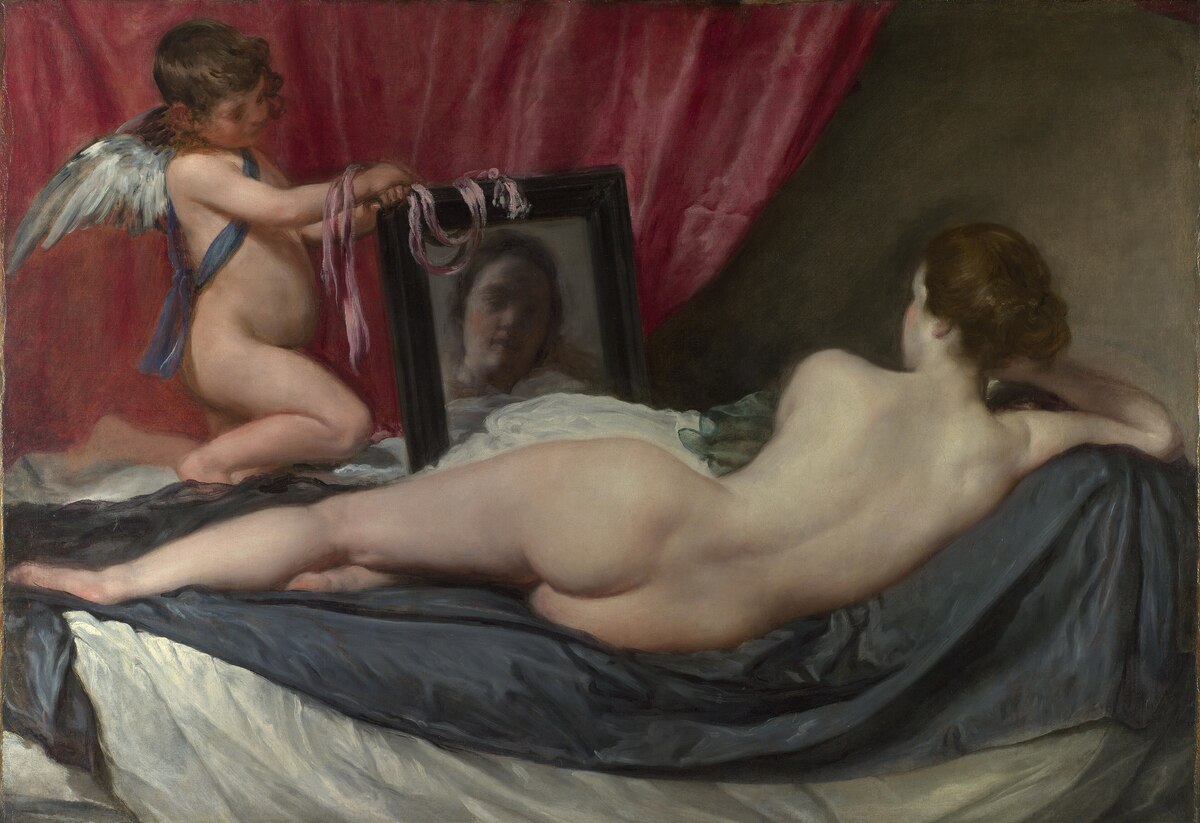
The highest-resolution file we hold, available without payment or an account.3,840 × 2,634 pixels.
Download highest-resolution imageThe full length of the nude figure, extending from her bare foot at the left edge to her shoulder at the right, laid over white sheets and a fold of dark blue silk. The long diagonal of luminous flesh against the cold drapery is the painting's dominant formal gesture and should be framed complete rather than cropped.
The back of the woman's head, auburn hair gathered in a low knot, resting on her raised arm. The turned-away head is the emotional pivot of the picture: her expression is withheld from us and can only be reconstructed through the mirror, which is exactly the tension a camera should dramatise.
The kneeling winged boy at the upper left, nude but for a blue sash across his chest, both arms raised to steady the mirror by its pink ribbon ties. His rounded flesh, feathered wings and absorbed profile convey the conspiratorial, decorative role he plays in staging the toilet scene.
Your gallery guide
A docent-led reading of Velázquez's only surviving female nude: Venus reclines with her back to us while Cupid holds a mirror whose blurred reflection withholds her face.
Editorial review by Artifact Archive automated publishing
Explore the researchAudio transcript The complete spoken story
This is The Toilet of Venus, painted by Diego Velázquez. It's the only surviving female nude he made. The goddess of love lies on her bed, turned away from us. Her son Cupid holds up a mirror where her face appears as a blurred reflection.
Look at how her body's curve answers the sweep of satin beneath her. The fabric reads grey now, but it was originally more purple in tone. Cupid's face and far leg are painted so loosely they look almost unfinished. That sketchiness is a tool. It keeps your attention on Venus herself.
Her smooth, pearly skin sits against richer colours and livelier brushwork in the curtain and sheets. The contrast makes her body feel calm and still. In the mirror, her features stay indistinct. We can't see who she really is.
Nude Venuses were rare in seventeenth-century Spain. The Catholic Church disapproved of overtly sensual images, yet the king and wealthy collectors in his circle still owned mythological nudes by artists like Rubens and Titian.
Velázquez merged two traditions here. One showed Venus at her toilet, sitting upright and looking into a mirror. The other showed her reclining, usually out in a landscape. He kept the mirror but laid her down indoors, folding the two ideas into one image.
The National Gallery offers a reading of that blur. Perhaps Velázquez wanted to make sure Venus, the very personification of female beauty, was not an identifiable person. We have to complete her features with our imagination.
Evidence supports the care behind that choice. Velázquez first painted her head slightly more in profile, so her nose was visible, then changed his mind. Perhaps he thought that gave too much away.
There may be another layer in the mirror's pink ribbons. Their crossing over Cupid's wrist could allude to a blindfold, one of his attributes, or to the shackles he used to bind lovers' hearts.
The painting's path to fame was long. It first appears in a 1651 inventory described simply as a nude woman, then passed through the Alba collection and later hung at Rokeby Park, which gave it its nickname.
So this isn't just a nude. It's a picture about looking, and about how much of beauty stays out of reach. We see her back, her bed, the mirror. Her face is left for us to finish.
Editorial review by Artifact Archive automated publishing.
Historical claims are linked to the records below. Close looking and interpretation are identified in the passage notes.
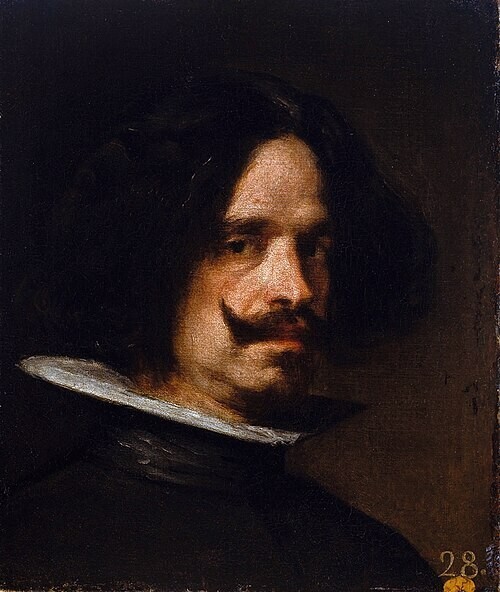
Diego Velázquez. Image source · Public domain
About the artist
1599 to 1660
Diego Velázquez was a Spanish painter (1599–1660). Their work is associated with Baroque. Their recorded places of work include Seville; Madrid; Venice; Rome; Naples; Italy.
The research & record
Find catalogue details, historical context, technical research and the literature behind this artwork.
Your browser could not copy automatically. Select the research text below, then copy it.
Open the complete research textThe artwork record
Catalogue information and detailed research, with references that link to the bibliography.
Updated .
The painting is catalogued as The Toilet of Venus, known by the nickname 'The Rokeby Venus', and is attributed to Diego Velázquez. It is an oil on canvas measuring 122.5 × 177 cm. The National Gallery dates the work to 1647–51, but the same source states that we are not sure when and where the painting was made: it has been variously dated to before, during and after Velázquez's second trip to Italy of 1649–51. That 1647–51 catalogue range is therefore best understood as an inclusive estimate that brackets the competing possibilities rather than as a settled date of execution, and the object date must be distinguished from later catalogue and museum dates such as its arrival and public display at the National Gallery in 1906.(The National Gallery, London, n.d., Full title, Artist; Date made; Medium and support; Dimensions; In-depth)
Interpretation
The catalogue and provenance units establish a securely attributed Velázquez oil on canvas of fixed dimensions, with a firm documentary foothold in 1651 and a firm institutional destination in 1906, while the date of execution remains genuinely open between the years around Velázquez's second Italian journey. The rarity claims and the ownership of other nudes by the king and his circle operate at the level of general cultural context, and they are attributable to the National Gallery's curatorial account rather than to the object's own documentary record. The material facts of attribution, support and measurement are not in dispute in these units; the disputed elements concern when and where the picture was made, and how its earliest description as 'a nude woman' relates to the mythological title it now bears. Because the first inventory entry names no goddess, the identification of the subject as Venus is a later, interpretive layer, while the object itself and its physical description are documented.(The National Gallery, London, n.d., Full title, Artist; Medium and support; Dimensions; In-depth)
The painting is titled The Toilet of Venus ('The Rokeby Venus') and was made by Diego Velázquez.(The National Gallery, London, n.d.)
The painting is dated 1647-51.(The National Gallery, London, n.d.)
The medium is oil on canvas.(The National Gallery, London, n.d.)
The dimensions are 122.5 × 177 cm.(The National Gallery, London, n.d.)
Visual observation
The painting known as The Toilet of Venus, or The Rokeby Venus, shows the goddess reclining on a bed, her body turned away from the viewer while her son Cupid holds a mirror to her. The National Gallery's account describes her pose as languid and notes that the curve of her body is echoed in the sweep of satin fabric beneath her. That fabric, the gallery records, was originally more purple than grey in tone, a detail of appearance that the painting no longer presents in the same way. In the mirror Cupid holds, Venus's reflection is blurred, so that, as the gallery puts it, we cannot see who she really is. The picture is thus built around a withheld face rather than a legible one, and the composition asks the viewer to read a body and a setting while denying direct access to the features of the person depicted. The gallery identifies the painting as the work of Diego Velázquez, dated 1647-51, oil on canvas, measuring 122.5 by 177 centimetres, in the collection of The National Gallery, London, accession number NG2057, and presented by the Art Fund in 1906.(The National Gallery, London, n.d., Overview; In-depth)
The mirror itself is not a plain attribute. Its intertwining pink ribbons are knotted at the top, and the gallery notes that the way these ribbons cross Cupid's wrist may allude to a blindfold, one of his attributes, or to the shackles he used to bind the hearts of lovers. Each reading is offered as a possibility rather than a settled identification, and the difference matters. A blindfold would extend the theme of obstructed sight already present in the blurred reflection, while the shackle reading would connect the image to Cupid's power over lovers. The evidence establishes the crossing of the ribbons and the two proposed allusions, but it does not decide between them. What can be said is that the mirror is not treated as a neutral prop: its ornament participates in the picture's concern with sight, binding and the ambiguities of looking.(The National Gallery, London, n.d., In-depth)
Interpretation
Handling varies sharply across the canvas. Cupid's face and far leg are very loosely painted and appear almost unfinished, while Venus's smooth skin is rendered in pearly tones that contrast with the rich colours and lively brushstrokes of the curtain and sheets. The gallery reads this sketchiness as deliberate, a means of focusing attention on Venus, and the contrast between the calm, pearly flesh and the more active brushwork around it supports that reading of the surface. The same source reports that Velázquez originally painted Venus's head slightly more in profile, so that her nose was visible, but later changed his mind, perhaps because this would give too much away. The physical evidence of a change, then, is consistent with the gallery's suggestion that the blurring was intentional: the artist moved from a more informative profile toward a less legible face. The gallery also proposes that Velázquez may have wanted to ensure Venus, the personification of female beauty, was not an identifiable person, leaving viewers to complete her features with their imagination. These are attributed interpretations built on observed features, and they are stronger for being tied to an observable alteration in the paint rather than offered as pure conjecture.(The National Gallery, London, n.d., Overview)
Visual observation
Venus reclines languidly on her bed, the curve of her body echoed in the sweep of satin fabric beneath her, which was originally more purple than grey in tone.(The National Gallery, London, n.d.)
Cupid, her son, holds a mirror up to her, its intertwining pink ribbons knotted at the top.(The National Gallery, London, n.d.)
Venus's reflection is blurred, so we cannot see who she really is.(The National Gallery, London, n.d.)
Cupid's face and far leg are very loosely painted and appear almost unfinished.(The National Gallery, London, n.d.)
The pearly tones of Venus's smooth skin contrast with the rich colours and lively brushstrokes of the curtain and sheets.(The National Gallery, London, n.d.)
Velázquez's Toilet of Venus is the only surviving female nude that he painted, and the subject was rare in seventeenth-century Spain, where overtly sensual images met with the disapproval of the Catholic Church. That austerity of taste did not, however, mean the naked Venus was absent from Spanish collections: the king and wealthy collectors in his circle did own mythological paintings depicting nudes by artists such as Rubens and Titian. The distinction matters for understanding the picture's social world. The prohibition the source describes was a climate of official and religious disapproval rather than an absolute scarcity of the imagery, and the ownership of Venetian and Flemish nudes by the crown and its courtly circle shows that the mythological nude circulated in precisely the elite sphere to which Velázquez belonged as a court painter. The subject also had a deep pictorial pedigree: paintings of the naked Venus had been made popular by sixteenth-century Venetian painters, especially Giorgione and Titian, whose reclining goddesses established the type against which a seventeenth-century Spanish treatment would be read.(The National Gallery, London, n.d., In-depth)
Within that tradition Velázquez did not simply copy a single model. According to the National Gallery's account, he merged two traditional representations of the goddess: one of Venus 'at her toilet', seated upright and looking in a mirror, and another of her reclining, usually in a landscape. The resulting picture is a composite. It retains the mirror and the act of self-regard that belong to the toilet type, but places the goddess lying down indoors rather than seated or set in open landscape. Because the evidence presents this as Velázquez's merger of two conventional schemes, the formal choices can be understood as a deliberate negotiation with an inherited Venetian formula rather than as an isolated invention. The picture belongs to a recognizable genre of the nude Venus while recomposing its standard elements.(The National Gallery, London, n.d., In-depth)
The circumstances of making are not securely fixed. The National Gallery states that we are not sure when and where the painting was made, and that it has been variously dated to before, during and after Velázquez's second trip to Italy of 1649 to 1651. This uncertainty is itself part of the object's documented history and should not be resolved into a single confident occasion. A firm identification of the painter and subject does not settle the commissioning history, and the evidence supplied does not name a patron, a place of execution, or a motive for the commission. Any account that assigns the picture to a particular moment or a particular patron would be going beyond what the evidence establishes. What can be said is that the traditional dating range brackets the Italian journey, so the question of whether the picture belongs to Spanish or Italian experience, or to the years before or after the journey, remains open in the source.(The National Gallery, London, n.d., In-depth)
Interpretation
Studying this object means holding three kinds of evidence in view without collapsing them. The painted surface supplies firsthand observation: the reclining pose, the satin beneath her, the mirror held by Cupid, the blurred reflection, the uneven finish, and the contrast between pearly flesh and livelier furnishings. The curatorial account supplies attributed interpretation: the idea that the blur withholds an identifiable person, the reading of sketchiness as a device for attention, the proposal that a revision to the head was made to conceal, and the possible allusion in the ribbons to a blindfold or to lovers' shackles. The inventory and provenance record supplies dated documentation: the 1651 description as 'a nude woman', the descent through the Méndez de Haro family to the Alba collection, the transfer to Godoy by order of Charles IV, the nineteenth-century hang at Rokeby Park, and the 1906 arrival at the National Gallery. Only the last group carries firm dates for ownership. The interpretations offered for the mirror and the brushwork are qualified and attributed, and the moment and place of the picture's making remain undetermined within the range that brackets the second Italian journey. Read together, these strands show a rare Spanish mythological nude whose creation circumstances cannot be pinned down but whose subsequent life among elite collections, its later reading as a picture about looking, and its eventual public fame can each be documented within their proper limits.(The National Gallery, London, n.d., In-depth; Overview)
This is the only surviving female nude painted by Velázquez, and the subject was rare in seventeenth-century Spain, where overtly sensual images were met with disapproval by the Catholic Church.(The National Gallery, London, n.d.)
Despite the disapproval, the king and wealthy Spanish art collectors in his circle did own mythological paintings depicting nudes by artists such as Rubens and Titian.(The National Gallery, London, n.d.)
Paintings of the naked Venus had been made popular by sixteenth-century Venetian painters, especially Giorgione and Titian.(The National Gallery, London, n.d.)
Velázquez merged two traditional representations of the goddess: one of Venus 'at her toilet', seated upright looking in a mirror, and another of her reclining, usually in a landscape.(The National Gallery, London, n.d.)
We are not sure when and where the painting was made. It has been variously dated to before, during and after Velázquez's second trip to Italy (1649-51).(The National Gallery, London, n.d.)
The earliest documented trace of the painting is an inventory entry rather than a commission or a signature. It first appears in the 1651 inventory of Don Gaspar Méndez de Haro, Marqués del Carpio, where it is entered with no title and no attribution, described simply as 'a nude woman'. The bareness of that phrase is itself evidence: what the record registers is a subject category, not an authorial identity. That gap matters for the object's standing, because the National Gallery notes that the painting's date and place of manufacture remain uncertain. It has been variously dated to before, during and after Velázquez's second trip to Italy, which ran from 1649 to 1651, so the work cannot be securely anchored to a single campaign in the artist's career on present evidence. The 1651 inventory therefore gives a firm upper threshold for its presence in a Spanish collection while leaving the circumstances of its making open. Within the broader history of the nude, the picture is exceptional in a way that conditions everything said about its provenance: it is the only surviving female nude painted by Velázquez, and the subject was rare in seventeenth-century Spain, where the Catholic Church disapproved of overtly sensual images. Yet the disapproval was not uniform in practice, since the king and wealthy Spanish collectors in his circle did own mythological paintings depicting nudes by artists such as Rubens and Titian. This painting's entry into an aristocratic inventory belongs to that second, permissive strand of collecting rather than to the censorious one.(The National Gallery, London, n.d., In-depth)
The inventory of 1651 belongs to a longer tradition of collecting Venuses, not to an isolated Spanish aberration. Naked Venus paintings had been made popular by sixteenth-century Venetian painters, especially Giorgione and Titian, and Spanish aristocratic and royal collections absorbed that inheritance. Set against this, the composition shows Velázquez working within an established genre while altering its conventions. He merged two traditional representations of the goddess: one of Venus 'at her toilet', seated upright and looking in a mirror, and another of her reclining, usually in a landscape. The picture keeps the mirror but moves the figure indoors onto a bed, so that a Venetian subject is restated in terms of a Spanish interior. Reading the object through its own imagery, Venus reclines on her bed, her body's curve echoed in the sweep of satin beneath her, fabric that was originally more purple in tone than the grey it now reads as. Cupid holds a mirror up to her, with intertwining pink ribbons knotted at the top, and the reflection is blurred, so that the viewer cannot see who she really is. The loose, almost unfinished handling of Cupid's face and far leg, alongside the contrast between the pearly tones of Venus's smooth skin and the richer colours and livelier brushwork of curtain and sheets, is a way of directing attention to the figure rather than to the accessories. The crossing of the mirror's pink ribbons over Cupid's wrist may allude to a blindfold, one of his attributes, or to the shackles he used to bind the hearts of lovers. These are prompted readings of visual detail, and they should be weighed as such; what they establish is that the picture was made for close and knowing viewing in exactly the kind of collection the 1651 inventory documents.(The National Gallery, London, n.d., In-depth)
The painting's documented movements begin to depend on family succession after the mid-seventeenth century. Don Gaspar died in 1687, and the picture passed to his daughter, Doña Catalina Méndez de Haro y Guzmán, who married the 10th Duke of Alba in 1688. It then remained in the Alba collection until the early nineteenth century. The record is clear that the transfer was by inheritance within a family line and then by the marriage that joined that line to the house of Alba, and it is equally clear that no intervening sale or relocation is documented for roughly a century and a quarter. This is an instance where an unrecorded interval should not be mistaken for a proven change of ownership: the evidence establishes continuous Alba possession up to the early nineteenth century and nothing more specific about where the picture hung or how it was displayed during that time.(The National Gallery, London, n.d., Provenance)
The Alba tenure ended under pressure from the crown. In the early nineteenth century, Charles IV of Spain ordered the Duchess of Alba to sell the painting, and other works, to Don Manuel Godoy, his favourite minister. This was not a market transaction between willing private parties but a royal command, and the plural 'other works' indicates that the Velázquez was transferred as part of a group rather than singled out. At Godoy's, the picture entered a setting that has a bearing on how it was understood. He hung it alongside Correggio's Venus and Mercury with Cupid and Goya's The Nude Maja and The Clothed Maja in a very private room, described by a contemporary as a 'gavinete interior'. The hang is significant in two directions. It places the Velázquez within a deliberate assembly of Venuses and majas, connecting it to both an Italian Renaissance lineage and to contemporary Spanish painting, and it situates the work in a space of restricted access rather than public display. The contemporary phrase for that room survives, but the extent of access to it, and the intentions behind the arrangement, are not documented here.(The National Gallery, London, n.d., In-depth)
The painting's popular name comes from its later English home rather than from the artist or the original subject. It is called 'The Rokeby Venus' after Rokeby Park, a country house in County Durham, where it hung for much of the nineteenth century. That nickname records an English phase of ownership and display that followed the Spanish one, and it is a reminder that the object's identity in common usage was shaped by where it hung rather than by what it depicts or by who made it. The documented chain reaches its public endpoint with the painting's arrival and public display at the National Gallery in 1906, an event the source treats as the beginning of its modern celebrity: since then it has become one of Velázquez's most celebrated works. The same institutional record supplies the factual frame now attached to the object: the title The Toilet of Venus, with 'The Rokeby Venus' as the familiar alternative; the artist Diego Velázquez; the medium oil on canvas; the dimensions 122.5 by 177 centimetres; the accession number NG2057; and presentation by the Art Fund in 1906. Taken together with the earlier evidence, these data show a painting whose documented history runs from a bare inventory phrase in 1651, through aristocratic inheritance and a forced sale, to a private cabinet of Venuses, an English country house, and finally a national collection.(The National Gallery, London, n.d., Overview; In-depth; Provenance)
Interpretation
The provenance record and the questions of authorship and dating sit at different levels of certainty, and the difference is worth stating. The inventory of 1651, the succession to Doña Catalina, the Alba marriage of 1688, the transfer ordered by Charles IV, the Godoy cabinet, the Rokeby Park hang, and the National Gallery accession all belong to documented ownership and display. By contrast, when and where the picture was painted remain unresolved, with dates proposed before, during and after the Italian journey of 1649 to 1651. Even the reputed image of the artist looking at his subject is not documentary: there is no external evidence in this material identifying the blurred reflection with Velázquez, and the National Gallery's suggestion that the indistinct face may have been intended to prevent Venus, the personification of female beauty, from becoming an identifiable person, so that the viewer must complete her features with imagination, is explicitly offered as a reading. The same caution applies to the observation that Velázquez first painted Venus's head slightly more in profile, so that her nose was visible, and then changed his mind, perhaps thinking that this gave too much away: the change is described, the motive is conjectural. Reading these together, the picture's evidentiary centre of gravity lies in its documented movements through Spanish and English collections, not in the uncertainties of its making or in the interpretive accounts of its mirror.(The National Gallery, London, n.d., In-depth; Provenance; Overview)
The painting first appears in the 1651 inventory of Don Gaspar Méndez de Haro, Marqués del Carpio, where it is described simply as 'a nude woman'.(The National Gallery, London, n.d.)
Don Gaspar died in 1687 and the picture passed to his daughter, Doña Catalina Méndez de Haro y Guzmán, who married the 10th Duke of Alba in 1688; it remained in the Alba collection until the early nineteenth century.(The National Gallery, London, n.d.)
In the early nineteenth century, Charles IV of Spain ordered the Duchess of Alba to sell the painting, and other works, to Don Manuel Godoy, his favourite minister.(The National Gallery, London, n.d.)
Godoy hung The Rokeby Venus alongside Correggio's Venus and Mercury with Cupid and Goya's The Nude Maja and The Clothed Maja in a very private room, described by a contemporary as a 'gavinete interior'.(The National Gallery, London, n.d.)
The painting takes its nickname, 'The Rokeby Venus', from Rokeby Park, a country house in County Durham, where it hung for much of the nineteenth century.(The National Gallery, London, n.d.)
The painting is first recorded in an inventory of Don Gaspar Méndez de Haro, Marqués del Carpio, described only as a nude woman.(The National Gallery, London, n.d., In-depth)
Don Gaspar dies and the picture passes to his daughter Doña Catalina Méndez de Haro y Guzmán.(The National Gallery, London, n.d., Provenance)
Doña Catalina marries the 10th Duke of Alba; the painting remains in the Alba collection until the early nineteenth century.(The National Gallery, London, n.d., Provenance)
The National Gallery dates Diego Velázquez's The Toilet of Venus, known as 'The Rokeby Venus', to 1647-51, an oil on canvas measuring 122.5 × 177 cm, now in the collection of The National Gallery, London, with accession number NG2057. It was presented by the Art Fund in 1906, and since its arrival and public display at the National Gallery in that year the painting has become one of Velázquez's most celebrated works. The precision of the stated date range should be read against the Gallery's own qualification that we are not sure when and where the painting was made: it has been variously dated to before, during and after Velázquez's second trip to Italy (1649-51). The secure facts of medium, dimensions, accession and 1906 presentation thus sit alongside an unresolved question of dating that the museum itself keeps open.(The National Gallery, London, n.d., In-depth)
Interpretation
The National Gallery's interpretation treats the indistinct reflection as purposeful rather than incidental: perhaps Velázquez wanted to make sure that Venus, the personification of female beauty, was not an identifiable person, and we have to 'complete' her features with our imagination. The Gallery also reports that Velázquez deliberately used a sketchy style in order to focus our attention on Venus, and that he originally painted Venus's head slightly more in profile so that her nose was visible, but later changed his mind, perhaps thinking that this would give too much away. These are attributed readings and qualified proposals rather than documented statements of the artist's intent, and they should be weighed as such. Read alongside the evidence of the loose painting of Cupid and the blurred mirror, they support an account in which the painting's reception has repeatedly centred on what the image withholds, with the Gallery's interpretations offering one institutional framework for that recurring theme rather than a settled explanation.(The National Gallery, London, n.d., In-depth; Overview)
Since its arrival and public display at the National Gallery in 1906, the painting has become one of Velázquez's most celebrated works.(The National Gallery, London, n.d.)
Interpretation
The National Gallery's account of The Toilet of Venus treats several of its most discussed features as readings rather than as fixed meanings, and it frames them in conditional language that should be preserved. The blurred reflection in the mirror, which means we cannot see who Venus really is, is linked by the Gallery to a suggestion that Velázquez perhaps wanted to ensure that Venus, the personification of female beauty, would not be an identifiable person, leaving viewers to complete her features with their imagination. The same source proposes that Velázquez deliberately used a sketchy style in order to concentrate attention on Venus, an explanation that connects the handling of paint to an intended effect on the viewer. Neither proposal is presented as certain, and neither should be restated as a documented statement of the painter's private intention.(The National Gallery, London, n.d., Overview)
The claim that the indistinct face was a deliberate choice gains technical support from a change made during work on the picture. According to the Gallery, Velázquez originally painted Venus's head slightly more in profile so that her nose was visible, and later changed his mind; the source suggests he perhaps thought this would give too much away. This is the strongest evidence offered for treating the unfinished-looking face as intentional rather than as an accident of execution or survival, although the reconstruction of the earlier state and the motive assigned to the revision remain attributed interpretations. The painted evidence of a revised head should therefore be distinguished from the speculative reason proposed for the revision.(The National Gallery, London, n.d., In-depth)
Cupid, Venus's son, holds a mirror up to her, and its intertwining pink ribbons are knotted at the top. The Gallery notes that the way these ribbons cross Cupid's wrist may allude to a blindfold, one of Cupid's attributes, or to the shackles he used to bind the hearts of lovers. The wording marks this as a possible allusion rather than a settled identification, and it offers two alternative readings rather than one. The painted fact on which both depend is the crossing of the ribbons over the wrist, which is observable independently of whichever mythological association is preferred.(The National Gallery, London, n.d., In-depth)
The way the mirror's pink ribbons cross Cupid's wrist may allude to a blindfold, one of his attributes, or to the shackles he used to bind the hearts of lovers.(The National Gallery, London, n.d.)
Perhaps Velázquez wanted to make sure that Venus, the personification of female beauty, was not an identifiable person; we have to 'complete' her features with our imagination.(The National Gallery, London, n.d.)
Velázquez deliberately used a sketchy style in order to focus our attention on Venus.(The National Gallery, London, n.d.)
Velázquez originally painted Venus's head slightly more in profile so that her nose was visible, but he later changed his mind; perhaps he thought that this would give too much away.(The National Gallery, London, n.d.)
The Toilet of Venus, known widely as The Rokeby Venus, is a painting by Diego Velázquez now in the collection of The National Gallery, London, where it carries the accession number NG2057. It entered that collection through a presentation by the Art Fund in 1906, the event the Gallery identifies as the beginning of its public display. The Gallery dates the work to 1647-51 and describes it as oil on canvas measuring 122.5 by 177 centimetres. The picture is also the only surviving female nude painted by Velázquez, a fact that shapes nearly every subsequent discussion of its subject and its place in his career.(The National Gallery, London, n.d., Inventory number; Acquisition credit)
Interpretation
The Gallery is explicit that the circumstances of production are not settled. We are not sure when and where the painting was made, and it has been variously dated to before, during and after Velázquez's second trip to Italy, which ran from 1649 to 1651. This qualification matters for how the work is understood: the proposed Italian journey is a dating hypothesis supported by style and by comparison, not a documented fact of production, and the Gallery presents the competing placements together rather than choosing among them. The title The Toilet of Venus is the Gallery's own designation, matched to the subject of a woman at her dressing rather than to any inscription on the canvas.(The National Gallery, London, n.d., Inventory number; Acquisition credit)
The composition shows Venus reclining languidly on her bed, the curve of her body echoed in the sweep of satin fabric beneath her, which the Gallery notes was originally more purple than the grey it now reads. Her son Cupid holds a mirror up to her, its intertwining pink ribbons knotted at the top. Venus's reflection is blurred, so that we cannot see who she really is. The pearly tones of her smooth skin are set against the rich colours and lively brushwork of the curtain and sheets, a contrast the Gallery treats as deliberate. Cupid's face and his far leg are very loosely painted and appear almost unfinished, and the Gallery reads that sketchiness as a means of focusing attention on Venus rather than as an accident or an incomplete passage.(The National Gallery, London, n.d., Inventory number)
The mirror's ribbons carry a further suggestion. The way they cross Cupid's wrist may allude to a blindfold, one of his attributes, or to the shackles he used to bind the hearts of lovers. The Gallery offers this as a possible reading, not a settled meaning, and it sits alongside the treatment of the reflection itself. A related observation concerns Venus's head: Velázquez originally painted it slightly more in profile, so that her nose was visible, and later changed his mind, perhaps because that would give too much away. Taken with the blurred reflection, these details indicate that the obscuring of Venus's features was worked at and revised rather than left vague by default.(The National Gallery, London, n.d., Inventory number)
Interpretation
The Gallery's interpretation of the indistinct face is that Velázquez perhaps wanted to make sure Venus, the personification of female beauty, was not an identifiable person, so that we have to complete her features with our imagination. The Gallery also states that he deliberately used a sketchy style in order to focus our attention on Venus. Both claims are offered as curatorial readings rather than as documented intentions, and they are consistent with the evidence of the reworked head and the loosely finished Cupid. They also connect the picture to the broader question of what a nude can show: the painting withholds a face while presenting a body, and the act of looking is built into the subject through the mirror.(The National Gallery, London, n.d., Inventory number)
The subject itself was unusual in its setting. This is the only surviving female nude painted by Velázquez, and the subject was rare in seventeenth-century Spain, where overtly sensual images were met with disapproval by the Catholic Church. The Gallery qualifies that disapproval by noting that the king and wealthy Spanish art collectors in his circle did own mythological paintings depicting nudes by artists such as Rubens and Titian. Naked Venuses had been made popular by sixteenth-century Venetian painters, especially Giorgione and Titian. The Gallery further explains that Velázquez merged two traditional representations of the goddess: one of Venus at her toilet, seated upright looking in a mirror, and another of her reclining, usually in a landscape. On this account the Rokeby Venus keeps the mirror of the first tradition and the recumbent pose of the second, combining them indoors.(The National Gallery, London, n.d., Inventory number)
The documented history of ownership begins in 1651, when the painting first appears in the inventory of Don Gaspar Méndez de Haro, Marqués del Carpio, described simply as a nude woman. Don Gaspar died in 1687, and the picture passed to his daughter, Doña Catalina Méndez de Haro y Guzmán, who married the 10th Duke of Alba in 1688; it remained in the Alba collection until the early nineteenth century. In the early nineteenth century, Charles IV of Spain ordered the Duchess of Alba to sell the painting, and other works, to Don Manuel Godoy, his favourite minister. Godoy hung The Rokeby Venus alongside Correggio's Venus and Mercury with Cupid and Goya's The Nude Maja and The Clothed Maja in a very private room, described by a contemporary as a 'gavinete interior'. The nickname by which the painting is now best known comes from Rokeby Park, a country house in County Durham, where it hung for much of the nineteenth century.(The National Gallery, London, n.d., Inventory number)
Interpretation
The gallery history and the visual account meet in a single arc: a picture that appears in 1651 under the bare description of a nude woman, moves through the Alba family and a private ministerial cabinet, takes its modern name from a nineteenth-century English country house, and then, since its arrival and public display at the National Gallery in 1906, becomes one of Velázquez's most celebrated works. That trajectory is worth separating from the question of quality. The evidence establishes the accession number, the gift, the medium and dimensions, the subject and its Spanish context, the date range with its unresolved placement around the Italian journey, and the ownership sequence. It does not provide a record of the painting's own commissioning, of its earlier setting before 1651, or of the price and terms of the 1906 presentation, and those gaps should remain visible in any account of how the object became canonical.(The National Gallery, London, n.d., Inventory number; Acquisition credit)
The painting is in the collection of The National Gallery, London, with accession number NG2057.(The National Gallery, London, n.d.)
It was presented by the Art Fund in 1906.(The National Gallery, London, n.d.)
Interpretation
The National Gallery, London identifies this canvas as Diego Velázquez's The Toilet of Venus, commonly known as The Rokeby Venus, an oil painting on canvas measuring 122.5 by 177 cm and held under accession number NG2057. The Gallery dates it to 1647 to 1651, but the same curatorial account states plainly that we are not sure when and where the painting was made, and that it has been variously dated to before, during and after Velázquez's second trip to Italy of 1649 to 1651. The Gallery presents the work as Velázquez's only surviving female nude and as one of his most celebrated works, and records that it was presented by the Art Fund and has been on public display at the National Gallery since 1906. An institutional record on Wikimedia Commons serves as a discovery aid for the same picture, supplying alternate titles, dimensions and collection metadata. The uncertainty about dating is not a marginal caveat: it conditions how the object can be placed within Velázquez's career, since the Italian journey is one of the few fixed anchors for a work whose making cannot be tied to a documented place or year.(The National Gallery, London, n.d.)(commons.wikimedia.org, n.d.)
The only valuation figure in the supplied evidence is a calculated working insurance estimate of US$500M to US$1B, recorded as a working calculation generated on 2026-10-16. Its stated methodology is a conservative trophy-asset insurance ceiling derived from confirmed artwork context, applied because no public sale price, official appraisal or institutional insurance value is supplied in the excerpts. The calculation rests on the work's extreme art-historical importance, its unique status within Velázquez's surviving oeuvre, and its permanent collection context, which the National Gallery account supports by describing the painting as Velázquez's only surviving female nude and one of his most celebrated works. The range is intentionally wide to support manual review. Its qualification is explicit and should govern any use of the figure: it is a model-generated, broad working range for manual review only, not an official insurance value, an appraisal, an auction result or a sale price, and it does not reflect private insurance schedules, comparable sales or institutional valuation records. Actual insurance coverage, loan valuation or market value may differ materially and should be determined by qualified appraisers, insurers and the owning institution.(The National Gallery, London, n.d.)(commons.wikimedia.org, n.d.)
The value of this object in the supplied record is therefore documented along a different axis from its price. What the evidence establishes is a set of material and institutional facts: oil on canvas, 122.5 by 177 cm, accession NG2057, presented by the Art Fund and on public display since 1906, with a dating range of 1647 to 1651 that the Gallery itself qualifies as uncertain, a subject that the Gallery describes as Velázquez's only surviving female nude, and a provenance that runs from a 1651 inventory through the Alba collection, Godoy's private cabinet, Rokeby Park and into a national collection. The calculated insurance range is a separate, explicitly provisional construction generated from that context on 2026-10-16, and it neither records nor substitutes for a sale, appraisal or official schedule. Keeping the two kinds of statement distinct is what allows the object to function as evidence in a history of art and material culture: the picture matters because a rare Spanish nude by Velázquez, made at an uncertain moment, was kept in enclosed and elite settings for centuries and then became a public possession, and the numbers attached to it by an insurance calculation depend on that history rather than illuminating it.(The National Gallery, London, n.d.)(commons.wikimedia.org, n.d.)
Working estimate
Calculated working insurance estimate, not a sale price: Estimated value: US$500M to US$1B Recorded date: Working calculation, generated 2026-10-16. Methodology: This broad working range is calculated for manual insurance review from confirmed artwork context. The National Gallery identifies the work as Diego Velazquez's The Toilet of Venus (The Rokeby Venus), oil on canvas, 1647-51, 122.5 x 177 cm, accession NG2057, and describes it as Velazquez's only surviving female nude and one of his most celebrated works. It has been on public display at the National Gallery since 1906 and was presented by the Art Fund. Because no public sale price, official appraisal, or institutional insurance value is supplied in the excerpts, the calculation applies a conservative trophy-asset insurance ceiling based on the work's extreme art-historical importance, unique status within Velazquez's surviving oeuvre, and permanent collection context. The range is intentionally wide to support manual review and should be replaced by a professional appraisal or official insurance schedule before any binding use. Qualification: This is a model-generated, broad working range for manual review only. It is not an official insurance value, an appraisal, an auction result, or a sale price. It does not reflect private insurance schedules, comparable sales, or institutional valuation records. Actual insurance coverage, loan valuation, or market value may differ materially and should be determined by qualified appraisers, insurers, and the owning institution.(The National Gallery, London, n.d.)(commons.wikimedia.org, n.d.)
Further reading
Paid links. As an Amazon Associate I earn from qualifying purchases.

Taschen
Recorded subject headings include 'Criticism and interpretation' and 'Painting, Spanish -- 17th century' alongside Velázquez's dates. This signals an art-historical study of Velázquez's paintings, making it a plausible comparison source for a specific mythological work like 'The Toilet of Venus'.
ISBN 9783836531924
Bibliography
References are arranged by author or organisation, with links to the original publications. Where no publication date is recorded, n.d. means no date.
Source notes updated .
No recorded sources match these filters. Reset the filters to see the full bibliography.
Official · About this artwork
Institutional record for The Rokeby Venus. Wikimedia Commons file page for the painting.
Discovery aid providing alternate titles, dimensions, and collection metadata.
Book
Recorded subject headings include 'Criticism and interpretation' and 'Painting, Spanish -- 17th century' alongside Velázquez's dates. This signals an art-historical study of Velázquez's paintings, making it a plausible comparison source for a specific mythological work like 'The Toilet of Venus'.
Museum · About this artwork
Official National Gallery page for the painting, providing curatorial overview and in-depth interpretation.
Art to live with
A piece of the archive, made yours. Explore The Toilet of Venus ('The Rokeby Venus') in a size and finish that fits your space.
Choose your edition Combine this painting with your favourites10 × 8 in / 25.4 × 20.3 cm · Standard
10 × 8 in / 25.4 × 20.3 cm · Standard

10 × 8 in / 25.4 × 20.3 cm · Standard

10 × 8 in / 25.4 × 20.3 cm · Standard

10 × 8 in / 25.4 × 20.3 cm · Standard
A gallery paper print with a smooth art-paper surface. Choose a size that suits the painting.
Choose size and finish10 × 8 in / 25.4 × 20.3 cm · Black frame
10 × 8 in / 25.4 × 20.3 cm · Black frame

10 × 8 in / 25.4 × 20.3 cm · Black frame

10 × 8 in / 25.4 × 20.3 cm · Black frame

10 × 8 in / 25.4 × 20.3 cm · Black frame

10 × 8 in / 25.4 × 20.3 cm · Black frame
A ready-to-hang wooden frame with a clear Perspex cover and a semi-gloss printed insert, made in the UK.
Choose size and finish11oz · 2 image repeats
11oz · Standard

11oz · 2 image repeats

11oz · 2 image repeats

11oz · 2 image repeats

11oz · 2 image repeats

11oz · 2 image repeats
An 11oz white ceramic mug with AAA+ ORCA coating and a C-shaped handle. Dishwasher and microwave safe, printed and dispatched in the UK.
Choose size and finish15 × 16.5 in / 38 × 42 cm · Black
15 × 16.5 in / 38 × 42 cm · Black

15 × 16.5 in / 38 × 42 cm · Black

15 × 16.5 in / 38 × 42 cm · Black

15 × 16.5 in / 38 × 42 cm · Black

15 × 16.5 in / 38 × 42 cm · Black

15 × 16.5 in / 38 × 42 cm · Black
A cotton tote with reinforced handles and artwork on the front, printed and dispatched in the UK.
Choose size and finish8.7 × 8.7 in / 22 × 22 cm · Standard
8.7 × 8.7 in / 22 × 22 cm · Standard

8.7 × 8.7 in / 22 × 22 cm · Standard

8.7 × 8.7 in / 22 × 22 cm · Standard
A rectangular PU leather mouse mat with a non-slip base, printed locally for your delivery country.
Choose size and finishA5 · Glossy cover · Lined pages
A5 · Glossy cover · Lined pages

A5 · Glossy cover · Lined pages

A5 · Glossy cover · Lined pages

A5 · Glossy cover · Lined pages

A5 · Glossy cover · Lined pages

A5 · Glossy cover · Lined pages
An A5 notebook with 150 lined pages, a glossy laminated front cover carrying your artwork, black wire-o binding and a white back cover.
Choose size and finishKeep exploring