ArchiveLas Meninas

Artwork record / 314 of 331

Las Meninas by Diego Velázquez (1656–1657)

Artist: Diego Velázquez

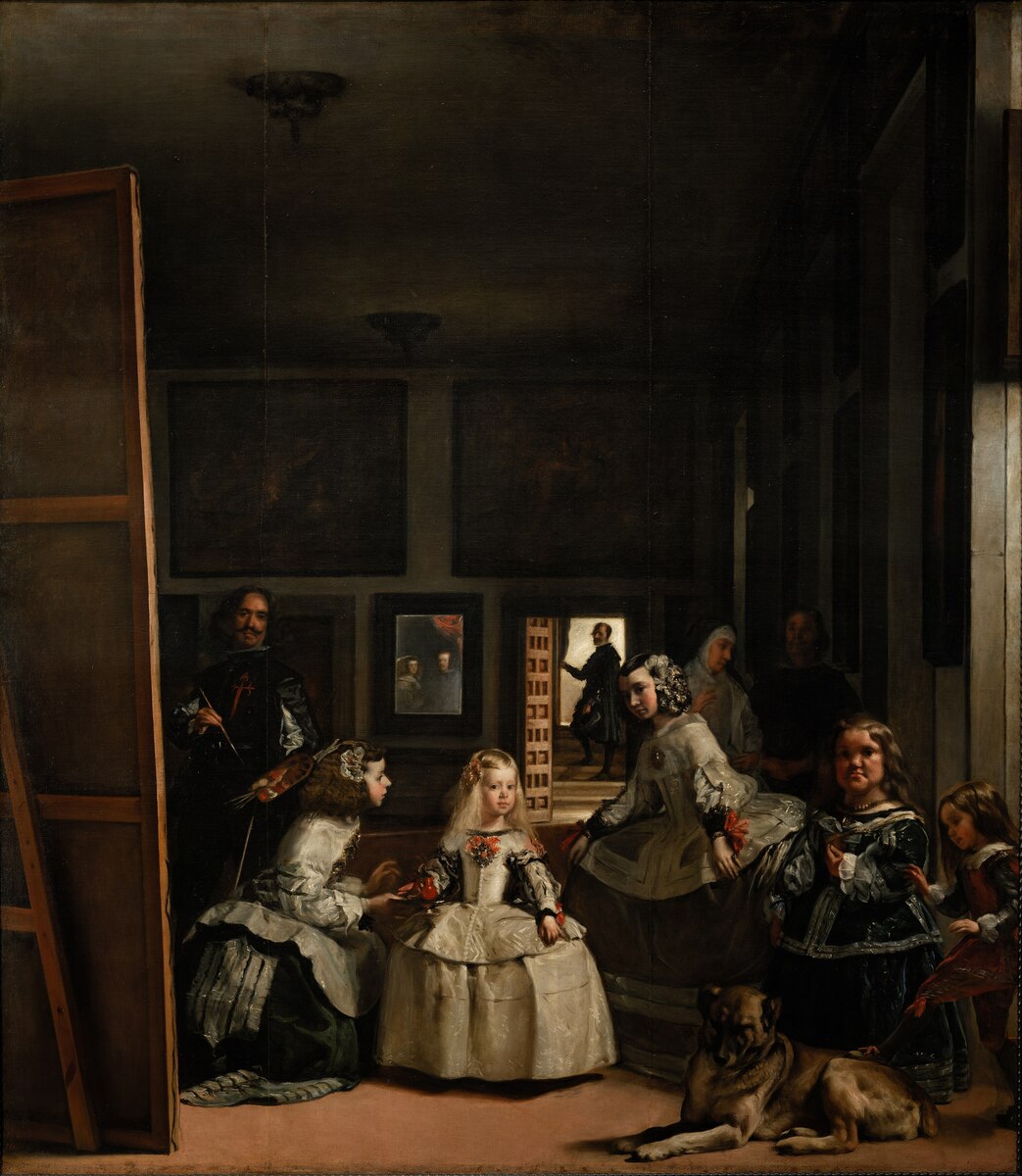
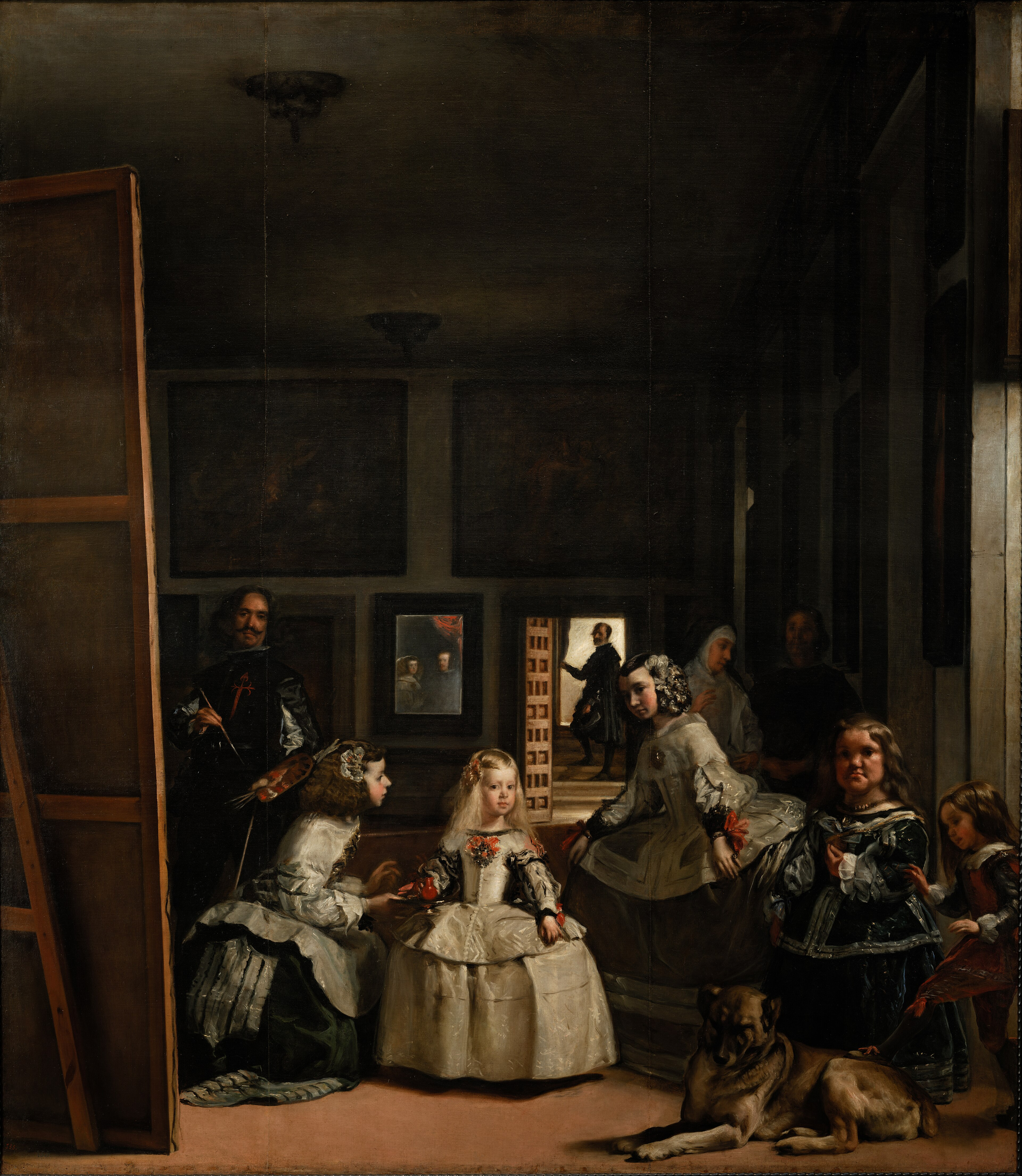
Stand in front of Diego Velázquez's Las Meninas and you meet a room full of people, each looking somewhere different. The painter places the young Infanta Margarita Theresa at the centre of her household, and puts himself at the easel, while the king and queen appear only in a mirror. This docent's tour explains what is happening, who the figures are, and why the mirror at the back changes how we read the whole scene.

Read the story ↓ About the artist ↓ Research and record ↓ Literature and sources ↓ Listen to the article ↓
Article text for AI
Shop this artwork ↓ 0 visits
Date1656–1657CultureSpain PeriodBaroqueCurrent locationMuseo del Prado, Madrid, Spain
Listen to the article
100%
Las Meninas by Diego Velázquez (1656–1657)
Loading full-resolution artwork…
Scroll to zoom · drag to pan · double-click to focus Pinch to zoom · drag to explore · double-tap to focus FIELD VIEW / 314
Tools & download
Pixel colour Select a pixel with the eyedropper
No pixel selected

Choose the eyedropper, then click or tap the image. Scroll to zoom for finer selection.

Add text

Hand to pan · Select to move text and drawings · Add as many texts as you like · Scroll to zoom

Las Meninas: high-resolution image

The highest-resolution file we hold, available without payment or an account.3,840 × 4,420 pixels.

Download highest-resolution image

Details to notice

About 4 minutes to read
01

Figure in the open doorway

The marshal José Nieto silhouetted on the stairs of a brightly lit open door at the back right, pausing with one leg raised and looking inward. His luminous rectangle creates the deepest point of the room and a second source of light.

02

Mastiff and dwarfs

The large mastiff lying in the right foreground, heavy-headed and half asleep, with the dwarfs Maribárbola and Nicolasito Pertusato standing over it, one foot hovering near its flank. The animals and court entertainers balance the gravity of the centre.

03

Maid offering the búcaro

The kneeling maid of honour María Agustina Sarmiento, seen in profile, presenting a small red clay water jug to the Infanta. The gesture of offering and the two hands meeting carry the courtly etiquette of the scene.

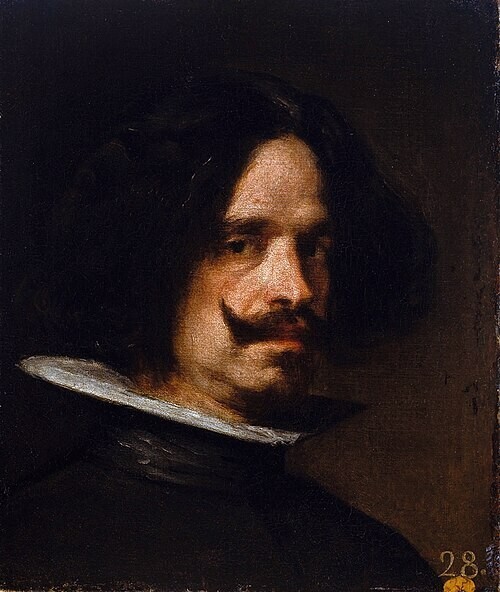
Artist portrait of Diego Velázquez
Artist portrait Image credit

Diego Velázquez. Image source · Public domain

About the artist

Diego Velázquez

1599 to 1660

Diego Velázquez was a Spanish painter (1599–1660). Their work is associated with Baroque. Their recorded places of work include Seville; Madrid; Venice; Rome; Naples; Italy.

Born
1599
Died
1660
Nationality
Spain
Birthplace
Seville
Died in
Madrid

The research & record

Study the work.
Follow the evidence.

Find catalogue details, historical context, technical research and the literature behind this artwork.

Article text for AI
Open research text

The artwork record

Research catalogue

Catalogue information and detailed research, with references that link to the bibliography.

Updated .

Identity and catalogue

Link
Title
Las Meninas
Artist or attribution
Diego Velázquez
Object date
1656–1657
Medium and support
Oil on canvas
Dimensions
318 cm × 276 cm
Current collection or location
Museo del Prado, Madrid, Spain
Movement or period
Baroque
Country or culture
Spain
Depicted subject
A large group portrait set in a palace room, centered on the young Infanta Margarita Theresa of Spain, surrounded by her maids of honour, dwarfs, a mastiff, and the artist himself at his canvas, with the king and queen reflected in a mirror.
Title variants
The Maids of Honour; Las Meninas; Les Ménines; Die Hoffräulein; Panny dworskie; ラス・メニーナス; 시녀들; 宮女; Дв; Dvorné dámy; Dvorní dámy
Accession number
P001174
Support
Canvas
Catalogue record

The painting entered the archive under the title Las Meninas and is attributed to Diego Velázquez, painted between 1656 and 1657. It is an oil on canvas measuring 318 cm in height and 276 cm in width. In the collection of the Museo del Prado, Madrid, it carries the accession number P001174. The date range 1656 to 1657 is the painting's own historical date range, recorded in the source's file information; it is not a catalogue date or a date of reproduction. The painting was made in Spain and belongs to the Baroque period in the source's own description.(Wikimedia Commons: Las Meninas, n.d., File information: Date between 1656 and 1657)

Depicted people

The depicted people in Las Meninas are Philip IV of Spain, Margaret Theresa of Spain, Diego Velázquez, Mariana of Austria, Maria Agustina Sarmiento, Mari Bárbola, Nicolasito Pertusato, Marcela de Ulloa, and José Nieto Velázquez. This list is the structured identification of the persons represented in the painting. Because the source lists the king and queen among the depicted people, their presence in the composition is documented as part of the painting's subject matter rather than as a later story told about it. The list itself does not assign roles or positions to each name beyond identifying them as depicted people, so the arrangement of these figures in the room belongs to the visual account rather than to this catalogue unit.(Wikimedia Commons: Las Meninas, n.d., Structured data: depicted people)

Las Meninas was painted by Diego Velázquez between 1656 and 1657.(Wikimedia Commons: Las Meninas, n.d.)

The depicted people in Las Meninas include Philip IV of Spain, Margaret Theresa of Spain, Diego Velázquez, Mariana of Austria, Maria Agustina Sarmiento, Mari Bárbola, Nicolasito Pertusato, Marcela de Ulloa, and José Nieto Velázquez.(Wikimedia Commons: Las Meninas, n.d.)

Subject and iconography

Link
Composition and recorded subject

Visual observation

Las Meninas is recorded as a group portrait centred on the Infanta Margarita Theresa of Spain, who is surrounded by her maids of honour, dwarfs, a mastiff, and the artist Diego Velázquez. On the back wall, King Philip IV of Spain and Queen Mariana of Austria appear reflected in a mirror. This description is catalogued in the Wikimedia Commons file as structured data on depicted people, so it functions as an observation of the composition rather than an inference about what the painting means or how it was received. The same source establishes the medium and support, oil on canvas, and dimensions of 318 cm in height by 276 cm in width, which give a concrete sense of the picture's scale relative to the figures it contains. The painting is catalogued in the collection of the Museo del Prado, Madrid, under accession number P001174, anchoring it to a specific institutional holding and a specific documentary record. Taken together, these facts fix the object's physical character, its present location and its central subject without yet addressing the questions of depth, light and viewpoint that the composition raises.(Wikimedia Commons: Las Meninas, n.d., Structured data: depicted people; File information: Medium, Dimensions)

The file's structured data names the depicted people individually: Philip IV of Spain, Margaret Theresa of Spain, Diego Velázquez, Mariana of Austria, Maria Agustina Sarmiento, Mari Bárbola, Nicolasito Pertusato, Marcela de Ulloa and José Nieto Velázquez. This matters because the picture is not simply a generic court scene but a record of named individuals, which is why the source can be treated as identifying people rather than merely describing types. The inclusion of a court official, Marcela de Ulloa, alongside the royal family and the dwarfs indicates the range of the household represented. The same source notes that the king and queen are present only through the mirror reflection, which distinguishes them from the figures physically occupying the room. Within the larger history of portraiture, a group image that names attendants, dwarfs and the painter himself alongside the royal child shifts the subject from a single sitter to an entire court formation, and the structured data allows that formation to be read as a documented set of named persons rather than an anonymous crowd.(Wikimedia Commons: Las Meninas, n.d., Structured data: depicted people)

Las Meninas depicts a group portrait with the Infanta Margarita Theresa of Spain at the center, surrounded by her maids of honour, dwarfs, a mastiff, and the artist Diego Velázquez, with King Philip IV and Queen Mariana of Austria reflected in a mirror.(Wikimedia Commons: Las Meninas, n.d.)

Materials and technique

Link
The documented support and medium

The primary physical record for Las Meninas in this archive is a file-level description accompanying a digital reproduction: the painting is an oil on canvas measuring 318 cm in height and 276 cm in width. These are the only support, medium and dimension facts carried by the supplied evidence, and they establish the work as a large-scale painting executed in oil on a woven canvas support. Nothing in the evidence identifies the canvas weave, the number or type of preparatory layers, the ground, the priming, the pigments, the medium or any later treatment, so none of those can be asserted here. The description comes from the Wikimedia Commons file record for the image, an openly accessible digital representation that is itself in the public domain, and the painting it reproduces is catalogued in the Museo del Prado, Madrid, under accession number P001174.(Wikimedia Commons: Las Meninas, n.d., File information: Medium, Dimensions)

Las Meninas is an oil on canvas painting measuring 318 cm in height and 276 cm in width.(Wikimedia Commons: Las Meninas, n.d.)

Provenance and ownership

Link
The Documentation Horizon: Provenance of the Record, Not Yet of the Object

The provenance documentation available for this object is at present limited to a single record, and it concerns the digital file rather than the painting itself. The Wikimedia Commons file described in the structured data is a digital representation of Las Meninas and is stated there to be in the public domain. That statement applies to the reproduction file hosted on Wikimedia Commons, not to the physical canvas, its ownership, or its legal status as an object. Nothing in the supplied unit records a maker, a date, a photographer, a source institution beyond the access route named in the file title, or any chain of custody for the digital asset. What the record does establish, within its own scope, is that the image file carries an explicit public domain status, which is the kind of rights information that governs reuse of the reproduction rather than the history of the painting.(Wikimedia Commons: Las Meninas, n.d., Structured data: copyright status)

Interpretation

The same source page is also the point at which the object's current custodial facts are anchored for this archive. The painting is reported there as belonging to the collection of the Museo del Prado, Madrid, under accession number P001174. That institutional identification and accession number are the kind of data a museum uses to locate a work within its own registration system, and they are the only ownership and identifier information the supplied evidence provides. No earlier owner, dealer, sale, gift, bequest, confiscation, transfer, or deposit is documented in the units available here, and no date is given for when the work entered the Prado's collection. The record therefore supports the present custodial attribution and the accession number, and it leaves every prior interval unrecorded. An unrecorded interval is not the same as a proven change of ownership: the absence of a recorded transaction in these units does not establish that the painting left or entered any particular collection, nor does it establish the identity of any intermediate holder.(Wikimedia Commons: Las Meninas, n.d., Structured data: copyright status)

The Wikimedia Commons file is a digital representation of Las Meninas and is in the public domain.(Wikimedia Commons: Las Meninas, n.d.)

Reception and literature

Link
Institutional and Digital Reception

Reception of Las Meninas has accumulated in at least two documented registers, and they should not be collapsed into one story. The first is curatorial and art historical: the painting is in the collection of the Museo del Prado, Madrid, with accession number P001174, a fact that fixes its present institutional home and the framework within which most modern viewers encounter it. The second is digital and evaluative. According to the Wikimedia Commons file, the image carries a 3-star rating, designated a featured picture, and is considered one of the finest images. That rating is a judgment about the digital reproduction and its file, not about the seventeenth-century canvas itself, and it records a distinct stage in reception: the circulation of a photographically derived surrogate through an open platform where quality is assessed by a community rather than a museum. The two stages differ in object, audience and authority, and both are part of how the work is publicly known today.(Wikimedia Commons: Las Meninas, n.d., Assessment; Structured data: copyright status)

According to the Wikimedia Commons file, Las Meninas has a 3-star rating (featured picture) and is considered one of the finest images.(Wikimedia Commons: Las Meninas, n.d.)

Collection and display

Link
The object and its repository

The painting known as Las Meninas, by Diego Velázquez, is held in the collection of the Museo del Prado in Madrid, where it is catalogued under accession number P001174. That museum identity and inventory number are the firmest points of attachment between the object and the institution that currently preserves it, and they anchor every other claim about the work's materials, date and subject matter. The same structured record describes the picture as an oil on canvas measuring 318 cm in height and 276 cm in width, painted in Spain between 1656 and 1657, and as a group portrait centred on the Infanta Margarita Theresa of Spain, surrounded by her maids of honour, dwarfs, a mastiff and the artist himself, with King Philip IV and Queen Mariana of Austria appearing as reflections in a mirror. The commons file that carries this information is itself a digital representation of the painting and is in the public domain, which matters for how the object circulates as an image even though the physical work belongs to the Prado.(Wikimedia Commons: Las Meninas, n.d., File information: Collection, Accession number)

Named sitters and the court as subject

The identification of the sitters rests on names recorded with the painting rather than on inference from the image alone. The list given in the source includes Philip IV of Spain, Margaret Theresa of Spain, Diego Velázquez, Mariana of Austria, Maria Agustina Sarmiento, Mari Bárbola, Nicolasito Pertusato, Marcela de Ulloa and José Nieto Velázquez. To read the picture through that list is to read it as a document of a specific court at a specific moment: the Infanta at the centre of a household of attendants, the king and queen present only as reflected figures, and the artist standing among the company at his canvas on the left. The presence of the painter inside his own group portrait is part of what the record establishes about the work's composition, and it is inseparable from the fact that Velázquez served as court painter in a period when the Spanish court used paintings to project authority and lineage.(Wikimedia Commons: Las Meninas, n.d., File information: Collection, Accession number)

Space, depth and the back wall

The composition distributes its figures across distinct depths, and that spatial arrangement is part of the object's documented description rather than an incidental impression. The Infanta and her maids of honour occupy the middle ground, the artist stands at his easel to the left, and a man identified as José Nieto Velázquez appears in a doorway at the back right, where a staircase opens into brightness. Marcela de Ulloa, described as a court official, stands nearby in the shadows. The mirror set into the dim back wall holds the two small reflected figures of the king and queen, so that the rear of the room simultaneously contains a lit opening and a dark reflecting surface. Taken together with the canvas turned away from the viewer, these elements produce a palace interior that appears to continue beyond the people we see, and they explain why the mirror and the doorway, rather than the central figure alone, organise the way the scene is read.(Wikimedia Commons: Las Meninas, n.d., File information: Collection, Accession number)

The digital surrogate and its reception

Interpretation

The Wikimedia Commons record also carries reception information beyond the painting's own description: the file holds a three-star rating as a featured picture and is considered one of the finest images on that platform. This is evidence about the digital surrogate and its standing in a commons community, not about the seventeenth-century canvas, but it belongs in the account because it documents one of the ways the object is encountered today. The same source describes the file as a public domain digital representation, a status distinct from the physical work's ownership by the Museo del Prado. Separating these layers, the painting in Madrid under accession number P001174, the digital file and its quality rating, and the public domain status of that file, keeps the collection history and the image circulation history from being collapsed into a single claim.(Wikimedia Commons: Las Meninas, n.d., File information: Collection, Accession number)

Las Meninas is in the collection of the Museo del Prado, Madrid, with accession number P001174.(Wikimedia Commons: Las Meninas, n.d.)

Documented values and qualified estimates

Link
The object and its recorded standing

Interpretation

Las Meninas, painted by Diego Velázquez between 1656 and 1657, is an oil on canvas measuring 318 cm in height and 276 cm in width and is held at the Museo del Prado, Madrid, under accession number P001174. The picture is a group portrait centred on the Infanta Margaret Theresa of Spain, attended by her maids of honour and accompanied by two dwarfs and a large mastiff, with Velázquez himself standing at his canvas and King Philip IV and Queen Mariana of Austria visible as reflections in a mirror on the back wall. The named figures recorded with the work are Philip IV of Spain, Margaret Theresa of Spain, Diego Velázquez, Mariana of Austria, Maria Agustina Sarmiento, Mari Bárbola, Nicolasito Pertusato, Marcela de Ulloa and José Nieto Velázquez. It is among the most prominent works of the Spanish Baroque, and its repeated prominence in reference sources reflects that canonical standing.(Wikimedia Commons: Las Meninas, n.d.)

Recorded values

The single document available for this section is not a record of a sale, a valuation or an insurance policy. It is a working calculation generated on 2026-10-16: an estimated value of US$500 million to US$1 billion, described in the record itself as a model-generated working range for manual review only, and explicitly not an official insurance value, appraisal, auction result or sale price. That distinction is the central fact of the source. No comparable sales or private insurance records were used or claimed in producing the range, and no public sale or appraisal of the painting appears in the supplied sources. The figures therefore document a modelling exercise rather than any transaction or underwriting decision attached to the object.(Wikimedia Commons: Las Meninas, n.d.)

The method described in the record explains both the form of the number and its limits. Because Las Meninas is a collection-held masterpiece with no market history in the supplied sources, the calculation could not proceed from open-market comparables. It instead models the painting as effectively irreplaceable and anchors a high-end figure to its canonical status, its scale and its permanent collection context, producing a deliberately wide range that is said to reflect the absence of comparable transactions and the extreme rarity of the object. The width of the band is thus a measure of the evidential gap, not a measure of price volatility: a narrow range would have implied comparability the source does not possess. The record adds that actual insurance coverage for a collection-held masterpiece of this kind would require formal appraisal, institutional documentation and specialist underwriting review.(Wikimedia Commons: Las Meninas, n.d.)

Read together, the two strands of the evidence describe an object whose documented life is institutional rather than commercial. The painting's confirmed context consists of authorship, date, medium, dimensions and Prado accession number; the only monetary figures attached to it in this evidence set are explicitly disclaimed as a planning model. Any account of Las Meninas that cites a value should therefore cite it as the record does, as a broad working range generated from canonical status and permanent collection context, and should keep it separate from appraisal, auction and insurance documentation, none of which the supplied sources establish.(Wikimedia Commons: Las Meninas, n.d.)

Working estimate

Calculated working insurance estimate, not a sale price: Estimated value: US$500M to US$1B Recorded date: Working calculation, generated 2026-10-16. Methodology: Broad working insurance range calculated from confirmed artwork context only. Las Meninas is an oil on canvas by Diego Velazquez dated 1656 to 1657, dimensions 318 cm by 276 cm, held at the Museo del Prado, Madrid, accession number P001174, and is among the most prominent works of the Spanish Baroque. Because the painting is a collection-held masterpiece with no public sale or appraisal in the supplied sources, no market transaction data can be used. A conservative insurance planning figure is therefore modeled by treating the work as effectively irreplaceable and assigning a broad, high-end range anchored to its canonical status, scale, and permanent collection context. The range is intentionally wide to reflect the absence of comparable open-market transactions and the extreme rarity of the object. Qualification: This is a model-generated working range for manual review only. It is not an official insurance value, appraisal, auction result, or sale price. No comparable sales or private insurance records were used or claimed. Actual insurance coverage for a collection-held masterpiece such as this would require formal appraisal, institutional documentation, and specialist underwriting review.(Wikimedia Commons: Las Meninas, n.d.)

Further reading

Books for a closer look

Paid links. As an Amazon Associate I earn from qualifying purchases.

  • Cover of Velazquez's Las Meninas
    Open Library

    Diego Velázquez, 2003

    Velazquez's Las Meninas

    Cambridge University Press

    Titled 'Velazquez's Las Meninas' with subjects including 'Museo del Prado', 'Painting', 'Criticism and interpretation', 'Velazquez, diego, 1599-1660' and 'Painting, spanish'. This is the only candidate whose recorded title and subjects point directly to a study of this specific painting rather than to drama, fiction or a general artist survey.

    ISBN 0521800579

    Find book on Amazon.co.uk View reference
  • Cover of Diego Velázquez, 1599-1660: the face of Spain
    Open Library

    Norbert Wolf, 2011

    Diego Velázquez, 1599-1660: the face of Spain

    Taschen

    A monograph on Diego Velázquez, 1599-1660, with subjects including 'Criticism and interpretation', 'Painting, Spanish' and 'Painters, spain'. It is an object-relevant art-historical source on the painter of Las Meninas, though the record does not show chapter-level treatment of that painting.

    ISBN 9783836531924

    Find book on Amazon.co.uk View reference

Bibliography

Sources and further reading

References are arranged by author or organisation, with links to the original publications. Where no publication date is recorded, n.d. means no date.

Source notes updated .

  1. 02

    Book

    Velazquez's Las Meninas. Cambridge University Press.

    Titled 'Velazquez's Las Meninas' with subjects including 'Museo del Prado', 'Painting', 'Criticism and interpretation', 'Velazquez, diego, 1599-1660' and 'Painting, spanish'. This is the only candidate whose recorded title and subjects point directly to a study of this specific painting rather than to drama, fiction or a general artist survey.

    ISBN
    0521800579
    Link to reference
    Citation text
  2. 03

    Book

    Diego Velázquez, 1599-1660: the face of Spain. Taschen.

    A monograph on Diego Velázquez, 1599-1660, with subjects including 'Criticism and interpretation', 'Painting, Spanish' and 'Painters, spain'. It is an object-relevant art-historical source on the painter of Las Meninas, though the record does not show chapter-level treatment of that painting.

    ISBN
    9783836531924
    Link to reference
    Citation text
  3. 01

    Secondary · About this artwork

    Wikimedia Commons: Las Meninas (n.d.). Wikimedia Commons.

    Wikimedia Commons file page for the painting Las Meninas by Diego Velázquez, providing structured data, depicted people, and provenance information.

    Link to reference
    Citation text

Article text and sources · Reading and attribution

An unhandled error has occurred. Reload 🗙