Thérèse Louise de Sureda
Artist: Francisco Goya · c. 1803/1804
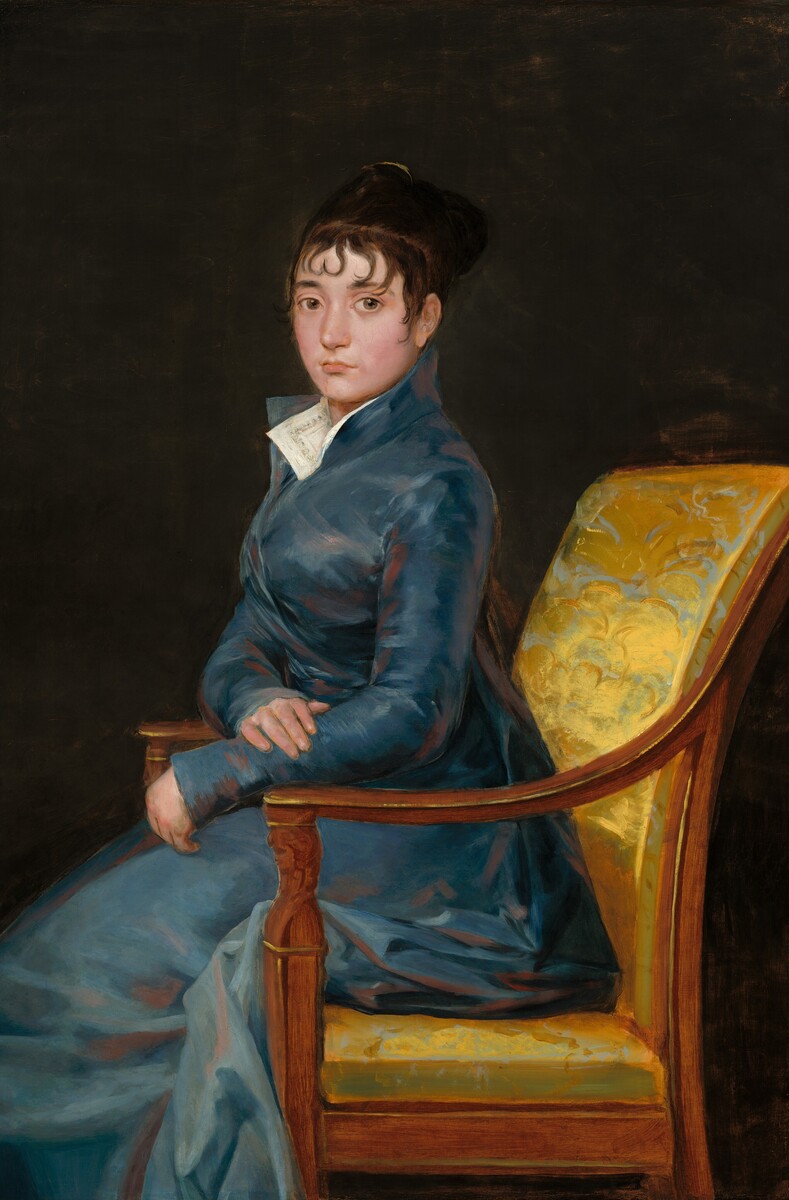
Thérèse Louise de Sureda: high-resolution image
The highest-resolution file we hold, available without payment or an account.2,693 × 4,096 pixels.
Download highest-resolution imageThe complete story
The story About 3 minutes to read
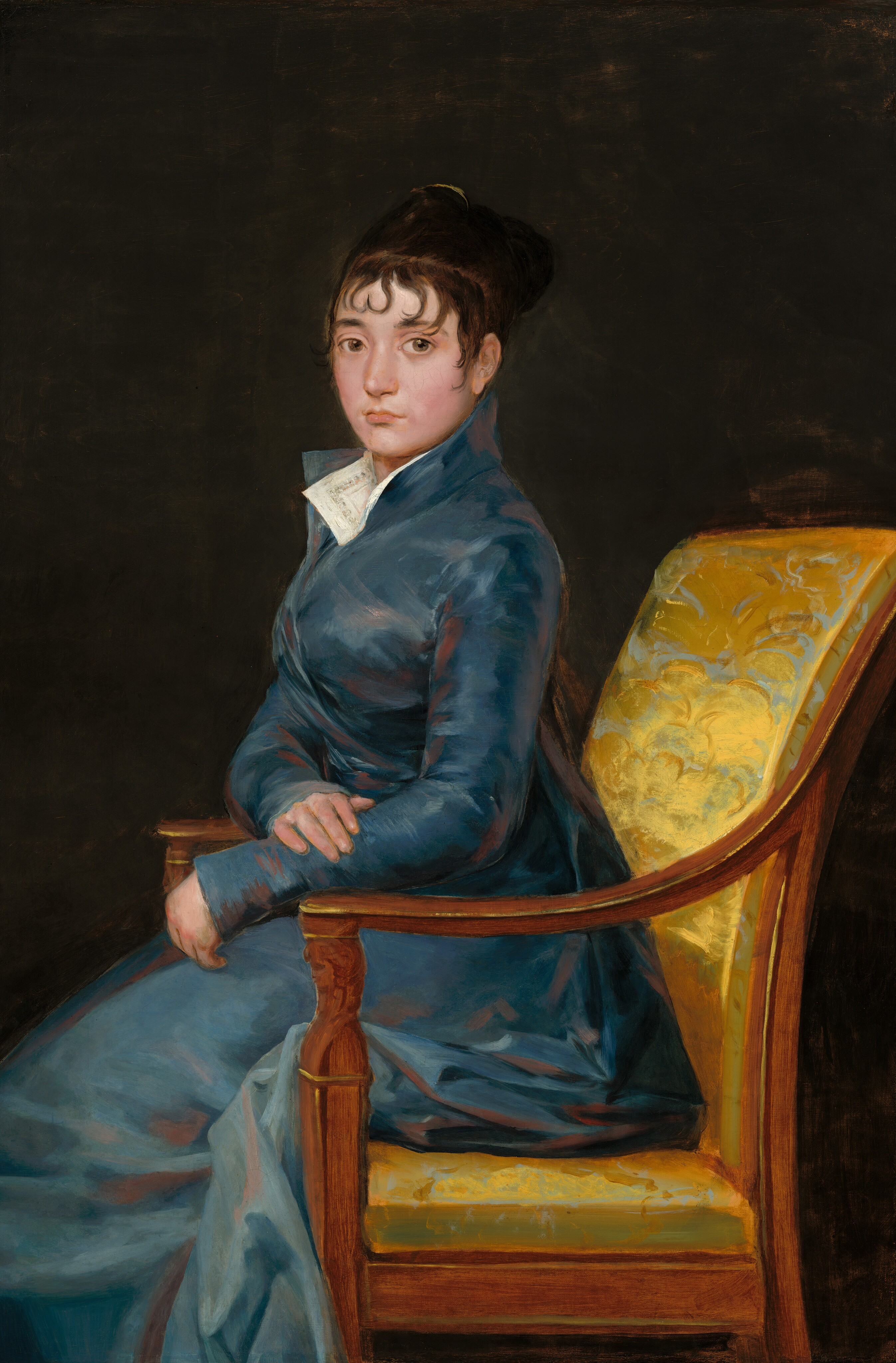
This is Thérèse Louise de Sureda, painted by Francisco Goya around 1803 or 1804. She is seated in the portrait and faces the viewer. The supplied record confirms her as the sitter, and it dates the painting to the turn of the nineteenth century, when Goya was working in Spain.
What you see is a single seated woman, presented frontally and filling the painted field. The format is a standard portrait shape, taller than it is wide. Goya worked the portrait in oil on canvas. The record gives us the medium and the canvas format but does not describe the sitter's dress, her surroundings, or her expression.
The painting belongs to the National Gallery of Art in Washington, D.C. It entered the collection as a gift of Mr. and Mrs. P. H. B. Frelinghuysen, in memory of her father and mother, Mr. and Mrs. H. O. Havemeyer. That credit tells us how the picture reached the museum. It does not tell us who commissioned the portrait or how it left the sitter's world.
Goya is the artist named in the record, and the work is placed within Spanish painting of the Romantic period. The date is given as a range, about 1803 to 1804, rather than a fixed day. That range is the working date for the painting itself. The record supplies no separate date for the sitting or for any earlier version.
It is tempting to read a mood or a relationship into a portrait like this one. The evidence here does not support that reading. The supplied record gives us the sitter's name, the artist, the approximate date, the materials and the museum custody. It offers no commentary on the sitter's life, the pose's meaning, or Goya's aims. Any richer account would need sources this record does not provide.
So keep the essentials in view. A woman named Thérèse Louise de Sureda sits for Goya in a portrait from around 1803 or 1804, painted in oil on canvas and now in Washington. The portrait's broader story, of who she was and why she sat for Goya, remains outside what this record can tell us.
The story and its sources
Historical claims are linked to the records below. Close looking and interpretation are identified in the passage notes.
- Passage 1Documented historyWikimedia Commons: Thérèse Louise de Sureda
- Passage 2Close lookingWikimedia Commons: Thérèse Louise de Sureda
- Passage 3Documented historyWikimedia Commons: Thérèse Louise de Sureda
- Passage 4Documented historyWikimedia Commons: Thérèse Louise de Sureda
- Passage 5InterpretationWikimedia Commons: Thérèse Louise de Sureda
- Passage 6Documented historyWikimedia Commons: Thérèse Louise de Sureda
Details to notice
About 2 minutes to readBlue Dress Drapery
The blue skirt falls into broad, luminous folds across the lap and lower left, showing Goya's loose brushwork and the weight of the fabric.
Gilded Chair Back
The gold upholstered chair back with its pale damask pattern and carved wooden frame sets off the blue dress and signals the sitter's social position.
White Standing Collar
The stiff white collar rises sharply behind her neck, creating a crisp geometric accent against the deep blue fabric of the dress.
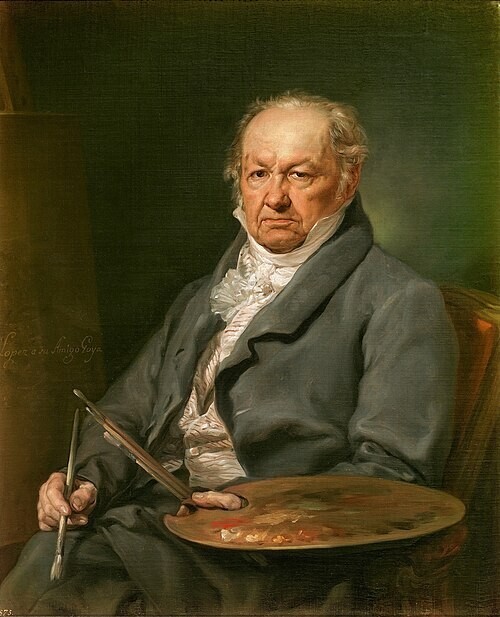
Artist portrait Image credit
Vicente López Portaña. Image source · Public domain
About the artist
Francisco de Goya
30 March 1746 to 16 April 1828
Goya was a Spanish painter and printmaker whose career extended from royal tapestry designs and court portraiture to images of war, repression and unsettling fantasy. Born in Fuendetodos, he trained in Zaragoza and Madrid and became First Painter to Charles IV in 1799. He spent his final years in Bordeaux.
- Born
- 30 March 1746
- Died
- 16 April 1828
- Nationality
- Spanish
- Birthplace
- Fuendetodos, Spain
- Died in
- Bordeaux, France
The research & record
Study the work.
Follow the evidence.
Find catalogue details, historical context, technical research and the literature behind this artwork.
The artwork record
Research catalogue
Catalogue information and detailed research, with references that link to the bibliography.
Updated .
Identity and catalogue
Link- Title
- Thérèse Louise de Sureda
- Artist or attribution
- Francisco Goya(Wikimedia Commons: Thérèse Louise de Sureda, n.d.)
- Object date
- c. 1803/1804
- Medium and support
- oil on canvas(Wikimedia Commons: Thérèse Louise de Sureda, n.d.)
- Dimensions
- overall: 119.7 x 79.4 cm (47 1/8 x 31 1/4 in.); framed: 137.8 x 98.4 cm (54 1/4 x 38 3/4 in.)
- Current collection or location
- National Gallery of Art, Washington, D.C.(Wikimedia Commons: Thérèse Louise de Sureda, n.d.)
- Movement or period
- Romanticism
- Country or culture
- Spain
- Depicted subject
- Portrait of Thérèse Louise de Sureda, seated and facing the viewer, painted by Francisco Goya around 1803/1804.(Wikimedia Commons: Thérèse Louise de Sureda, n.d.)
- Accession number
- 1942.3.1
- Support
- canvas
Read valuation records and their limitations
Catalogue identification
The painting is catalogued as Thérèse Louise de Sureda by Francisco Goya, dated to around 1803/1804. The work is a portrait, and the record identifies Thérèse Louise de Sureda as its sitter, so the title, the artist attribution and the subject coincide in the catalogue entry rather than resting on separate documentation. The date is given as an approximate range spanning two years, not as a fixed day or a securely documented year of completion. Nothing in the supplied record supplies a separate date for a sitting or for any earlier version, and no inscription or signature is recorded. The attribution to Goya and the identification of the sitter are therefore catalogue statements: they establish how the object is named and classified, but they are not accompanied here by the documentary apparatus, such as a contract, a letter or an inscription, that would independently fix the commission or the moment of painting.(Wikimedia Commons: Thérèse Louise de Sureda, n.d., Description)
The object is oil on canvas. Its overall dimensions are 119.7 by 79.4 centimeters, and its framed dimensions are 137.8 by 98.4 centimeters. The difference between the two sets of measurements gives the scale of the frame that surrounds the painted canvas, while the painted surface itself is taller than it is wide, a vertical portrait format. The medium and these measurements are the material facts the record establishes about the physical object. The record does not describe the sitter's dress, her surroundings or her expression, and it does not give a condition history, a pigment analysis or a record of conservation treatment. Any account of how the picture looks beyond its medium and proportions would have to rest on evidence not supplied here.(Wikimedia Commons: Thérèse Louise de Sureda, n.d.)
Museum custody and credit line
The painting is in the collection of the National Gallery of Art, Washington, D.C., under accession number 1942.3.1. It entered the museum as a gift of Mr. and Mrs. P. H. B. Frelinghuysen, in memory of her father and mother, Mr. and Mrs. H. O. Havemeyer. That credit line records the immediate circumstances of the gift and the family the donors wished to commemorate. It does not record who commissioned the portrait, how it passed from the sitter's circle, or through whose hands it traveled before it reached the Frelinghuysens. The accession number and the gift credit thus document the museum's custody from 1942 onward, but the earlier provenance remains outside what the supplied evidence establishes.(Wikimedia Commons: Thérèse Louise de Sureda, n.d.)
Interpretation
Read together, these catalogue facts define the object's identity while marking the limits of that definition. The title names a sitter, the attribution names an artist, the date places the work at the turn of the nineteenth century, the medium and dimensions describe a vertical canvas in oil, and the accession record fixes its modern institutional home. What the record does not contain is equally part of the scholarly picture: there is no recorded inscription, no documented commission, no provenance between the sitter's world and the 1942 gift, and no description of the painted surface beyond its support and size. The portrait matters within a larger history of Goya's portraiture and of Spanish painting of the period precisely as a securely catalogued but thinly documented object, one whose identity as Thérèse Louise de Sureda by Goya is stated by the catalogue and whose fuller history would require sources the present record does not provide.(Wikimedia Commons: Thérèse Louise de Sureda, n.d., Description)
The painting is Thérèse Louise de Sureda by Francisco Goya, dated around 1803/1804.(Wikimedia Commons: Thérèse Louise de Sureda, n.d.)
The work is a portrait depicting Thérèse Louise de Sureda as its sitter.(Wikimedia Commons: Thérèse Louise de Sureda, n.d.)
Materials and technique
LinkRead valuation records and their limitations
Documented medium and dimensions
The supplied record describes Thérèse Louise de Sureda as a portrait painted in oil on canvas, and it supplies the measured dimensions of the object. The unframed work measures 119.7 by 79.4 centimeters, while the framed dimensions are 137.8 by 98.4 centimeters. Taken together, these figures establish both the scale of the painted surface and the additional size contributed by the frame, and they confirm that the format is taller than it is wide. The medium statement and the measurements are the full extent of the material information carried by this evidence unit; the record does not characterize the canvas weave, the stretcher, the ground or preparatory layers, the palette, the binding medium beyond the general designation of oil, or any conservation treatment.(Wikimedia Commons: Thérèse Louise de Sureda, n.d.)
Interpretation
The evidence for this section is documentary rather than technical. The dimensions and the oil-on-canvas designation come from a collection record for the painting, not from examination reports, imaging, or sampling, and the source itself is noted as only partially consulted. That distinction matters for how the material account should be used: the medium and measurements can be stated as documented facts about the object, but nothing in this evidence establishes how the paint was applied, what pigments were chosen, whether the canvas was prepared with a particular ground, or how the surface has aged. Any description of handling, brushwork or layer structure in this portrait would rest on visual inference from the image rather than on the supplied record, and should be identified as such rather than presented as technical finding.(Wikimedia Commons: Thérèse Louise de Sureda, n.d.)
The work is oil on canvas, with overall dimensions of 119.7 by 79.4 centimeters and framed dimensions of 137.8 by 98.4 centimeters.(Wikimedia Commons: Thérèse Louise de Sureda, n.d.)
Collection and display
LinkRead valuation records and their limitations
Museum custody and the terms of the gift
The painting identified as Thérèse Louise de Sureda by Francisco Goya is held by the National Gallery of Art under accession number 1942.3.1. The museum's custody is recorded as the result of a gift from Mr. and Mrs. P.H.B. Frelinghuysen, made in memory of her father and mother, Mr. and Mrs. H.O. Havemeyer. This credit establishes the immediate route by which the picture entered the national collection and names the donors responsible for the transfer. It also embeds the painting in a commemorative act, since the gift is framed as a memorial to the donor's parents rather than simply as an acquisition. What the credit does not supply is equally important for a collection history: it says nothing about who commissioned the portrait, when or how it left the sitter's circle, or what hands it passed through before reaching the Frelinghuysen family. The gap between the documented gift and the undocumented earlier provenance should be kept visible in any account of the work's collecting history.(Wikimedia Commons: Thérèse Louise de Sureda, n.d.)
Interpretation
The accession number and the form of the credit place the object within a specific institutional record, where the work can be identified by number and by the terms of its donation. Because the evidence supplied here consists of that collection record, the painting's documented history in this archive begins with its arrival at the National Gallery of Art; earlier ownership remains outside what these units establish. The Havemeyer name in the memorial dedication is part of the donor's family genealogy as stated in the credit, not, on this evidence, a claim about the painting's prior ownership by the Havemeyers. Distinguishing the two is consequential: a memorial dedication records whom the donors wished to honor, while a provenance chain would require separate documentation that the supplied record does not contain. The collection history of the painting therefore rests on a firm institutional fact and an open question about its life before the gift.(Wikimedia Commons: Thérèse Louise de Sureda, n.d.)
The painting is in the collection of the National Gallery of Art, accession number 1942.3.1, as a gift of Mr. and Mrs. P.H.B. Frelinghuysen in memory of her father and mother, Mr. and Mrs. H.O. Havemeyer.(Wikimedia Commons: Thérèse Louise de Sureda, n.d.)
Documented values and qualified estimates
LinkRead valuation records and their limitations
The object and its recorded context
Interpretation
The object documented here is a portrait of Thérèse Louise de Sureda by Francisco Goya, dated around 1803/1804. It is oil on canvas, measuring 119.7 by 79.4 centimeters overall; the framed dimensions are given as 137.8 by 98.4 centimeters. The work belongs to the National Gallery of Art, accession number 1942.3.1, where it entered as a gift of Mr. and Mrs. P.H.B. Frelinghuysen in memory of her father and mother, Mr. and Mrs. H.O. Havemeyer. These identification details, medium, dimensions, accession number and gift credit are the factual foundation on which any discussion of the picture's value must rest.(Wikimedia Commons: Thérèse Louise de Sureda, n.d.)
Status of the valuation figure
The single evidence unit bearing on value is not a market record but a model-generated working calculation, generated on 2026-11-16. It proposes a broad, conservative insurance working range of US$8M to US$25M, explicitly framed as a range for manual review. The calculation states its own basis: an oil-on-canvas portrait by Goya dated c. 1803/1804, a Romantic-period Spanish masterwork in a major public museum collection, Goya's canonical status, the documented museum provenance and gift credit, the substantial 119.7 by 79.4 cm scale, and the general scarcity of comparable museum-quality Goya portraits in private trade. It states that no comparable sales or private insurance data were claimed or used, and the cited source itself contains no public valuation. This qualification matters: the range is a reasoning exercise built from contextual facts, not a figure drawn from any transaction, appraisal or policy.(Wikimedia Commons: Thérèse Louise de Sureda, n.d.)
Read against the object record, the valuation unit's inputs are limited to identification and context: sitter, artist, approximate date, medium, dimensions, collection and gift credit. The stated rationale, that such a work is rare in private trade because museum-quality Goya portraits of this kind seldom appear there, is the valuation model's own reasoning rather than a documented market fact within the evidence. It therefore supports only the cautious conclusion that the picture is of high institutional significance; it does not establish any exchangeable price, and it does not show how the figure of US$8M to US$25M was derived beyond the listed contextual factors.(Wikimedia Commons: Thérèse Louise de Sureda, n.d.)
Working estimate
Calculated working insurance estimate, not a sale price: Estimated value: US$8M to US$25M Recorded date: Working calculation, generated 2026-11-16. Methodology: Broad conservative insurance working range derived from confirmed context only: an oil-on-canvas portrait by Francisco Goya dated c. 1803/1804, a Romantic-period Spanish masterwork in a major public museum collection (National Gallery of Art, accession 1942.3.1). The range reflects Goya's canonical status, the portrait's documented museum provenance and gift credit referenced in the excerpt, the substantial scale of 119.7 x 79.4 cm, and the general scarcity of comparable museum-quality Goya portraits in private trade. The range is intentionally wide and rounded for manual review, with no comparable sales or private insurance data claimed or used. Qualification: This is a model-generated working range for manual review only. It is not an official insurance value, not an appraisal, not an auction estimate or result, and not a sale price. The cited source supports object identification and context only and does not contain a public valuation. Actual insurance coverage should be set by a qualified fine-art appraiser or broker using physical inspection, condition, provenance, title, and current market evidence.(Wikimedia Commons: Thérèse Louise de Sureda, n.d.)
Further reading
Books for a closer look
Paid links. As an Amazon Associate I earn from qualifying purchases.

Open Library Goya
Kodansha International
A catalogue raisonné and critical study of Goya, the artist of this portrait; subjects include catalogues raisonnés and Spanish painting, making it potentially the most object-oriented reference for locating a documented painting by Goya.
ISBN 0870110837
Bibliography
Sources and further reading
References are arranged by author or organisation, with links to the original publications. Where no publication date is recorded, n.d. means no date.
Source notes updated .
No recorded sources match these filters. Reset the filters to see the full bibliography.
- 02
Book
Goya. Kodansha International.
A catalogue raisonné and critical study of Goya, the artist of this portrait; subjects include catalogues raisonnés and Spanish painting, making it potentially the most object-oriented reference for locating a documented painting by Goya.
- ISBN
- 0870110837
Citation text
- 03
Book
Francisco Goya - the Paintings. Independently Published.
Titled as a study of Goya's paintings, which directly matches the medium and subject type of Thérèse Louise de Sureda, a painted portrait by Goya from around 1803/1804.
- ISBN
- 9781521566466
Citation text
- 01
Secondary · About this artwork
Wikimedia Commons: Thérèse Louise de Sureda (n.d.). Wikimedia Commons: Thérèse Louise de Sureda. Wikimedia Commons.
Wikimedia Commons file providing basic identification, medium, dimensions and accession number for the painting.
Citation text
Art to live with
Bring this painting
home.
A piece of the archive, made yours. Explore Thérèse Louise de Sureda in a size and finish that fits your space.
Your text and annotations appear on these editions. Adding to cart saves that design for printing.
Combine this painting with your favourites01 / Find your edition
Made for you
Suggested from your location. Change it if you're sending elsewhere or using a VPN. Prices and delivery are shown in GBP.
19 products
Choose an edition to make it yours
6 × 8 in · Printed cover · 118 lined pages
6 × 8 in · Printed cover · 118 lined pages
6 × 8 in · Printed cover · 118 lined pages
Notebook
GBP 12.03
Delivery GBP 5.35 / Total GBP 17.38
A 6 × 8 inch spiral notebook with 118 ruled pages (59 sheets), a printed front cover, dark grey back cover and metal spiral binding.
Fit and fill keep the painting’s proportions. Stretch changes them.
Move and zoom the painting on your notebook.
Made to order with your design
Made to order
US delivery only
12.7 × 17.8 cm / 5 × 7 in · Standard
12.7 × 17.8 cm / 5 × 7 in · Standard

5 × 7 in / 12.7 × 17.8 cm · Standard

5 × 7 in / 12.7 × 17.8 cm · Standard

5 × 7 in / 12.7 × 17.8 cm · Standard

5 × 7 in / 12.7 × 17.8 cm · Standard

5 × 7 in / 12.7 × 17.8 cm · Standard
Metal art sign
GBP 19.84
Delivery GBP 17.90 / Total GBP 37.74
A printed aluminium sign with rounded corners and mounting holes.
Fit and fill keep the painting’s proportions. Stretch changes them.
Move and zoom the painting on your metal art sign.
Made to order with your design
Printed aluminium · mounting holes included
US delivery only
iPhone 12 Mini ? Glossy ? back view
iPhone 12 Mini · Glossy

iPhone 12 Mini ? Glossy ? back view

iPhone 12 Mini ? Glossy ? back view

iPhone 12 Mini ? Glossy ? back view
Tough phone case
GBP 16.56
Delivery GBP 4.28 / Total GBP 20.84
A two-layer phone case with a printed polycarbonate shell and a shock-absorbing inner liner.
Two layers with a shock-absorbing TPU liner
Case & print details
- Device
- Apple · iPhone 12 Mini
- Material
- Polycarbonate shell with a TPU inner liner
- Artwork
- Outer back and wrapped edges from one template
- Finish
- Glossy
- Version
- Standard version
- Printing
- Dye sublimation
- Print file
- 1,122 × 1,831 px · 95 × 155 mm · PNG · 300 dpi recommended
Rear outline and camera openings follow this variant's Printify template. Case depth and small hardware remain illustrative.
Supplier product detailsFit and fill keep the painting’s proportions. Stretch changes them.
Move and zoom the painting on your tough phone case.
Made to order with your design
Made to order
US delivery only
30.4 × 40.6 cm / 12 × 16 in · Black
30.4 × 40.6 cm / 12 × 16 in · Black

12 × 16 in / 30.4 × 40.6 cm · Black

12 × 16 in / 30.4 × 40.6 cm · Black

12 × 16 in / 30.4 × 40.6 cm · Black

12 × 16 in / 30.4 × 40.6 cm · Black
Framed art print
GBP 53.41
- 1 framed print
- GBP 53.41
- Delivery to United States
- GBP 14.31
- Total
- GBP 67.72
A ready-to-hang wooden frame with a clear Perspex cover and a semi-gloss printed insert.
Delivery is quoted for all selected copies together.
Fit and fill keep the painting’s proportions. Stretch changes them.
Move and zoom the painting on your framed art print.
Made to order with your design
Wooden frame & protective clear front included
US delivery only
38.1 × 40.6 cm / 15 × 16 in · Natural
38.1 × 40.6 cm / 15 × 16 in · Natural

15 × 16 in / 38.1 × 40.6 cm · Natural

15 × 16 in / 38.1 × 40.6 cm · Natural

15 × 16 in / 38.1 × 40.6 cm · Natural

15 × 16 in / 38.1 × 40.6 cm · Natural

15 × 16 in / 38.1 × 40.6 cm · Natural
Canvas tote bag
GBP 14.40
Delivery GBP 4.38 / Total GBP 18.78
A sturdy cotton canvas tote with reinforced handles and artwork on the front panel.
Fit and fill keep the painting’s proportions. Stretch changes them.
Move and zoom the painting on your canvas tote bag.
Made to order with your design
Front print · reinforced cotton handles
US delivery only
22.9 × 20.3 cm / 9 × 8 in · Standard
22.9 × 20.3 cm / 9 × 8 in · Standard

9 × 8 in / 22.9 × 20.3 cm · Standard

9 × 8 in / 22.9 × 20.3 cm · Standard

9 × 8 in / 22.9 × 20.3 cm · Standard

9 × 8 in / 22.9 × 20.3 cm · Standard
Mouse mat
GBP 7.36
Delivery GBP 4.87 / Total GBP 12.23
A rectangular fabric mouse mat with a rubber backing and rounded corners.
Fit and fill keep the painting’s proportions. Stretch changes them.
Move and zoom the painting on your mouse mat.
Made to order with your design
Made to order
US delivery only
See more13 more products
43.2 × 45.7 cm / 17 × 18 in · Artwork
43.2 × 45.7 cm / 17 × 18 in · Artwork

17 × 18 in / 43.2 × 45.7 cm · Artwork

17 × 18 in / 43.2 × 45.7 cm · Artwork

17 × 18 in / 43.2 × 45.7 cm · Artwork
Woven tote bag
GBP 47.33
Delivery GBP 5.94 / Total GBP 53.27
A woven tote with cotton webbing handles and the painting translated into a woven design.
Fit and fill keep the painting’s proportions. Stretch changes them.
Move and zoom the painting on your woven tote bag.
Made to order with your design
Made to order
US delivery only
20.3 × 30.5 cm / 8 × 12 in · Standard
20.3 × 30.5 cm / 8 × 12 in · Standard

8 × 12 in / 20.3 × 30.5 cm · Standard

8 × 12 in / 20.3 × 30.5 cm · Standard

8 × 12 in / 20.3 × 30.5 cm · Standard

8 × 12 in / 20.3 × 30.5 cm · Standard

8 × 12 in / 20.3 × 30.5 cm · Standard
Matte art print
GBP 14.07
Delivery GBP 7.29 / Total GBP 21.36
An unframed matte poster with archival inks, ready for a frame of your choice.
Fit and fill keep the painting’s proportions. Stretch changes them.
Move and zoom the painting on your matte art print.
Made to order with your design
Unframed · frame it your way
US delivery only
iPhone 12 Mini ? Standard ? back view
iPhone 12 Mini · Standard

iPhone 12 Mini ? Standard ? back view

iPhone 12 Mini ? Standard ? back view

iPhone 12 Mini ? Standard ? back view
Flexible phone case
GBP 15.76
Delivery GBP 4.28 / Total GBP 20.04
A flexible TPU phone case with a frosted finish, a printed back and precise port openings.
Flexible TPU with a frosted, matte finish
Case & print details
- Device
- Apple · iPhone 12 Mini
- Material
- Semi-transparent thermoplastic polyurethane (TPU)
- Artwork
- Back print; rim stays unprinted
- Finish
- Standard
- Version
- Standard version
- Printing
- Dye sublimation
- Print file
- 791 × 1,586 px · 67 × 134.3 mm · PNG · 300 dpi recommended
Rear outline and camera openings follow this variant's Printify template. Case depth and small hardware remain illustrative.
Supplier product detailsFit and fill keep the painting’s proportions. Stretch changes them.
Move and zoom the painting on your flexible phone case.
Made to order with your design
Made to order
S · Standard
S · Standard

S · Standard

S · Standard

S · Standard

S · Standard

S · Standard
Crew socks
GBP 10.78
Delivery GBP 4.49 / Total GBP 15.27
Crew-length polyester and spandex socks with a ribbed cuff, cushioned sole and sublimated artwork.
Fit and fill keep the painting’s proportions. Stretch changes them.
Move and zoom the painting on your crew socks.
Made to order with your design
One pair · design repeated on both socks
US delivery only
12" · Standard
12" · Standard

12" · Standard

12" · Standard

12" · Standard
Laptop sleeve
GBP 26.36
Delivery GBP 4.96 / Total GBP 31.32
A polyester laptop sleeve with a fleece lining, top zip, printed front and black reverse.
Fit and fill keep the painting’s proportions. Stretch changes them.
Move and zoom the painting on your laptop sleeve.
Made to order with your design
Made to order
US delivery only
11oz · 2 image repeats
11oz · White
11oz · 2 image repeats
Mug
GBP 7.42
Delivery GBP 6.23 / Total GBP 13.65
A glossy white ceramic mug with a C-shaped handle, available in 11oz and 15oz sizes.
repeat layout · choose single, double or a repeating pattern in Customise.
Repeat, fit, fill and position your artwork around the mug.
Made to order with your design
Made to order
iPhone 12 Mini ? Standard ? back view
iPhone 12 Mini · Standard

iPhone 12 Mini ? Standard ? back view

iPhone 12 Mini ? Standard ? back view

iPhone 12 Mini ? Standard ? back view

iPhone 12 Mini ? Standard ? back view

iPhone 12 Mini ? Standard ? back view
Biodegradable phone case
GBP 21.19
Delivery GBP 4.28 / Total GBP 25.47
A matte phone case made from plant polymers and bamboo fibre, with the artwork printed on the back.
Flexible plant-polymer shell with a matte finish
Case & print details
- Device
- Apple · iPhone 12 Mini
- Material
- PLA and PBAT polymers with bamboo fibre
- Artwork
- Back print; rim stays unprinted
- Finish
- Standard
- Version
- Standard version
- Printing
- Dye sublimation
- Print file
- 777 × 1,553 px · 65.8 × 131.5 mm · PNG · 300 dpi recommended
Rear outline and camera openings follow this variant's Printify template. Case depth and small hardware remain illustrative.
Supplier product detailsFit and fill keep the painting’s proportions. Stretch changes them.
Move and zoom the painting on your biodegradable phone case.
Made to order with your design
Made to order
30.5 × 45.7 cm / 12 × 18 in · Standard
30.5 × 45.7 cm / 12 × 18 in · Standard

12 × 18 in / 30.5 × 45.7 cm · Standard

12 × 18 in / 30.5 × 45.7 cm · Standard

12 × 18 in / 30.5 × 45.7 cm · Standard
Fine art poster
GBP 17.03
Delivery GBP 7.69 / Total GBP 24.72
A gallery paper print with a smooth art-paper surface. Choose a size that suits the painting.
Fit and fill keep the painting’s proportions. Stretch changes them.
Move and zoom the painting on your fine art poster.
Made to order with your design
Unframed · frame it your way
iPhone 12 Mini ? Standard ? back view
iPhone 12 Mini · Standard

iPhone 12 Mini ? Standard ? back view

iPhone 12 Mini ? Standard ? back view

iPhone 12 Mini ? Standard ? back view
Clear phone case
GBP 15.28
Delivery GBP 4.28 / Total GBP 19.56
A clear phone case with artwork on the back. Leave areas transparent to show the phone underneath.
Clear shell with shock-absorbing TPU sides
Case & print details
- Device
- Apple · iPhone 12 Mini
- Material
- Polycarbonate back and clear TPU sides
- Artwork
- Back print; clear sides stay unprinted
- Finish
- Standard
- Version
- Standard version
- Printing
- Dye sublimation
- Print file
- 732 × 1,527 px · 62 × 129.3 mm · PNG · 300 dpi recommended
Rear outline and camera openings follow this variant's Printify template. Case depth and small hardware remain illustrative.
Supplier product detailsFit and fill keep the painting’s proportions. Stretch changes them.
Move and zoom the painting on your clear phone case.
Made to order with your design
Made to order
15oz · 3 image repeats
15oz · Standard

15oz · 3 image repeats

15oz · 3 image repeats

15oz · 3 image repeats

15oz · 3 image repeats

15oz · 3 image repeats
Travel mug
GBP 32.33
Delivery GBP 5.75 / Total GBP 38.08
A stainless-steel travel mug with a black lid, a tapered base and a printed white exterior.
repeat layout · choose single, double or a repeating pattern in Customise.
Repeat, fit, fill and position your artwork around the mug.
Made to order with your design
Made to order
US delivery only
2.5 × 3.4 cm / 1 × 1.4 in · Glossy
2.5 × 3.4 cm / 1 × 1.4 in · Glossy

1 × 1.4 in / 2.5 × 3.4 cm · Glossy

1 × 1.4 in / 2.5 × 3.4 cm · Glossy

1 × 1.4 in / 2.5 × 3.4 cm · Glossy

1 × 1.4 in / 2.5 × 3.4 cm · Glossy
Photo keyring
GBP 10.30
Delivery GBP 5.45 / Total GBP 15.75
A rectangular zinc-alloy photo keyring with a glossy insert and a swivel split ring.
Fit and fill keep the painting’s proportions. Stretch changes them.
Move and zoom the painting on your photo keyring.
Made to order with your design
Photo insert · zinc frame & swivel ring
US delivery only
iPhone 15 Pro ? Glossy ? back view
iPhone 15 Pro · Glossy

iPhone 15 Pro ? Glossy ? back view

iPhone 15 Pro ? Glossy ? back view

iPhone 15 Pro ? Glossy ? back view

iPhone 15 Pro ? Glossy ? back view

iPhone 15 Pro ? Glossy ? back view
Slim phone case
GBP 16.53
Delivery GBP 5.85 / Total GBP 22.38
A slim printed phone shell with open ports and a lightweight profile.
Slim, lightweight polycarbonate shell
Case & print details
- Device
- Apple · iPhone 15 Pro
- Material
- Polycarbonate
- Artwork
- Outer back and wrapped edges from one template
- Finish
- Glossy
- Version
- Standard version
- Printing
- Dye sublimation
- Print file
- 1,278 × 1,971 px · 108.2 × 166.9 mm · PNG · 300 dpi recommended
Rear outline and camera openings follow this variant's Printify template. Case depth and small hardware remain illustrative.
Supplier product detailsFit and fill keep the painting’s proportions. Stretch changes them.
Move and zoom the painting on your slim phone case.
Made to order with your design
Made to order
US delivery only
36.6 × 30.7 cm / 14.4 × 12.1 in · Standard
36.6 × 30.7 cm / 14.4 × 12.1 in · Standard

14.4 × 12.1 in / 36.6 × 30.7 cm · Standard

14.4 × 12.1 in / 36.6 × 30.7 cm · Standard

14.4 × 12.1 in / 36.6 × 30.7 cm · Standard
Desk mat
GBP 15.17
Delivery GBP 7.21 / Total GBP 22.38
A smooth polyester desk mat with a natural rubber non-slip base and anti-fray edges, available in three sizes.
Fit and fill keep the painting’s proportions. Stretch changes them.
Move and zoom the painting on your desk mat.
Made to order with your design
Made to order
The 30 cm ruler is scaled alongside your selected print. Keep the painting’s proportions with a black background, or stretch it to fill. Frame width, material texture and screen colours are illustrative.
Keep exploring