A gallery reading of Raphael's 1511 fresco in the Villa Farnesina, Rome, showing the sea nymph Galatea crossing the waves in a shell chariot, with her marine escort and the conch horn sounding above. The account separates what is visible in the work from the mythological context the supplied record establishes, and it notes the unsettled question of the fresco's title.
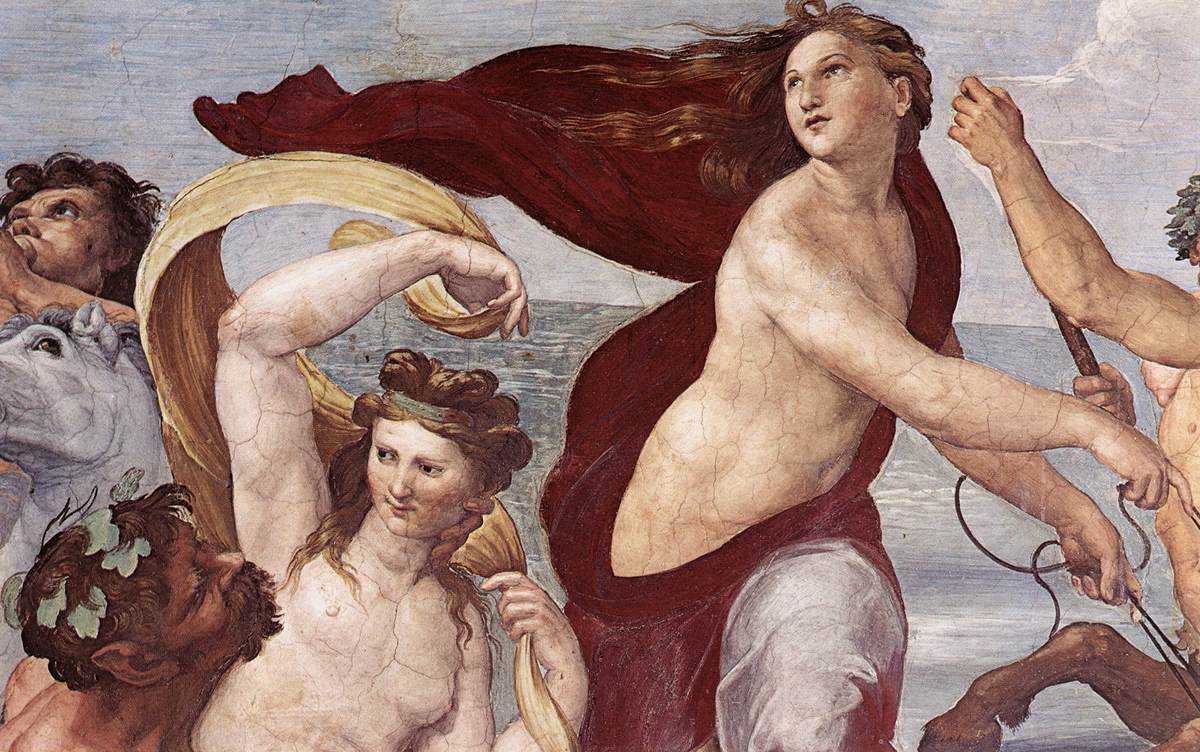
The pale horse head rearing at the left edge, its eye and muzzle visible as part of the sea-centaur team that pulls the chariot through the water.
02
Ivy-crowned triton
The bearded marine god at the lower left, crowned with ivy leaves, his dark profile thrusting upward beneath the white horse as he joins the escort of Galatea.
03
Sea nymph
The white-shouldered sea nymph with golden hair and a fillet, gazing sideways while she lifts and twists a strand of hair, her gesture echoing the twisting movement of the whole group.
Your gallery guide
The Triumph of Galatea by Raphael (1511)
A gallery reading of Raphael's 1511 fresco in the Villa Farnesina, Rome, showing the sea nymph Galatea crossing the waves in a shell chariot, with her marine escort and the conch horn sounding above. The account separates what is visible in the work from the mythological context the supplied record establishes, and it notes the unsettled question of the fresco's title.
Editorial review by Artifact Archive automated publishing
This is Raphael's Galatea, a fresco of 1511. It shows a sea nymph named Galatea riding across the water in a shell chariot.
She is not alone. A sea nymph, a conch horn, a triton and sea horses attend her passage, and the whole scene is based on Greek mythology.
Start with the chariot itself. Its shell form carries Galatea over the waves, so the sea is not a backdrop behind her. It is the road she travels.
The figures spread out around that central car, which keeps your attention on the nymph even as the scene widens to include her escort.
A conch horn sounds above her. That horn turns the group into a procession rather than a crowd, because a horn announces an arrival.
Beside her moves another sea nymph, and a triton and sea horses fill the water around the chariot. Together they give the crossing its noise and motion.
The fresco stands in the Villa Farnesina in Rome, painted directly on the wall. It belongs to the High Renaissance in Italy.
The subject is drawn from Greek mythology, so Galatea is a figure from inherited story rather than a person from the painter's own time.
The title is not fully settled. The supplied institutional record calls the work The Voyage of Galatea, while the file page also carries the title The Triumph of Galatea.
Both names describe the same fresco. Voyage stresses the crossing, and Triumph stresses the display and escort, so the difference is one of emphasis rather than a different subject.
What the work gives you, then, is a sea journey made ceremonial. Galatea crosses in her shell chariot, a horn sounds, and the sea itself travels with her.
Read that way, the fresco is not simply a picture of a nymph on water. It is a mythological passage turned into a public procession, which is what the two titles are each reaching for.
The story and its sources
Editorial review by Artifact Archive automated publishing.
Historical claims are linked to the records below. Close looking and interpretation are identified in the passage notes.
A mythological marine scene showing the nymph Galatea riding a shell chariot across the sea, escorted by sea gods and nymphs, with a conch horn sounded above.(Wikimedia Commons: The Triumph of Galatea, n.d.)
Title variants
The Voyage of Galatea; Galatea; Trionfo di Galatea
Support
Wall
Catalogue identity and the limits of the record
The object is catalogued as a fresco by Raphael, dated 1511, depicting Galatea. That single sentence carries three separable claims that the record does not support equally. The identification of the subject as Galatea and the attribution to Raphael are stated directly in the institutional file information, as is the date of 1511; the medium, fresco, is likewise recorded. The file also describes the painting as executed directly on a wall, which is what the term fresco specifies technically: pigment applied to wet lime plaster, so that the wall surface itself is the support rather than a panel or canvas. The record further places the work within the High Renaissance in Italy. These are catalogue statements about identity rather than direct visual description, and they should be read as such. The record gives no independent documentation of commission, patron, contract or payment that would confirm either the attribution or the year, and the entry itself does not claim to provide any. Where the record speaks of Raphael and of 1511, it is transmitting an attribution and a date that later scholarship and museum practice have conventionally carried, not reporting a signature, an inscription or a dated document in the object. Nothing in the supplied evidence establishes an inscription on the fresco that names the artist or the year.(Wikimedia Commons: The Triumph of Galatea, n.d., File information)
Title variants
The title of the work is not fully settled in the record supplied. The same page carries The Triumph of Galatea as the file title, while an alternative title, The Voyage of Galatea, is also recorded for the object. The record treats these as two names for one fresco, not as evidence of two works or of a contested subject. The two titles distribute emphasis differently: one foregrounds a crossing or journey, the other a display or ceremonial escort. Because the record does not state which title is preferred by the holding institution, or the date at which either name was assigned, the variant should be preserved as a catalogue fact rather than resolved. It is worth distinguishing this kind of variation from the attribution and date discussed above: a title variant is a matter of naming practice and can shift with curatorial convention or with the language of publication, whereas an attribution and a dating claim are assertions about authorship and chronology that require different kinds of support. The record offers no evidence of when the alternative title came into use, and no argument for which better fits the object. Nothing here indicates a change in the subject, only a difference in what each name chooses to stress.(Wikimedia Commons: The Triumph of Galatea, n.d., File information)
Interpretation
Within the larger history of European art, the object's significance as recorded here rests on three connected facts the evidence states: it is a fresco, it is attributed to Raphael, and it is dated 1511, within the Italian High Renaissance. The record's identification of the support as a wall is not incidental to that significance. A fresco is site-specific by its technique: it is made on the wall it occupies, so the object cannot be understood apart from the architecture it was made for, even though the supplied evidence does not describe that architecture or the room. The record also asserts that the imagery belongs to Greek myth, which places the work in a long line of classical subjects reworked in later European art. Taken together, these statements make the object a case where a named Renaissance artist, a fixed wall support, a datable year and a classical subject converge. The evidence does not extend to how the work was received, what it influenced, or how it was later described by critics and historians. What the record establishes is the object's position in that history; it does not explain why the destination was chosen, or what the painting meant to the people who saw it in its own time.(Wikimedia Commons: The Triumph of Galatea, n.d., File information; Other versions, based on)
The fresco depicts Galatea riding a shell chariot across the waves, and the recorded composition places her within a moving escort rather than alone: a sea nymph, a conch horn, a triton and sea horses accompany the crossing. Because the shell vehicle carries her over the water, the sea functions in the image as the surface she travels rather than as a neutral backdrop, and the dispersal of the accompanying figures around the central chariot keeps attention on the nymph even as the scene opens outward. The subject belongs to Greek mythology, so the figure is presented as an inherited mythological character rather than as a person of the painter's own time.(Wikimedia Commons: The Triumph of Galatea, n.d., Structured data, depicts; Other versions, based on)
Naming the work
The supplied records also give the work more than one title: the institutional record calls it The Voyage of Galatea, while the file page also carries the title The Triumph of Galatea. Both names describe the same fresco, so the difference is one of emphasis rather than evidence of two subjects. Voyage foregrounds the crossing over the water, while Triumph foregrounds the display and the accompanying escort. The recorded description of the composition, in which Galatea crosses in a shell chariot with a sea nymph, conch horn, triton and sea horses, supports either emphasis without settling the naming question, and the title should be treated as unsettled in the present evidence.(Wikimedia Commons: The Triumph of Galatea, n.d., Structured data, depicts)
Interpretation
Read against the mythology and against the wall-bound medium, the work can be described in the supplied evidence as a sea journey made ceremonial, in which Galatea crosses in her shell chariot while a horn sounds and the surrounding water carries her party with her. That reading does not add to the documented facts; it draws together the recorded elements, the mythological subject and the fixed architectural setting into a single account of what the image shows and why the two titles each reach for a different part of it. It remains an interpretation of the surviving record rather than a documented statement about the painter's intention.(Wikimedia Commons: The Triumph of Galatea, n.d., Other versions, based on; File information; Structured data, depicts)
A tension runs through the naming of the fresco. The supplied institutional record calls the work The Voyage of Galatea, while the file page also carries the title The Triumph of Galatea. Both names describe the same fresco. The difference is one of emphasis rather than of subject, since Voyage stresses the crossing of the water and Triumph stresses the display and escort. Because the two titles attach to a single documented object, the variation should be understood as two ways of framing the same content rather than as evidence for separate compositions or separate commissions. The variation also registers two things the picture does at once: it moves Galatea over the sea and presents her passage as a ceremonial arrival.(Wikimedia Commons: The Triumph of Galatea, n.d., Other versions, based on)
The object examined here is a fresco painted directly on a wall, identified by the supplied institutional record as a work by Raphael, dated 1511, depicting Galatea, and held in the Villa Farnesina in Rome. The technical fact established by the record is twofold: the support is a wall, and the medium is fresco, the technique of painting on freshly laid lime plaster so that the picture forms as part of the wall surface. That combination determines much about how the work can be studied: there is no canvas or panel to move, no separate ground and paint layer in the way an easel painting has, and condition, surface and setting cannot be separated from one another. Any examination of the picture's making therefore has to begin with the wall it occupies.(Wikimedia Commons: The Triumph of Galatea, n.d., File information; Structured data, depicts)
The surviving record is the basis for what can be said about the making of this fresco beyond its medium, and the record is limited. It supplies object identity, artist, date, medium, dimensions and collection, and structured data describing what is depicted, but the file page as annotated does not set out a technical examination of the plaster, preparation or pigments, nor a sequence of paint layers, nor a named treatment or restoration campaign. Fresco painting by its nature requires the preparation of the wall, the laying of plaster, the application of pigment while the plaster is fresh, and the joining of successive areas of plaster, but the supplied evidence does not document those steps for this object individually. The evidence therefore supports the identification of the technique and the wall support, and it does not support claims about specific mixtures, tools, hands or interventions.(Wikimedia Commons: The Triumph of Galatea, n.d., File information; Structured data, depicts)
What the record documents and what it does not
What the picture shows is recorded as structured data rather than as a technical finding: Galatea rides a shell chariot across the waves, accompanied by a sea nymph, a conch horn, a triton and sea horses, and the subject is based on Greek mythology. These are observations of depicted content, and they matter for the study of materials only in a qualified way. They establish that the painted surface carries an elaborate marine scene with multiple figures, a chariot, water and an instrument, all disposed across the wall. They do not establish how that surface was built, what pigments were used, or what preparation was laid beneath the paint. The distinction is important here: what is seen in the image and what is documented about its fabrication are two different orders of evidence, and the supplied units keep them apart.(Wikimedia Commons: The Triumph of Galatea, n.d., Structured data, depicts; File information)
Interpretation
The differing titles recorded for the work, The Voyage of Galatea and The Triumph of Galatea, describe the same fresco and differ in emphasis, one stressing the crossing and the other the display and escort of the figure. For a study of materials and technique this title variation is a reminder that the object is known through institutional and file-page descriptions rather than through a technical report, and that those descriptions can vary in wording without implying different objects or different physical evidence. The stable facts in the supplied units remain the wall support, the fresco medium, the attribution to Raphael, the date 1511, the Villa Farnesina in Rome, and the depicted marine subject.(Wikimedia Commons: The Triumph of Galatea, n.d., File information; Structured data, depicts)
The Triumph of Galatea is a fresco painted directly on a wall, located in the Villa Farnesina in Rome. The institutional record identifies it as a work by Raphael, dated 1511, and classifies it within the High Renaissance in Italy. The subject is drawn from Greek mythology, which places Galatea within an inherited narrative tradition rather than among the painter's contemporaries.(Wikimedia Commons: The Triumph of Galatea, n.d., File information)
The object under consideration is a monumental High Renaissance wall fresco by Raphael, dated 1511, measuring approximately 295 by 225 cm, held at the Villa Farnesina in Rome, a historic institutional collection. The subject is drawn from Greek mythology: Galatea rides a shell chariot across the waves, accompanied by a sea nymph, a conch horn, a triton, and sea horses. The fresco is painted directly on a wall using the medium of fresco, and the available record supports identification, dimensions, location, medium, date, and public domain status. The title is not fully settled. The supplied institutional record calls the work The Voyage of Galatea, while the file page also carries the title The Triumph of Galatea. Both names describe the same fresco. Voyage stresses the crossing, and Triumph stresses the display and escort, so the difference is one of emphasis rather than a different subject.(Wikimedia Commons: The Triumph of Galatea, n.d.)
Valuation record
The supplied valuation material is a calculated working insurance estimate: an estimated working insurance range of US$50M to US$150M, recorded as a working calculation generated 2026-10-16. The methodology states that this broad working range is calculated for manual review only. Because the fresco is an immovable, site-specific wall painting in a public heritage collection, it is not a normal privately traded object; the range reflects the extreme scarcity and canonical status of Raphael frescoes rather than a market comparison. The calculation conservatively assumes that any insurance interest would relate to total loss, damage, or reproduction exposure, not to an actual sale of the original wall. No confirmed sale, auction, or official insurance figure was available in the supplied context. The provided Wikimedia Commons page supports identification, dimensions, location, medium, date, and public domain status, but it does not supply a monetary appraisal.(Wikimedia Commons: The Triumph of Galatea, n.d.)
The valuation unit carries explicit qualifications. It is a model-generated working range for manual review only, not an official insurance value, appraisal, auction result, or sale price. It does not rely on comparable sales or private insurance records. Any actual insurance valuation for this monumental in situ Raphael fresco requires specialist heritage and fine art insurance assessment. The artwork remains in a public institutional collection and may be subject to cultural heritage protections that prohibit or restrict transfer. This matters for a larger history of art and material culture because it marks the point at which an object's canonical status and its physical immovability, rather than any market transaction, generate the recorded figure: the value is attached to loss, damage, or reproduction exposure, not to exchange.(Wikimedia Commons: The Triumph of Galatea, n.d.)
Working estimate
Calculated working insurance estimate, not a sale price: Estimated working insurance range: US$50M to US$150M Recorded date: Working calculation, generated 2026-10-16. Methodology: This broad working range is calculated for manual review only. The work is a monumental High Renaissance wall fresco by Raphael, dated 1511, approximately 295 by 225 cm, and held at the Villa Farnesina in Rome, a historic institutional collection. Because the fresco is an immovable, site-specific wall painting in a public heritage collection, it is not a normal privately traded object; the range reflects the extreme scarcity and canonical status of Raphael frescoes rather than a market comparison. The calculation conservatively assumes that any insurance interest would relate to total loss, damage, or reproduction exposure, not to an actual sale of the original wall. No confirmed sale, auction, or official insurance figure was available in the supplied context. The provided Wikimedia Commons page supports identification, dimensions, location, medium, date, and public domain status, but it does not supply a monetary appraisal. Qualification: This is a model-generated working range for manual review only. It is not an official insurance value, appraisal, auction result, or sale price. It does not rely on comparable sales or private insurance records. Any actual insurance valuation for this monumental in situ Raphael fresco requires specialist heritage and fine art insurance assessment. The artwork remains in a public institutional collection and may be subject to cultural heritage protections that prohibit or restrict transfer.(Wikimedia Commons: The Triumph of Galatea, n.d.)
Bibliography
Sources and further reading
References are arranged by author or organisation, with links to the original publications. Where no publication date is recorded, n.d. means no date.
Source notes updated .
No recorded sources match these filters. Reset the filters to see the full bibliography.
Advertising supports the archive. These preferences control aggregate page counting, reading activity and ad-delivery diagnostics. They use no visitor tracking cookie.