A docent-led reading of Raphael's Sistine Madonna, painted in Italy around 1512 to 1513. The tour explains the Madonna and Child, Saint Sixtus II and Saint Barbara, using the supplied identification and collection record, and stays honest about how much the sources do and do not explain.
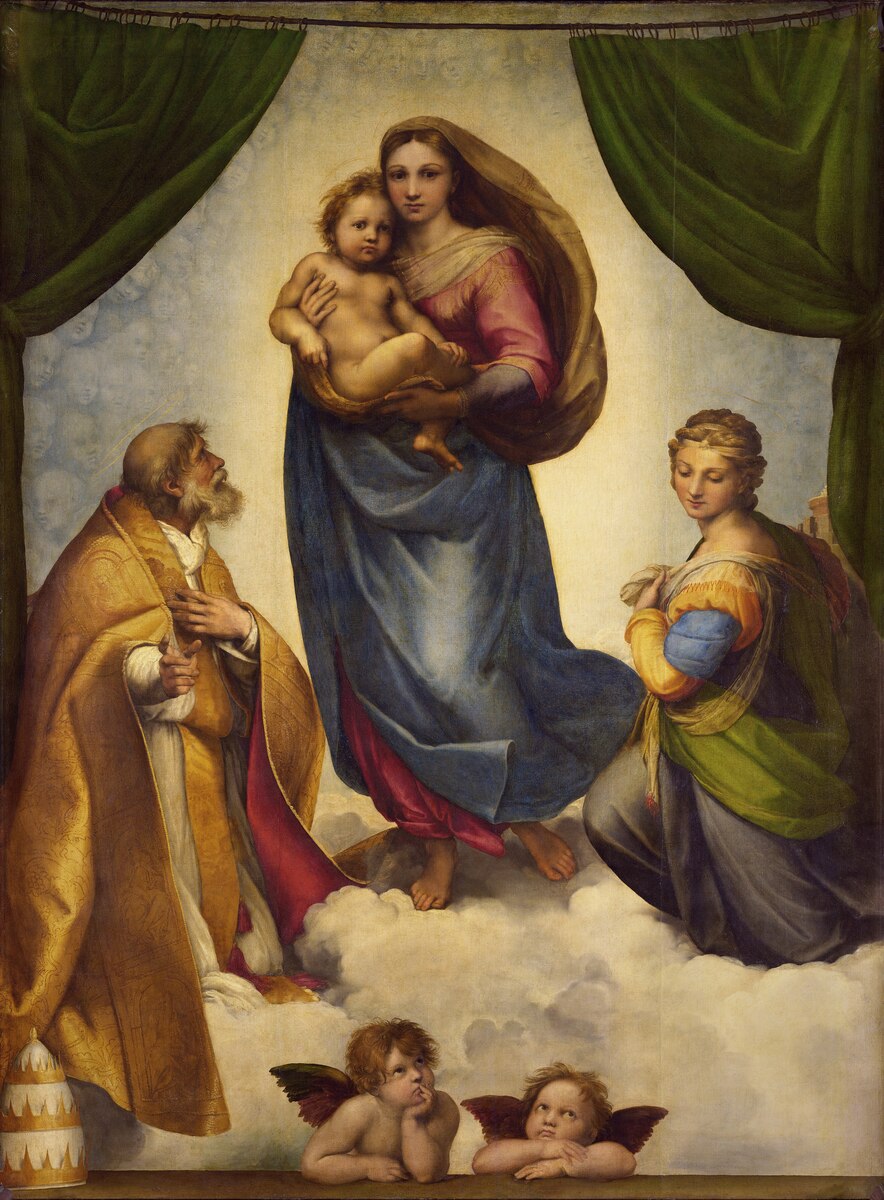
The triple-crowned papal tiara resting on the parapet at the lower left corner, a symbolic object tying the altarpiece to the papacy of Julius II and anchoring the heavenly vision to a tangible earthly throne.
02
Saint Barbara
The richly dressed saint kneeling at right, eyes lowered in modesty while the Virgin and Child look outward. Her golden hair, jewels, and layered yellow, blue and green drapery sit against the hint of a tower, her attribute.
03
Pope Sixtus II
The bearded pope in a heavy gold-embroidered cope at lower left, head tilted up toward the Virgin and Child, one hand raised to his breast and the other gesturing outward toward the viewer, acting as intercessor and presenting the altarpiece's audience.
Your gallery guide
Sistine Madonna by Raphael (between circa 1512 and circa 1513)
A docent-led reading of Raphael's Sistine Madonna, painted in Italy around 1512 to 1513. The tour explains the Madonna and Child, Saint Sixtus II and Saint Barbara, using the supplied identification and collection record, and stays honest about how much the sources do and do not explain.
Editorial review by Artifact Archive automated publishing
This is Raphael's Sistine Madonna, a religious painting made in Italy around 1512 to 1513.
It shows Mary holding the Christ Child, with Saint Sixtus II and Saint Barbara beside them, and two cherubs on the ledge below.
The Madonna and Child sit at the centre of the picture.
To the left and right, Saint Sixtus II and Saint Barbara stand, slightly lower, and two cherubs appear on a parapet beneath the main group.
Raphael painted it in Italy, in the High Renaissance, as a religious work.
In Christian art, the Madonna is Mary, the Christ Child is Jesus, and the saints are honoured figures in the church's history.
The painting is built around a hierarchy, not a flat group portrait.
Mary and the child sit highest, Sixtus and Barbara flank them, and the cherubs rest at the bottom. That vertical order shows who is central to the picture's religious meaning.
What we can say with certainty comes from the object record: Raphael's Sistine Madonna is an oil painting on canvas from around 1512 to 1513, showing Mary, the Christ Child, Sixtus II and Barbara.
The record confirms who and what is shown, but it does not explain Raphael's private intentions or each figure's full symbolic role here.
The story and its sources
Editorial review by Artifact Archive automated publishing.
Historical claims are linked to the records below. Close looking and interpretation are identified in the passage notes.
The painting depicts the Madonna and Child, with the Virgin Mary holding the Christ Child, accompanied by Saint Sixtus II and Saint Barbara, along with two cherubs on a parapet below.(Wikimedia Commons: Sistine Madonna, n.d.)
The painting catalogued as the Sistine Madonna, known in German as the Sixtinische Madonna, is attributed to Raphael and dated to between circa 1512 and circa 1513. Its recorded dimensions are a height of 269.5 cm and a width of 201 cm. It is a religious artwork of the Madonna and Child type, in which Mary and the Christ Child are the main figures; the depiction also includes Saint Sixtus II among the persons shown. The work belongs to the High Renaissance period and was created in Italy. Its current institutional identification is the accession number Gal.-Nr. 93 at the Staatliche Kunstsammlungen Dresden, where it forms part of the collection and is exhibited in the Gemäldegalerie Alte Meister.(Wikimedia Commons: Sistine Madonna, n.d.)
Two elements of the record require separate handling because they date from different moments in the object's life. The execution of the painting belongs to circa 1512 to circa 1513 and to Raphael's activity in Italy during the High Renaissance. The catalogue identity, by contrast, belongs to a much later institutional history: the German title, the designation as part of the Staatliche Kunstsammlungen Dresden, its exhibition in the Gemäldegalerie Alte Meister, and the accession number Gal.-Nr. 93 are all products of collection and cataloguing rather than of the period of creation. The accession number in particular is not evidence about when the work was made; it is a modern administrative label. Keeping these two chronologies distinct means the circa 1512 to circa 1513 date describes the making of the picture, while the Dresden identifiers describe where and how it has since been recorded and displayed.(Wikimedia Commons: Sistine Madonna, n.d.)
The attribution to Raphael is the term the record uses, and it is best preserved as an attribution rather than restated as an unqualified fact of authorship. The supporting documentation consulted here is a Wikimedia Commons file page, annotated as providing identification details, collection information and provenance data drawn from Google Arts and Culture, and described as only partially consulted. That page establishes how the object is identified in the source's terms, including its subject, its German title, its dimensions, its period, its place of creation, and its Dresden collection and exhibition context. Because the annotation itself notes that consultation was partial, the account here should be read as an accurate report of the catalogue information supplied by that source, not as an independent examination of the painting, its documents or its condition.(Wikimedia Commons: Sistine Madonna, n.d.)
Subject and title
The subject matter is described at two levels of specificity that should not be collapsed into one another. At the general level the work is a religious artwork depicting the Madonna and Child, with Mary and the Christ Child as the main figures. At the more particular level the people depicted are named as Mary, Sixtus II and the Christ Child. The record therefore establishes who is shown, and it supports describing the picture as a religious Madonna and Child composition with Sixtus II among the depicted persons. It does not, in these units, set out the iconographic function of each figure or explain every symbolic role within the composition, so those questions remain outside what the cited evidence can establish. The German title, Sixtinische Madonna, is a further recorded variant of the object's name alongside the English Sistine Madonna, and both refer to the same catalogued painting.(Wikimedia Commons: Sistine Madonna, n.d.)
The details assembled here have a wider value for the history of art and material culture because they tie a single celebrated religious image to a precise institutional identity across centuries. The making of the work is located in Italy in the High Renaissance at circa 1512 to circa 1513, while its documented life as a numbered and exhibited museum object is located in Dresden, in the collection of the Staatliche Kunstsammlungen Dresden and in the Gemäldegalerie Alte Meister, under the accession number Gal.-Nr. 93. Connecting those two moments shows that the object's identity is not exhausted by its authorship or its date: it also consists of a later history of naming, cataloguing and display. The public domain status recorded for the image belongs to that later documentation of the painting, not to the painting's original creation context.(Wikimedia Commons: Sistine Madonna, n.d.)
The painting Sistine Madonna is a religious artwork depicting the Madonna and Child, with Mary and the Christ Child as the main figures.(Wikimedia Commons: Sistine Madonna, n.d.)
The Sistine Madonna is documented as a painting of the High Renaissance period, created in Italy. Around these broad parameters the object record supplies the identification details through which the work is normally catalogued: the work is attributed to Raphael; it is dated to approximately 1512 to 1513; and the medium is recorded as oil on canvas. Its recorded dimensions are 269.5 cm in height and 201 cm in width. Those are the material and chronological facts on which any account of the commission has to rest, and they also establish the scale of the work as a large altarpiece-sized canvas rather than a small devotional panel. The support, oil on canvas, is significant because the surviving record ties the picture to a specific physical format, and the stated measurements allow the object to be understood as a monumental painted surface. Within the period designation High Renaissance and the place designation Italy, the picture is thus fixed as a religious image made in a specific artistic environment, but the record as supplied does not name a contract, a patron, a church, or a workshop document that would explain the circumstances under which it was made.(Wikimedia Commons: Sistine Madonna, n.d.)
The Sistine Madonna is recorded as executed in oil on canvas, and that single material statement is the anchor for any technical account of the picture. The medium places the work within the oil painting tradition of the Italian High Renaissance, while the support is canvas rather than a rigid panel, which matters because canvas supports were increasingly used for large altarpiece-scale images in this period and because the choice of support conditions how a picture is prepared, handled, transported and later conserved. The object record also gives the dimensions as 269.5 cm in height and 201 cm in width, so the painted surface is substantial and vertically oriented, consistent with a large religious composition rather than a small devotional panel. These are documented properties supplied by the collection record, not inferences from the image, and they should be distinguished from any visual impression of texture, weave or paint handling, which the evidence here does not describe.(Wikimedia Commons: Sistine Madonna, n.d.)
Attribution, date and collection context
Attribution, dating and location provide the framework within which the materials evidence sits. The painting is attributed to Raphael, dated to approximately 1512 to 1513, associated with Italy and the High Renaissance, and is held in the Gemäldegalerie Alte Meister, Staatliche Kunstsammlungen Dresden, Dresden, Germany, where it carries the accession number Gal.-Nr. 93. The work is also recorded under the German title Sixtinische Madonna and is described as a religious artwork belonging to the Dresden collection. These facts locate the object institutionally and historically, but they do not by themselves establish pigment analysis, layer structure, preparatory drawing or workshop participation. Any statement about how the oil paint was applied, what pigments were used, how the canvas was prepared or whether the surface was later treated lies outside the present evidence and must not be inferred from attribution or date alone.(Wikimedia Commons: Sistine Madonna, n.d.)
Subject and collection identity
The subject recorded for the picture is the Madonna and Child, with Mary and the Christ Child as the main figures, accompanied by Sixtus II and further figures identified as people, including the Christ Child. This iconographic description is the content evidence that a material and technical account must serve: whatever the support and medium are, the image is organized around a central mother-and-child group with flanking saintly figures. The evidence does not specify how the composition is built in physical layers, whether underdrawing is present, or how the figures are modelled in paint, so the connection between subject and technique remains a question for examination rather than a documented finding. What is documented is the identification of the work, its German title, its public-domain status, its Italian origin, its membership in the Staatliche Kunstsammlungen Dresden, and its exhibition in the Gemäldegalerie Alte Meister, all of which frame the object as a collection piece whose material history is institutionally tracked.(Wikimedia Commons: Sistine Madonna, n.d.)
What the evidence establishes and what it does not
Interpretation
Taken together, the evidence supports a careful separation between what is documented and what is visually inferred. Documented: oil on canvas, dimensions of 269.5 by 201 cm, attribution to Raphael, date of about 1512 to 1513, Italian origin, High Renaissance period, religious subject with Mary, the Christ Child and Sixtus II, German title Sixtinische Madonna, public-domain status, Dresden collection and display, and accession number Gal.-Nr. 93. Not documented here: specific pigments, ground or priming layers, canvas weave, brushwork, varnish or restoration history, preparatory drawings, workshop division of labour, or any private intention behind the making. In an accumulating account of materials and technique, the responsible move is to treat the oil-on-canvas record and its physical dimensions as the secure starting point, and to mark every further technical claim as requiring examination or source evidence that the present units do not supply. This matters because the Sistine Madonna's place in the history of art rests substantially on its monumental scale and its oil medium within High Renaissance practice, and those material facts can be asserted without extending them into undocumented claims about pigments or process.(Wikimedia Commons: Sistine Madonna, n.d.)
The Sistine Madonna is exhibited in the Gemäldegalerie Alte Meister, the museum named in the object record as its display location. That statement concerns where the painting is shown, not merely where it is owned, and it should be kept distinct from the separate claim about the collection that holds it: the object record places the work in the collection of the Staatliche Kunstsammlungen Dresden, and it locates the Gemäldegalerie Alte Meister in Dresden, Germany. Exhibition history and current display are therefore two different kinds of statement in the evidence. The supplied units do not record any earlier venue, loan, tour or temporary showing, so the account of the painting's exhibition life rests on its stated place in the Dresden gallery and should not be expanded into a sequence of exhibitions the sources do not establish.(Wikimedia Commons: Sistine Madonna, n.d.)
Identification of the object and identification of its display context come from the same record. The painting is attributed to Raphael, dated to circa 1512 to circa 1513, executed in oil on canvas, and measured at a height of 269.5 cm and a width of 201 cm. It carries the accession number Gal.-Nr. 93 at the Staatliche Kunstsammlungen Dresden and is titled in German as Sixtinische Madonna. It was created in Italy and belongs to the High Renaissance. These details matter to an exhibition account because they are the terms in which the work can be tracked between collection and gallery: a named artist, a date range, a medium and support, dimensions, an accession number and a German title. Where the evidence says the painting is exhibited in the Gemäldegalerie Alte Meister, it is these identified objects and records that are being displayed and administered.(Wikimedia Commons: Sistine Madonna, n.d.)
The image record is the source of the exhibition statement, and its own annotation describes it as a file page providing identification details, collection information and provenance data derived from Google Arts & Culture. That provenance is metadata about the image record rather than an account of the painting's movements, and the record is marked as partially consulted. The practical consequence for an exhibition section is that the display location, the Dresden collection and the accession number are reported through an aggregated image file page whose annotation explicitly frames it as supplying collection information. The evidence supports the statement that the painting is exhibited in the Gemäldegalerie Alte Meister; it does not supply a loan history, installation history, wall label, gallery number or exhibition catalogue reference, and none of those should be inferred from the presence of collection metadata alone.(Wikimedia Commons: Sistine Madonna, n.d.)
Circulation and Rights
Interpretation
The painting's public domain status is a rights statement rather than an exhibition fact, yet it shapes how the work circulates in the same institutional setting described by the display record. The object record places the Sistine Madonna in the public domain and identifies the Gemäldegalerie Alte Meister, Staatliche Kunstsammlungen Dresden, as its current location, within the collection of the Staatliche Kunstsammlungen Dresden. The image file page through which these identification, collection and provenance details are reported is itself an instance of that circulation. This is the connection between the artwork's legal status and its public availability, not evidence of any particular exhibition programming, and it should not be read as documenting a specific showing beyond the gallery location the record states.(Wikimedia Commons: Sistine Madonna, n.d.)
The Sistine Madonna attributed to Raphael is documented in the collection record as an oil painting on canvas dated to about 1512 to 1513, made in Italy during the High Renaissance and today held by the Staatliche Kunstsammlungen Dresden under accession number Gal.-Nr. 93, where it is exhibited in the Gemäldegalerie Alte Meister. The same record identifies the subject as a religious work showing the Madonna and Child, with Mary and the Christ Child as the main figures together with Sixtus II and the child, and gives the German title Sixtinische Madonna. These points establish the object's material, date, authorship attribution and present institutional home; they also frame the reception history that follows, because the painting's standing as a named, inventoried museum work is what later appreciation, reproduction and display could attach themselves to. The record further states that the painting is in the public domain, a status relevant to the circulation of its image rather than to its original devotional function.(Wikimedia Commons: Sistine Madonna, n.d.)
The Sistine Madonna, attributed to Raphael and dated to about 1512 to 1513, is now held in Dresden. The object record places the painting in the Gemäldegalerie Alte Meister, Staatliche Kunstsammlungen Dresden, in Dresden, Germany, and likewise records that it forms part of the collection of the Staatliche Kunstsammlungen Dresden; the same source gives its display location as the Gemäldegalerie Alte Meister. Within that institution the work carries the accession number Gal.-Nr. 93. These two statements about current location and collection membership are not competing claims but complementary levels of the same institutional fact: the Gemäldegalerie Alte Meister is the museum venue, and the Staatliche Kunstsammlungen Dresden is the wider collecting body to which the painting belongs. The source consulted for this information is the Wikimedia Commons file page for the Sistine Madonna, which is described as drawing its identification, collection and provenance details from Google Arts & Culture. That chain of transmission matters for how the collection data should be weighed: the evidence establishes the Dresden location and the Gal.-Nr. 93 accession number as the record's account of the work's present institutional home, while the file page itself is a secondary compilation rather than the museum's own catalogue entry. The unit is annotated as partially consulted, so the collection statements are supported at the level of the object record, and no fuller provenance history, acquisition date or transfer between collections is established by the supplied evidence.(Wikimedia Commons: Sistine Madonna, n.d.)
The painting Sistine Madonna is currently located in the Gemäldegalerie Alte Meister, Staatliche Kunstsammlungen Dresden, Dresden, Germany.(Wikimedia Commons: Sistine Madonna, n.d.)
The Sistine Madonna is recorded as a religious painting attributed to Raphael and dated between about 1512 and about 1513, executed in oil on canvas in Italy and associated with the High Renaissance. Its recorded dimensions are 269.5 cm in height and 201 cm in width. The object record names the Gemäldegalerie Alte Meister, Staatliche Kunstsammlungen Dresden, Dresden, Germany, as its current location, with accession number Gal.-Nr. 93, and the German title Sixtinische Madonna. The subject is the Madonna and Child: Mary and the Christ Child are the main figures, accompanied by Sixtus II and by Barbara, with the depicted people explicitly identified in the record as Mary, Sixtus II and the Christ Child. The record also states that the painting is in the public domain and that it is part of the collection of the Staatliche Kunstsammlungen Dresden. These identification details are the evidentiary base on which any value discussion about this object must rest, because they establish that the object in question is a fully verified High Renaissance oil on canvas of monumental scale rather than a work known only through reproduction or uncertain attribution.(Wikimedia Commons: Sistine Madonna, n.d.)
The working insurance range
The only valuation evidence supplied for this object is a model-generated working insurance range of US$500M to US$2B, recorded as generated on 2026-10-16. Its stated methodology is an extrapolation from the rare public market context for top-tier Old Master paintings of comparable extreme rarity, iconic status and art historical importance, together with the museum deaccession impossibility of the Dresden picture; the range uses a broad multiplier rather than any specific comparable sale. The same unit carries an explicit qualification: it is a working range for manual review only, not an official insurance value, appraisal, auction result or sale price, and no private insurance records or comparable sales were accessed. It further states that the true insurance value of a masterpiece held in perpetuity by a public collection is effectively uninsurable on the open market, and that any actual coverage would be set by specialist fine art underwriters after direct examination.(Wikimedia Commons: Sistine Madonna, n.d.)
The dimensions and medium recorded for the Sistine Madonna, 269.5 by 201 cm in oil on canvas, are the concrete features on which the working range's own description of the picture as being of monumental scale depends. That description in turn depends on the identification details asserted in the same unit: attribution to Raphael, High Renaissance date, and the painting's holding by the Gemäldegalerie Alte Meister, Staatliche Kunstsammlungen Dresden, under accession number Gal.-Nr. 93. The calculation therefore cannot be detached from those object facts, because its stated premise is a fully verified Raphael of that scale in that public collection. The evidence does not supply an earlier or later valuation history, a documented market transaction, an exhibition or loan history, or any underwriter's assessment; the 2026-10-16 date belongs to the working calculation itself, not to the painting.(Wikimedia Commons: Sistine Madonna, n.d.)
Recorded values in context
Within the wider history of art and material culture, the evidence for this picture places it in two registers at once. In the first register it is an object of documented art historical identity: a Raphael-attributed High Renaissance religious painting in oil on canvas, associated with Italy around 1512 to 1513, now in the Gemäldegalerie Alte Meister with the Dresden accession number Gal.-Nr. 93 and the Staatliche Kunstsammlungen Dresden collection, and in the public domain. In the second register it is treated in the supplied valuation evidence as an instance of a category defined by extreme rarity, iconic status and art historical importance combined with deaccession impossibility, which is precisely why the evidence describes it as effectively uninsurable on the open market and why any coverage would depend on specialist underwriters examining the work directly. The valuation unit is the only supplied evidence that speaks to monetary value, and it does so as a model-generated working bracket for manual review rather than as an official figure, appraisal or sale record.(Wikimedia Commons: Sistine Madonna, n.d.)
Working estimate
Calculated working insurance estimate, not a sale price: Estimated value: US$500M to US$2B Recorded date: Working calculation, generated 2026-10-16. Methodology: The range is a conservative working insurance bracket for a fully verified Raphael High Renaissance oil on canvas of monumental scale (269.5 x 201 cm) held by the Gemäldegalerie Alte Meister, Staatliche Kunstsammlungen Dresden, with accession number Gal.-Nr. 93. The calculation extrapolates from the rare public market context for top-tier Old Master paintings of comparable extreme rarity, iconic status, art historical importance, and museum deaccession impossibility, using a broad multiplier rather than any specific comparable sale. Qualification: This is a model-generated working range for manual review only, not an official insurance value, appraisal, auction result, or sale price. No private insurance records or comparable sales were accessed. The true insurance value of a masterpiece held in perpetuity by a public collection is effectively uninsurable on the open market, and any actual coverage would be set by specialist fine art underwriters after direct examination.(Wikimedia Commons: Sistine Madonna, n.d.)
Bibliography
Sources and further reading
References are arranged by author or organisation, with links to the original publications. Where no publication date is recorded, n.d. means no date.
Source notes updated .
No recorded sources match these filters. Reset the filters to see the full bibliography.
Recorded title 'Raffaels Sixtinische Madonna' by Harald Schwaetzer, with the subject 'Criticism and interpretation'. That pairing names the artwork in the title and classifies the work as interpretive scholarship on it, making it a directly object-specific candidate rather than a general Raphael survey.
Recorded title 'Die Sixtinische Madonna' with Raphael among the listed authors and Andreas Henning. Its subjects include Exhibitions, Influence, Angels in art, Adaptations, Rezeption and Vermarktung, so the catalogue record itself points to object-specific study of this painting plus its reception and later adaptation, which matches the preference for documented cultural reception over a broad artist survey.
Advertising supports the archive. These preferences control aggregate page counting, reading activity and ad-delivery diagnostics. They use no visitor tracking cookie.