Identity and catalogue
Link- Title
- The Alba Madonna
- Movement or period
- Italian High Renaissance
- Country or culture
- Italy
- Depicted subject
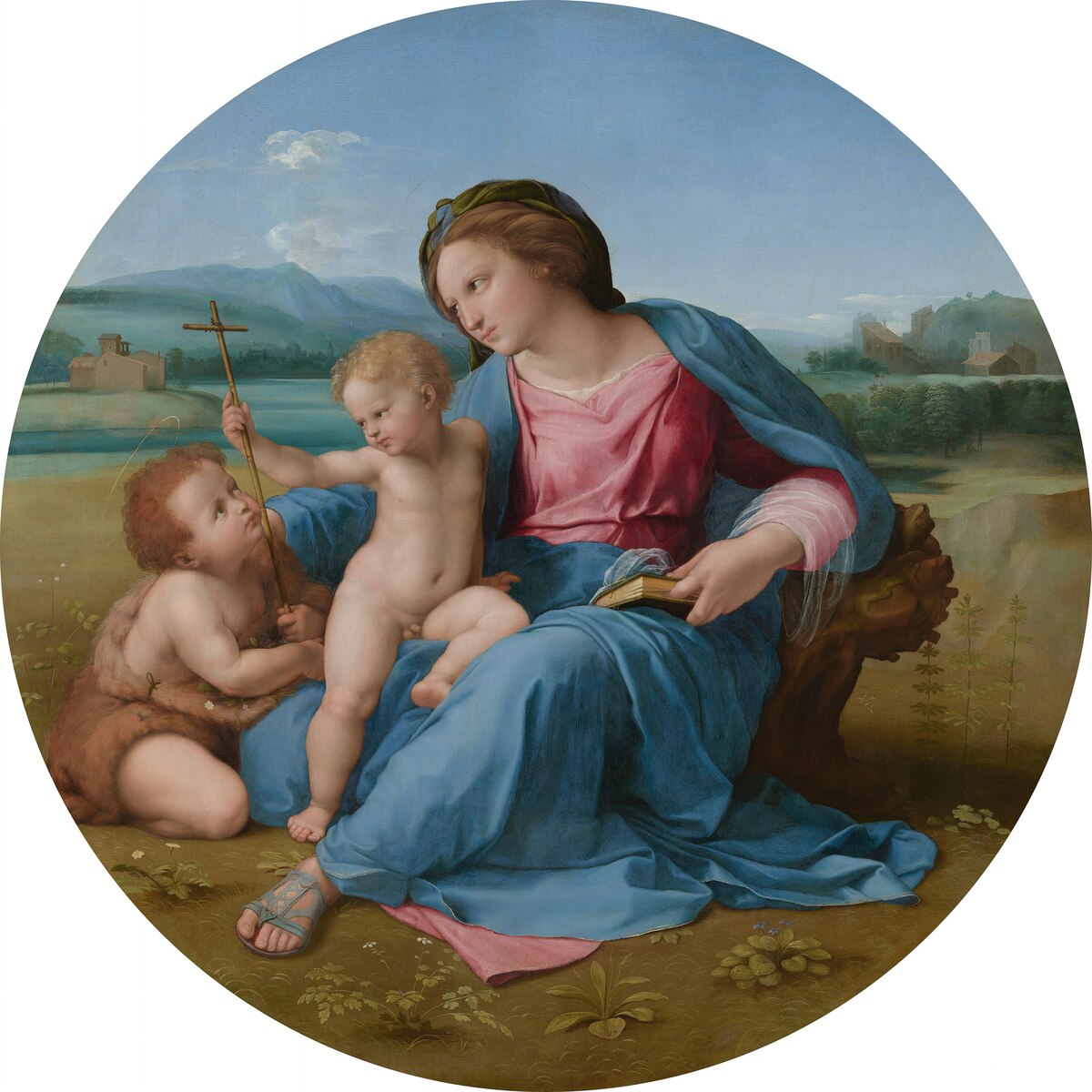
- A circular devotional painting, c. 1510, showing the Virgin Mary with the Christ Child and the child Saint John the Baptist in a landscape, presented as Madonna and Child.(Wikimedia Commons: The Alba Madonna, n.d.)
- Title variants
- Madonna d'Alba; La Madone d'Alba; Virgen de la Casa de Alba; Madonna Alba, Szene: Maria mit Christuskind und Johannes dem Täufer, Tondo; Alba Etxeko Ama Birjina; Мадонна Альба
- Accession number
- 1937.1.24
- Support
- oil on panel transferred to canvas
Catalogue identification
The object is catalogued as The Alba Madonna, a painting by Raphael made around 1510. The supplied record classifies it as religious art and describes it as a Madonna and Child, and identifies the depicted people as Mary, the Christ Child and the child Saint John. Its form is not a rectangle but a tondo, a circular composition. The catalogued date is given as circa 1510, which is a scholarly approximation for the making of the painting rather than a documented day or year of completion, and it should be distinguished from the dates of the later reference works and records through which the painting is now catalogued and reproduced.(Wikimedia Commons: The Alba Madonna, n.d., File information, Artist and Date; Object type: painting / tondo; Genre: religious art; Description: Madonna and Child; Depicted people: Mary, Christ Child, Child Saint John; Date: circa 1510)
The recorded measurements describe a large circular picture: the overall diameter is ninety-four point five centimetres, or about thirty-seven and three sixteenths inches. The framed dimensions are recorded separately as one hundred thirty-nine point seven by one hundred thirty-five point nine by fourteen centimetres, so the frame is a substantial constructed surround rather than a negligible edge, and the two sets of figures measure different things, the painted circle and the encased object. The entry lists several external catalogue references for the work: RKDimages identifier 269634, Web Gallery of Art identifier r/raphael/5roma/1/06alba, and a Federico Zeri Foundation image identifier 29058. These identifiers belong to modern documentation systems for images and catalogue records and are not inscriptions on the object; they are the routes by which the painting is located in research indexes.(Wikimedia Commons: The Alba Madonna, n.d., Dimensions, overall (diameter); Dimensions, framed; References: RKDimages ID 269634; WGA work ID; Zeri Foundation image ID 29058)
The record consulted here is the Wikimedia Commons file page for the painting, and the file itself derives from a National Gallery of Art photographic reproduction donated under the Gallery's Open Access Policy and released under CC0. That matters for how the account should be weighed: it is an open-access discovery and reference record rather than the Gallery's own catalogue essay, so its provenance notes and its readings of the subject are treated in this section accordingly. The Commons file-usage list also cites catalogues of Raphael's work by De Vecchi from 1966, Dussler from 1971, and Ferino Pagden and Zancan from 1989, which are literature on this painting reached through the file page rather than the present source's own arguments. The supplied digital file is a very high-resolution photograph, twelve thousand and ninety pixels square with a file size of about fifty-four point seven megabytes, which is a property of the reproduction and not of the panel itself.(Wikimedia Commons: The Alba Madonna, n.d., References: RKDimages ID 269634; WGA work ID; Zeri Foundation image ID 29058)
Collection and credit
The institutional identity of the painting is established by its present collection and credit line. The work is in the collection of the National Gallery of Art in Washington, D.C., and is numbered 1937.1.24; the Gallery credits it to the Andrew W. Mellon Collection. That accession number and credit line date the painting's entry into a public American collection to the Mellon gift era, and they distinguish the object's sixteenth-century making from its twentieth-century institutional registration. Earlier in its documented history, the supplied record lists a reference to the collection of W. G. Coesvelt of London, with the number 82, which places the painting in a nineteenth-century private London collection before its later American ownership.(Wikimedia Commons: The Alba Madonna, n.d., References: RKDimages ID 269634; WGA work ID; Zeri Foundation image ID 29058; Credit line: Andrew W. Mellon Collection; Collection of pictures of W. G. Coesvelt, esq., of London, 82)
Subject and composition
Interpretation
The visual content recorded for the painting can be set out in the terms the supplied description and interpretation use. The nude Christ Child is steadied against his mother's knee and grips a slender reed cross with both hands, a gesture read as his acceptance of future suffering and as the painting's central symbol. The kneeling boy, understood as the wilderness precursor Saint John, wears a rough animal skin, presents the cross staff and gazes up at the Christ Child, linking the two children in a single gesture of offering and receiving. The Virgin's downcast, pensive gaze beneath a green and blue headdress has been read as carrying foreknowledge of the Passion as she looks toward the children and the cross. The open book is held in the Virgin's left hand with a translucent veil drawn across it, a pairing of scripture and textile that demonstrates the refinement of Raphael's painted surfaces. Behind the figures, a tranquil lake with a walled town and church tower on the far shore sits below blue-hazed mountains, an idealized setting that contrasts with the cross's foreshadowing of the Passion. The catalogue description itself is simply Madonna and Child; the Passion reading and the identification of the landscape's symbolic role are interpretive readings rather than statements in the record, and they are presented here as attributed interpretations.(Wikimedia Commons: The Alba Madonna, n.d., Depicted people: Mary, Christ Child, Child Saint John; Genre: religious art; Description: Madonna and Child)
The tondo format is a compositional constraint as much as a shape. A circle has no corner in which to place a figure or to hide an awkward join, so the participants must be arranged around a centre rather than distributed across a rectangle, and the curve of the frame echoes their grouping. In this painting the arrangement of Mary, the Christ Child and the child Saint John turns and leans toward one another, which makes the object suited to close devotional looking rather than to a long viewing distance. The same circular logic governs the relationship between the figures and the setting: the landscape opens behind them and the frame gathers them, so that the picture holds both an intimate foreground group and a wide, calm view within one boundary. This is an interpretive synthesis of the supplied formal description rather than a claim recorded in the source.(Wikimedia Commons: The Alba Madonna, n.d., Object type: painting / tondo; Dimensions, overall (diameter))
Materials and technique
LinkDocumented object and medium
The supplied record documents the Alba Madonna as a painting by Raphael made around 1510, a religious image described as Madonna and Child and identified as a tondo, a circular composition, depicting Mary, the Christ Child and the child Saint John. Its recorded medium is oil on panel transferred to canvas, and its overall diameter is ninety-four point five centimetres, about thirty-seven and three sixteenths inches; the framed dimensions are given as one hundred thirty-nine point seven by one hundred thirty-five point nine by fourteen centimetres. The work belongs to the National Gallery of Art in Washington, D.C., accession number 1937.1.24, credited to the Andrew W. Mellon Collection. These are the object's documented parameters as the record states them, and they frame any discussion of how the picture was made and how it now exists.(Wikimedia Commons: The Alba Madonna, n.d., Medium: oil on panel transferred to canvas)
Interpretation
The medium designation itself carries technical weight rather than being a simple label. Oil on panel transferred to canvas describes not a single original state but a layered history of support: a wooden panel painted in oil, later separated from that panel and reattached to a canvas support. The record supplies the transfer as part of the medium statement without describing when, why or by whom the transfer was carried out, and it does not itemize the pigments, ground, preparation layers or any conservation treatment. What the evidence establishes, therefore, is the composite physical identity of the object as it is registered in the collection record; what it leaves open are the specific materials and interventions that produced that composite state.(Wikimedia Commons: The Alba Madonna, n.d., Medium: oil on panel transferred to canvas)
Format, subjects and iconography
The circular format governs the composition materially as well as visually. The record identifies the object as a tondo, and the painting's diameter is what the recorded dimensions describe. Within that circle the record places Mary seated on the ground, the nude Christ Child steadied against his mother's knee, and the kneeling boy understood as the wilderness precursor Saint John in a rough animal skin, presenting a slender reed cross while gazing up at the Christ Child, who grips it with both hands. The record's interpretation describes the gesture as linking the two children, one offering and one receiving, and reads the cross as a sign of the Passion; it likewise reads the Virgin's downcast, pensive gaze beneath a green and blue headdress as foreknowledge of that fate. These are attributed readings, not statements of fact in the record, and they concern iconography and composition rather than the physical materials of the panel or its painted layers.(Wikimedia Commons: The Alba Madonna, n.d., Medium: oil on panel transferred to canvas)
Documentation and open questions
The record situates the work within a documentary apparatus rather than a physical examination. It lists RKDimages identifier 269634, Web Gallery of Art identifier r/raphael/5roma/1/06alba, and Federico Zeri Foundation image identifier 29058, and it cites catalogues of Raphael's work by De Vecchi from 1966, Dussler from 1971, and Ferino Pagden and Zancan from 1989. It also notes a reference to the collection of W. G. Coesvelt of London, with the number 82, locating a nineteenth-century provenance point. A file-usage list indicates that the painting has a documented later history tied to pages on Boris Legran and a Soviet sale. The record explicitly states that the excerpt does not detail the painting's provenance between the Coesvelt collection and the Mellon gift, nor its acquisition price or any exhibition history, so those routes remain open questions rather than established findings.(Wikimedia Commons: The Alba Madonna, n.d., Medium: oil on panel transferred to canvas)
Interpretation
Taken together, the evidence supports a careful division of claims. The object's identity, date, format, medium, dimensions, collection, accession number, credit line and depicted figures are documented in the record; the transfer from panel to canvas is part of the recorded medium and points to a material history that the record does not otherwise narrate; the high-resolution file establishes the availability of a detailed photographic record while remaining a reproduction rather than an examination; and the iconographic readings of the cross, the Virgin's gaze, the landscape and the book and veil are attributed interpretations. The gaps, including pigments, preparation layers, tools, treatments and the provenance interval, are not filled by the evidence and should not be filled by invention. The object matters within a larger history of art and material culture precisely because its recorded composite state, an oil painting on panel transferred to canvas, is itself evidence of how such works were made, valued and later conserved, even where the record leaves the specifics of that history unresolved.(Wikimedia Commons: The Alba Madonna, n.d., Medium: oil on panel transferred to canvas; Size of this preview; Original file)
The object and its documented technical parameters
Technical study of The Alba Madonna has to begin from what the available record actually documents about the object and about the images through which it is examined. The supplied record states that the medium is oil on panel transferred to canvas, a formulation that describes both the original support and a subsequent intervention in the life of the picture. The record also gives the work's form and scale: a circular composition, a tondo, with an overall diameter of ninety-four point five centimetres, about thirty-seven and three sixteenths inches, and framed dimensions recorded as one hundred thirty-nine point seven by one hundred thirty-five point nine by fourteen centimetres. The painting is credited to Raphael and dated to circa 1510, and it is held in the collection of the National Gallery of Art in Washington, D.C., under the number 1937.1.24, credited to the Andrew W. Mellon Collection. These are the physical and institutional parameters within which any technical description must operate.(Wikimedia Commons: The Alba Madonna, n.d., Medium: oil on panel transferred to canvas; Size of this preview; Original file)
Technical examination
The only technical specification supplied for the examination file itself is that it is a very high-resolution photograph, twelve thousand and ninety pixels square, with a file size of about fifty-four point seven megabytes. This is a specification of the reproduction, not of the painting: it tells us the resolution and scale of the digital image, and nothing about the panel, the canvas, the paint layers or their condition. The square pixel dimension also reflects the circular format of the composition as reproduced, since the tondo is presented within a square file. What the image can support is close visual description at a high level of detail; what it cannot supply on its own is any information about materials, structure or history of treatment, which would require examination methods not described in the record at all.(Wikimedia Commons: The Alba Madonna, n.d., Size of this preview; Original file)
The photographic file itself has a documented institutional route. The reproduction was donated to Wikimedia Commons by the National Gallery of Art under its Open Access Policy and is released under CC0, which is why the record carries the Gallery's credit, accession number and collection information alongside the image. The provenance of the image, in other words, is separate from the provenance of the painting, and the record is explicit about which is which. The record also supplies external reference identifiers for the work: RKDimages identifier 269634, Web Gallery of Art identifier r/raphael/5roma/1/06alba, and a Federico Zeri Foundation image identifier 29058. These identifiers belong to cataloguing and image-documentation systems rather than to the object, and they point to the existence of further photographic and scholarly documentation beyond what is summarized here.(Wikimedia Commons: The Alba Madonna, n.d., Size of this preview; Original file)
Limits of the technical record
Interpretation
The record notes that the National Gallery of Art's credit line and the medium statement, oil on panel transferred to canvas, are given at the level of summary cataloguing, and that the supplied excerpt does not detail the painting's provenance between the Coesvelt collection and the Mellon gift, nor its acquisition price, nor any exhibition history. The transfer of the support is therefore a documented fact about the medium, but the record gives no date, no agent and no account of the condition or losses associated with that transfer. A technical account that inferred from the transfer a particular state of the paint surface, a particular campaign of conservation, or a particular date for the intervention would be going beyond the evidence. What can be stated is the recorded medium and the fact of transfer; what remains an open question is everything about when, how and by whom it was carried out.(Wikimedia Commons: The Alba Madonna, n.d., Medium: oil on panel transferred to canvas; Size of this preview; Original file)
Subject, reading and the status of interpretation
Technical examination
The record's description of the picture's subject matter is cataloguing rather than technical analysis: it classifies the work as religious art with the description Madonna and Child and records the depicted people as Mary, the Christ Child and the child Saint John. That three-figure group is visible in the reproduction at the resolution the file provides, and it is the baseline against which any closer technical observation would be made. The interpretation offered in the record, that the Virgin's downcast, pensive gaze beneath a green and blue headdress carries foreknowledge of the Passion as she looks toward the children and the cross, is explicitly flagged in the record as interpretation and not as a statement in the supplied record. The same qualification attaches to the reading of the nude Christ Child steadied against his mother's knee, gripping a slender reed cross, as accepting future suffering, and to the reading of the kneeling boy in a rough animal skin, understood as the wilderness precursor Saint John, presenting the cross staff while gazing up at the Christ Child.(Wikimedia Commons: The Alba Madonna, n.d., Size of this preview; Original file)
Interpretation
Two further interpretive readings in the record concern surface and setting. The open book held in the Virgin's left hand with a translucent veil drawn across it is described as a quiet pairing of scripture and textile that demonstrates the refinement of Raphael's painted surfaces, and the tranquil lake with a walled town and church tower on the far shore below blue-hazed mountains is described as an idealized setting that contrasts with the cross's foreshadowing of the Passion. The veil across the open book is the kind of detail that a high-resolution reproduction can genuinely support as an observation about what is depicted, while the judgement about refinement of painted surfaces is an aesthetic inference drawn from that observation rather than a measurement. Distinguishing the two is the point of treating the record's readings as interpretation: the depiction of a veil and a book can be checked against the image, whereas its significance for an account of Raphael's technique would require examination of paint handling that the supplied file specification alone does not provide.(Wikimedia Commons: The Alba Madonna, n.d., Size of this preview; Original file)
Limits of the technical record
Technical examination
The record cites literature on the painting in catalogues of Raphael's work by De Vecchi from 1966, Dussler from 1971, and Ferino Pagden and Zancan from 1989, and it lists a reference to the collection of W. G. Coesvelt of London, with the number 82. These are the bibliographic and early-provenance anchors available, and they establish that the work has been catalogued repeatedly in the twentieth century and that it was recorded in a London collection in the nineteenth. The record's file-usage list includes pages on Boris Legran and a Soviet sale, indicating that the painting has a documented later history tied to those subjects, but the excerpt does not supply the intervening provenance or the details of that sale. The move from the Coesvelt reference to the Soviet-era material and on to the Mellon gift is not described, so it should be presented as a gap in the record rather than reconstructed.(Wikimedia Commons: The Alba Madonna, n.d., Size of this preview; Original file)
Technical examination
The supplied digital file is a very high-resolution photograph, twelve thousand and ninety pixels square, with a file size of about fifty-four point seven megabytes.(Wikimedia Commons: The Alba Madonna, n.d.)
Provenance and ownership
LinkProvenance
The Alba Madonna is now in the collection of the National Gallery of Art in Washington, D.C., where it carries the accession number 1937.1.24 and is credited to the Andrew W. Mellon Collection. The Gallery's own open-access release of a photographic reproduction of the painting, donated to Wikimedia Commons under its Open Access Policy and issued under CC0, is the medium through which the object's record and image circulate publicly. This credit line establishes the institution and the benefactor whose name attaches to the work, but the credit alone does not itemise the purchase, the vendor or the date on which the painting entered Mellon's hands. The catalogues cited alongside the image, Raffaello Sanzio catalogue raisonné entries by De Vecchi from 1966, Dussler from 1971, and Ferino Pagden and Zancan from 1989, show that the painting has been treated within the established literature on the artist, which is relevant here because provenance claims about such works conventionally rest on that literature as much as on Gallery records. The supplied record also supplies external identifiers, RKDimages 269634, a Web Gallery of Art identifier r/raphael/5roma/1/06alba, and a Federico Zeri Foundation image identifier 29058, which fix the object within networked image and research archives and make it traceable across institutions beyond the Gallery itself.(Wikimedia Commons: The Alba Madonna, n.d., Credit line: Andrew W. Mellon Collection; Credit and Permission; Raffaello Sanzio catalogue raisonné, 1966 De Vecchi; 1971 Dussler; 1989 Ferino Pagden and Zancan)
Earlier in the recorded chain, the supplied file lists a reference to the collection of W. G. Coesvelt of London, with the number 82. This is the earliest ownership connected to the painting in the supplied evidence, and it is a named collection rather than a mere location, since the number 82 suggests an entry within a published or catalogued inventory associated with Coesvelt. The reference does not state how the painting reached Coesvelt, whether by purchase, gift or inheritance, nor does it give a date for that collection. The record also does not describe where the object was between Coesvelt's collection and the later entry into the Mellon Collection that the Gallery's credit line attests. That gap is a genuine absence in the supplied evidence rather than proof that ownership was continuous or that no transaction occurred. An unrecorded interval is not the same as a documented change of hands, and neither the sale of the work from Coesvelt nor any intermediate owner is established by the units supplied here.(Wikimedia Commons: The Alba Madonna, n.d., Collection of pictures of W. G. Coesvelt, esq., of London, 82; Credit line: Andrew W. Mellon Collection; Credit line and References)
Later movements and open questions
The painting's more recent documented history is signalled by the file-usage list for the object on Wikimedia Commons, which includes pages on Boris Legran and a Soviet sale. These linked subjects indicate that the picture has a later history tied to Soviet-era transactions and to a figure associated with those transactions, but the supplied evidence does not state which sale, which year, which parties, or what role Legran played in relation to this specific painting. The Coesvelt reference in the same file points to the earlier nineteenth-century layer of ownership, while the Soviet sale context belongs to a different period, yet the evidence does not supply the intervening owner, the route by which the work left the Coesvelt collection, or the terms under which it later moved. This material is therefore best read as a lead toward a documented later history rather than as a completed account of the painting's movement between collections.(Wikimedia Commons: The Alba Madonna, n.d., File usage on other wikis: Boris Legran; Soviet sale; Collection of pictures of W. G. Coesvelt, esq., of London, 82; Credit line and References)
Interpretation
The supplied excerpt explicitly notes that it does not detail the painting's provenance between the Coesvelt collection and the Mellon gift, nor its acquisition price, nor any exhibition history, treating those routes as open questions rather than established findings. Making that gap explicit matters for the scholarship: the credit line and the Coesvelt reference are documentary anchors at two ends of a long interval, and the Soviet sale context supplies a direction for the later period, but they do not by themselves form a complete chain of title. The recorded dimensions and technical data, an overall diameter of ninety-four point five centimetres (about thirty-seven and three sixteenths inches), framed dimensions of one hundred thirty-nine point seven by one hundred thirty-five point nine by fourteen centimetres, and a medium recorded as oil on panel transferred to canvas, describe the physical state of the object as it exists in the Gallery's care. The transfer of the support is part of the object's material history, and the supplied record does not attribute that intervention to any particular date, owner or conservator, so it too sits among the questions that further archival work would need to resolve rather than among the facts this record settles.(Wikimedia Commons: The Alba Madonna, n.d., Credit line and References; Credit line: Andrew W. Mellon Collection; Collection of pictures of W. G. Coesvelt, esq., of London, 82; File usage on other wikis: Boris Legran; Soviet sale)
The file-usage list for this object on Wikimedia Commons includes pages on Boris Legran and a Soviet sale, indicating that the painting has a documented later history tied to those subjects.(Wikimedia Commons: The Alba Madonna, n.d.)
The supplied excerpt does not detail the painting's provenance between the Coesvelt collection and the Mellon gift, nor its acquisition price or any exhibition history; those routes remain open questions rather than established findings.(Wikimedia Commons: The Alba Madonna, n.d.)
Interpretations and debates
LinkThe Status of the Supplied Readings
Interpretation
The five readings supplied for this section are flagged as interpretation rather than as statements in the underlying record, and that distinction governs how they should be weighted here. They concern the Virgin's expression and headdress, the Christ Child's grip on the reed cross, the kneeling boy in animal skin, the open book crossed by a veil, and the lake landscape. Each is attached to locators that record depicted people or the genre classification of religious art, so the readings are built on what the record describes rather than on separate documentary testimony about the maker's intentions. They therefore remain attributed interpretations of the image, coherent with the composition but not established as Raphael's private purpose.(Wikimedia Commons: The Alba Madonna, n.d., Depicted people: Mary; Depicted people: Christ Child; Depicted people: Child Saint John; Genre: religious art)
Figures and the Cross
The first reading holds that the Virgin's downcast, pensive gaze beneath a green and blue headdress carries foreknowledge of the Passion as she looks toward the children and the cross. The second reads the nude Christ Child, steadied against his mother's knee, as gripping a slender reed cross in a gesture understood as his acceptance of future suffering and as the painting's central symbol. The third identifies the kneeling boy in rough animal skin as the wilderness precursor Saint John, who presents the cross staff while gazing up at the Christ Child, so that the offering and the receiving bind the two children into one action. Taken together these three readings treat the cross as the hinge of the picture: it passes between the children while the mother's lowered face registers what it foreshadows. The record itself lists Mary, the Christ Child and the child Saint John among the depicted people, which is what allows the figure identifications to be made at all; the meanings assigned to gesture and gaze are the interpretive layer added on top.(Wikimedia Commons: The Alba Madonna, n.d., Depicted people: Mary; Depicted people: Christ Child; Depicted people: Child Saint John)
Book, Veil and Landscape
The fourth reading concerns the open book held in the Virgin's left hand with a translucent veil drawn across it, described as a pairing of scripture and textile that demonstrates the refinement of Raphael's painted surfaces. This is the one reading in the group that moves between subject and technique: the book and veil are both motifs and an occasion for showing how surfaces are rendered. It should be kept separate from any claim that the veil carries a fixed symbolic program, since the supplied statement argues from the quality of execution rather than from an iconographic source. The fifth reading describes a tranquil lake with a walled town and church tower on the far shore below blue-hazed mountains, an idealized setting whose calm is said to contrast with the cross's foreshadowing of the Passion. Its locator is the religious-art genre classification rather than a named depicted person, which is consistent with a landscape read as setting instead of as narrative agent.(Wikimedia Commons: The Alba Madonna, n.d., Depicted people: Mary; Genre: religious art)
Limits of Interpretation
These readings are on firmer ground when they are treated as a description of how the picture is organized than when they are treated as a record of what Raphael meant. The record supplies the subject description Madonna and Child, the classification as religious art, and the names of the three depicted people, and it supplies the object's date of about 1510, its tondo form, its medium of oil on panel transferred to canvas, and its overall diameter of ninety-four point five centimetres, about thirty-seven and three sixteenths of an inch. Nothing in the supplied material documents a program drawn up by the artist or a patron, so the Passion reading and the reading of the Virgin's awareness stand as attributed interpretations that the composition can support, not as documented intentions. The same restraint applies to the landscape: its contrast with the cross is an argument about pictorial effect, not a recorded commission detail.(Wikimedia Commons: The Alba Madonna, n.d., Depicted people: Christ Child; Depicted people: Mary)
What matters for interpretation is that the same record shows where the documentation thins. It does not detail the painting's provenance between the Coesvelt collection and the Mellon gift, nor its acquisition price, nor any exhibition history, and those routes remain open questions rather than established findings. Because the arguments about gaze and cross depend on visual evidence rather than on a documented program, they cannot borrow authority from the catalogues, which are cited as literature on the painting rather than as sources for those specific readings. The context evidence likewise bears on access and reproduction rather than on meaning: the photographic reproduction was donated to Wikimedia Commons by the National Gallery of Art under its Open Access Policy and released under CC0, and the supplied digital file is a very high-resolution photograph, twelve thousand and ninety pixels square, about fifty-four point seven megabytes in size. That resolution is what makes close visual argument about surfaces such as the book and veil possible in the first place.(Wikimedia Commons: The Alba Madonna, n.d., Depicted people: Mary)
Interpretation, not a statement in the supplied record: the Virgin's downcast, pensive gaze beneath a green and blue headdress carries the foreknowledge of the Passion as she looks toward the children and the cross.(Wikimedia Commons: The Alba Madonna, n.d.)
Interpretation, not a statement in the supplied record: the nude Christ Child, steadied against his mother's knee, grips a slender reed cross, a gesture read as his acceptance of future suffering and the painting's central symbol.(Wikimedia Commons: The Alba Madonna, n.d.)
Interpretation, not a statement in the supplied record: the kneeling boy in a rough animal skin, understood as the wilderness precursor Saint John, presents the cross staff while gazing up at the Christ Child, linking the two children in a single gesture.(Wikimedia Commons: The Alba Madonna, n.d.)
Interpretation, not a statement in the supplied record: the open book is held in the Virgin's left hand with a translucent veil drawn across it, a quiet pairing of scripture and textile that demonstrates the refinement of Raphael's painted surfaces.(Wikimedia Commons: The Alba Madonna, n.d.)
Interpretation, not a statement in the supplied record: a tranquil lake with a walled town and church tower on the far shore sits below blue-hazed mountains; the idealized setting contrasts with the cross's foreshadowing of the Passion.(Wikimedia Commons: The Alba Madonna, n.d.)
Collection and display
LinkObject record and format
The work is a painting in the form of a tondo, a circular composition, and the supplied record classifies it as religious art with the description Madonna and Child. The depicted people are recorded as Mary, the Christ Child and the child Saint John, and the medium is recorded as oil on panel transferred to canvas. Its overall diameter is given as ninety-four point five centimetres, about thirty-seven and three sixteenths inches, while the framed dimensions are recorded as one hundred thirty-nine point seven by one hundred thirty-five point nine by fourteen centimetres. The date is given as circa 1510.(Wikimedia Commons: The Alba Madonna, n.d., Collection: National Gallery of Art; Accession number: 1937.1.24)
Collection, credit line and provenance gaps
The painting is in the collection of the National Gallery of Art in Washington, D.C., and carries the accession number 1937.1.24. The National Gallery of Art credits the work to the Andrew W. Mellon Collection. The supplied record also lists a reference to the collection of W. G. Coesvelt of London, with the number 82. The excerpt does not detail the painting's provenance between the Coesvelt collection and the Mellon gift, nor its acquisition price or any exhibition history, so those routes remain open questions rather than established findings.(Wikimedia Commons: The Alba Madonna, n.d., Collection: National Gallery of Art; Accession number: 1937.1.24)
Reference apparatus and literature
The object is documented in several reference systems and bodies of literature: the record lists RKDimages identifier 269634, Web Gallery of Art identifier r/raphael/5roma/1/06alba, and a Federico Zeri Foundation image identifier 29058. The file-usage list cites catalogues of Raphael's work by De Vecchi from 1966, Dussler from 1971, and Ferino Pagden and Zancan from 1989. These identifiers and catalogue citations establish the work's standing as a repeatedly catalogued object, and they show that its documentation extends well beyond a single collection record.(Wikimedia Commons: The Alba Madonna, n.d., Collection: National Gallery of Art; Accession number: 1937.1.24)
Collection, credit line and provenance gaps
The supplied record also indicates a documented later history: the file-usage list for this object includes pages on Boris Legran and a Soviet sale. That connection attaches the painting to those subjects in the digital record, though the excerpt itself does not narrate the events behind the link. Taken together with the Coesvelt reference and the Mellon credit, this shows that the object's collecting history spans more than one national context, while the specific transitions between those contexts are not established by the supplied material.(Wikimedia Commons: The Alba Madonna, n.d., Collection: National Gallery of Art; Accession number: 1937.1.24)
Pictorial description and attributed readings
The visual content of the work as described in the record can be set out directly: the Virgin's downcast, pensive gaze sits beneath a green and blue headdress; the nude Christ Child is steadied against his mother's knee and grips a slender reed cross; the kneeling boy in a rough animal skin, understood as the wilderness precursor Saint John, presents the cross staff while gazing up at the Christ Child; the open book is held in the Virgin's left hand with a translucent veil drawn across it; and a tranquil lake with a walled town and church tower on the far shore sits below blue-hazed mountains. The record presents these readings of meaning as interpretation rather than as statements of fact, so they are best treated as attributed accounts of the picture's symbolism and setting.(Wikimedia Commons: The Alba Madonna, n.d., Collection: National Gallery of Art; Accession number: 1937.1.24)
Devotional form and art-historical placement
Interpretation
The tondo format and the devotional subject together explain why this object matters within a larger history of art and material culture. A circular panel imposes a centre-oriented arrangement rather than a rectangular field, and the record's account of the figures turning and leaning toward one another, with the curve of the frame echoing their grouping, describes a composition made for close looking. Within the history of Christian devotional imagery, the pairing of the children with a cross and the Virgin's lowered gaze belongs to a well-established iconographic tradition, and the record's reading of the cross as a sign of the Passion places the object within that tradition without asserting more than the evidence supports.(Wikimedia Commons: The Alba Madonna, n.d., Collection: National Gallery of Art; Accession number: 1937.1.24)
Reference apparatus and literature
The digital record itself is part of the object's documentation and deserves notice. The photographic reproduction was donated to Wikimedia Commons by the National Gallery of Art under its Open Access Policy and is released under CC0, and the supplied digital file is a very high-resolution photograph, twelve thousand and ninety pixels square with a file size of about fifty-four point seven megabytes. This matters for research because high-resolution open-access reproduction supports close study of surface detail and of the painted transitions in flesh, hair and drapery that the record notes, while also making clear that the supplied description is an open-access file donated by the Gallery rather than the Gallery's own catalogue essay.(Wikimedia Commons: The Alba Madonna, n.d., Collection: National Gallery of Art; Accession number: 1937.1.24)
Documented values and qualified estimates
LinkObject record
Interpretation
The object recorded here is Raphael's The Alba Madonna, dated circa 1510, a circular devotional painting in the form of a tondo with an overall diameter of 94.5 centimetres, about 37 and 3/16 inches. The medium is recorded as oil on panel transferred to canvas, and the framed dimensions are given as 139.7 by 135.9 by 14 centimetres. The supplied record classifies the work as religious art with the description Madonna and Child and identifies the depicted people as Mary, the Christ Child and the child Saint John. It is held by the National Gallery of Art, Washington, D.C., accession number 1937.1.24, credited to the Andrew W. Mellon Collection.(Wikimedia Commons: The Alba Madonna, n.d.)
The supplied record lists a reference to the collection of W. G. Coesvelt of London, with the number 82, and its file-usage list includes pages on Boris Legran and a Soviet sale, indicating that the painting has a documented later history tied to those subjects. The record also lists three external image or documentation identifiers for the work: RKDimages 269634, the Web Gallery of Art identifier r/raphael/5roma/1/06alba, and a Federico Zeri Foundation image identifier 29058. It further cites catalogues of Raphael's work by De Vecchi from 1966, Dussler from 1971, and Ferino Pagden and Zancan from 1989 as literature on the painting. The supplied excerpt does not detail the painting's provenance between the Coesvelt collection and the Mellon gift, nor its acquisition price or any exhibition history; those routes remain open questions rather than established findings.(Wikimedia Commons: The Alba Madonna, n.d.)
The supplied record and its limits
The digital file itself is a very high-resolution photograph, 12,090 pixels square, with a file size of about 54.7 megabytes. The photographic reproduction was donated to Wikimedia Commons by the National Gallery of Art under its Open Access Policy and is released under CC0. The supplied record is an open-access file donated by the National Gallery of Art, not the Gallery's own catalogue essay, and its consultation status is partial. This matters for the evidential weight of everything below: the descriptive and interpretive readings attached to the file are treated here as interpretation, while its provenance references are treated as incomplete.(Wikimedia Commons: The Alba Madonna, n.d.)
Attributed readings of the figures
The supplied record offers a set of visual readings identified explicitly as interpretation rather than statements in the record. In these readings, the Virgin's downcast, pensive gaze beneath a green and blue headdress carries the foreknowledge of the Passion as she looks toward the children and the cross. The nude Christ Child, steadied against his mother's knee, grips a slender reed cross, a gesture read as his acceptance of future suffering and as the painting's central symbol. The kneeling boy in a rough animal skin, understood as the wilderness precursor Saint John, presents the cross staff while gazing up at the Christ Child, linking the two children in a single gesture. A common Christian reading treats the cross as a sign of the Passion, the suffering and death foretold for Christ, under which the children's play carries the weight of the future, while Mary's lowered gaze has been read as her awareness of that same fate, with the meaning sitting beneath a quiet gesture. Because the record marks these as interpretation, they are reported here as attributed readings rather than as documented meanings.(Wikimedia Commons: The Alba Madonna, n.d.)
The same interpretive register covers the still-life and setting. The open book is held in the Virgin's left hand with a translucent veil drawn across it, described as a quiet pairing of scripture and textile that demonstrates the refinement of Raphael's painted surfaces, with soft transitions in the flesh, hair and drapery keeping the scene tender rather than lofty. Behind the figures a tranquil lake with a walled town and church tower on the far shore sits below blue-hazed mountains; the idealized setting is said to contrast with the cross's foreshadowing of the Passion.(Wikimedia Commons: The Alba Madonna, n.d.)
The tondo and devotional function
The tondo format is treated in the record as structurally consequential: a circle has no corner, so the figures must be arranged around a centre rather than across a rectangle, and Mary, Jesus and John turn and lean toward each other while the curve of the frame echoes their grouping. The record accordingly describes a devotional object made for close looking, in which image and frame shape reinforce one another rather than the frame merely containing the scene.(Wikimedia Commons: The Alba Madonna, n.d.)
The recorded value range
Only one evidence unit supplies a recorded value for this object, and it is not a market or institutional figure. The calculated working insurance estimate gives an estimated value of US$150M to US$500M, with a recorded date of working calculation generated 2026-10-16. The methodology stated is a broad working insurance range calculated for manual review only, using the confirmed context of the object: Raphael, The Alba Madonna, circa 1510, oil on panel transferred to canvas, tondo approximately 94.5 centimetres in diameter, held by the National Gallery of Art, Washington, D.C., accession number 1937.1.24, Andrew W. Mellon Collection.(Wikimedia Commons: The Alba Madonna, n.d.)
The stated basis for that range is the extreme scarcity of securely attributed, museum-quality Raphael panel paintings of this scale and period, the work's long-standing prominence in the literature on the Italian High Renaissance, its public collection status, and the institutional context visible in the supplied record. The methodology explains that a very wide spread is used because no public sale, official appraisal, or private insurance schedule for this object is provided, and because such works are effectively absent from the open market. The figure is therefore presented as a conservative model-generated bracket intended to trigger manual review, not as an assessed value.(Wikimedia Commons: The Alba Madonna, n.d.)
The qualification attached to the figure is decisive for how it should be read in this archive: it is a model-generated working range for manual review only, and is not an official insurance value, appraisal, auction result, sale price, or statement of the National Gallery of Art. It is not based on comparable sales, private insurance records, or any confidential valuation. Because the supplied sources document identification and collection context only, the record states that the actual insurance amount requires a qualified appraiser and policy review. Any later use of the number should preserve this status; presenting it as an official valuation or as a market price would misrepresent the evidence, and the number carries no information about the acquisition price of the work, which the record leaves as an open question alongside the provenance gap and the exhibition history.(Wikimedia Commons: The Alba Madonna, n.d.)
How the accounts relate
Taken together, the supplied units document an object whose historical significance is established by attribution, format, medium, scale, collection context and catalogue literature, not by any recorded transaction. The single value figure present is a review trigger rather than a finding, and the visual readings supplied with the file are marked as interpretation. The defensible account of the Alba Madonna therefore rests on the identification and collection facts, on the documented nineteenth-century Coesvelt reference and the later history touched by the Legran and Soviet sale pages, and on the unresolved provenance, price and exhibition questions, with the value range reported strictly under the qualification attached to it.(Wikimedia Commons: The Alba Madonna, n.d.)
Working estimate
Calculated working insurance estimate, not a sale price: Estimated value: US$150M to US$500M Recorded date: Working calculation, generated 2026-10-16. Methodology: Broad working insurance range calculated for manual review only, using the confirmed context: Raphael, The Alba Madonna, circa 1510, oil on panel transferred to canvas, tondo approximately 94.5 cm in diameter, held by the National Gallery of Art, Washington, D.C., accession number 1937.1.24, Andrew W. Mellon Collection. The range reflects the extreme scarcity of securely attributed, museum-quality Raphael panel paintings of this scale and period, the work's long-standing prominence in the literature on the Italian High Renaissance, its public collection status, and the institutional context visible in the supplied record. A very wide spread is used because no public sale, official appraisal, or private insurance schedule for this object is provided, and because such works are effectively absent from the open market. The figure is a conservative model-generated bracket intended to trigger manual review, not an assessed value. Qualification: Model-generated working range for manual review only. This is not an official insurance value, appraisal, auction result, sale price, or statement of the National Gallery of Art. It is not based on comparable sales, private insurance records, or any confidential valuation. Because the supplied sources document identification and collection context only, the actual insurance amount requires a qualified appraiser and policy review.(Wikimedia Commons: The Alba Madonna, n.d.)