The story About 4 minutes to read
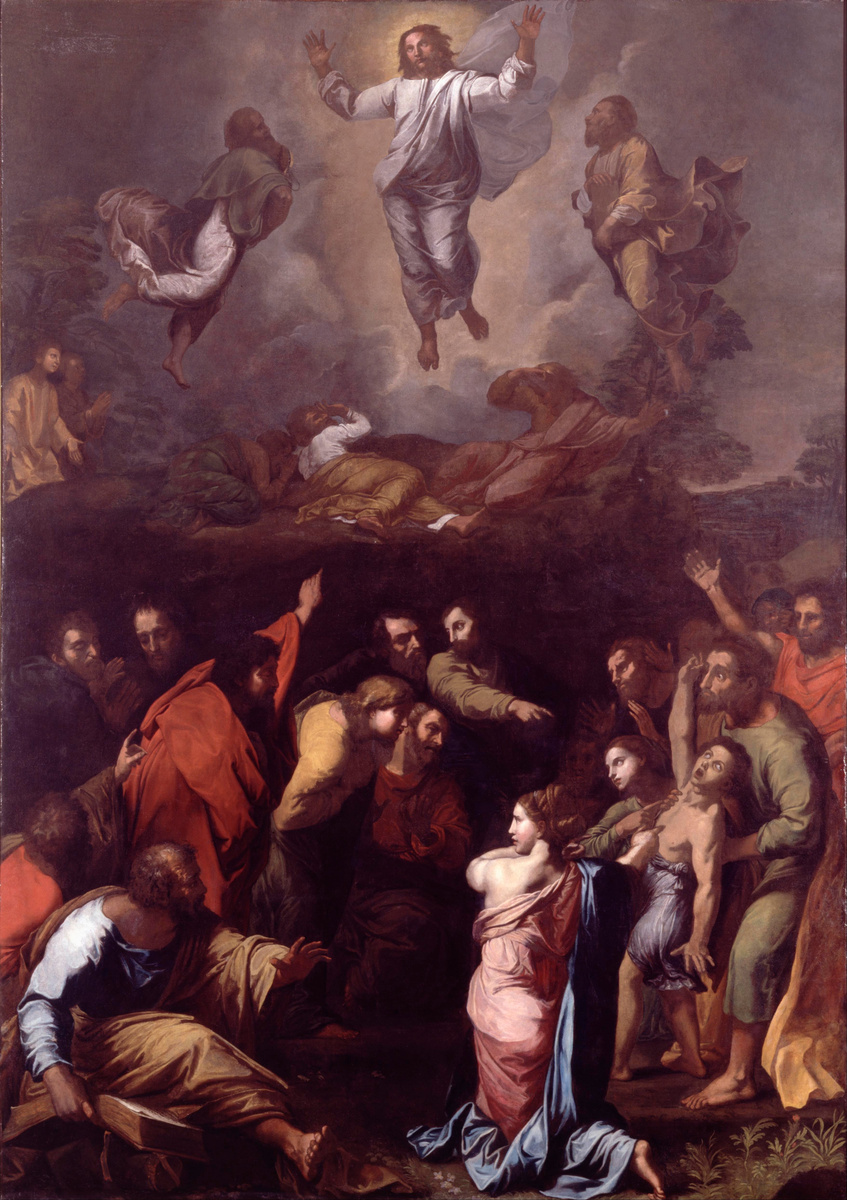
This is Raphael's Transfiguration, a large oil painting on canvas from the sixteenth century, now in the collection of Dulwich Picture Gallery in London.
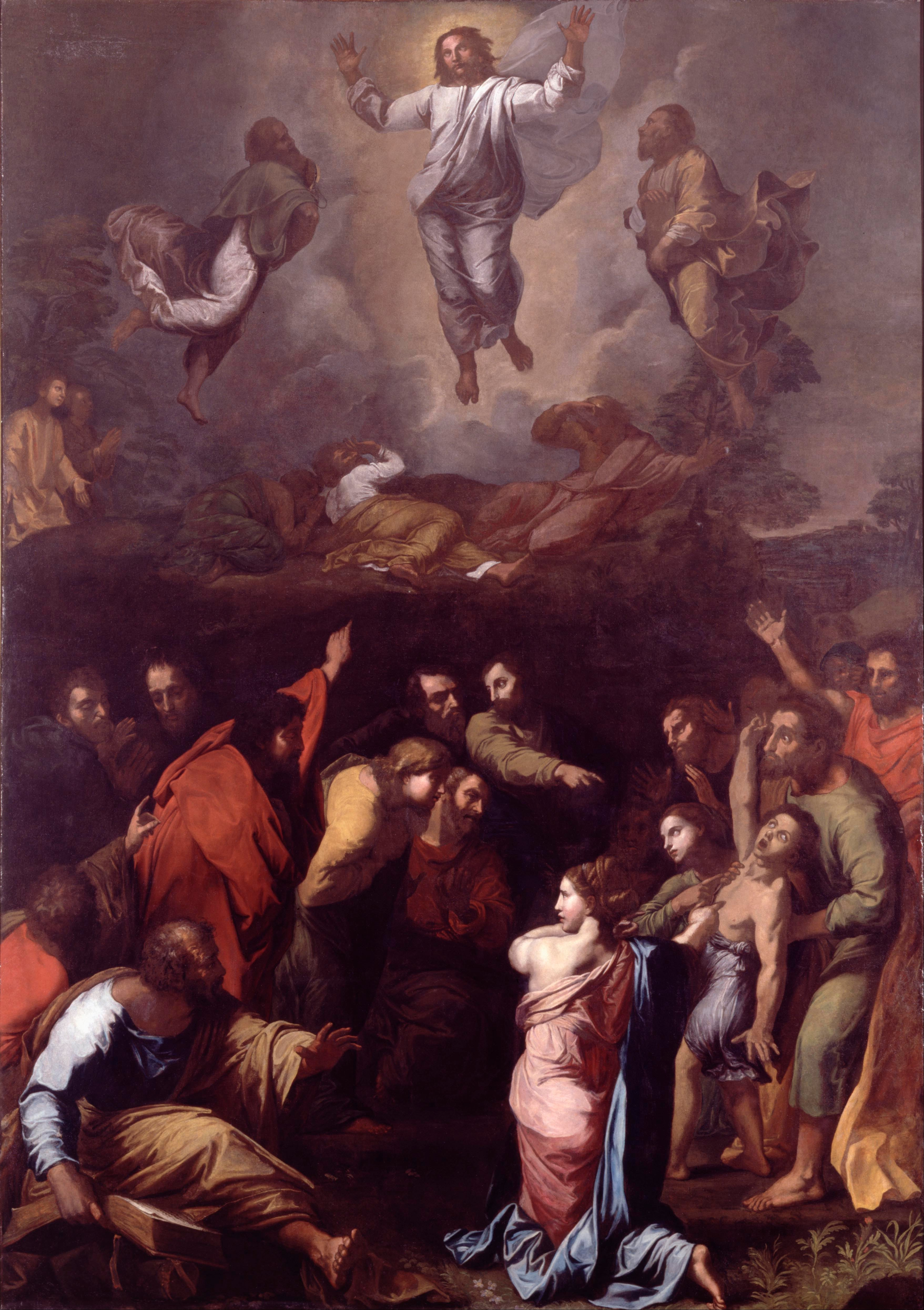
The subject is a single Gospel episode in two connected zones. Christ appears in glory above, and below him a possessed boy is brought forward for healing.
Your eye probably climbs the picture before it settles anywhere. Christ stands high on a mound, lifted above the group, while the disciples and the crowd press close at ground level.
The glowing figure and the darker, agitated bodies below belong to one scene, even though the space between them reads almost like a division.
The painting condenses a story that in the Gospels has an interval and a descent. Christ is shown transfigured, and below, a father has brought his possessed son to the disciples, who cannot cure him.
Raphael's composition lets both moments occupy one surface. The upper glory and the lower distress are not separate pictures; they are the two halves of the same event.
The boy is the visual counterweight to Christ. He is held or supported among the crowd, his body angled and unsettled, while the figures around him gesture toward him and toward the height above.
Those gestures tie the two registers together. The raised arms below and the calm, radiant figure above create a tension between helplessness and a promised cure.
The painting can be read as an image about mediation. The disciples below are asked to heal and cannot, so the crowd's attention is pushed upward to Christ.
What looks like a simple contrast between light and dark is also a contrast between human limit and divine power. That reading comes from the composition itself, not from anything the sources attribute to Raphael's private intention.
The object record places the work in the sixteenth century and describes oil on canvas, with dimensions of 3,766 by 2,648 millimetres. The same record gives the subject as the Transfiguration of Jesus, with Christ glorified above and the possessed boy below.
Its provenance is documented from B. Vandergucht before 1794, through a Christie's sale in London on 11 March 1796, lot 92, to Thomas Mills, who bought it and gifted it in 1796.
So the painting is not only a vision of glory. It is also a scene of unfinished business on the ground, where a boy waits and a crowd looks up.
That double subject, glory above and need below, is what holds the picture together and gives Raphael's Transfiguration its lasting force.