The story About 6 minutes to read
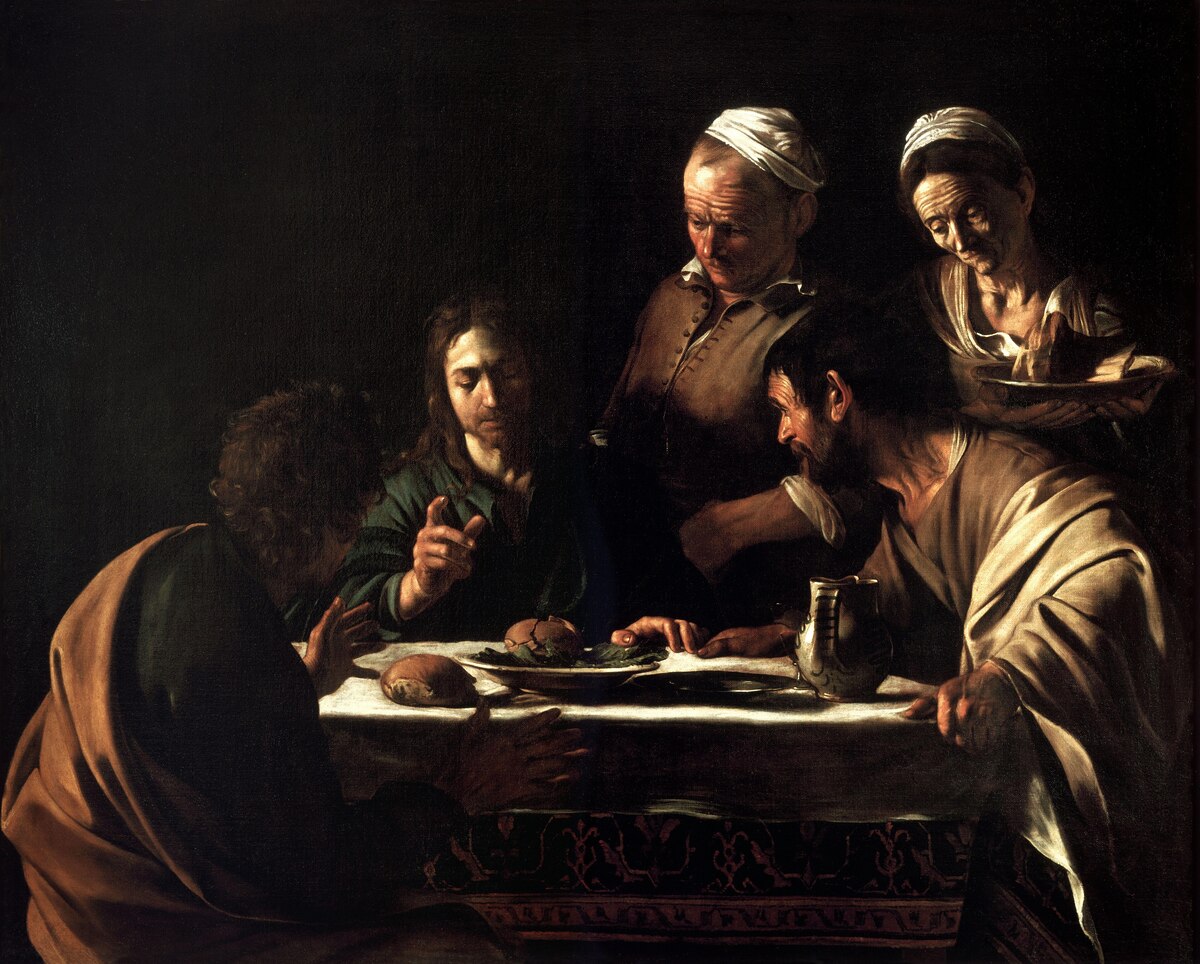
This is the Supper at Emmaus. Caravaggio paints the instant two travellers finally recognise the stranger who has walked beside them all day.
The story comes from the Gospel of Saint Luke. On the third day after the Crucifixion, two disciples walked to Emmaus and met the resurrected Christ, but they did not know him.
That evening at supper he took bread, blessed it, broke it, and gave it to them. Their eyes were opened, and they knew him, and he vanished.
Caravaggio shows the climax, the moment the disciples suddenly see what has been in front of them all along.
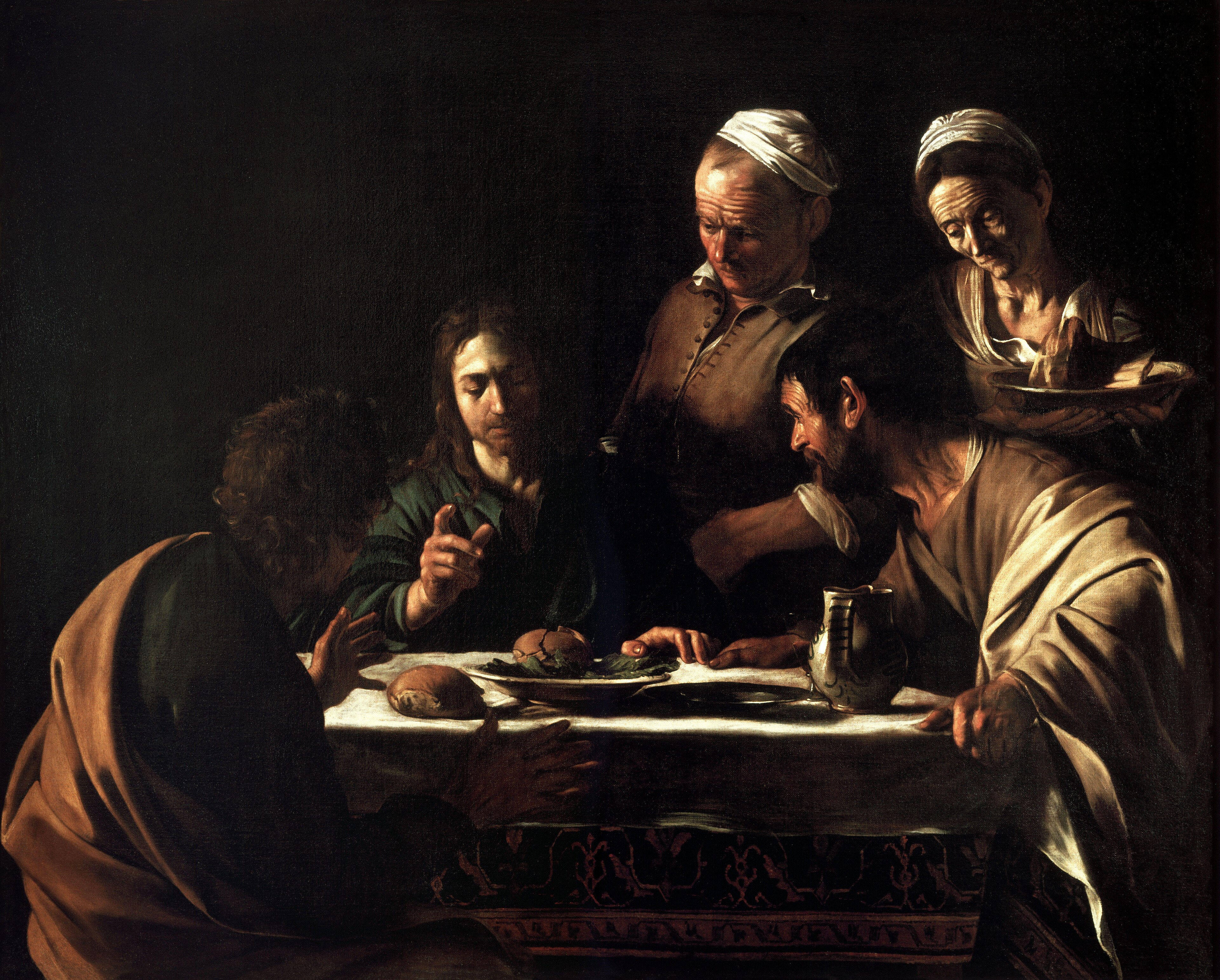
Christ sits at the centre, facing us across a square table. Two disciples sit to his left and right, and an innkeeper stands close by on the left, ready to serve.
The disciple on Christ's right is older, with a rugged profile, a hooked nose, a receding hairline and a grey beard. His arms are thrown wide open.
The other disciple sits with his back to us, gripping the arms of his wooden chair as if he is about to stand. Much of his face is hidden, but the tension in his arms shows his shock.
Christ raises his right arm out towards us, while his left hand rests on the table over a small loaf, blessing the bread.
The disciple with outstretched arms forms the shape of a cross with his body. The National Gallery reads this as a deliberate reference to the Crucifixion.
Christ himself is youthful and beardless, in contrast to the bearded, lined faces and ragged clothes of the disciples. They look like ordinary working men.
The table carries a still life of fruit, bread, a carafe and a roast bird. In front of us, the bowl of fruit casts a shadow shaped like a fish on the white cloth.
The Gallery interprets that fish-shaped shadow as a reference to Christ, and as an example of Caravaggio using light and shadow for symbolic meaning as well as realism.
Caravaggio received the commission in 1601, after his paintings of Saint Matthew in the Contarelli Chapel in Rome caused a public sensation.
It was made for Ciriaco Mattei, who with his brother Asdrubale was an enthusiastic patron and protector of the artist. They commissioned three works from him in 1601 and 1602.
The stark light and deep shadow, called chiaroscuro, heighten the drama of an otherwise ordinary room. The setting is plain, the revelation is not.
Christ's raised hand reaches out towards our space. The Gallery notes that it also pulls the viewer into the painting.
The surface realism makes the nearest disciple's hand appear to extend out of the canvas into our real space. That illusion depends on Caravaggio's close observation of ordinary things.
An empty place is left at the table, an invitation for the viewer to join the group.
The still life is not decoration. The fruit, bread and wine carry symbolic associations, and the fish-shaped shadow turns a passing effect of light into a sign of Christ.
So the painting holds two kinds of seeing at once. The disciples see at last who has been with them, and we are placed at the table to see it with them.
Caravaggio does not show the moment before or after. He fixes the second of recognition, and lets the light, the open arms and the empty place carry the meaning.
This is the 1601 Supper at Emmaus, oil on canvas, painted for Ciriaco Mattei and now in the National Gallery in London.
Caravaggio made a second, different Supper at Emmaus about 1606, now in the Pinacoteca di Brera in Milan. It is a separate work, not the painting in front of you.
The earlier canvas asks you to stand where the disciples stood, at the table, in the instant when the bread is blessed and the stranger is known.