Identity and catalogue
Link- Title
- The Flagellation of Christ
- Movement or period
- Italian Baroque
- Country or culture
- Italy
- Depicted subject
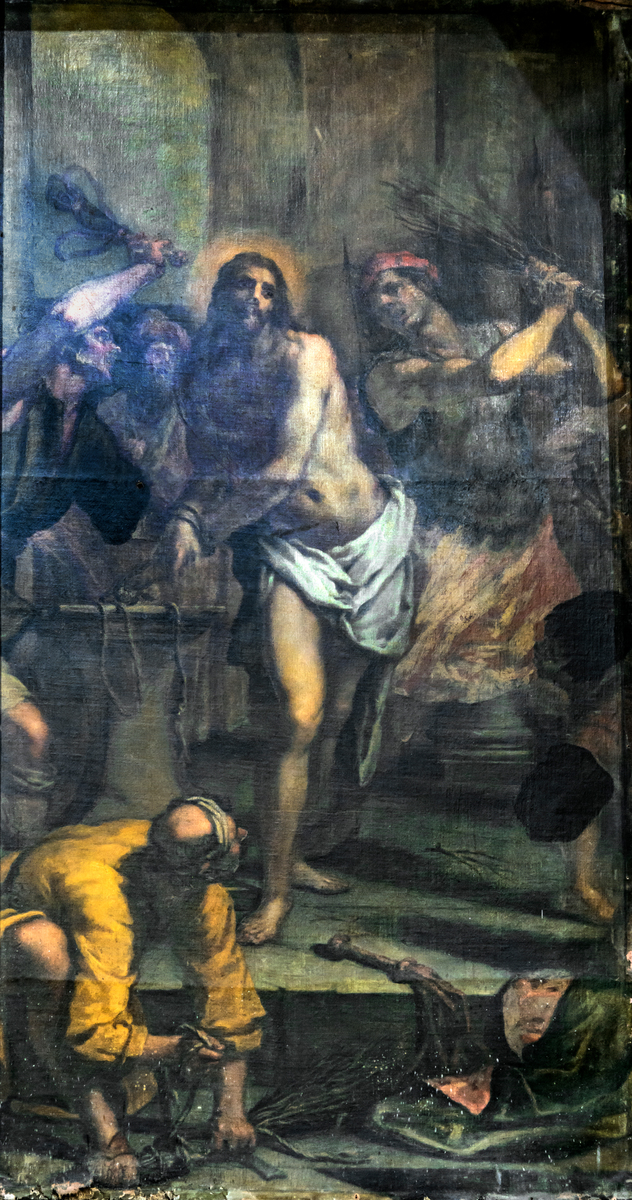
- The painting depicts the Flagellation of Christ, the episode in which Christ is bound and scourged before the Crucifixion. Christ stands at a low column, haloed and almost naked, while tormentors raise a knotted scourge and birch rods and a kneeling assistant gathers or knots the cords.
- Title variants
- Flagellation of Christ; Flagellation du Christ; Flagellazione di Cristo
- Support
- canvas
- Dimensions
- Unknown
Catalogue identity
The painting is catalogued as the Flagellation of Christ, a title also recorded in French as Flagellation du Christ and in Italian as Flagellazione di Cristo. It is attributed to Matteo Ponzone, whose life dates are given as 1583 to 1664, and the object is dated to circa 1622. This is the documented catalogue identity: an artist identification, a multilingual set of equivalent titles, and an approximate date. The attribution and the circa date are the framing facts that any further account of the picture must work within, and the three language forms of the title indicate that the object circulates in catalogues and photographic records across more than one linguistic tradition rather than under a single fixed name.(Didier Descouens, 2016, Summary, Artist; Summary, Title; Summary, Date)
Matteo Ponzone (1583–1664) is the artist identified for the Flagellation of Christ at Madonna dell'Orto.(Didier Descouens, 2016)
The painting is titled Flagellation of Christ, also given in French as Flagellation du Christ and in Italian as Flagellazione di Cristo.(Didier Descouens, 2016)
Subject and iconography
LinkThe object and its documentation
Visual observation
The Flagellation of Christ at the church of Madonna dell'Orto in Venice is attributed to Matteo Ponzone and dated to about 1622, and it is executed in oil on canvas. The painting hangs on the left side of the nave of that church, so the picture is encountered within a working ecclesiastical interior rather than a museum hang, which is relevant to how its shadowed background and emphatic lighting operate at a distance and in situ. The identification of the artist, the title in its several language forms, the approximate dating, the medium and the location are all parts of a single object record assembled from the Wikimedia Commons documentation of the work. The surviving photographic record of the painting was made by Didier Descouens on 31 May 2016 under a CC BY-SA 4.0 licence, which means the close reading of composition offered below is grounded in a specific, dated photographic document rather than in an unspecified reproduction.(Didier Descouens, 2016, Summary, Medium)
Composition and lighting
The subject depicted is the episode in which Christ is bound and scourged before the Crucifixion. In the picture Christ stands bound at a low column; he is shown with a halo and almost naked, his head tilts and his torso twists, and his hands are tied with cords. He is illuminated against a shadowed interior. The composition centers on this bound figure at the column, and the contrast between his lit body and the dark interior is what organizes the picture's emotional and narrative weight. Any account of the flagellation here has to begin from that structural fact: the victim at the column, not the surrounding action, is the fixed point around which everything else is arranged.(Didier Descouens, 2016)
The binding of Christ is described in more than one register. His hands are tied with cords, and his wrists are lashed with a rope that trails away and dangles in a long loop toward the steps. That trailing, falling line is a compositional device as much as an item of narrative detail: it links the bound victim, the column and the men working below into a single connected action, so that the binding itself, and not only the blows, becomes something the eye follows across the canvas. The evidence establishes the line and its direction toward the steps; it does not establish what Ponzone intended the loop to signify, and that inference should not be pushed beyond what is visible.(Didier Descouens, 2016)
Figures, tools and the orchestration of the action
The implements of the scourging are distributed across the two sides of the composition. At the upper left a dark figure throws an arm upward, gripping a knotted rope scourge about to fall. On the right a bare-shouldered man in a red cap swings a bundle of long birch rods with both hands. Below and around these two principal agents, a crouched, balding man in a bright ochre-yellow jacket bends to gather or knot the cords at the base of the column, and in the lower right a man in a dark green hooded garment crouches low holding a bundle of switches that extends diagonally across the foreground. Taken together, the raised implements and the kneeling or crouching assistants prepare and enact the flagellation around Christ. The description distinguishes the knotted rope scourge from the bundle of birch rods and the switches, and it locates each in a distinct zone of the canvas; the identification of the materials of the instruments belongs to this descriptive record and should not be expanded into claims about actual implements used in flagellations beyond what the picture shows.(Didier Descouens, 2016)
Interpretation
Reading these details together, the picture presents the flagellation as a single orchestrated moment rather than as a sequence of blows. The instruments on the left and right, the assistants at the base of the column, and the directional light all converge on the figure at the column, and the surrounding hands and weapons point back toward him. The distribution of the flails, rods and switches around the periphery, with the lit body at the centre, is what produces the sense of a coordinated action; the evidence supports this as a description of the composition's structure, while the further claim that the artist deliberately constructed a unified dramatic instant is an interpretation rather than a documented statement by the painter.(Didier Descouens, 2016)
Visual observation
The painting shows Christ bound at a low column, with a halo and almost naked, head tilted and torso twisting, hands tied with cords, illuminated against a shadowed interior.(Didier Descouens, 2016)
Christ's wrists are lashed with a rope that trails away and dangles in a long loop toward the steps.(Didier Descouens, 2016)
At the upper left, a dark figure throws an arm upward, gripping a knotted rope scourge about to fall.(Didier Descouens, 2016)
On the right, a bare-shouldered man in a red cap swings a bundle of long birch rods with both hands.(Didier Descouens, 2016)
A crouched, balding man in a bright ochre-yellow jacket bends to gather or knot the cords at the base of the column.(Didier Descouens, 2016)
In the lower right, a man in a dark green hooded garment crouches low, holding a bundle of switches that extends diagonally across the foreground.(Didier Descouens, 2016)
Condition and conservation
LinkThe dated photographic record
The condition record for Matteo Ponzone's Flagellation of Christ at the church of Madonna dell'Orto in Venice is anchored by a photograph taken by Didier Descouens on 31 May 2016, released under a CC BY-SA 4.0 licence. This image is the evidentiary basis for the visual observations that accompany the object record: it captures the oil-on-canvas painting as it appeared on that date, in its location on the left side of the nave of Madonna dell'Orto, and serves as the dated state record against which any account of the picture's condition must be measured. Because the photograph is a licensed reproduction by a named photographer, its evidentiary value is inseparable from its own documentation: the medium of the painting (oil on canvas) and the conditions under which it was recorded are both established by the same file.(Didier Descouens, 2016, Photograph; Summary, Medium)
The photograph was captured with a Nikon D800E, and the Wikimedia Commons file it belongs to was promoted as a valued image in March 2017. These details matter for conservation research because they describe the imaging technology and the editorial review that the file passed through, not merely its subject. A high-resolution camera and a community assessment of image quality support the use of this photograph as a reliable visual record of the painting's appearance in 2016, although the evidence does not state what conservation treatment, if any, the painting had received before or after that date.(Didier Descouens, 2016, Photograph)
Visual condition observations of 2016
The photograph documents the painting's visible composition in 2016 rather than a later or earlier state. It shows Christ bound at a low column, haloed and almost naked, his head tilted and torso twisting, hands tied with cords and illuminated against a shadowed interior; the cord lashing his wrists trails away and dangles in a long loop toward the steps. At the upper left a dark figure throws an arm upward gripping a knotted rope scourge, on the right a bare-shouldered man in a red cap swings a bundle of long birch rods, a crouched balding man in a bright ochre-yellow jacket bends at the base of the column, and in the lower right a man in a dark green hooded garment crouches with a bundle of switches extending across the foreground. These are observations of the picture as photographed on 31 May 2016, and they should not be treated as a description of the painting today.(Didier Descouens, 2016, Photograph)
Scope and limits of the condition record
Interpretation
Within the limits of the supplied record, the condition evidence for this painting consists of the dated photograph and the metadata surrounding it; no treatment history, structural assessment, pigment analysis, environmental measurement or conservation intervention is documented. The available evidence identifies the artist as Matteo Ponzone (1583–1664), dates the work to circa 1622 and places it in the collection of the church of Madonna dell'Orto on the left side of the nave. Any statement about damage, restoration, lining, cleaning or display conditions beyond what the 2016 photograph shows would exceed the evidence assembled here. The responsible account is therefore a dated one: what the painting looked like when Descouens photographed it, and what that photograph's own technical and licensing record establishes.(Didier Descouens, 2016, Photograph; Summary, Medium)
The supplied photograph of the painting was taken by Didier Descouens on 31 May 2016 and is licensed under CC BY-SA 4.0.(Didier Descouens, 2016)
Reception and literature
LinkEarly admiration and the votive afterlife of the image
According to the account transmitted by Wikimedia Commons, the Flagellation of Christ at the church of Madonna dell'Orto in Venice is attributed to Matteo Ponzone (1583-1664), dated to around 1622, and executed in oil on canvas. The painting is reported to hang on the left side of the nave of the church it was made for, so its earliest documented form of reception is its continuing presence at the site of its original destination, where it is seen among the other works lining the nave rather than as an isolated museum object. This condition of display matters for the history of reception because the picture was never detached from its devotional setting: the account of its location is inseparable from the account of its making, and the later photographic record discussed below derives from exactly this in-situ arrangement.(Didier Descouens, 2016, Structured data)
Reproduction and the modern documentation of the painting
The later reception of the painting is documented above all through photography. The supplied photograph of the work was taken by Didier Descouens on 31 May 2016 and is licensed under CC BY-SA 4.0; the Wikimedia Commons file record identifies it as a valued image promoted in March 2017, captured with a Nikon D800E. These are the concrete circumstances under which the picture has circulated most widely in recent years: not through the church itself but through an openly licensed digital surrogate. The key details of date, equipment, photographer and licensing status belong to the file, not to the painting, and the Commons record also supplies the painting's titles, in English as Flagellation of Christ, in French as Flagellation du Christ, and in Italian as Flagellazione di Cristo, which is how the object is indexed for multilingual audiences.(Didier Descouens, 2016, Structured data)
Interpretation
Because the photographic record is dated and attributed while the painting's own documentation is not, the two kinds of evidence should be kept distinct. The Commons record is a photograph and object entry consulted in part, not a catalogue raisonne or archival document for the painting's early history; it anchors the work to a named artist, a circa 1622 date, an oil-on-canvas medium and a specific church location, but the earliest phases of the painting's reception at Madonna dell'Orto are not otherwise established by the supplied material. Modern viewing of the Flagellation is therefore mediated by a 2016 photograph promoted as a valued image in 2017, and this is the form in which the object now reaches most of its audience.(Didier Descouens, 2016, Structured data)
The Wikimedia Commons file is a valued image promoted in March 2017, captured with a Nikon D800E.(Didier Descouens, 2016)
Interpretations and debates
LinkObject and Attribution
Interpretation
Matteo Ponzone's Flagellation of Christ at the church of Madonna dell'Orto in Venice carries a date of about 1622 and is executed in oil on canvas; the work is recorded under the English title Flagellation of Christ, in French as Flagellation du Christ and in Italian as Flagellazione di Cristo, and it hangs on the left side of the nave. The object record identifies the maker as Matteo Ponzone, whose dates are given as 1583 to 1664. These are the co-ordinates within which any reading of the picture has to operate: a Venetian church interior setting of the early 1620s, a canvas rather than a panel, and a painter whose career is documented in the object record only by those birth and death years. Nothing in the supplied evidence describes a commission, a patron, a payment or a documented installation, so the circumstances that produced the canvas remain outside the account, and the dating to about 1622 stands as the record's attribution rather than a fixed documentary point.(Didier Descouens, 2016)
Attributed Readings and Their Limits
The reading that the composition centers on the bound Christ at the column, whose illuminated body against the shadowed interior forms the emotional and narrative core of the picture, belongs to the object record itself and is an interpretation of the visible arrangement rather than a statement about the painter's intention. The same holds for the companion reading that the raised implements, the knotted scourge on the left and the birch rods on the right, together with the kneeling assistants, prepare and enact the flagellation around Christ. Both readings are consistent with the described placement of the figures and the light, and both are attributed to the record rather than presented as documentary fact. It is worth separating what the evidence shows from what it concludes: that the four surrounding men carry or handle instruments, and that Christ is illuminated against a darker interior, are observations, while the claim that these elements form the emotional and narrative core is a synthesis drawn from them. The record offers no testimony from the artist, no contemporary description and no programme of iconographic sources, so the bound figure's centrality is best described as the record's interpretation of how the picture is composed, not as evidence of what Ponzone privately intended.(Didier Descouens, 2016)
The binding itself carries the visual argument of the canvas. The rope at Christ's wrists trails away and dangles in a long loop toward the steps, so that the cord which restrains him also links the victim, the column and the men working below into one connected action. This is a compositional fact established by observation, and it explains why the picture can be described as an orchestrated moment in which the instruments, the assistants and the light all converge on Christ at the column, rather than as an array of separate incidents. The crouched man who bends to gather or knot the cords at the base of the column belongs to the same chain: his task concerns the binding, not the blow. Reading the loose, falling line of the rope as the thread that carries the eye across the canvas is an interpretive step, but it follows closely from the visible geometry, and it complements the record's emphasis on the illuminated body as the narrative core. The two readings are not in competition: one locates the picture's center of gravity in the lit figure, the other in the connective line that reaches out from him toward the assistants.(Didier Descouens, 2016)
The Photographic Record
Within a larger history of art and material culture, the canvas belongs to a long visual tradition of representing the flagellation as a coordinated act performed by named types of assistants with recognizable instruments. The record's inventory of those instruments and figures, the knotted rope scourge raised at the upper left, the bundle of long birch rods swung at the right, the switches held low in the foreground, and the men who crouch and kneel around the column, is what allows the picture to be read as a single orchestrated moment rather than a static portrait of a bound figure. Ponzone's placement of the suffering figure at the center, with the surrounding hands and weapons pointing back to him, is the record's account of how that convergence is achieved. What the evidence does not supply is the larger Venetian or devotional context in which the picture hung, the response of its original viewers, or the iconographic sources on which the painter drew; those remain outside the present account. The painting matters here because the record preserves both what can be seen and what the record itself concludes from seeing it, and because the 2016 photograph fixes that double record for later research.(Didier Descouens, 2016)
The composition centers on the bound Christ at the column, whose illuminated body against the shadowed interior forms the emotional and narrative core of the picture.(Didier Descouens, 2016)
The raised implements, the knotted scourge on the left and the birch rods on the right, together with the kneeling assistants, prepare and enact the flagellation around Christ.(Didier Descouens, 2016)
Collection and display
LinkCollection and location
Matteo Ponzone's Flagellation of Christ, a painting dated circa 1622 and executed in oil on canvas, belongs to the collection of the church of Madonna dell'Orto in Venice, Italy. Within that church the picture hangs on the left side of the nave, so the documented collection history is inseparable from a specific architectural setting rather than a museum or private context. Two distinct categories of information establish this placement: the object record assigns the work to the church's holdings, while the file title of the Wikimedia Commons record and its photographed view locate it physically along the left side of the nave. Both the collection attribution and the topographical placement derive from the same documentation, so they are best treated as related facets of a single provenance and display account rather than independent confirmations. The evidence does not specify when the painting entered the church, whether it was commissioned for that position, or whether it has ever been moved, so the account stops at a present-tense description of ownership and location. Nothing in the supplied material records prior owners, transfers, or display elsewhere, and no gap in the record should be filled by assumption.(Didier Descouens, 2016, Summary, Collection; File title)
The photographic record and its limits
Interpretation
The surviving visual documentation of the painting is a photograph taken by Didier Descouens on 31 May 2016 and released under a CC BY-SA 4.0 licence. The image was captured with a Nikon D800E and, in March 2017, was promoted as a valued image on Wikimedia Commons. This provenance of the photograph matters for research on the object because nearly all of the fine-grained visual observations available here, from the tilt of Christ's head to the colour of a tormentor's jacket, are mediated by that single 2016 capture. The photographer is identified as the author of the image record, not of the painting, and the image's licensing and quality status say nothing about the painting's condition, its earlier appearance, or its conservation history, none of which the evidence addresses. Reading the picture through this one high-resolution photograph means that the account of its iconography is as much a record of a modern reproduction as of a seventeenth-century canvas, and any claim about colour, lighting, or surface should be understood as describing the painting as it appeared in that photograph.(Didier Descouens, 2016, Summary, Collection; File title)
Documented values and qualified estimates
LinkThe object and its documentation
Interpretation
The object in question is the Flagellation of Christ by Matteo Ponzone, an Italian Baroque painter active in Venice whose life dates are recorded as 1583 to 1664. The picture is oil on canvas, dated circa 1622, and it belongs to the church of Madonna dell'Orto in Venice, Italy, where it hangs on the left side of the nave. The work is known under several titles across languages: Flagellation of Christ in English, Flagellation du Christ in French, and Flagellazione di Cristo in Italian. These are the fixed coordinates of the object, and they matter because every valuation statement about it must be measured against them: a dated, located, single-canvas old-master painting in an ecclesiastical collection, with no other documented transactional history in the supplied evidence.(Didier Descouens, 2016)
The primary photographic record of the painting is a Wikimedia Commons file described as a valued image promoted in March 2017. The photograph was taken by Didier Descouens on 31 May 2016 and is licensed CC BY-SA 4.0; the capture was made with a Nikon D800E. This documentation matters to the object's research history because the evidence explicitly separates the photograph (a 2016 digital capture, later promoted) from the painting itself (circa 1622). Any claim about the picture's appearance rests on this photographed record, not on the painting's own physical inspection, and the file's annotations are accordingly evidence about a reproduction as much as about the canvas.(Didier Descouens, 2016)
Figure, instruments and action
The recorded composition centers on Christ bound at a low column. He is haloed and almost naked, his head tilted and his torso twisting, his hands tied with cords, and he is illuminated against a shadowed interior. The account stresses that this illuminated body against the dark framing holds the picture together and forms its emotional and narrative core. The lighting is therefore not incidental description but the structural device the evidence identifies as organizing the scene, with Christ at the center and the surrounding action arranged around him.(Didier Descouens, 2016)
The agents of the flagellation are distributed across the canvas in a specific arrangement. At the upper left, a dark figure throws an arm upward, gripping a knotted rope scourge about to fall. On the right, a bare-shouldered man in a red cap swings a bundle of long birch rods with both hands. A crouched, balding man in a bright ochre-yellow jacket bends to gather or knot the cords at the base of the column, and in the lower right a man in a dark green hooded garment crouches low, holding a bundle of switches that extends diagonally across the foreground. The raised implements are split between the two sides, the knotted scourge left and the birch rods right, and together with the kneeling and crouching assistants they prepare and enact the flagellation around Christ. The instruments and the bodies handling them are the mechanism by which the narrative converges on the bound figure.(Didier Descouens, 2016)
One detail is recorded with unusual specificity: Christ's wrists are lashed with a rope that trails away and dangles in a long loop toward the steps. The account treats this loose, falling line as tying the victim, the column, and the men below into one connected action, so that the binding, and not only the blows, becomes the subject followed across the canvas. Read against the distribution of the scourge, rods, and switches, this rope describes a composition in which the restraint itself is as visually active as the weapons, linking the human figures through a single linear motif rather than through discrete episodes of violence.(Didier Descouens, 2016)
As a whole, the account characterizes the picture as the flagellation rendered as a single orchestrated moment, in which instruments, assistants, and light all converge on Christ at the column; Ponzone places the suffering figure at the center and lets the surrounding hands and weapons point back to him. This is a description of compositional method rather than of iconographic novelty, and it should be weighed as such. The subject, the bound and scourged Christ before the Crucifixion, is the conventional episode; what the evidence identifies as distinctive is the coordination of the picture's parts around that center, not a new subject or a documented innovation in the painter's biography.(Didier Descouens, 2016)
The valuation statement and its limits
The only valuation figure in the supplied evidence is a calculated working insurance estimate: a range of US$300K to US$1.5M, recorded as a working calculation generated on 2026-10-16. Its methodology is stated as a broad working range for manual insurance review, built only from confirmed context in the supplied excerpts: Matteo Ponzone (1583 to 1664), Italian Baroque painter active in Venice, oil on canvas, circa 1622, held at Madonna dell'Orto in Venice. By its own terms the range reflects an old-master work of modest art-historical prominence by a secondary Venetian Baroque painter, and it exists precisely because no documented sale, auction, appraisal, or acquisition price appears in the supplied sources. The upper bound is described as kept conservative, and no exact dimensions or condition report were available.(Didier Descouens, 2016)
The estimate's qualification is explicit and should be preserved at full strength: it is a model-generated working insurance range for manual review only, not an official insurance value, appraisal, auction result, or sale price. It is based solely on the supplied public context, does not rely on comparable sales, private insurance records, or confirmed market data, and was produced without dimensions, condition, provenance, or exhibition history. The stated remedy is verification with a qualified appraiser and the institutional record before relying on any figure. This means the monetary range is evidence about how the object was characterized for a specific administrative purpose, not evidence about the object's market value; the number should never be detached from the conditions under which it was generated.(Didier Descouens, 2016)
Taken together, the evidence establishes a sharp asymmetry between what is documented about the object and what is documented about its value. The object's identification, authorship, date, medium, location, and visible composition are all specified, down to the photograph's author, date, license, and camera; its price history, by contrast, is entirely absent, and the single figure that exists is an explicitly non-authoritative review range. The painting therefore matters within a larger history of art and material culture less as a priced commodity than as a located, dated, publicly photographed work of the Venetian Baroque whose present documentary record is rich in description and silent on transaction. Any future valuation claim will have to displace the qualified 2026 working estimate with an appraisal, an institutional record, or comparable sales, none of which the supplied evidence contains.(Didier Descouens, 2016)
Working estimate
Calculated working insurance estimate, not a sale price: Estimated value: US$300K to US$1.5M Recorded date: Working calculation, generated 2026-10-16. Methodology: Broad working range calculated for manual insurance review, using only confirmed context from the supplied excerpts: Matteo Ponzone (1583 to 1664), Italian Baroque painter active in Venice, oil on canvas, circa 1622, held at Madonna dell'Orto in Venice. The range reflects an old-master work of modest art-historical prominence by a secondary Venetian Baroque painter, with no documented sale, auction, appraisal, or acquisition price in the supplied sources. The upper bound is kept conservative and no exact dimensions or condition report were available. This is a model-generated estimate for manual review only, not an official insurance value. Qualification: This is a model-generated working insurance range for manual review only. It is not an official insurance value, appraisal, auction result, or sale price. It is based solely on the supplied public context and does not rely on comparable sales, private insurance records, or confirmed market data. No dimensions, condition, provenance, or exhibition history were available. Verify with a qualified appraiser and the institutional record before relying on any figure.(Didier Descouens, 2016)