Identity and catalogue
Link- Movement or period
- Italian Baroque
- Country or culture
- Italy
- Depicted subject
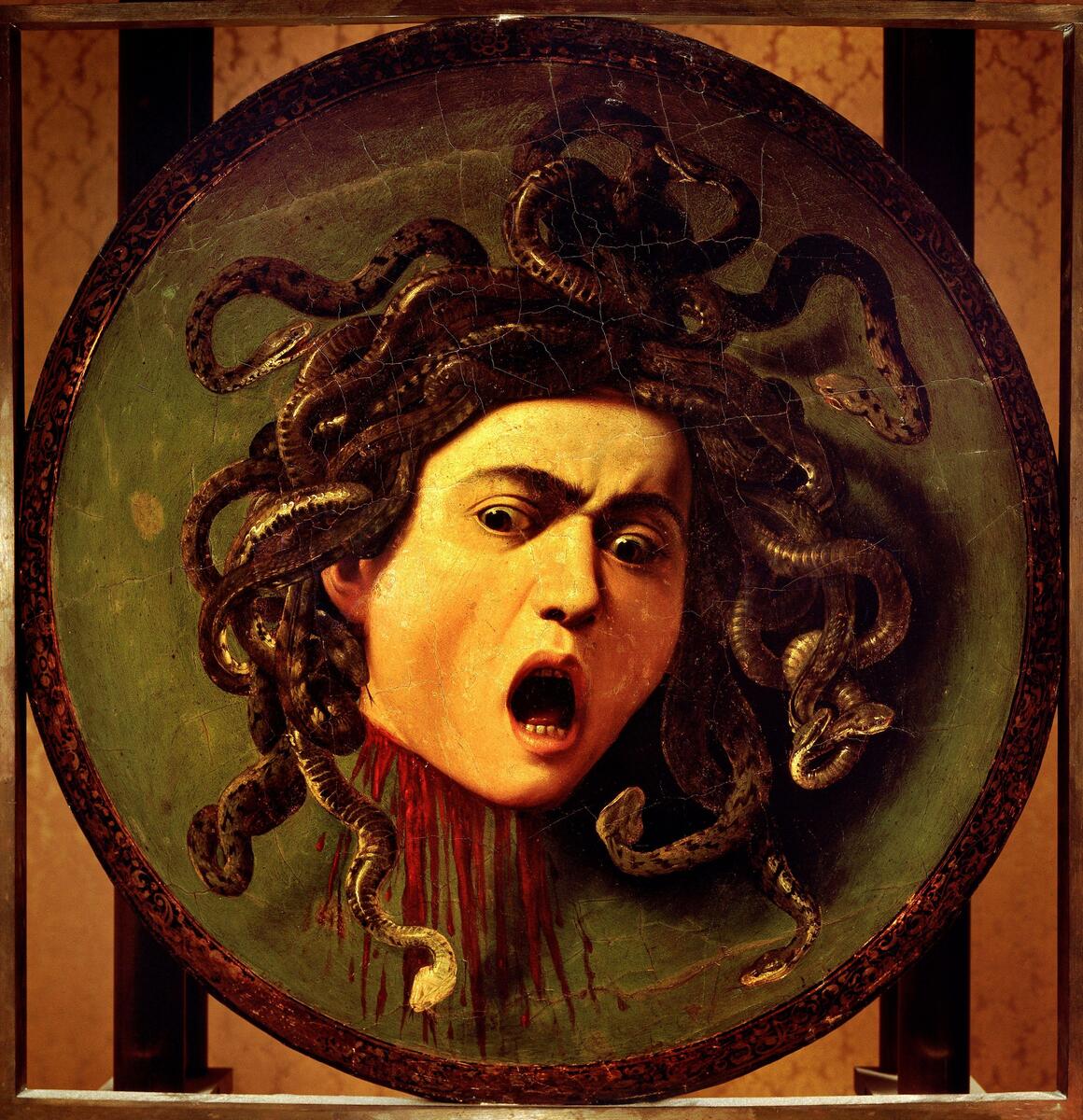
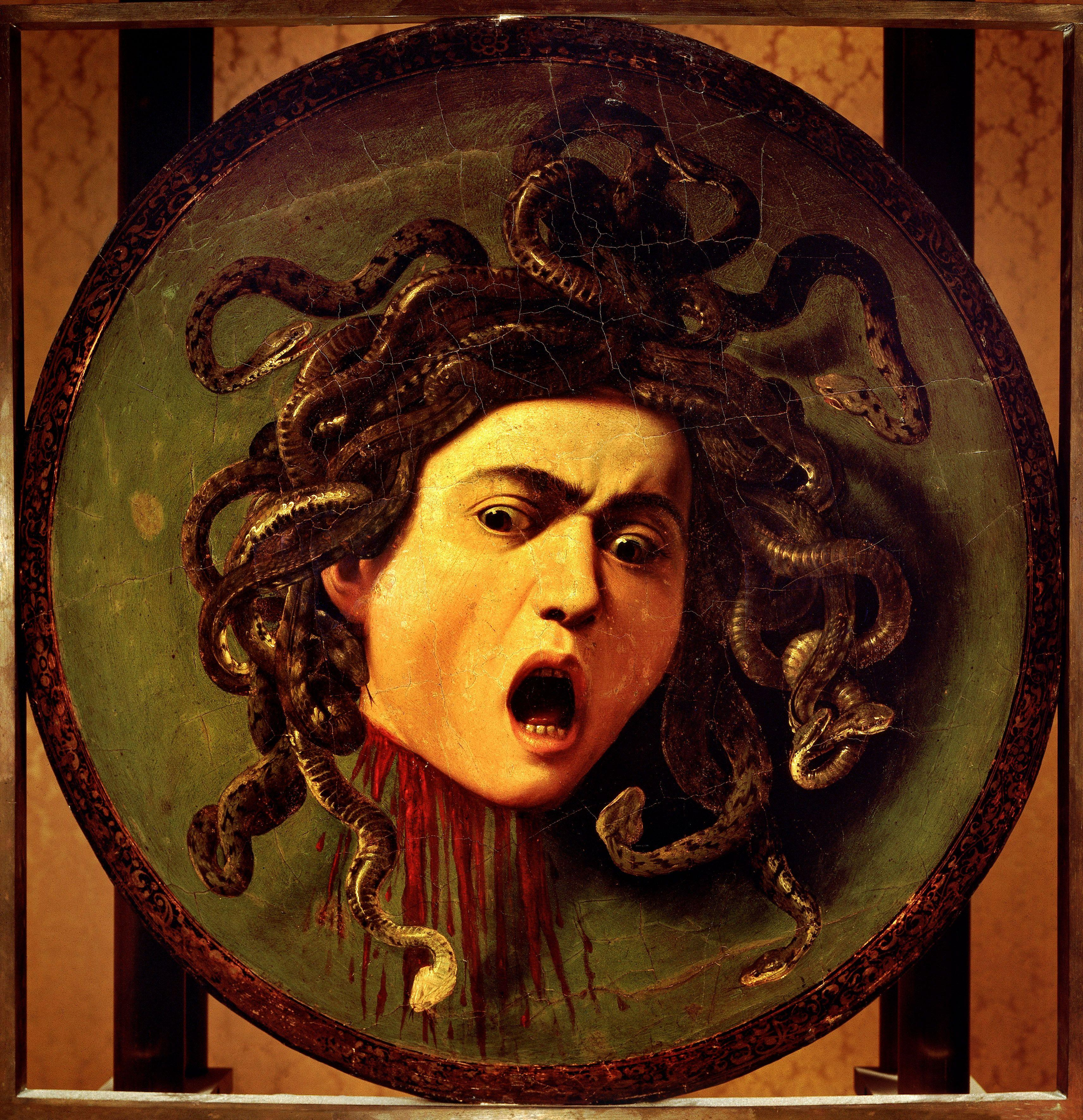
- A frontal, close-up head of Medusa, the Gorgon of Greek myth, with serpents coiling in place of hair and an open-mouthed scream, presented as a painted tondo shield.
- Title variants
- Głowa Meduzy; Head of Medusa
- Accession number
- 1351
- Support
- Canvas
Catalogue identification
The supplied file record catalogues the work under the title Medusa, attributed to Caravaggio, and it supplies the fuller forms of that name as Michelangelo Merisi da Caravaggio and, as birth name, Michelangelo Merisi. The same record classifies the object type as both a painting and a tondo, that is, a round composition, and assigns it to the genre of mythological painting, a classification that follows from the subject named in the title field rather than from any documented commission or setting. Within the record the identification of the maker and the identification of the subject sit at the same level: the title names Medusa, while the artist field names Caravaggio, and the record offers no further description of how the two are related beyond the act of attribution itself.(Wikimedia Commons: Medusa, n.d., Summary section, Artist field; Object type and Genre fields; Title field)
The recorded date is circa 1598, a qualification that matters because it places the canvas near the opening of the artist's documented working period rather than at its close. The same record gives Caravaggio's life dates as 29 September 1571 to 18 July 1610, with birth in Milan, death at Porto Ercole, and a work period of 1593 to 1610, and it describes him as an Italian painter. Those dates establish only a broad frame within which a date of about 1598 is plausible. They do not in themselves certify the year of execution, and the catalogue formulation should be read as an approximate dating rather than a documented one. The date assigned to the object and the dates assigned to the artist are distinct pieces of catalogue information, and the object date carries its own uncertainty marker that the artist's dates do not.(Wikimedia Commons: Medusa, n.d., Date field; Artist field, Date of birth/death line; Artist field, Description line)
The record states the medium as oil on canvas, which is consistent with its object type of painting, and gives the dimensions as fifty-five centimetres in height by sixty centimetres in width, equivalently 21.6 by 23.6 inches. The width therefore slightly exceeds the height, a difference that a round or near-round format would absorb visually, and the numbers are supplied in both metric and imperial units in the record. The record further lists the work in the Uffizi Gallery collection in Florence under accession number 1351. The record does not give an inscription, a signature, a commission, an original setting or a provenance interval, and none of those should be inferred from the fields it does supply.(Wikimedia Commons: Medusa, n.d., Dimensions field)
The file record and its reference apparatus
The reference apparatus attached to the file is itself part of the record's history and should be distinguished from the object's own catalogue data. The source is a Wikimedia Commons file page supporting a self-scanned photographic reproduction of a two-dimensional public domain work, released under a public domain mark; the original uploaded image measures 3,425 by 3,543 pixels and has a file size of 2.45 megabytes. The page states that the work of art is in the public domain because its author died in 1610, with the copyright term measured by the author's life plus one hundred years or fewer. It also cites the publication 1001 Paintings You Must See Before You Die at page 205 as a reference. That citation is catalogued here as background only: no author, publisher or edition is supplied, the publication was not consulted directly, and it supports no claim about the object's date, attribution or physical history beyond the existence of a later popular-survey mention.(Wikimedia Commons: Medusa, n.d., Object type and Genre fields)
Interpretation
Read together, the fields establish a compact set of certainties and a larger set of silences. What is documented is a round oil painting on canvas of mythological subject, titled Medusa and attributed to Caravaggio, dated to about 1598, measuring fifty-five by sixty centimetres, held in the Uffizi in Florence as accession number 1351. What is absent is equally consequential: the record names no patron, no original location, no inscription and no physical description of the surface. The mythological genre classification and the round format are the two structural facts that any account of the work's meaning must reckon with, and both come from the catalogue rather than from a documented commission. The attribution to Caravaggio and the approximate date are the record's claims about authorship and chronology, and they are the kind of claim that later scholarship, connoisseurship or technical examination could confirm, refine or dispute; within the supplied evidence they stand as catalogue assertions.(Wikimedia Commons: Medusa, n.d., Summary section, Artist field; Date field; Object type and Genre fields; Dimensions field; Title field)
The supplied file record identifies the work as Medusa by Caravaggio, with alternative names Michelangelo Merisi da Caravaggio and the birth name Michelangelo Merisi.(Wikimedia Commons: Medusa, n.d.)
The supplied record gives the dimensions as height 55 centimetres, equal to 21.6 inches, and width 60 centimetres, equal to 23.6 inches.(Wikimedia Commons: Medusa, n.d.)
The Object and Its Catalogued Identity
The supplied record identifies this work as Medusa by Caravaggio, with the alternative names Michelangelo Merisi da Caravaggio and the birth name Michelangelo Merisi, and classifies the object type as both a painting and a tondo, a round composition. The same record gives the genre as mythological painting, the medium as oil on canvas, and the dimensions as 55 centimetres in height (21.6 inches) and 60 centimetres in width (23.6 inches). It lists the work in the Uffizi Gallery collection, Florence, under accession number 1351, and dates it to circa 1598. These are the catalogue facts that any discussion of the object's circumstances has to start from: a small, round, oil-on-canvas mythological picture, held in a public Florentine collection, whose attribution and subject are secure in the supplied record even though the circumstances of its making are not described there.(Wikimedia Commons: Medusa, n.d., Artist field, Date of birth/death line; Artist field, Description line)
The record describes Caravaggio as an Italian painter and gives his life dates as 29 September 1571 to 18 July 1610, with birth in Milan, death at Porto Ercole, and a documented work period running from 1593 to 1610. Placing a canvas of about 1598 against that span puts it in the earlier part of the documented career rather than near its end, when the artist's Roman commissions and later travels had already made his name. The catalogue therefore establishes that the picture belongs to a period of roughly five to seven years after the start of recorded activity, a phase in which the record's own chronological range offers context but not a specific commission.(Wikimedia Commons: Medusa, n.d., Artist field, Date of birth/death line; Artist field, Description line)
What the record does not supply is as important as what it does. It names the subject in both the file title and the title field, and it identifies artist, genre, medium, dimensions, date and collection, but it records no commission, no patron and no original setting. It says nothing about who ordered the work or where it first hung. The narration of the object has sometimes treated the round, shield-like shape as evidence of a specific commission history, but the supplied documentation does not establish that; the tondo form is recorded as part of the object type, an observation about the physical format, not as a document about who paid for it or why.(Wikimedia Commons: Medusa, n.d., Artist field, Date of birth/death line)
The record cites the publication 1001 Paintings You Must See Before You Die at page 205 as a reference, without supplying an author, publisher or edition for that volume, and the work was not consulted directly. Its role in the present account is therefore background only: it indicates that the picture has entered popular survey literature on the canon of paintings, but it cannot be used here to support any claim about the commission, the patron or the early history of the object. The distinction matters because later reference works frequently repeat earlier catalogue information, and the fact that a painting appears in such a survey is evidence of its reception, not of its documented creation circumstances.(Wikimedia Commons: Medusa, n.d., Artist field, Date of birth/death line; Artist field, Description line)
The supplied file is a self-scanned photographic reproduction of the two-dimensional public domain work, released under a public domain mark, and the original uploaded image file measures 3,425 by 3,543 pixels with a file size of 2.45 megabytes. The record states that the work of art is in the public domain because its author died in 1610, with copyright term measured by the author's life plus 100 years or fewer. These are facts about the modern circulation of an image, not about the seventeenth-century object, and they should not be folded into the creation history: the high-resolution scan and its public domain status describe the conditions under which the picture is now seen and reproduced, while the painting's own documentation remains the catalogue entry from the Uffizi record.(Wikimedia Commons: Medusa, n.d., Artist field, Date of birth/death line)
The supplied record gives Caravaggio's life dates as 29 September 1571 to 18 July 1610, with birth in Milan, death in Porto Ercole, and a work period of 1593 to 1610.(Wikimedia Commons: Medusa, n.d.)
The supplied record describes Caravaggio as an Italian painter.(Wikimedia Commons: Medusa, n.d.)
Materials and technique
LinkDocumented support and medium
The supplied record gives the medium of this object as oil on canvas, and classifies the object type as both a painting and a tondo, that is, a round composition. The same record dates the work to circa 1598 and identifies the subject by title as Medusa. Dimensions are given as 55 centimetres in height, equal to 21.6 inches, and 60 centimetres in width, equal to 23.6 inches, so the support is slightly wider than it is tall within its round format. The record also places the work in the Uffizi Gallery collection, Florence, under accession number 1351. These are catalogue and record fields rather than results of technical examination: they establish how the object is documented and described, not what examination of its surface would show.(Wikimedia Commons: Medusa, n.d., Medium field)
Attribution and dating
The record describes the work as an Italian painting and names Caravaggio, with the alternative name Michelangelo Merisi da Caravaggio and the birth name Michelangelo Merisi. Caravaggio's life dates are given as 29 September 1571 to 18 July 1610, with birth in Milan, death in Porto Ercole, and a work period from 1593 to 1610. Because the object is dated to about 1598, that dating places the canvas near the beginning of the documented career rather than at its end. The record states that the work of art is in the public domain because its author died in 1610, with the copyright term measured by the author's life plus 100 years or fewer. The genre is recorded as mythological painting, and the title and file title name the subject Medusa.(Wikimedia Commons: Medusa, n.d., Medium field)
Limits of the technical record
What the documentation does not establish is as consequential for a materials and technique account as what it does. The record gives no commission, no original setting, and nothing about who ordered the work or where it first hung. It also supplies no pigment analysis, no information on ground or priming layers, no account of the canvas weave or selvage, no record of lining, stretcher, frame or treatment history, and no technical imaging or sampling results. Any statement about how the paint was laid on, what pigments were used, or how the support was prepared therefore cannot be made from the supplied units, and the round format is documented as part of the object type rather than as a finding of technical examination.(Wikimedia Commons: Medusa, n.d., Medium field)
Photographic reproduction
The photographic record attached to the file is itself a document with material properties. The supplied file is a self-scanned photographic reproduction of the two-dimensional public domain work, released under a public domain mark. The original uploaded image file measures 3,425 by 3,543 pixels and has a file size of 2.45 megabytes. That scan, not the canvas, is what a reader consulting this record can actually inspect, so pixel dimensions and file size describe the reproduction's resolution rather than the physical support, its layers or its condition. The painted object and its digital surrogate should not be conflated when the evidence for technique is drawn from the record alone.(Wikimedia Commons: Medusa, n.d., Medium field)
Background citation
The record cites the publication 1001 Paintings You Must See Before You Die at page 205 as a reference. No author, publisher or edition is supplied, and that publication was not consulted directly, so it is catalogued here as background only and cannot be used to establish medium, materials, dating or technique. This qualification matters because the more specific claims in the record, including the medium, dimensions and dating, rest on the catalogue fields rather than on the cited survey publication, whose content remains unverified in the supplied evidence.(Wikimedia Commons: Medusa, n.d., Medium field)
Documented support and medium
Interpretation
Read together, the documented material facts support only a narrow but firm statement: a round, oil-on-canvas painting of Medusa, about 55 by 60 centimetres, dated circa 1598 and attributed to Caravaggio, held in the Uffizi under accession number 1351. The technique behind that surface, meaning the preparation of the canvas, the build-up of paint, the pigments used and any later intervention, is not established by the supplied evidence and should not be inferred from the image. What the record permits is a clear separation: the support and medium are documented catalogue information, the physical making remains unexamined here, and the round format is a documented object type whose material consequences, including how such a support would have been prepared, are left open by the evidence.(Wikimedia Commons: Medusa, n.d., Medium field)
Reception and literature
LinkCatalogued Identity and Present Record
The supplied record establishes the basic parameters within which any account of this object's reception must operate. It identifies the work as Medusa by Caravaggio, giving the artist's alternative names Michelangelo Merisi da Caravaggio and his birth name Michelangelo Merisi, and classifies the object type as both a painting and a tondo, that is, a round composition, with a genre designation of mythological painting. The medium is recorded as oil on canvas, the date as circa 1598, and the dimensions as 55 centimetres in height, equal to 21.6 inches, and 60 centimetres in width, equal to 23.6 inches. The work is listed in the Uffizi Gallery collection, Florence, under accession number 1351. These catalogued facts underpin every later stage of reception discussed below, because they fix the object's identity, format, medium and present institutional home independently of any interpretive narrative.(Wikimedia Commons: Medusa, n.d., Source/Photographer and Licensing sections; File heading and File history)
Limits of the Supplied Record
Interpretation
The record does not give a commission or an original setting. It states nothing about who ordered the work or where it first hung. Any reception history of the Medusa must therefore keep the object's documented classification and dating separate from later cultural roles, since the supplied evidence does not connect the canvas to a patron, a room, or a programmatic context. This absence is itself consequential for the accumulating account: it means that the round format, the mythological genre and the early date are the only supplied anchors for discussion of function, and that later associations, however widely repeated, are not established by the record supplied here.(Wikimedia Commons: Medusa, n.d., Source/Photographer and Licensing sections; File heading and File history)
Reproduction and Copyright Status
The supplied file is a self-scanned photographic reproduction of the two-dimensional public domain work, released under a public domain mark. The original uploaded image file measures 3,425 by 3,543 pixels and has a file size of 2.45 megabytes. These technical details document one specific stage of the work's modern circulation: its reissue as a digital surrogate. The record states the work of art is in the public domain because its author died in 1610, with copyright term measured by the author's life plus 100 years or fewer. That copyright rationale ties the legal availability of the image to the documented death date of Caravaggio, one of the few biographical facts in the supplied evidence that directly conditions how the object can now be reproduced, distributed and reused.(Wikimedia Commons: Medusa, n.d., Source/Photographer and Licensing sections; File heading and File history; Licensing section)
Popular Canon and Reference Lists
Interpretation
The record cites the publication 1001 Paintings You Must See Before You Die at page 205 as a reference, without supplying an author, publisher or edition, and the annotation notes that the work was not consulted directly, so it is catalogued as background only. This citation is itself evidence of one layer of reception: inclusion in a popular list of paintings framed as required viewing. The citation does not establish what that publication says about the Medusa, only that the work appears there. The annotation's qualification that the source was not directly consulted and that no author, publisher or edition is supplied means that the entry can be treated as a marker of the painting's place in popular art-historical canon formation, not as a source for claims about its making or meaning.(Wikimedia Commons: Medusa, n.d., Source/Photographer and Licensing sections)
The supplied file is a self-scanned photographic reproduction of the two-dimensional public domain work, released under a public domain mark.(Wikimedia Commons: Medusa, n.d.)
The supplied record states the work of art is in the public domain because its author died in 1610, with copyright term measured by the author's life plus 100 years or fewer.(Wikimedia Commons: Medusa, n.d.)
Collection and display
LinkCatalogue record and attribution
The supplied record catalogues this object under the title Medusa, attributed to Caravaggio, and it preserves the artist's alternative name forms: Michelangelo Merisi da Caravaggio and the birth name Michelangelo Merisi. Caravaggio is described as an Italian painter whose life dates are given as 29 September 1571 to 18 July 1610, born in Milan and dead at Porto Ercole, with a recorded work period running from 1593 to 1610. The same record classifies the object type as both a painting and a tondo, that is, a round composition, and places its genre among mythological paintings. Treating the attribution and the object type as catalogued rather than self-evident matters here, because the record is a file page whose statements are transcribed metadata rather than the result of direct examination.(Wikimedia Commons: Medusa, n.d., Collection and Accession number fields)
The record dates the work to circa 1598 and gives its medium as oil on canvas, with dimensions of 55 centimetres in height, equal to 21.6 inches, and 60 centimetres in width, equal to 23.6 inches. Those figures establish a small, nearly circular support, slightly wider than it is tall, which is consistent with the round object type the record assigns. Because the evidence supplies approximate dating and no commission, patron, or original setting, the account of the work's making and first display cannot be reconstructed from these units; the record is silent on who ordered it and where it first hung. The accession number is 1351, and the record lists the work in the Uffizi Gallery collection in Florence.(Wikimedia Commons: Medusa, n.d., Collection and Accession number fields)
The file record also documents the reproduction itself as a source: it is described as a self-scanned photographic reproduction of a two-dimensional public domain work released under a public domain mark, with the original uploaded image measuring 3,425 by 3,543 pixels and a file size of 2.45 megabytes. The record states that the work of art is in the public domain because its author died in 1610, with the copyright term measured by the author's life plus 100 years or fewer. This technical and legal metadata matters for research use because the availability of a high-resolution scan conditions how the object can be studied at a distance, while the public domain determination rests on the artist's death date rather than on the object's own history.(Wikimedia Commons: Medusa, n.d., Collection and Accession number fields)
The record cites the publication 1001 Paintings You Must See Before You Die at page 205 as a reference. In the supplied materials that citation arrives without an author, publisher or edition, and the publication was not consulted directly, so it can only be catalogued as background rather than treated as a corroborating scholarly source.(Wikimedia Commons: Medusa, n.d., Collection and Accession number fields)
Interpretation
Read together, the units describe a single object with two lives in the record: the early modern painting in Florence, dated around 1598, and the digital file that circulates as a scan of it. The collection and accession data anchor the work in the Uffizi, while the file data describe how it is re-presented, and the cited popular survey suggests how it has entered broader viewing canons. The evidence does not tell us whether the accession reflects an early or later arrival in the collection, nor how the painting moved before it, so the provenances of the object and of its reproduction should not be conflated.(Wikimedia Commons: Medusa, n.d., Collection and Accession number fields)
The recorded literature
The only object-specific publication recorded in the supplied evidence is 1001 Paintings You Must See Before You Die, cited at page 205 in the reference list of the Commons file page for this work. The record supplies no author, publisher or edition for that publication, and the evidence does not indicate that its text was consulted directly; the annotation accompanying the source classifies it as background and records only partial consultation, alongside an access status that is not recorded. What the citation therefore establishes is that the painting was listed in a wide-circulation survey volume at that page, not that the volume's treatment of the work has been read, summarised or corroborated here. Any statement about the book's argument, attributions or date for the canvas would go beyond the evidence; the reference establishes a place in a popular canon of paintings rather than a body of object-specific scholarship.(Wikimedia Commons: Medusa, n.d., References list)
Interpretation
Read together, these units place the painting in a popular canon without yielding a scholarly bibliography. One citation, to a multi-author survey at a single page, is all the record supplies; there is no monograph, article, catalogue entry or archival document among the supplied evidence, no author for the cited volume, and no indication that the work was examined in it. The entry therefore cannot be used to substantiate claims about the painting's commission, original setting, dating or interpretation, none of which the record provides. Its significance in a history of art or material culture rests on the bare fact that the Medusa is repeatedly included in broad selections of paintings deemed essential to see, while the object-specific literature remains, on this evidence, unrecorded.(Wikimedia Commons: Medusa, n.d., References list; Artist field, Date of birth/death line)
Documented values and qualified estimates
LinkThe Object and Its Record
Interpretation
The object documented here is Medusa, identified in the supplied file record as a painting by Caravaggio, with the alternative names Michelangelo Merisi da Caravaggio and the birth name Michelangelo Merisi. The same record classifies the object type as both a painting and a tondo, a round composition, and its genre as a mythological painting. Caravaggio is described as an Italian painter with life dates of 29 September 1571 to 18 July 1610, born in Milan and dead at Porto Ercole, and a documented work period of 1593 to 1610. The work is dated in the record to circa 1598, which places it near the beginning of that working period rather than at its end. It is executed in oil on canvas and measures 55 centimetres in height, equal to 21.6 inches, and 60 centimetres in width, equal to 23.6 inches. The record lists it in the Uffizi Gallery collection, Florence, under accession number 1351. These are the confirmed contextual facts on which every value statement below depends.(Wikimedia Commons: Medusa, n.d.)
Recorded Values and Their Limits
The only valuation unit supplied for this object is explicitly a working estimate rather than a market record. It records an estimated value of US$80M to US$300M, generated on 2026-10-16 as a working calculation. The stated methodology is a conservative working insurance range based on the confirmed context: original oil on canvas by Caravaggio, circa 1598, approximately 55 by 60 cm, held in the Uffizi Gallery, Florence, with accession number 1351. The unit states that the object is widely published and culturally prominent, as shown by the well-populated institutional record, numerous authority identifiers, and inclusion in 1001 Paintings You Must See Before You Die. Because no official appraisal, auction result, or insurance figure is supplied, the range is described as calculated only as a broad order-of-magnitude bracket for manual review, reflecting the extreme scarcity of comparable works by this artist rather than any claimed market transaction. The qualification attached to the unit is decisive for how it should be used: it is a model-generated working range for manual review only; it is not an official insurance value, appraisal, auction result, or sale price; it does not rely on comparable sales or private insurance records; and the source URL provides contextual identification only, not a public valuation. The figure therefore documents a calculated bracket and its stated limits, not a price the object has commanded.(Wikimedia Commons: Medusa, n.d.)
The prominence that the valuation unit treats as a premise is separately documented in the file record. The record cites the publication 1001 Paintings You Must See Before You Die at page 205 as a reference, and the record notes many authority identifiers and a well-populated institutional record. Two qualifications must be kept with that citation. The annotation supplied with the source states that the publication is cited in the reference list of the Commons file page, that no author, publisher or edition is supplied, that the work was not consulted directly, and that it is therefore catalogued as background only. The access status is recorded as not recorded and the consultation status as partially consulted. The inclusion of the painting in that survey is thus evidence of its standing in a popular canon, reported through the file record's reference list, not evidence of a documented transaction or of official valuation.(Wikimedia Commons: Medusa, n.d.)
The Object and Its Record
The same file record also documents the reproduction through which the image circulates. The file is described as a self-scanned photographic reproduction of a two-dimensional public domain work, released under a public domain mark; the original uploaded image file measures 3,425 by 3,543 pixels and has a file size of 2.45 megabytes. The record states that the work of art is in the public domain because its author died in 1610, with copyright term measured by the author's life plus 100 years or fewer. The file title and title field name the subject Medusa. These points do not bear on value, but they establish what kind of document the record is: a scan of a public domain painting, catalogued with identification data and a reference to a survey publication, and not a valuation document.(Wikimedia Commons: Medusa, n.d.)
Recorded Values and Their Limits
Read together, the units establish an asymmetry worth stating plainly. The object's identity, date, medium, dimensions, collection and accession number are recorded in the file record; the valuation unit treats those same items as its confirmed context and derives its bracket from them. The bracket itself is qualified as generated for manual review, not official, not based on comparable sales or private insurance records, and not a transaction price. On the supplied evidence, what can responsibly be said about value is that a model-generated working insurance range of US$80M to US$300M was calculated on 2026-10-16 from the object's confirmed identity and its documented cultural prominence, and that this range is offered as an order-of-magnitude bracket reflecting the scarcity of comparables for works by this artist. No official appraisal, auction result or insurance figure is supplied for the object in this archive, so the range should be treated as a documented calculation with attached limits rather than as a value the object is known to hold.(Wikimedia Commons: Medusa, n.d.)
Working estimate
Calculated working insurance estimate, not a sale price: Estimated value: US$80M to US$300M Recorded date: Working calculation, generated 2026-10-16. Methodology: Conservative working insurance range based on the confirmed context: original oil on canvas by Caravaggio, circa 1598, approximately 55 by 60 cm, held in the Uffizi Gallery, Florence, with accession number 1351. The object is widely published and culturally prominent, as shown by the well-populated institutional record, numerous authority identifiers, and inclusion in 1001 Paintings You Must See Before You Die. Because no official appraisal, auction result, or insurance figure is supplied, the range is calculated only as a broad order-of-magnitude bracket for manual review, reflecting the extreme scarcity of comparable works by this artist rather than any claimed market transaction. Qualification: This is a model-generated working range for manual review only. It is not an official insurance value, appraisal, auction result, or sale price. It does not rely on comparable sales or private insurance records. The source URL provides contextual identification only, not a public valuation.(Wikimedia Commons: Medusa, n.d.)