Identity and catalogue
Link- Country or culture
- Flemish
- Title variants
- Rape of the Daughters of Leucippus; The Rape of the Daughters of Leucippus; Raub der Töchter des Leukippos; De ontvoering van de Dochters van Leucippus
- Support
- canvas
Catalogue identity
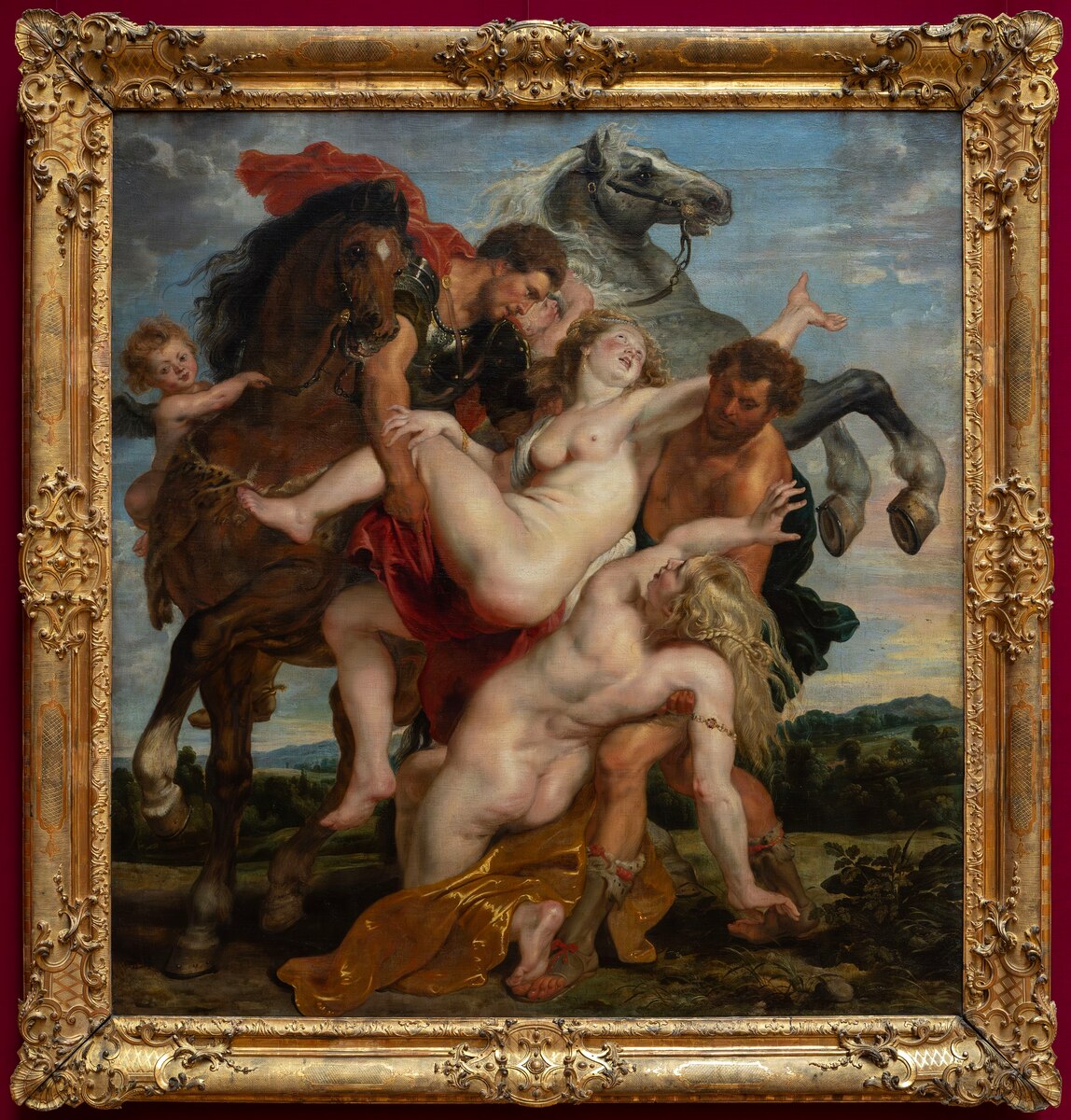
The catalogue identity of this canvas is concise. Its title is 'The Rape of the Daughters of Leucippus', the artist is Peter Paul Rubens, the date is given as circa 1617, and the accession number is 321. The recorded dimensions are 224 cm in height and 211 cm in width, while the supporting medium is oil on canvas and the work belongs to the collection of the Alte Pinakothek in Munich, Germany. The 'circa' qualification matters: it marks the painting's own dating as approximate rather than fixed, and it should be distinguished from any later catalogue or file-page date attached to the documentation. The source consulted here is a Wikimedia Commons file page, a partly consulted, open-access record rather than a full catalogue raisonne or museum publication, so these identifications are reported as the page states them.(Wikimedia Commons: The Rape of the Daughters of Leucippus, n.d., Title; Artist; Date; Dimensions; Accession number)
Subject and iconography
LinkThe depicted subject
Visual observation
The canvas presents two women being seized and carried off by two men, and the group is not alone: a winged putto and horses are present within the scene. That is the level of description the surviving record supports directly, and it is worth separating from the identification of who these figures are. The same source that supplies this description also gives the picture its title, The Rape of the Daughters of Leucippus, and names Peter Paul Rubens as the artist, dating the work to about 1617. The mythological reading, that the abduction is that of the daughters of Leucippus by the Dioscuri twins Castor and Pollux, belongs to the title and subject identification rather than to a neutral inventory of bodies: the wings of the putto, the horses and the paired male abductors are what make that identification legible, but the naming of Castor and Pollux is an act of interpretation grounded in the classical story, not an inscription on the canvas.(Wikimedia Commons: The Rape of the Daughters of Leucippus, n.d., Depicted people; Title)
The object and its medium
Interpretation
Read together, the observation unit and the contextual identification describe a composition organised around several distinct presences: two female figures, two male figures, a winged putto, and horses. The putto introduces a third point of movement above the central struggle, and the horses contribute animal energy at the level of the group. The source does not itemise clothing, furnishings, architecture or landscape, and no evidence unit here specifies pigments, supports beyond canvas, or later treatment and change in appearance. The account therefore has to be honest about its limits: what can be said about the composition rests on the presence and interaction of these figures, on the medium and dimensions, and on the subject identification, while questions of setting, dress and surface condition remain outside the supplied record.(Wikimedia Commons: The Rape of the Daughters of Leucippus, n.d., Depicted people; Medium)
Identification and Subject
The painting known as The Rape of the Daughters of Leucippus is attributed to Peter Paul Rubens and dated about 1617. It is an oil painting on canvas measuring 224 centimetres in height and 211 centimetres in width, and it belongs to the collection of the Alte Pinakothek in Munich, Germany, where it carries the accession number 321. These are the basic identification data recorded for the work, and they frame the subject that the picture treats: the mythological abduction of the daughters of Leucippus by the Dioscuri twins, Castor and Pollux. The title itself names the episode, so subject and identification arrive together in the record, and the canvas is the physical support on which both the myth and the attribution depend.(Wikimedia Commons: The Rape of the Daughters of Leucippus, n.d., Title)
The painting depicts the mythological abduction of the daughters of Leucippus by the Dioscuri twins, Castor and Pollux.(Wikimedia Commons: The Rape of the Daughters of Leucippus, n.d.)
Interpretations and debates
LinkAttributed Readings and Their Limits
Interpretation
None of the supplied evidence states what Rubens himself intended the picture to mean, and the two characterisations that the record does carry work at different levels. One is a description of subject matter: the painting depicts the mythological abduction of the daughters of Leucippus by the Dioscuri twins, Castor and Pollux. The other is a classification of kind: the artwork is a nude genre painting. The second is an interpretation rather than a transcription of the canvas, and it should be attributed as such. It does not name a scholar or institution in the supplied unit, so it is best recorded as a reading that has attached itself to the picture, not as a statement of the maker's private purpose.(Wikimedia Commons: The Rape of the Daughters of Leucippus, n.d., Genre; Title)
Calling the work a nude genre painting sits in a different register from calling it a mythological abduction. The term genre directs attention to the treatment of unclothed bodies and to the picture's operation as a display of flesh and physical action, while the title directs attention to a story. These are not mutually exclusive, and the evidence does not present them as rivals. What the record permits is a description of the painting as a mythological scene whose handling of the nude has repeatedly invited a genre reading alongside the narrative one. Further synthesis, such as a claim about which aspect Rubens himself privileged, is not supported here.(Wikimedia Commons: The Rape of the Daughters of Leucippus, n.d., Genre; Title)
Collection and display
LinkIdentification, medium and subject
The painting known as The Rape of the Daughters of Leucippus is attributed to Peter Paul Rubens and dated to about 1617. It is executed in oil on canvas and measures 224 cm in height by 211 cm in width. The subject is the mythological abduction of the daughters of Leucippus by the Dioscuri twins, Castor and Pollux, shown as two women being seized and carried off by two men, with rearing horses and a winged putto present in the scene. The work has also been characterized as a nude genre painting, a description that registers how the picture operates as a display of unclothed bodies in motion as much as a narrative of classical myth.(Wikimedia Commons: The Rape of the Daughters of Leucippus, n.d., Collection)
The painting belongs to the collection of the Alte Pinakothek in Munich, Germany. That single documented collection fact is the anchor of the work's museum history in the supplied record: it establishes the present institutional home of the canvas but does not, on this evidence, establish when or by what route the painting entered the collection. The attribution to Rubens, the circa 1617 dating, the oil-on-canvas medium, the dimensions of 224 by 211 cm, the subject of the Dioscuri abducting the daughters of Leucippus, the presence of the winged putto and horses, the nude genre characterization and the accession number 321 are all facts carried by the same source record as the Munich location, so the object's basic identification and its collection data stand together as the documentary basis for any further account.(Wikimedia Commons: The Rape of the Daughters of Leucippus, n.d., Collection)
Documented values and qualified estimates
LinkObject and documentation
Interpretation
The Wikimedia Commons file page for The Rape of the Daughters of Leucippus identifies the painting's author as Peter Paul Rubens, its date as circa 1617, its medium as oil on canvas, and its dimensions as approximately 224 by 211 cm. The same record places the canvas in the collection of the Alte Pinakothek in Munich, Germany, under accession number 321. These are the basic identifying facts on which every other account of the work, including the valuation discussion below, depends.(Wikimedia Commons: The Rape of the Daughters of Leucippus, n.d.)
The Commons record and the accompanying description agree on subject matter: two women are seized and carried off by two men, with rearing horses and a winged putto present. The record further specifies that the picture depicts the mythological abduction of the daughters of Leucippus by the Dioscuri twins, Castor and Pollux, and classifies the work as a nude genre painting. The double classification matters, because it names both the narrative content and the pictorial mode in which that content is rendered, and it is the basis for the observation that the painting has often been described as much a nude genre scene as a mythological narrative.(Wikimedia Commons: The Rape of the Daughters of Leucippus, n.d.)
The recorded value estimate
The working insurance estimate recorded for the painting is a calculated range of US$300 million to US$600 million, generated as a working calculation on 2026-10-16. The stated methodology is a conservative model-based range derived from confirmed context: the Rubens attribution within the Flemish Baroque (1577-1640), the circa 1617 date, oil on canvas, dimensions of approximately 224 by 211 cm, and the painting's status as a held work in the Alte Pinakothek, Munich, accession 321. The calculation treats confirmed artist attribution, early date, large scale, and museum collection status as value indicators, and applies a deliberately broad range because no public sale or insurance figure is available and institutional works of this significance are rarely traded. The stated purpose of the breadth is to reflect uncertainty and to support manual review only.(Wikimedia Commons: The Rape of the Daughters of Leucippus, n.d.)
That range carries explicit qualifications that should travel with any citation of the figure. It is a model-generated working range for manual review only, and it is expressly not an official insurance value, appraisal, auction result, or sale price. It is based only on the supplied artwork context and source excerpts and does not rely on comparable sales, private insurance records, or market data. Actual insurance values, by the estimate's own terms, require physical inspection, provenance research, and professional appraisal. The estimate should therefore be read as an internal working construction whose inputs are the identification facts above, not as a market datum about the painting.(Wikimedia Commons: The Rape of the Daughters of Leucippus, n.d.)
The relationship between the description and the valuation is direct and one-directional in the evidence: attribution, early date, large scale, and museum collection status are the four named value indicators, and each of them is established by the Commons identification rather than by any independent market source. The narrative and formal content of the painting, including the abduction subject, the putto, and the rearing horses, plays no role in the calculation as described. What the two accounts share is the same core set of object facts; what they do not share is a common evidential basis for price, since the valuation explicitly disclaims reliance on comparables, private records, and market data while the description supplies only identification and collection information.(Wikimedia Commons: The Rape of the Daughters of Leucippus, n.d.)
Set against the documented creation, form, and collection history of the painting, the estimate is best understood as an artifact of the same sparse record that governs everything else known about the object. No public sale, insurance figure, appraised value, or comparable transaction is supplied in the evidence, and the range is deliberately widened to absorb that absence. The qualification that institutional works of this significance are rarely traded explains why a broad model-based range was preferred over a point estimate, and it also explains why the figure cannot be checked against the ordinary market evidence that would normally discipline such a number. The estimate's own insistence on physical inspection, provenance research, and professional appraisal identifies exactly the categories of evidence that are missing.(Wikimedia Commons: The Rape of the Daughters of Leucippus, n.d.)
Working estimate
Calculated working insurance estimate, not a sale price: Estimated insurance range: US$300M to US$600M Recorded date: Working calculation, generated 2026-10-16. Methodology: Conservative model-based working range derived from confirmed context: Peter Paul Rubens (Flemish Baroque, 1577-1640), circa 1617, oil on canvas, approximately 224 x 211 cm, held at the Alte Pinakothek, Munich (accession 321). The calculation uses the confirmed artist attribution, early date, large scale, and museum collection status as value indicators. A broad range is applied given that no public sale or insurance figure is available and institutional works of this significance are rarely traded. The range is intentionally wide to reflect uncertainty and to support manual review only. Qualification: This is a model-generated working range for manual review only. It is not an official insurance value, appraisal, auction result, or sale price. It is based only on the supplied artwork context and source excerpts and does not rely on comparable sales, private insurance records, or market data. Actual insurance values require physical inspection, provenance research, and professional appraisal.(Wikimedia Commons: The Rape of the Daughters of Leucippus, n.d.)