ArchiveThe Night Café

Artwork record / 184 of 331

The Night Café by Vincent van Gogh (1888)

Artist: Vincent van Gogh

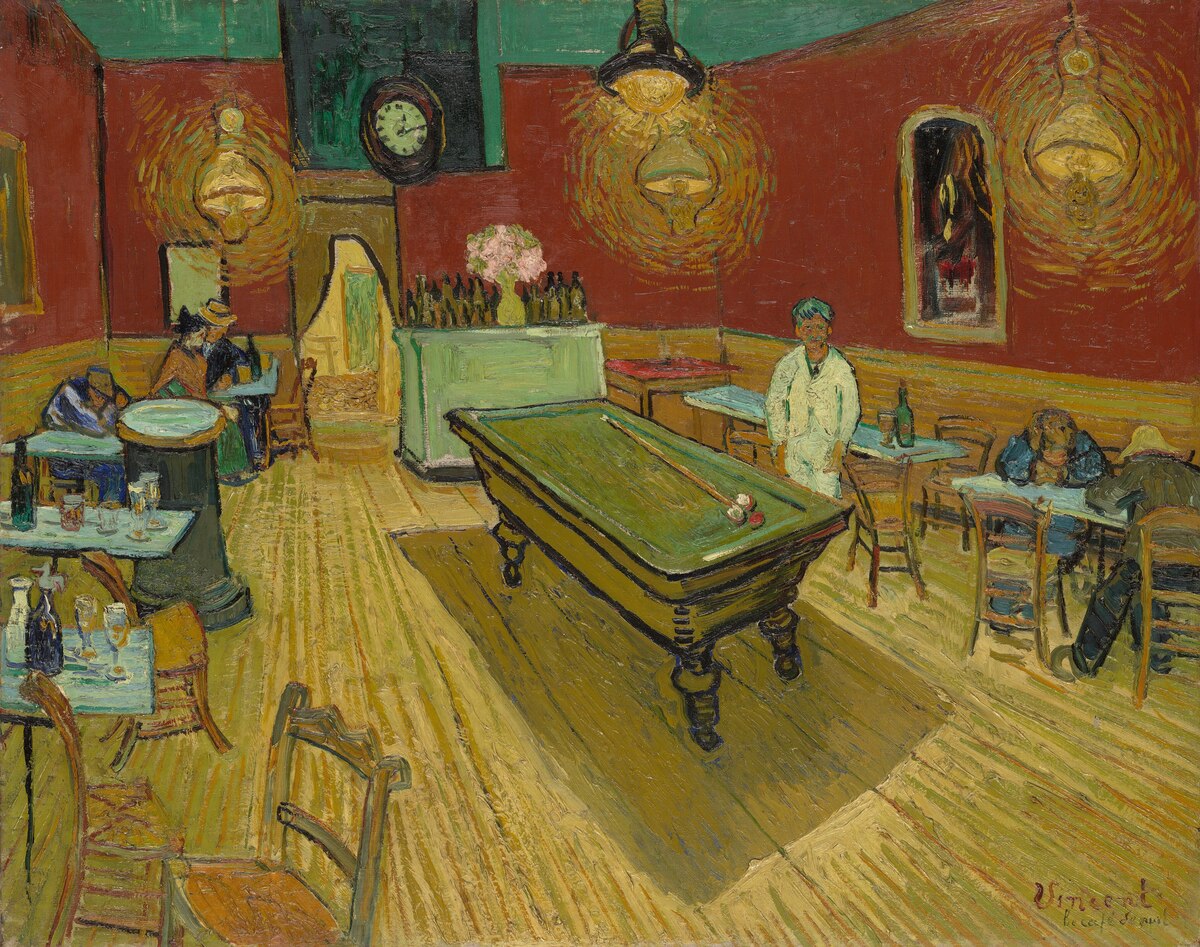
A gallery guide to Vincent van Gogh's The Night Café, painted in Arles in 1888: a café interior at night, with a green billiard table at its centre, a landlord standing behind it, and drinkers slumped at the tables. The lamps burn as rings of yellow and orange, and the tilted floor and red walls give the room its unsettling glare.

Read the story ↓ About the artist ↓ Research and record ↓ Literature and sources ↓ Listen to the article ↓
Article text for AI
Shop this artwork ↓ 0 visits
Date1888CultureDutch, painted in Arles, France PeriodPost-ImpressionismCurrent locationYale University Art Gallery, New Haven
Listen to the article
100%
The Night Café by Vincent van Gogh (1888)
Loading full-resolution artwork…
Scroll to zoom · drag to pan · double-click to focus Pinch to zoom · drag to explore · double-tap to focus FIELD VIEW / 184
Tools & download
Pixel colour Select a pixel with the eyedropper
No pixel selected

Choose the eyedropper, then click or tap the image. Scroll to zoom for finer selection.

Add text

Hand to pan · Select to move text and drawings · Add as many texts as you like · Scroll to zoom

The Night Café: high-resolution image

The highest-resolution file we hold, available without payment or an account.3,840 × 3,031 pixels.

Download highest-resolution image

Details to notice

About 3 minutes to read
01

Wall clock

The round clock with pale face mounted high above the doorway, its late hour underscoring the theme of the night that never ends.

02

Counter with bottles and flowers

The service counter behind the billiard table, lined with dark bottles and a vase of pink blossoms, the still-life note that separates the table from the doorway.

03

Slumped drinker

A patron collapsed face-down on a table at the left, bottle and glass beside him, embodying the late-night desolation of the café.

Artist portrait of Vincent van Gogh
Artist portrait Image credit

Vincent van Gogh. Image source · CC BY-SA 4.0

About the artist

Vincent van Gogh

1853 to 1890

Vincent van Gogh was a Dutch painter (1853–1890). Their work is associated with Post-impressionism; Expressionism. Their recorded places of work include Tilburg; The Hague; London; Paris; Ramsgate; Etten-Leur; Dordrecht; Amsterdam; Borinage; Brussels; Hoogeveen; Nuenen; Antwerp; Arles; Saint-Rémy-de-Provence; Auvers-sur-Oise; Van Gogh House; Emmen; Maison Van Gogh.

Born
1853
Died
1890
Nationality
Kingdom of the Netherlands
Birthplace
Zundert
Died in
Auvers-sur-Oise; Auberge Ravoux

The research & record

Study the work.
Follow the evidence.

Find catalogue details, historical context, technical research and the literature behind this artwork.

Article text for AI
Open research text

The artwork record

Research catalogue

Catalogue information and detailed research, with references that link to the bibliography.

Updated .

Identity and catalogue

Link
Title
The Night Café
Artist or attribution
Vincent van Gogh(Vincent van Gogh, 1888)
Object date
1888
Medium and support
Oil on canvas
Current collection or location
Yale University Art Gallery, New Haven(Vincent van Gogh, 1888)
Movement or period
Post-Impressionism
Country or culture
Dutch, painted in Arles, France
Depicted subject
An interior night scene of a café in Arles, with a green billiard table at the centre, a standing landlord in a white coat behind it, slumped drinkers at the tables, and hanging lamps casting rings of light across a red-walled room.(Vincent van Gogh, 1888)
Title variants
Le café de nuit; Het nachtcafé; El café de noche; Das Nachtcafé
Accession number
12507
Support
Canvas
Dimensions
Unknown
Catalogue identity

The Night Café is a painting by Vincent van Gogh, recorded under that English title with variants in Dutch, Spanish, Basque, Catalan, German, Persian, Bulgarian and Danish carried alongside it in the same file record. The object is identified in the catalogue raisonné as F463 and, in the revised edition of that catalogue, as JH1575. These two numbers attach the painting to a single documented work while showing that its identity is normally cited in the literature through catalogue numbering rather than through title alone, a practical consequence of the several language variants under which it circulates. The file record also places the work within a series titled The Night Café and states that it is different from The Night Cafe in Arles, a separate painting with a similar name. That distinction matters because the two titles are easily confused: the record treats them as distinct objects rather than as alternative names for one picture, so any account that merges them would misdescribe what F463 and JH1575 designate.(Vincent van Gogh, 1888, Summary, Artist; Title; References; Other versions)

The painting was made in Arles in the period 1888 to 1889, when van Gogh was working in that city; the source published the work under the year 1888. This place and period is the working context for the object, not a later catalogue date. The record that supplies the title variants, the F463 and JH1575 numbers and the distinction from The Night Cafe in Arles is also the file that carries the Arles dating, and it credits the Yale University Art Gallery as the source of the image and as holder of the referenced object record, accession ID 12507. The catalogue numbers should therefore be understood as references assigned in the literature to an object whose documented making belongs to van Gogh's Arles period, while the accession identifier belongs to the holding institution's own record. The supplied evidence does not give a precise day, month or year of execution beyond the 1888 to 1889 range and the published year 1888.(Vincent van Gogh, 1888, Work location; References)

Documentation and its limits

On the evidence assembled here, the object's public-domain status rests on the death of its author in 1890, and the faithful photographic reproduction of the two-dimensional work is also considered public domain in the United States. This is a statement about rights in the image and its reproduction, not about the painting's physical condition or its exhibition record. The same body of evidence explicitly notes that the supplied excerpt does not record condition, conservation, technical analysis, provenance history, exhibition history or specific literature for this exact painting. That qualification limits what can responsibly be asserted in a catalogue entry built from these units: the attribution, title variants, catalogue numbers, series placement, Arles dating, holding institution and accession identifier are supported, while questions of surface, treatment, ownership sequence and reception history remain outside the evidence and should not be filled in from assumption.(Vincent van Gogh, 1888, Summary, Artist; Other versions)

Interpretation

Read together, these units show an object whose identity is stabilised by a small set of interlocking records: a title in multiple languages, two catalogue raisonné numbers, a stated place in a named series, a clear separation from a similarly titled work, and an institutional accession identifier tied to Yale University Art Gallery. The catalogue date belongs to the scholarly reference apparatus, while the making of the painting is dated to van Gogh's Arles years of 1888 to 1889. Keeping those two kinds of dating apart, and keeping the rights statement apart from the object's material history, is what allows the entry to remain accurate about what is documented and silent about what the supplied evidence leaves unrecorded.(Vincent van Gogh, 1888, Title; References; Work location)

The Night Café is a painting by Vincent van Gogh.(Vincent van Gogh, 1888)

The work is titled The Night Café, with variants in Dutch, Spanish, Basque, Catalan, German, Persian, Bulgarian and Danish recorded alongside it.(Vincent van Gogh, 1888)

The painting is recorded in the catalogue raisonné as F463 and as JH1575 in the revised edition of the catalogue raisonné.(Vincent van Gogh, 1888)

The file record notes this work as part of the series 'The Night Café' and states it is different from 'The Night Cafe in Arles'.(Vincent van Gogh, 1888)

Subject and iconography

Link
The composition described

Visual observation

The painting shows the interior of a night café, organized around a green billiard table with a landlord in a white coat standing behind it and drinkers at the tables. The green table anchors the room: cues lie across it and it rests on heavy green-painted legs, holding the still centre of the picture while the floor tilts and the red walls press. Behind the table a service counter is lined with dark bottles and a vase of pink blossoms, separating the table from a doorway; high above that doorway hangs a wall clock with a pale face, its late hour underscoring the theme of the night that never ends. At the left a patron lies face down on a table with a bottle and glass beside him, embodying the late-night desolation of the café, while the landlord, in cream white coat and cap, faces the viewer with a level, impassive gaze as the only upright person in a room of slumped drinkers.(Vincent van Gogh, 1888, Caption; Summary; Summary)

Light and the painted room

The lamps are the source of the room's glare, rendered as glowing halos built from concentric rings of yellow and orange. Read together with the tilted floor and the pressing red walls that surround the anchored green billiard table, this lighting contributes to an oppressive and disorienting reading of the café interior: the stable object at the centre is held inside a space that refuses to sit level.(Vincent van Gogh, 1888, Summary)

The painting depicts the interior of a night café, with a green billiard table, a landlord in a white coat standing behind it, and drinkers at the tables.(Vincent van Gogh, 1888)

The lamps are rendered as glowing halos, described as concentric rings of yellow and orange that generate the room's glare.(Vincent van Gogh, 1888)

The green billiard table anchors the room, with cues laid across it and heavy green-painted legs, as the still centre around which the tilted floor and red walls press.(Vincent van Gogh, 1888)

The landlord stands upright behind the billiard table in a cream white coat and cap, facing the viewer with a level, impassive gaze, the only upright person in a room of slumped drinkers.(Vincent van Gogh, 1888)

A patron lies face down on a table at the left, with a bottle and glass beside him, embodying the late-night desolation of the café.(Vincent van Gogh, 1888)

Behind the billiard table a service counter is lined with dark bottles and a vase of pink blossoms, separating the table from the doorway.(Vincent van Gogh, 1888)

A wall clock with a pale face is mounted high above the doorway, its late hour underscoring the theme of the night that never ends.(Vincent van Gogh, 1888)

Historical context

Link
Identification and place

The Night Café is a painting by Vincent van Gogh, made in Arles, where the artist worked between 1888 and 1889. The file record gives the work's title as The Night Café, notes variant titles recorded in Dutch, Spanish, Basque, Catalan, German, Persian, Bulgarian and Danish, and distinguishes this picture from a different painting with a similar title, The Night Cafe in Arles. Within the catalogue literature the work is recorded as F463 and, in the revised edition of the catalogue raisonné, as JH1575. The Yale University Art Gallery is credited as the source of the image and holds the referenced object record under accession ID 12507. These identifiers matter because they fix which canvas is under discussion: the shared title and the close variant in another Arles picture have to be separated before any claim about this object's making can be assessed.(Vincent van Gogh, 1888, Work location)

Van Gogh worked in Arles between 1888 and 1889, which is the period and place in which this painting was made.(Vincent van Gogh, 1888)

Condition and conservation

Link
Condition and conservation

The only evidence assembled for this section is a negative finding, and it governs how the object can be described here. The supplied excerpt does not record condition, conservation, technical analysis, provenance history, exhibition history or specific literature for this exact painting. That absence is not a statement that the work has never been examined, treated, cleaned, relined or documented; it means the material at hand establishes none of those things. The section therefore functions as an explicit boundary for the archive: whatever is said elsewhere about the composition, the café interior and its figures rests on a file record of the image rather than on condition reporting or conservation documentation.(Vincent van Gogh, 1888, Summary)

Interpretation

The absence carries a practical consequence for any account of the painting's present appearance. No dated condition observation, no description of damage, no intervention, no treatment material, no conservation decision and no environmental measure is supplied, so no statement about the work's current physical state can be attached to a particular moment or examination. Condition accounts are time-bound by nature: an earlier assessment describes the object as it stood at that earlier date and cannot be carried forward as a description of the object now. Because no assessment of any date is present in this evidence, the archive records the gap rather than filling it, and readers should treat any appearance-based claim about the work as unverified by the sources gathered here.(Vincent van Gogh, 1888, Summary)

The supplied excerpt does not record condition, conservation, technical analysis, provenance history, exhibition history or specific literature for this exact painting.(Vincent van Gogh, 1888)

Provenance and ownership

Link
Provenance timeline
  1. 1888–1889

    Van Gogh worked in Arles during this period and place, in which the painting was made.(Vincent van Gogh, 1888, Work location)

Reception and literature

Link
Documentary Identity and Reception

The Night Café by Vincent van Gogh has accumulated a layered documentary identity that is itself part of its reception. The Wikimedia Commons file record catalogues the work under the title The Night Café, recording variant titles in Dutch, Spanish, Basque, Catalan, German, Persian, Bulgarian and Danish, and entering it in the catalogue raisonné as F463 and in the revised edition as JH1575. That same record identifies the work as part of the series 'The Night Café,' states that it is different from 'The Night Cafe in Arles,' and credits the Yale University Art Gallery as the source of the image and holder of the referenced object record, accession ID 12507.(Vincent van Gogh, 1888, Licensing; Work location)

A basic reception fact establishing the work's wide availability is its legal status: the painting is in the public domain, its author having died in 1890, and the faithful photographic reproduction of the two-dimensional work is also considered public domain in the United States. This open status underwrites the circulation of the image through public repositories, and it frames the Commons record as a reception document rather than a museum publication. Van Gogh worked in Arles between 1888 and 1889, which is the period and place in which this painting was made, so the public-domain reproduction circulates a work whose original making belongs to a specific two-year window and location in the south of France.(Vincent van Gogh, 1888, Licensing; Work location)

The Yale University Art Gallery is credited as the source of the image and holds the referenced object record, accession ID 12507, and the file record notes that the supplied excerpt does not record condition, conservation, technical analysis, provenance history, exhibition history or specific literature for this exact painting. That qualification is itself consequential for reception: the archive's evidence documents the painting's published identity, catalogue numbers, collection source and the openness of its reproduction, but the excerpt's own limits caution against treating this record as a full account of the object's material history or its exhibitions.(Vincent van Gogh, 1888, Licensing; Work location)

Visual Conventions and the Sources of Its Reception

Interpretation

Read together, the documentary and visual strands explain how meaning accumulates across this record. The Commons file page anchors a solid set of facts: catalogue numbers F463 and JH1575, the distinction from 'The Night Cafe in Arles,' the collection credit to the Yale University Art Gallery with accession ID 12507, the Arles period of 1888 to 1889, and public-domain status tied to the author's death in 1890. The visual evidence supplies the composition that has historically drawn attention: the central green billiard table with cues and heavy painted legs, the impassive landlord in cream white coat and cap, the slumping drinkers and the face-down patron with bottle and glass, the counter with dark bottles and pink blossoms, the lamps built from concentric rings of yellow and orange, and the pale-faced clock above the doorway. The two levels should not be conflated: the object's original function as a description of a night café interior is distinct from its later role as an image circulated through open repositories, and neither should be reduced to a single dramatic event.(Vincent van Gogh, 1888, Licensing; Work location; Caption; Summary; Summary)

The work is in the public domain, its author having died in 1890, and the faithful photographic reproduction of the two-dimensional work is also considered public domain in the United States.(Vincent van Gogh, 1888)

Interpretations and debates

Link
The Disorienting Room

Interpretation

The composition of The Night Café has been read as oppressive and disorienting, and that reading is grounded in specific painted relationships rather than in a general mood. A tilted floor and pressing red walls are arranged around an anchored green billiard table, so that a stable object at the centre is held inside a space that will not sit level. The room's character, on this account, comes from the composition itself: the walls close in rather than open out, and the sense of the café is produced by that arrangement rather than merely described by it.(Vincent van Gogh, 1888, Summary)

The billiard table is the element that fixes the composition. Its cues lie across the green top and its heavy green-painted legs anchor it to the floor, making it the still centre around which the rest of the room is organised. This stability matters because everything else works against it. The floor tilts and the red walls press inward, so the still object and the unsteady space pull against each other within a single image. Read together with the tilted floor and pressing red walls, the table is not simply furniture but the counterweight that makes the room's instability legible.(Vincent van Gogh, 1888, Summary)

The lighting contributes to the same effect. The lamps are rendered as glowing halos, described as concentric rings of yellow and orange that generate the room's glare. Those rings spread across the red walls, so the light does not simply illuminate the café: it presses on everything in it. The glare is therefore a painted structure of rings and spreading colour rather than a naturalistic record of lamplight, and it belongs with the tilted floor and closing walls among the devices that shape how the room feels to stand in.(Vincent van Gogh, 1888, Summary)

Attribution and Evidence Limits

The painting is the interior of a night café, with a green billiard table, a landlord in a white coat standing behind it, and drinkers at the tables; these observations are the basis for the reading summarised above. Van Gogh worked in Arles between 1888 and 1889, which is the period and place in which this painting was made, and the work is attributed to Vincent van Gogh. The supplied excerpt does not record condition, conservation, technical analysis, provenance history, exhibition history or specific literature for this exact painting. This absence limits how far any interpretation can be pressed: the compositional reading rests on what is visible in the painting and on the attributed account of its arrangement, not on technical study or on documentation of the maker's intentions.(Vincent van Gogh, 1888, Caption; Summary; Work location; Summary)

The reading of the café as oppressive and disorienting is an attributed interpretation rather than a statement of the maker's private intent. It is offered as a consequence of the composition: a stable object at the centre, a space that refuses to sit level, and walls that close in rather than open out. Keeping that distinction matters, because the visible features are observations while the claim that the painted choices shape how the room feels is an interpretive judgement built on them. The painting's placement in the history of art and material culture depends on this kind of argument, in which formal decisions are understood to construct an experience of place rather than to transcribe one.(Vincent van Gogh, 1888, Summary; Caption; Summary)

The painting's arrangement of a tilted floor and pressing red walls around the anchored green billiard table contributes to an oppressive and disorienting reading of the café interior.(Vincent van Gogh, 1888)

Collection and display

Link
The object record and its limits

The Yale University Art Gallery is credited as the source of the image and holds the referenced object record, accession ID 12507. This institutional credit and the object record it references are the only collection information supplied for the painting. The same source record does not record condition, conservation, technical analysis, provenance history, exhibition history or specific literature for this exact painting, so the account that follows rests on the identification and description the record does provide rather than on any documented history of how the canvas was made, treated, or shown.(Vincent van Gogh, 1888, Summary; File information)

Within that record the work is titled The Night Café, a painting by Vincent van Gogh, with variants of the title recorded in Dutch, Spanish, Basque, Catalan, German, Persian, Bulgarian and Danish alongside the English form. The catalogue raisonné records it as F463, and the revised edition of the catalogue raisonné records it as JH1575. Van Gogh worked in Arles between 1888 and 1889, the period and place in which this painting was made. The file record also notes the work as part of the series 'The Night Café' and states that it is different from 'The Night Cafe in Arles'; that distinction matters because the similar titles belong to two different paintings, and conflating them would misattribute the object's identity within the catalogue numbering.(Vincent van Gogh, 1888, Summary; File information)

The painted room: fixtures and figures

The composition can be described as it is recorded: the interior of a night café, with a green billiard table at the centre, a landlord in a white coat standing behind it, and drinkers at the tables. The landlord stands upright behind the billiard table in a cream white coat and cap, facing the viewer with a level, impassive gaze, the only upright person in a room of slumped drinkers. A patron lies face down on a table at the left, with a bottle and glass beside him, embodying the late-night desolation of the café. Behind the billiard table a service counter is lined with dark bottles and a vase of pink blossoms, separating the table from the doorway, and a wall clock with a pale face is mounted high above the doorway, its late hour underscoring the theme of the night that never ends.(Vincent van Gogh, 1888, Summary; File information)

Interpretation

The lamps are rendered as glowing halos, described as concentric rings of yellow and orange that generate the room's glare. The green billiard table anchors the room, with cues laid across it and heavy green-painted legs, as the still centre around which the tilted floor and red walls press. The record ties these painted choices to a reading: the arrangement of a tilted floor and pressing red walls around the anchored green billiard table contributes to an oppressive and disorienting reading of the café interior. That reading is attributed to the description in the record and rests on the composition itself, on a stable object at the centre, a space that refuses to sit level, and walls that close in rather than open out. The most defensible inference is that these are deliberate compositional decisions whose effect is legible in the painting, not an established record of the artist's intent.(Vincent van Gogh, 1888, Summary; File information)

The object record and its limits

The painting's public domain status is stated on the record: the author died in 1890, and the faithful photographic reproduction of the two-dimensional work is also considered public domain in the United States. This is the only rights and reproduction information supplied, and it is what allows the image to circulate as a source document for the object. Because the record supplies no exhibition or provenance history, there is no evidence here for when or where the painting was displayed, how it entered the Yale University Art Gallery, or what literature has treated it. The supportable weight therefore falls on the identification, the catalogue numbers, the Arles period and the described composition, while questions of condition, treatment and display history remain open in this account.(Vincent van Gogh, 1888, Summary; File information)

The Yale University Art Gallery is credited as the source of the image and holds the referenced object record, accession ID 12507.(Vincent van Gogh, 1888)

Documented values and qualified estimates

Link
Object and documentation

Interpretation

The object described in the Wikimedia Commons file record is The Night Café, an oil painting made by Vincent van Gogh in Arles, where he worked between 1888 and 1889; the record places its making in that period and place. It is identified in the catalogue raisonné as F463 and, in the revised edition, as JH1575. The file record notes the work as part of the series 'The Night Café' and expressly states that it is different from 'The Night Cafe in Arles', a separate painting with a similar title, so the catalogue numbers and the series note belong to this canvas rather than to the other picture. The Yale University Art Gallery is credited as the source of the image and holds the referenced object record, accession ID 12507. The record also states that the work is in the public domain, its author having died in 1890, and that the faithful photographic reproduction of the two-dimensional work is considered public domain in the United States. This is a narrow documentary base: the supplied excerpt does not record condition, conservation, technical analysis, provenance history, exhibition history or specific literature for this exact painting, so the object's material state and ownership history remain outside the evidence gathered here.(Vincent van Gogh, 1888)

Subject and visual conventions

The pictorial account supplied with the file describes the scene rather than the paint layer. It depicts the interior of a night café with a green billiard table at the centre, a landlord in a white coat standing behind it, and drinkers at the tables. The lamps are rendered as glowing halos, described as concentric rings of yellow and orange that generate the room's glare; those rings spread across the red walls, so the light does not simply illuminate the café but presses on everything in it. A wall clock with a pale face is mounted high above the doorway, its late hour underscoring the theme of the night that never ends. These are descriptions of depicted things and of their arrangement, not of pigments, supports or handling, and the record does not supply technical analysis that would connect the visual effect to particular materials.(Vincent van Gogh, 1888)

The composition is characterized in the supplied account through the relation between a stable centre and an unsteady space. The green billiard table anchors the room, with cues laid across it and heavy green-painted legs, as the still centre around which the tilted floor and red walls press. The landlord stands upright behind the table in a cream white coat and cap, facing the viewer with a level, impassive gaze, described as the only upright person in a room of slumped drinkers. A patron lies face down on a table at the left, with a bottle and glass beside him, embodying the late-night desolation of the café, and behind the billiard table a service counter is lined with dark bottles and a vase of pink blossoms, separating the table from the doorway. The file's reading is that this arrangement of a tilted floor and pressing red walls around the anchored green billiard table contributes to an oppressive and disorienting impression of the café interior. Because that reading is attributed to the supplied description, it should be understood as interpretation of the painted composition rather than as a documented fact about the work's making.(Vincent van Gogh, 1888)

Recorded values and their limits

The only valuation figure in the record is not a market result at all. It is a model-generated working insurance range of US$500 million to US$1 billion, recorded as a working calculation generated 2026-10-16. The methodology states that it is a conservative range produced for manual review, calculated from the confirmed context supplied: a catalogued Vincent van Gogh oil painting of 1888, The Night Café, catalogue raisonné F463/JH1575, held by the Yale University Art Gallery, New Haven, accession ID 12507, with a documented public-domain reproduction and prominent Wikimedia Commons representation. The reasoning recorded is that because the work is a unique, museum-held, world-renowned Post-Impressionist painting by a major artist, its insurance-replacement value would fall in the highest tier of the art market. The range reflects only that tier; dimensions and condition were not supplied, and the local system sets price_date to the generation date. The accompanying qualification is explicit and should be preserved: this is not an official insurance value, appraisal, auction result, or sale price, and it is not a substitute for a professional appraisal or formal insurance valuation. No comparable sales or private insurance records were accessed, and the range is broad and conservative, based only on the supplied confirmed artwork context and public source excerpts. The record adds that actual insurance values depend on physical inspection, condition, provenance, exhibition history, and underwriting requirements, which are precisely the categories the supplied excerpt does not document for this painting.(Vincent van Gogh, 1888)

Working estimate

Calculated working insurance estimate, not a sale price: Working insurance range: US$500M to US$1B Recorded date: Working calculation, generated 2026-10-16. Methodology: This is a conservative model-generated working insurance range for manual review. It is calculated from the confirmed context supplied: a catalogued Vincent van Gogh oil painting of 1888, The Night Café, catalogue raisonné F463/JH1575, held by the Yale University Art Gallery, New Haven, accession ID 12507, with a documented public-domain reproduction and prominent Wikimedia Commons representation. Because the work is a unique, museum-held, world-renowned Post-Impressionist painting by a major artist, its insurance-replacement value would fall in the highest tier of the art market. The broad range reflects only that tier and the dimensions and condition are not supplied; it does not use specific comparable sales, private insurance records, or an appraisal. The local system sets price_date to the generation date. Qualification: This is a model-generated working insurance range for manual review only. It is not an official insurance value, appraisal, auction result, or sale price. It is not a substitute for a professional appraisal or formal insurance valuation. No comparable sales or private insurance records were accessed. The range is broad, conservative, and based only on the supplied confirmed artwork context and public source excerpts; actual insurance values depend on physical inspection, condition, provenance, exhibition history, and underwriting requirements.(Vincent van Gogh, 1888)

Further reading

Books for a closer look

Paid links. As an Amazon Associate I earn from qualifying purchases.

  • Cover of Vincent van Gogh.
    Open Library

    Vincent van Gogh, 1990

    Vincent van Gogh.

    Rizzoli; Rizzoli International Publications, Incorporated

    Catalogued with subjects including 'Catalogues raisonnés', 'Catalogs', 'Exhibitions' and 'Gogh, Vincent van,' indicating a scholarly Van Gogh catalogue or collection that could include documented discussion of The Night Cafe among his works. Broad in scope, but art-historical and not fiction.

    ISBN 084781288X

    Find book on Amazon.co.uk View reference
  • Cover of The letters of Vincent Van Gogh
    Open Library

    Vincent van Gogh, 1963

    The letters of Vincent Van Gogh

    Atheneum

    Van Gogh's own letters, catalogued with subject 'Correspondence' and 'Gogh, vincent van, 1853-1890'. Contemporary correspondence is a primary documentary source for the artist's accounts and plans, so it is potentially relevant to documented context around The Night Cafe, though not an object-specific study.

    ISBN 0689701675

    Find book on Amazon.co.uk View reference

Bibliography

Sources and further reading

References are arranged by author or organisation, with links to the original publications. Where no publication date is recorded, n.d. means no date.

Source notes updated .

  1. 01

    Secondary · About this artwork

    Wikimedia Commons: The Night Cafe. The Night Café. Wikimedia Commons.

    Wikimedia Commons file page for the painting, credited to the Yale University Art Gallery (accession ID 12507). Supplies the title, artist, collection, catalogue numbers F463 and JH1575, and a distinction from 'The Night Cafe in Arles'.

    Language
    English
    Citation text
  2. 03

    Book

    The letters of Vincent Van Gogh. Atheneum.

    Van Gogh's own letters, catalogued with subject 'Correspondence' and 'Gogh, vincent van, 1853-1890'. Contemporary correspondence is a primary documentary source for the artist's accounts and plans, so it is potentially relevant to documented context around The Night Cafe, though not an object-specific study.

    ISBN
    0689701675
    Link to reference
    Citation text
  3. 02

    Book

    Vincent van Gogh. Rizzoli; Rizzoli International Publications, Incorporated.

    Catalogued with subjects including 'Catalogues raisonnés', 'Catalogs', 'Exhibitions' and 'Gogh, Vincent van,' indicating a scholarly Van Gogh catalogue or collection that could include documented discussion of The Night Cafe among his works. Broad in scope, but art-historical and not fiction.

    ISBN
    084781288X
    Link to reference
    Citation text

Article text and sources · Reading and attribution

An unhandled error has occurred. Reload 🗙