A docent's reading of Vincent van Gogh's 1888 night scene at the Place du Forum in Arles. The supplied record identifies the artist, title, date and setting, and credits the painting to the Kröller-Müller Museum; the account below keeps that modest evidence base visible and treats the imagery in the picture as the main subject for interpretation.
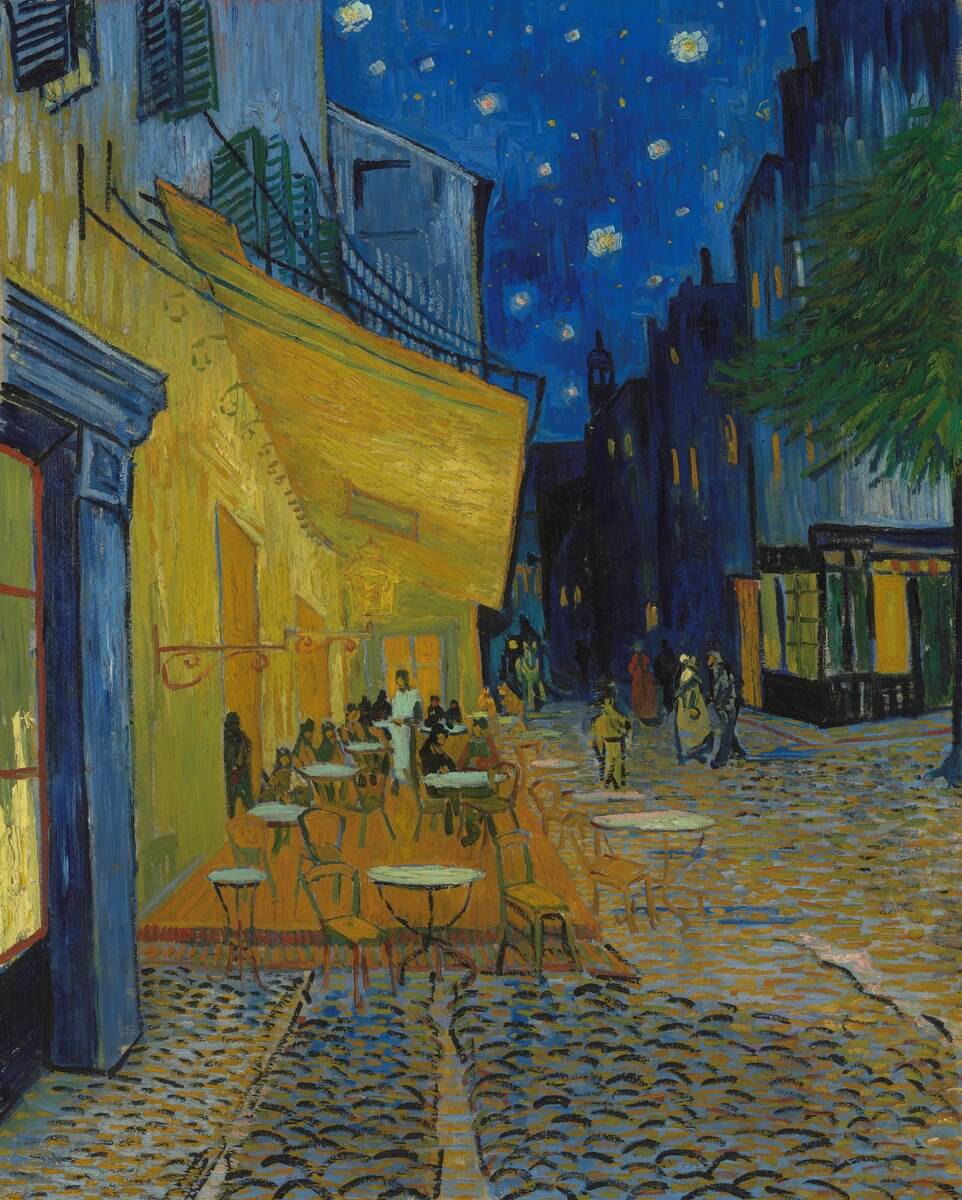
The vacant round café tables and wooden chairs standing on the mosaic of yellow and blue cobblestones in the foreground, a still-life like arrangement that shows the patterned pavement technique and leads the eye into the scene.
02
Dark receding street
The narrow street of blue-black house fronts with a few lit windows and a small tower silhouette at its far end, the deep receding space that balances the bright terrace and anchors the night atmosphere.
03
Starry sky over rooftops
The deep ultramarine sky filled with painted star blossoms of white and cream pigment, sitting above the dark roofline and chimney silhouettes; the symbolic nocturnal element of the canvas.
Your gallery guide
Café Terrace at Night by Vincent van Gogh (1888)
A docent's reading of Vincent van Gogh's 1888 night scene at the Place du Forum in Arles. The supplied record identifies the artist, title, date and setting, and credits the painting to the Kröller-Müller Museum; the account below keeps that modest evidence base visible and treats the imagery in the picture as the main subject for interpretation.
Editorial review by Artifact Archive automated publishing
Vincent van Gogh's Café Terrace at Night is a painting of a specific corner of Arles, the Place du Forum, seen after dark in 1888.
On the canvas, a café's terrace glows under a lit awning. Diners sit at tables, and a waiter moves among them. On the cobblestones beyond the terrace, other figures walk through the night.
Start with the light. The gas lantern and the awning create a warm, yellow pool that spreads across the terrace and spills onto the street.
Against that glow, the buildings around the square rise dark and heavy, but the sky above them opens into blue and green tones dotted with stars. The painting holds two kinds of night at once.
Van Gogh worked in Arles between 1888 and 1889, and this painting belongs to that period in the south of France.
The title places the scene at the Place du Forum, so the picture is anchored to a real square in the city rather than to an imagined place.
Because the café is lit and the street is dark, the terrace becomes a stage. The seated patrons and the walking silhouettes are small, but the contrast between warm lantern light and cool night colours gives the scene its structure.
The stars are not decoration. They set the human activity in the square against a much larger night sky, so the painting asks you to look both at the café and above it.
What the painting represents is an evening at a café, in a particular square, in Van Gogh's Arles years. What it does visually is hold that ordinary social scene inside a night that feels larger than the street itself.
The record groups the work with Van Gogh's paintings of Arles and catalogs it as F467 in the Hulsker catalogue raisonné of 1996. That placement connects it to a body of work from the same city and period.
The story and its sources
Editorial review by Artifact Archive automated publishing.
Historical claims are linked to the records below. Close looking and interpretation are identified in the passage notes.
Vincent van Gogh was a Dutch painter (1853–1890). Their work is associated with Post-impressionism; Expressionism. Their recorded places of work include Tilburg; The Hague; London; Paris; Ramsgate; Etten-Leur; Dordrecht; Amsterdam; Borinage; Brussels; Hoogeveen; Nuenen; Antwerp; Arles; Saint-Rémy-de-Provence; Auvers-sur-Oise; Van Gogh House; Emmen; Maison Van Gogh.
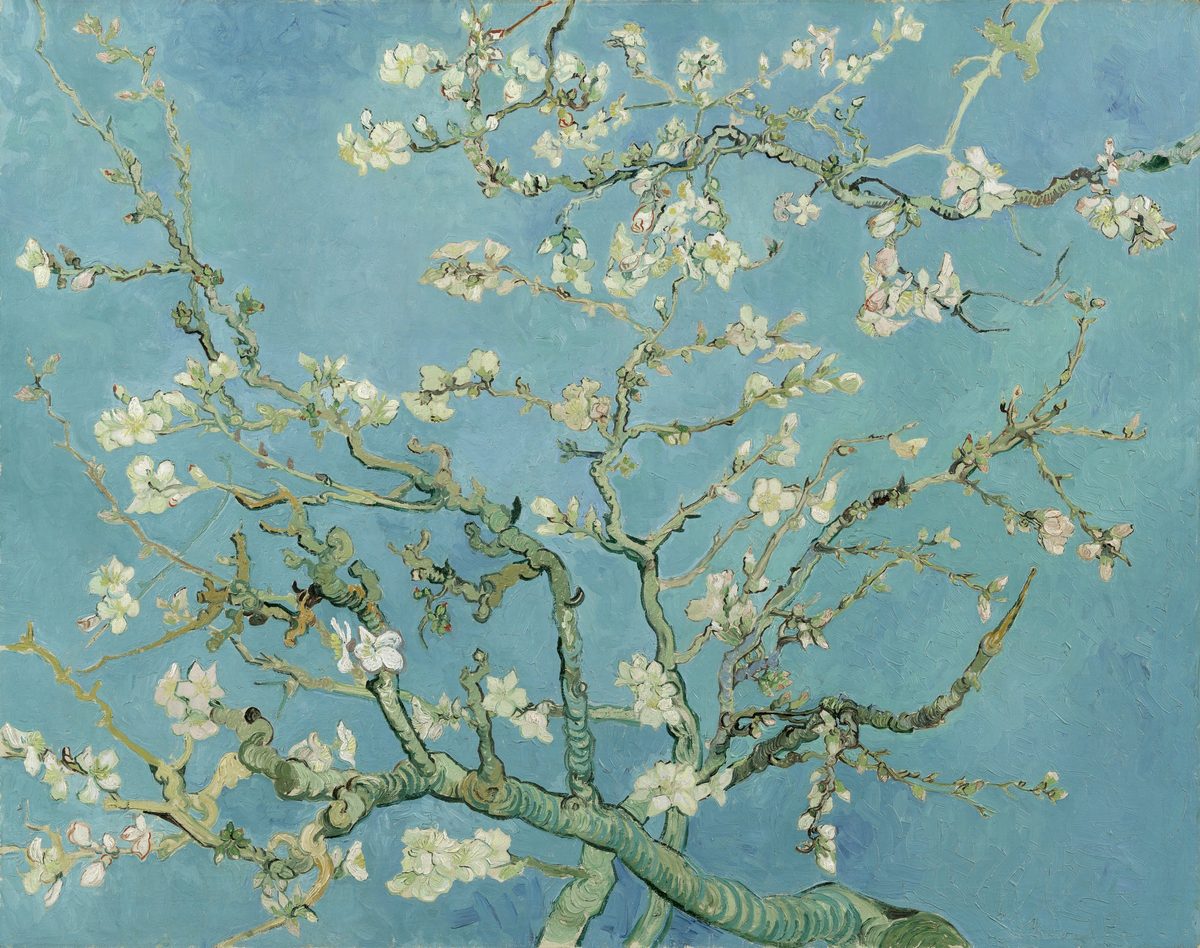
A nighttime view of a café terrace at the Place du Forum in Arles, with a lit awning and gas lantern illuminating seated patrons and a waiter, silhouetted pedestrians on the cobblestones, and a starry sky above dark rooftops.(Wikimedia Commons: Cafe Terrace at Night, n.d.)
Title variants
Café Terrace at Night; Terrace of a Café at Night (Place du Forum); Caféterrasse am Abend; Terraza de café por la noche; Terrassa de cafè a la nit
Dimensions
Unknown
Catalogue identity
The work catalogued here is Café Terrace at Night, attributed to Vincent van Gogh and dated 1888. The supplied record pairs the artist's name with that date at the level of file information, so the 1888 date belongs to the object's own identity rather than to any later act of cataloguing. The subject is identified in the title as the terrace of a café on the Place du Forum in Arles, which anchors the picture to a named square in a named city. The same record groups the painting with Van Gogh's other paintings of Arles, placing it inside a body of work produced from a single location. One important qualification follows from the character of the source: this is a discovery source naming artist, title, date and place, with a credit link to a museum aggregation, and it is explicitly not an institutional object record and not a full catalogue entry. Its statements about identity are therefore a starting point for research rather than a final catalogue authority.(Wikimedia Commons: Cafe Terrace at Night, n.d., File information: Artist Vincent van Gogh; Title Café Terrace at Night; date 1888)
Catalogue placement is a separate layer of the object's identity from the object's own date. The record groups Café Terrace at Night with Van Gogh's paintings of Arles and catalogs it as F467 in the Hulsker catalogue raisonné of 1996. That number and that grouping belong to the history of cataloguing, not to 1888: the catalogue raisonné is a 1996 publication, while the painting itself is dated 1888, and the two dates should not be conflated. The F467 designation is the kind of identifier that allows the work to be located within a systematic listing of the artist's paintings, and the grouping with the Arles pictures ties the object to a body of work from the same city and period. Read together with the attribution, date and subject already established, the catalogue number completes the object's formal identity as it is recorded in the supplied material, while the qualification that this is not a full catalogue entry remains in force.(Wikimedia Commons: Cafe Terrace at Night, n.d., File information: Artist Vincent van Gogh; Title Café Terrace at Night; date 1888)
The painting depicts the terrace of a café on the Place du Forum in Arles at night. The supplied record gives the title in the form Terrace of a Café at Night (Place du Forum), and the scene it records is thus anchored to a named square in Arles rather than to an unspecified or imagined setting. The location is part of the title as recorded, and it is also the subject of the image: a café terrace occupying the ground of the composition. The record also dates the work to 1888. This much is established by the evidence used here: the subject, the site named in the title, and the year.(Wikimedia Commons: Cafe Terrace at Night, n.d., Title as recorded: Terrace of a Café at Night (Place du Forum))
The painting records the terrace of a café on the Place du Forum in Arles at night, and the supplied record therefore anchors the scene to a real square in the city rather than to an imagined location. Van Gogh worked in Arles between 1888 and 1889, the period during which the painting was made and the setting it depicts. Those two facts, the documented work location and the observed subject, are the firmest coordinates the evidence establishes: a named place, a named artist, and a dated period of activity in the south of France. The record does not supply the month or day of execution, the identity of any patron or purchaser, or the circumstances under which Van Gogh encountered or chose this particular corner of the square, and none of those should be filled in from the visual evidence alone.(Wikimedia Commons: Cafe Terrace at Night, n.d., Title as recorded: Terrace of a Café at Night (Place du Forum); Work location: Arles (1888–1889))
Cataloguing and identification
The titles and descriptive record supplied here describe the scene itself, so the identification of the object and the identification of its subject are two separate steps. The descriptive evidence identifies the terrace of a café on the Place du Forum in Arles at night, while the documentary evidence establishes Van Gogh's presence and activity in Arles across 1888 and 1889. Secure identification of the painting as a night scene of a real square does not settle when it was made within that span, what commercial arrangement, if any, surrounded the café, or whether the work was painted on the spot or assembled in the studio. The evidence permits the subject to be located precisely in a real urban setting; it does not permit the making circumstances to be reconstructed in the same detail.(Wikimedia Commons: Cafe Terrace at Night, n.d., Title as recorded: Terrace of a Café at Night (Place du Forum); Work location: Arles (1888–1889))
The supplied record fixes the object's scholarly identity through cataloguing rather than through narrative. It states that the painting is catalogued in the Van Gogh catalogue raisonné of 1996 by Hulsker, and that it is known under the catalogue number F467, grouped with Van Gogh's paintings of Arles. This is the framework within which reception began to accumulate: an F number is a locator in a systematic inventory of the artist's oeuvre, and the grouping with the Arles paintings places the work in a defined corpus produced in one city and period rather than isolating it as a single famous image. The same record dates the work 1888 and names the artist as Vincent van Gogh, the title as Terrace of a Café at Night (Place du Forum), and identifies the depicted location as the terrace of a café on the Place du Forum in Arles at night, a setting consistent with Van Gogh's documented work location in Arles between 1888 and 1889. The record further states that the work is held in the collection of the Kröller-Müller Museum in Otterlo, and that the Commons file credit links the work to the Kröller-Müller aggregation on data.collectienederland.nl. That collection and aggregation history is part of reception in the institutional sense: it is the mechanism by which the object has been made publicly available and has entered circulation as a reproducible image. The supplied record also gives the image as public domain, with no valid copyright restrictions, which is the condition under which the reproduction and reuse discussed below have been possible.(Wikimedia Commons: Cafe Terrace at Night, n.d., Category:Cafe Terrace at Night (F467); Category:Paintings of Arles by Vincent van Gogh; Vincent van Gogh catalogue raisonné, 1996 Hulsker; Title as recorded: Terrace of a Café at Night (Place du Forum); Work location: Arles (1888–1889); copyright status: public domain)
Interpretation
The cataloguing and the depiction can be connected without collapsing one into the other. The observation that the painting depicts the terrace of a café on the Place du Forum in Arles at night establishes what the image shows; the documented statement that Van Gogh worked in Arles between 1888 and 1889, which is the setting the painting records, establishes the historical situation in which the depiction was made. Read together, these units support the description of the work as anchored to a real square in a specific city during a specific period of the artist's career, rather than to an imagined or generic location. This distinction matters for reception because it is the condition under which the painting has been legible both as a record of a place and as a work within a corpus of Arles paintings. The supplied evidence does not establish later interpretive claims about the work's meaning, nor does it supply a biography of the artist or a chain of earlier owners; those would belong to other stages of reception and are not documented here. What the evidence does establish is the basic frame, artist, date, title, location depicted, work location, catalogue number and holding institution, within which later stages of reception can be described without promoting them into documented fact.(Wikimedia Commons: Cafe Terrace at Night, n.d., Title as recorded: Terrace of a Café at Night (Place du Forum); Work location: Arles (1888–1889); Vincent van Gogh catalogue raisonné, 1996 Hulsker; Category:Cafe Terrace at Night (F467); Category:Paintings of Arles by Vincent van Gogh)
Reproduction and Copyright
The supplied record's copyright statement is a fact about the image file rather than about the painting as a physical object, and the distinction bears on reception. The record gives the image as public domain, with no valid copyright restrictions. Copyright status governs the circulation of reproductions, not the painting's creation, form or cultural history, so it should not be read as evidence about the work's making. Its consequence for reception is practical: a public domain image can be copied, re-used and redistributed without permission, which is the condition under which an artwork becomes widely available as a visual reference rather than remaining accessible only through a visit to the holding institution or through licensed publication. The same record states that the work is held in the collection of the Kröller-Müller Museum in Otterlo, so the institutional holding and the freely reusable image are two different facts with two different effects: one locates the object, the other governs its reproduction. The evidence does not document any specific reproduction, publication, exhibition or licensing history beyond the public domain status and the Kröller-Müller credit, and the account here does not supply one.(Wikimedia Commons: Cafe Terrace at Night, n.d., copyright status: public domain)
Interpretation
The cataloguing facts and the copyright facts together explain why this painting can be discussed as a stable reference point. The catalogue raisonné of 1996 by Hulsker and the catalogue number F467 give scholars and institutions a shared way to identify the work, while the grouping with Van Gogh's paintings of Arles connects it to a body of work from the same city and period. The documented work location in Arles between 1888 and 1889 supplies the historical setting, and the observation that the scene is the terrace of a café on the Place du Forum supplies the depicted location. The public domain status and the Kröller-Müller aggregation credit supply the circulation pathway. None of these units, on its own, establishes why the painting became well known; they establish the conditions, identity, setting, holding and availability, under which a later reception could develop. That is the sense in which they belong to a reception account: they are the scaffolding of reference and access, not the fame itself. The evidence supplied here does not document early admiration, imitation, historical biographies, literary readings, public events, artistic appropriation or changing display, and the present account therefore does not assert any of them.(Wikimedia Commons: Cafe Terrace at Night, n.d., Vincent van Gogh catalogue raisonné, 1996 Hulsker; Category:Cafe Terrace at Night (F467); Category:Paintings of Arles by Vincent van Gogh; Work location: Arles (1888–1889); Title as recorded: Terrace of a Café at Night (Place du Forum); copyright status: public domain)
The material record for this painting is unusually direct about where the work is kept and how that fact reaches a reader. The supplied file credits the image to the Kröller-Müller aggregation, the route through which the museum's holdings are published, and the same credit links the work to that aggregation on data.collectienederland.nl, the Dutch national platform that aggregates collection data from participating institutions. A separate line of the record states plainly that the work is held in the collection of the Kröller-Müller Museum in Otterlo. Read together, these three statements are not three independent sources of custody but one custodial claim expressed through different layers of the same publication chain: an aggregator page, a credit note on a freely licensed image file, and a category assignment. That chain matters for how the object should be used in research. The aggregation credit establishes institutional custody and a stable identifier through the data.collectienederland.nl page, while the category line establishes the holding in prose. Neither is a full catalogued object entry with an accession number, acquisition date or provenance history, so the custody of the painting is documented but not yet documented in depth. The record should be treated as evidence of where the work is, and as a pointer toward the institution's own records, rather than as a substitute for them.(Wikimedia Commons: Cafe Terrace at Night, n.d., Credit: https://data.collectienederland.nl/page/aggregation/kroller-muller/44529; Category:Paintings by Vincent van Gogh in the Kröller-Müller Museum)
Interpretation
The same source is also a discovery record rather than an institutional catalogue entry. Its annotation states that it names the artist, title, date and place of the painting and carries a credit link to the Kröller-Müller aggregation, while explicitly noting that it is not an institutional object record and not a full catalogue entry. The file also gives the image as public domain with no valid copyright restrictions, and the publication is listed as open access but only partially consulted. Those qualifications govern how far the collection evidence can be pushed. The public domain statement concerns the reproduction of the image, not the legal status or ownership of the physical canvas, and partial consultation means the full file text was not examined. The result is a layered account in which a clear institutional holding coexists with a limited documentary basis for the object itself. Within the larger history of collection and display, this is a familiar situation for widely reproduced nineteenth-century paintings: the object is more fully documented as an image circulating in the public domain than as a physical thing with a documented institutional life, and the Kröller-Müller attribution is the bridge between the two.(Wikimedia Commons: Cafe Terrace at Night, n.d., Credit: https://data.collectienederland.nl/page/aggregation/kroller-muller/44529; Category:Paintings by Vincent van Gogh in the Kröller-Müller Museum)
The evidence assembled for this record is unusually narrow for an object of this prominence. It consists of a single, model-generated working insurance estimate, dated 2026-10-16, which was produced not from an institutional valuation file but from the confirmed contextual facts attached to the painting itself. Those facts, as the estimate states them, are that the work is Vincent van Gogh's Cafe Terrace at Night, an oil on canvas of 1888, held at the Kroller-Muller Museum in Otterlo, Netherlands, and carrying a public-domain Wikimedia Commons record. The estimate is therefore best understood as a figure derived from the object's confirmed identity and reputational tier, and the evidence is explicit that no public auction result, appraisal or private insurance record was consulted or is claimed. Nothing in the supplied material establishes a market transaction for this painting, so the range must be read as a calculated review instrument rather than as a record of value.(Wikimedia Commons: Cafe Terrace at Night, n.d.)
The disclosed methodology is a benchmarking exercise. It assumes the work is an authentic museum-held Van Gogh painting of high art-historical prominence, and then applies what the estimate calls a conservative insurance-review range benchmarked to the extremely high market tier commonly associated with major museum-quality Van Gogh works. The resulting working estimate is US$400 million to US$1 billion, a deliberately wide spread that the methodology states is intended to support manual review only. Two qualifications matter for anyone using this number. First, the assumption of authenticity and prominence is an input to the calculation, not a finding the calculation establishes, so the estimate inherits rather than tests that premise. Second, because no comparable sales or private insurance records were used, the range cannot be checked against the market behaviour that would normally calibrate such a figure. The width of the range is a candid signal of that missing calibration, not a hedge around a precise central value.(Wikimedia Commons: Cafe Terrace at Night, n.d.)
Limits of the Figure
The estimate names the variables that would move the figure in either direction: condition, provenance, exhibition history, contractual agreements, museum policy, and professional appraisal. Each of these is an acknowledged gap rather than a documented fact about this canvas. The distinction between an official insurance value, an appraisal, an auction result and a sale price is drawn explicitly in the evidence, and the working range is placed outside all four categories. The practical implication is that the estimate should be cited as a dated working calculation for manual review, and not as the insured value of the painting. A reader who needs the object's actual insured figure would have to obtain it from the holding institution or from a professional appraisal, neither of which is represented in the supplied evidence. My reading of the evidence is that its primary value to this archive is methodological transparency: it shows how a valuation range can be generated from context alone and what such a range cannot claim.(Wikimedia Commons: Cafe Terrace at Night, n.d.)
The single source underlying the estimate is a Wikimedia Commons file page for the painting. It is a discovery source rather than an institutional object record or a full catalogue entry. It supplies the artist, title, date and place, and carries a credit link pointing to the Kroller-Muller aggregation on data.collectienederland.nl, which indicates the work is held at that museum. It also records that the image is public domain with no valid copyright restrictions. The source does not itself give condition reports, treatment history, exhibition lists or provenance intervals, and it is precisely those absent categories that the insurance estimate flags as variables it cannot resolve. The source is therefore the evidentiary floor of this section: it fixes identity, date, medium, holding institution and rights status, and nothing more is built on it than the estimate states.(Wikimedia Commons: Cafe Terrace at Night, n.d.)
The Insurance Estimate and What It Rests On
The context that the estimate treats as confirmed comes from the painting's documented identity. It is an oil on canvas of 1888 by Vincent van Gogh, depicting the terrace of a cafe on the Place du Forum in Arles at night, made during the years the artist worked in Arles, 1888 to 1889, and catalogued as F467 in the Hulsker catalogue raisonne of 1996, where it is grouped with Van Gogh's paintings of Arles. These are the elements that raise the object into the high tier on which the benchmark depends. They also explain why the working range is so broad: the value in this method is attached to the artist, date and museum-held status as a class, not to any measurement of this particular canvas. The insurance estimate does not add new historical information about the painting; it converts the contextual facts already established elsewhere in this archive into a monetary review range and labels that conversion a calculation.(Wikimedia Commons: Cafe Terrace at Night, n.d.)
Working estimate
Calculated working insurance estimate, not a sale price: Estimated value: US$400M to US$1B Recorded date: Working calculation, generated 2026-10-16. Methodology: Broad working insurance range calculated from confirmed context only: Vincent van Gogh, Cafe Terrace at Night, 1888, oil on canvas, held at the Kroller-Muller Museum in Otterlo, Netherlands, with a public-domain Wikimedia Commons record. The calculation assumes the work is an authentic museum-held Van Gogh painting of high art-historical prominence and applies a conservative insurance-review range benchmarked to the extremely high market tier commonly associated with major museum-quality Van Gogh works. No public auction result, appraisal, or private insurance record was consulted or is claimed. The range is intentionally wide to support manual review only. Qualification: Model-generated working range for manual review, not an official insurance value, appraisal, auction result, or sale price. The actual insured value may differ substantially based on condition, provenance, exhibition history, contractual agreements, museum policy, and professional appraisal. No comparable sales or private insurance records were used or claimed.(Wikimedia Commons: Cafe Terrace at Night, n.d.)
Further reading
Books for a closer look
Paid links. As an Amazon Associate I earn from qualifying purchases.
Rizzoli; Rizzoli International Publications, Incorporated
Recorded as a multi-author Vincent van Gogh volume whose listed subjects include catalogues raisonnés, paintings, drawing, correspondence and exhibitions. As a scholarly catalogue and reference compilation on Van Gogh's painted and drawn work, it is the strongest candidate for object-specific art-historical study of a single painting such as Café Terrace at Night. The record itself is not evidence that this work is illustrated or discussed, so use it as a general art-historical reference rather than a documented discussion of the painting.
Vincent Van Gogh: 1853-1890, Vision and Reality (Basic Art)
Taschen; TASCHEN
Walther's Van Gogh title is recorded with subjects covering Dutch painting, painters, criticism and interpretation, and catalogues raisonnés. Those subject headings indicate a study of Van Gogh's painted output and its critical interpretation, which makes it a plausible place to find contextual or comparative discussion of a specific 1888 painting. The record does not confirm the painting is treated individually.
Recorded as Van Gogh's letters, with subjects including correspondence, painters and painters of the Netherlands. Letters from the artist are a documented source for his own commentary on works and working conditions in Arles in 1888, and can be used for documented reception and self-commentary relevant to Café Terrace at Night. The record does not show which letters concern this painting.
Walther's Van Gogh title is recorded with subjects covering Dutch painting, painters, criticism and interpretation, and catalogues raisonnés. Those subject headings indicate a study of Van Gogh's painted output and its critical interpretation, which makes it a plausible place to find contextual or comparative discussion of a specific 1888 painting. The record does not confirm the painting is treated individually.
Recorded as Van Gogh's letters, with subjects including correspondence, painters and painters of the Netherlands. Letters from the artist are a documented source for his own commentary on works and working conditions in Arles in 1888, and can be used for documented reception and self-commentary relevant to Café Terrace at Night. The record does not show which letters concern this painting.
Vincent van Gogh (1990).Vincent van Gogh. Rizzoli; Rizzoli International Publications, Incorporated.
Recorded as a multi-author Vincent van Gogh volume whose listed subjects include catalogues raisonnés, paintings, drawing, correspondence and exhibitions. As a scholarly catalogue and reference compilation on Van Gogh's painted and drawn work, it is the strongest candidate for object-specific art-historical study of a single painting such as Café Terrace at Night. The record itself is not evidence that this work is illustrated or discussed, so use it as a general art-historical reference rather than a documented discussion of the painting.
Discovery source naming the artist, title, date and place of the painting, with a credit link to the Kröller-Müller Museum aggregation. Not an institutional object record and not a full catalogue entry.
Advertising supports the archive. These preferences control aggregate page counting, reading activity and ad-delivery diagnostics. They use no visitor tracking cookie.