The Milkmaid
Artist: Johannes Vermeer · c. 1660
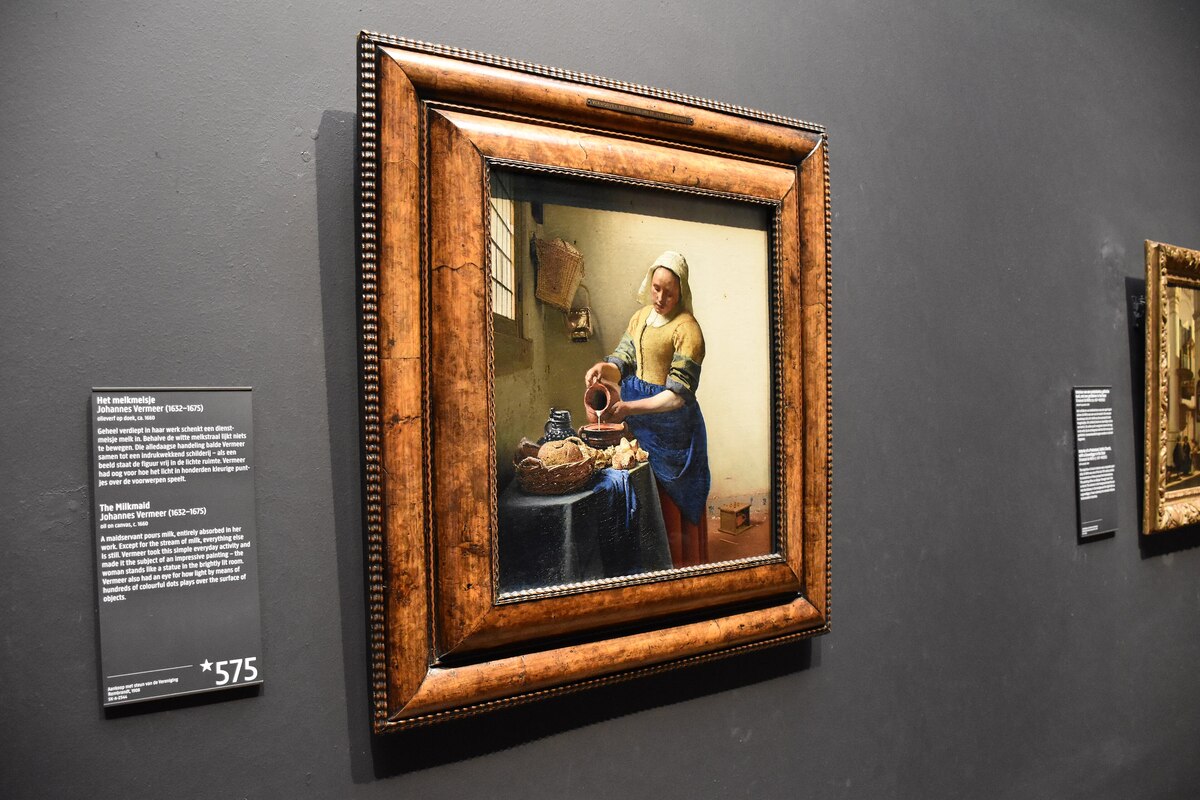
The Milkmaid: high-resolution image
The highest-resolution file we hold, available without payment or an account.3,840 × 2,560 pixels.
Download highest-resolution imageThe complete story
The story About 3 minutes to read
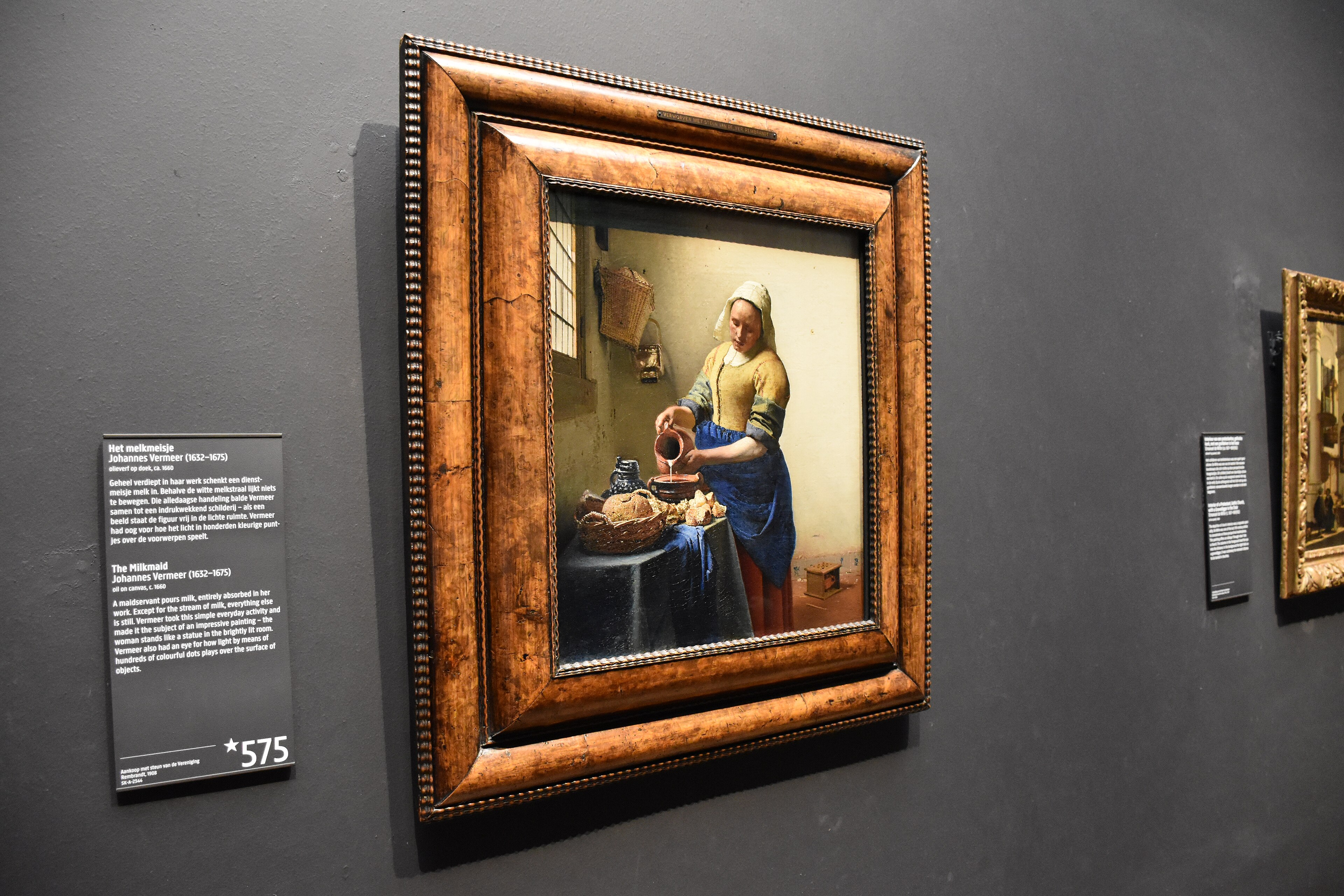
Johannes Vermeer painted The Milkmaid around 1660. A maidservant stands behind a table and pours milk from a jug into a cooking pot. The room is bright and quiet. Except for the stream of milk, everything else is still. It is a simple everyday task, made the subject of a remarkable painting.
Look at how much is arranged around her. A basket of bread and a stone jug sit on the table. At the left, a window holds a wicker basket and a copper pot. Along the lower wall at right, a row of tiles meets a foot stove. These ordinary objects place her in a working kitchen, not a grand room.
The Rijksmuseum describes her as standing like a statue in the brightly lit room. Vermeer took this simple activity and made it the subject of an impressive painting. Her plain clothing and steady posture give the scene weight. The painting turns daily work into something monumental, without changing what she is doing.
The milk is the only moving thing. Vermeer paid close attention to how light plays over surfaces, using hundreds of colourful dots to build up the bread, the jug, the basket and the walls. The stream of milk seems to fall in real time. The Rijksmuseum has asked how Vermeer made it look as if it were streaming from the pitcher, a sign of technical interest in this small detail.
The Rijksmuseum record includes a story titled 'A sexual or lesbian symbol'. That is a reported interpretation of the figure and her objects, not a universal reading. It shows that viewers have sometimes looked for meanings beyond the everyday scene. The painting itself is clear about her action. The rest is interpretation.
So what are we meant to take away? The Milkmaid is a genre painting, a picture of ordinary life. Its power comes from Vermeer's focus on a woman completely absorbed in her work. He gives that work stillness, light and scale. The result is an image that asks us to look closely at something we might otherwise overlook.
The story and its sources
Historical claims are linked to the records below. Close looking and interpretation are identified in the passage notes.
- Passage 1Documented historyThe Milkmaid, Rijksmuseum collection recordThe Milkmaid, Rijksmuseum collection (Dutch-language record)
- Passage 2Close lookingThe Milkmaid, Rijksmuseum collection recordThe Milkmaid, Rijksmuseum collection (Dutch-language record)
- Passage 3InterpretationThe Milkmaid, Rijksmuseum collection recordThe Milkmaid, Rijksmuseum collection (Dutch-language record)
- Passage 4Close lookingThe Milkmaid, Rijksmuseum collection recordThe Milkmaid, Rijksmuseum collection (Dutch-language record)
- Passage 5Reported traditionThe Milkmaid, Rijksmuseum collection recordThe Milkmaid, Rijksmuseum collection (Dutch-language record)
- Passage 6InterpretationThe Milkmaid, Rijksmuseum collection recordThe Milkmaid, Rijksmuseum collection (Dutch-language record)
Details to notice
About 2 minutes to readDelft-tiled foot warmer
The foot warmer set into the wall of Delft blue-and-white tiles at the lower right, a small still-life of Dutch domestic detail and a signature of Vermeer's Delft setting.
Window daylight source
The leaded window at the left that motivates the cool daylight modeling the figure, bread and wall, the painting's controlling light logic.
Bread basket and table still life
The woven basket of broken loaves and the blue-draped table, Vermeer's dense still life of everyday nourishment that anchors the lower left of the canvas.
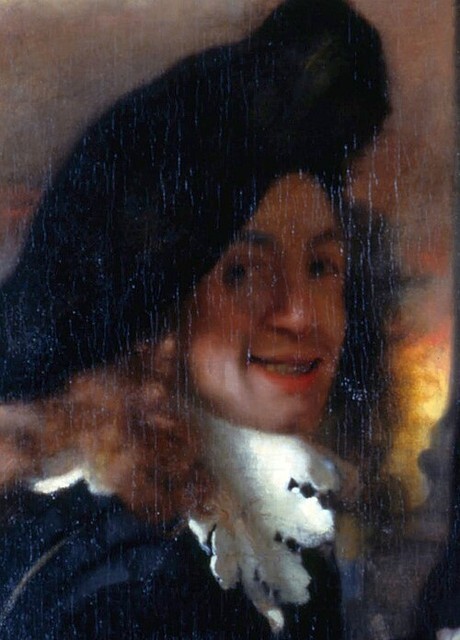
Possible self-portrait Image credit
Johannes Vermeer. Image source · Public domain
About the artist
Johannes Vermeer
1632 to 1675
Vermeer was a Dutch painter who lived and worked in Delft. His small surviving body of work includes religious subjects and domestic interiors shaped by carefully placed objects, architectural space and subtle light. He became a master in Delft's painters' guild in 1653, and his paintings attracted collectors during his lifetime.
- Born
- 1632
- Died
- 1675
- Nationality
- Dutch
- Birthplace
- Delft, Netherlands
- Died in
- Delft, Netherlands
The research & record
Study the work.
Follow the evidence.
Find catalogue details, historical context, technical research and the literature behind this artwork.
The artwork record
Research catalogue
Catalogue information and detailed research, with references that link to the bibliography.
Updated .
Identity and catalogue
Link- Title
- The Milkmaid(Rijksmuseum, n.d.b)
- Artist or attribution
- Johannes Vermeer
- Object date
- c. 1660
- Medium and support
- oil on canvas
- Dimensions
- 45.5 cm x 41 cm(Rijksmuseum, n.d.b)(Rijksmuseum, n.d.a)
- Current collection or location
- Rijksmuseum, Amsterdam
- Movement or period
- Dutch Golden Age, genre painting
- Country or culture
- Netherlands (Delft)
- Depicted subject
- A maidservant stands behind a table and pours milk from a pitcher into a cooking pot. On the table are a basket of bread and a stone jug; at left, a window with a wicker basket and a copper pot. Along the lower wall at right are a row of tiles and a foot stove. The simple everyday activity is the subject.(Rijksmuseum, n.d.b)(Rijksmuseum, n.d.a)
- Title variants
- Het melkmeisje; De keukenmeid; De melkmeid
- Accession number
- SK-A-2344
- Support
- canvas
Read valuation records and their limitations
Catalogue identity
The Rijksmuseum catalogue record identifies the painting as The Milkmaid (Het melkmeisje), attributed to Johannes Vermeer and dated around 1660. The physical entry gives oil on canvas, 45.5 cm in height by 41 cm in width, and the object number SK-A-2344. The Dutch-language version of the same record supplies the alternative title, so the object carries two catalogue names in the institution's own documentation. The date is the period assigned to the painting's making, not the date of any catalogue entry or acquisition event, and it should be kept distinct from the later documented history of ownership and museum entry that follows.(Rijksmuseum, n.d.b, Identification; Physical characteristics; Acquisition and rights)(Rijksmuseum, n.d.a)
Institutionally the work is classed as a genre painting, and the Rijksmuseum's subject terms run through milkmaid, milk, kitchen-maid, ceramic container, foot stove and bread. Those terms describe the picture's ordinary domestic equipment and its central action rather than a narrative or mythological subject. The descriptive record sets out what is visible: a maidservant behind a table pours milk from a milk jug into a cooking pot; a basket with bread and a stone jug stand on the table; at the left a window holds a wicker basket and a copper pot; along the lower wall at right a row of tiles meets a foot stove. The catalogue's own gloss is that the woman is entirely absorbed in her work and that, except for the stream of milk, everything else is still, and that Vermeer made this simple everyday activity the subject of an impressive painting, with the figure standing like a statue in the brightly lit room. These are the institution's characterisations of the image, grounded in the objects and pose it describes.(Rijksmuseum, n.d.b, This work is about; Identification; Physical characteristics)(Rijksmuseum, n.d.a)
Documentation and reception
The record's associated material shows how the object is documented and presented rather than what it depicts. It is listed as in the public domain and is connected to a photograph reproduction, former frames, a current profile frame, and an exhibition titled 'Glorie van de Gouden Eeuw: De Keukenmeid'. The Rijksmuseum also lists 21 related publications, among them 'The Milkmaid by Johannes Vermeer', studies of the painting's technique, and articles on its provenance by Pieter Roelofs and Jonathan Bikker. The record includes a video story on everyday chores of the seventeenth century, linking the painting to the daily work of its period, and a separate story describing the work as 'extraordinary ordinary', which frames the transformation of a chore into an impressive painting. An educational video on the record asks how Vermeer made the milk seem to be streaming from the pitcher, an indication of technical interest in that small detail. The presence of a story titled 'A sexual or lesbian symbol' is recorded as a reported interpretation connected to the figure and her objects; it belongs to the history of reception rather than to the catalogue description of the scene, and the record presents it as one reading among others, not as a settled meaning.(Rijksmuseum, n.d.b, Stories; Identification; Physical characteristics)(Rijksmuseum, n.d.a)
Interpretation
Read together, the identity record and the ownership record show why this object carries weight in a larger history of art and material culture. The catalogue keeps the object date of about 1660 separate from the dated sales, the 1908 acquisition and the later documentation, so that the painting's making, its circulation through Delft and Amsterdam collections, and its institutional presentation remain distinct layers of evidence. The genre classification and the enumerated kitchen objects tie the picture to seventeenth-century domestic work, which the museum's own video story about everyday chores makes explicit, while the provenance sequence records an unbroken line of documented owners and sale prices from the Van Ruijven and De Knuijt collection onward. The Rijksmuseum's descriptive language, the technical publications on the painting's surface and the reception stories attached to the record together indicate that the object is studied both as a painted image of ordinary labour and as a documented artifact whose meanings have been argued over, the sexual or lesbian reading being one attributed interpretation rather than a property of the catalogue description.(Rijksmuseum, n.d.b, Identification; Physical characteristics; This work is about; Acquisition and rights; Stories)(Rijksmuseum, n.d.a)
The painting is titled The Milkmaid (Het melkmeisje), made by Johannes Vermeer around 1660, oil on canvas, 45.5 cm by 41 cm, in the Rijksmuseum, object number SK-A-2344.(Rijksmuseum, n.d.b)
Subject and iconography
LinkRead valuation records and their limitations
The recorded composition
Visual observation
The Rijksmuseum's description of The Milkmaid (object SK-A-2344) records a compact interior composition in oil on canvas measuring 45.5 by 41 cm. A maidservant stands behind a table and pours milk from a milk jug into a cooking pot. On the table are a basket with bread and a stone jug; at the left is a window with a wicker basket and a copper pot; and along the lower wall at right run a row of tiles and a foot stove. Read together, these elements locate the figure in a working kitchen rather than a grand room: the vessels, bread basket, tiles and foot stove are the equipment of domestic labor, and the window at left supplies the light that models them. The Rijksmuseum classifies the picture as a genre painting, and its listed subjects name precisely these components: milkmaid, milk, kitchen-maid, ceramic container, foot stove and bread. The inventory of objects is therefore not decorative filler but the documentary core of the scene, and any account of what the painting shows must begin from this arrangement of figure, furniture and fittings.(Rijksmuseum, n.d.b, Description; Physical characteristics; This work is about)(Rijksmuseum, n.d.a)
The Rijksmuseum's summary describes the maidservant as entirely absorbed in her work, and notes that except for the stream of milk everything else is still. This is an observation about the picture's internal action: a single continuous motion, the poured milk, set against an otherwise motionless room. The stillness is not emptiness. The figure's absorption and the quiet of the surrounding objects are what the description asks the viewer to notice, and the milk stream becomes the focal event against which the rest of the composition is measured. This emphasis on the one moving element also explains why the milk itself has attracted technical curiosity, a point developed below.(Rijksmuseum, n.d.b, Summary)
Light and surface
The Rijksmuseum summary attributes to the painter an eye for how light, by means of hundreds of colourful dots, plays over the surface of objects. In the context of this picture, that description bears directly on the recorded objects: the bread in its basket, the stone jug, the wicker basket and the copper pot, and the walls of the room are the surfaces over which such light is described as playing. The formulation is the institution's characterization of the painter's handling rather than a technical analysis of pigments or build-up, and it should be reported as such. It does, however, connect what a viewer sees in the finished picture, the animation of ordinary surfaces, to a named feature of the painted surface itself, the multitude of small touches of colour.(Rijksmuseum, n.d.b, Summary; Description)(Rijksmuseum, n.d.a)
Interpretation and reception
The Rijksmuseum record includes a story titled 'A sexual or lesbian symbol' connected to The Milkmaid. This is a reported interpretation of the figure and her objects as sexual or lesbian symbolism, and the evidence attributes it to a story on the museum's record rather than to a consensus of scholarship. It should be weighed as one historically circulating reading among others, not as a documented meaning of the painting. The visible evidence remains the action described in the record: a maidservant pouring milk, absorbed in her work, in a room of kitchen equipment. Interpretations that go beyond that action are layered onto the scene by viewers, and the record itself presents the symbolic reading as something reported, which is the appropriate evidential status to preserve when discussing it.(Rijksmuseum, n.d.b, Description; Summary)(Rijksmuseum, n.d.a)
A maidservant stands behind a table and pours milk from a milk jug into a cooking pot. On the table are a basket with bread and a stone jug; at left is a window with a wicker basket and a copper pot. Along the lower wall at right are a row of tiles and a foot stove.(Rijksmuseum, n.d.b)(Rijksmuseum, n.d.a)
A maidservant pours milk, entirely absorbed in her work. Except for the stream of milk, everything else is still.(Rijksmuseum, n.d.b)
Historical context
LinkRead valuation records and their limitations
Commission, function and social world
The Rijksmuseum classifies the painting as a genre painting, and its listed subjects are the milkmaid, milk, the kitchen-maid, a ceramic container, a foot stove and bread. That classification matters for how the work's historical situation should be described. The record does not document a named patron who ordered a portrait of a specific woman, nor a contract, nor an occasion. What it documents is a picture organized around an anonymous maidservant and the equipment of her work. The museum's own narrative material reinforces this framing by presenting a video story on everyday chores of the seventeenth century, explicitly connecting the painting to the daily labour of its period. The social world the record establishes is therefore the working kitchen rather than a court or regent's chamber, even though the painting's later owners were collectors of high standing.(Rijksmuseum, n.d.b, This work is about; Stories)(Rijksmuseum, n.d.a)
The work is a genre painting; its subjects include milkmaid, milk, kitchen-maid, ceramic container, foot stove, and bread.(Rijksmuseum, n.d.b)(Rijksmuseum, n.d.a)
The Rijksmuseum record includes a video story about everyday chores of the 17th century, connecting the painting to the daily work of its time.(Rijksmuseum, n.d.b)(Rijksmuseum, n.d.a)
Materials and technique
LinkRead valuation records and their limitations
The documented support and medium
Visual observation
The Rijksmuseum's collection records, in both their English and Dutch versions, describe The Milkmaid as an oil painting on canvas measuring 45.5 cm in height by 41 cm in width. These are the only material facts about support and medium that the supplied records state directly; the records do not describe a panel, a transferred support, a lining, or any other structural intervention, and nothing in the evidence documents ground layers, priming, canvas weave, stretcher history, or conservation treatment. The object is catalogued as a genre painting whose listed subjects include milkmaid, milk, kitchen-maid, ceramic container, foot stove, and bread, which places the picture's depicted materials (ceramic and metal vessels, bread, tiles, a foot stove) within a domestic working interior rather than a grand room. Any account of how the paint was built up on this canvas must therefore be distinguished carefully from what the records actually attest: the medium and dimensions are documented, while statements about preparation and layering are not supplied here.(Rijksmuseum, n.d.b, Physical characteristics; Description; Related objects)(Rijksmuseum, n.d.a)
The Rijksmuseum record credits Vermeer with a particular sensitivity to how light, by means of hundreds of colourful dots, plays over the surface of objects. In the record's phrasing this is an observation about the painter's handling of light and colour across the surfaces of things, and it is the closest the supplied evidence comes to describing a making technique. The description should not be converted into a claim about specific pigments, a stippling method, or a named layer structure, because the record does not identify pigments or enumerate layers. What it establishes is that the museum's account of the picture's surface effects is framed around many small touches of colour distributed across depicted objects, and that this handling is treated as characteristic of Vermeer's eye rather than as an incidental feature of the scene.(Rijksmuseum, n.d.b, Summary)
Documentation and the limits of the record
Interpretation
Read together, the supplied evidence supports a careful division between what can be seen in the picture and what the records establish. The visible arrangement is fully described: a maidservant behind a table pours milk from a jug into a cooking pot; a basket with bread and a stone jug stand on the table; at left a window holds a wicker basket and a copper pot; along the lower wall at right a row of tiles meets a foot stove. These are observations of depicted contents, not of materials. The documented material facts are narrower: oil on canvas, 45.5 by 41 cm, with a noted attention to light rendered through hundreds of colourful dots and an open museological question about how the milk stream was made to appear to flow. The distinction matters for a materials-and-technique account because the depicted vessels, bread, tiles, and stove are subjects represented in paint, not themselves evidence of pigment or support, and the record nowhere specifies the pigments used to paint them.(Rijksmuseum, n.d.b, Description; Physical characteristics; Summary)(Rijksmuseum, n.d.a)
Vermeer had an eye for how light by means of hundreds of colourful dots plays over the surface of objects.(Rijksmuseum, n.d.b)
The painting's dimensions are height 45.5 cm by width 41 cm, oil on canvas.(Rijksmuseum, n.d.b)(Rijksmuseum, n.d.a)
Condition and conservation
LinkRead valuation records and their limitations
Condition and conservation
The Rijksmuseum collection record treats the physical state and museum life of The Milkmaid as part of the object's documentation rather than as a separate anecdote. The painting is oil on canvas, with dimensions of 45.5 cm in height by 41 cm in width, and it is associated in the record with a photograph reproduction, with former frames, with its current profile frame, and with the exhibition 'Glorie van de Gouden Eeuw: De Keukenmeid'. Those related items show that the museum documents the work's framing history and reproductive afterlife alongside the painted surface itself, but the record as supplied does not state when any frame was fitted, when the photograph was made, what the frame profiles look like, or what condition the canvas was in at any of those points. The association with former frames is therefore evidence that the frame has changed over time, not evidence of a treatment date or of present appearance.(Rijksmuseum, n.d.b, Related objects)(Rijksmuseum, n.d.a)
What the sources make visible is the painting's present public life rather than a dated condition report. The institutional record places the work in room 10 of the Rijksmuseum, which is where the object can now be seen, but that record does not describe the room's climate, glazing, lighting levels or display furniture. The collection record's account of the surface is likewise descriptive of the image, noting Vermeer's attention to how light plays over objects through hundreds of colourful dots of paint; that is a statement about the painted handling and the visual effect of the finish, not an analysis of pigment samples, varnish layers or abrasion. The evidence available here supports the identification of the medium and the discussion of the painted surface as it reads, and it does not support a technical condition grade.(Rijksmuseum, n.d.b, Physical characteristics; Summary; Related objects)(Rijksmuseum, n.d.a)
Interpretation
The supplied evidence contains no dated condition observations, no record of damage, no conservation treatment, no treatment materials and no environmental measures for this painting. The collection record instead points outward to scholarship: it lists 21 related publications, among them studies on the painting's technique and 'The Milkmaid by Johannes Vermeer', and articles on its provenance by Pieter Roelofs and Jonathan Bikker. Those titles establish that technical study of the object exists and has been published, but the units supplied here give no findings from that research, so no cleaning, lining, retouching, varnish reduction or pigment identification should be inferred from them. Any future account of the work's material condition should be built from those technical studies rather than read back into the museum's descriptive entry or into its educational material, including the video asking how Vermeer made the milk appear to stream from the pitcher.(Rijksmuseum, n.d.b, Related objects)(Rijksmuseum, n.d.a)
The painting is related to a photograph reproduction, former frames, a current profile frame, and the exhibition 'Glorie van de Gouden Eeuw: De Keukenmeid'.(Rijksmuseum, n.d.b)(Rijksmuseum, n.d.a)
Provenance and ownership
LinkRead valuation records and their limitations
The Seventeenth-Century Delft Collection and the Dissius Sale
The documented history of The Milkmaid (Rijksmuseum object number SK-A-2344) can be traced through a continuous sequence of collections and public sales in Delft and Amsterdam, beginning with an early documented presence in Delft and ending with the museum's purchase in 1908. The Rijksmuseum's provenance account places the painting first in the collection of Pieter Claesz van Ruijven (1624-1674) and Maria Simonsdr de Knuijt (1623-1681) in Delft. From them it passed to their daughter Magdalena van Ruijven and then to her widower Jacob Dissius, in whose Amsterdam sale on 16 May 1696 it appeared as lot no. 2 and sold for 175 guilders to Isaac Rooleeuw. Because the record describes this as an early documented presence rather than a complete chain, the precise circumstances by which the painting entered the Van Ruijven collection are not established by the supplied evidence.(Rijksmuseum, n.d.b, Provenance)(Rijksmuseum, n.d.a)
Eighteenth-Century Sales in Amsterdam
The eighteenth-century sequence is recorded as a series of dated Amsterdam sales, several of them at rising or falling prices that indicate an active second-hand market for the picture. It was sold again at the Rooleeuw sale in Amsterdam on 20 April 1701, no. 7, for 320 guilders, nearly double the 1696 price. In the Jacob van Hoek sale, Amsterdam, 12 April 1719, no. 20, it fetched only 126 guilders, well below the 1701 figure. It later appeared in the De Neufville sale, Amsterdam, 19 June 1765, no. 65, selling for 560 guilders, and in the Jean Dulong sale, Amsterdam, 18 April 1768, no. 10, for 925 guilders. The record does not explain the sharp drop in 1719 or the subsequent rises; it establishes the sale dates, lot numbers and prices, and the successive ownership those sales imply, without attributing motives or market conditions.(Rijksmuseum, n.d.b, Provenance)(Rijksmuseum, n.d.a)
The De Bruyn Collection and the Nineteenth-Century Six Family
By the later eighteenth century the painting was in the collection of Jan Jacob de Bruyn (1720-1792), Amsterdam, and it sold in his sale on 12 September 1798, no. 32, for 1,550 guilders. This is the first point in the supplied record where the owner is named directly rather than inferred from a sale catalogue, and the price continues the upward movement visible in the Dulong sale of 1768. As with the earlier entries, the evidence establishes the owner, the sale date, the lot number and the price; it does not describe how De Bruyn acquired the work or what interval elapsed between the 1768 sale and his ownership.(Rijksmuseum, n.d.b, Provenance)(Rijksmuseum, n.d.a)
The passage into the Six family is recorded in detail. The painting was sold in the Hendrik Muilman sale, Amsterdam, 12 April 1813, no. 96, for 2,125 guilders, to the dealer J. de Vries for Lucretia Johanna van Winter (1785-1845). It then passed to her widower Jonkheer Hendrik Six (1790-1847) and their son Jonkheer Pieter Hendrik Six (1827-1905). The record thus documents a purchase through an intermediary dealer on behalf of a named collector, followed by descent within one family across three generations. The 1813 price is the highest individual figure in the supplied sale sequence prior to the 1908 acquisition.(Rijksmuseum, n.d.b, Provenance)(Rijksmuseum, n.d.a)
The 1908 Rijksmuseum Acquisition
The painting entered the Rijksmuseum in 1908, purchased with the support of the Vereniging Rembrandt from the heirs of Jonkheer Pieter Hendrik Six for 550,000 guilders together with 38 other paintings. The acquisition is therefore a single transaction covering 39 works rather than a purchase of The Milkmaid alone, and the sum cannot be assigned to this painting individually on the supplied evidence. The seller is identified as the heirs of Pieter Hendrik Six (1827-1905), which closes the family sequence that began with the 1813 purchase for Lucretia Johanna van Winter. The Rijksmuseum's own record describes the 1908 transaction in the same terms in its English and Dutch versions.(Rijksmuseum, n.d.b, Acquisition and rights)(Rijksmuseum, n.d.a)
Reading the Provenance Record
Interpretation
Across the whole documented chain, the record distinguishes sharply between dated transactions and unrecorded intervals. Every change of hands in the supplied provenance is tied to a named sale, date, lot number and price, or to the 1908 purchase from named heirs; the evidence does not fill in how the painting moved between owners outside those sales, nor how it first entered the Van Ruijven collection. The price history runs from 175 guilders in 1696, down to 126 guilders in 1719, and up through 560, 925, 1,550 and 2,125 guilders to the 1813 acquisition. The 1908 figure of 550,000 guilders covers 38 other paintings as well, so it marks the scale of a collective museum purchase rather than an attributable value for The Milkmaid. Because the Rijksmuseum record is the common source for these entries, the sequence should be treated as an institutional provenance account rather than as independent corroboration by separate documents. The Rijksmuseum's list of related publications includes articles on the painting's provenance by Pieter Roelofs and Jonathan Bikker, indicating that the ownership history has itself been the subject of published research beyond the summary in the collection record.(Rijksmuseum, n.d.b, Acquisition and rights; Provenance; Documentation)(Rijksmuseum, n.d.a)
The painting entered the Rijksmuseum in 1908, purchased with the support of the Vereniging Rembrandt, from the heirs of Jonkheer Pieter Hendrik Six for 550,000 guilders together with 38 other paintings.(Rijksmuseum, n.d.b)(Rijksmuseum, n.d.a)
The provenance includes an early documented presence in the collection of Pieter Claesz van Ruijven (1624-1674) and Maria Simonsdr de Knuijt (1623-1681) in Delft, then their daughter Magdalena van Ruijven, then her widower Jacob Dissius. At his sale in Amsterdam on 16 May 1696, no. 2, it sold for 175 guilders to Isaac Rooleeuw.(Rijksmuseum, n.d.b)(Rijksmuseum, n.d.a)
The painting was in the collection of Jan Jacob de Bruyn (1720-1792), Amsterdam, and sold in his sale on 12 September 1798, no. 32, for 1,550 guilders.(Rijksmuseum, n.d.b)(Rijksmuseum, n.d.a)
It was sold in the Hendrik Muilman sale, Amsterdam, 12 April 1813, no. 96, for 2,125 guilders, to the dealer J. de Vries for Lucretia Johanna van Winter (1785-1845). It then passed to her widower Jonkheer Hendrik Six (1790-1847) and their son Jonkheer Pieter Hendrik Six (1827-1905).(Rijksmuseum, n.d.b)(Rijksmuseum, n.d.a)
Provenance timeline
- 16 May 1696
At the Dissius sale in Amsterdam, the painting sold for 175 guilders to Isaac Rooleeuw, following its presence in the collections of Pieter Claesz van Ruijven and Maria Simonsdr de Knuijt, their daughter Magdalena van Ruijven, and her widower Jacob Dissius.(Rijksmuseum, n.d.b, Provenance)(Rijksmuseum, n.d.a)
- 20 April 1701
The painting sold again at the Rooleeuw sale in Amsterdam for 320 guilders.(Rijksmuseum, n.d.b, Provenance)(Rijksmuseum, n.d.a)
- 12 April 1719
The painting sold in the Jacob van Hoek sale in Amsterdam for 126 guilders.(Rijksmuseum, n.d.b, Provenance)(Rijksmuseum, n.d.a)
- 19 June 1765
The painting appeared in the De Neufville sale in Amsterdam, selling for 560 guilders.(Rijksmuseum, n.d.b, Provenance)(Rijksmuseum, n.d.a)
- 18 April 1768
The painting appeared in the Jean Dulong sale in Amsterdam, selling for 925 guilders.(Rijksmuseum, n.d.b, Provenance)(Rijksmuseum, n.d.a)
- 12 September 1798
The painting, then in the collection of Jan Jacob de Bruyn in Amsterdam, sold in his sale for 1,550 guilders.(Rijksmuseum, n.d.b, Provenance)(Rijksmuseum, n.d.a)
- 12 April 1813
The painting sold in the Hendrik Muilman sale in Amsterdam for 2,125 guilders to the dealer J. de Vries for Lucretia Johanna van Winter; it later passed to her widower Jonkheer Hendrik Six and their son Jonkheer Pieter Hendrik Six.(Rijksmuseum, n.d.b, Provenance)(Rijksmuseum, n.d.a)
- 1908
The painting entered the Rijksmuseum, purchased with the support of the Vereniging Rembrandt from the heirs of Jonkheer Pieter Hendrik Six for 550,000 guilders together with 38 other paintings.(Rijksmuseum, n.d.b, Acquisition and rights)(Rijksmuseum, n.d.a)
- from 20 February 2017
The painting was exhibited in Vermeer and the Masters of Genre Painting: Inspiration and Rivalry at the Louvre Museum.(commons.wikimedia.org, n.d., Exhibition history)
- from 10 February 2023
The painting was exhibited in Vermeer at the Rijksmuseum.(commons.wikimedia.org, n.d., Exhibition history)
Exhibition history
LinkRead valuation records and their limitations
Exhibition history and current display
The exhibition record of The Milkmaid includes two named loan exhibitions in the twenty-first century. The painting was shown in 'Vermeer and the Masters of Genre Painting: Inspiration and Rivalry' at the Louvre Museum from 20 February 2017, and in 'Vermeer' at the Rijksmuseum from 10 February 2023. These are dated entries in the object's exhibition history, distinct from the question of where the painting hangs today. The institutional record also notes that the painting is in room 10 of the Rijksmuseum, establishing its current display location as separate information from its loan history.(commons.wikimedia.org, n.d., Exhibition history)
The painting has been exhibited in 'Vermeer and the Masters of Genre Painting: Inspiration and Rivalry' at the Louvre Museum (from 20 February 2017) and in 'Vermeer' at the Rijksmuseum (from 10 February 2023).(commons.wikimedia.org, n.d.)
Reception and literature
LinkRead valuation records and their limitations
Curatorial and Popular Framing
Interpretation
Reception of The Milkmaid can be traced through documents that record not a single moment of recognition but a long series of transactions, publications, displays and readings. The Rijksmuseum's own account describes the picture as 'extraordinary ordinary', a phrase that captures the institution's position that an everyday chore has been transformed into an impressive painting; the phrasing is a curatorial interpretation of the work's achievement rather than a contemporary description of it. That same institutional voice emphasises how Vermeer built the image from observation of light, noting his eye for how light plays over surfaces by means of hundreds of colourful dots, and it observes that the maidservant stands like a statue in the brightly lit room. The underlying action remains domestic and specific: a woman pours milk from a jug into a cooking pot, and except for the stream of milk everything else is still. Later commentary has therefore attached value to two different things at once, the humble subject and the painted handling, and the phrase 'extraordinary ordinary' holds them together.(Rijksmuseum, n.d.b, Stories; Documentation; Description; This work is about)(Rijksmuseum, n.d.a, Stories)
Technical curiosity has become part of the picture's public life. The Rijksmuseum record includes an educational video that asks how Vermeer made the milk seem to be streaming from the pitcher, evidence that viewers and educators have singled out the depiction of the milk stream as a problem worth explaining. This attention to a small painted detail sits alongside the broader invitation to stand before the picture and notice stillness, light and absorbed work. The video's question is a prompt for looking rather than a statement of a resolved technical finding, and the record does not here supply a method or a conclusion about how the effect was achieved.(Rijksmuseum, n.d.b, Stories)(Rijksmuseum, n.d.a, Stories)(commons.wikimedia.org, n.d., Exhibition history)
Scholarship
The scholarly afterlife of the painting is visible in the documentation the Rijksmuseum assembles around it. The record lists 21 related publications, among them 'The Milkmaid by Johannes Vermeer', studies of the painting's technique, and articles on its provenance by Pieter Roelofs and Jonathan Bikker. The list shows that research has moved along at least three tracks: monographic attention to the object, technical study of how it was made, and archival reconstruction of who owned it. The presence of provenance articles by named curators indicates that the chain of sales and family collections has been treated as a subject in its own right, not merely as a footnote to attribution. The record does not summarise the arguments of these publications, so their individual conclusions should be sought in the texts themselves.(Rijksmuseum, n.d.b, Documentation; Acquisition and rights; Provenance)(Rijksmuseum, n.d.a)
Curatorial and Popular Framing
Visual observation
The Rijksmuseum also presents the picture within the everyday life of the seventeenth century, through a video story about everyday chores of that period that connects the painting to the daily work of its time. Alongside this, the collection record classifies the work as a genre painting and indexes its subjects as milkmaid, milk, kitchen-maid, ceramic container, foot stove and bread, a taxonomy that places it in a category of ordinary-life imagery rather than in history painting or portraiture. These framing choices shape how audiences meet the object: the kitchen equipment and the act of pouring are presented as historical information as well as painted form. The record also includes a story given the title 'A sexual or lesbian symbol', which reports an interpretation of the figure and its objects as sexual or lesbian symbolism. That reading is presented as a reported interpretation, not as the institution's settled account, and it should be weighed as one strand of reception among others rather than as a documented intention of the painter.(Rijksmuseum, n.d.b, Stories; This work is about; Description)(Rijksmuseum, n.d.a, Stories)
Accumulated Meanings
Interpretation
Taken together, these records show meanings accumulating in layers rather than replacing one another. The seventeenth-century inventories and sale catalogues register the picture as a named lot with a price; nineteenth-century sales and the Six family's tenure register it as a prized possession; the 1908 purchase registers it as a national asset; the Louvre and Rijksmuseum exhibitions register it as a key work in narratives of genre painting and of Vermeer; and the museum's stories, including the reported sexual or lesbian reading and the video about the milk stream, register it as an object of interpretation and technical curiosity. The everyday subject, indexed in the record as milkmaid, milk, kitchen-maid, ceramic container, foot stove and bread, remains constant across these stages, which is precisely why the changing frames around it are instructive. What the object meant in a Delft household, what it meant on the Amsterdam art market, and what it means in a twenty-first-century gallery are related but not identical questions.(Rijksmuseum, n.d.b, This work is about; Stories; Documentation)(Rijksmuseum, n.d.a)
An educational video on the Rijksmuseum record asks how Vermeer made the milk seem to be streaming from the pitcher, indicating technical interest in the depiction of the milk stream.(Rijksmuseum, n.d.b)(Rijksmuseum, n.d.a)
The Rijksmuseum record lists 21 related publications, including 'The Milkmaid by Johannes Vermeer', studies on the painting's technique, and articles on its provenance, such as by Pieter Roelofs and Jonathan Bikker.(Rijksmuseum, n.d.b)(Rijksmuseum, n.d.a)
Interpretations and debates
LinkRead valuation records and their limitations
Interpretation
Interpretation
The Rijksmuseum record offers an explicit interpretive characterization of the painting's achievement: Vermeer took this simple everyday activity and made it the subject of an impressive painting, and the woman stands like a statue in the brightly lit room. That formulation links two things the record also documents separately: the genre subject, whose listed subjects include milkmaid, milk, kitchen-maid, ceramic container, foot stove and bread, and the painted stillness of a maidservant entirely absorbed in her work, with everything except the stream of milk held still. The image described in the record corresponds closely to that reading: a maidservant behind a table pours milk from a milk jug into a cooking pot, a basket with bread and a stone jug stand on the table, a window at left holds a wicker basket and a copper pot, and along the lower wall at right a row of tiles meets a foot stove. The comparison to a statue is the museum's figure of speech for the figure's quiet, monumental presence in a brightly lit interior; it is an attributed interpretation, not a statement about what Vermeer intended.(Rijksmuseum, n.d.b, Summary; This work is about; Description)(Rijksmuseum, n.d.a)
Reported traditions and disputed accounts
Reported tradition
The Rijksmuseum collection record for Johannes Vermeer's The Milkmaid (Het melkmeisje, object number SK-A-2344) includes a story titled 'A sexual or lesbian symbol'. Both the English and Dutch versions of the record carry this story, and the evidence describes it as a reported interpretation of the figure and her objects as sexual or lesbian symbolism. The record does not present this reading as established fact; it is framed as one account attached to the painting, and the evidence attributes it to the museum's own story feature rather than to any named scholar, treatise or period source.(Rijksmuseum, n.d.b, Stories)(Rijksmuseum, n.d.a, Stories)
The evidential status of the story matters. Nothing in the supplied evidence identifies who advanced the sexual or lesbian reading, when it arose, or on what specific objects and gestures it rests. The museum record's physical description of the scene, a maidservant standing behind a table and pouring milk from a jug into a cooking pot, with a basket of bread, a stone jug, a window with wicker basket and copper pot, a row of tiles and a foot stove, establishes the visible contents but does not itself assign symbolic meaning to them. The reported interpretation therefore sits apart from the documented description, and it should be treated as an attributed account rather than as a documented intention of the painter.(Rijksmuseum, n.d.b, Stories)(Rijksmuseum, n.d.a, Stories)
Interpretation
Read against the other materials the record supplies, the sexual or lesbian reading does not displace the painting's documented identity as a genre painting whose subjects include milkmaid, milk, kitchen-maid, ceramic container, foot stove and bread. The record's description emphasises absorption in work: a maidservant pours milk, entirely absorbed in her work, and except for the stream of milk everything else is still. The museum also characterises the figure as standing like a statue in the brightly lit room and describes the work as 'extraordinary ordinary', a transformation of an everyday chore into an impressive painting. These attributed characterisations concern labour, stillness and light; the symbolic story is a separate reported layer that viewers have attached to the same image. Holding the two together, the interpretive dispute is best understood as a question about how much meaning to read into ordinary kitchen objects, not as a conflict over what the painting depicts.(Rijksmuseum, n.d.b, Stories)(Rijksmuseum, n.d.a, Stories)
Vermeer took this simple everyday activity and made it the subject of an impressive painting; the woman stands like a statue in the brightly lit room.(Rijksmuseum, n.d.b)
The painting is described as 'extraordinary ordinary' in a Rijksmuseum story, highlighting the transformation of an everyday chore into an impressive painting.(Rijksmuseum, n.d.b)(Rijksmuseum, n.d.a)
Reported tradition
The Rijksmuseum record includes a story titled 'A sexual or lesbian symbol' connected to The Milkmaid, indicating a reported interpretation of the figure and its objects as sexual or lesbian symbolism.(Rijksmuseum, n.d.b)(Rijksmuseum, n.d.a)
Collection and display
LinkRead valuation records and their limitations
The object and its documentation
The Milkmaid is a genre painting, listed by the Rijksmuseum under object number SK-A-2344, painted in oil on canvas with dimensions of 45.5 cm in height by 41 cm in width. Its recorded subjects include a milkmaid, milk, a kitchen-maid, a ceramic container, a foot stove and bread, and the same record notes that the painting is related to a photograph reproduction, former frames, a current profile frame, and the exhibition 'Glorie van de Gouden Eeuw: De Keukenmeid'. The Rijksmuseum record also lists 21 related publications, including a volume titled 'The Milkmaid by Johannes Vermeer', studies on the painting's technique, and articles on its provenance by Pieter Roelofs and Jonathan Bikker, which indicates that the object has accumulated a substantial technical and art-historical literature around it rather than standing as an isolated image.(Rijksmuseum, n.d.b, Acquisition and rights)
The painting is in the public domain, and the Rijksmuseum record supplies this rights statement alongside its descriptive and provenance material. Within a larger history of art and material culture, the public-domain status is what has allowed the image to circulate so widely alongside the museum's own account, while the museum record remains the primary institutional source for the object's identity, subject, dimensions, provenance and acquisition.(Rijksmuseum, n.d.b, Acquisition and rights)
The painting is currently displayed in room 10 of the Rijksmuseum, according to the institutional record that accompanies its image. This room location is part of the object's present display history rather than its original setting, and it sits alongside a separate exhibition record: the painting has been shown in 'Vermeer and the Masters of Genre Painting: Inspiration and Rivalry' at the Louvre Museum from 20 February 2017, and in 'Vermeer' at the Rijksmuseum from 10 February 2023. These two dated exhibitions, together with the 'Glorie van de Gouden Eeuw: De Keukenmeid' exhibition named in the museum record, establish that the work has been repeatedly placed in comparative and monographic contexts, first among genre painters and later within a dedicated Vermeer presentation.(commons.wikimedia.org, n.d., Current location)(Rijksmuseum, n.d.b, Acquisition and rights)
Provenance and the 1908 acquisition
The most fully documented episode of the painting's modern history is its acquisition. It entered the Rijksmuseum in 1908, purchased with the support of the Vereniging Rembrandt from the heirs of Jonkheer Pieter Hendrik Six for 550,000 guilders together with 38 other paintings. The purchase price therefore covered a group of thirty-nine works rather than The Milkmaid alone, a qualification worth keeping in view whenever the figure is cited as a measure of the painting's value. The chain of ownership immediately before the sale runs through Lucretia Johanna van Winter (1785-1845), her widower Jonkheer Hendrik Six (1790-1847), and their son Jonkheer Pieter Hendrik Six (1827-1905), whose heirs were the sellers in 1908.(Rijksmuseum, n.d.b, Acquisition and rights)
The earlier provenance recorded by the Rijksmuseum begins with an early documented presence in the collection of Pieter Claesz van Ruijven (1624-1674) and Maria Simonsdr de Knuijt (1623-1681) in Delft, after which it passed to their daughter Magdalena van Ruijven and then to her widower Jacob Dissius. At the Dissius sale in Amsterdam on 16 May 1696, as no. 2, it sold for 175 guilders to Isaac Rooleeuw. It was sold again at the Rooleeuw sale in Amsterdam on 20 April 1701, as no. 7, for 320 guilders, and then in the Jacob van Hoek sale in Amsterdam on 12 April 1719, as no. 20, for 126 guilders. The sequence of these three prices, rising and then falling sharply, is documented in the record without explanation, and should not be read as a settled account of the painting's changing reputation without further evidence.(Rijksmuseum, n.d.b, Acquisition and rights)
Later auction appearances continue the documented chain. The painting appeared in the De Neufville sale in Amsterdam on 19 June 1765, as no. 65, selling for 560 guilders, and in the Jean Dulong sale in Amsterdam on 18 April 1768, as no. 10, for 925 guilders. It was in the collection of Jan Jacob de Bruyn (1720-1792) in Amsterdam and sold in his sale on 12 September 1798, as no. 32, for 1,550 guilders. It was then sold in the Hendrik Muilman sale in Amsterdam on 12 April 1813, as no. 96, for 2,125 guilders, to the dealer J. de Vries for Lucretia Johanna van Winter (1785-1845). Taken together, the recorded sale prices climb from 126 guilders in 1719 to 2,125 guilders in 1813 and to the 1908 group purchase, a trajectory that documents the painting's movement through Dutch private collections and the Amsterdam auction market over more than two centuries.(Rijksmuseum, n.d.b, Acquisition and rights)
Interpretation and display framing
The Rijksmuseum's account of the picture is inseparable from the interpretation it publishes about it. The record describes a maidservant pouring milk, entirely absorbed in her work, with everything except the stream of milk held still, and it states that Vermeer took this simple everyday activity and made it the subject of an impressive painting, with the woman standing like a statue in the brightly lit room. The same record credits Vermeer with an eye for how light, by means of hundreds of colourful dots, plays over the surface of objects, and elsewhere describes the work as 'extraordinary ordinary', highlighting the transformation of an everyday chore into an impressive painting. These are the institution's characterisations of the work, and they explain why the object matters within a history of genre painting: it is presented as the elevation of ordinary labour into a monumental subject.(Rijksmuseum, n.d.b, Acquisition and rights)
Interpretation
The museum record also shows how the painting is framed for different audiences. It includes an educational video asking how Vermeer made the milk seem to be streaming from the pitcher, which indicates a technical interest in the depiction of the milk stream, and a separate video story about everyday chores of the 17th century, which connects the painting to the daily work of its time. The record further includes a story titled 'A sexual or lesbian symbol' connected to The Milkmaid, indicating a reported interpretation of the figure and its objects as sexual or lesbian symbolism. This is presented as a reported reading within the museum's own materials rather than as an established fact about the painting, and it should be weighed as one strand of reception alongside the record's emphasis on absorbed labour and stillness, not as a substitute for the documented subject.(Rijksmuseum, n.d.b, Acquisition and rights)
The painting is in the public domain.(Rijksmuseum, n.d.b)
The painting is in room 10 of the Rijksmuseum.(commons.wikimedia.org, n.d.)
Documented values and qualified estimates
LinkRead valuation records and their limitations
The recorded price history of The Milkmaid
The Rijksmuseum's collection record preserves two auction and acquisition prices for Johannes Vermeer's The Milkmaid (Het melkmeisje), made around 1660 in oil on canvas at 45.5 by 41 cm and catalogued as object number SK-A-2344. On 12 April 1813 the painting sold at the Muilman sale in Amsterdam for 2,125 guilders; the record identifies this as sale no. 96 within that auction. The Rijksmuseum provenance further specifies that the buyer was the dealer J. de Vries, acting for Lucretia Johanna van Winter (1785-1845), and that the painting then passed to her widower Jonkheer Hendrik Six (1790-1847) and their son Jonkheer Pieter Hendrik Six (1827-1905). Both recorded figures are explicitly qualified in the record as historical prices rather than current market values, so they document past transactions and the movement of the object rather than any present-day valuation.(Rijksmuseum, n.d.b)
The second recorded figure belongs to the museum's own acquisition. The painting entered the Rijksmuseum in 1908, purchased with the support of the Vereniging Rembrandt from the heirs of Jonkheer Pieter Hendrik Six for 550,000 guilders, together with 38 other paintings. The record's own qualification matters for how the number should be read: the 550,000 guilders was not paid for The Milkmaid alone but covered the entire group of 39 paintings, so no individual price can be assigned to this canvas from that transaction. The two values sit at opposite ends of the documented history supplied here, an 1813 auction result and a 1908 institutional purchase, and they are not directly comparable either in scope or in the money they represent.(Rijksmuseum, n.d.b)
Placing the two supplied figures beside the fuller provenance in the Rijksmuseum record shows how much the documented price history exceeds them. The record traces an early presence in the Delft collection of Pieter Claesz van Ruijven (1624-1674) and Maria Simonsdr de Knuijt (1623-1681), then their daughter Magdalena van Ruijven and her widower Jacob Dissius; at the Dissius sale in Amsterdam on 16 May 1696, no. 2, the painting sold for 175 guilders to Isaac Rooleeuw. At the Rooleeuw sale in Amsterdam on 20 April 1701, no. 7, it brought 320 guilders. It sold in the Jacob van Hoek sale in Amsterdam on 12 April 1719, no. 20, for 126 guilders, then appeared in the De Neufville sale in Amsterdam on 19 June 1765, no. 65, for 560 guilders, and in the Jean Dulong sale in Amsterdam on 18 April 1768, no. 10, for 925 guilders. It was in the collection of Jan Jacob de Bruyn (1720-1792) in Amsterdam and sold at his sale on 12 September 1798, no. 32, for 1,550 guilders, before the 1813 Muilman sale at 2,125 guilders. The succession of sums does not move in a single direction: the 1719 result of 126 guilders is well below the 1701 price of 320 guilders, so the record documents how the painting's recorded value fluctuated across sales rather than rising steadily. All of these are historical auction figures, qualified as such, and none of them establishes a current value.(Rijksmuseum, n.d.b)
What the object is and how it has been studied
The record beyond the prices establishes the object itself and the terms of its study. The work is a genre painting, oil on canvas, with subjects catalogued as milkmaid, milk, kitchen-maid, ceramic container, foot stove and bread; the scene shows a maidservant behind a table pouring milk from a milk jug into a cooking pot, with a basket of bread and a stone jug on the table, a window at left holding a wicker basket and a copper pot, and a row of tiles meeting a foot stove along the lower wall at right. The Rijksmuseum describes the woman as entirely absorbed in her work, with everything except the stream of milk still, and describes her as standing like a statue in the brightly lit room. The record also notes Vermeer's attention to how light plays over surfaces through hundreds of colourful dots. The painting is in the public domain and is related to a photograph reproduction, former frames, a current profile frame, and the exhibition 'Glorie van de Gouden Eeuw: De Keukenmeid'. The record lists 21 related publications, including 'The Milkmaid by Johannes Vermeer', studies of the painting's technique, and articles on its provenance such as those by Pieter Roelofs and Jonathan Bikker. Together these qualify the price history: the documented sums are one strand of a record that also includes technical study, frames, exhibition and a substantial literature.(Rijksmuseum, n.d.b)
Interpretation
The Rijksmuseum's interpretive framing should be attributed to the institution rather than treated as a neutral description. The record calls the painting a case of taking a simple everyday activity and making it the subject of an impressive painting, and a museum story describes it as 'extraordinary ordinary', highlighting the transformation of an everyday chore into an impressive painting. The record also includes educational video content: one asks how Vermeer made the milk seem to be streaming from the pitcher, indicating technical interest in the depiction of the milk stream, and another discusses everyday chores of the 17th century, connecting the painting to the daily work of its time. A separate Rijksmuseum story titled 'A sexual or lesbian symbol' is a reported interpretation of the figure and its objects as sexual or lesbian symbolism, not a universal reading. These are institutional and viewer interpretations attached to the object; they should be distinguished from the documented provenance and the physical description, which are the record's evidential core.(Rijksmuseum, n.d.b)
The painting was sold again at the Rooleeuw sale in Amsterdam on 20 April 1701, no. 7, for 320 guilders.(Rijksmuseum, n.d.b)(Rijksmuseum, n.d.a)
It was sold in the Jacob van Hoek sale, Amsterdam, 12 April 1719, no. 20, for 126 guilders.(Rijksmuseum, n.d.b)(Rijksmuseum, n.d.a)
It later appeared in the De Neufville sale, Amsterdam, 19 June 1765, no. 65, selling for 560 guilders, and in the Jean Dulong sale, Amsterdam, 18 April 1768, no. 10, for 925 guilders.(Rijksmuseum, n.d.b)(Rijksmuseum, n.d.a)
Historical acquisition value: Acquired by the Rijksmuseum in 1908 with 38 other paintings for 550,000 guilders. Recorded date: 1908. Methodology: Historical acquisition price recorded in the Rijksmuseum provenance. Qualification: A historical price in guilders, not a current market value. The amount covers The Milkmaid and 38 other paintings.(Rijksmuseum, n.d.b)
Documented sale value: Sold at the Muilman sale in Amsterdam on 12 April 1813 for 2,125 guilders. Recorded date: 1813. Methodology: Recorded auction price from the painting's provenance. Qualification: A historical auction price, not a current valuation.(Rijksmuseum, n.d.b)
Further reading
Books for a closer look
Paid links. As an Amazon Associate I earn from qualifying purchases.

Open Library Vermeer. 1632 - 1675.
Taschen Verlag
A Vermeer monograph with recorded subjects on criticism and interpretation of the artist and Dutch 17th-century painting, which bears directly on The Milkmaid as a Vermeer work.
ISBN 9783822863770

Open Library Johannes Vermeer
National Gallery of Art; Royal Cabinet of Paintings Mauritshuis; Yale University Press
A Vermeer catalogue with recorded subjects 'Catalogs' and 'Exhibitions', offering object-based cataloguing context relevant to Vermeer paintings such as The Milkmaid.
ISBN 0300065582

Open Library Johannes Vermeer (1632-1675)
Waanders; Rijksmuseum; W Books; Brand: Waanders Uitgevers
Recorded subjects include criticism and interpretation and the Rijksmuseum, the institution holding The Milkmaid, making it potentially relevant to this painting's scholarly study.
ISBN 9040088179
Bibliography
Sources and further reading
References are arranged by author or organisation, with links to the original publications. Where no publication date is recorded, n.d. means no date.
Source notes updated .
No recorded sources match these filters. Reset the filters to see the full bibliography.
- 03
Official · About this artwork
Institutional record for The Milkmaid. File:The Milkmaid by Johannes Vermeer (1).jpg.
Wikimedia Commons file page providing an image of the painting and structured data, including exhibition history and current room location.
- Language
- English
Citation text
- 05
Book
Johannes Vermeer. National Gallery of Art; Royal Cabinet of Paintings Mauritshuis; Yale University Press.
A Vermeer catalogue with recorded subjects 'Catalogs' and 'Exhibitions', offering object-based cataloguing context relevant to Vermeer paintings such as The Milkmaid.
- ISBN
- 0300065582
Citation text
- 06
Book
Johannes Vermeer (1632-1675). Waanders; Rijksmuseum; W Books; Brand: Waanders Uitgevers.
Recorded subjects include criticism and interpretation and the Rijksmuseum, the institution holding The Milkmaid, making it potentially relevant to this painting's scholarly study.
- ISBN
- 9040088179
Citation text
- 04
Book
Vermeer. 1632 - 1675. Taschen Verlag.
A Vermeer monograph with recorded subjects on criticism and interpretation of the artist and Dutch 17th-century painting, which bears directly on The Milkmaid as a Vermeer work.
- ISBN
- 9783822863770
Citation text
- 02
Museum · About this artwork
The Milkmaid, Rijksmuseum collection (Dutch-language record). Het melkmeisje, Rijksmuseum collectie.
Dutch-language version of the Rijksmuseum collection record, with same object information and additional title variants.
- Language
- Dutch
Citation text
- 01
Museum · About this artwork
The Milkmaid, Rijksmuseum collection record. The Milkmaid, Rijksmuseum collection record.
Official Rijksmuseum collection record for object SK-A-2344, providing identity, subject, dimensions, provenance, acquisition, and interpretation.
- Language
- English
Citation text
Art to live with
Bring this painting
home.
A piece of the archive, made yours. Explore The Milkmaid in a size and finish that fits your space.
Your text and annotations appear on these editions. Adding to cart saves that design for printing.
Combine this painting with your favourites01 / Find your edition
Made for you
Suggested from your location. Change it if you're sending elsewhere or using a VPN. Prices and delivery are shown in GBP.
19 products
Choose an edition to make it yours
6 × 8 in · Printed cover · 118 lined pages
6 × 8 in · Printed cover · 118 lined pages
6 × 8 in · Printed cover · 118 lined pages
Notebook
GBP 11.91
Delivery GBP 5.30 / Total GBP 17.21
A 6 × 8 inch spiral notebook with 118 ruled pages (59 sheets), a printed front cover, dark grey back cover and metal spiral binding.
Fit and fill keep the painting’s proportions. Stretch changes them.
Move and zoom the painting on your notebook.
Made to order with your design
Made to order
US delivery only
17.8 × 12.7 cm / 7 × 5 in · Standard
17.8 × 12.7 cm / 7 × 5 in · Standard

7 × 5 in / 17.8 × 12.7 cm · Standard

7 × 5 in / 17.8 × 12.7 cm · Standard

7 × 5 in / 17.8 × 12.7 cm · Standard

7 × 5 in / 17.8 × 12.7 cm · Standard

7 × 5 in / 17.8 × 12.7 cm · Standard
Metal art sign
GBP 19.63
Delivery GBP 17.71 / Total GBP 37.34
A printed aluminium sign with rounded corners and mounting holes.
Fit and fill keep the painting’s proportions. Stretch changes them.
Move and zoom the painting on your metal art sign.
Made to order with your design
Printed aluminium · mounting holes included
US delivery only
iPhone 12 Mini ? Glossy ? back view
iPhone 12 Mini · Glossy

iPhone 12 Mini ? Glossy ? back view

iPhone 12 Mini ? Glossy ? back view

iPhone 12 Mini ? Glossy ? back view
Tough phone case
GBP 16.40
Delivery GBP 4.25 / Total GBP 20.65
A two-layer phone case with a printed polycarbonate shell and a shock-absorbing inner liner.
Two layers with a shock-absorbing TPU liner
Case & print details
- Device
- Apple · iPhone 12 Mini
- Material
- Polycarbonate shell with a TPU inner liner
- Artwork
- Outer back and wrapped edges from one template
- Finish
- Glossy
- Version
- Standard version
- Printing
- Dye sublimation
- Print file
- 1,122 × 1,831 px · 95 × 155 mm · PNG · 300 dpi recommended
Rear outline and camera openings follow this variant's Printify template. Case depth and small hardware remain illustrative.
Supplier product detailsFit and fill keep the painting’s proportions. Stretch changes them.
Move and zoom the painting on your tough phone case.
Made to order with your design
Made to order
US delivery only
40.6 × 30.4 cm / 16 × 12 in · Black
40.6 × 30.4 cm / 16 × 12 in · Black

16 × 12 in / 40.6 × 30.4 cm · Black

16 × 12 in / 40.6 × 30.4 cm · Black

16 × 12 in / 40.6 × 30.4 cm · Black

16 × 12 in / 40.6 × 30.4 cm · Black
Framed art print
GBP 53.30
- 1 framed print
- GBP 53.30
- Delivery to United States
- GBP 14.16
- Total
- GBP 67.46
A ready-to-hang wooden frame with a clear Perspex cover and a semi-gloss printed insert.
Delivery is quoted for all selected copies together.
Fit and fill keep the painting’s proportions. Stretch changes them.
Move and zoom the painting on your framed art print.
Made to order with your design
Wooden frame & protective clear front included
US delivery only
38.1 × 40.6 cm / 15 × 16 in · Natural
38.1 × 40.6 cm / 15 × 16 in · Natural

15 × 16 in / 38.1 × 40.6 cm · Natural

15 × 16 in / 38.1 × 40.6 cm · Natural

15 × 16 in / 38.1 × 40.6 cm · Natural

15 × 16 in / 38.1 × 40.6 cm · Natural

15 × 16 in / 38.1 × 40.6 cm · Natural
Canvas tote bag
GBP 14.25
Delivery GBP 4.33 / Total GBP 18.58
A sturdy cotton canvas tote with reinforced handles and artwork on the front panel.
Fit and fill keep the painting’s proportions. Stretch changes them.
Move and zoom the painting on your canvas tote bag.
Made to order with your design
Front print · reinforced cotton handles
US delivery only
22.9 × 20.3 cm / 9 × 8 in · Standard
22.9 × 20.3 cm / 9 × 8 in · Standard

9 × 8 in / 22.9 × 20.3 cm · Standard

9 × 8 in / 22.9 × 20.3 cm · Standard

9 × 8 in / 22.9 × 20.3 cm · Standard

9 × 8 in / 22.9 × 20.3 cm · Standard
Mouse mat
GBP 7.29
Delivery GBP 4.82 / Total GBP 12.11
A rectangular fabric mouse mat with a rubber backing and rounded corners.
Fit and fill keep the painting’s proportions. Stretch changes them.
Move and zoom the painting on your mouse mat.
Made to order with your design
Made to order
US delivery only
See more13 more products
43.2 × 45.7 cm / 17 × 18 in · Artwork
43.2 × 45.7 cm / 17 × 18 in · Artwork

17 × 18 in / 43.2 × 45.7 cm · Artwork

17 × 18 in / 43.2 × 45.7 cm · Artwork

17 × 18 in / 43.2 × 45.7 cm · Artwork
Woven tote bag
GBP 46.87
Delivery GBP 5.88 / Total GBP 52.75
A woven tote with cotton webbing handles and the painting translated into a woven design.
Fit and fill keep the painting’s proportions. Stretch changes them.
Move and zoom the painting on your woven tote bag.
Made to order with your design
Made to order
US delivery only
25.4 × 25.4 cm / 10 × 10 in · Standard
25.4 × 25.4 cm / 10 × 10 in · Standard

10 × 10 in / 25.4 × 25.4 cm · Standard

10 × 10 in / 25.4 × 25.4 cm · Standard

10 × 10 in / 25.4 × 25.4 cm · Standard

10 × 10 in / 25.4 × 25.4 cm · Standard

10 × 10 in / 25.4 × 25.4 cm · Standard
Matte art print
GBP 11.31
Delivery GBP 7.22 / Total GBP 18.53
An unframed matte poster with archival inks, ready for a frame of your choice.
Fit and fill keep the painting’s proportions. Stretch changes them.
Move and zoom the painting on your matte art print.
Made to order with your design
Unframed · frame it your way
US delivery only
iPhone 12 Mini ? Standard ? back view
iPhone 12 Mini · Standard

iPhone 12 Mini ? Standard ? back view

iPhone 12 Mini ? Standard ? back view

iPhone 12 Mini ? Standard ? back view
Flexible phone case
GBP 15.62
Delivery GBP 4.25 / Total GBP 19.87
A flexible TPU phone case with a frosted finish, a printed back and precise port openings.
Flexible TPU with a frosted, matte finish
Case & print details
- Device
- Apple · iPhone 12 Mini
- Material
- Semi-transparent thermoplastic polyurethane (TPU)
- Artwork
- Back print; rim stays unprinted
- Finish
- Standard
- Version
- Standard version
- Printing
- Dye sublimation
- Print file
- 791 × 1,586 px · 67 × 134.3 mm · PNG · 300 dpi recommended
Rear outline and camera openings follow this variant's Printify template. Case depth and small hardware remain illustrative.
Supplier product detailsFit and fill keep the painting’s proportions. Stretch changes them.
Move and zoom the painting on your flexible phone case.
Made to order with your design
Made to order
S · Standard
S · Standard

S · Standard

S · Standard

S · Standard

S · Standard

S · Standard
Crew socks
GBP 10.66
Delivery GBP 4.43 / Total GBP 15.09
Crew-length polyester and spandex socks with a ribbed cuff, cushioned sole and sublimated artwork.
Fit and fill keep the painting’s proportions. Stretch changes them.
Move and zoom the painting on your crew socks.
Made to order with your design
One pair · design repeated on both socks
US delivery only
12" · Standard
12" · Standard

12" · Standard

12" · Standard

12" · Standard
Laptop sleeve
GBP 26.12
Delivery GBP 4.92 / Total GBP 31.04
A polyester laptop sleeve with a fleece lining, top zip, printed front and black reverse.
Fit and fill keep the painting’s proportions. Stretch changes them.
Move and zoom the painting on your laptop sleeve.
Made to order with your design
Made to order
US delivery only
11oz · single image
11oz · White
11oz · single image
Mug
GBP 7.36
Delivery GBP 6.17 / Total GBP 13.53
A glossy white ceramic mug with a C-shaped handle, available in 11oz and 15oz sizes.
single layout · choose single, double or a repeating pattern in Customise.
Repeat, fit, fill and position your artwork around the mug.
Made to order with your design
Made to order
iPhone 12 Mini ? Standard ? back view
iPhone 12 Mini · Standard

iPhone 12 Mini ? Standard ? back view

iPhone 12 Mini ? Standard ? back view

iPhone 12 Mini ? Standard ? back view

iPhone 12 Mini ? Standard ? back view

iPhone 12 Mini ? Standard ? back view
Biodegradable phone case
GBP 20.96
Delivery GBP 4.25 / Total GBP 25.21
A matte phone case made from plant polymers and bamboo fibre, with the artwork printed on the back.
Flexible plant-polymer shell with a matte finish
Case & print details
- Device
- Apple · iPhone 12 Mini
- Material
- PLA and PBAT polymers with bamboo fibre
- Artwork
- Back print; rim stays unprinted
- Finish
- Standard
- Version
- Standard version
- Printing
- Dye sublimation
- Print file
- 777 × 1,553 px · 65.8 × 131.5 mm · PNG · 300 dpi recommended
Rear outline and camera openings follow this variant's Printify template. Case depth and small hardware remain illustrative.
Supplier product detailsFit and fill keep the painting’s proportions. Stretch changes them.
Move and zoom the painting on your biodegradable phone case.
Made to order with your design
Made to order
30.5 × 20.3 cm / 12 × 8 in · Standard
30.5 × 20.3 cm / 12 × 8 in · Standard

12 × 8 in / 30.5 × 20.3 cm · Standard

12 × 8 in / 30.5 × 20.3 cm · Standard

12 × 8 in / 30.5 × 20.3 cm · Standard
Fine art poster
GBP 12.90
Delivery GBP 7.61 / Total GBP 20.51
A gallery paper print with a smooth art-paper surface. Choose a size that suits the painting.
Fit and fill keep the painting’s proportions. Stretch changes them.
Move and zoom the painting on your fine art poster.
Made to order with your design
Unframed · frame it your way
iPhone 12 Mini ? Standard ? back view
iPhone 12 Mini · Standard

iPhone 12 Mini ? Standard ? back view

iPhone 12 Mini ? Standard ? back view

iPhone 12 Mini ? Standard ? back view
Clear phone case
GBP 15.11
Delivery GBP 4.25 / Total GBP 19.36
A clear phone case with artwork on the back. Leave areas transparent to show the phone underneath.
Clear shell with shock-absorbing TPU sides
Case & print details
- Device
- Apple · iPhone 12 Mini
- Material
- Polycarbonate back and clear TPU sides
- Artwork
- Back print; clear sides stay unprinted
- Finish
- Standard
- Version
- Standard version
- Printing
- Dye sublimation
- Print file
- 732 × 1,527 px · 62 × 129.3 mm · PNG · 300 dpi recommended
Rear outline and camera openings follow this variant's Printify template. Case depth and small hardware remain illustrative.
Supplier product detailsFit and fill keep the painting’s proportions. Stretch changes them.
Move and zoom the painting on your clear phone case.
Made to order with your design
Made to order
15oz · single image
15oz · Standard

15oz · single image

15oz · single image

15oz · single image

15oz · single image

15oz · single image
Travel mug
GBP 32.00
Delivery GBP 5.68 / Total GBP 37.68
A stainless-steel travel mug with a black lid, a tapered base and a printed white exterior.
single layout · choose single, double or a repeating pattern in Customise.
Repeat, fit, fill and position your artwork around the mug.
Made to order with your design
Made to order
US delivery only
2.5 × 3.4 cm / 1 × 1.4 in · Glossy
2.5 × 3.4 cm / 1 × 1.4 in · Glossy

1 × 1.4 in / 2.5 × 3.4 cm · Glossy

1 × 1.4 in / 2.5 × 3.4 cm · Glossy

1 × 1.4 in / 2.5 × 3.4 cm · Glossy

1 × 1.4 in / 2.5 × 3.4 cm · Glossy
Photo keyring
GBP 10.19
Delivery GBP 5.39 / Total GBP 15.58
A rectangular zinc-alloy photo keyring with a glossy insert and a swivel split ring.
Fit and fill keep the painting’s proportions. Stretch changes them.
Move and zoom the painting on your photo keyring.
Made to order with your design
Photo insert · zinc frame & swivel ring
US delivery only
iPhone 15 Pro ? Glossy ? back view
iPhone 15 Pro · Glossy

iPhone 15 Pro ? Glossy ? back view

iPhone 15 Pro ? Glossy ? back view

iPhone 15 Pro ? Glossy ? back view

iPhone 15 Pro ? Glossy ? back view

iPhone 15 Pro ? Glossy ? back view
Slim phone case
GBP 16.37
Delivery GBP 5.79 / Total GBP 22.16
A slim printed phone shell with open ports and a lightweight profile.
Slim, lightweight polycarbonate shell
Case & print details
- Device
- Apple · iPhone 15 Pro
- Material
- Polycarbonate
- Artwork
- Outer back and wrapped edges from one template
- Finish
- Glossy
- Version
- Standard version
- Printing
- Dye sublimation
- Print file
- 1,278 × 1,971 px · 108.2 × 166.9 mm · PNG · 300 dpi recommended
Rear outline and camera openings follow this variant's Printify template. Case depth and small hardware remain illustrative.
Supplier product detailsFit and fill keep the painting’s proportions. Stretch changes them.
Move and zoom the painting on your slim phone case.
Made to order with your design
Made to order
US delivery only
36.6 × 30.7 cm / 14.4 × 12.1 in · Standard
36.6 × 30.7 cm / 14.4 × 12.1 in · Standard

14.4 × 12.1 in / 36.6 × 30.7 cm · Standard

14.4 × 12.1 in / 36.6 × 30.7 cm · Standard

14.4 × 12.1 in / 36.6 × 30.7 cm · Standard
Desk mat
GBP 15.29
Delivery GBP 7.13 / Total GBP 22.42
A smooth polyester desk mat with a natural rubber non-slip base and anti-fray edges, available in three sizes.
Fit and fill keep the painting’s proportions. Stretch changes them.
Move and zoom the painting on your desk mat.
Made to order with your design
Made to order
The 30 cm ruler is scaled alongside your selected print. Keep the painting’s proportions with a black background, or stretch it to fill. Frame width, material texture and screen colours are illustrative.
Keep exploring