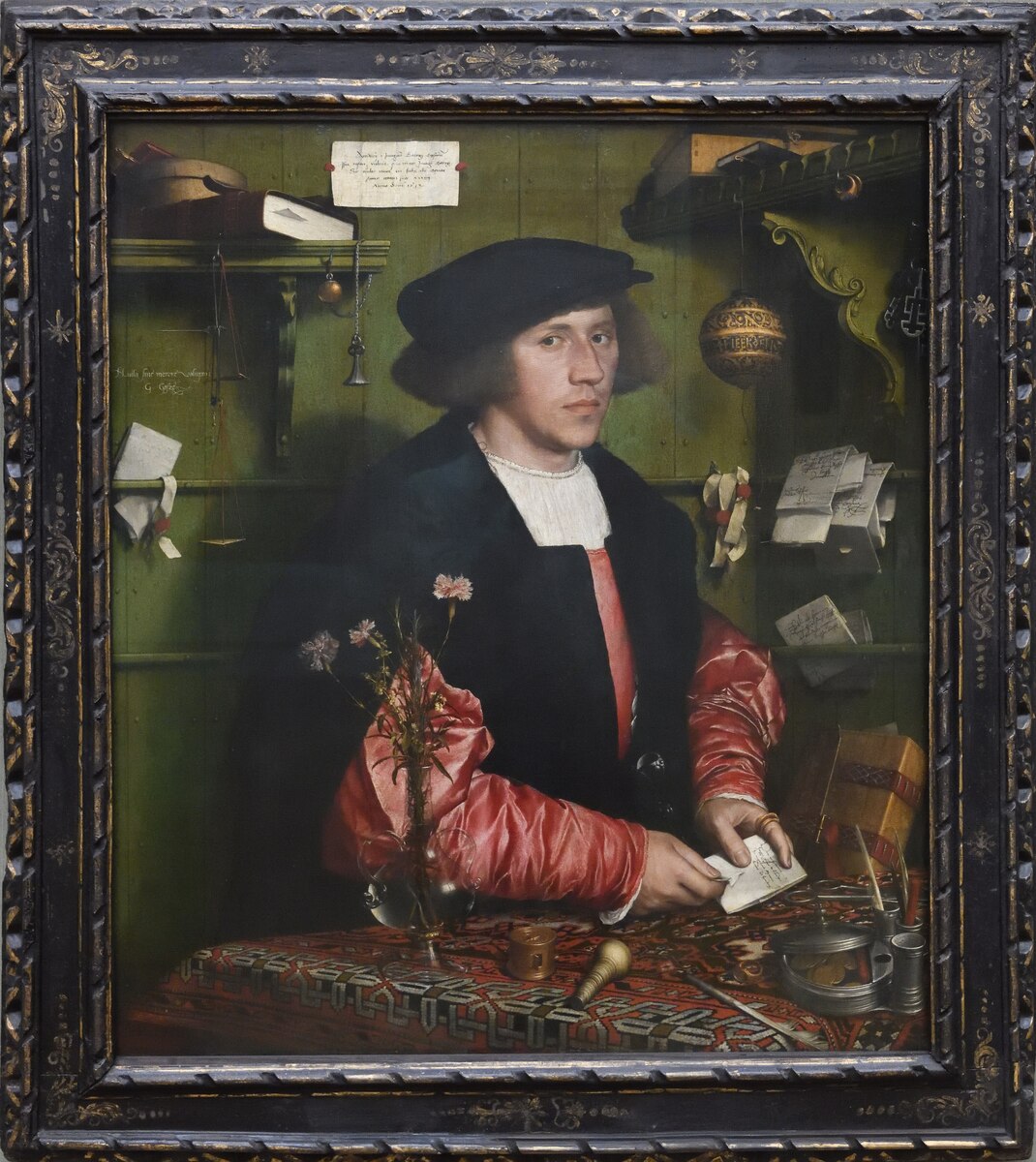
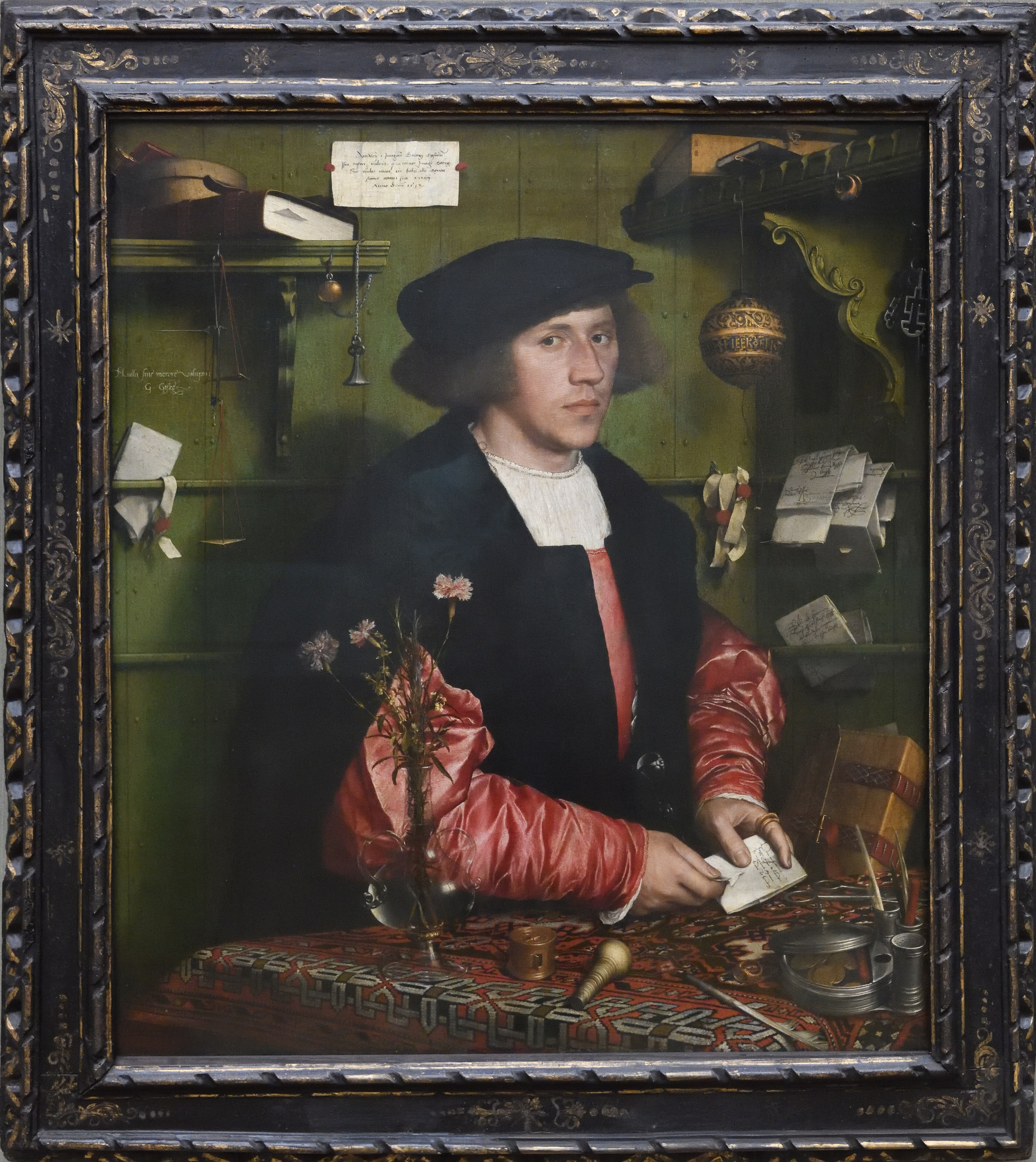
Hans Holbein the Younger painted the merchant Georg Gisze at his writing desk in 1532. This short tour looks at how the picture builds a professional identity through direct address, the tools of trade and a controlled, luminous realism, and it flags the limits of what a single photograph can show us.
A small paper slip with handwritten Latin hexameters and the calligraphy formula pinned to the green wall by two red wax seals near the shelf, part of the painted letter rack and the work's meditation on pleasure and sorrow.
02
Hanging gilded sphere
An ornate gilded sphere with engraved bands, probably a clock or pomander, suspended from a shelf bracket at the right against the dark green panelled wall; a conspicuous emblem of wealth, learning and imported luxury goods.
03
Writing desk and carpet
The foreground still life of an oriental carpet, brass inkwell, sand shaker, wax seal impression, turned wooden handle, quill pens and stacked gold coins, showing the workshop tools of a merchant's correspondence and the craftsmanship of painted surfaces.
Your gallery guide
The Merchant Georg Gisze by Hans Holbein the Younger (1532)
Hans Holbein the Younger painted the merchant Georg Gisze at his writing desk in 1532. This short tour looks at how the picture builds a professional identity through direct address, the tools of trade and a controlled, luminous realism, and it flags the limits of what a single photograph can show us.
Editorial review by Artifact Archive automated publishing
This is Georg Gisze, a merchant, painted by Hans Holbein the Younger in 1532. He sits at a writing desk, surrounded by the tools of commerce and correspondence.
The picture presents him as a prosperous man of business. His steady gaze meets ours, and the objects around him describe a working life.
Notice how much of the surface is given to things rather than to the man. Folded letters, a quill, sealing wax, a small clock, and a glass vase with flowers crowd the desk.
Each object is painted with the same sharp attention as his face. That evenness is the point: the desk and the man belong to one identity.
Holbein made the portrait in 1532, during a period when merchants in northern Europe were building reputations across long-distance trade. A portrait like this could serve as a public face for a man whose work depended on trust and credit.
The careful arrangement of ledgers and letters turns private paperwork into a visible claim about reliability. His direct look adds a personal reserve to that professional show.
A photograph is not the painting. The supplied image record notes reflections that disturbed the picture when it was photographed.
So some gleams on the surface may belong to the camera, not to Holbein's painted light. Keep that in mind when you read the shine on glass, wax, or skin.
What stays with you is the balance between openness and control. Gisze looks out, but the desk keeps him at work.
The painting turns the tools of trade into a portrait of character. That is how a merchant becomes more than a face: he becomes a network of promises, letters, and goods.
The story and its sources
Editorial review by Artifact Archive automated publishing.
Historical claims are linked to the records below. Close looking and interpretation are identified in the passage notes.
Hans Holbein the Younger was a German artist and printmaker (1497–1543). Their work is associated with German Renaissance; Northern Renaissance. Their recorded places of work include Bologna; Florence; Rome; Venice; Basel; Lucerne; London.
The portrait depicts the merchant Georg Gisze, shown at his writing desk surrounded by the tools of commerce and correspondence. The painting presents a carefully constructed image of a prosperous merchant's professional identity, with the sitter's direct gaze and the finely painted details of his workspace conveying both his worldly success and his personal reserve.
Title variants
Der Kaufmann Georg Gisze; Portrait of the Merchant Georg Gisze
Dimensions
Unknown
Catalogue identity
The painting is catalogued as The Merchant Georg Gisze, attributed to Hans Holbein the Younger and dated 1532. That attribution and date belong to the work itself rather than to the later photographic record through which the picture is most widely encountered today; the supplied file documentation identifies the sitter by name and role, the artist, and the year of execution as the terms of the catalogue entry. The account below therefore keeps two chronologies separate: the sixteenth-century date of the painting's making, and the 2021 date of the photograph that transmits its present appearance.(Wikimedia Commons: The Merchant Georg Gisze, 2021, File title and description)
Interpretation
The evidence supporting this catalogue identity is a Wikimedia Commons file page for a photograph of the painting, which supplies the title, artist, date and collection and which was annotated with the circumstances of the photograph itself: it was taken by Dosseman on 21 September 2021, and the file page is dated 2021. The page is recorded as open access and only partially consulted, so the catalogue facts it carries should be treated as the framing of the object rather than as a full scholarly examination. A consequence worth stating plainly is that the image record does not simply duplicate the painting: it is a 2021 document about a 1532 object, and its own metadata, including the photographer's name and the date of exposure, belongs to the photograph rather than to Holbein's panel.(Wikimedia Commons: The Merchant Georg Gisze, 2021, File title and description)
The transcript already published for this section establishes the basic subject: a merchant seated at a writing desk, surrounded by the tools of commerce and correspondence, presented as a prosperous man of business whose steady gaze meets the viewer while the objects around him describe a working life. The transcript also reads the desk as an argument about identity, observing that folded letters, a quill, sealing wax, a small clock and a glass vase with flowers are painted with the same sharp attention as the face, so that the desk and the man belong to one identity. Those points are noted here only to mark what the present account does not need to repeat; the research value of the catalogue evidence lies in the precision of title, attribution, date and medium of transmission rather than in a fresh description of the sitter's pose.(Wikimedia Commons: The Merchant Georg Gisze, 2021, File title and description)
Photographic transmission
A separate qualification concerns the surface we see. The supplied image record notes that reflections disturbed the picture when it was photographed. Since the photograph was made on 21 September 2021, some gleams on glass, wax or skin in that image may belong to the camera and its lighting rather than to Holbein's painted light. This does not alter the catalogue identity of the painting, but it does govern how far the photograph can be used as evidence for the finish of the panel, and it is a caution that applies to any reading of the picture's shine, including readings that treat the still-life passages as demonstrations of technical brilliance.(Wikimedia Commons: The Merchant Georg Gisze, 2021, File title and description)
The surviving condition record for this object begins with the photograph rather than with the panel itself. The Wikimedia Commons file page for the painting documents that the image was taken by Dosseman on 21 September 2021, and its description states plainly that the photograph shows reflections which disturbed the picture. That is a dated statement about the photographic capture, not a description of the painting's present surface: it establishes that some bright passages in the supplied image belong to the circumstances of photography, so any reading of gleams on the glass, on the sealing wax or on skin must first be checked against the painting itself. The same record supplies the object's basic identification, title, artist, date and collection, which anchor the condition account to a specific work rather than to an image floating free of context.(Wikimedia Commons: The Merchant Georg Gisze, 2021, Description English)
Interpretation
Because the file page is the only condition documentation supplied here, the account can state the date of the photograph and the disturbance it records but cannot extend that observation forward in time or describe the painting as it stands today. Reflections in a 2021 photograph are evidence about a photographic event; they are not evidence that the panel is reflective, damaged or altered. The distinction matters for conservation history because condition observations are always tethered to the moment and the method of their making, and this record is explicit about both.(Wikimedia Commons: The Merchant Georg Gisze, 2021, Description English)
The painting known as The Merchant Georg Gisze is attributed to Hans Holbein the Younger and dated 1532. It is held in the Gemäldegalerie in Berlin, the collection that supplies the object's present institutional context and the setting from which its photographic record derives. The file record for the image gives the title, artist, date and collection together, so these identifications function as the basic archival frame for everything that follows: a sixteenth-century portrait of a named merchant, by a named artist, surviving in a public museum collection rather than in private hands or an unknown location.(Wikimedia Commons: The Merchant Georg Gisze, 2021, File title)
The photograph that circulates of this painting was taken by Dosseman on 21 September 2021, and its file record notes that reflections disturbed the picture at the time of photography. That qualification matters for any visual reading of the portrait. Where the image shows gleams or highlights on the desk, the glass, the wax or the skin of the sitter, those effects cannot be assumed to belong to Holbein's painted surface. A photograph is a separate document from the painting it records, and its lighting conditions introduce information that the object itself does not contain. The evidential situation is therefore layered: the painting is the primary object, the photograph is a later record of it made under imperfect conditions, and the two must not be conflated when describing what is visible.(Wikimedia Commons: The Merchant Georg Gisze, 2021, File title)
The painting known as The Merchant Georg Gisze is a portrait by Hans Holbein the Younger, dated 1532, and is held in the Gemäldegalerie in Berlin. Its subject is identified by name and occupation: Georg Gisze, a merchant, shown seated at a writing desk among the tools of commerce and correspondence. The work belongs to the Northern Renaissance German tradition, and the attribution is described as fully confirmed and of high confidence. The Wikimedia Commons file page that supplies the title, artist, date, and collection also records that the available photograph of the painting was taken by Dosseman on 21 September 2021.(Wikimedia Commons: The Merchant Georg Gisze, 2021)
The 2026 working valuation
A working insurance estimate generated on 2026-10-16 places the painting at an estimated value of US$50M to US$150M. The methodology behind that range is deliberately narrow in its inputs: it was calculated only from the confirmed context that the work is a fully attributed, high-confidence painting by Hans Holbein the Younger dated 1532, in the Northern Renaissance German tradition, held in the Gemäldegalerie, Berlin. The range is described as intentionally broad and conservative. It reflects the extreme rarity and canonical status of securely attributed Holbein paintings, and it also reflects the absence of any supplied dimensions, condition report, support, provenance, accession number, or verified market transaction. No comparable auction results, private insurance schedules, or institutional appraisals were used in producing it.(Wikimedia Commons: The Merchant Georg Gisze, 2021)
The estimate carries an explicit qualification of its own status. It is a model-generated working range intended for manual review. It is not an official insurance value, appraisal, auction result, or sale price. It is based only on the supplied context and public source material and contains no verified market data, provenance, condition report, or dimensions. Actual insurance scheduling, the record states, would require professional appraisal, physical examination, verified provenance, and institutional confirmation. Two features of the object's situation are treated as determinative of what the range can and cannot mean: the work is in a major public collection and is therefore not represented by any documented sale price, and the supplied record includes no dimensions, condition report, support, provenance, or accession number against which a market comparison could be anchored.(Wikimedia Commons: The Merchant Georg Gisze, 2021)
How the accounts relate
Reading the range against the object's documented standing clarifies what the number is doing. The evidence establishes the artist, the date, the tradition, and the holding institution, and it establishes the absence of market and physical documentation. The valuation therefore does not register a transaction or an institutional appraisal; it registers canonical status and rarity as the dominant variables, with the public collection context removing the sale-price reference point entirely. The breadth of the range, from US$50M to US$150M, is the visible form of that method: wide enough to accommodate the unknowns the record itself names, and qualified at every point by the requirement of professional appraisal, physical examination, verified provenance, and institutional confirmation before any scheduling could occur.(Wikimedia Commons: The Merchant Georg Gisze, 2021)
Working estimate
Calculated working insurance estimate, not a sale price: Estimated value: US$50M to US$150M Recorded date: Working calculation, generated 2026-10-16. Methodology: Working range calculated only from the confirmed context: a fully attributed, high-confidence painting by Hans Holbein the Younger, dated 1532, in the Northern Renaissance German tradition, held in the Gemäldegalerie, Berlin. The range is intentionally broad and conservative. It reflects the extreme rarity and canonical status of securely attributed Holbein paintings, the absence of any supplied dimensions, condition report, support, provenance, accession number, or verified market transaction, and the fact that this work is in a major public collection and therefore not represented by any documented sale price. No comparable auction results, private insurance schedules, or institutional appraisals were used. Qualification: This is a model-generated working insurance range for manual review. It is not an official insurance value, appraisal, auction result, or sale price. It is based only on the supplied context and public source material and contains no verified market data, provenance, condition report, or dimensions. Actual insurance scheduling would require professional appraisal, physical examination, verified provenance, and institutional confirmation.(Wikimedia Commons: The Merchant Georg Gisze, 2021)
Bibliography
Sources and further reading
References are arranged by author or organisation, with links to the original publications. Where no publication date is recorded, n.d. means no date.
Source notes updated .
No recorded sources match these filters. Reset the filters to see the full bibliography.
A bibliographic study of Hans Holbein the Younger, useful for locating documented scholarly literature about the artist and, by extension, reception and study of portraits such as Georg Gisze. The subject data shows a bibliography rather than a reading of the painting.
Wikimedia Commons file page for a photograph of the painting, providing the title, artist, date, and collection. The photograph was taken by Dosseman on 21 September 2021.
Advertising supports the archive. These preferences control aggregate page counting, reading activity and ad-delivery diagnostics. They use no visitor tracking cookie.