The Ludwigskirche in Munich
Artist: Wassily Kandinsky · 1908

The Ludwigskirche in Munich: high-resolution image
The original file is hosted by Wikimedia Commons, available without payment or an account.
Open high-resolution image on Wikimedia CommonsThe complete story
The story About 4 minutes to read
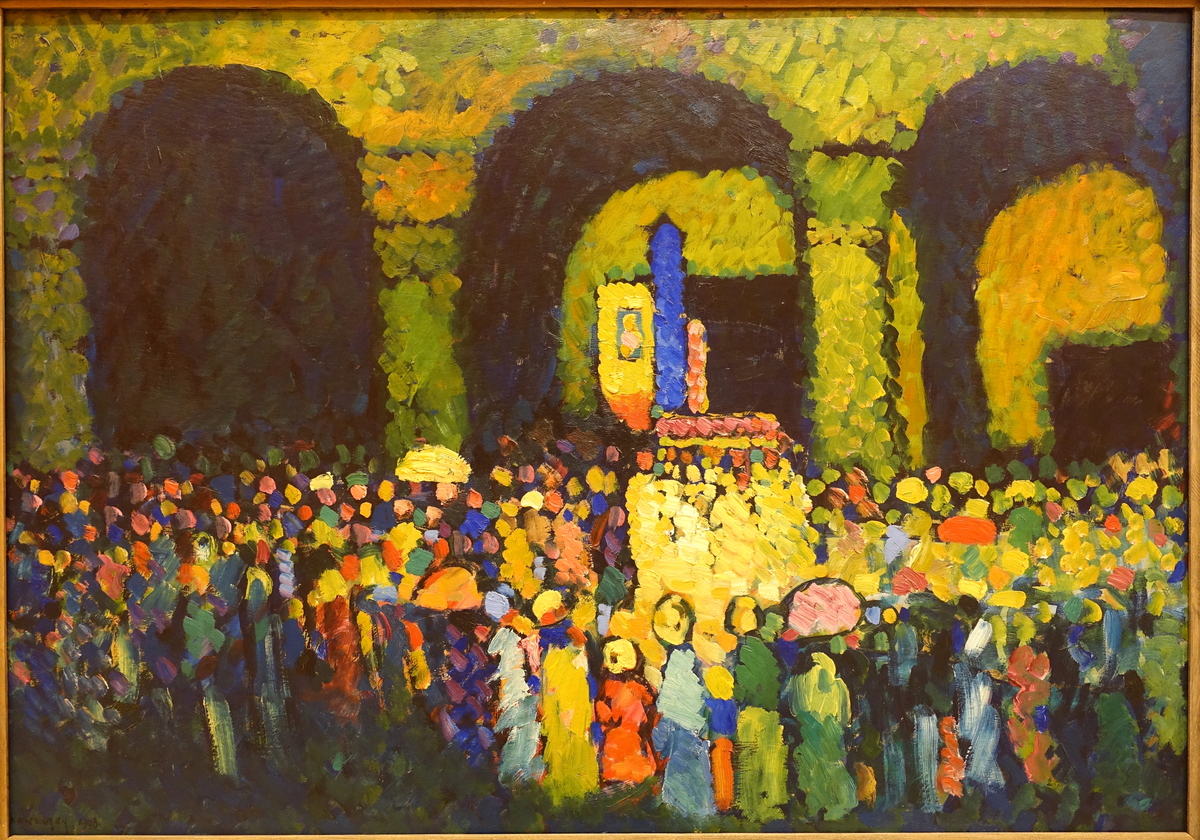
This is Wassily Kandinsky's The Ludwigskirche in Munich, painted in 1908. It shows the church of that name in Munich, with a dense crowd of townspeople filling the square in front of it. The painting is oil on cardboard. The supplied record does not explain how or why Kandinsky chose this subject, so we should be careful about going further than the picture itself.
At the centre of the composition, a shrine-like feature holds a framed image or icon on a yellow panel. A tall blue element and a red-pink ledge sit with it, and the record describes this as the devotional focal point. Around it, thick yellow-green strokes arch over a dark opening, forming a luminous frame. On the right, the paint is noticeably built up, with layered yellow and green strokes over darkness.
Below the arches, a compressed band of people runs across the foreground. Hats, coats and faces crowd together, so the square reads as a packed field of colour rather than open space. At left of centre, a pale yellow disc rises above the throng. The record identifies it as likely a wide-brimmed hat or parasol, and it gives a sense of human scale and a festive accent to the crowd.
The Commons record files this painting under the genre of abstract art. You can see why the label might appear beside a picture that still shows a recognisable church and crowd. The paint is handled in broad, emphatic strokes, and the arches carry more weight as colour and surface than as careful architectural description.
Put the arches and the crowd together, and the picture's argument starts to show. The framing strokes set the shrine and the people apart together, as one devotional scene. That reading rests on the described composition, not on a supplied statement of the artist's intention. The record gives us the shrine as focal point and the crowd as a dense band, and the framing holds them in one view.
So this is not really a portrait of a building. It's a square turned into a gathering, with the church held at its centre by arches of yellow and green. The pale hat above the crowd keeps that gathering human in scale. The painting asks you to see the place through its people and its colour, at least as much as through its architecture.
The story and its sources
Historical claims are linked to the records below. Close looking and interpretation are identified in the passage notes.
- Passage 1Documented historyWikimedia Commons: The Ludwigskirche in Munich
- Passage 2Close lookingWikimedia Commons: The Ludwigskirche in Munich
- Passage 3Close lookingWikimedia Commons: The Ludwigskirche in Munich
- Passage 4Documented historyWikimedia Commons: The Ludwigskirche in Munich
- Passage 5InterpretationWikimedia Commons: The Ludwigskirche in Munich
- Passage 6InterpretationWikimedia Commons: The Ludwigskirche in Munich
Details to notice
About 3 minutes to readPale yellow hat or parasol
A pale yellow disc, likely a wide-brimmed hat or parasol, rises above the crowd at left center and gives a human scale and festive accent to the throng.
Right arch mosaic
The right-hand arch shows conspicuous impasto, with yellow and green strokes layering over the dark void and demonstrating the painting's heavily worked surface.
Central arch vaulting
The central arch, made from thick yellow-green strokes around a dark opening, provides the luminous mosaic frame that sets off the shrine and crowd.
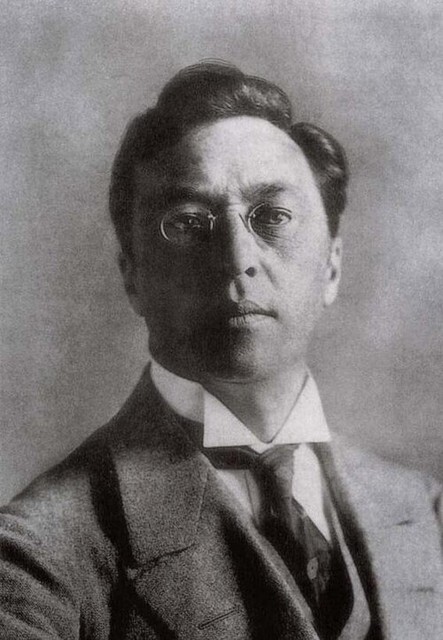
Artist portrait Image credit
未知上傳者. Image source · Public domain
About the artist
Wassily Kandinsky
1866 to 1944
Wassily Kandinsky was an avant-garde painter of Russian origin (1866–1944). Their work is associated with Expressionism; Symbolism; Bauhaus. Their recorded places of work include Paris; Munich; Weimar; Rapallo; The Hague; Russia; Stockholm; Switzerland; Tunis.
- Born
- 1866
- Died
- 1944
- Nationality
- Russian Empire; Russian Soviet Federative Socialist Republic; Soviet Union; France; Germany
- Birthplace
- Moscow
- Died in
- Neuilly-sur-Seine
Biography sources
The research & record
Study the work.
Follow the evidence.
Find catalogue details, historical context, technical research and the literature behind this artwork.
The artwork record
Research catalogue
Catalogue information and detailed research, with references that link to the bibliography.
Updated .
Identity and catalogue
Link- Title
- The Ludwigskirche in Munich(Daderot (photographer), 2014)
- Artist or attribution
- Wassily Kandinsky
- Object date
- 1908
- Medium and support
- Oil on cardboard(Daderot (photographer), 2014)
- Dimensions
- 67.3 cm × 96 cm
- Current collection or location
- Museo Nacional Centro de Arte Reina Sofía, Madrid, Spain(Daderot (photographer), 2014)
- Movement or period
- Early twentieth-century modernism
- Country or culture
- Germany (Bavaria)
- Depicted subject
- Kandinsky's 1908 oil on cardboard depicts the Ludwigskirche in Munich as a shrine-like sacred centre framed by heavy arching strokes of yellow and green, with a dense band of brightly coloured townspeople filling the foreground square and a pale yellow hat or parasol rising above the crowd.
- Accession number
- CTB.1977.101
- Support
- Cardboard
Read valuation records and their limitations
Catalogue record
The object is catalogued as The Ludwigskirche in Munich by Wassily Kandinsky, with a date of 1908. The supplied record identifies the medium as oil on cardboard, and its measured height and width are given as 67.3 cm by 96 cm. The painting is listed in the collection of the Museo Nacional Centro de Arte Reina Sofía in Madrid, Spain, and the record carries the accession number CTB.1977.101 with a reference to the Thyssen-Bornemisza Museum. The dating supplied here is the work's own date of execution, 1908. A distinct and later date belongs to the photographic record of the object, which was made by the photographer Daderot on 11 October 2014. The two dates should not be conflated: 1908 concerns the making of the painting, while 2014 concerns the making of the modern photograph and its placement on Wikimedia Commons. The 2014 image was released into the public domain on the ground that the artist had died more than seventy years earlier, and museum photography was permitted at the time without restriction. Source metadata and locators are omitted from this prose; the service attaches the clickable references from the evidence IDs cited for each paragraph.(Daderot (photographer), 2014, File title and description; Source/Photographer and Permission)
The recording file classifies the painting under the genre of abstract art. That classification sits beside a picture whose subject remains legible: a named Munich church, a central shrine-like feature and a crowd of townspeople. The record does not explain the basis on which the genre term was assigned, so the label is best reported as the file's classification rather than treated as a settled description of the work's style. The relation between the abstract label and the recognisable subject matter is a point where the catalogue vocabulary and the described composition pull in different directions.(Daderot (photographer), 2014, File title and description; Description, Genre)
Described composition
The record describes the composition as organised around a shrine-like centrepiece containing a framed image or icon on a yellow panel, accompanied by a tall blue element and a red-pink ledge; this ensemble is described as the devotional focal point. Around it, a central arch of thick yellow-green strokes spans a dark opening and forms a luminous frame that sets off both the shrine and the crowd. On the right-hand side the record notes conspicuous impasto, with layered yellow and green strokes worked over a dark void. Below the arches a dense band of brightly coloured townspeople fills the foreground, so that the church square reads as a compressed field of hats, coats and faces rather than as open space. At left of centre a pale yellow disc rises above the throng, described as likely a wide-brimmed hat or parasol, giving human scale and a festive accent to the crowd. These are recorded observations of the painting rather than statements of the artist's intention, and the record offers no account of how or why Kandinsky chose this subject. Read together, the described elements place a devotional centre inside a frame of heavy, coloured strokes and surround it with a tightly packed public, making the painted architecture and the painted gathering parts of a single scene.(Daderot (photographer), 2014, File title and description; Description, Genre)
The painting is Wassily Kandinsky's The Ludwigskirche in Munich, dated 1908.(Daderot (photographer), 2014)
The recording file classifies the painting under the genre abstract art.(Daderot (photographer), 2014)
Subject and iconography
LinkRead valuation records and their limitations
The devotional centre and the crowd
Visual observation
The composition is organised around what the record describes as its devotional focal point: a shrine-like centerpiece built from a framed image or icon set on a yellow panel, a tall blue element and a red-pink ledge. This cluster of elements is not simply a passage of bright colour; it is the narrative and cultic centre of the scene, and the rest of the picture is arranged so that the eye returns to it. Reading the central group this way depends on the supplied description rather than on any statement by the artist about his intentions, and the record gives no argument for why this subject was chosen.(Daderot (photographer), 2014, Semantic focus, central shrine with framed image)
Around that centerpiece, a central arch of thick yellow-green strokes opens onto a dark void and forms a luminous, mosaic-like frame that isolates the shrine and the crowd from the surrounding architecture. The right-hand arch is described as especially heavily worked, with conspicuous impasto in which layers of yellow and green are laid over darkness. In visual terms these arches carry weight as colour and as paint surface at least as much as they do as careful architectural description, so the church interior is rendered through passages of built-up pigment rather than through linear perspective or crisp detailing.(Daderot (photographer), 2014, Semantic focus, central arch vaulting and right arch mosaic)
Interpretation
The foreground is given over to a dense band of brightly coloured townspeople, a compressed field of hats, coats and faces that turns the church square into a tight mass rather than open ground. Among this throng, at left of centre, a pale yellow disc rises above the heads; the record identifies it only as likely a wide-brimmed hat or parasol, an identification offered with qualification, and observes that it lends human scale and a festive accent to the crowd. Taken together, the framing arches and the packed band of figures present shrine and congregation as a single scene held in one view, although that reading is a synthesis of the described composition, not a documented statement of the artist's programme.(Daderot (photographer), 2014, Semantic focus, pale yellow hat or parasol; Semantic focus, congregation in the foreground; Semantic focus, central shrine with framed image; Semantic focus, central arch vaulting and right arch mosaic)
Visual observation
The central feature of the composition is a shrine-like centerpiece with a framed image or icon on a yellow panel, a tall blue element and a red-pink ledge, described as the devotional focal point.(Daderot (photographer), 2014)
A dense band of brightly coloured townspeople fills the foreground, turning the church square into a compressed field of hats, coats and faces.(Daderot (photographer), 2014)
A central arch of thick yellow-green strokes around a dark opening forms a luminous mosaic frame that sets off the shrine and crowd, and the right-hand arch shows conspicuous impasto with layered yellow and green strokes over dark void.(Daderot (photographer), 2014)
A pale yellow disc, likely a wide-brimmed hat or parasol, rises above the crowd at left centre and gives human scale and a festive accent to the throng.(Daderot (photographer), 2014)
Materials and technique
LinkRead valuation records and their limitations
Support and medium
The primary record for this painting gives its support and medium directly: it is oil on cardboard, measuring 67.3 cm in height and 96 cm in width. This is the only physical, technical information supplied, and it establishes two things at once. The paint medium is oil, and the layer carrying it is a paper pulp board rather than canvas or panel. The modest thickness of cardboard, combined with a width approaching a metre, makes this a work of substantial size on a light, non-traditional support. The record does not describe how the board was primed or prepared, what ground or sizing lies beneath the oil, what pigments were used, what brushes or tools were employed, or what conservation treatment, if any, the surface has received. Those gaps should be stated plainly rather than filled with assumptions drawn from general knowledge of the period.(Daderot (photographer), 2014, Description, medium and dimensions)
What the evidence establishes
Interpretation
Taken together, the evidence separates cleanly into documented fact and visual inference. The medium, support and dimensions are documented in the record; the layered impasto, the mosaic-like arch of thick strokes and the compressed field of colour are observations of the image. No pigment names, binding media analysis, ground composition, brushmark measurements or condition report are supplied, so any account of Kandinsky's palette or preparation at the material level would exceed the evidence. What the record does support is a description of a painting in which the arch elements are built from visibly thick, layered strokes of yellow and green over darkness, while the figure band and the shrine are described by colour and arrangement rather than by paint application. This distinction matters for how the object is studied: it allows the surface texture of the arches to be discussed as a visible feature without treating it as a laboratory finding.(Daderot (photographer), 2014, Description, medium and dimensions; Semantic focus, central arch vaulting and right arch mosaic; Semantic focus, congregation in the foreground)
The work is oil on cardboard with a height of 67.3 cm and a width of 96 cm.(Daderot (photographer), 2014)
Provenance and ownership
LinkRead valuation records and their limitations
Documentation and Collection Record
The documentary record supplied for this section concerns the painting's modern photographic documentation rather than its earlier ownership. The work was photographed by Daderot on 11 October 2014, and that photograph was released into the public domain on the ground that the artist had died more than seventy years earlier; photography in the museum was permitted without restriction. The Commons record of that image identifies the painting as Wassily Kandinsky's The Ludwigskirche in Munich, dated 1908, oil on cardboard, 67.3 by 96 cm, in the collection of the Museo Nacional Centro de Arte Reina Sofía in Madrid, and lists accession number CTB.1977.101 with a reference to the Thyssen-Bornemisza Museum.(Daderot (photographer), 2014, Source/Photographer and Permission)
Interpretation
The accession number CTB.1977.101 is the only identifier supplied, and the record's reference to the Thyssen-Bornemisza Museum sits alongside the Reina Sofía as the stated holding collection. The evidence does not describe how the painting passed between collections, name any intermediate owner, record a sale, gift or bequest, or give a date of entry into either institution. The 1977 embedded in the accession number is not explained in the supplied unit and should not be read as a documented acquisition date. Within this section, the interval between the work's execution in 1908 and its documentation in 2014 is an unrecorded provenance gap, not a proven chain of ownership, and the 2014 photograph establishes only the painting's documented location and appearance at that moment.(Daderot (photographer), 2014, Source/Photographer and Permission)
The painting was photographed by Daderot on 11 October 2014 and the image was released into the public domain because the artist died more than seventy years ago; museum photography was permitted without restriction.(Daderot (photographer), 2014)
Provenance timeline
- 11 October 2014
The painting was photographed by Daderot and the resulting image was released into the public domain on the grounds that the artist had died more than seventy years earlier; museum photography was permitted without restriction.(Daderot (photographer), 2014, Source/Photographer and Permission)
Collection and display
LinkRead valuation records and their limitations
Collection record
The supplied record for Wassily Kandinsky's The Ludwigskirche in Munich, dated 1908 and painted in oil on cardboard, places the work in the collection of the Museo Nacional Centro de Arte Reina Sofía in Madrid, Spain. The same record gives the accession number CTB.1977.101 and carries a reference to the Thyssen-Bornemisza Museum. These are the only collection details the evidence establishes, and they are reported here as the record states them rather than as a verified museum catalogue entry: the source is a Wikimedia Commons discovery record and photograph, not an official institutional catalogue, and it is noted as only partially consulted. The coexistence of a Reina Sofía holding with a Thyssen-Bornemisza reference is recorded without further explanation in the evidence, so the relationship between the two institutional names, and the history by which the painting entered the Reina Sofía collection under that accession number, remain unestablished in the supplied material.(Daderot (photographer), 2014, Description, Collection and Accession number)
The record is tied to a specific act of documentation as well as to a collection: the painting was photographed by Daderot on 11 October 2014, and the image was released into the public domain on the ground that the artist died more than seventy years ago. The record also notes that museum photography was permitted without restriction at the time. This dates the photographic witness and explains the legal basis on which the image circulates, but it does not date the painting's acquisition, its display history, or any treatment; those matters fall outside the evidence. What the photograph and its accompanying record do supply is the descriptive vocabulary through which the object has been presented to a wider public: the identification of the subject as the Ludwigskirche in Munich, the medium and support, and the compositional features noted below. The distinction matters for how the object is studied, because the accessible description originates in a public image record made in 2014 rather than in a published scholarly catalogue.(Daderot (photographer), 2014, Description, Collection and Accession number)
Visual description and its status
The record describes the painting's centre as a shrine-like feature holding a framed image or icon on a yellow panel, accompanied by a tall blue element and a red-pink ledge, and calls this the devotional focal point of the composition. Around it, an arch of thick yellow-green strokes frames a dark opening, described as a luminous mosaic frame that sets off the shrine and the crowd; on the right-hand side the record singles out conspicuous impasto, with layered yellow and green strokes over a dark void. In the foreground a dense band of brightly coloured townspeople fills the church square, compressed into a field of hats, coats and faces, and a pale yellow disc, likely a wide-brimmed hat or parasol, rises above the crowd at left of centre, giving human scale and a festive accent to the throng. These observations belong to the source's description of the visible surface. They establish what the record reports as seen, and they support a reading in which the framing strokes hold shrine and people together in one devotional scene, but they do not establish the artist's intention, which the evidence does not supply.(Daderot (photographer), 2014, Description, Collection and Accession number)
Interpretation
The same record classifies the painting under the genre of abstract art, a label that sits alongside a composition the record itself describes as showing a recognisable church and a crowd of townspeople. The tension is worth preserving rather than resolving: the classification is a genre tag attached in the record, while the described imagery remains figurative in its subject, with the arches carrying weight as colour and surface as much as architectural description. Read together, the collection data and the visual description explain why the object matters beyond a single parish view. A painting dated 1908, on cardboard, held in a major Spanish national collection and catalogued under an abstract designation while still depicting the Munich church square, marks a point at which the depiction of a place is carried by colour, framing and crowd rather than by architectural record. That is the larger art-historical interest the evidence can support; claims about the work's place in a narrative of abstraction's origins would go beyond what the record states.(Daderot (photographer), 2014, Description, Collection and Accession number)
The painting is held in the collection of the Museo Nacional Centro de Arte Reina Sofía in Madrid, Spain, and the record lists accession number CTB.1977.101 with a reference to the Thyssen-Bornemisza Museum.(Daderot (photographer), 2014)
Documented values and qualified estimates
LinkRead valuation records and their limitations
The working valuation figure and its basis
Interpretation
The only recorded value figure associated with this painting is not a market price or an appraisal but a calculated working insurance estimate, generated on 2026-10-30 and stated as a broad range of US$8M to US$18M. The methodology behind it is explicit: the range was derived solely from the confirmed identification context, namely an original 1908 Kandinsky oil on cardboard of roughly 67 by 96 cm, documented in a major national museum under accession CTB.1977.101 with a Thyssen-Bornemisza note. The calculation states that it reflects the artist's canonical status, the early date just before his breakthrough to abstraction, the large scale, the unusual support, and the museum-held, non-market status that limits current price discovery. It is presented as an order-of-magnitude bracket for manual insurance review, not a point estimate, and no comparable sales, auction results or private insurance data were available or used in producing it.(Daderot (photographer), 2014)
The estimate carries qualifications that should govern any use of it. It is described as a model-generated working range for manual review only, and expressly not an official insurance value, appraisal, auction estimate, sale result or sale price; it should not be used to bind coverage or settle a claim. Its stated reliance on supplied identification context and limited public metadata, rather than inspection, condition reporting, provenance verification or market comparables, means the figure documents a procedure applied to known facts about the object rather than any measured or negotiated value. In the archive's terms, this is an attributed institutional computation, and it should be reported as such, with its date and its limits intact, and not folded into the painting's documented history as a price.(Daderot (photographer), 2014)
Working estimate
Calculated working insurance estimate, not a sale price: Estimated value: US$8M to US$18M Recorded date: Working calculation, generated 2026-10-30. Methodology: Broad, conservative working range derived solely from the confirmed context: an original 1908 Kandinsky oil (on cardboard) of roughly 67 x 96 cm, documented in a major national museum under accession CTB.1977.101 with a Thyssen-Bornemisza note. The range reflects the artist's canonical status, the early date just before his breakthrough to abstraction, the large scale, the unusual support, and the museum-held, non-market status, which limits current price discovery. It is intended as an order-of-magnitude bracket for manual insurance review, not a point estimate. No comparable sales, auction results, or private insurance data were available or used. Qualification: This is a model-generated working range for manual review only. It is not an official insurance value, appraisal, auction estimate, sale result, or sale price, and it should not be used to bind coverage or settle a claim. The range relies on supplied identification context and limited public metadata, not on inspection, condition reporting, provenance verification, or market comparables.(Daderot (photographer), 2014)
Further reading
Books for a closer look
Paid links. As an Amazon Associate I earn from qualifying purchases.

Open Library Concerning the spiritual in art
Dover Publications
Kandinsky's own treatise on the spiritual dimension of art, matching the artist and the documented reading of this Munich church square as a shrine-like sacred centre with a devotional focal point. The catalogue subjects on aesthetics and on themes and motives in art connect to the painting's treatment of a church as spiritual subject rather than mere topography, which is the kind of documented cultural context the artwork evidence supports.
ISBN 0486234118

Open Library Kandinsky, complete writings on art
G.K. Hall
A collection of Kandinsky's complete writings listed under modern art of the twentieth century, directly relevant to the artist who made this 1908 Munich scene and to the period of his move toward abstraction noted in the record. Because it gathers his writings, it is a plausible documentary source for the artist's own statements around his Munich years, though the catalogue record alone does not confirm contents.
ISBN 0805799508

Open Library Kandinsky: Russian and Bauhaus years, 1915-1933.
Solomon R. Guggenheim Museum
A Kandinsky catalogue with exhibition and criticism subjects, including Munich collections and catalogues raisonnes, which suits object and provenance oriented research on this painting held in Madrid and linked to the Thyssen-Bornemisza reference. Its survey and catalogue scope can supply art-historical comparison for the palette and framing of the Ludwigskirche composition, without implying any specific chapter was consulted.
ISBN 0892070447
Bibliography
Sources and further reading
References are arranged by author or organisation, with links to the original publications. Where no publication date is recorded, n.d. means no date.
Source notes updated .
No recorded sources match these filters. Reset the filters to see the full bibliography.
- 01
Secondary · About this artwork
Wikimedia Commons: The Ludwigskirche in Munich. Wikimedia Commons file: The Ludwigskirche in Munich. Wikimedia Commons.
Discovery record and photograph for the painting, supplying artist, title, date, medium, dimensions, collection, accession number and described visual features. Not an official museum catalogue entry.
- Language
- English
Citation text
- 02
Book
Concerning the spiritual in art. Dover Publications.
Kandinsky's own treatise on the spiritual dimension of art, matching the artist and the documented reading of this Munich church square as a shrine-like sacred centre with a devotional focal point. The catalogue subjects on aesthetics and on themes and motives in art connect to the painting's treatment of a church as spiritual subject rather than mere topography, which is the kind of documented cultural context the artwork evidence supports.
- ISBN
- 0486234118
Citation text
- 03
Book
Kandinsky, complete writings on art. G.K. Hall.
A collection of Kandinsky's complete writings listed under modern art of the twentieth century, directly relevant to the artist who made this 1908 Munich scene and to the period of his move toward abstraction noted in the record. Because it gathers his writings, it is a plausible documentary source for the artist's own statements around his Munich years, though the catalogue record alone does not confirm contents.
- ISBN
- 0805799508
Citation text
- 04
Book
Kandinsky: Russian and Bauhaus years, 1915-1933. Solomon R. Guggenheim Museum.
A Kandinsky catalogue with exhibition and criticism subjects, including Munich collections and catalogues raisonnes, which suits object and provenance oriented research on this painting held in Madrid and linked to the Thyssen-Bornemisza reference. Its survey and catalogue scope can supply art-historical comparison for the palette and framing of the Ludwigskirche composition, without implying any specific chapter was consulted.
- ISBN
- 0892070447
Citation text
Art to live with
Bring this painting
home.
A piece of the archive, made yours. Explore The Ludwigskirche in Munich in a size and finish that fits your space.
Your text and annotations appear on these editions. Adding to cart saves that design for printing.
Combine this painting with your favourites01 / Find your edition
Made for you
Suggested from your location. Change it if you're sending elsewhere or using a VPN. Prices and delivery are shown in GBP.
4 products
Choose an edition to make it yours
76.2 × 50.8 cm / 30 × 20 in · Standard
76.2 × 50.8 cm / 30 × 20 in · Standard

30 × 20 in / 76.2 × 50.8 cm · Standard

30 × 20 in / 76.2 × 50.8 cm · Standard

30 × 20 in / 76.2 × 50.8 cm · Standard

30 × 20 in / 76.2 × 50.8 cm · Standard

30 × 20 in / 76.2 × 50.8 cm · Standard
Metal art sign
GBP 63.49
Delivery GBP 20.62 / Total GBP 84.11
A printed aluminium sign with rounded corners and mounting holes.
Fit and fill keep the painting’s proportions. Stretch changes them.
Move and zoom the painting on your metal art sign.
Made to order with your design
Printed aluminium · mounting holes included
US delivery only
40.6 × 30.4 cm / 16 × 12 in · Black
40.6 × 30.4 cm / 16 × 12 in · Black

16 × 12 in / 40.6 × 30.4 cm · Black

16 × 12 in / 40.6 × 30.4 cm · Black

16 × 12 in / 40.6 × 30.4 cm · Black

16 × 12 in / 40.6 × 30.4 cm · Black
Framed art print
GBP 53.10
- 1 framed print
- GBP 53.10
- Delivery to United States
- GBP 14.11
- Total
- GBP 67.21
A ready-to-hang wooden frame with a clear Perspex cover and a semi-gloss printed insert.
Delivery is quoted for all selected copies together.
Fit and fill keep the painting’s proportions. Stretch changes them.
Move and zoom the painting on your framed art print.
Made to order with your design
Wooden frame & protective clear front included
US delivery only
25.4 × 25.4 cm / 10 × 10 in · Standard
25.4 × 25.4 cm / 10 × 10 in · Standard

10 × 10 in / 25.4 × 25.4 cm · Standard

10 × 10 in / 25.4 × 25.4 cm · Standard

10 × 10 in / 25.4 × 25.4 cm · Standard

10 × 10 in / 25.4 × 25.4 cm · Standard

10 × 10 in / 25.4 × 25.4 cm · Standard
Matte art print
GBP 11.27
Delivery GBP 7.19 / Total GBP 18.46
An unframed matte poster with archival inks, ready for a frame of your choice.
Fit and fill keep the painting’s proportions. Stretch changes them.
Move and zoom the painting on your matte art print.
Made to order with your design
Unframed · frame it your way
US delivery only
30.5 × 20.3 cm / 12 × 8 in · Standard
30.5 × 20.3 cm / 12 × 8 in · Standard

12 × 8 in / 30.5 × 20.3 cm · Standard

12 × 8 in / 30.5 × 20.3 cm · Standard

12 × 8 in / 30.5 × 20.3 cm · Standard
Fine art poster
GBP 12.85
Delivery GBP 7.58 / Total GBP 20.43
A gallery paper print with a smooth art-paper surface. Choose a size that suits the painting.
Fit and fill keep the painting’s proportions. Stretch changes them.
Move and zoom the painting on your fine art poster.
Made to order with your design
Unframed · frame it your way
The 30 cm ruler is scaled alongside your selected print. Keep the painting’s proportions with a black background, or stretch it to fill. Frame width, material texture and screen colours are illustrative.
Keep exploring