Scheveningen
Artist: Wassily Kandinsky · 1904

Scheveningen: high-resolution image
The original file is hosted by Wikimedia Commons, available without payment or an account.
Open high-resolution image on Wikimedia CommonsThe complete story
The story About 3 minutes to read
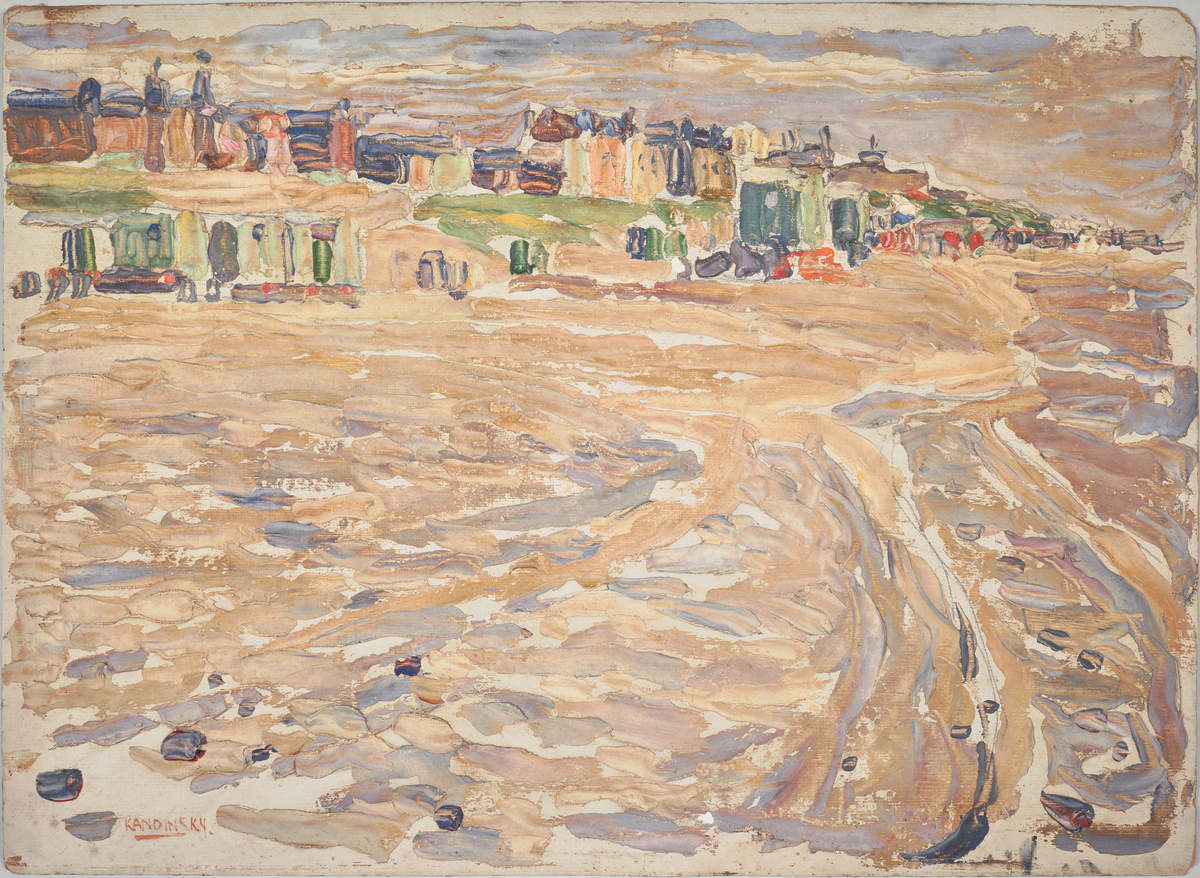
This is Wassily Kandinsky's Scheveningen, painted in 1904. It shows the beach at Scheveningen, a seaside resort near The Hague in the Netherlands. The scene takes in the shoreline, the sea beyond it, and people using the strand. Kandinsky made this small painting years before the abstract work he later became known for.
Look along the sand. A long line of beach cabins, painted in green and red, runs back into the distance. Small dark figures are scattered along the same strip of beach. Together, the cabins and the figures carry your eye from the foreground toward the far shoreline.
That receding line does more than decorate the beach. It sets up the depth of the scene, so the strand reads as a long space stretching away from us. The cabins act like markers along the way, and the tiny figures give that space a sense of scale.
The figures are deliberately small. They aren't portraits or close-up bathers; they belong to the wider sweep of the beach. What holds the picture together is the arrangement of the strand, the cabins and the open sky and sea around them.
So this isn't a dramatic seaside moment. It's a careful study of a popular resort, built from a line of cabins, scattered figures and a long view down the sand. Seeing it that way, the painting becomes a record of ordinary beach life, and an early lesson in how Kandinsky used arrangement and depth to organise a scene.
The story and its sources
Historical claims are linked to the records below. Close looking and interpretation are identified in the passage notes.
- Passage 1Documented historyWikimedia Commons: ScheveningenInstitutional record for Scheveningen
- Passage 2Close lookingWikimedia Commons: ScheveningenInstitutional record for Scheveningen
- Passage 3InterpretationInstitutional record for Scheveningen
- Passage 4Close lookingWikimedia Commons: ScheveningenInstitutional record for Scheveningen
- Passage 5InterpretationInstitutional record for ScheveningenInstitutional record for Scheveningen
Details to notice
About 2 minutes to readKandinsky signature
Handwritten KANDINSKY inscription at the lower left, the clearest attributional mark and a conspicuous trace of the picture's informal, sketchlike making.
Tidal flat stones
Scattered blue-grey stones and shell-like marks across the lower beach, painted with quick strokes that echo the darker accents of cabins and figures above.
Curving sand track
Pale sweeping path that arcs down the right foreground, edged by dark stones and tracks; its curve is the strongest compositional lead through the broad beach.
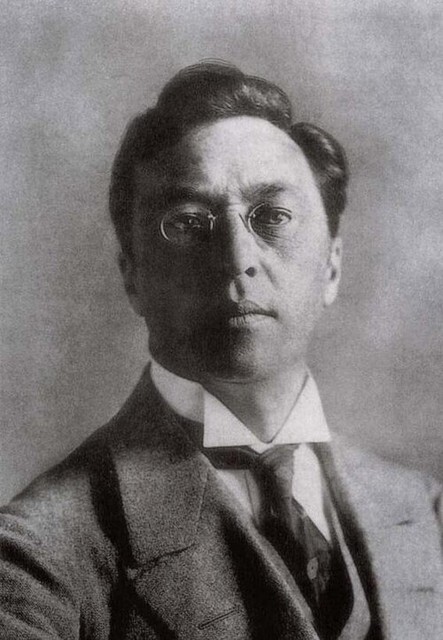
Artist portrait Image credit
未知上傳者. Image source · Public domain
About the artist
Wassily Kandinsky
1866 to 1944
Wassily Kandinsky was an avant-garde painter of Russian origin (1866–1944). Their work is associated with Expressionism; Symbolism; Bauhaus. Their recorded places of work include Paris; Munich; Weimar; Rapallo; The Hague; Russia; Stockholm; Switzerland; Tunis.
- Born
- 1866
- Died
- 1944
- Nationality
- Russian Empire; Russian Soviet Federative Socialist Republic; Soviet Union; France; Germany
- Birthplace
- Moscow
- Died in
- Neuilly-sur-Seine
Biography sources
The research & record
Study the work.
Follow the evidence.
Find catalogue details, historical context, technical research and the literature behind this artwork.
The artwork record
Research catalogue
Catalogue information and detailed research, with references that link to the bibliography.
Updated .
Identity and catalogue
Link- Title
- Scheveningen
- Artist or attribution
- Wassily Kandinsky(www.centrepompidou.fr, n.d.)(Wikimedia Commons: Scheveningen, n.d.)
- Object date
- 1904
- Medium and support
- Oil on board(www.centrepompidou.fr, n.d.)(Wikimedia Commons: Scheveningen, n.d.)
- Dimensions
- 23.8 x 32.7 cm
- Current collection or location
- Musée National d'Art Moderne, Centre Pompidou, Paris, France (on deposit at Palazzo Bonaparte, Rome, Italy from 15 September 2026 to 14 February 2027)(www.centrepompidou.fr, n.d.)(collection.centrepompidou.fr, n.d.)
- Movement or period
- Early twentieth-century modernism
- Country or culture
- Russian-born artist working in Europe; Dutch subject
- Depicted subject
- A beach scene at Scheveningen, a seaside resort near The Hague in the Netherlands. The painting depicts the sandy strand, rows of beach cabins, bathers, and the North Sea shoreline, capturing resort activity under an open sky.
- Title variants
- Plage en Hollande; Scheveningen, Holland(www.centrepompidou.fr, n.d.)
- Accession number
- AM 81-65-21
- Support
- Board
- Inscriptions
- Signed lower left in red: KANDINSKY(www.centrepompidou.fr, n.d.)
Read valuation records and their limitations
Title, date and naming
The painting is catalogued as Scheveningen, painted by Wassily Kandinsky in 1904. The date belongs to the making of the work itself and should not be confused with later dates attached to the object through its institutional life, such as its entry into a public collection. The same painting circulates under two further recorded titles, Plage en Hollande and Scheveningen, Holland, so a reader meeting it under a French or expanded Dutch form is looking at the same object rather than a separate version. The descriptive title and the place names agree with the subject: the picture shows a beach scene at Scheveningen, the seaside resort near The Hague in the Netherlands, taking in the shoreline, the sea and activity on the beach. The differing titles are a catalogue matter, reflecting how the work has been named in different linguistic and institutional settings, and do not imply competing attributions or a change in subject.(www.centrepompidou.fr, n.d.)(Wikimedia Commons: Scheveningen, n.d.)
On the face of the work, the artist's name appears lower left, signed in red as KANDINSKY. This inscription is a physical feature of the painting recorded in the institutional description, and it anchors the identification of the picture as an autograph Kandinsky alongside the catalogue attribution. The record does not elaborate the form of the signature beyond its position, colour and lettering, so the inscription should be treated as documented identification rather than as evidence about the artist's working method or the painting's internal chronology. Its presence matters because it ties the object, as it survives, directly to the named artist without relying on a later label or a dealer's attribution.(www.centrepompidou.fr, n.d.)
The institutional record places the painting in the collection of the Musée National d'Art Moderne, Centre Pompidou, Paris, under inventory number AM 81-65-21. That accession identity is the fixed point for tracking the object in the museum's holdings and distinguishes it from other Kandinsky works with similar titles or subjects. The inventory number belongs to the museum's registration history rather than to the year of execution, and it should be cited whenever the painting is discussed in a collection context, since the catalogue titles alone do not uniquely identify a single physical object.(www.centrepompidou.fr, n.d.)(Wikimedia Commons: Scheveningen, n.d.)
Wassily Kandinsky painted Scheveningen in 1904.(www.centrepompidou.fr, n.d.)(Wikimedia Commons: Scheveningen, n.d.)
The painting is signed lower left in red with the artist's name, KANDINSKY.(www.centrepompidou.fr, n.d.)
The work is also known by the titles Plage en Hollande and Scheveningen, Holland.(www.centrepompidou.fr, n.d.)
Subject and iconography
LinkRead valuation records and their limitations
The painted scene
Visual observation
The most structurally important feature recorded in the visual evidence is the long line of beach cabins, painted in green and red, that recedes along the strand. Diminutive dark figures are distributed along the same strip of beach. The record states that together the cabins and figures establish the resort activity and the depth of the scene, so the receding row operates simultaneously as subject matter, as a measure of scale, and as the picture's primary device for organizing space. It is worth separating what the evidence asserts from what it does not: the cabins are described as green and red and the figures as dark, but no further palette, modeling, brushwork or light conditions are documented, and no claim is made about the direction of the view or the weather. What is established is a shallow, linear recession of repeated structures with small figures acting as scale markers within it.(collection.centrepompidou.fr, n.d.)(Wikimedia Commons: Scheveningen, n.d.)
The scene is a working resort rather than an isolated landscape: the cabins and the figures are what register the beach as a place of organized leisure, and the shoreline, sea and beach activity named in the subject description are the frame within which that activity takes place. Read together, the units support a description of ordinary recreational life at Scheveningen observed through repeated, small-scale elements rather than through individual portraits or closely described bathers. The evidence does not establish who the figures are, how many cabins are shown, or how far the row extends, and those limits should be kept in view when the picture is described in general terms.(collection.centrepompidou.fr, n.d.)(Wikimedia Commons: Scheveningen, n.d.)(www.centrepompidou.fr, n.d.)
Documentation and classification
Interpretation
Taken as a whole, the evidence supports a reading of the picture as a study in spatial organization through repeated form: a receding row of green and red cabins, small dark figures for scale, and the open shoreline and sea around them. That is an interpretation of the recorded description rather than a documented artist's statement, and it should be presented as such, since the records establish what is depicted and how the depiction is described but not Kandinsky's intentions in making it. Within a larger history of the painted beach and the modern resort landscape, the object's interest lies in its small format and its reliance on the arrangement of ordinary structures and anonymous figures rather than on dramatic incident, documented in the institutional record, repeatedly exhibited, and catalogued in both the Centre Pompidou catalogue and Barnett's aquarelles raisonné.(collection.centrepompidou.fr, n.d., cat. no. 43, p. 50; cat. no. 15, p. 55)(Wikimedia Commons: Scheveningen, n.d.)(www.centrepompidou.fr, n.d.)
Visual observation
A long line of green and red beach cabins and diminutive dark figures recede along the strand, establishing the resort activity and depth of the scene.(collection.centrepompidou.fr, n.d.)(Wikimedia Commons: Scheveningen, n.d.)
Historical context
LinkRead valuation records and their limitations
Subject and setting
Visual observation
The painting depicts a beach scene at Scheveningen, a seaside resort near The Hague in the Netherlands, and its subject is the shoreline, the sea and the activity on the sand rather than a single incident or figure. The institutional record also lists the work under the alternate titles Plage en Hollande and Scheveningen, Holland, a naming variation worth noting when the picture is traced across catalogues and exhibitions in different languages. The object is signed lower left in red with the artist's name, KANDINSKY, a detail recorded in the Centre Pompidou's description of the work.(www.centrepompidou.fr, n.d.)(collection.centrepompidou.fr, n.d.)(Wikimedia Commons: Scheveningen, n.d.)
Formal evidence and the resort world
What can be seen supports a reading of the picture as a study of resort activity: a long line of green and red beach cabins and diminutive dark figures recede along the strand, and that recession establishes both the resort character of the scene and the depth of the view. The cabins function visually as markers along the path of the strand, while the small dark figures give the open space a sense of scale rather than serving as close-up portraits or bathers. The evidence records these as observations of the picture, not as statements of the artist's intention. The shell of the setting, the shoreline, the sea beyond and the beach activity of the resort near The Hague, is what the scene is organised around.(www.centrepompidou.fr, n.d.)(collection.centrepompidou.fr, n.d.)(Wikimedia Commons: Scheveningen, n.d.)
Provenance and institutional life
The painting is in the collection of the Musée National d'Art Moderne, Centre Pompidou, Paris, with inventory number AM 81-65-21, and it entered the collection as a bequest from Nina Kandinsky in 1981. That bequest is the documented point of entry into public ownership supplied here; the evidence does not record earlier owners, intervening sales, or the intervals between the painting's making in 1904 and its arrival in the collection. The work's presence in a national modern art museum, catalogued alongside its date, medium, dimensions and signature, is the context in which later exhibition and publication records for the object should be read.(www.centrepompidou.fr, n.d.)
Reading the evidence together
Interpretation
Taken together, the evidence separates what the picture shows, what the institutional record documents, and what remains unestablished. The date of 1904, the oil-on-board medium, the dimensions, the signature and the Scheveningen subject are documented; the line of green and red cabins and the small dark figures are observations of the visible image; the 1981 bequest from Nina Kandinsky and the Centre Pompidou inventory number are provenance facts; and the exhibition and catalogue entries are a later documentary trail. Because the units do not record a commission, a patron or the painting's function in a specific household, any account of who first owned or used the work would be inference rather than documented history. The picture's importance in a larger history of art rests here on its position as an early 1904 resort scene by Kandinsky, made long before the abstract work for which he is best known, and on its secure place in a public collection and its catalogue record.(www.centrepompidou.fr, n.d.)(collection.centrepompidou.fr, n.d.)(Wikimedia Commons: Scheveningen, n.d.)
The painting depicts a beach scene at Scheveningen, a seaside resort near The Hague in the Netherlands, showing the shoreline, sea, and beach activity.(www.centrepompidou.fr, n.d.)
Materials and technique
LinkRead valuation records and their limitations
Support, medium and documented dimensions
Scheveningen is recorded as oil on board and as measuring 23.8 by 32.7 centimeters, a support and scale that place it among Kandinsky's small paintings rather than large exhibition canvases. Both the Wikimedia Commons description and the institutional record agree on this medium and these dimensions. The support is described only as board; the supplied evidence does not specify whether it is wood panel, cardboard or another board type, nor does it document a ground, varnish, framing or later conservation treatment. The technical account available here is therefore limited to medium and measurement, with no examination data on layers, pigments or condition beyond the red of the signature.(www.centrepompidou.fr, n.d.)(Wikimedia Commons: Scheveningen, n.d.)
The one color the evidence locates with precision is red, and it is the color of the signature rather than of a painted passage: the work is signed lower left in red with the artist's name, KANDINSKY. This is a positional and material detail documented in the institutional record. Paint handling and palette in the depicting layers are not described technically; the only additional color information in the supplied units belongs to visual observation, treated separately below.(www.centrepompidou.fr, n.d.)(Wikimedia Commons: Scheveningen, n.d.)
Interpretation
Read together, the documented and observed evidence supports a limited but useful synthesis. A small oil on board, signed in red at the lower left, carries a beach scene organized by a receding row of green and red cabins and dark figures whose small scale sets the depth of the strand. The evidence establishes the materials of the support and the placement of the signature, and it establishes the presence and color of the cabins as a matter of visual observation. It does not establish a pigment analysis, an underdrawing, a preparatory layer or a painting sequence, and none should be assumed from the reproduction. Where the two kinds of evidence meet is color: red is documented in the signature and observed in the cabins, but the evidence does not claim a single pigment for both.(www.centrepompidou.fr, n.d.)(Wikimedia Commons: Scheveningen, n.d.)(collection.centrepompidou.fr, n.d.)
The painting is oil on board and measures 23.8 by 32.7 centimeters.(www.centrepompidou.fr, n.d.)(Wikimedia Commons: Scheveningen, n.d.)
Provenance and ownership
LinkRead valuation records and their limitations
Scheveningen is a 1904 oil on board by Wassily Kandinsky, measuring 23.8 by 32.7 centimeters, now in the collection of the Musée National d'Art Moderne, Centre Pompidou, Paris, under inventory number AM 81-65-21. The work is signed lower left in red with the artist's name, KANDINSKY, and is also known by the titles Plage en Hollande and Scheveningen, Holland. Its subject is the beach at Scheveningen, the seaside resort near The Hague in the Netherlands, with the shoreline, the sea and beach activity visible across the small panel. These particulars come from the institution's own records and frame the provenance account that follows, since the object's identity, title variants and inventory number are the anchors by which its ownership history is tracked.(www.centrepompidou.fr, n.d.)
The 1981 Bequest
The documented provenance of the painting consists of a single recorded event. In 1981 the work entered the collection as a bequest from Nina Kandinsky. The institutional record does not state where the painting was before that bequest, nor does it name any earlier owner, dealer, gallery or intervening transfer. The record therefore establishes one dated change of ownership and leaves the preceding period unrecorded rather than proving continuity of possession or documenting a gap in ownership. An unrecorded interval of this kind should not be read as evidence that no transfer occurred; it simply means the sources supplied here do not document one.(www.centrepompidou.fr, n.d.)
The bequest is also the origin of the inventory number AM 81-65-21, whose components align with an acquisition in 1981. The number belongs to the Musée National d'Art Moderne, Centre Pompidou, the institution that holds the work and publishes the provenance, signature, exhibition and bibliography data together in its collection record. Because the inventory number and the bequest are recorded by the same holding institution, the 1981 transfer is the best documented link between the painting and its present public collection.(www.centrepompidou.fr, n.d.)
The painting entered the collection as a bequest from Nina Kandinsky in 1981.(www.centrepompidou.fr, n.d.)
Provenance timeline
- 1981
The painting entered the collection of the Musée National d'Art Moderne, Centre Pompidou, Paris, as a bequest from Nina Kandinsky.(www.centrepompidou.fr, n.d.)
- 1994
The painting was included in an exhibition at the Brücke Museum Berlin.(collection.centrepompidou.fr, n.d.)
- 1994-1995
The painting was included in an exhibition at the Kunsthalle Tübingen.(collection.centrepompidou.fr, n.d.)
- 2009
The painting was included in an exhibition at the Centre Pompidou Paris.(collection.centrepompidou.fr, n.d.)
- 2015
The painting was included in an exhibition at the Franz Marc Museum Kochel am See.(collection.centrepompidou.fr, n.d.)
- 2024
The painting was included in an exhibition at the H'ART Museum Amsterdam.(collection.centrepompidou.fr, n.d.)
- 2026-2027
The painting is scheduled to be shown at the Palazzo Bonaparte Rome.(collection.centrepompidou.fr, n.d.)
Exhibition history
LinkRead valuation records and their limitations
Recorded exhibition venues
The exhibition history recorded for Wassily Kandinsky's Scheveningen is a sequence of venues rather than a continuous display, and the institutional record gives it without exhibition titles, catalogue numbers or installation details for the individual showings. The list runs from the Brücke Museum in Berlin in 1994 and the Kunsthalle Tübingen in 1994 to 1995, through the Centre Pompidou in Paris in 2009 and the Franz Marc Museum in Kochel am See in 2015, to the H'ART Museum in Amsterdam in 2024. A further showing is recorded as planned for the Palazzo Bonaparte in Rome in 2026 to 2027. The same evidence places the work in the collection of the Musée National d'Art Moderne, Centre Pompidou, Paris, under inventory number AM 81-65-21, so the Paris appearance of 2009 is a showing by the holding institution while the other venues are host institutions. The record as supplied does not name the exhibitions themselves, does not distinguish monographic from thematic presentations, and does not state what travelled or whether the board was shown in every case; those gaps should be left open rather than filled by inference.(collection.centrepompidou.fr, n.d.)(www.centrepompidou.fr, n.d.)
Interpretation
The exhibition list is best read alongside the work's arrival in a public collection, which the institutional record dates to 1981, when the painting entered the collection as a bequest from Nina Kandinsky. That date precedes every venue on the exhibition list, from Berlin in 1994 onward, so the recorded exhibition life of the picture belongs to its period as a museum-owned work rather than to its earlier history. The record supplies no exhibitions before 1981 and no loans between the bequest and 1994, and none should be assumed. On the evidence available, the object's public visibility as a loan is a late twentieth- and twenty-first-century phenomenon, extending into a scheduled Rome presentation in 2026 to 2027, while its documented institutional home throughout that period remains the Musée National d'Art Moderne.(www.centrepompidou.fr, n.d.)(collection.centrepompidou.fr, n.d.)
Catalogues, numbers and the limits of the record
Exhibition history and publication history are recorded as separate strands for this work, and the two should not be conflated. The painting is cited and reproduced in the 1984 Centre Pompidou catalogue Kandinsky: oeuvres de Vassily Kandinsky at catalogue number 43, page 50, and in Vivian Endicott Barnett's Kandinsky Aquarelles catalogue raisonné, volume I, 1900-1921, at catalogue number 15, page 55, where it is described as an addendum to the paintings catalogue raisonné. The 1984 catalogue predates the earliest listed exhibition, so its discussion of the painting, with its own catalogue number and plate, is evidence of scholarly and institutional attention independent of whether the object hung in a show. Neither entry is described in the supplied evidence as an exhibition catalogue tied to one of the listed venues, and the exhibition list itself carries no catalogue numbers or page references. The numbered catalogue entries therefore document reception and documentation of the work, not participation in a specific exhibition.(collection.centrepompidou.fr, n.d., cat. no. 43, p. 50; cat. no. 15, p. 55)
Interpretation
The institutional record's description of the composition, in which a long line of green and red beach cabins and diminutive dark figures recede along the strand, matters to how the exhibition history can be read, because it indicates what a viewer at any of these venues would have encountered: a small oil on board, 23.8 by 32.7 centimeters, signed lower left in red with the artist's name, showing the shoreline, sea and beach activity at the resort near The Hague. The record also lists the alternative titles Plage en Hollande and Scheveningen, Holland, which means the same object may appear in catalogues and exhibition documentation under more than one name. No supplied evidence gives installation conditions, frames, or any conservation treatment associated with the loans, and the record does not state which titles were used at which venue. The gap is worth marking, since the naming of a work in exhibition material is itself part of its reception history and cannot be reconstructed from this record alone.(collection.centrepompidou.fr, n.d., cat. no. 43, p. 50)
The painting has been included in exhibitions at the Brücke Museum Berlin (1994), Kunsthalle Tübingen (1994-1995), Centre Pompidou Paris (2009), Franz Marc Museum Kochel am See (2015), H'ART Museum Amsterdam (2024), and will be at Palazzo Bonaparte Rome (2026-2027).(collection.centrepompidou.fr, n.d.)
Reception and literature
LinkRead valuation records and their limitations
Catalogues, Catalogues Raisonnés and Scholarly Reception
The documented reception of Scheveningen begins with its reproduction and citation in the scholarly literature of Kandinsky's own institutional context. The 1984 Centre Pompidou catalogue Kandinsky: oeuvres de Vassily Kandinsky cites and reproduces the work as cat. no. 43, p. 50. This is an early checkpoint in the painting's public scholarly life, and it adopts the museum's own numbering and titling for a small oil on board that had entered the collection three years earlier as a bequest from Nina Kandinsky in 1981. The catalogue entry establishes the work within a sequence of Kandinsky's oeuvres rather than as an isolated curiosity. The object's identification in that catalogue is inseparable from the wider project of organising Kandinsky's output: the painting's title, its Dutch subject, and its early date all become fixed points against which later scholarship could measure other works.(collection.centrepompidou.fr, n.d., cat. no. 43, p. 50)(www.centrepompidou.fr, n.d.)
The painting's place in the catalogues raisonnés was consolidated when Vivian Endicott Barnett cited and reproduced it in Kandinsky Aquarelles, vol. I, 1900-1921, cat. no. 15, p. 55. The Centre Pompidou record describes this as an addendum to the paintings catalogue raisonné. That phrase matters for how the work's reception should be understood: the object is an oil on board measuring 23.8 by 32.7 centimeters, and it belongs to the paintings catalogue, yet it is documented inside the aquarelles volume as an addition. The reception of a small early painting therefore runs partly through the apparatus of cataloguing, where its status is defined by the editor's decision about where it belongs. Barnett's inclusion gave the work a stable cat. no. 15 within the 1900-1921 volume, and the addendum clarifies that the entry supplements rather than replaces the paintings corpus. The effect is to anchor the painting in two overlapping bibliographic systems, and any future account of its exhibition history or provenance will rest on that double citation.(collection.centrepompidou.fr, n.d., cat. no. 15, p. 55)
The work is cited and reproduced in the 1984 Centre Pompidou catalogue Kandinsky: oeuvres de Vassily Kandinsky, cat. no. 43, p. 50.(collection.centrepompidou.fr, n.d.)
The painting is cited and reproduced in Vivian Endicott Barnett's Kandinsky Aquarelles catalogue raisonné, vol. I, 1900-1921, cat. no. 15, p. 55 (addendum to the paintings catalogue raisonné).(collection.centrepompidou.fr, n.d.)
Collection and display
LinkRead valuation records and their limitations
Institutional identity
The institutional record for this painting places it in the collection of the Musée National d'Art Moderne, Centre Pompidou, Paris, under inventory number AM 81-65-21. Both of the Centre Pompidou records supplied here agree on that location and number, so the work's present custodian and identifying number are documented rather than reported. Because the inventory number is given, the object can be followed through the museum's own documentation independently of its older or alternative titles. Within a collection history, this is the point at which a small, portable painting made in 1904 for the art market becomes a catalogued public object, and the record that anchors its identity is the entry under that number.(www.centrepompidou.fr, n.d.)(collection.centrepompidou.fr, n.d.)
How the work entered the museum is recorded as a bequest from Nina Kandinsky in 1981. The inventory number AM 81-65-21 is consistent with that year of accession, and the gift places the painting within the larger transfer of the artist's estate to the French national collection rather than within a purchase or dealer transaction. For the object's biography, this is the decisive provenance event that the evidence supports: an artist's widow's bequest, formalized in the museum's inventory, rather than an unbroken record of intervening owners. The evidence supplied here does not document the sequence of hands between the painting's making and that bequest, and none should be assumed.(www.centrepompidou.fr, n.d.)(collection.centrepompidou.fr, n.d.)
Documentation in catalogues
Interpretation
Taken together, the two institutional records let the object be described along a chain: made in 1904, small in scale and painted in oil on board, signed lower left in red, known under several titles, shown in six listed venues between 1994 and a planned 2026-2027 presentation, reproduced in a 1984 museum catalogue and in Barnett's catalogue raisonné addendum, and finally held in the Musée National d'Art Moderne under AM 81-65-21 as a 1981 bequest of Nina Kandinsky. The records agree on inventory and location and are complementary in coverage, one emphasizing title, medium, dimensions, signature and bequest, the other exhibition list and bibliography. No supplied evidence contradicts another account, so the differences here are matters of what each record chose to document. The object's interest within a wider history of art lies in this documented position: an early beach study by an artist later identified with abstraction, preserved, exhibited and catalogued under a national collection's care.(www.centrepompidou.fr, n.d.)(collection.centrepompidou.fr, n.d.)
The work is in the collection of the Musée National d'Art Moderne, Centre Pompidou, Paris, with inventory number AM 81-65-21.(www.centrepompidou.fr, n.d.)(collection.centrepompidou.fr, n.d.)
Documented values and qualified estimates
LinkRead valuation records and their limitations
The working estimate and its limits
Interpretation
The working valuation estimate records a range of US$800K to US$2.5M, dated as a working calculation generated 2026-10-30. The range is explicitly described as derived conservatively from confirmed context: an early 1904 oil on board by a major modernist whose early figurative and landscape works are widely exhibited and documented. The small scale and board support are said to temper the range relative to large mature oils, while the institutional status is treated as strong, citing the Centre Pompidou accession AM 81-65-21, the 1981 Nina Kandinsky bequest, inclusion in a Kandinsky catalogue raisonné addendum, and a record of multiple museum exhibitions including the upcoming Palazzo Bonaparte display. The account states that this provenance, documentation and exhibition record support higher insurance sensitivity. The estimate also states plainly that no public appraisal, auction result or private insurance data was supplied, so the range intentionally stays wide and low-confidence for manual review, and that its ranges are rounded and indicative only.(Wikimedia Commons: Scheveningen, n.d.)(www.centrepompidou.fr, n.d.)(collection.centrepompidou.fr, n.d.)
The estimate's own qualification is as consequential as its figures. It is a model-generated working range for manual review only, not an official insurance value, not an appraisal, not an auction estimate or result, and not a sale price. It was calculated from supplied confirmed artwork context without comparable sales data or access to private insurance records, and the record states that actual insured values require a qualified appraiser and current market and replacement-cost analysis. The number, in other words, is a structured statement about the object's institutional and documentary standing rather than a market observation derived from the object's own physical evidence. Read alongside the object record, the estimate's stated inputs are precisely the facts that make the painting historically legible: its date, medium, dimensions, bequest provenance, catalogue raisonné entry and exhibition itinerary. The valuation does not add new evidence about the work; it aggregates the evidence already documented in the institutional and descriptive records.(Wikimedia Commons: Scheveningen, n.d.)(www.centrepompidou.fr, n.d.)(collection.centrepompidou.fr, n.d.)
Working estimate
Calculated working insurance estimate, not a sale price: Estimated value: US$800K to US$2.5M Recorded date: Working calculation, generated 2026-10-30. Methodology: Broad working range derived conservatively from confirmed context: an early (1904) oil on board by Wassily Kandinsky, a major modernist whose early figurative and landscape works are widely exhibited and documented. The small scale (23.8 x 32.7 cm) and board support temper the range relative to large mature oils. Institutional status is strong: it is held by the Musee National d'Art Moderne, Centre Pompidou (accession AM 81-65-21), acquired via the 1981 Nina Kandinsky bequest, included in a Kandinsky catalogue raisonne addendum, and shown in multiple museum exhibitions with an upcoming Palazzo Bonaparte display. This provenance, documentation and exhibition record support higher insurance sensitivity. No public appraisal, auction result or private insurance data was supplied, so the range intentionally stays wide and low-confidence for manual review. Ranges are rounded and indicative only. Qualification: This is a model-generated working range for manual review only. It is not an official insurance value, not an appraisal, not an auction estimate or result, and not a sale price. It was calculated from the supplied confirmed artwork context without comparable sales data or access to private insurance records. Actual insured values require a qualified appraiser and current market and replacement-cost analysis.(Wikimedia Commons: Scheveningen, n.d.)(www.centrepompidou.fr, n.d.)(collection.centrepompidou.fr, n.d.)
Further reading
Books for a closer look
Paid links. As an Amazon Associate I earn from qualifying purchases.

Open Library Kandinsky: Russian and Bauhaus years, 1915-1933.
Solomon R. Guggenheim Museum
A Kandinsky catalogue associated with the Centre Georges Pompidou and the Musee national d'art moderne, the collection that holds Scheveningen (1904). Its subjects include Kandinsky catalogues, collections, and catalogues raisonnes, making it the most directly relevant object-level candidate for a Pompidou-held Kandinsky painting documented as reproduced in Centre Pompidou catalogues.
ISBN 0892070447

Open Library Kandinsky, complete writings on art
G.K. Hall
Kandinsky's complete writings on art, recorded under his own name. Relevant to the artist of Scheveningen through primary-source art writing, though it concerns his texts rather than this specific 1904 beach painting.
ISBN 0805799508
Bibliography
Sources and further reading
References are arranged by author or organisation, with links to the original publications. Where no publication date is recorded, n.d. means no date.
Source notes updated .
No recorded sources match these filters. Reset the filters to see the full bibliography.
- 03
Official · About this artwork
Institutional record for Scheveningen. Vassily KANDINSKY - Scheveningen | Musée national d’art moderne – Centre Pompidou.
Detailed collection record including signature, exhibition list, and bibliography.
- Language
- French
Citation text
- 05
Book
Kandinsky, complete writings on art. G.K. Hall.
Kandinsky's complete writings on art, recorded under his own name. Relevant to the artist of Scheveningen through primary-source art writing, though it concerns his texts rather than this specific 1904 beach painting.
- ISBN
- 0805799508
Citation text
- 04
Book
Kandinsky: Russian and Bauhaus years, 1915-1933. Solomon R. Guggenheim Museum.
A Kandinsky catalogue associated with the Centre Georges Pompidou and the Musee national d'art moderne, the collection that holds Scheveningen (1904). Its subjects include Kandinsky catalogues, collections, and catalogues raisonnes, making it the most directly relevant object-level candidate for a Pompidou-held Kandinsky painting documented as reproduced in Centre Pompidou catalogues.
- ISBN
- 0892070447
Citation text
- 01
Secondary · About this artwork
Wikimedia Commons: Scheveningen (n.d.). Wikimedia Commons: Scheveningen. Wikimedia Commons.
Wikimedia Commons file description providing basic identification and image.
- Language
- English
Citation text
- 02
Official · About this artwork
Institutional record for Scheveningen. Scheveningen - Centre Pompidou.
Official object record from the Centre Pompidou, providing title, date, medium, dimensions, provenance, current location, and exhibition history.
- Language
- French
Citation text
Art to live with
Bring this painting
home.
A piece of the archive, made yours. Explore Scheveningen in a size and finish that fits your space.
Your text and annotations appear on these editions. Adding to cart saves that design for printing.
Combine this painting with your favourites01 / Find your edition
Made for you
Suggested from your location. Change it if you're sending elsewhere or using a VPN. Prices and delivery are shown in GBP.
19 products
Choose an edition to make it yours
6 × 8 in · Printed cover · 118 lined pages
6 × 8 in · Printed cover · 118 lined pages
6 × 8 in · Printed cover · 118 lined pages
Notebook
GBP 11.87
Delivery GBP 5.27 / Total GBP 17.14
A 6 × 8 inch spiral notebook with 118 ruled pages (59 sheets), a printed front cover, dark grey back cover and metal spiral binding.
Fit and fill keep the painting’s proportions. Stretch changes them.
Move and zoom the painting on your notebook.
Made to order with your design
Made to order
US delivery only
17.8 × 12.7 cm / 7 × 5 in · Standard
17.8 × 12.7 cm / 7 × 5 in · Standard

7 × 5 in / 17.8 × 12.7 cm · Standard

7 × 5 in / 17.8 × 12.7 cm · Standard

7 × 5 in / 17.8 × 12.7 cm · Standard

7 × 5 in / 17.8 × 12.7 cm · Standard

7 × 5 in / 17.8 × 12.7 cm · Standard
Metal art sign
GBP 19.57
Delivery GBP 17.65 / Total GBP 37.22
A printed aluminium sign with rounded corners and mounting holes.
Fit and fill keep the painting’s proportions. Stretch changes them.
Move and zoom the painting on your metal art sign.
Made to order with your design
Printed aluminium · mounting holes included
US delivery only
iPhone 12 Mini ? Glossy ? back view
iPhone 12 Mini · Glossy

iPhone 12 Mini ? Glossy ? back view

iPhone 12 Mini ? Glossy ? back view

iPhone 12 Mini ? Glossy ? back view
Tough phone case
GBP 16.34
Delivery GBP 4.22 / Total GBP 20.56
A two-layer phone case with a printed polycarbonate shell and a shock-absorbing inner liner.
Two layers with a shock-absorbing TPU liner
Case & print details
- Device
- Apple · iPhone 12 Mini
- Material
- Polycarbonate shell with a TPU inner liner
- Artwork
- Outer back and wrapped edges from one template
- Finish
- Glossy
- Version
- Standard version
- Printing
- Dye sublimation
- Print file
- 1,122 × 1,831 px · 95 × 155 mm · PNG · 300 dpi recommended
Rear outline and camera openings follow this variant's Printify template. Case depth and small hardware remain illustrative.
Supplier product detailsFit and fill keep the painting’s proportions. Stretch changes them.
Move and zoom the painting on your tough phone case.
Made to order with your design
Made to order
US delivery only
40.6 × 30.4 cm / 16 × 12 in · Black
40.6 × 30.4 cm / 16 × 12 in · Black

16 × 12 in / 40.6 × 30.4 cm · Black

16 × 12 in / 40.6 × 30.4 cm · Black

16 × 12 in / 40.6 × 30.4 cm · Black

16 × 12 in / 40.6 × 30.4 cm · Black
Framed art print
GBP 53.10
- 1 framed print
- GBP 53.10
- Delivery to United States
- GBP 14.11
- Total
- GBP 67.21
A ready-to-hang wooden frame with a clear Perspex cover and a semi-gloss printed insert.
Delivery is quoted for all selected copies together.
Fit and fill keep the painting’s proportions. Stretch changes them.
Move and zoom the painting on your framed art print.
Made to order with your design
Wooden frame & protective clear front included
US delivery only
38.1 × 40.6 cm / 15 × 16 in · Natural
38.1 × 40.6 cm / 15 × 16 in · Natural

15 × 16 in / 38.1 × 40.6 cm · Natural

15 × 16 in / 38.1 × 40.6 cm · Natural

15 × 16 in / 38.1 × 40.6 cm · Natural

15 × 16 in / 38.1 × 40.6 cm · Natural

15 × 16 in / 38.1 × 40.6 cm · Natural
Canvas tote bag
GBP 14.20
Delivery GBP 4.32 / Total GBP 18.52
A sturdy cotton canvas tote with reinforced handles and artwork on the front panel.
Fit and fill keep the painting’s proportions. Stretch changes them.
Move and zoom the painting on your canvas tote bag.
Made to order with your design
Front print · reinforced cotton handles
US delivery only
22.9 × 20.3 cm / 9 × 8 in · Standard
22.9 × 20.3 cm / 9 × 8 in · Standard

9 × 8 in / 22.9 × 20.3 cm · Standard

9 × 8 in / 22.9 × 20.3 cm · Standard

9 × 8 in / 22.9 × 20.3 cm · Standard

9 × 8 in / 22.9 × 20.3 cm · Standard
Mouse mat
GBP 7.28
Delivery GBP 4.81 / Total GBP 12.09
A rectangular fabric mouse mat with a rubber backing and rounded corners.
Fit and fill keep the painting’s proportions. Stretch changes them.
Move and zoom the painting on your mouse mat.
Made to order with your design
Made to order
US delivery only
See more13 more products
43.2 × 45.7 cm / 17 × 18 in · Artwork
43.2 × 45.7 cm / 17 × 18 in · Artwork

17 × 18 in / 43.2 × 45.7 cm · Artwork

17 × 18 in / 43.2 × 45.7 cm · Artwork

17 × 18 in / 43.2 × 45.7 cm · Artwork
Woven tote bag
GBP 46.69
Delivery GBP 5.86 / Total GBP 52.55
A woven tote with cotton webbing handles and the painting translated into a woven design.
Fit and fill keep the painting’s proportions. Stretch changes them.
Move and zoom the painting on your woven tote bag.
Made to order with your design
Made to order
US delivery only
25.4 × 25.4 cm / 10 × 10 in · Standard
25.4 × 25.4 cm / 10 × 10 in · Standard

10 × 10 in / 25.4 × 25.4 cm · Standard

10 × 10 in / 25.4 × 25.4 cm · Standard

10 × 10 in / 25.4 × 25.4 cm · Standard

10 × 10 in / 25.4 × 25.4 cm · Standard

10 × 10 in / 25.4 × 25.4 cm · Standard
Matte art print
GBP 11.27
Delivery GBP 7.19 / Total GBP 18.46
An unframed matte poster with archival inks, ready for a frame of your choice.
Fit and fill keep the painting’s proportions. Stretch changes them.
Move and zoom the painting on your matte art print.
Made to order with your design
Unframed · frame it your way
US delivery only
iPhone 12 Mini ? Standard ? back view
iPhone 12 Mini · Standard

iPhone 12 Mini ? Standard ? back view

iPhone 12 Mini ? Standard ? back view

iPhone 12 Mini ? Standard ? back view
Flexible phone case
GBP 15.55
Delivery GBP 4.22 / Total GBP 19.77
A flexible TPU phone case with a frosted finish, a printed back and precise port openings.
Flexible TPU with a frosted, matte finish
Case & print details
- Device
- Apple · iPhone 12 Mini
- Material
- Semi-transparent thermoplastic polyurethane (TPU)
- Artwork
- Back print; rim stays unprinted
- Finish
- Standard
- Version
- Standard version
- Printing
- Dye sublimation
- Print file
- 791 × 1,586 px · 67 × 134.3 mm · PNG · 300 dpi recommended
Rear outline and camera openings follow this variant's Printify template. Case depth and small hardware remain illustrative.
Supplier product detailsFit and fill keep the painting’s proportions. Stretch changes them.
Move and zoom the painting on your flexible phone case.
Made to order with your design
Made to order
S · Standard
S · Standard

S · Standard

S · Standard

S · Standard

S · Standard

S · Standard
Crew socks
GBP 10.63
Delivery GBP 4.42 / Total GBP 15.05
Crew-length polyester and spandex socks with a ribbed cuff, cushioned sole and sublimated artwork.
Fit and fill keep the painting’s proportions. Stretch changes them.
Move and zoom the painting on your crew socks.
Made to order with your design
One pair · design repeated on both socks
US delivery only
12" · Standard
12" · Standard

12" · Standard

12" · Standard

12" · Standard
Laptop sleeve
GBP 26.00
Delivery GBP 4.89 / Total GBP 30.89
A polyester laptop sleeve with a fleece lining, top zip, printed front and black reverse.
Fit and fill keep the painting’s proportions. Stretch changes them.
Move and zoom the painting on your laptop sleeve.
Made to order with your design
Made to order
US delivery only
11oz · single image
11oz · White
11oz · single image
Mug
GBP 7.32
Delivery GBP 6.14 / Total GBP 13.46
A glossy white ceramic mug with a C-shaped handle, available in 11oz and 15oz sizes.
single layout · choose single, double or a repeating pattern in Customise.
Repeat, fit, fill and position your artwork around the mug.
Made to order with your design
Made to order
iPhone 12 Mini ? Standard ? back view
iPhone 12 Mini · Standard

iPhone 12 Mini ? Standard ? back view

iPhone 12 Mini ? Standard ? back view

iPhone 12 Mini ? Standard ? back view

iPhone 12 Mini ? Standard ? back view

iPhone 12 Mini ? Standard ? back view
Biodegradable phone case
GBP 20.89
Delivery GBP 4.22 / Total GBP 25.11
A matte phone case made from plant polymers and bamboo fibre, with the artwork printed on the back.
Flexible plant-polymer shell with a matte finish
Case & print details
- Device
- Apple · iPhone 12 Mini
- Material
- PLA and PBAT polymers with bamboo fibre
- Artwork
- Back print; rim stays unprinted
- Finish
- Standard
- Version
- Standard version
- Printing
- Dye sublimation
- Print file
- 777 × 1,553 px · 65.8 × 131.5 mm · PNG · 300 dpi recommended
Rear outline and camera openings follow this variant's Printify template. Case depth and small hardware remain illustrative.
Supplier product detailsFit and fill keep the painting’s proportions. Stretch changes them.
Move and zoom the painting on your biodegradable phone case.
Made to order with your design
Made to order
40.6 × 30.5 cm / 16 × 12 in · Standard
40.6 × 30.5 cm / 16 × 12 in · Standard

16 × 12 in / 40.6 × 30.5 cm · Standard

16 × 12 in / 40.6 × 30.5 cm · Standard

16 × 12 in / 40.6 × 30.5 cm · Standard
Fine art poster
GBP 17.30
Delivery GBP 7.58 / Total GBP 24.88
A gallery paper print with a smooth art-paper surface. Choose a size that suits the painting.
Fit and fill keep the painting’s proportions. Stretch changes them.
Move and zoom the painting on your fine art poster.
Made to order with your design
Unframed · frame it your way
iPhone 12 Mini ? Standard ? back view
iPhone 12 Mini · Standard

iPhone 12 Mini ? Standard ? back view

iPhone 12 Mini ? Standard ? back view

iPhone 12 Mini ? Standard ? back view
Clear phone case
GBP 15.05
Delivery GBP 4.22 / Total GBP 19.27
A clear phone case with artwork on the back. Leave areas transparent to show the phone underneath.
Clear shell with shock-absorbing TPU sides
Case & print details
- Device
- Apple · iPhone 12 Mini
- Material
- Polycarbonate back and clear TPU sides
- Artwork
- Back print; clear sides stay unprinted
- Finish
- Standard
- Version
- Standard version
- Printing
- Dye sublimation
- Print file
- 732 × 1,527 px · 62 × 129.3 mm · PNG · 300 dpi recommended
Rear outline and camera openings follow this variant's Printify template. Case depth and small hardware remain illustrative.
Supplier product detailsFit and fill keep the painting’s proportions. Stretch changes them.
Move and zoom the painting on your clear phone case.
Made to order with your design
Made to order
15oz · single image
15oz · Standard

15oz · single image

15oz · single image

15oz · single image

15oz · single image

15oz · single image
Travel mug
GBP 31.88
Delivery GBP 5.66 / Total GBP 37.54
A stainless-steel travel mug with a black lid, a tapered base and a printed white exterior.
single layout · choose single, double or a repeating pattern in Customise.
Repeat, fit, fill and position your artwork around the mug.
Made to order with your design
Made to order
US delivery only
2.5 × 3.4 cm / 1 × 1.4 in · Glossy
2.5 × 3.4 cm / 1 × 1.4 in · Glossy

1 × 1.4 in / 2.5 × 3.4 cm · Glossy

1 × 1.4 in / 2.5 × 3.4 cm · Glossy

1 × 1.4 in / 2.5 × 3.4 cm · Glossy

1 × 1.4 in / 2.5 × 3.4 cm · Glossy
Photo keyring
GBP 10.16
Delivery GBP 5.37 / Total GBP 15.53
A rectangular zinc-alloy photo keyring with a glossy insert and a swivel split ring.
Fit and fill keep the painting’s proportions. Stretch changes them.
Move and zoom the painting on your photo keyring.
Made to order with your design
Photo insert · zinc frame & swivel ring
US delivery only
iPhone 15 Pro ? Glossy ? back view
iPhone 15 Pro · Glossy

iPhone 15 Pro ? Glossy ? back view

iPhone 15 Pro ? Glossy ? back view

iPhone 15 Pro ? Glossy ? back view

iPhone 15 Pro ? Glossy ? back view

iPhone 15 Pro ? Glossy ? back view
Slim phone case
GBP 16.31
Delivery GBP 5.76 / Total GBP 22.07
A slim printed phone shell with open ports and a lightweight profile.
Slim, lightweight polycarbonate shell
Case & print details
- Device
- Apple · iPhone 15 Pro
- Material
- Polycarbonate
- Artwork
- Outer back and wrapped edges from one template
- Finish
- Glossy
- Version
- Standard version
- Printing
- Dye sublimation
- Print file
- 1,278 × 1,971 px · 108.2 × 166.9 mm · PNG · 300 dpi recommended
Rear outline and camera openings follow this variant's Printify template. Case depth and small hardware remain illustrative.
Supplier product detailsFit and fill keep the painting’s proportions. Stretch changes them.
Move and zoom the painting on your slim phone case.
Made to order with your design
Made to order
US delivery only
36.6 × 30.7 cm / 14.4 × 12.1 in · Standard
36.6 × 30.7 cm / 14.4 × 12.1 in · Standard

14.4 × 12.1 in / 36.6 × 30.7 cm · Standard

14.4 × 12.1 in / 36.6 × 30.7 cm · Standard

14.4 × 12.1 in / 36.6 × 30.7 cm · Standard
Desk mat
GBP 15.23
Delivery GBP 7.11 / Total GBP 22.34
A smooth polyester desk mat with a natural rubber non-slip base and anti-fray edges, available in three sizes.
Fit and fill keep the painting’s proportions. Stretch changes them.
Move and zoom the painting on your desk mat.
Made to order with your design
Made to order
The 30 cm ruler is scaled alongside your selected print. Keep the painting’s proportions with a black background, or stretch it to fill. Frame width, material texture and screen colours are illustrative.
Keep exploring