ArchiveThe Large Bathers

Artwork record / 294 of 331

The Large Bathers by Paul Cézanne (1898-1905)

Artist: Paul Cézanne

A docent-led look at Cézanne's late, monumental bathing scene, a fictional arrangement of nude figures in a landscape rather than a story from myth or scripture. The account stays close to the supplied record: what the painting shows, how its composition and handling shape the reading, and the object's documented history.

Read the story ↓ About the artist ↓ Research and record ↓ Literature and sources ↓ Listen to the article ↓
Article text for AI
Shop this artwork ↓ 0 visits
Date1898-1905CultureFrench PeriodPost-ImpressionismCurrent locationPhiladelphia Museum of Art, Philadelphia, United States
Listen to the article
100%
The Large Bathers by Paul Cézanne (1898-1905)
Loading full-resolution artwork…
Scroll to zoom · drag to pan · double-click to focus Pinch to zoom · drag to explore · double-tap to focus FIELD VIEW / 294
Tools & download
Pixel colour Select a pixel with the eyedropper
No pixel selected

Choose the eyedropper, then click or tap the image. Scroll to zoom for finer selection.

Add text

Hand to pan · Select to move text and drawings · Add as many texts as you like · Scroll to zoom

The Large Bathers: high-resolution image

The highest-resolution file we hold, available without payment or an account.3,840 × 3,210 pixels.

Download highest-resolution image

Details to notice

About 3 minutes to read
01

Seated bather seen from behind

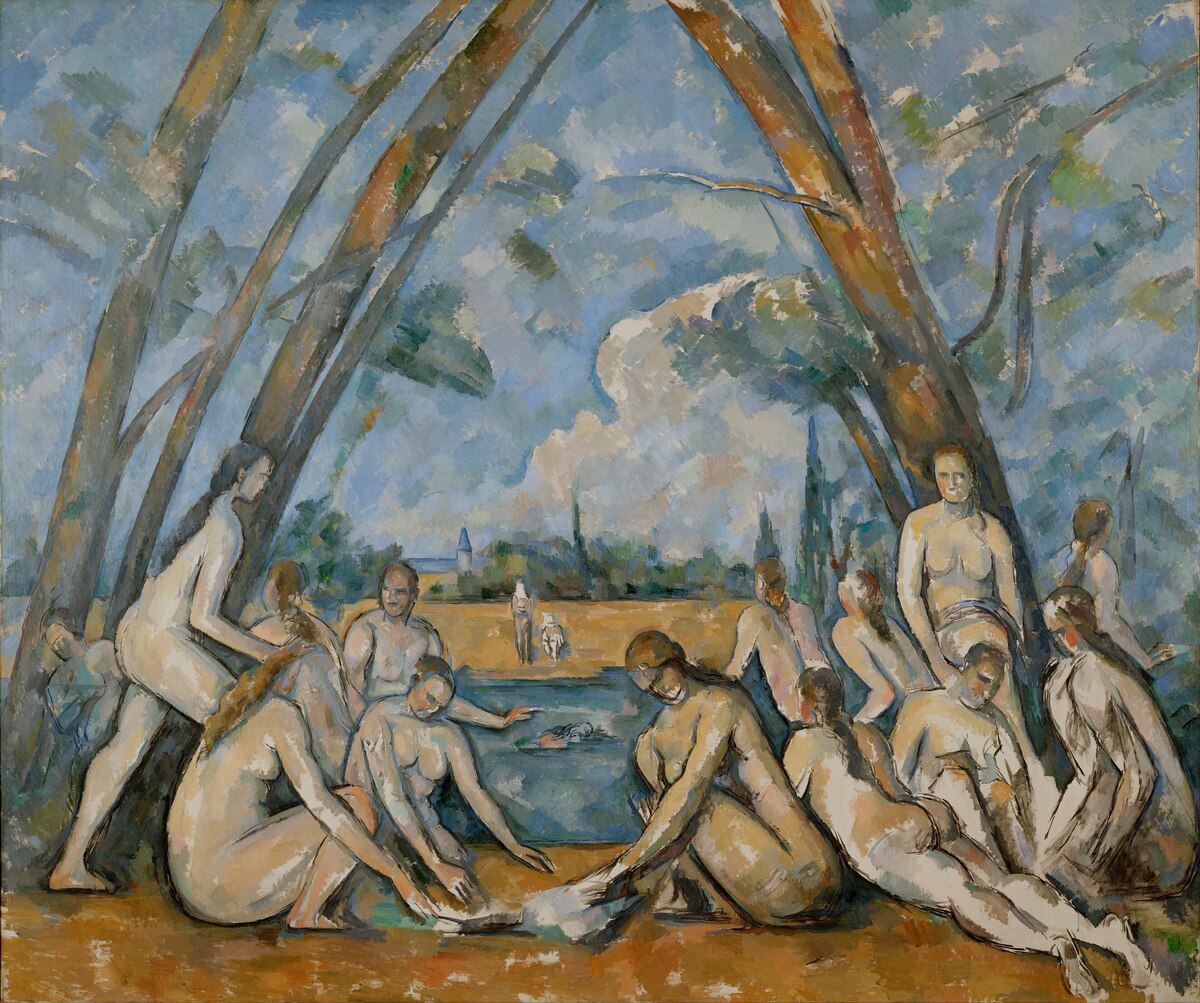
The large foreground figure at lower left who sits with her broad back to the viewer and head turned in profile, anchoring the near edge of the composition and showing Cézanne's blocky, faceted handling of the nude.

02

Crossing tree trunks

The apex where the leaning pine trunks cross and form the triangular canopy that encloses the bathers, the structural device that gives the picture its cathedral-like vaulting.

03

Distant town on the horizon

The small band of buildings with a pointed church spire and trees on the far shore, the deepest point of the landscape and the detail that most clearly distinguishes this canvas among the Large Bathers versions.

Portrait unrecorded

About the makers

Paul Cézanne

Individual life dates unrecorded

Biographical details and a verified portrait have not yet been recorded for this attribution.

The research & record

Study the work.
Follow the evidence.

Find catalogue details, historical context, technical research and the literature behind this artwork.

Article text for AI
Open research text

The artwork record

Research catalogue

Catalogue information and detailed research, with references that link to the bibliography.

Updated .

Identity and catalogue

Link
Title
The Large Bathers
Artist or attribution
Paul Cézanne(Wikimedia Commons: The Bathers, n.d.)
Medium and support
Oil on canvas(Wikimedia Commons: The Bathers, n.d.)
Dimensions
210.5 cm × 250.8 cm (82 7/8 in × 98 3/4 in)(Wikimedia Commons: The Bathers, n.d.)
Current collection or location
Philadelphia Museum of Art, Philadelphia, United States(Wikimedia Commons: The Bathers, n.d.)
Movement or period
Post-Impressionism
Country or culture
French
Depicted subject
A group of nude women, some standing, some stooping toward a pool, arranged in a landscape with crossing tree trunks that frame them; the scene is a fictional bather composition, not a narrative event.
Title variants
The Large Bathers; Les Grandes Baigneuses; The Bathers
Accession number
W1937-1-1(Wikimedia Commons: The Bathers, n.d.)
Catalogue identity

The painting is by Paul Cézanne (1839-1906) and is known in English as The Large Bathers or in French as Les Grandes Baigneuses; both forms of the title circulate for the same object. It is an oil painting on canvas measuring 210.5 cm high by 250.8 cm wide, and it belongs to the collection of the Philadelphia Museum of Art, where it carries the accession number W1937-1-1.(Wikimedia Commons: The Bathers, n.d.)

The date of the painting is not recorded uniformly. The Commons caption dates it 1898-1905, while the structured data give 1906. These are catalogue dates rather than the object's own date, and the discrepancy should be kept visible rather than resolved by preference: the caption presents the work as the product of a span of years, while the structured data record a single terminal year. Any account of the picture's place in Cézanne's late production has to work with that unresolved range.(Wikimedia Commons: The Bathers, n.d.)

The painting is by Paul Cézanne (1839-1906).(Wikimedia Commons: The Bathers, n.d.)

The painting is titled The Large Bathers or Les Grandes Baigneuses.(Wikimedia Commons: The Bathers, n.d.)

The painting is dated 1898-1905 in the Commons caption and 1906 in the structured data.(Wikimedia Commons: The Bathers, n.d.)

The accession number is W1937-1-1.(Wikimedia Commons: The Bathers, n.d.)

Materials and technique

Link
Support, medium and scale

The Large Bathers is executed in oil on canvas, measuring 210.5 centimeters in height and 250.8 centimeters in width. These two facts, the support and medium on the one hand and the unusually large dimensions on the other, are the foundation of everything else recorded about the picture's physical character: the scale is monumental, and the technique is the standard Western easel medium of oil paint applied to a woven textile support. The institutional record does not, in the supplied evidence, describe the canvas weight, the ground or priming layer, the presence or absence of an underdrawing, the pigments used, or any conservation treatment or lining. Where the account speaks of how the paint behaves, it remains a description of the visible surface rather than the result of technical analysis, and the two orders of statement should be kept distinct.(Wikimedia Commons: The Bathers, n.d.)

What can be seen, as described in the viewing account, is a surface in which the bodies are not sharply outlined and their edges blur into the trees, the ground and the light behind them. The same account characterizes the sky and water as pale, open bands of color against which the figures read as warm, rounded shapes, and describes crossing tree trunks that tilt into a rough triangular frame above the group. These are observations of pictorial effect: they establish how the composition looks and how forms are related on the picture surface, but they do not by themselves establish the materials, layer structure or sequence of application that produced those effects. The softness of the transitions and the roughness of the enclosing frame in the trunks are precisely the kinds of passages that later technical examination could test against the record, but the supplied evidence contains no such examination, and the description should therefore be read as visual inference rather than as documented technique.(Wikimedia Commons: The Bathers, n.d.)

The dating associated with the work bears directly on any account of its making. The institutional record gives the date as 1898 to 1905, while structured data for the same record carries 1906, the year of Cézanne's death. The viewing account notes both dates and reports that Cézanne worked on the painting over several years. A period of work spanning the late 1890s into the first years of the twentieth century is consistent with the picture being one of the largest and latest of the many bathing pictures the account attributes to him, and it matters for technique because a canvas of this size carried over several years implies sustained, cumulative work rather than a single campaign. The uncertainty between the two recorded dates should be preserved rather than resolved, since the evidence does not establish which date the catalogue raisonné entry endorses.(Wikimedia Commons: The Bathers, n.d.)

Provenance, exhibition and cataloguing

The object's documented history situates it firmly in the material culture of the early twentieth-century art market and museum. After Cézanne's death in 1906 the painting passed to his estate, was purchased by Ambroise Vollard in Paris in 1907 from Cézanne's son, and was owned by Auguste Pellerin (1852-1929), Paris, by 1923; it then descended to Pellerin's son Jean-Victor Pellerin, Paris, in 1929 through 1936, was handled by Wildenstein and Company, New York, acting as agent for Pellerin in 1936, and was sold to the City of Philadelphia for the W. P. Wilstach Collection on July 6, 1937. It was lent by M. and Mme. Pellerin to the 1936 exhibition Cézanne at the Musee de l'Orangerie, Paris, number 107, and is now in the collection of the Philadelphia Museum of Art under accession number W1937-1-1. The painting is referenced in John Rewald, The Paintings of Paul Cezanne: A Catalogue Raisonne, New York, 1996, number 857. This chain of custody establishes where the physical object has been and under what identity it has been catalogued; it does not, in the supplied evidence, record any intervention on the surface, so it cannot be used to infer condition, restoration or alteration.(Wikimedia Commons: The Bathers, n.d.)

The picture's standing in the literature rests on the catalogue raisonné reference, which fixes its identity among Cézanne's late works. That fixed identity is what allows the material facts, oil on canvas, the stated dimensions, the dating range and the record of ownership, to be attached to one object rather than to a family of related bathing compositions. The evidence establishes provenance intervals, an exhibition number, an accession number and a catalogue number, but it does not supply the pigment analysis, canvas examination or treatment history that would allow the surface to be described in technical terms. The distinction is worth keeping: what the documentation establishes is the object's administrative and market history, while what the viewing account establishes is its visible structure.(Wikimedia Commons: The Bathers, n.d.)

Interpretation

Taken together, the evidence supports a picture that is large, late, long in the making and traceable through a well-documented sequence of owners and institutions, yet whose materials beyond medium and support remain unexamined in the supplied record. The scale of roughly two and a half meters in width, the several-year dating range, the repeated bathing subject among Cézanne's works, and the passage through Vollard, Pellerin and finally the Wilstach Collection together explain why the object matters to a larger history of art and material culture: it is a monumental late canvas whose physical facts and documentary history are unusually well recorded even though its pigments, preparation layers and condition history are not. The account should present that gap as part of the state of research rather than filling it with inference from the visible surface.(Wikimedia Commons: The Bathers, n.d.)

The medium is oil on canvas.(Wikimedia Commons: The Bathers, n.d.)

Dimensions are 210.5 cm high by 250.8 cm wide.(Wikimedia Commons: The Bathers, n.d.)

Provenance and ownership

Link
Documented Chain of Ownership

The documented provenance of the painting begins with the death of its author. The institutional record lists the Estate of Paul Cézanne as the first station in the chain of ownership in 1906, the year Cézanne died. The following year, in 1907, the work was purchased by Ambroise Vollard in Paris from Cézanne's son. That transaction is the earliest recorded change of hands away from the family and places the canvas within the dealer network through which much of Cézanne's late output moved in the years immediately after his death. Everything before 1906 is not documented in the supplied record: the earlier history of the canvas, including the years Cézanne kept it and any arrangements made during his lifetime, is unrecorded here rather than proven to be a continuous line of possession.(Wikimedia Commons: The Bathers, n.d.)

The next documented owner is Auguste Pellerin (1852-1929) of Paris, who held the painting by 1923. The qualifier "by 1923" is significant: it establishes a terminus ante quem for Pellerin's acquisition without fixing the exact date or the transaction through which he obtained it, so the interval between the 1907 Vollard purchase and Pellerin's possession remains only partly documented. On Pellerin's death in 1929 the painting passed by descent to his son Jean-Victor Pellerin, also of Paris, who is recorded as holding it from 1929 to 1936.(Wikimedia Commons: The Bathers, n.d.)

A further transfer is recorded for 1936, when the painting was with Wildenstein & Co. in New York acting as agent for Pellerin. The wording matters for the interpretation of the chain: an agency relationship is not in itself a sale, and the record does not state that ownership changed hands at that point. The end of the documented sequence is a sale to the City of Philadelphia for the W. P. Wilstach Collection on July 6, 1937, which is the acquisition that brought the work into the public collection now associated with the Philadelphia Museum of Art and its accession number W1937-1-1.(Wikimedia Commons: The Bathers, n.d.)

One event sits across the ownership record and the exhibition history: in 1936 the painting was lent by M. and Mme. Pellerin to the exhibition "Cézanne" at the Musée de l'Orangerie in Paris, where it appeared as number 107. The lender named there is M. and Mme. Pellerin, while the same year's ownership entry records the work with Wildenstein & Co. as agent for Pellerin. Taken together, the two records show the canvas in Pellerin hands on the eve of its sale to Philadelphia and on public view in Paris the year before that sale. The loan also predates the July 1937 acquisition, so the exhibition was not a showing of a newly accessioned museum object.(Wikimedia Commons: The Bathers, n.d.)

Interpretation

Read as a whole, the record distinguishes several different kinds of statement. Documented events include the 1906 estate, the 1907 purchase by Vollard from Cézanne's son, Pellerin's possession by 1923, the descent to Jean-Victor Pellerin for 1929 to 1936, the 1936 agency of Wildenstein & Co., the 1936 Orangerie loan, and the July 6, 1937 sale to the City of Philadelphia. Less precise are the intervals: the date and circumstances of Pellerin's acquisition are bounded only by the phrase "by 1923," and the passage from Vollard to Pellerin is not itemized in the supplied evidence. The record therefore supports a sequence of named owners and dated transactions without supporting a claim that every intervening step is known. Describing these gaps as unrecorded is more accurate than treating them as transfers, and the agency relationship in 1936 should not be read as a change of ownership on the evidence given.(Wikimedia Commons: The Bathers, n.d.)

Provenance: Estate of Paul Cézanne, 1906; purchased by Ambroise Vollard, Paris from Cézanne's son, 1907; Auguste Pellerin (1852-1929), Paris, by 1923; by descent to his son Jean-Victor Pellerin, Paris, 1929-1936; with Wildenstein & Co., New York, acting as agent for Pellerin, 1936; sold to the City of Philadelphia for the W. P. Wilstach Collection, July 6, 1937.(Wikimedia Commons: The Bathers, n.d.)

Provenance timeline
  1. 1906

    The painting is recorded in the estate of Paul Cézanne following his death, marking the earliest documented stage of its provenance.(Wikimedia Commons: The Bathers, n.d.)

  2. 1907

    Ambroise Vollard in Paris purchases the work from Cézanne's son.(Wikimedia Commons: The Bathers, n.d.)

  3. by 1923

    Auguste Pellerin of Paris is recorded as an owner of the painting by this year.(Wikimedia Commons: The Bathers, n.d.)

  4. 1929-1936

    The painting passes by descent to Pellerin's son Jean-Victor Pellerin in Paris, in whose hands it is recorded during this interval.(Wikimedia Commons: The Bathers, n.d.)

  5. 1936

    Wildenstein and Co. of New York holds the work while acting as agent for Pellerin.(Wikimedia Commons: The Bathers, n.d.)

  6. 1936

    M. and Mme. Pellerin lend the painting to the exhibition Cézanne at the Musée de l'Orangerie in Paris, listed as number 107.(Wikimedia Commons: The Bathers, n.d.)

  7. July 6, 1937

    The painting is sold to the City of Philadelphia for the W. P. Wilstach Collection, entering public collection.(Wikimedia Commons: The Bathers, n.d.)

Exhibition history

Link
The 1936 Orangerie Exhibition

The Bathers, also known as Les Grandes Baigneuses, was lent by M. and Mme. Pellerin to the 1936 exhibition 'Cézanne' at the Musée de l'Orangerie, Paris, where it appeared as no. 107. This is the one documented exhibition showing in the supplied evidence, and it falls between the painting's descent to Jean-Victor Pellerin in 1929 and its sale to the City of Philadelphia for the W. P. Wilstach Collection on July 6, 1937. The loan therefore belongs to the final phase of the Pellerin family's ownership, immediately before the picture left France for an American public collection. The evidence records the exhibition title, the venue, the year and the checklist number, but establishes nothing further about the installation, the other works shown or how the painting was received there; those points must not be assumed from the record as supplied.(Wikimedia Commons: The Bathers, n.d.)

The exhibition history and the provenance history are closely braided. The painting passed from Cézanne's estate in 1906 to Ambroise Vollard in Paris, who purchased it from Cézanne's son in 1907; it was with Auguste Pellerin (1852-1929) in Paris by 1923 and descended to his son Jean-Victor Pellerin in 1929. In 1936 it was with Wildenstein & Co., New York, acting as agent for Pellerin, and was also lent by M. and Mme. Pellerin to the Orangerie's 'Cézanne' exhibition as no. 107. The same year thus saw both a public Paris showing under family ownership and the painting's placement with a New York dealer acting on the family's behalf. The sale to the City of Philadelphia for the W. P. Wilstach Collection followed on July 6, 1937. The evidence supports the sequence of custody and the loan, not any inference about what the loan achieved for the family or the dealer.(Wikimedia Commons: The Bathers, n.d.)

Cataloguing and Documentation

The painting's standing in the literature rests on John Rewald's The Paintings of Paul Cézanne: A Catalogue Raisonné, published in New York in 1996, where it is referenced as no. 857. The catalogue raisonné entry is a scholarly apparatus rather than an exhibition record; the evidence cites it plainly as a reference. It does not establish that the painting was exhibited in 1996, nor does it attach the work to any specific display, only to a numbered place within Rewald's survey of Cézanne's paintings. The juxtaposition of the number with the 1936 Orangerie checklist shows two distinct documentary frameworks at work: one recording a physical showing, the other fixing an identity among Cézanne's painted works.(Wikimedia Commons: The Bathers, n.d.)

What the record establishes about the object itself and what it records about its display should be kept apart. The painting is by Paul Cézanne (1839-1906), is titled The Bathers or Les Grandes Baigneuses, is oil on canvas measuring 210.5 cm high by 250.8 cm wide, and belongs to the Philadelphia Museum of Art under accession number W1937-1-1. Its date is given in two forms: 1898-1905 in the Commons caption and 1906 in the structured data. Those facts come from the institutional record and its caption data, and they remain the physical and cataloguing context within which the single documented 1936 loan sits. The evidence does not record any other exhibition, so the discussion of display must rest on the Orangerie showing and on the present collection holding only insofar as the accession data indicate it.(Wikimedia Commons: The Bathers, n.d.)

The painting was lent by M. and Mme. Pellerin to the 1936 exhibition 'Cézanne' at the Musée de l'Orangerie, Paris, no. 107.(Wikimedia Commons: The Bathers, n.d.)

Reception and literature

Link
Cataloguing and Scholarly Fixity

Interpretation

The object now known as The Large Bathers, or Les Grandes Baigneuses, holds a secure position in the scholarly literature because it entered John Rewald's catalogue raisonné of Cézanne's paintings, published in New York in 1996, where it appears as number 857. To be catalogued with a single, stable number is itself a stage of reception: it fixes the picture's identity for later researchers, anchors it among Cézanne's late works, and allows its provenance, exhibition history and bibliography to be tracked under one heading. The cataloguing does not by itself supply those other facts, but it is the reference point within which they are organized and cited.(Wikimedia Commons: The Bathers, n.d.)

Public Display and the Move to Philadelphia

Taken together, the provenance and the 1936 loan establish a transition in the object's cultural role that should be kept separate from its original function. The painting was made by Cézanne and, according to the Commons caption, dated 1898 to 1905, with 1906 also recorded in structured data, so its making belongs to the artist's late working years. Its later career, by contrast, runs through an estate sale, a dealer, private collectors, an exhibition and a municipal purchase. These are successive documented receptions of the same canvas, and none of them can be collapsed into a single dramatic event or made to stand in for the picture's meaning; the significance of the object in a larger history of art and material culture is cumulative, built from its making, its market passage and its eventual public ownership as much as from any one showing or sale.(Wikimedia Commons: The Bathers, n.d.)

The painting is referenced in John Rewald, The Paintings of Paul Cézanne: A Catalogue Raisonné, New York, 1996, no. 857.(Wikimedia Commons: The Bathers, n.d.)

Collection and display

Link
The object and its documentation

The object is Paul Cézanne's The Large Bathers, also called Les Grandes Baigneuses, an oil painting on canvas measuring 210.5 cm high by 250.8 cm wide. It belongs to the Philadelphia Museum of Art, where it carries the accession number W1937-1-1 and is recorded as part of the W. P. Wilstach Collection. The dating is not stated uniformly across the available record: the caption transmitted with the institutional image gives 1898 to 1905, while the structured data attached to the same record gives 1906. Both datings therefore circulate in the documentation of the same object, a discrepancy that matters because the painting's position as one of the largest and latest of Cézanne's bathing compositions depends on how that final period of work is bounded.(Wikimedia Commons: The Bathers, n.d.)

Provenance and exhibition

The provenance traced in the record begins with the artist's estate in 1906. In 1907 the painting was purchased from Cézanne's son by Ambroise Vollard in Paris. By 1923 it belonged to Auguste Pellerin (1852-1929), and on Pellerin's death in 1929 it descended to his son Jean-Victor Pellerin, in whose hands it remained until 1936. That year it was with Wildenstein & Co. in New York, acting as agent for Pellerin, and on July 6, 1937 it was sold to the City of Philadelphia for the W. P. Wilstach Collection. Before the sale, M. and Mme. Pellerin lent the painting to the 1936 exhibition Cézanne at the Musée de l'Orangerie in Paris, where it was shown as number 107. The public exhibition and the private negotiation thus fall within the same year, and the Paris showing stands as the documented exhibition moment before the picture entered a public American collection.(Wikimedia Commons: The Bathers, n.d.)

The painting's fixed place in the scholarly literature rests on its inclusion in John Rewald's The Paintings of Paul Cézanne: A Catalogue Raisonné, published in New York in 1996 as number 857. This catalogue entry is what gives the object a stable identity for research: it associates the canvas with the documented title, the late bathing series, and the provenance and exhibition history recorded above, so that the various accounts of the picture can be referred to a single numbered work.(Wikimedia Commons: The Bathers, n.d.)

Interpretation

Read together, the surviving evidence describes an object whose documentary history begins only after the painter's death: the earliest recorded transfer is the 1906 estate and the 1907 sale to Vollard, and the accession record is unusually complete for the following three decades. What the record does not supply is equally consequential. It gives two dates for the making of the picture but no secure sequence of work, no record of pigments or technical examination, and no account of the painter's intentions. Because those elements are absent, the interpretation of the canvas must rest on the documented circumstances of its creation and circulation rather than on inferred narrative, and the discrepancies in dating should be preserved as part of the object's history rather than resolved without further evidence.(Wikimedia Commons: The Bathers, n.d.)

The painting is in the collection of the Philadelphia Museum of Art.(Wikimedia Commons: The Bathers, n.d.)

Documented values and qualified estimates

Link
Object and dating

Interpretation

The Large Bathers, also called Les Grandes Baigneuses, was painted by Paul Cézanne (1839-1906) in oil on canvas and measures approximately 210.5 by 250.8 cm, making it one of the largest and latest of his many bathing compositions. The Philadelphia Museum of Art holds the work under accession W1937-1-1. Dating is recorded inconsistently: the Commons caption gives 1898-1905, while the structured data also records 1906, so the execution period is best described as spanning the end of Cézanne's life rather than fixed to a single year.(Wikimedia Commons: The Bathers, n.d.)

Visual conventions

The picture shows a group of nude women in a landscape, some standing and some stooping toward a pool, framed by tree trunks that cross the sky. The figures spread across the width of the canvas without forming a tight single group, and the crossing trunks above them tilt into a rough triangular frame that holds the scattered bodies together as one scene. The bodies are not sharply outlined; their edges blur into the trees, the ground and the pale open bands where sky and water meet, so the women read as part of the landscape rather than placed in front of it. The scene is a fictional bathing composition, not an event drawn from myth, scripture or history, which means its order comes from arrangement, pose and light rather than from a plot.(Wikimedia Commons: The Bathers, n.d.)

Provenance

The documented provenance runs from Cézanne's estate in 1906, through Ambroise Vollard in Paris in 1907, who purchased it from Cézanne's son, to Auguste Pellerin (1852-1929) in Paris by 1923, and by descent to his son Jean-Victor Pellerin, 1929-1936. Wildenstein & Co. of New York then acted as agent for Pellerin in 1936, and the painting was sold to the City of Philadelphia for the W. P. Wilstach Collection on July 6, 1937. This chain places the work in the hands of a major dealer before entering a private collection, and it connects the object to the institutional formation of a public collection through a documented sale rather than an undocumented transfer.(Wikimedia Commons: The Bathers, n.d.)

Exhibition and catalogue record

M. and Mme. Pellerin lent the painting to the 1936 exhibition Cézanne at the Musée de l'Orangerie, Paris, as number 107, the year before its sale to Philadelphia. The work is also entered in John Rewald, The Paintings of Paul Cézanne: A Catalogue Raisonné, New York, 1996, as number 857, giving it a fixed identity in the literature of Cézanne's late works. The exhibition record and the catalogue raisonné entry are separate forms of documentation: one attests to its public display while still in Pellerin hands, the other to its place in the scholarly catalogue of the artist's paintings.(Wikimedia Commons: The Bathers, n.d.)

Recorded values

The only supplied valuation is a calculated working insurance range of US$250M to US$500M, recorded as a working calculation generated 2026-10-16. Its stated methodology derives the range from the confirmed artwork context: Cézanne's canonical status in Post-Impressionism, the monumental scale and importance of this bather composition, its prominence in the museum's collection, and its documented provenance. No official appraisal, private insurance schedule, auction result or sale price was available in the supplied excerpts, and no comparable sales or market data were accessed or invented, so the range is intentionally broad and conservative and must be reviewed manually by a qualified professional. It is not an official insurance value, appraisal, auction result or sale price, and it should not be used as the basis for binding coverage, lending, tax or financial decisions. The documented attributes that carry the greatest weight for such a valuation, the artist's canonical status, the monumental scale, the late dating and the unbroken provenance through identifiable dealers and collections, are the same facts that define the object's place in the history of Post-Impressionism rather than merely its market position.(Wikimedia Commons: The Bathers, n.d.)

Working estimate

Calculated working insurance estimate, not a sale price: Estimated value: US$250M to US$500M Recorded date: Working calculation, generated 2026-10-16. Methodology: Broad working insurance range for manual review, calculated from the confirmed artwork context: Paul Cézanne, The Large Bathers (Les Grandes Baigneuses), 1898-1905, oil on canvas, approximately 210.5 by 250.8 cm, held by the Philadelphia Museum of Art, accession W1937-1-1. The range reflects the artist's canonical status in Post-Impressionism, the monumental scale and importance of this bather composition, its prominence in the museum's collection, and its documented provenance through Cézanne's estate, Ambroise Vollard, Auguste Pellerin, Wildenstein & Co., and acquisition by the City of Philadelphia in 1937. No official appraisal, private insurance schedule, auction result, or sale price was available in the supplied excerpts, so the range is intentionally broad and conservative and must be reviewed manually by a qualified professional. Qualification: This is a model-generated working insurance range for manual review only. It is not an official insurance value, appraisal, auction result, or sale price, and it should not be used as the basis for binding coverage, lending, tax, or financial decisions. No comparable sales, private insurance records, or market data were accessed or invented. The range is a conservative placeholder pending review by a qualified fine-art insurance specialist or appraiser.(Wikimedia Commons: The Bathers, n.d.)

Further reading

Books for a closer look

Paid links. As an Amazon Associate I earn from qualifying purchases.

  • Cover of Les grandes baigneuses de Picasso: Musée de l'Orangerie, 22 novembre 1988-6 mars 1989
    Open Library

    Michel Hoog, 1988

    Les grandes baigneuses de Picasso: Musée de l'Orangerie, 22 novembre 1988-6 mars 1989

    Editions de la Réunion des musées nationaux

    Titled Les grandes baigneuses de Picasso with subjects Influence and Exhibitions. It offers a documented art historical comparison around the Bathers subject and possible influence of Cezanne's bather compositions, while not being a direct study of Cezanne's own painting.

    ISBN 2711822303

    Find book on Amazon.co.uk View reference

Bibliography

Sources and further reading

References are arranged by author or organisation, with links to the original publications. Where no publication date is recorded, n.d. means no date.

Source notes updated .

  1. 02

    Book

    Les grandes baigneuses de Picasso: Musée de l'Orangerie, 22 novembre 1988-6 mars 1989. Editions de la Réunion des musées nationaux.

    Titled Les grandes baigneuses de Picasso with subjects Influence and Exhibitions. It offers a documented art historical comparison around the Bathers subject and possible influence of Cezanne's bather compositions, while not being a direct study of Cezanne's own painting.

    ISBN
    2711822303
    Link to reference
    Citation text
  2. 01

    Secondary · About this artwork

    Wikimedia Commons: The Bathers (n.d.). Institutional record for The Bathers. Wikimedia Commons.

    Institutional record page with detailed object history and bibliography.

    Link to reference
    Citation text

Article text and sources · Reading and attribution

An unhandled error has occurred. Reload 🗙