ArchiveThe Bathers (Les Grandes Baigneuses)

Artwork record / 83 of 331

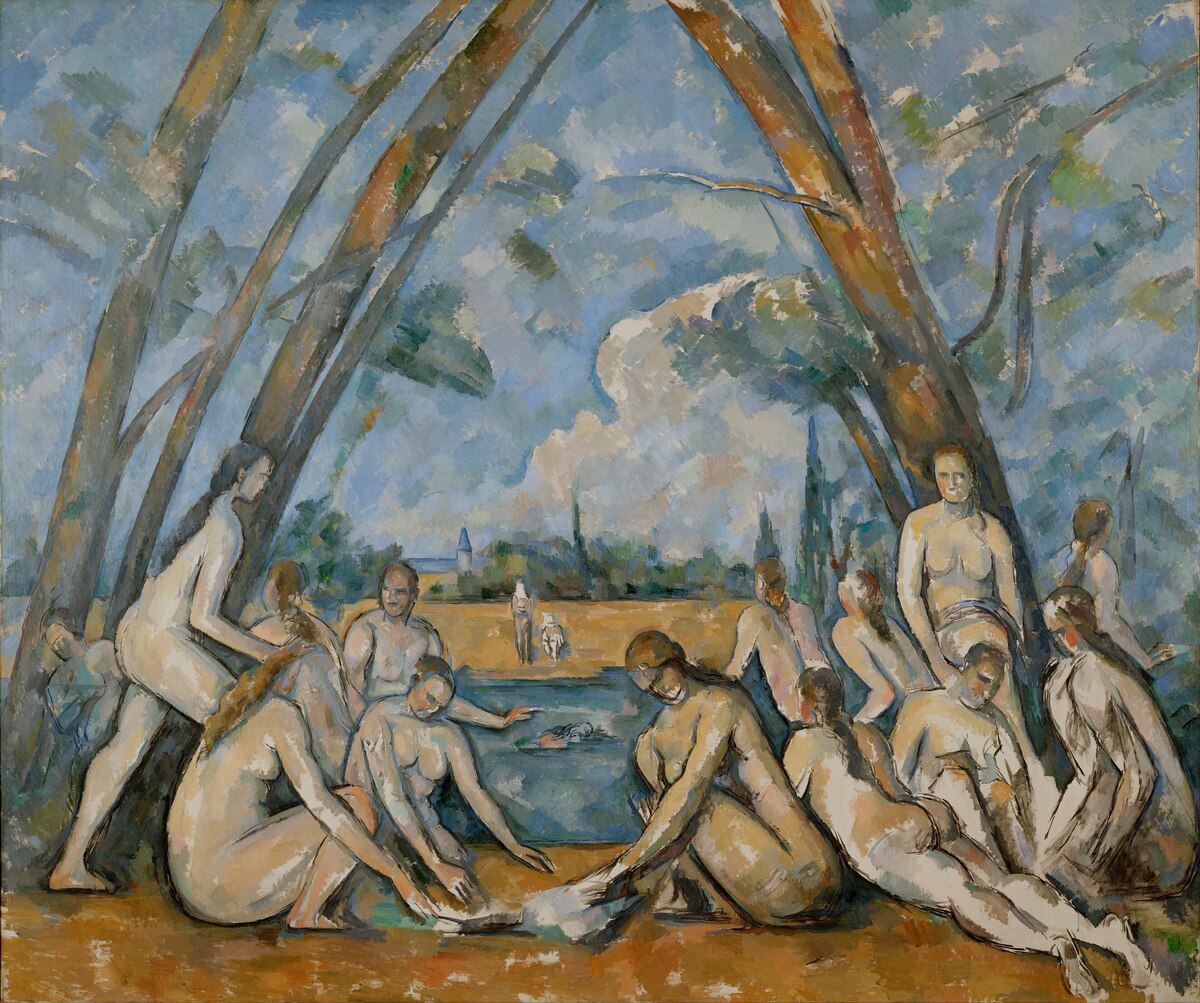
The Bathers (Les Grandes Baigneuses) by Paul Cézanne (1898–1905 (identified in the source as 1906 and 1898–1905))

Artist: Paul Cézanne

Paul Cézanne's late, monumental painting of nude women beside a stream, where classical structure meets the flicker of direct observation. A docent-led reading of the Philadelphia Museum of Art's Large Bathers, guided by the supplied object record and Cézanne scholarship.

Read the story ↓ About the artist ↓ Research and record ↓ Literature and sources ↓ Listen to the article ↓
Article text for AI
Shop this artwork ↓ 0 visits
Date1898–1905 (identified in the source as 1906 and 1898–1905)CultureFrance PeriodPost-ImpressionismCurrent locationPhiladelphia Museum of Art, Philadelphia, United States
Listen to the article
100%
The Bathers (Les Grandes Baigneuses) by Paul Cézanne (1898–1905 (identified in the source as 1906 and 1898–1905))
Loading full-resolution artwork…
Scroll to zoom · drag to pan · double-click to focus Pinch to zoom · drag to explore · double-tap to focus FIELD VIEW / 83
Tools & download
Pixel colour Select a pixel with the eyedropper
No pixel selected

Choose the eyedropper, then click or tap the image. Scroll to zoom for finer selection.

Add text

Hand to pan · Select to move text and drawings · Add as many texts as you like · Scroll to zoom

The Bathers (Les Grandes Baigneuses): high-resolution image

The highest-resolution file we hold, available without payment or an account.3,840 × 3,210 pixels.

Download highest-resolution image

Details to notice

About 3 minutes to read
01

Far shore town, spire, and tiny figures

Small landscape strip between the water and the sky containing a town, a church spire, dark cypress forms, and two minute figures on the far bank; this quiet distance contrasts with the crowded nudes and gives the scene its Arcadian setting.

02

Leaning bather at the left edge

Long-haired nude at the left who leans forward over the seated bather below her, her back curved and her head inclined; she forms the left slope of the human pyramid and presses against the bending tree trunk.

03

Seated and reclining bathers, lower right

Cluster of figures at the lower right, one seated upright in profile and one lying with her legs extended toward the bottom corner; the languid sprawl closes the composition's base and shows the loosest, most summary brushwork in the picture.

Portrait unrecorded

About the makers

Paul Cézanne

Individual life dates unrecorded

Biographical details and a verified portrait have not yet been recorded for this attribution.

The research & record

Study the work.
Follow the evidence.

Find catalogue details, historical context, technical research and the literature behind this artwork.

Article text for AI
Open research text

The artwork record

Research catalogue

Catalogue information and detailed research, with references that link to the bibliography.

Updated .

Identity and catalogue

Link
Title
The Bathers (Les Grandes Baigneuses)(commons.wikimedia.org, n.d.)
Object date
1898–1905 (identified in the source as 1906 and 1898–1905)(commons.wikimedia.org, n.d.)
Medium and support
oil on canvas(commons.wikimedia.org, n.d.)
Dimensions
210.5 cm × 250.8 cm (82 7/8 in × 98 3/4 in)(commons.wikimedia.org, n.d.)
Current collection or location
Philadelphia Museum of Art, Philadelphia, United States(commons.wikimedia.org, n.d.)
Movement or period
Post-Impressionism
Country or culture
France
Depicted subject
A group of nude women, Cézanne's bathers, arranged on the bank of a stream with a distant town and spire beyond; one of Cézanne's large, late bather compositions, built from repeated groups of figures in an outdoor landscape setting.
Title variants
The Large Bathers; Les Grandes Baigneuses; The Bathers (Les Grandes Baigneuses); The Large Bathers or The Bathers (Les Grandes Baigneuses)
Accession number
W1937-1-1(commons.wikimedia.org, n.d.)
Support
canvas
Catalogue identity and physical description

The catalogue entry for the painting at the Philadelphia Museum of Art gives its title as Les Grandes Baigneuses, rendered in English as The Large Bathers, and attributes the work to Paul Cézanne. The record is a composite institutional entry, hosted on Wikimedia Commons but drawing its detailed catalogue data from the institutional record, and it is the principal source for the object's identity, medium, dimensions, genre classification, series membership, provenance, exhibition history and catalogue raisonné references. The painting is oil on canvas and measures 210.5 cm high by 250.8 cm wide, that is 82 7/8 inches by 98 3/4 inches, making it a large-scale canvas rather than a study or sketch. It is classified as a genre work, a scene of figures in a landscape rather than a narrative portrait, and it depicts a group of bathers in a landscape setting. The same record places the picture within Cézanne's Baigneuses, or Bathers, series, the recurrent subject of individual and grouped bathers that Cézanne returned to throughout his career.(commons.wikimedia.org, n.d., Summary, Artist; Summary, Title)(The Museum of Modern Art, 2021)

Date and the artist's biography

The date recorded for the painting is not internally consistent. The record states 1906 as the date, while another part of the same record gives a range of 1898 to 1905. Both statements belong to the same institutional entry rather than to two separate catalogues, so the discrepancy is best described as an unresolved difference within a single source, not as a conflict between competing authorities. Cézanne's life dates, 1839 to 1906, and his working locations are also supplied: he was born in Aix-en-Provence and worked in Paris, Auvers-sur-Oise, Aix-en-Provence and Marseille. Any attempt to describe the painting as a product of his final year, or alternatively of the years around the turn of the century, has to acknowledge that the catalogue itself supports both formulations.(commons.wikimedia.org, n.d., Summary, Date; Summary, Artist)(The Museum of Modern Art, 2021)

Subject tradition and the Bathers series

Interpretation

Cézanne's practice in the Bathers compositions is described by MoMA as engaging a subject long associated with the museum tradition, the nude in landscape. MoMA further notes that Cézanne associated the pose of the left-most nude in a Bathers composition with a Mercury copied after Pigalle. MoMA's account of his aims characterises Cézanne as seeking to make of Impressionism something solid and durable, like the art of the museum, uniting direct observation with classical structure. Taken together with the background evidence that grouped and individual bathers were among his familiar subjects across his career, this positions the painting within a sustained engagement with a traditional figure subject rather than as an isolated late experiment.(The Museum of Modern Art, 2021)(commons.wikimedia.org, n.d., Summary, Artist)

Exhibition and cataloguing references

The painting has a documented exhibition history and a set of catalogue raisonné citations in the institutional record. It was lent by M. and Mme. Pellerin to the 1936 exhibition Cézanne at the Musée de l'Orangerie, Paris, as number 107. It appears in John Rewald, The Paintings of Paul Cézanne: A Catalogue Raisonné, New York, 1996, as number 857. It is recorded as FWN 981 in The Paintings, Watercolors and Drawings of Paul Cezanne: An Online Catalogue Raisonné, as number 719 in Cézanne: Son art, son œuvre, and as number 657 in the 1970 Paul Cézanne catalogue raisonné. These four numbering systems identify the same canvas under different cataloguing traditions, which is why the object is encountered under several distinct reference numbers in the literature.(commons.wikimedia.org, n.d., Object history; Summary, Title)

The painting is titled Les Grandes Baigneuses (The Large Bathers).(commons.wikimedia.org, n.d.)

The painting is dated 1906 in the record, with a stated range of 1898 to 1905 in another part of the same record.(commons.wikimedia.org, n.d.)

Subject and iconography

Link
Subject and genre

Visual observation

The object is a group of bathers arranged in a landscape setting, a subject the institutional record classifies as a genre work: a scene of figures in a landscape rather than a narrative portrait. That classification matters because it places the picture outside the traditions of portraiture and history painting, where named sitters or recounted events anchor meaning. Here the figures are anonymous and the setting carries the weight of the composition. The record identifies the work as belonging to Cézanne's Baigneuses (Bathers) series, a designation that situates this canvas within a recurring subject rather than treating it as an isolated performance.(commons.wikimedia.org, n.d., Summary, Title; Summary, Genre; Summary, Series title)

Dating and the late career

Cézanne was born in Aix-en-Provence and worked in Paris, Auvers-sur-Oise, Aix-en-Provence and Marseille, according to the biographical record. That geography connects the bathers subject to the landscapes and working conditions of the artist's career rather than to a single studio moment. The Baigneuses series, to which this painting belongs, was a subject he revisited repeatedly, and the recurrence indicates an ongoing program of work rather than a one-off image. The record does not establish a precise location of execution for this canvas, so the biographical frame should be treated as context for the series, not as a documented fact about this particular painting's making.(commons.wikimedia.org, n.d., Summary, Artist; Summary, Series title)(The Museum of Modern Art, 2021)

Technical means and visible surface

The technical account describes repeated parallel and perpendicular pencil strokes used to model surfaces and build volume, alongside fragmented multiple outlines that mirror the skips and pauses of vision. In the painting itself the figures are built out of visible, rhythmic marks rather than smooth illusion, and the edges of forms read as provisional boundaries rather than fixed borders. The museum's account also notes repetitions and transformations that realize a composition, elements of unfinish that suggest the contingency of perception, and searching multiple lines that describe form without sealing it. These are attributed characterizations of Cézanne's working means, and they connect what is visible in the picture to a documented method of building a composition across repeated marks.(commons.wikimedia.org, n.d., Summary, Title)

Provenance and public life

The provenance documented in the record runs from Cézanne's estate after his death in 1906, to purchase by Ambroise Vollard, Paris, from Cézanne's son in 1907, into the collection of Auguste Pellerin (1852–1929), Paris, by 1923, and by descent to his son Jean-Victor Pellerin, Paris, 1929–1936. Wildenstein & Co., New York, acted as agent for Pellerin in 1936, and the painting was sold to the City of Philadelphia for the W. P. Wilstach Collection on July 6, 1937. The record also notes that the painting was lent by M. and Mme. Pellerin to the 1936 exhibition Cézanne at the Musée de l'Orangerie, Paris, no. 107. This sequence establishes the movement of the object from the artist's family into private collections and finally into a public American museum, and it dates its entry into Philadelphia to 1937.(commons.wikimedia.org, n.d., Summary, Series title)

Interpretation

Read together, the visible subject, the documented medium and dimensions, the contested dating, and the catalogue numbering show an object that is both a monumental image of figures in landscape and a heavily inventoried late work. The genre classification keeps the picture from being mistaken for a portrait or a narrative scene, while the Baigneuses series designation ties it to a lifelong subject. The Pigalle Mercury association and the museum's account of Cézanne's aims together explain why the picture matters within a larger history: it takes a museum subject, the nude in landscape, and rebuilds it through repeated and searching marks whose unresolved edges later artists could use. The provenance and exhibition record supply the object's public history, and the competing dates preserve the uncertainty that surrounds a canvas made at the very end of the artist's life.(The Museum of Modern Art, 2021)(commons.wikimedia.org, n.d., Summary, Dimensions; Summary, Genre; References)

Visual observation

The painting depicts a group of bathers in a landscape setting.(commons.wikimedia.org, n.d.)

The painting is a genre work, a scene of figures in a landscape rather than a narrative portrait.(commons.wikimedia.org, n.d.)

The painting belongs to Cézanne's Baigneuses (Bathers) series.(commons.wikimedia.org, n.d.)

Historical context

Link
The Artist and the Subject in His Career

Visual observation

Paul Cézanne (1839–1906) was born in Aix-en-Provence and worked in Paris, Auvers-sur-Oise, Aix-en-Provence and Marseille, a geography of movement between the capital and the south that frames the working life behind the Bathers series. His career was one of recurrence rather than a single decisive subject: he painted throughout his working life, and the bathers, whether shown singly or in groups, were among his familiar subjects. The Large Bathers belongs to this Baigneuses (Bathers) series, so the picture is not an isolated late performance but one entry in a long-running inquiry into figures in landscape that Cézanne returned to repeatedly.(The Museum of Modern Art, 2021)(commons.wikimedia.org, n.d., Summary, Artist; Summary, Series title)

Classical Precedent and the Museum

One documented link between Cézanne's practice and the museum tradition is specific: he associated the pose of the left-most nude in Bathers with a Mercury copied after Pigalle. This is an association recorded for a Bathers composition, not a claim that the Philadelphia canvas reproduces a specific sculpture, and it should be held with that qualification. It nonetheless shows that when Cézanne arranged nudes in landscape he was working with poses that carried classical and sculptural precedent in his mind, so that a theme long established in museum art was being reworked rather than simply observed from nature.(The Museum of Modern Art, 2021)

Cézanne painted recurrently throughout his career, including individual and grouped bathers among his familiar subjects.(The Museum of Modern Art, 2021)

Cézanne lived from 1839 to 1906; he was born in Aix-en-Provence and worked in Paris, Auvers-sur-Oise, Aix-en-Provence and Marseille.(commons.wikimedia.org, n.d.)(The Museum of Modern Art, 2021)

Cézanne associated the pose of the left-most nude in Bathers with a Mercury copied after Pigalle.(The Museum of Modern Art, 2021)

Materials and technique

Link
Documented support and format

The Philadelphia Museum of Art records this painting, Paul Cézanne's Les Grandes Baigneuses (The Large Bathers), as oil on canvas, and gives its dimensions as 210.5 cm high by 250.8 cm wide, or 82 7/8 in by 98 3/4 in. These are the two technical facts the institutional record states directly about the object's physical makeup: a fabric support prepared for oil paint and a canvas whose roughly square, slightly wider-than-tall format makes it one of the largest works in the series to which it belongs. The scale is not incidental to the materials discussion, because a canvas of these dimensions required a substantial stretched support and a considerable quantity of paint to cover, and it conditioned how the composition was built up across the surface.(commons.wikimedia.org, n.d., Summary, Medium; Summary, Dimensions)

The painting is oil on canvas.(commons.wikimedia.org, n.d.)

The painting measures 210.5 cm high by 250.8 cm wide (82 7/8 in by 98 3/4 in).(commons.wikimedia.org, n.d.)

Provenance and ownership

Link
Documented chain of ownership

The documented sequence of custody begins at the artist's death. Paul Cézanne, who lived from 1839 to 1906, died in 1906, and the painting was then in his estate. In 1907 it was purchased by Ambroise Vollard, Paris, from Cézanne's son. This is the first recorded transfer, and it is stated as a purchase rather than a bequest or family retention, which places the canvas in the dealer market within a year of the artist's death. The record gives no intermediate location, valuation or transaction document between the estate and Vollard beyond the fact of the 1907 sale.(commons.wikimedia.org, n.d., Object history; Summary, Artist)(The Museum of Modern Art, 2021)

The next recorded owner is Auguste Pellerin (1852–1929), in whose Paris collection the painting is placed by 1923. The phrasing "by 1923" marks a terminus ante quem rather than the date of acquisition: the evidence does not establish when or how Pellerin obtained the work, nor whether his purchase was directly from Vollard, so the interval between 1907 and 1923 is an unrecorded gap rather than a proven continuity of ownership. On Pellerin's death in 1929 the painting passed by descent to his son Jean-Victor Pellerin, Paris, whose holding is dated 1929 to 1936. Descent within a family is a distinct mode of transfer from purchase, and the record presents it as such.(commons.wikimedia.org, n.d., Object history)

In 1936 Wildenstein & Co., New York, acted as agent for Pellerin, and on July 6, 1937 the painting was sold to the City of Philadelphia for the W. P. Wilstach Collection. The agency relationship and the eventual municipal purchaser are both explicit, and they establish a transatlantic dealing step between the Paris family collection and an American public collection. The sale is dated precisely to the day, and the beneficiary is named as the Wilstach Collection rather than the museum in the abstract, which is the institutional form through which the work entered public custody. The accession number recorded for the painting is W1937-1-1, consistent with a 1937 Wilstach entry.(commons.wikimedia.org, n.d., Object history)

One event in this period shows the painting as a lent work rather than a commodity: it was lent by M. and Mme. Pellerin to the 1936 exhibition Cézanne at the Musée de l'Orangerie, Paris, no. 107. Because the loan is credited to M. and Mme. Pellerin, the exhibition record places the work in Pellerin hands in the same year that Wildenstein & Co. is documented acting as agent for Pellerin. The two facts are compatible but not identical in what they prove: the exhibition establishes physical possession and public display in Paris in 1936, while the agency record establishes a step toward the 1937 sale. Neither document, as supplied, specifies the exact date within 1936 when the agent's role began relative to the loan.(commons.wikimedia.org, n.d., Object history, note 1; Object history)

Catalogue identities and the work they do

The work itself, identified in the institutional record as Les Grandes Baigneuses (The Large Bathers), is oil on canvas measuring 210.5 cm high by 250.8 cm wide (82 7/8 in by 98 3/4 in), and is held by the Philadelphia Museum of Art, Philadelphia, Pennsylvania, United States, under accession W1937-1-1. The record dates the painting 1906, with a stated range of 1898 to 1905 in another part of the same record. Both statements belong to the supplied evidence and should be kept visible rather than resolved: the object's dating is unstable within its own documentation, and that instability is a condition of any provenance timeline that tries to fix the moment of creation before the 1906 estate. Thematically the canvas depicts a group of bathers in a landscape setting and is classified as a genre work, a scene of figures in a landscape rather than a narrative portrait, belonging to Cézanne's Baigneuses (Bathers) series.(commons.wikimedia.org, n.d., Object history; References)

Why this provenance matters

Interpretation

Why this particular custody chain matters within a larger history can be stated only as far as the evidence supports it. Cézanne pushed the boundaries of seeing and paved the way for further developments in abstraction in the twentieth century, from Pablo Picasso to Henri Matisse and beyond. The 1937 sale into the W. P. Wilstach Collection therefore places a late Cézanne of monumental size and unresolved surface into a public American collection in the same decade as the 1936 Orangerie showing, at a moment when his position in that narrative was being consolidated. The evidence supplies the reception claim and the acquisition facts separately; the connection between them is an interpretive reading of the chronology rather than a documented causal statement.(The Museum of Modern Art, 2021)(commons.wikimedia.org, n.d., Object history; Object history, note 1)

A provenance account of this canvas is bounded by what its documents omit. The record establishes ownership at named moments and transfers in 1907, 1929 by descent, and 1937 by sale, but it does not describe storage, condition, restoration, insurance, or any intermediate exhibition between the Pellerin holding and the Wilstach acquisition. The gap between the 1907 Vollard purchase and Pellerin's appearance by 1923 is unrecorded rather than proven to be continuous or to have involved additional owners. Likewise, the record does not reconcile the 1906 date with the 1898 to 1905 range, nor does it explain how a canvas dated within that span came to be in the estate of an artist who died in 1906. Those unresolved points are part of the evidence as supplied and should remain attached to the object's history rather than smoothed away. The painting also belongs to the broader documentation of Cézanne's Baigneuses series and his career-long return to individual and grouped bathers, and it entered a public Philadelphia collection at the same time as the 1936 Orangerie exhibition, when the canvas was lent by M. and Mme. Pellerin and shown in Paris under no. 107.(commons.wikimedia.org, n.d., Object history; Summary, Artist; Object history, note 1)(The Museum of Modern Art, 2021)

After Cézanne's death in 1906, the painting was in the estate of Paul Cézanne; it was purchased by Ambroise Vollard, Paris, from Cézanne's son in 1907.(commons.wikimedia.org, n.d.)

The painting entered the collection of Auguste Pellerin (1852–1929), Paris, by 1923, and passed by descent to his son Jean-Victor Pellerin, Paris, 1929–1936.(commons.wikimedia.org, n.d.)

Wildenstein & Co., New York, acted as agent for Pellerin in 1936, and the painting was sold to the City of Philadelphia for the W. P. Wilstach Collection on July 6, 1937.(commons.wikimedia.org, n.d.)

Provenance timeline
  1. 1906

    Cézanne dies; the painting is in the estate of Paul Cézanne.(commons.wikimedia.org, n.d., Object history)

  2. 1907

    Ambroise Vollard, Paris, purchases the painting from Cézanne's son.(commons.wikimedia.org, n.d., Object history)

  3. by 1923

    The painting enters the collection of Auguste Pellerin, Paris.(commons.wikimedia.org, n.d., Object history)

  4. 1929–1936

    The painting passes by descent to Pellerin's son Jean-Victor Pellerin, Paris.(commons.wikimedia.org, n.d., Object history)

  5. 1936

    Wildenstein & Co., New York, acts as agent for Pellerin; the painting is lent by M. and Mme. Pellerin to the Cézanne exhibition at the Musée de l'Orangerie, Paris, no. 107.(commons.wikimedia.org, n.d., Object history; Object history, note 1)

  6. July 6, 1937

    The painting is sold to the City of Philadelphia for the W. P. Wilstach Collection.(commons.wikimedia.org, n.d., Object history)

Exhibition history

Link
Exhibition History

The exhibition history of Paul Cézanne's Les Grandes Baigneuses (The Large Bathers) is thin in the supplied record but precise where it exists. The painting was lent by M. and Mme. Pellerin to the 1936 exhibition Cézanne at the Musée de l'Orangerie, Paris, where it carried catalogue number 107. That loan is dated to the same year in which Auguste Pellerin's holdings passed to his son Jean-Victor Pellerin, and to the year in which Wildenstein & Co., New York, acted as agent for Pellerin. The 1936 Orangerie showing is therefore the moment at which the painting left private hands for public view and entered the market negotiation that would place it in Philadelphia the following year. The exhibition record establishes both the venue and the catalogue number, and the provenance establishes the lending party and the commercial context surrounding the loan.(commons.wikimedia.org, n.d., Object history, note 1; Object history)

The lending attribution deserves care because two different parties are named across the record. The exhibition entry credits M. and Mme. Pellerin, while the provenance states that the painting had passed by descent from Auguste Pellerin (1852–1929) to his son Jean-Victor Pellerin, Paris, 1929–1936. Read together, these establish that the 1936 lender was the Pellerin household of that moment, the younger generation holding the work after the father's death. The sale to the City of Philadelphia for the W. P. Wilstach Collection followed on July 6, 1937, with Wildenstein & Co., New York, acting as agent for Pellerin in 1936. The exhibition was thus not an isolated retrospective honor but the most visible stage in a sequence that ran from Cézanne's estate to Ambroise Vollard, who purchased it from Cézanne's son in 1907, to Pellerin, to the 1936 Orangerie exhibition, to Philadelphia.(commons.wikimedia.org, n.d., Object history, note 1; Object history)

Catalogues and Current Display

The exhibition history recorded in the evidence must not be confused with the painting's catalogue raisonné record or its present disposition. Beyond the 1936 Orangerie loan, no further exhibition is supplied by the evidence, and the accession number W1937-1-1 records the work as part of the collection of the Philadelphia Museum of Art, Philadelphia, Pennsylvania, United States, following the 1937 sale to the City of Philadelphia for the Wilstach Collection. Nor should the Orangerie exhibition be confused with a catalogue that discusses an unexhibited object. The catalogue references supplied for the painting are distinct documents with their own numbering: it appears in John Rewald, The Paintings of Paul Cézanne: A Catalogue Raisonné, New York, 1996, no. 857; it is recorded as FWN 981 in The Paintings, Watercolors and Drawings of Paul Cezanne: An Online Catalogue Raisonné; as no. 719 in Cézanne: Son art, son œuvre; and as no. 657 in the 1970 Paul Cézanne catalogue raisonné. These are bibliographic identifications rather than exhibitions, and the evidence attaches no page or plate numbers to them.(commons.wikimedia.org, n.d., Object history, note 1; Object history; References)

The Object Seen

Interpretation

The Philadelphia record, the exhibition entry and the provenance together document a single object with a continuous history, but the sources differ in what they emphasize. The institutional record supplies the physical description, the series attribution, the provenance chain and the exhibition loan; the provenance evidence places the 1936 loan in the context of Auguste Pellerin's death in 1929 and the passage of the work to Jean-Victor Pellerin for the years 1929 to 1936; the sale in 1937 concludes that sequence. The 1936 Orangerie exhibition is the only exhibition the evidence identifies, and it is the point at which the painting entered public view under the Pellerin name. The larger history of the work, from Cézanne's death in 1906 through Vollard in 1907 to Pellerin and then Philadelphia, is established by the same evidence that establishes the exhibition, and the two should be read as one continuous account.(commons.wikimedia.org, n.d., Object history, note 1; Object history)

Reception and Significance

The reception of Cézanne's work, as recorded by MoMA, holds that he pushed the boundaries of seeing and paved the way for further developments in abstraction in the twentieth century, from Pablo Picasso to Henri Matisse and beyond. That attribution matters for how the 1936 Orangerie loan is understood: an exhibition at a national museum in 1936 placed a large, late Baigneuses canvas before a public that was already being asked to see Cézanne as a progenitor of new directions in art. The evidence attributes this reception claim to MoMA rather than presenting it as a neutral fact, and it should be read as an institutional interpretation of Cézanne's significance. The exhibition entry and the catalogue raisonné references document the object's status and its scholarly record; the reception claim explains why a work of this kind was worth exhibiting and cataloguing in the first place.(The Museum of Modern Art, 2021)(commons.wikimedia.org, n.d., Object history, note 1; References)

The painting was lent by M. and Mme. Pellerin to the 1936 exhibition Cézanne at the Musée de l'Orangerie, Paris, no. 107.(commons.wikimedia.org, n.d.)

Reception and literature

Link
Cataloguing and Canonicity

The painting's standing in the literature is documented through its repeated inclusion in catalogues raisonnés. It appears in John Rewald, The Paintings of Paul Cézanne: A Catalogue Raisonné, New York, 1996, no. 857. It is recorded as FWN 981 in The Paintings, Watercolors and Drawings of Paul Cezanne: An Online Catalogue Raisonné, and as no. 719 in Cézanne: Son art, son œuvre, and no. 657 in the 1970 Paul Cézanne catalogue raisonné. These numbers do not by themselves describe reception, but they establish the work's canonical cataloguing across reference systems from the 1970 catalogue to the 1996 print and online resources.(commons.wikimedia.org, n.d., References)

MoMA's account credits Cézanne with pushing the boundaries of seeing and with paving the way for further developments in abstraction in the twentieth century, from Pablo Picasso to Henri Matisse and beyond. This is an attributed institutional claim about Cézanne's broader influence, not a documented record of reception specific to this canvas. Its value here is that it names the later artists through whom Cézanne's significance has been framed within a history of modern art.(The Museum of Modern Art, 2021)

Cézanne pushed the boundaries of seeing and paved the way for further developments in abstraction in the twentieth century, from Pablo Picasso to Henri Matisse and beyond.(The Museum of Modern Art, 2021)

The painting appears in John Rewald, The Paintings of Paul Cézanne: A Catalogue Raisonné, New York, 1996, no. 857.(commons.wikimedia.org, n.d.)

The painting is recorded as FWN 981 in The Paintings, Watercolors and Drawings of Paul Cezanne: An Online Catalogue Raisonné, and as no. 719 in Cézanne: Son art, son œuvre, and no. 657 in the 1970 Paul Cézanne catalogue raisonné.(commons.wikimedia.org, n.d.)

Interpretations and debates

Link
Ambition and the museum tradition

Interpretation

A recurring attributed account of Cézanne's aim holds that he sought to make of Impressionism something solid and durable, like the art of the museum, uniting direct observation with classical structure. MoMA associates this ambition with the Bathers series, noting that he tackled a subject long associated with the museum tradition, the nude in landscape, and that he associated the pose of the left-most nude in a Bathers composition with a Mercury copied after Pigalle. That association is recorded as Cézanne's own connection of the pose with the Mercury, not as a private intention reconstructed by later writers.(The Museum of Modern Art, 2021)

Technical means

The attributed technical reading identifies two related means. Cézanne used repeated parallel and perpendicular pencil strokes to model surfaces and give a sense of volume, and he employed fragmented multiple outlines to mirror the skips and pauses of vision. A further attributed account describes the works as revealing repetitions and transformations that realize a composition, elements of unfinish that suggest the contingency of perception, and searching multiple lines that describe form. Read together, these accounts describe how the picture is built: the hatching models volume, while the broken, searching contours refuse to seal the edges of forms as fixed borders, leaving them as provisional boundaries.(The Museum of Modern Art, 2021)

Limits of synthesis

Taken together, the visual evidence, the technical account and the provenance record allow a qualified synthesis: the picture is a monumental image of women in landscape, built from visible strokes and searching lines, that turns a familiar subject into a study of how form is constructed and perceived. The evidence supports the attributed readings of Cézanne's ambition and his methods, and it supports the chronology of ownership and exhibition, but it does not establish a documented private intention behind the composition, nor does it settle the disputed dating between 1906 and the stated range of 1898 to 1905. The significance of the work within a larger history of art rests on the attributed reception of its constructive and unresolved surfaces as a precedent for twentieth-century abstraction, a claim that belongs to the institutional account rather than to the object's own documentary record.(commons.wikimedia.org, n.d., Summary, Title; Summary, Genre; Summary, Series title)(The Museum of Modern Art, 2021)

Cézanne sought to make of Impressionism something solid and durable, like the art of the museum, uniting direct observation with classical structure.(The Museum of Modern Art, 2021)

Cézanne used repeated parallel and perpendicular pencil strokes to model surfaces and give a sense of volume, and employed fragmented multiple outlines to mirror the skips and pauses of vision.(The Museum of Modern Art, 2021)

The works reveal Cézanne's innovative technical means: repetitions and transformations that realize a composition, elements of unfinish that suggest the contingency of perception, and searching multiple lines that describe form.(The Museum of Modern Art, 2021)

Collection and display

Link
Collection and accession

The painting known as Les Grandes Baigneuses (The Large Bathers), also called The Bathers, is in the collection of the Philadelphia Museum of Art, Philadelphia, Pennsylvania, United States, where it carries the accession number W1937-1-1. That accession number encodes the institution's acquisition year and the collection into which the work entered, and it is the identifier under which the museum's records for the canvas are organized. The object record covering the painting is a composite one, gathering identity, date, medium, dimensions, genre, series membership, provenance, exhibition history and catalogue raisonné references into a single institutional description; its detailed catalogue data derive from the institutional record, and Wikimedia Commons hosts the page on which that record has been made accessible. A note on the record itself: it states the date as 1906, while another part of the same record gives a range of 1898 to 1905. Both statements belong to the same institutional source, so the divergence is internal to it and should be carried forward as such rather than resolved here.(commons.wikimedia.org, n.d., Summary, Collection; Summary, Accession number)

The same institutional record identifies the work as a painting by Paul Cézanne, titled Les Grandes Baigneuses (The Large Bathers), executed in oil on canvas and measuring 210.5 cm high by 250.8 cm wide (82 7/8 in by 98 3/4 in). It describes the subject as a group of bathers in a landscape setting and classifies the picture as a genre work, a scene of figures in a landscape rather than a narrative portrait; the canvas belongs to Cézanne's Baigneuses, or Bathers, series. The record also supplies the artist's life dates, 1839 to 1906, noting that he was born in Aix-en-Provence and worked in Paris, Auvers-sur-Oise, Aix-en-Provence and Marseille. Those biographical and material facts frame the canvas within a long-running series rather than as an isolated picture, and they establish the medium and scale on which any account of its display and condition depends.(commons.wikimedia.org, n.d., Summary, Accession number)

Provenance and transfer

Provenance as recorded runs from the artist's death in 1906, when the painting was in the estate of Paul Cézanne, to its purchase by Ambroise Vollard, Paris, from Cézanne's son in 1907. It entered the collection of Auguste Pellerin (1852–1929), Paris, by 1923, and passed by descent to his son Jean-Victor Pellerin, Paris, for the years 1929 to 1936. Wildenstein & Co., New York, acted as agent for Pellerin in 1936, and on July 6, 1937, the painting was sold to the City of Philadelphia for the W. P. Wilstach Collection. The chain of custody thus moves from the artist's family to a dealer, then through two generations of a private Paris collection represented by a New York agent, and finally into a municipal collection in the United States. The 1936 agency date and the 1937 sale date are closely spaced, and the accession number W1937-1-1 corresponds to that 1937 entry into the Philadelphia collection.(commons.wikimedia.org, n.d., Summary, Collection; Summary, Accession number)

Before crossing the Atlantic, the painting was lent by M. and Mme. Pellerin to the 1936 exhibition Cézanne at the Musée de l'Orangerie, Paris, where it appeared as number 107. That loan places the canvas on public view in Paris in the year of the Wildenstein agency and immediately before the 1937 sale to Philadelphia, so the exhibition and the transaction belong to the same brief moment in the object's history. The record documents the exhibition number and venue; it does not, on the supplied evidence, describe the display circumstances, installation or reception of the work in that exhibition.(commons.wikimedia.org, n.d., Summary, Accession number)

Cataloguing references

Scholarly cataloguing of the painting is recorded in several reference works. It appears in John Rewald, The Paintings of Paul Cézanne: A Catalogue Raisonné, New York, 1996, no. 857. It is recorded as FWN 981 in The Paintings, Watercolors and Drawings of Paul Cezanne: An Online Catalogue Raisonné, and separately as no. 719 in Cézanne: Son art, son œuvre, and no. 657 in the 1970 Paul Cézanne catalogue raisonné. These distinct numbers attach to different reference systems compiled at different times, which is why no single catalogue number identifies the work across the literature. Taken together they show that the canvas has been repeatedly catalogued and cross-referenced by specialists, and they give the terms under which the object can be located in the published scholarly apparatus independently of its museum accession number.(commons.wikimedia.org, n.d., Summary, Accession number)

The painting is in the collection of the Philadelphia Museum of Art, Philadelphia, Pennsylvania, United States.(commons.wikimedia.org, n.d.)

The Philadelphia Museum of Art accession number for the painting is W1937-1-1.(commons.wikimedia.org, n.d.)

Documented values and qualified estimates

Link
Identity, medium and the uncertainty of date

Interpretation

The date question matters for how the picture is understood within the series. The 1898 to 1905 span overlaps the years of Cézanne's late large bather compositions, the period in which the working insurance calculation places the canvas, while the 1906 date falls in the year of the artist's death. The evidence supplied does not adjudicate between these accounts, and neither the catalogue raisonné numbers nor the provenance establishes which date is correct. What the record does establish firmly is the material identity of the work, its scale, its genre designation, and its membership in the Bathers series.(The Museum of Modern Art, 2021)(commons.wikimedia.org, n.d.)

Provenance and the 1937 Philadelphia acquisition

The same ownership sequence is compressed in the valuation calculation, which describes the painting as held by the Philadelphia Museum of Art (accession W1937-1-1) and acquired from the Pellerin collection via Wildenstein in 1937 for the W. P. Wilstach Collection. The two accounts agree on the chain of custody and the accession number, which is significant because the valuation's stated methodology depends on the confirmed identification of the work as an oil on canvas by Paul Cézanne, 1898 to 1905, of large scale, held by the Philadelphia Museum of Art and acquired from the Pellerin collection via Wildenstein in 1937. In that calculation, the date range is given as 1898 to 1905 rather than 1906, showing that the working estimate adopts one of the two dates present in the institutional record.(The Museum of Modern Art, 2021)(commons.wikimedia.org, n.d.)

Recorded values and the limits of the estimate

A separate, model-generated working insurance estimate records a range of US$250M to US$500M, with a recorded date of a working calculation generated 2026-10-16. Its stated methodology is a broad, conservative working range prepared for manual insurance review only. The calculation explicitly rests on the confirmed identification of the painting as an oil on canvas by Paul Cézanne, 1898 to 1905, of large scale, held by the Philadelphia Museum of Art, and acquired as described above, and on the work being widely recognized as one of Cézanne's late large bather compositions. Because no public appraisal, auction result, or private insurance record was supplied, the range is not derived from comparable sales; it is described as a wide precautionary bracket inferred from the work's confirmed authorship, museum-level collection status, art-historical prominence, and the extreme rarity of comparable large-scale late Cezanne bather paintings, set conservatively so that manual review can refine it.(The Museum of Modern Art, 2021)(commons.wikimedia.org, n.d.)

The qualification attached to the estimate is as important as the figure. It is not an official insurance value, appraisal, auction result, or sale price, and no comparable sales or private insurance records were used in its preparation. The calculation states that actual insurance values, replacement costs, and market values require professional appraisal by qualified specialists. What the record therefore establishes is a documented working bracket and its reasoning, not a market price for Les Grandes Baigneuses. The range should be read alongside the object's documented status as a Philadelphia Museum of Art accession (W1937-1-1), its 1937 acquisition for the W. P. Wilstach Collection, and its catalogue raisonné positions, since those are the confirmed facts the estimate itself cites as its basis.(The Museum of Modern Art, 2021)(commons.wikimedia.org, n.d.)

Working estimate

Calculated working insurance estimate, not a sale price: Working insurance range: US$250M to US$500M Recorded date: Working calculation, generated 2026-10-16. Methodology: Broad, conservative working range prepared for manual insurance review only. The calculation reflects the confirmed identification of The Bathers (Les Grandes Baigneuses) as an oil on canvas by Paul Cezanne, 1898 to 1905, of large scale (210.5 cm by 250.8 cm), held by the Philadelphia Museum of Art (accession W1937-1-1), acquired from the Pellerin collection via Wildenstein in 1937 for the W. P. Wilstach Collection, and widely recognized as one of Cezanne's late large bather compositions. Because no public appraisal, auction result, or private insurance record was supplied, the range is not derived from comparable sales. It is a wide precautionary bracket inferred from the work's confirmed authorship, museum-level collection status, art-historical prominence, and the extreme rarity of comparable large-scale late Cezanne bather paintings, set conservatively so that manual review can refine it. Qualification: This is a model-generated working range for manual review only. It is not an official insurance value, appraisal, auction result, or sale price. No comparable sales or private insurance records were used. Actual insurance values, replacement costs, and market values require professional appraisal by qualified specialists.(The Museum of Modern Art, 2021)(commons.wikimedia.org, n.d.)

Bibliography

Sources and further reading

References are arranged by author or organisation, with links to the original publications. Where no publication date is recorded, n.d. means no date.

Source notes updated .

  1. 02

    Official · About this artwork

    Institutional record for The Bathers. Institutional record for The Bathers.

    Composite object record for Paul Cézanne, Les Grandes Baigneuses, Philadelphia Museum of Art, accession W1937-1-1. Supplies identity, date, medium, dimensions, genre, series, provenance, exhibition history and catalogue raisonné references. Wikimedia Commons hosted page; underlying detailed catalogue data are from the institutional record.

    Language
    English
    Link to reference
    Citation text
  2. 01

    Museum · Background reading

    Paul Cézanne, The Museum of Modern Art collection record. Paul Cézanne.

    MoMA collection page on Paul Cézanne by Kiko Aebi, Curatorial Assistant, Department of Drawings and Prints, 2021. Supplies biography, subject repertoire including bathers, technique, and reception. Background source rather than the owner's record for The Bathers.

    Language
    English
    Link to reference
    Citation text

Article text and sources · Reading and attribution

An unhandled error has occurred. Reload 🗙