02
Official · About this artwork
Object record for Still Life with Skull (Nature morte au crâne) including curatorial text, provenance, exhibition history, and bibliography.
Artwork record / 201 of 331
Artist: Paul Cézanne
A docent's tour of Cézanne's late still life with a skull, cloth, fruit and plate, explaining how the painting works and what the source-evidenced skull tradition and studio history add to our reading of it.
Read the story ↓ About the artist ↓ Research and record ↓ Literature and sources ↓ Listen to the article ↓Your browser could not copy automatically. Select the research text below, then copy it.
Open the complete research text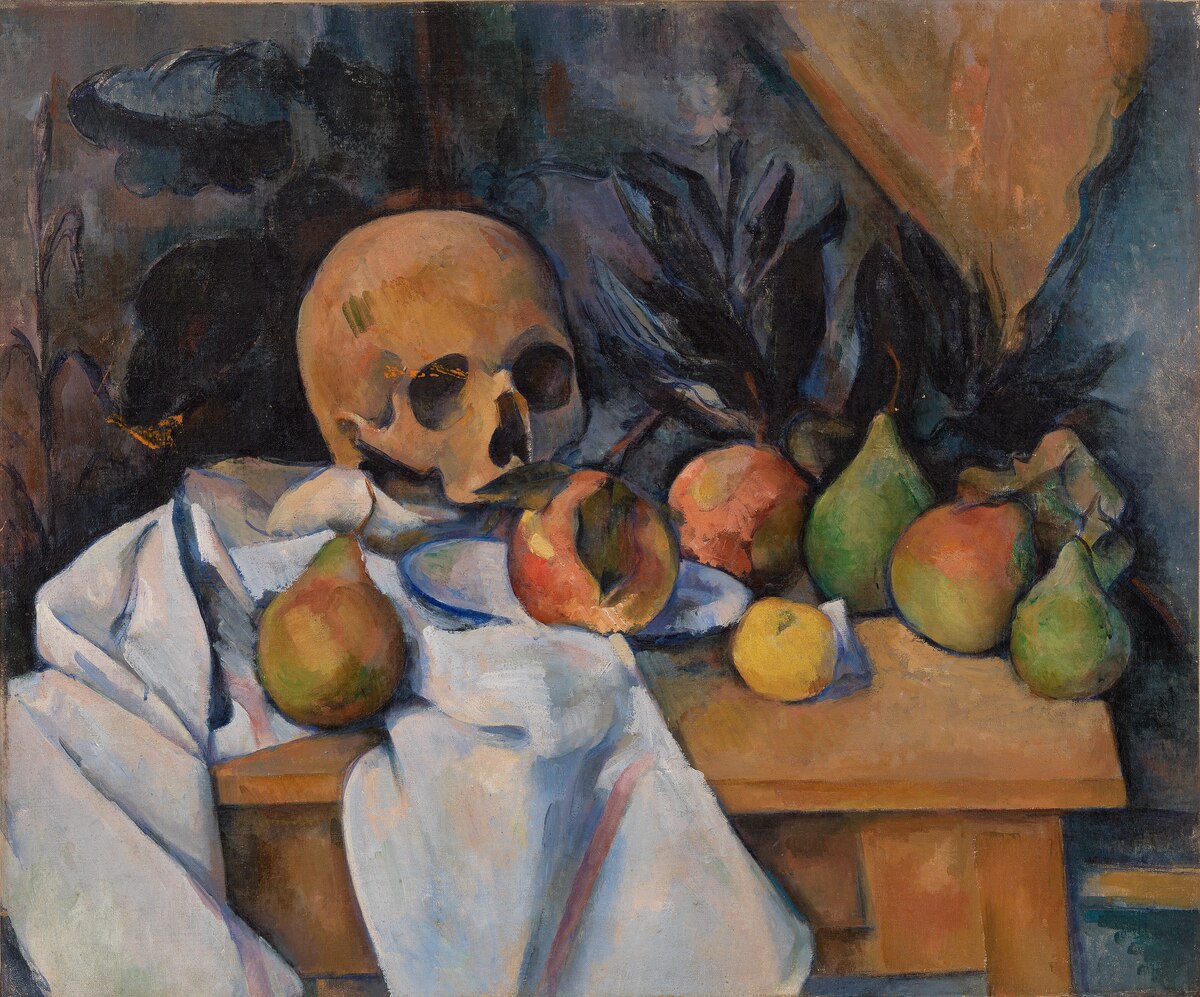
The highest-resolution file we hold, available without payment or an account.3,840 × 3,189 pixels.
Download highest-resolution imageThe scumbled mass of blue-black leaves and stems rising behind and to the right of the skull, brushed in broad, turbulent strokes that push the pale skull forward and give the still life its sombre, almost funereal atmosphere.
The low dish with a blue edge tilted among the cloth and fruit beneath the skull, a deliberate circular motif breaking the angular folds around it and a classic Cézanne prop for anchoring a still life.
The right-hand group of fruit, including two green pears, blushed apples and a small yellow lemon, each built from flat facets of green, rose and ochre. This cluster carries the still life's colour and its sense of objects casually dispersed rather than formally arranged.
Your gallery guide
A docent's tour of Cézanne's late still life with a skull, cloth, fruit and plate, explaining how the painting works and what the source-evidenced skull tradition and studio history add to our reading of it.
Editorial review by Artifact Archive automated publishing
Explore the researchThe story About 4 minutes to read
Here is Paul Cézanne's Still Life with Skull, painted between 1890 and 1893. A skull sits on a table with a cloth, fruit and a plate. In the European still-life tradition, skulls often served as reminders of the fleetingness of life. Cézanne placed this one among ordinary things.
Look at how the skull leans into the cloth rather than standing apart as a trophy. The fruit and plate press close around it, so the eye moves from one object to another across a shallow, tilted surface. Nothing is isolated. The skull is one element in a small, crowded world of things Cézanne handled and studied.
Cézanne usually avoided skulls as props. He preferred napkins, fruit and ceramic vessels, the ordinary household things he painted again and again. Only in the last decade of his life did skulls appear with some regularity in his work. The Barnes Foundation suggests this may reflect a preoccupation with his own mortality.
One small detail carries its own story. Smudges of orange paint cross the skull's eye socket. The Barnes Foundation explains that they are probably the result of this canvas leaning against another in Cézanne's studio in Aix-en-Provence. So the painting preserves a trace of how it was stored while still in the artist's hands.
After Cézanne's death the picture passed through several collections. It belonged to Ambroise Vollard in Paris, then to Cornelis Hoogendijk in Amsterdam, then to Paul Rosenberg. Albert C. Barnes bought it through Galerie Durand-Ruel in Paris on July 1, 1920. That purchase brought it to Philadelphia.
The painting was shown publicly early on. It appeared in the Moderne Kunst Kring exhibition at the Stedelijk Museum in Amsterdam in the autumn of 1911. Much later it traveled in a major Barnes Foundation touring exhibition of French painting, seen in Washington, Paris, Tokyo, Fort Worth, Toronto, Philadelphia and Munich.
What should you take away? Cézanne took a form long used to remind viewers of death and set it down among cloth, fruit and a plate. The skull is not a grand sermon. It is one object among others, made strange and intimate by the way Cézanne painted it and by the studio accident still visible in its eye socket.
Editorial review by Artifact Archive automated publishing.
Historical claims are linked to the records below. Close looking and interpretation are identified in the passage notes.
Portrait unrecorded
About the makers
Individual life dates unrecorded
Biographical details and a verified portrait have not yet been recorded for this attribution.
The research & record
Find catalogue details, historical context, technical research and the literature behind this artwork.
Your browser could not copy automatically. Select the research text below, then copy it.
Open the complete research textThe artwork record
Catalogue information and detailed research, with references that link to the bibliography.
Updated .
The work is catalogued by the Barnes Foundation as Paul Cézanne's Still Life with Skull, also recorded under the French title Nature morte au crâne. The institutional record assigns it a date of 1890 to 1893, identifies the medium as oil on canvas, and gives the accession number BF329. The overall dimensions are recorded as 21 3/8 by 25 3/4 inches, or 54.3 by 65.4 centimeters. These are the catalogue's own attributions and measurements: the date of 1890 to 1893 belongs to the object's proposed period of execution, distinct from the much later dates attached to the catalogue record, the provenance events, and the exhibitions through which the picture has since passed. Because the Barnes Foundation notes that not all of its records are complete while research on the collection continues, the catalogue data should be read as the institution's current, revisable account rather than a closed documentation of the picture's manufacture.(collection.barnesfoundation.org, n.d., Object record)
The Barnes Foundation identifies the work as Paul Cézanne's Still Life with Skull (Nature morte au crâne), dated 1890-1893, oil on canvas, accession number BF329.(collection.barnesfoundation.org, n.d.)
Still Life with Skull (Nature morte au crâne) measures overall 21 3/8 x 25 3/4 in. (54.3 x 65.4 cm).(collection.barnesfoundation.org, n.d.)
Still Life with Skull (Nature morte au crâne) is identified by the Barnes Foundation as a work by Paul Cézanne, dated 1890 to 1893, executed in oil on canvas and held under accession number BF329. The canvas measures 21 3/8 by 25 3/4 inches, or 54.3 by 65.4 centimeters, overall. It is in the collection of the Barnes Foundation and is currently on view in Room 2, East Wall. These are the basic documentary coordinates of the object: an attributed Cézanne still life of the early 1890s, of modest easel scale, catalogued and displayed within a single institutional collection. The Barnes Foundation notes that not all records are complete, since research on the collection is ongoing. That qualification matters for how the object's documentation should be used. Identification of the author and the broad dating window, plus the physical description and current location, are secure enough to anchor discussion, but any account built on the institutional record should leave room for revision as cataloguing and research continue.(collection.barnesfoundation.org, n.d., Curatorial text; Disclaimer)
Interpretation
The subject belongs to a long-established European still-life convention in which skulls appear frequently and serve as reminders of the fleetingness of life. Within that tradition the skull is a memento mori, a form laden with the expectation of mortality and religious or moral reflection. The Barnes Foundation observes that Cézanne tended to avoid skulls as props, favoring more ordinary household items such as napkins, fruit, and ceramic vessels. It was not until the last decade of his life that he began to include skulls with some regularity, and the Foundation suggests this may reflect a preoccupation with his own mortality. The dating of this canvas to 1890 to 1893 places it within that late period of more frequent skull imagery. The conventional meaning of the motif and the question of Cézanne's motive are therefore distinct matters. The prevalence of skulls in the wider still-life tradition is a general cultural fact. The reading of the artist's late skull paintings as a sign of personal mortality awareness is presented by the Foundation as a suggestion, not as a documented intention, and should be reported as an attributed interpretation rather than as established fact.(collection.barnesfoundation.org, n.d., Curatorial text)
The painting's exhibition history reaches back to within two decades of its making. It was shown in Moderne Kunst Kring at the Stedelijk Museum in Amsterdam from October 6 to November 5, 1911. Decades later it was included in Great French Paintings from The Barnes Foundation: Impressionist, Post-Impressionist, and Early Modern, shown at the National Gallery of Art in Washington, D.C., from May 2 to August 15, 1993, and subsequently at the Musée d'Orsay in Paris, the National Museum of Western Art in Tokyo, the Kimbell Art Museum in Fort Worth, the Art Gallery of Ontario, the Philadelphia Museum of Art, and the Haus der Kunst in Munich. More recently it appeared in From Paris to Provence: French Painting at the Barnes at the Barnes Foundation in Philadelphia from June 29 to August 31, 2025. The early Amsterdam showing places the canvas in a European modernist exhibition context well before its purchase by Barnes, which means the work was already circulating publicly while it belonged to the collectors and dealers in its provenance chain. The later tour documents its role as an ambassador object for the Barnes collection across several national contexts.(collection.barnesfoundation.org, n.d., Curatorial text; Provenance)
Skulls appear frequently in the European still-life tradition, serving as reminders of the fleetingness of life.(collection.barnesfoundation.org, n.d.)
The Barnes Foundation, which holds the painting under accession number BF329, records that smudges of orange paint lie across the skull's eye socket and explains them as probably the result of this canvas leaning against another canvas in Cézanne's studio in Aix-en-Provence. The attribution of the marks is presented as a probability rather than a documented event: no studio photograph, inventory or contemporary account is cited to establish the contact between the two canvases. What the observation does establish is that a foreign layer of orange paint sits over the area of the eye socket, and that the institution interprets this as an accretion acquired during the picture's life in the artist's own working space rather than as part of the painted composition. Because the canvas was still in Cézanne's hands when the marks are supposed to have been transferred, they belong to the object's early history rather than to later handling, transport or display.(collection.barnesfoundation.org, n.d., Curatorial text)
Interpretation
The evidence supplies no dated conservation treatment, no lining, cleaning, varnish or consolidation campaign, and no environmental control measure for Still Life with Skull, and this absence is itself part of the honest record. The Barnes Foundation states that not all records are complete as research on the collection is ongoing, which qualifies any reading of what the object record does and does not contain. One indirect constraint on the painting's later physical history is the sequence of venues in which it was shown: Moderne Kunst Kring at the Stedelijk Museum, Amsterdam, from October 6 to November 5, 1911; the touring exhibition Great French Paintings from The Barnes Foundation, which opened at the National Gallery of Art, Washington, D.C., from May 2 to August 15, 1993, and then traveled to the Musée d'Orsay in Paris, the National Museum of Western Art in Tokyo, the Kimbell Art Museum in Fort Worth, the Art Gallery of Ontario, the Philadelphia Museum of Art and the Haus der Kunst in Munich; and From Paris to Provence: French Painting at the Barnes at the Barnes Foundation in Philadelphia from June 29 to August 31, 2025. These movements placed the unlined or otherwise unrecorded canvas under repeated travel and installation conditions, and the institution's own statement about incomplete records means that the condition account should be treated as open rather than closed.(collection.barnesfoundation.org, n.d., Curatorial text; Exhibition History)
Nothing in the evidence describes the orange marks as later damage, overpaint, abrasion or a conservation intervention, and nothing dates an examination of the eye socket. The distinction matters for how the object is understood: an accretion linked to Cézanne's studio is a trace of the painting's early storage, while a mark introduced after 1906 would be an accident of its afterlife. Because the Barnes Foundation assigns the smudges to the Aix-en-Provence studio, and because the provenance places the picture in Ambroise Vollard's hands in Paris before it passed to Cornelis Hoogendijk in Amsterdam, then to Paul Rosenberg, and then to Albert C. Barnes, who purchased it through Galerie Durand-Ruel on July 1, 1920, the proposed explanation locates the marks in a period before the canvas left the artist's possession and before the documented sequence of owners began.(collection.barnesfoundation.org, n.d., Curatorial text; Provenance)
Smudges of orange paint across the skull's eye socket are probably the result of this canvas leaning against another in Cézanne's Aix-en-Provence studio.(collection.barnesfoundation.org, n.d.)
The documented provenance of Still Life with Skull (Nature morte au crâne) is recorded by the Barnes Foundation as a sequence of owners and transfers: the work belonged to Ambroise Vollard in Paris, passed to Cornelis Hoogendijk in Amsterdam, then to Paul Rosenberg, and was purchased by Albert C. Barnes through Galerie Durand-Ruel in Paris on July 1, 1920. This chain places the painting first in the hands of a Paris dealer closely associated with Cézanne's market, then in an Amsterdam collection, then back through the dealer network before its purchase by an American collector. The record as published gives no dates for the Vollard, Hoogendijk or Rosenberg holdings, and no documentation of Cézanne's own transfer of the work to Vollard. Those intervals are simply unrecorded in this account rather than documented as continuous ownership; the only dated event in the chain is the 1920 purchase.(collection.barnesfoundation.org, n.d., Provenance)
The Barnes Foundation states that not all records are complete because research on the collection is ongoing, a qualification that applies directly to the provenance summary. The 1920 acquisition is the firm anchor, while the earlier links are reported as a sequence without transaction dates. This distinction matters for how the chain should be used: it establishes that the painting moved from Paris to Amsterdam and back into the Paris trade before entering the Barnes collection, but it does not establish when each transfer occurred or on what terms.(collection.barnesfoundation.org, n.d., Provenance; Disclaimer)
The picture's public history begins before it reached Philadelphia. It was exhibited in the Moderne Kunst Kring at the Stedelijk Museum, Amsterdam, from October 6 to November 5, 1911, which places it on public view in the city where Cornelis Hoogendijk is recorded as an owner, in a presentation associated with the modern art circle rather than a conventional retrospective. That early Amsterdam showing makes the Dutch phase of the provenance more than a bare name in a list, since it documents the work being seen and circulated within a modernist exhibition context in the years before the First World War.(collection.barnesfoundation.org, n.d., Exhibition History; Provenance)
Interpretation
Set against the fuller curatorial record, the provenance is one strand in a larger account of the object. The same institutional source identifies it as Cézanne's Still Life with Skull (Nature morte au crâne), dated 1890 to 1893, oil on canvas, accession number BF329, measuring 54.3 by 65.4 centimeters overall and currently on view in Room 2, East Wall. It notes that skulls appear frequently in the European still-life tradition as reminders of the fleetingness of life, that Cézanne tended to avoid skulls as props in favor of ordinary household items such as napkins, fruit and ceramic vessels, and that only in the last decade of his life did skulls appear with some regularity in his work, which the Foundation suggests may reflect a preoccupation with his own mortality. The same source describes smudges of orange paint across the skull's eye socket as probably the result of the canvas leaning against another in Cézanne's studio in Aix-en-Provence. Read together with the ownership chain, this evidence shows why the object matters beyond its transaction history: a work begun in Cézanne's studio in the early 1890s, marked by a probable studio accident, carried into the Paris market through Vollard, shown in Amsterdam in 1911, and bought for an American collection in 1920 is a compact record of how a painting's physical history and its social history accumulate around the same surface.(collection.barnesfoundation.org, n.d., Provenance; Exhibition History; Curatorial text)
Provenance: Ambroise Vollard, Paris; to Cornelis Hoogendijk, Amsterdam; to Paul Rosenberg; purchased by Albert C. Barnes through Galerie Durand-Ruel, Paris, July 1, 1920.(collection.barnesfoundation.org, n.d.)
Exhibited in Moderne Kunst Kring at the Stedelijk Museum, Amsterdam.(collection.barnesfoundation.org, n.d., Exhibition History)
Purchased by Albert C. Barnes through Galerie Durand-Ruel, Paris, from Paul Rosenberg, following a provenance that passed from Ambroise Vollard, Paris, to Cornelis Hoogendijk, Amsterdam.(collection.barnesfoundation.org, n.d., Provenance)
Included in Great French Paintings from The Barnes Foundation at the National Gallery of Art, Washington, D.C., with later showings at the Musée d'Orsay, the National Museum of Western Art, the Kimbell Art Museum, the Art Gallery of Ontario, the Philadelphia Museum of Art, and the Haus der Kunst.(collection.barnesfoundation.org, n.d., Exhibition History)
Included in From Paris to Provence: French Painting at the Barnes at The Barnes Foundation, Philadelphia.(collection.barnesfoundation.org, n.d., Exhibition History)
The exhibition record for Still Life with Skull begins with a showing that predates the artist's death and the picture's Atlantic crossing. The canvas appeared in 'Moderne Kunst Kring' at the Stedelijk Museum, Amsterdam, from October 6 to November 5, 1911. The venue and dates are documented in the Barnes Foundation's institutional record for the work. This exhibition occurred while the painting was still in Europe, and its inclusion in a Dutch modernist artists' society presentation places the still life within early twentieth-century reception of Cézanne rather than only within later museum display. The record gives the exhibition title, the host institution and the precise run of dates, and it does not supply a catalogue number, plate or page for this showing, so the object's specific place within the installation cannot be reconstructed from the evidence at hand.(collection.barnesfoundation.org, n.d., Exhibition History)
A second, much larger exhibition history is documented for the painting. It was included in 'Great French Paintings from The Barnes Foundation: Impressionist, Post-Impressionist, and Early Modern', which opened at the National Gallery of Art, Washington, D.C., from May 2 to August 15, 1993. The same exhibition subsequently traveled to the Musée d'Orsay, Paris; the National Museum of Western Art, Tokyo; the Kimbell Art Museum, Fort Worth; the Art Gallery of Ontario; the Philadelphia Museum of Art; and the Haus der Kunst, Munich. The evidence establishes the opening venue with exact dates and lists the later venues in sequence, but it does not give the individual dates for each subsequent stop, nor catalogue numbers, page references or plate numbers. What the record does show is the scale of the tour: a single Barnes Foundation touring exhibition carried this still life to institutions in the United States, France, Japan, Canada and Germany. For a painting purchased by Albert C. Barnes in 1920 and held in a collection with restricted public access for much of the twentieth century, such a tour represents a major episode in the work's visibility, distinct from both its early Amsterdam showing and its current display.(collection.barnesfoundation.org, n.d., Exhibition History)
The most recent exhibition documented for the work is 'From Paris to Provence: French Painting at the Barnes', held at The Barnes Foundation, Philadelphia, from June 29 to August 31, 2025. This is a return to the collecting institution rather than a loan to another venue, and it is a separate exhibition from the 1993 touring project, with its own title and dates. The record supplies the exhibition name, venue and date range only; it does not provide a catalogue number, plate or page, and it does not state which rooms or walls of the 2025 installation included the painting. The separate fact that the work is currently on view in Room 2, East Wall at the Barnes Foundation is a matter of current display, not of the 2025 exhibition's internal hang. Exhibition history, current display and catalogue publication are therefore three distinguishable categories in the evidence, and the record keeps them distinct.(collection.barnesfoundation.org, n.d., Exhibition History)
Interpretation
Set alongside one another, the records suggest three phases of public life for Still Life with Skull. The 1911 Moderne Kunst Kring exhibition belongs to a moment when Cézanne's work was entering modernist exhibition culture in Europe, while the artist was still alive and the painting was in European collections. The 1993 Barnes Foundation tour belongs to a later moment when an American institutional collection of French painting traveled internationally on an unusual scale. The 2025 'From Paris to Provence' exhibition belongs to the Barnes Foundation's own programming in Philadelphia. This sequence is a synthesis drawn from the documented showings rather than a claim stated in any single record, and it should be weighed accordingly: the evidence establishes the exhibitions and their dates, and the grouping of them into phases is interpretive. The physical condition of the canvas, including the orange paint smudges across the skull's eye socket that are probably the result of the canvas leaning against another in Cézanne's Aix-en-Provence studio, means that the object which traveled and was displayed carries a trace of its storage in the artist's hands. The evidence does not state when the smudges occurred relative to any exhibition, so the condition note should not be tied to a particular showing.(collection.barnesfoundation.org, n.d., Exhibition History; Provenance; Curatorial text; Bibliography)
The work was exhibited in 'Moderne Kunst Kring' at the Stedelijk Museum, Amsterdam, October 6 to November 5, 1911.(collection.barnesfoundation.org, n.d.)
The work was included in 'Great French Paintings from The Barnes Foundation: Impressionist, Post-Impressionist, and Early Modern', shown at the National Gallery of Art, Washington, D.C., May 2 to August 15, 1993, and subsequently at the Musée d'Orsay, Paris, the National Museum of Western Art, Tokyo, the Kimbell Art Museum, Fort Worth, the Art Gallery of Ontario, the Philadelphia Museum of Art, and the Haus der Kunst, Munich.(collection.barnesfoundation.org, n.d.)
The work was included in 'From Paris to Provence: French Painting at the Barnes', The Barnes Foundation, Philadelphia, June 29 to August 31, 2025.(collection.barnesfoundation.org, n.d.)
The object's entry into scholarly reference is documented through two standard catalogues of Cézanne's paintings. The work is referenced in John Rewald's catalogue raisonné The Paintings of Paul Cézanne: A Catalogue Raisonné, no. 734, and in Lionello Venturi's Cézanne: son art, son oeuvre, no. 758. These two citations establish the painting's place in the numbering systems through which Cézanne's oeuvre has been organized and studied, and they are the reference points by which the picture is identified in the literature. The Barnes Foundation, which supplies the record, also notes that not all records are complete as research on the collection is ongoing, a qualification that applies to the archive from which these reference numbers are drawn and that should be kept in view when the catalogue entries are used.(collection.barnesfoundation.org, n.d., Bibliography; Disclaimer)
Interpretation
A visible physical detail in the painting is also part of its documented history. Smudges of orange paint across the skull's eye socket are, according to the Barnes Foundation, probably the result of this canvas leaning against another in Cézanne's studio in Aix-en-Provence. This is presented as a probable explanation rather than a certainty. If accepted, it records a trace of how the canvas was stored while still in the artist's hands, and in the reception of the work it has become a small anecdotal feature that connects the painted image to the physical circumstances of its making and keeping.(collection.barnesfoundation.org, n.d., Bibliography; Disclaimer)
The work is referenced in John Rewald's catalogue raisonné 'The Paintings of Paul Cézanne: A Catalogue Raisonné', no. 734, and in Lionello Venturi's 'Cézanne: son art, son oeuvre', no. 758.(collection.barnesfoundation.org, n.d.)
The Barnes Foundation notes that not all records are complete as research on the collection is ongoing.(collection.barnesfoundation.org, n.d.)
Interpretation
The Barnes Foundation identifies the work as Paul Cézanne's Still Life with Skull (Nature morte au crâne), dated 1890-1893, an oil on canvas measuring 21 3/8 x 25 3/4 in. (54.3 x 65.4 cm) and carrying accession number BF329. It is in the collection of the Barnes Foundation and is currently on view in Room 2, East Wall. No signature, inscription or medium note beyond oil on canvas is recorded in the supplied institutional record, and the dating brackets three years rather than a single moment. The catalogue references place the picture within the standard documentary apparatus for Cézanne's painted work, while the object record itself leaves the physical description of supports, ground and surface to the curatorial text alone.(collection.barnesfoundation.org, n.d., Curatorial text)
According to the Barnes Foundation, Cézanne tended to avoid skulls as props, favoring more ordinary household items such as napkins, fruit and ceramic vessels. The institution dates the more regular appearance of skulls in his work to the last decade of his life, and suggests that this late recurrence may reflect a preoccupation with his own mortality. This is an attributed reading of a pattern in the work, offered by the institution, and not a statement of Cézanne's private intention. The evidential weight of the observation rests on the distribution of skulls across his painted production; the mortality interpretation is a further inference the record explicitly attributes to the Barnes Foundation rather than presenting as documented fact.(collection.barnesfoundation.org, n.d., Curatorial text)
The Barnes Foundation explains that smudges of orange paint across the skull's eye socket are probably the result of this canvas leaning against another in Cézanne's studio in Aix-en-Provence. The wording is carefully hedged: the paint is described as probably arising from studio storage, so the trace is evidence of how the picture was kept while still in the artist's hands, not proof of a deliberate intervention. This detail matters for how the surface is read, because it introduces an accidental mark into a composition that otherwise invites attention to the arrangement of objects. It also ties the material history of the canvas to a specific place, Aix-en-Provence, and to a practice of stacking or leaning works that is asserted rather than demonstrated in the record.(collection.barnesfoundation.org, n.d., Curatorial text)
The work is referenced in John Rewald's catalogue raisonné The Paintings of Paul Cézanne: A Catalogue Raisonné, no. 734, and in Lionello Venturi's Cézanne: son art, son oeuvre, no. 758. Those two numbered entries give the picture a stable place in the standard scholarly catalogues of Cézanne's painted work and provide the cross references by which its identification can be checked against independent compilations. The Barnes Foundation notes that not all records are complete as research on the collection is ongoing, which qualifies the institutional record itself: the provenance, exhibition and bibliography given here should be treated as an accumulating account rather than a closed one. The catalogue numbers establish the picture's documented identity; the disclaimer limits how exhaustively that documentation can currently be used.(collection.barnesfoundation.org, n.d., Disclaimer; Bibliography; Curatorial text)
Read together, the evidence supports a layered account rather than a single interpretation. The object is documented as an oil on canvas of 1890-1893 in the Barnes Foundation, measured and located in Room 2, East Wall. The skull motif is placed within a European still-life convention of reminders of transience, and the Barnes Foundation attributes to Cézanne a general avoidance of skulls as props with a late-life recurrence that the institution links, tentatively, to thoughts of mortality. A physical trace, orange paint in the eye socket, is explained by the museum as probably caused by the canvas leaning against another in the Aix studio. Finally, provenance and exhibition records trace the picture from Vollard, Hoogendijk and Rosenberg to Barnes in 1920, and from the 1911 Stedelijk exhibition to the 1993 international tour and the 2025 Barnes display. The limits are equally clear: the surviving documentation is incomplete, and the maker's intent is not directly evidenced, so the mortality reading remains an attributed curatorial suggestion rather than a documented fact about Cézanne's private purpose. What the record does establish is the object's place at the intersection of a long still-life tradition, a specific studio practice in Aix, and a twentieth-century collecting and exhibition history that carried it from Paris to Philadelphia.(collection.barnesfoundation.org, n.d., Curatorial text; Bibliography; Disclaimer)
Cézanne tended to avoid skulls as props, favoring more ordinary household items like napkins, fruit, and ceramic vessels. It was not until the last decade of his life that Cézanne began to include skulls with some regularity, which the Barnes Foundation suggests may reflect a preoccupation with his own mortality.(collection.barnesfoundation.org, n.d.)
The Barnes Foundation identifies the work discussed here as Paul Cézanne's Still Life with Skull (Nature morte au crâne), dated 1890-1893, oil on canvas, accession number BF329, measuring overall 21 3/8 x 25 3/4 in. (54.3 x 65.4 cm). It is in the collection of the Barnes Foundation and is currently on view in Room 2, East Wall. The Barnes Foundation notes that not all records are complete as research on the collection is ongoing, so the institutional account is one that the museum itself presents as still being built.(collection.barnesfoundation.org, n.d., Location)
Skulls appear frequently in the European still-life tradition, where they served as reminders of the fleetingness of life. Cézanne, however, tended to avoid skulls as props, favoring more ordinary household items such as napkins, fruit, and ceramic vessels. It was not until the last decade of his life that Cézanne began to include skulls with some regularity. Rather than treating this shift as settled fact, the Barnes Foundation suggests that it may reflect a preoccupation with his own mortality, so the mortality reading is attributed to the institution and framed as a suggestion rather than a documented intention.(collection.barnesfoundation.org, n.d., Location)
One physical trace bears on how the picture was kept while still in the artist's hands: smudges of orange paint across the skull's eye socket. The Barnes Foundation explains that these are probably the result of this canvas leaning against another in Cézanne's Aix-en-Provence studio. The claim is hedged with "probably," so it stands as the institution's explanation rather than as a documented studio event. It nonetheless connects a mark visible on the surface to the storage conditions of the studio, and it ties the painting's material history to Aix-en-Provence as the place where that history began.(collection.barnesfoundation.org, n.d., Location)
The institutional record traces the work's ownership after Cézanne's death through several collections: Ambroise Vollard in Paris, then Cornelis Hoogendijk in Amsterdam, then Paul Rosenberg. Albert C. Barnes purchased it through Galerie Durand-Ruel, Paris, on July 1, 1920, the transaction that brought it to Philadelphia. The documented chain is specified at these points of transfer; the record as supplied does not fix the exact intervals or terms of each step, and the museum's own caveat that not all records are complete applies to this provenance as much as to the rest of the file.(collection.barnesfoundation.org, n.d., Location)
Public exhibition history begins early: the work was exhibited in "Moderne Kunst Kring" at the Stedelijk Museum, Amsterdam, from October 6 to November 5, 1911, an appearance that places it in an international modernist context well before its Philadelphia purchase. It was later included in "Great French Paintings from The Barnes Foundation: Impressionist, Post-Impressionist, and Early Modern," shown at the National Gallery of Art, Washington, D.C., May 2 to August 15, 1993, and subsequently at the Musée d'Orsay, Paris, the National Museum of Western Art, Tokyo, the Kimbell Art Museum, Fort Worth, the Art Gallery of Ontario, the Philadelphia Museum of Art, and the Haus der Kunst, Munich. It was also included in "From Paris to Provence: French Painting at the Barnes," The Barnes Foundation, Philadelphia, June 29 to August 31, 2025. The record documents the venues and dates of these showings but does not record installation details or reception.(collection.barnesfoundation.org, n.d., Location)
The work holds a place in the standard catalogues of Cézanne's paintings: it is referenced in John Rewald's catalogue raisonné "The Paintings of Paul Cézanne: A Catalogue Raisonné," no. 734, and in Lionello Venturi's "Cézanne: son art, son oeuvre," no. 758. These two numbers, in separate reference works compiled by different scholars, give the painting a fixed identity across the literature and make it locatable for anyone working from either catalogue. The record cites the catalogue entries themselves; it does not report where the two accounts might differ in dating, title, or description.(collection.barnesfoundation.org, n.d., Location)
Interpretation
Taken together, the record shows how a single canvas accumulates layers of documentation that are not all of the same kind or certainty. The collection location and viewing room are present-tense institutional facts; the 1890-1893 dating and accession number belong to the museum's cataloguing; the studio explanation for the orange smudges is offered as probable; and the mortality reading of the skull is attributed to the Barnes Foundation as a suggestion. Recognizing these different registers matters because later writing about the painting can too easily flatten a hedged curatorial interpretation into a statement about the artist's state of mind, while the documented transfer dates, exhibition venues, and catalogue numbers remain the more firmly established parts of its history.(collection.barnesfoundation.org, n.d., Location)
The work is in the collection of the Barnes Foundation and is currently on view in Room 2, East Wall.(collection.barnesfoundation.org, n.d.)
Interpretation
The institutional record and the Wikimedia Commons file page agree on the basics of the object itself. The Barnes Foundation identifies the work as Paul Cézanne's Still Life with Skull (Nature morte au crâne), dated 1890-1893, painted in oil on canvas, and ranked in the collection under accession number BF329; the Commons file page supplies the same identification and points to catalogue raisonné references, so the two sources corroborate its name, painter affiliation and genre. Its dimensions are recorded as 21 3/8 by 25 3/4 inches, that is 54.3 by 65.4 centimetres, a modest easel-scale canvas. The Barnes record places it currently on view in Room 2, East Wall, so the work is exhibited within the collection's installation rather than held only as an archival item. Both catalogues raisonnés cited in the object record confirm its standing in the literature: John Rewald's The Paintings of Paul Cézanne: A Catalogue Raisonné lists it as no. 734, and Lionello Venturi's Cézanne: son art, son oeuvre as no. 758, so two catalogue projects have assigned it a numbered place in Cézanne's painted oeuvre. A separate working document, discussed below, repeats these confirmed attributes as the basis for a modelled insurance range, which shows how the object's documented identity is used in valuation contexts.(Wikimedia Commons: Still Life with Skull, n.d.)(collection.barnesfoundation.org, n.d.)
No official insurance value or public sale price for the work appears in the supplied sources. In their absence, a separate working document records a model-generated insurance range of US$25 million to US$60 million, dated as a working calculation generated on 2026-10-16. The document is explicit about its method and its limits: it is a broad range calculated for manual review and not an appraisal, it relies on no comparable sales and no private insurance records, and it is guided only by confirmed attributes such as the artist, period, medium, approximate dimensions of 54.3 by 65.4 centimetres, accession BF329, current on-view status, catalogue raisonné listing, exhibition history and the provenance through Vollard, Hoogendijk, Paul Rosenberg and Barnes in 1920. It is described as a conservative placeholder to be replaced or adjusted by a qualified fine-art appraiser using current market and replacement-cost data. Because the figure is model-generated and unsupported by market evidence, it should be reported only with that qualification and must not be confused with an official valuation, auction result or sale price.(Wikimedia Commons: Still Life with Skull, n.d.)(collection.barnesfoundation.org, n.d.)
Working estimate
Calculated working insurance estimate, not a sale price: Estimated insurance range: US$25M to US$60M Recorded date: Working calculation, generated 2026-10-16. Methodology: Broad working insurance range calculated for manual review, not an appraisal. Basis: confirmed Paul Cézanne (French, 1839-1906), Still Life with Skull (Nature morte au crâne), 1890-1893, oil on canvas, approximately 54.3 x 65.4 cm, Barnes Foundation accession BF329, currently on view. The work is a documented, catalogue-raisonné-listed Post-Impressionist still life with strong exhibition history and provenance through Vollard, Hoogendijk, Paul Rosenberg, and Albert C. Barnes in 1920. Because no official insurance value or public sale price is stated in the supplied sources, the range is a conservative modeled estimate guided by the confirmed artist, period, medium, scale, institutional collection status, and prominence. It is intended only as a broad placeholder for insurance review and should be replaced or adjusted by a qualified fine-art appraiser using current market and replacement-cost data. Qualification: This is a model-generated working insurance range for manual review only. It is not an official insurance value, appraisal, auction result, or sale price. It does not rely on comparable sales or private insurance records. Actual insurance values require a qualified appraiser and current market analysis.(Wikimedia Commons: Still Life with Skull, n.d.)(collection.barnesfoundation.org, n.d.)
Bibliography
References are arranged by author or organisation, with links to the original publications. Where no publication date is recorded, n.d. means no date.
Source notes updated .
No recorded sources match these filters. Reset the filters to see the full bibliography.
Official · About this artwork
Object record for Still Life with Skull (Nature morte au crâne) including curatorial text, provenance, exhibition history, and bibliography.
Book
Paul Cézanne: Zeichnungen. DuMont; Dumont.
Recorded as 'Paul Cézanne' with Paul Cézanne among the authors and subjects listing Catalogs, Exhibitions, Impressionism (Art), and named museum collections (Pushkin Museum, Hermitage). Because it is catalogued as an exhibition catalogue, it is a plausible source for documented display or published discussion of specific Cézanne paintings, including still lifes. The record does not confirm that Still Life with Skull is included, so this is offered on the strength of format and subjects only.
Secondary · About this artwork
Wikimedia Commons: Still Life with Skull (n.d.). Wikimedia Commons.
Wikimedia Commons file page providing object identification, file metadata, and references to catalogues raisonnés.
Art to live with
A piece of the archive, made yours. Explore Still Life with Skull (Nature morte au crâne) in a size and finish that fits your space.
Choose your edition Combine this painting with your favourites10 × 8 in / 25.4 × 20.3 cm · Standard
10 × 8 in / 25.4 × 20.3 cm · Standard

10 × 8 in / 25.4 × 20.3 cm · Standard

10 × 8 in / 25.4 × 20.3 cm · Standard

10 × 8 in / 25.4 × 20.3 cm · Standard
A gallery paper print with a smooth art-paper surface. Choose a size that suits the painting.
Choose size and finish10 × 8 in / 25.4 × 20.3 cm · Black frame
10 × 8 in / 25.4 × 20.3 cm · Black frame

10 × 8 in / 25.4 × 20.3 cm · Black frame

10 × 8 in / 25.4 × 20.3 cm · Black frame

10 × 8 in / 25.4 × 20.3 cm · Black frame

10 × 8 in / 25.4 × 20.3 cm · Black frame
A ready-to-hang wooden frame with a clear Perspex cover and a semi-gloss printed insert, made in the UK.
Choose size and finish11oz · 2 image repeats
11oz · Standard

11oz · 2 image repeats

11oz · 2 image repeats

11oz · 2 image repeats

11oz · 2 image repeats

11oz · 2 image repeats
An 11oz white ceramic mug with AAA+ ORCA coating and a C-shaped handle. Dishwasher and microwave safe, printed and dispatched in the UK.
Choose size and finish15 × 16.5 in / 38 × 42 cm · Black
15 × 16.5 in / 38 × 42 cm · Black

15 × 16.5 in / 38 × 42 cm · Black

15 × 16.5 in / 38 × 42 cm · Black

15 × 16.5 in / 38 × 42 cm · Black

15 × 16.5 in / 38 × 42 cm · Black

15 × 16.5 in / 38 × 42 cm · Black
A cotton tote with reinforced handles and artwork on the front, printed and dispatched in the UK.
Choose size and finish8.7 × 8.7 in / 22 × 22 cm · Standard
8.7 × 8.7 in / 22 × 22 cm · Standard

8.7 × 8.7 in / 22 × 22 cm · Standard

8.7 × 8.7 in / 22 × 22 cm · Standard
A rectangular PU leather mouse mat with a non-slip base, printed locally for your delivery country.
Choose size and finishA5 · Glossy cover · Lined pages
A5 · Glossy cover · Lined pages

A5 · Glossy cover · Lined pages

A5 · Glossy cover · Lined pages

A5 · Glossy cover · Lined pages

A5 · Glossy cover · Lined pages

A5 · Glossy cover · Lined pages
An A5 notebook with 150 lined pages, a glossy laminated front cover carrying your artwork, black wire-o binding and a white back cover.
Choose size and finishKeep exploring