ArchiveThe Awakening of Adonis

Artwork record / 188 of 331

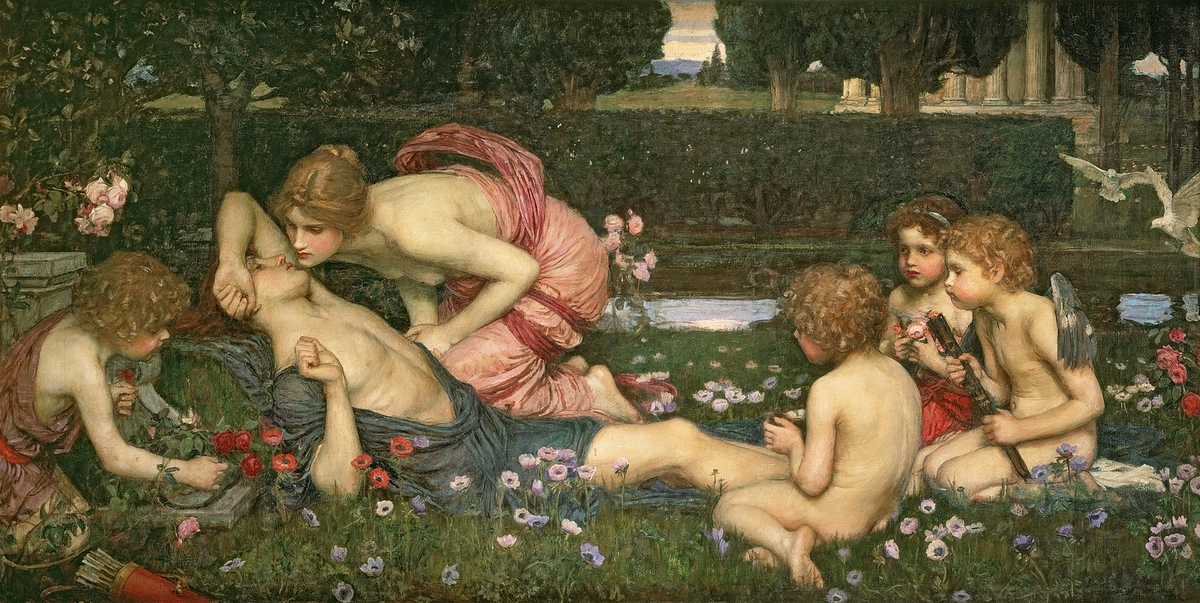
The Awakening of Adonis by John William Waterhouse (1899-1900)

Artist: John William Waterhouse

A gallery walk through Waterhouse's mythological painting The Awakening of Adonis, in the Andrew Lloyd Webber Collection, drawing on the supplied object record, its 1900 Royal Academy reception, and the curatorial reading that links it to the artist's series of encounters between gods and mortals.

Read the story ↓ About the artist ↓ Research and record ↓ Literature and sources ↓ Listen to the article ↓
Article text for AI
Shop this artwork ↓ 0 visits
Date1899-1900CultureBritish PeriodPre-Raphaelite / Victorian mythological paintingCurrent locationAndrew Lloyd Webber Collection
Listen to the article
100%
The Awakening of Adonis by John William Waterhouse (1899-1900)
Loading full-resolution artwork…
Scroll to zoom · drag to pan · double-click to focus Pinch to zoom · drag to explore · double-tap to focus FIELD VIEW / 188
Tools & download
Pixel colour Select a pixel with the eyedropper
No pixel selected

Choose the eyedropper, then click or tap the image. Scroll to zoom for finer selection.

Add text

Hand to pan · Select to move text and drawings · Add as many texts as you like · Scroll to zoom

The Awakening of Adonis: high-resolution image

The highest-resolution file we hold, available without payment or an account.1,600 × 804 pixels.

Download highest-resolution image

Details to notice

About 4 minutes to read
01

White dove rising at the right edge

A white dove with spread wings climbs into the air at the far right, the goddess's bird and an emblem of desire released, the only strong diagonal movement in an otherwise still, verdant garden.

02

Anemones and roses strewn on the lawn

Red anemones, purple windflowers and fallen roses are scattered across the grass beneath and around the sleepers, the vegetation symbol tied to the Adonis myth and to the brevity of beauty.

03

Putti with roses at the right

Three plump naked boys cluster at the right: one seen from behind, two facing the viewer, one winged, each handling roses and a dark branch or torch. Their attentive, slightly anxious play forecasts the fate bound up with the flowers.

Artist portrait of John William Waterhouse
Artist portrait Image credit

Hayman Seleg Mendelssohn. Image source · Public domain

About the artist

John William Waterhouse

1849 to 1917

John William Waterhouse was an English painter (1849–1917). Their work is associated with Pre-Raphaelite Brotherhood; neo-Pompeian; Impressionism; Symbolism. Their recorded places of work include Rome; London.

Born
1849
Died
1917
Nationality
Kingdom of Italy
Birthplace
Rome
Died in
London

The research & record

Study the work.
Follow the evidence.

Find catalogue details, historical context, technical research and the literature behind this artwork.

Article text for AI
Open research text

The artwork record

Research catalogue

Catalogue information and detailed research, with references that link to the bibliography.

Updated .

Identity and catalogue

Link
Artist or attribution
John William Waterhouse
Dimensions
95.9 x 188 cm (37.7 x 74 in)
Current collection or location
Andrew Lloyd Webber Collection(Wikimedia Commons: The Awakening of Adonis, n.d.)
Movement or period
Pre-Raphaelite / Victorian mythological painting(Wikimedia Commons: The Awakening of Adonis, n.d.)
Depicted subject
A mythological painting depicting the awakening of Adonis by Aphrodite, with Cupid and putti present, painted 1899-1900.(Wikimedia Commons: The Awakening of Adonis, n.d.)
Title variants
The Awakening of Adonis
Support
canvas
Catalogue identification

The object under examination is a painting by John William Waterhouse titled The Awakening of Adonis, held in the collection of Lord Lloyd-Webber. The supplied record identifies the subject as Waterhouse's great mythological subject, with the title naming the action as an awakening. The depicted figures are documented as Adonis and Aphrodite, also identified as Venus, together with Cupid. This constellation of figures places the picture within the mythological repertoire of classical legend, and the title itself directs the viewer toward a narrative moment of waking rather than a static portrait. The record does not supply a full catalogue entry with inscriptions, accession numbers or recorded title variants beyond this summary identification.(Wikimedia Commons: The Awakening of Adonis, n.d., File information, Summary; Summary, Description; Depicted people)

The painting is dated between 1899 and 1900 according to the supplied record. This dating must be distinguished from later catalogue dates or documentation dates attached to the object, such as the Sotheby's auction of 2016 or the record's own compilation. The supplied context adds that Waterhouse painted the work in 1899 but did not finish it in time to send it to the Royal Academy that year, which means the 1899 to 1900 range reflects the execution and completion period of the canvas itself rather than a subsequent event in its history. The distinction matters because the unfinished state in 1899 is part of the object's documented creation history, not a separate anecdote. Waterhouse's own working life is recorded as 1870 to 1917, and his dates as 6 April 1849 to 11 February 1917, which frame the painting within the last two decades of his career.(Wikimedia Commons: The Awakening of Adonis, n.d., Date; Summary, Description; Summary, artist record)

The mythological series and its reception

Interpretation

The Awakening of Adonis is one in a series of spectacular and challenging works by Waterhouse, each showing moments of fateful confrontation between the gods and mortals of Greek and Roman legend. The supplied reading compares it to Hylas and the Nymphs, in Manchester City Art Gallery, of 1896, and to Flora and the Zephyrs of 1897. In that account the series ends with Nymphs Finding the Head of Orpheus, in a private collection, exhibited in 1901, the year after The Awakening of Adonis. The comparison places the awakening near the close of a sequence of mythological encounters. This is the supplied reading's account of the series, and it is presented as an interpretation of Waterhouse's mythological output rather than a neutral catalogue fact.(Wikimedia Commons: The Awakening of Adonis, n.d., Summary, Description)

At the Royal Academy summer exhibition of 1900, The Awakening of Adonis was recognised as one of the artist's most powerful and characteristic works. One reviewer, writing in the Athenaeum in 1900, described its aim as representing the passionate emotions of an historic tragedy in a highly dramatic fashion. That phrase is a period voice and not a neutral verdict, and it tells us what at least one contemporary viewer understood Waterhouse to be attempting: drama, strong feeling, and a story with tragic weight behind it. The recognition at the Royal Academy and the Athenaeum review together provide the primary contemporary reception evidence supplied. The painting had been held over to that exhibition because it was not finished in time for 1899, so the 1900 showing is the documented exhibition context for the work's first public appearance.(Wikimedia Commons: The Awakening of Adonis, n.d., Summary, Description)

The painting is John William Waterhouse's The Awakening of Adonis, in the collection of Lord Lloyd-Webber.(Wikimedia Commons: The Awakening of Adonis, n.d.)

The painting is dated between 1899 and 1900.(Wikimedia Commons: The Awakening of Adonis, n.d.)

The Awakening of Adonis is Waterhouse's great mythological subject, showing the awakening of Adonis.(Wikimedia Commons: The Awakening of Adonis, n.d.)

The painting depicts the figures Adonis and Aphrodite (Venus), and Cupid.(Wikimedia Commons: The Awakening of Adonis, n.d.)

The supplied record notes a separate work described as a study for the Head of Venus in The Awakening of Adonis.(Wikimedia Commons: The Awakening of Adonis, n.d.)

Historical context

Link
The Artist Record and the Dating of the Canvas

The Awakening of Adonis is an oil painting on canvas, made between 1899 and 1900 and associated with the work of John William Waterhouse, whose dates are recorded as 6 April 1849 to 11 February 1917, with a documented working period of 1870 to 1917. The supplied record describes him as an Italian painter and architectural drafter, born in Rome and working in Rome and London. Because the identification of the painter rests on this supplied discovery record rather than on an institutional catalogue, the authorship and the biographical description should be treated as the record's own report, open to confirmation against primary catalogues. The canvas is dated between 1899 and 1900, so the year of execution and the year of exhibition do not coincide, and that gap is itself documented.(Wikimedia Commons: The Awakening of Adonis, n.d., Summary, Description; Summary, artist record)

Waterhouse painted The Awakening of Adonis in 1899 but did not finish it in time to send it to the Royal Academy that year; it was held over to the Royal Academy summer exhibition of 1900. This is the crux of the documented creation circumstances: the painting was not a lost or abandoned work but one whose completion ran past the annual submission date, so its first public appearance came a year later than its inception. The evidence establishes the deadline and the outcome of missing it, but it does not record who commissioned the picture, who owned it before that exhibition, or the reasons for the delay beyond incompletion. Any account of the commission therefore remains open. What can be said is that the choice to hold the canvas over placed it before the 1900 Academy public rather than the 1899 one, and that this was a normal mechanism of the exhibition system for works not ready in time.(Wikimedia Commons: The Awakening of Adonis, n.d., Summary, Description)

Subject, Figures and the Mythological Frame

The subject matter and the displayed figures are set out in the supplied record: the painting shows the awakening of Adonis, with Adonis, Aphrodite, called Venus in the Roman naming, and Cupid depicted. The record characterises the picture as Waterhouse's great mythological subject, drawing on Greek and Roman legend. The title names the action as an awakening, which is a narrative moment rather than a portrait or a landscape, and the presence of Cupid situates the scene within the divine apparatus of the myth. The record also notes a separate work described as a study for the Head of Venus in The Awakening of Adonis, which indicates that at least one individual element of the finished canvas was worked out beforehand, though the record says nothing about the extent or present location of that study. Nothing in the evidence identifies the specific literary or visual source Waterhouse used, so the derivation of the iconography cannot be traced further here.(Wikimedia Commons: The Awakening of Adonis, n.d., Summary, artist record)

The Series of Fateful Encounters

The supplied reading places the painting inside a series of spectacular and challenging works in which Waterhouse stages moments of fateful confrontation between the gods and mortals of Greek and Roman legend, and it offers two specific comparisons: Hylas and the Nymphs of 1896, in Manchester City Art Gallery, and Flora and the Zephyrs of 1897. In that account the sequence ends with Nymphs Finding the Head of Orpheus, in a private collection, exhibited in 1901, the year after The Awakening of Adonis. Taken at its own terms, this reading makes the awakening a late member of a group of encounter pictures, arriving in the same period as the 1899 completion date and the 1900 exhibition. The comparison is an attributed interpretation rather than a documentary fact about the painter's intentions, so it should be cited as such; the dates and present locations it supplies for the comparator works, however, are concrete anchors that allow the sequence to be checked. The identification of a series also implies that the exhibition history of The Awakening of Adonis belongs with the exhibition history of those pictures rather than standing alone.(Wikimedia Commons: The Awakening of Adonis, n.d., Summary, artist record)

Waterhouse painted The Awakening of Adonis in 1899, but did not finish it in time to send it to the Royal Academy that year.(Wikimedia Commons: The Awakening of Adonis, n.d.)

Waterhouse's work period is documented in the supplied record as 1870 to 1917, and his dates as 6 April 1849 to 11 February 1917.(Wikimedia Commons: The Awakening of Adonis, n.d.)

Waterhouse is described in the supplied record as an Italian painter and architectural drafter, born in Rome and working in Rome and London.(Wikimedia Commons: The Awakening of Adonis, n.d.)

Materials and technique

Link
Support, medium and format

The Awakening of Adonis is an oil painting on canvas, measuring 95.9 by 188 centimetres (37.7 by 74 inches). That combination of support and medium, canvas stretched for oil, is the material foundation of everything else the record describes, and the dimensions are unusually horizontal: the canvas is roughly twice as wide as it is tall, which the supplied reading associates with the painting's wide, shallow field in which the figures share one continuous band of space rather than being stacked in depth. The record does not describe the ground preparation, the priming, the weave or weight of the canvas, the number of paint layers, the pigments, the brushes or any other tool, nor any conservation treatment, examination or sampling. The medium and the dimensions are documented; the internal construction of the picture is not, and should not be inferred from the image alone.(Wikimedia Commons: The Awakening of Adonis, n.d., Captions; Medium; Dimensions)

The record notes a separate work described as a study for the Head of Venus in The Awakening of Adonis. The supplied evidence establishes only that such a study is recorded and that it relates to the head of Venus in this painting; it does not date the study, describe its medium or support, identify its present location, or specify how closely the finished head follows it. What the note does establish is that the finished canvas was preceded by preparatory looking at individual figures, even though the completed picture reads as one continuous scene. Any claim about the sequence of work, about whether Waterhouse worked up heads before composing the whole, or about how the study was used, would go beyond the evidence.(Wikimedia Commons: The Awakening of Adonis, n.d., Captions; Medium; Dimensions)

Composition and the reading of the scene

Interpretation

The composition described in the supplied reading is a wide, shallow field in which Adonis, Aphrodite (Venus) and Cupid are not isolated in a portrait-like close-up but sit inside a scene where the other figures also belong, with the eye moving sideways across the canvas. The record's identification of these figures, and its description of the subject as Waterhouse's great mythological subject showing the awakening of Adonis, come from the object record rather than from technical analysis. The relationship between that horizontal format and the narrative is a reading of the picture's effect: because the gods and the mortal occupy the same level and the same uninterrupted space, the meeting is legible as an encounter among several presences rather than a single private moment. This is interpretation of how the picture works, not a recovery of the artist's private intention.(Wikimedia Commons: The Awakening of Adonis, n.d., Captions; Medium; Dimensions)

Dates and the making of the picture

The painting is dated between 1899 and 1900. Waterhouse worked on it in 1899 but did not finish it in time to send it to the Royal Academy that year, and it was held over to the Royal Academy summer exhibition of 1900. The record documents Waterhouse's working period as 1870 to 1917 and his dates as 6 April 1849 to 11 February 1917, and describes him as an Italian painter and architectural drafter, born in Rome and working in Rome and London. Those biographical and chronological facts frame the making of the canvas: the delay into 1900 places the painting at the end of a run of ambitious mythological pictures rather than as a quick exhibit prepared for the 1899 season. The record does not date particular stages of work, does not establish when the canvas was begun, and does not explain why the painting was unfinished in 1899.(Wikimedia Commons: The Awakening of Adonis, n.d., Captions; Medium; Dimensions)

Contemporary reception

At the Royal Academy summer exhibition of 1900 the painting was recognised as one of the artist's most powerful and characteristic works, and one reviewer, writing in the Athenaeum in 1900, described its aim as representing the passionate emotions of an historic tragedy in a highly dramatic fashion. That is a period voice rather than a neutral verdict: it records what at least one contemporary viewer understood Waterhouse to be attempting, drama and strong feeling carried by a story with tragic weight. The Athenaeum phrase is a judgement about intention and effect, not a technical finding about materials or method, and it should be attributed to that reviewer rather than treated as a description of the canvas. The record does not report whether the reviewer described the picture's surface, its finish or its handling.(Wikimedia Commons: The Awakening of Adonis, n.d., Captions; Medium; Dimensions)

The supplied reading places The Awakening of Adonis inside a series of spectacular and challenging works in which Waterhouse stages moments of fateful confrontation between the gods and mortals of Greek and Roman legend, comparing it with Hylas and the Nymphs (Manchester City Art Gallery) of 1896 and Flora and the Zephyrs of 1897, and describing the series as ending with Nymphs Finding the Head of Orpheus (private collection), exhibited in 1901, the year after this painting. Within that account the awakening sits near the close of a sequence about encounters that change the people caught in them. This is an attributed reading of the painting's place in Waterhouse's career, not a documented programme, and the grouping rests on the supplied comparison rather than on any evidence about how the pictures were conceived together.(Wikimedia Commons: The Awakening of Adonis, n.d., Captions; Medium; Dimensions)

Collection and sale record

The painting is documented in the Andrew Lloyd Webber Collection, also referred to as the Collection of Lord Lloyd-Webber, and it was offered at Sotheby's, London, on 15 December 2016, lot 15. Those facts about ownership and the saleroom belong to the object's later history rather than to its making, but they matter for how the physical evidence has been transmitted: they establish where the canvas has been recorded and when it was publicly offered. The record does not describe condition, lining, stretcher, frame or any examination carried out in connection with the sale, and it does not supply a continuous provenance between the artist and the collection. What can be said is that the material facts of medium, support and dimensions are reported in the same record that documents this collection and sale history.(Wikimedia Commons: The Awakening of Adonis, n.d., Captions; Medium; Dimensions)

Interpretation

Taken together, the supplied units establish the painting's material identity, its dates and its exhibition history, and they attribute to the supplied reading a series of comparisons within Waterhouse's mythological work. They also record a study for the head of Venus, a fact that points to preparation for the finished canvas without explaining its method. What remains unestablished is the technical interior of the picture: no evidence unit describes pigments, preparatory layers, canvas preparation, tools or treatment, and none reports a technical examination. The distinction matters for future research, because the visible composition and the documented materials can be described with confidence, while any account of how the paint was built up would require evidence that the units do not contain. Completing that account is the evident next step for this canvas, alongside clarifying the status and location of the recorded study.(Wikimedia Commons: The Awakening of Adonis, n.d., Captions; Medium; Dimensions)

The Awakening of Adonis is an oil painting on canvas, measuring 95.9 by 188 centimetres (37.7 by 74 inches).(Wikimedia Commons: The Awakening of Adonis, n.d.)

Provenance and ownership

Link
Documented Ownership and the 2016 Sale

The documented modern history of The Awakening of Adonis centres on two connected facts recorded in the supplied material: the painting was offered at Sotheby's, London, on 15 December 2016 as lot 15, and it is documented in the Andrew Lloyd Webber Collection, also referred to in the record as the Collection of Lord Lloyd-Webber. These two statements are preserved together in the record, so the sale offering and the collection holding belong to the same documented account of where the picture has been and where it is described as being. The record does not date the moment the work entered the Lloyd Webber collection, nor does it state whether the 2016 Sotheby's offering changed hands or was withdrawn, and that silence should be respected rather than filled in with a presumed transfer. What the evidence does establish is that by the time of the 2016 sale, the picture was being described both through a public auction appearance and through a named private collection.(Wikimedia Commons: The Awakening of Adonis, n.d., References; References; Current location)

The provenance section of the record is short, and its brevity is itself information. Between the painting's creation and the events of 2016, the supplied units document neither intermediate owners, dealers, agents, nor a chain of sales. This means the interval is unrecorded in the evidence available, not proven to be a continuous single ownership. A gap of that kind differs in kind from a change of ownership: the record affirms the Sotheby's offering and the Lloyd Webber holding, but it does not affirm any intervening transaction. For the history of the object, the practical consequence is that any account of its movements before the twenty-first century must remain open. The painting's documented place in a named collection is a present-tense fact of the record; the route by which it arrived there is not.(Wikimedia Commons: The Awakening of Adonis, n.d., References; Current location; References)

One further item in the record is relevant to the object's history without being an ownership fact. The supplied material notes a separate work described as a study for the Head of Venus in The Awakening of Adonis. That is a related object with its own existence, and its presence in the record shows that the finished canvas had a preparatory afterlife in at least one associated study. The record does not state where that study is now, who owns it, or when it was made, so it cannot be folded into the provenance of the painting. It is best recorded as an associated work whose own ownership history remains undocumented in the supplied evidence.(Wikimedia Commons: The Awakening of Adonis, n.d., References; Current location; Summary, artist record)

Interpretation

The supplied record's description of the painting as Waterhouse's great mythological subject, showing the awakening of Adonis with Adonis, Aphrodite or Venus, and Cupid present, connects the object to a subject tradition rather than to a single owner. The painting may be seen as one in a series of spectacular and challenging works by Waterhouse, each showing moments of fateful confrontation between the gods and mortals of Greek and Roman legend, and the comparable works named in that reading are Hylas and the Nymphs of 1896, in Manchester City Art Gallery, and Flora and the Zephyrs of 1897. According to the supplied reading, the series ended with Nymphs Finding the Head of Orpheus, in a private collection, exhibited in 1901, the year after The Awakening of Adonis. These comparative holdings are documented for the other paintings, not for this one, and they help place The Awakening of Adonis within a group of mythological canvases without supplying any further owner for it.(Wikimedia Commons: The Awakening of Adonis, n.d., References; Current location; Summary, Description; Athenaeum, 1900, p.568; Summary, Description)

The Awakening of Adonis was offered at Sotheby's, London, on 15 December 2016, lot 15; the painting is also documented in the Andrew Lloyd Webber Collection.(Wikimedia Commons: The Awakening of Adonis, n.d.)

Provenance timeline
  1. 1899

    Waterhouse painted The Awakening of Adonis but did not finish it in time for submission to the Royal Academy that year.(Wikimedia Commons: The Awakening of Adonis, n.d., Summary, Description; Summary, artist record)

  2. 1900

    The painting was held over to the Royal Academy summer exhibition of 1900, where it was recognised as one of the artist's most powerful and characteristic works.(Wikimedia Commons: The Awakening of Adonis, n.d., Summary, Description)

  3. 15 December 2016

    The painting was offered at Sotheby's, London, lot 15, and is also documented in the Andrew Lloyd Webber Collection.(Wikimedia Commons: The Awakening of Adonis, n.d., References; References; Current location)

Exhibition history

Link
The Royal Academy Summer Exhibition of 1900

The exhibition record for The Awakening of Adonis begins with a deferral. Waterhouse painted the canvas in 1899 but did not finish it in time to send it to the Royal Academy that year, and the work was held over to the Royal Academy summer exhibition of 1900. That holdover is the single documented exhibition fact supplied for the painting, and it carries more weight than a routine scheduling note, because it fixes the picture's first public appearance to the 1900 Academy season and ties the finished canvas to a specific submission cycle rather than to an unrecorded unveiling. Because the evidence states the holdover without elaborating on the circumstances, the practical reasons for the delay remain unstated; what is documented is the outcome, that the painting reached the Academy in 1900 and not in 1899.(Wikimedia Commons: The Awakening of Adonis, n.d., Summary, Description)

The painting's placement within Waterhouse's working life gives the exhibition date its larger shape. Waterhouse's work period is documented in the supplied record as 1870 to 1917, with his dates given as 6 April 1849 to 11 February 1917, and he is described there as an Italian painter and architectural drafter, born in Rome and working in Rome and London. The Awakening of Adonis is dated between 1899 and 1900, an oil painting on canvas measuring 95.9 by 188 centimetres, or 37.7 by 74 inches, and it depicts Adonis, Aphrodite or Venus, and Cupid, described as Waterhouse's great mythological subject. The 1900 Academy exhibition thus falls late in a documented career that had already produced a substantial body of classical subjects, and the physical format, markedly wider than it is tall, is part of what the exhibition public encountered rather than a neutral container for the scene.(Wikimedia Commons: The Awakening of Adonis, n.d., Summary, Description; Summary, Description; Athenaeum, 1900, p.568)

Sequence and Comparative Context

Interpretation

Read against the supplied account of a sequence of related works, the 1900 showing sits near the close of a run of ambitious mythological pictures. That reading describes a series of spectacular and challenging works by Waterhouse, each showing moments of fateful confrontation between the gods and mortals of Greek and Roman legend, and it compares The Awakening of Adonis to Hylas and the Nymphs of 1896, in Manchester City Art Gallery, and to Flora and the Zephyrs of 1897. In that account the series ends with Nymphs Finding the Head of Orpheus, in a private collection, exhibited in 1901, the year after this painting. The comparison and the serial placement are an attributed reading rather than a documented programme, but they explain why the 1900 exhibition is treated as consequential: the canvas entered public view at a point when Waterhouse was repeatedly staging encounters between divine and mortal figures, and its deferral from 1899 to 1900 places it at the end of that run rather than in the middle of it. Within this account the wide, shallow field keeps the confronted parties in one continuous band of space, which is the compositional condition that makes the meeting legible as a confrontation.(Wikimedia Commons: The Awakening of Adonis, n.d., Summary, Description; References; Current location)

Preparatory Work and the Exhibited Canvas

The supplied record also notes a separate work described as a study for the Head of Venus in The Awakening of Adonis, a detail that connects the finished Academy canvas to preparatory activity on individual figures without establishing a date, medium, or present location for that study. It matters for the exhibition account because it shows the picture that reached the Royal Academy in 1900 was the product of staged work rather than a single continuous execution, even though the finished canvas reads as one uninterrupted scene. The study is not itself documented as exhibited, and the evidence does not say whether it was shown, retained, or sold; only its identification as a study for the Venus head is supplied.(Wikimedia Commons: The Awakening of Adonis, n.d., Summary, Description)

Distinguishing Exhibition, Reception and Custody Records

Interpretation

Taken together, the supplied evidence separates three things that are easily conflated. The first is the 1900 Royal Academy summer exhibition, the documented venue where the held-over canvas appeared. The second is the critical reception attached to that appearance, which survives as a period review praising the work's dramatic treatment of tragic emotion. The third is the later documentary life of the object in the Andrew Lloyd Webber Collection and its offering at Sotheby's, London, on 15 December 2016 as lot 15. No catalogue numbers, plate references, or page numbers are supplied for the painting beyond the Athenaeum page citation of 1900, page 568, and no other exhibition titles, venues, or dates are established by the evidence. Later accounts should be checked against that limit rather than assumed, and any future exhibition entry for this canvas should distinguish the confirmed 1900 Academy showing from the sale and collection records that follow it.(Wikimedia Commons: The Awakening of Adonis, n.d., Summary, Description; Summary, Description; Athenaeum, 1900, p.568; References; References; Current location)

The Awakening of Adonis was held over to the Royal Academy summer exhibition of 1900.(Wikimedia Commons: The Awakening of Adonis, n.d.)

Reception and literature

Link
The 1900 Royal Academy showing

The Awakening of Adonis is documented as an oil painting on canvas by John William Waterhouse, dated between 1899 and 1900 and measuring 95.9 by 188 centimetres (37.7 by 74 inches). The supplied record identifies the depicted figures as Adonis, Aphrodite (Venus) and Cupid, and describes the subject as Waterhouse's great mythological subject. Since the canvas was painted in 1899 but not finished in time to be sent to the Royal Academy that year, it was held over to the Royal Academy summer exhibition of 1900. This delay is the hinge on which the later reception of the picture turns: the work entered public view not as a rapid studio response but as a deferred submission, carrying with it a year of unresolved completion. Any reading of the painting's critical fortunes has to begin from that sequence, because every subsequent account of its exhibition history depends on the record that the 1900 showing was a carrying-over rather than a first intended appearance.(Wikimedia Commons: The Awakening of Adonis, n.d., Summary, Description; Athenaeum, 1900, p.568; Summary, Description)

At the Royal Academy summer exhibition of 1900, The Awakening of Adonis was recognised as one of the artist's most powerful and characteristic works. The Athenaeum, reviewing in 1900, wrote that the painting aimed 'at representing the passionate emotions of an historic tragedy in a highly dramatic fashion' (Athenaeum, 1900, p. 568). Two things should be kept distinct in this evidence. First, the recognition of the work as powerful and characteristic is a summary judgement about the artist's standing within his own output. Second, the Athenaeum's phrase is an attributed period voice describing what the painting was attempting, not a neutral verdict or a statement of achieved effect. The reviewer's language locates the work inside a register of drama and tragic feeling, which is precisely the register the painting's wide format and mythological subject invite, but the judgement remains that of a contemporary critic rather than an institutional assessment.(Wikimedia Commons: The Awakening of Adonis, n.d., Summary, Description; Athenaeum, 1900, p.568)

The mythological series and its comparisons

Interpretation

The supplied reading places The Awakening of Adonis inside a series of spectacular and challenging works in which Waterhouse stages moments of fateful confrontation between the gods and mortals of Greek and Roman legend. The comparison is made to Hylas and the Nymphs of 1896, in Manchester City Art Gallery, and to Flora and the Zephyrs of 1897. In this account the series is said to end with Nymphs Finding the Head of Orpheus, exhibited in 1901, the year after The Awakening of Adonis. Placing the painting near the close of such a sequence changes what its 1900 reception means: the Athenaeum's emphasis on dramatic emotion can be read against a body of work in which encounters between divine and mortal figures are the recurring subject. The series framing is an interpretive proposal in the supplied material rather than a documentary fact, and it should be weighed as such, but it usefully explains why contemporaries would have approached the canvas with expectations formed by those earlier pictures.(Wikimedia Commons: The Awakening of Adonis, n.d., Summary, Description; Athenaeum, 1900, p.568; Summary, Description)

Preparatory work and the finished canvas

The record notes a separate work described as a study for the Head of Venus in The Awakening of Adonis. This detail matters for reception because it documents that the finished canvas depended on preparatory study of individual figures, even though the painting itself reads as one continuous scene. Later appreciation of the work as a unified tableau tends to obscure that preparatory stage, and the survival of a Venus head study is one of the few pieces of evidence that connects the exhibited picture back to its making. It also qualifies any account that treats the painting purely as a finished public statement: the record establishes that at least one component of the composition was worked out separately before the final canvas.(Wikimedia Commons: The Awakening of Adonis, n.d., Summary, Description; Athenaeum, 1900, p.568)

At the Royal Academy summer exhibition of 1900, The Awakening of Adonis was recognised as one of the artist's most powerful and characteristic works, and one reviewer wrote that it aimed 'at representing the passionate emotions of an historic tragedy in a highly dramatic fashion' (Athenaeum, 1900, p. 568).(Wikimedia Commons: The Awakening of Adonis, n.d.)

Interpretations and debates

Link
A Series of Fateful Confrontations

Interpretation

The supplied reading frames The Awakening of Adonis not as an isolated canvas but as one entry in a run of works by John William Waterhouse in which the gods and mortals of Greek and Roman legend meet at moments the source calls fateful confrontation, and describes those pictures as spectacular and challenging. Within that account the series is anchored by two earlier comparanda: Hylas and the Nymphs of 1896, held at Manchester City Art Gallery, and Flora and the Zephyrs of 1897. The Awakening of Adonis is dated between 1899 and 1900, so the comparison places it a few years after those two and asks the viewer to measure it against them. Because the reading is attributed, it functions as a proposed frame for the painting rather than as a documented fact about how Waterhouse conceived the project; the object record establishes the date range, the title and the subject, but not the artist's own grouping of his works.(Wikimedia Commons: The Awakening of Adonis, n.d., Summary, Description)

The same reading closes the sequence rather than leaving it open. It states that the series of fateful-confrontation works ended with Nymphs Finding the Head of Orpheus, now in a private collection, which was exhibited in 1901, the year after The Awakening of Adonis. That claim about an ending is the more consequential half of the argument, because it turns a loosely related set of mythological pictures into a bounded episode with a terminus. The evidence for the boundary is exhibition chronology: The Awakening of Adonis was held over to the Royal Academy summer exhibition of 1900 after Waterhouse failed to finish it in time for the Academy in 1899, and the Orpheus picture followed in 1901. The record supplied here does not enumerate every mythological work Waterhouse made in those years, so the claim that the series ended in 1901 rests on the source's selection rather than on a complete catalogue, and it should be weighed as an attributed reading of a career phase, not as a documented terminus.(Wikimedia Commons: The Awakening of Adonis, n.d., Summary, Description)

The painting may be seen as one in a series of spectacular and challenging works by Waterhouse, each showing moments of fateful confrontation between the gods and mortals of Greek and Roman legend.(Wikimedia Commons: The Awakening of Adonis, n.d.)

The Awakening of Adonis may be compared to Waterhouse's Hylas and the Nymphs (Manchester City Art Gallery) of 1896 and Flora and the Zephyrs of 1897.(Wikimedia Commons: The Awakening of Adonis, n.d.)

According to the supplied reading, the series of fateful-confrontation works ended with Nymphs Finding the Head of Orpheus (private collection), exhibited in 1901, the year after The Awakening of Adonis.(Wikimedia Commons: The Awakening of Adonis, n.d.)

Collection and display

Link
Collection and display

The Awakening of Adonis is documented in the Andrew Lloyd Webber Collection, also referred to as the Collection of Lord Lloyd-Webber. That is the collection history the supplied record establishes for the canvas in the present, and it sits alongside the painting's appearance on the market: the work was offered at Sotheby's, London, on 15 December 2016, as lot 15. The two facts belong together because they describe different phases of the same object's life, one a named holding and the other a public sale offering. The record does not supply the outcome of that offering, nor does it explain how the painting entered the Lloyd Webber collection or when, so the interval between the 1900 exhibition and the 2016 sale remains undocumented here. What can be stated is the pairing itself: an auction lot number from 2016 and a named private collection that the supplied record treats as the painting's location.(Wikimedia Commons: The Awakening of Adonis, n.d., Current location)

The Awakening of Adonis is in the Andrew Lloyd Webber Collection, also referred to as the Collection of Lord Lloyd-Webber.(Wikimedia Commons: The Awakening of Adonis, n.d.)

Documented values and qualified estimates

Link
The Working Insurance Estimate and Its Limits

Interpretation

The one supply unit in this section is not a market or institutional valuation but a model-generated working insurance range produced for manual review, dated 2026-10-17. It states an estimated range of US$2M to US$6M and is explicit that this is a broad working range rather than an appraisal. Its stated inputs are limited to confirmed context: the attribution to John William Waterhouse, the title The Awakening of Adonis, the date of 1899-1900, the medium of oil on canvas, dimensions of approximately 95.9 by 188 cm, the description as a large-scale Pre-Raphaelite or Victorian mythological painting, and the holding in the Andrew Lloyd Webber Collection. The unit records that the excerpts also connect the picture to a major Waterhouse mythological subject, to exhibition at the Royal Academy in 1900, to the Sotheby's London sale of 15 December 2016, and to the Lloyd Webber collection. Crucially, the same unit states that no public auction result, private insurance record, or comparable sale figure was supplied, and that no comparable sales were reviewed and no private insurance records were accessed. The range therefore rests on the artist's prominence, the work's large scale and mythological subject, and its documented exhibition and collection history, and the unit itself requires review by a qualified fine-art insurance specialist or appraiser before any coverage decision, warning that actual insurance values may differ materially.(Wikimedia Commons: The Awakening of Adonis, n.d.)

What this estimate has to work with, and what it does not, is set out in the underlying object record rather than in the estimate itself. That record establishes the title The Awakening of Adonis and the attribution to Waterhouse, whose dates are given as 6 April 1849 to 11 February 1917 and whose documented working period is 1870 to 1917; the record describes him as an Italian painter and architectural drafter, born in Rome and working in Rome and London. It dates the painting between 1899 and 1900 and specifies oil on canvas measuring 95.9 by 188 centimetres (37.7 by 74 inches). It identifies the figures as Adonis and Aphrodite, also called Venus, together with Cupid, and calls the work Waterhouse's great mythological subject. It states that Waterhouse painted the picture in 1899 but did not finish it in time to send it to the Royal Academy that year, so it was held over to the Royal Academy summer exhibition of 1900. It places the painting in the Andrew Lloyd Webber Collection, also referred to as the Collection of Lord Lloyd-Webber, and records that it was offered at Sotheby's, London, on 15 December 2016, lot 15. This is the full evidentiary basis the valuation unit names: attribution, scale, subject, exhibition, collection and auction offer, with no price attached.(Wikimedia Commons: The Awakening of Adonis, n.d.)

The Awakening of Adonis was offered at Sotheby's, London, on 15 December 2016, lot 15.(Wikimedia Commons: The Awakening of Adonis, n.d.)

Working estimate

Calculated working insurance estimate, not a sale price: Estimated insurance range: US$2M to US$6M Recorded date: Working calculation, generated 2026-10-17. Methodology: This is a broad working insurance range calculated for manual review, not an appraisal. It is based only on the confirmed context: John William Waterhouse, The Awakening of Adonis, dated 1899-1900, oil on canvas, approximately 95.9 x 188 cm, a large-scale Pre-Raphaelite or Victorian mythological painting held in the Andrew Lloyd Webber Collection. The excerpts identify it as a major Waterhouse mythological subject, exhibited at the Royal Academy in 1900, connected to the Sotheby's London sale of 15 December 2016, and linked to the Lloyd Webber collection. No public auction result, private insurance record, or comparable sale figure was supplied. The range is therefore a conservative model-generated estimate that considers the artist's prominence, the work's large scale and mythological subject, and its documented exhibition and collection history, but it should be reviewed by a qualified fine-art insurance specialist or appraiser before any coverage decision. Qualification: This is a model-generated working insurance range for manual review only. It is not an official insurance value, appraisal, auction result, or sale price. No comparable sales were reviewed and no private insurance records were accessed. Actual insurance values may differ materially and should be determined by a qualified appraiser or insurer.(Wikimedia Commons: The Awakening of Adonis, n.d.)

Bibliography

Sources and further reading

References are arranged by author or organisation, with links to the original publications. Where no publication date is recorded, n.d. means no date.

Source notes updated .

  1. 01

    Secondary · About this artwork

    Wikimedia Commons: The Awakening of Adonis (n.d.). Wikimedia Commons, File:Waterhouse, John William - The Awakening of Adonis.jpg. Wikimedia Commons.

    Media repository file page that relays the object record (title, artist, date, medium, dimensions, collection, depicted people) and the Sotheby's and Athenaeum citations. Used here as the supplied discovery record, not as an institutional catalogue.

    Language
    English
    Link to reference
    Citation text

Article text and sources · Reading and attribution

An unhandled error has occurred. Reload 🗙