Audio transcript The complete spoken story
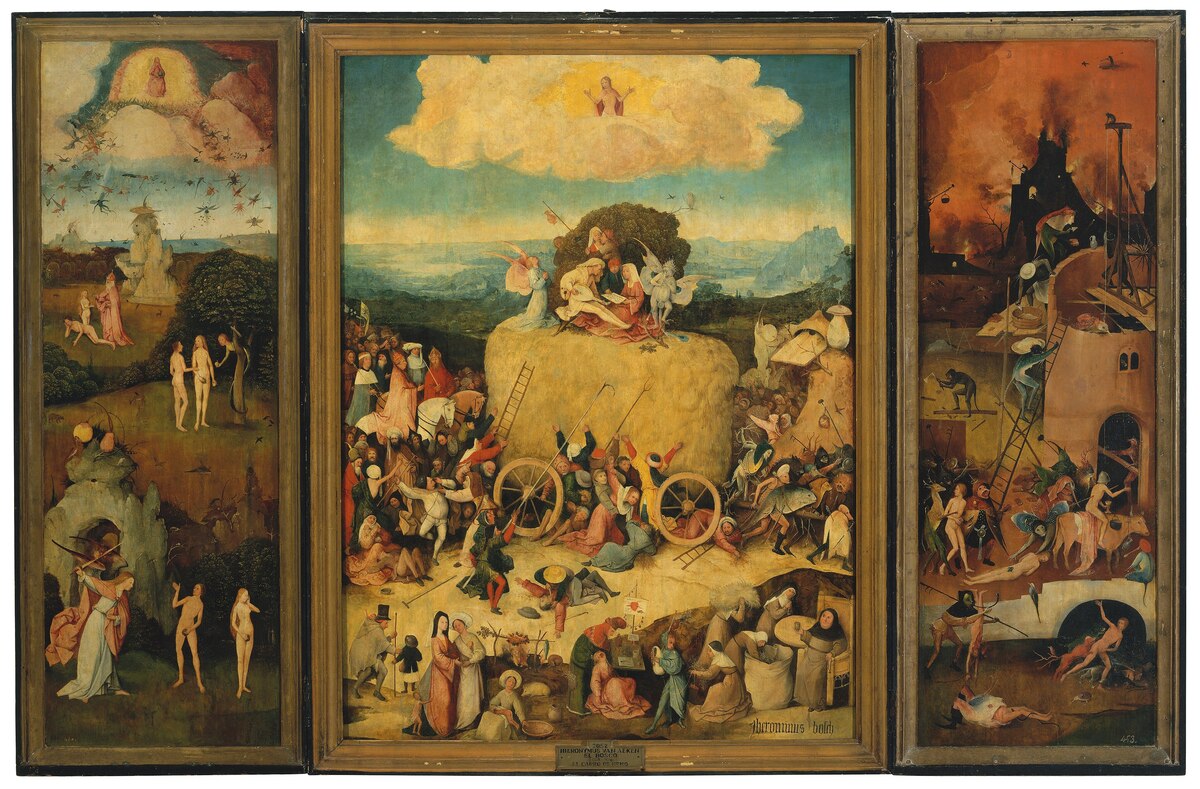
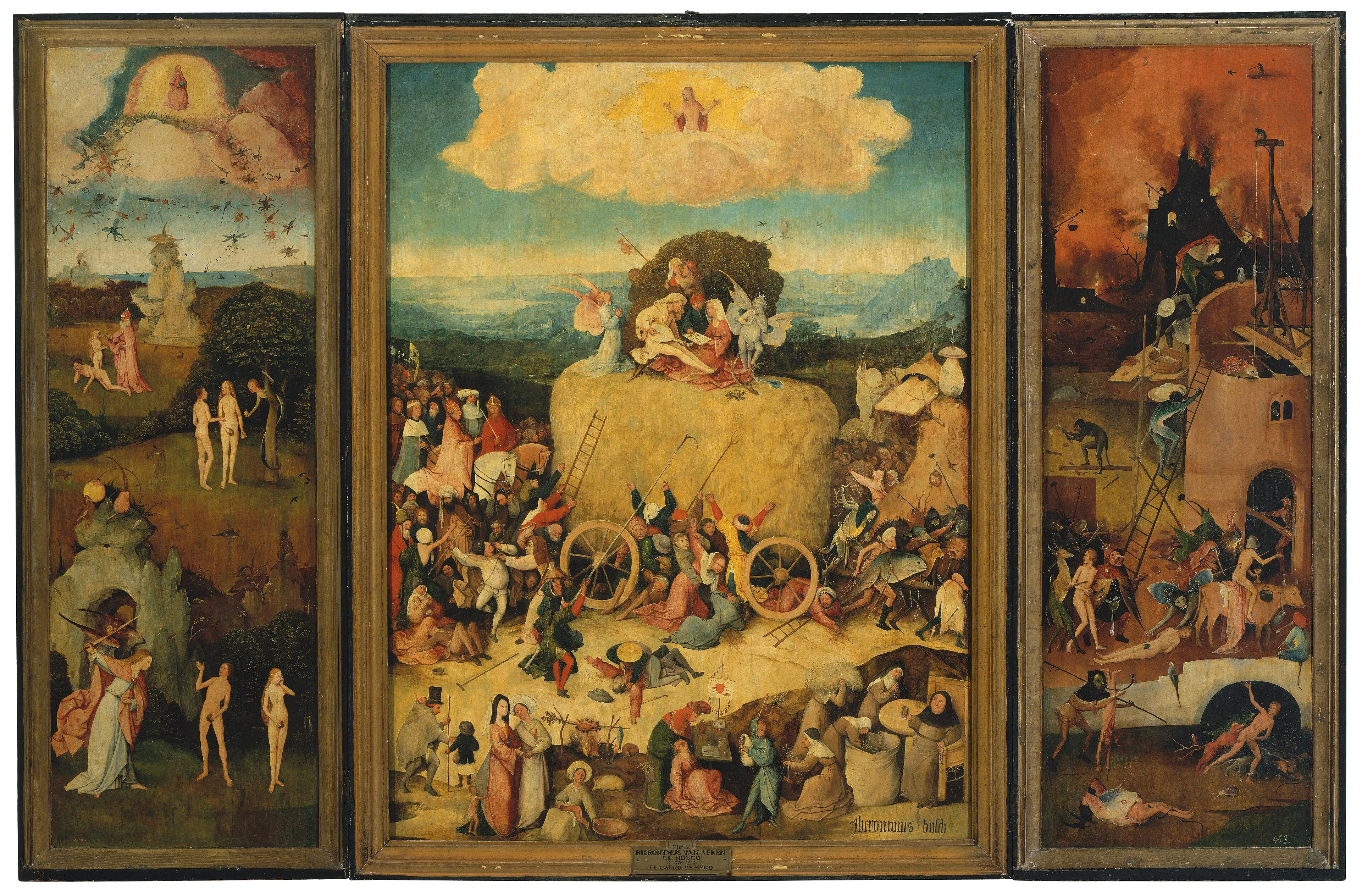
The Haywain Triptych is a three-part panel painting, attributed to Hieronymus Bosch or workshop, dated around 1516 or later.
Its central panel shows something strange and vivid: a huge golden mound of hay, drawn on a wagon with a dark tree growing from the top.
All around and beneath it, people seize at the hay, and above them Christ appears in a cloud, watching.
Look first at the heap itself. The hay is piled high on a wagon, a dark tree standing at the summit, and its colour pulls against the cooler landscape around it.
Below, people of every rank crowd the spoked wheels, fighting, stabbing and pulling, raising ladders and ropes against the mound.
Packed into the hay are a winged angel, embracing lovers and a pope-like figure, sharing the load they are carried on.
Curatorial interpretation reads the wagon as the moral centre: the world's false good, carried along by all of society, while each figure grabs what they can.
That reading depends on what we see. The crowd's grasping turns greed into physical violence, and the hay becomes the thing worth fighting over.
The pope-like figure and the lovers show that the scramble crosses rank and calling; no one on the wagon stands outside it.
Above this struggle, Christ appears in a cloud, arms raised inside a luminous ring. The source calls him a lonely heavenly witness to the scramble below.
That contrast matters. The crowd cannot see past the hay, but the panel gives the visitor a viewpoint above it, where the object of desire is small and the cost is visible.
The left wing opens the story in Paradise, with the first couple and the serpent in Eden beside the dark Tree of Knowledge. It shows the moment before the Fall, setting desire and punishment in motion.
The right wing closes the sequence in Hell: a blackened, burning city, a crane, ladders, demons driving naked souls, and bodies broken in the foreground darkness.
Read together, the wings turn the central panel into a story with a before and an after. The hay is not just a thing people want; it has a destination.
The right wing shows Hell as the end point of the hay the crowd was grasping. The triptych's meaning is carried by that movement from Eden, through the crowded present, to the fire.
A painted signature at the bottom right of the central panel reads Jheronimus bosch, a mark of authorship in a work the source attributes to Bosch or his workshop.
That qualification matters for how we look. The moral design is legible, but the exact hand behind it remains open in the evidence.
What stays with you is the contrast the triptych stages: a crowd seizing at hay, a Christ looking down, and a Hell that shows where the grasping ends.