Identity and catalogue
Link- Title
- Knight, Death, and the Devil
- Artist or attribution
- Albrecht Dürer
- Object date
- 1513
- Medium and support
- engraving
- Dimensions
- Sheet: 25 cm x 19.6 cm; Plate: 24.3 cm x 18.8 cm
- Current collection or location
- Metropolitan Museum of Art, New York City, United States
- Movement or period
- Northern Renaissance
- Country or culture
- German
- Depicted subject
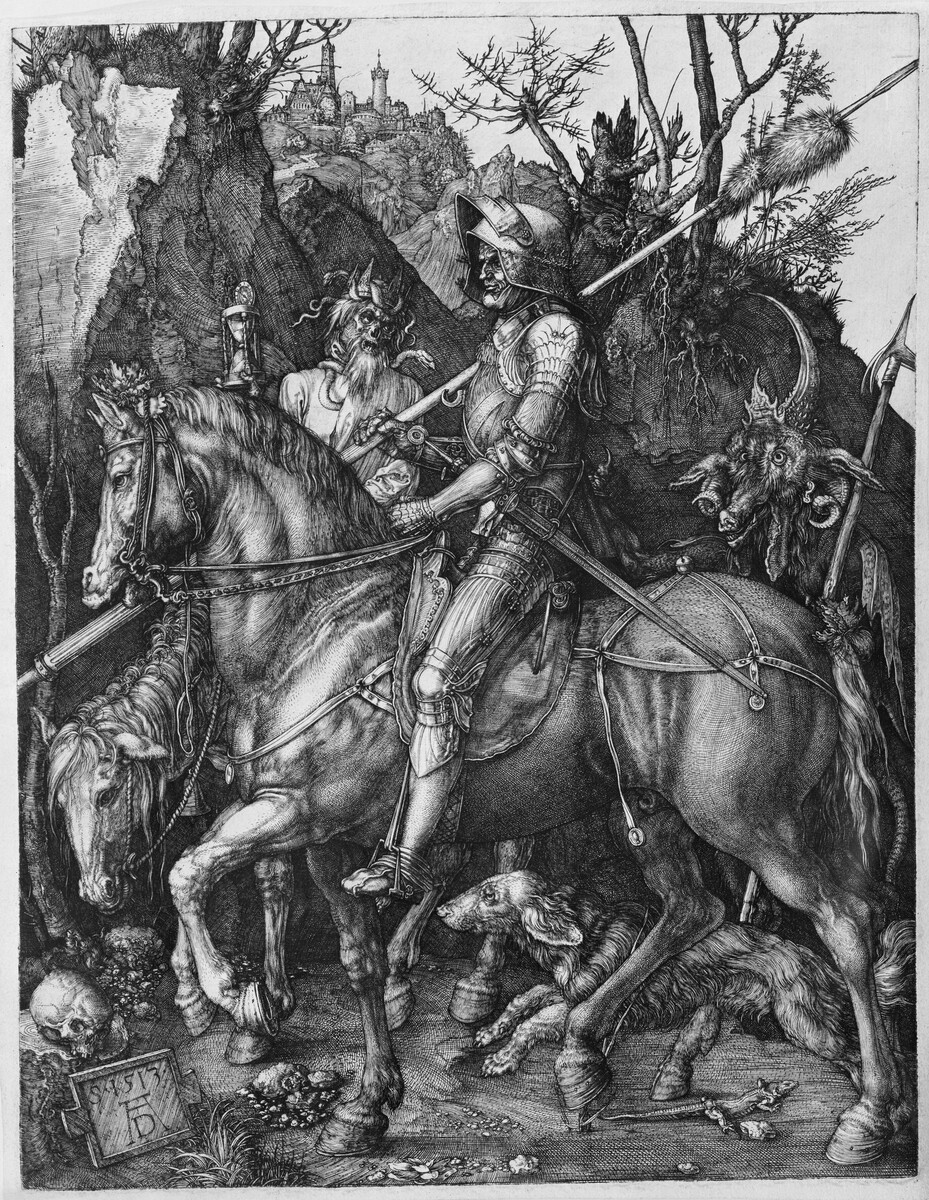
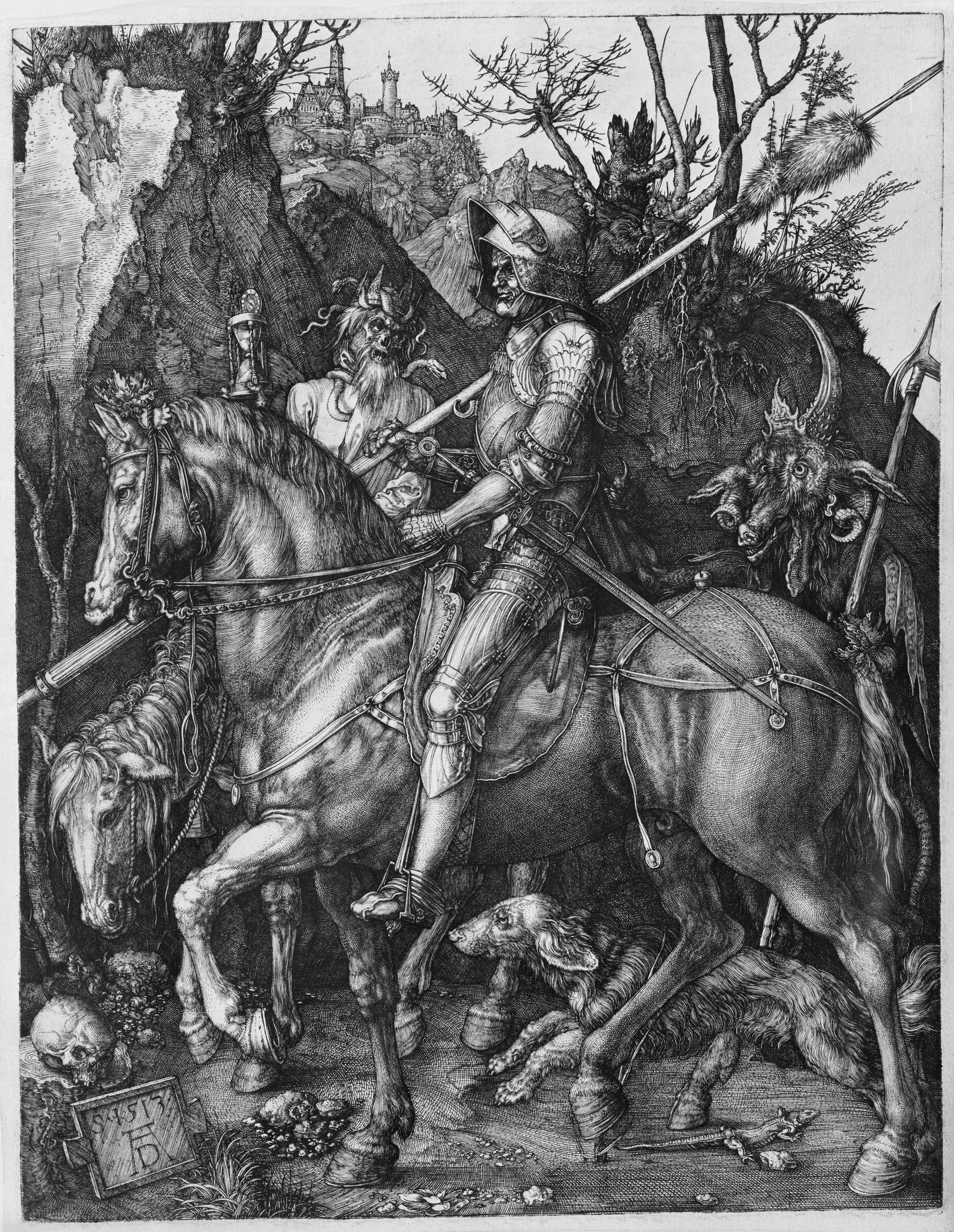
- An allegorical engraving showing a knight in full armor riding upright on horseback, pressing steadily forward while Death, a crowned corpse holding an hourglass, rides close behind him, and a grotesque horned devil lurks at the rear of the horse. The knight's fixed forward gaze and upright posture express steadfast faith and resolve amid surrounding menace.
- Title variants
- Der Reiter (Ritter, Tod und Teufel); El caballero, la muerte y el diablo; Il cavaliere, la morte e il diavolo; Ridder, Dood en Duivel; Riddaren, döden och djävulen; Rycerz, Śmierć i diabeł; O Cavaleiro, a Morte e o Diabo; El cavaller, la mort i el dimoni; Лицар, смерть і диявол
- Accession number
- 43.106.2
- Support
- paper
- Inscriptions
- Date: S•1513•; Monogram: AD [Albrecht Dürer]
Catalogue identity
The object catalogued here is an engraving on paper titled Knight, Death, and the Devil, created by Albrecht Dürer in 1513. The plate carries Dürer's monogram, the letters AD, together with the date 1513, so the signature and the year are integral to the printed image rather than later additions to a mount or label. The print belongs to the group known as the Meisterstiche, the master engravings, the term used for Dürer's finest works in the medium. The institutional record describes the composition as a knight in armor on horseback, with Death holding an hourglass and a devil at the horse's rear. Because the object is a print, the date inscribed on the plate is the date of the engraved design and its printing matrix; impressions pulled from that plate in later years remain, in catalogue terms, works of 1513.(Albrecht Dürer, 1513)
The print is held in the collection of the Metropolitan Museum of Art, New York, in the Drawings and Prints department, under accession number 43.106.2, and was acquired through the Harris Brisbane Dick Fund in 1943. The accession number and the fund name record the moment the sheet entered that public collection, not the moment the engraving was made; the 1513 plate date and the 1943 acquisition therefore mark two distinct events in the object's life, separated by more than four centuries. The institutional record consulted here was partially consulted, so the catalogue details preserved above are those the record establishes and not an exhaustive account of the sheet's condition, state or full exhibition history.(Albrecht Dürer, 1513)
Interpretation
Read together, the identity evidence and the acquisition evidence show how a single sheet carries two chronologies at once. The monogram and the 1513 date fix the engraving within Dürer's own working years and within the Meisterstiche group of master engravings, a category that rests on the technical refinement of the burin work. The accession number and the Harris Brisbane Dick Fund record place the same sheet in a twentieth-century museum context, where the print is studied as an impression within a public collection. The catalogue entry therefore does not describe one moment but a layered object: a design conceived and signed in 1513, and a physical impression whose documented institutional history begins with its 1943 acquisition.(Albrecht Dürer, 1513)
Medium and making
The medium statement that the work is an engraving on paper is significant for how the image should be described. Engraving is a process in which lines are cut into a plate and printed under pressure, and the resulting image is composed entirely of incised lines and the tonal density they produce when inked. The institutional record's description of the subject, a knight in armor on horseback, Death holding an hourglass, and a devil at the horse's rear, is a description of the printed composition that this technique delivers. The record treats these elements as the identifiable content of the print, and it associates the plate with Dürer as author of the design and the engraving.(Albrecht Dürer, 1513)
The artwork is an engraving titled Knight, Death, and the Devil, created by Albrecht Dürer in 1513.(Albrecht Dürer, 1513)
Subject and iconography
LinkThe recorded composition
Visual observation
The Metropolitan Museum of Art record for this object describes a composition built from three figures: a knight in armor on horseback, Death holding an hourglass, and a devil positioned at the rear of the horse. That distribution places the mounted knight at the center of the image and the two threatening figures behind and beside him, so that the print's action is organized around a single forward-moving rider accompanied by personifications of mortality and evil. The same institutional record names the work Knight, Death, and the Devil, attributes it to Albrecht Dürer, and gives the year 1513. These are the basic coordinates of the image as documented, and they frame any closer looking: the subject is not a battle or a narrative episode drawn from a text, but a mounted figure accompanied by two allegorical presences whose identities are established by their attributes rather than by an inscribed caption.(Albrecht Dürer, 1513)
The medium of the image matters for how its details were produced and how they are read. The work is an engraving on paper, a technique in which lines are cut into a plate and printed, and the Metropolitan Museum of Art record lists it in the Drawings and Prints department of that collection. The identification of the knight's armor as armor, of the hourglass as an hourglass, and of the devil as a horned figure belongs to the description of the print's content; the further claim that the knight's bearing conveys steadfast faith and resolve is an interpretation of that content rather than a documented feature of it. Keeping those two levels distinct is important here, because the print offers no written label inside the image identifying the knight's state of mind. What the record establishes is what is depicted and how it was made; what it does not establish is the intention behind the figures' expressions.(Albrecht Dürer, 1513)
The work depicts a knight in armor on horseback, Death holding an hourglass, and a devil at the horse's rear.(Albrecht Dürer, 1513)
Materials and technique
LinkDocumented Material and Inscription
The Artifact Archive record for this print identifies the work as an engraving on paper, an image made by cutting a design into a plate, inking that plate, and transferring the ink to a paper sheet under pressure. The same record names Albrecht Dürer as the author and attaches the date 1513 to the work, and it reports that the engraving carries Dürer's monogram, the letters A and D, together with that date, cut into the plate. This combination of medium, maker, and signed date is the primary documented information available about how the object was made and when. The record also notes that the print belongs to the group known as the Meisterstiche, Dürer's master engravings, a designation that situates it within an acknowledged high point of his work in this medium. Because the surviving evidence consists of the institutional record rather than a technical examination report, it establishes the material category of the object but does not document plate dimensions, paper type, watermark, ink composition, or printing history.(Albrecht Dürer, 1513)
The record places the print in the collection of the Metropolitan Museum of Art, New York, with accession number 43.106.2, held in the Drawings and Prints department, and states that it was acquired through the Harris Brisbane Dick Fund in 1943. These details concern the modern custody of the impression rather than its making, but they matter for reading the material evidence: what the record describes is a specific impression in a specific public collection, and any study of paper, ink, or plate wear would be a study of that impression. The identification of Dürer as author and the monogram and date as part of the engraved design belong to the same documented strand, while everything in the record about the scene's subject matter is a description of the image rather than a statement about the materials or technique by which it was produced.(Albrecht Dürer, 1513)
Visual observation
Taken together, the documented unit and the visual description permit a careful separation of claims. The medium is engraving on paper; the author is Albrecht Dürer; the date associated with the work is 1513; the print is signed with the monogram and dated 1513; it belongs to the Meisterstiche; it is in the Metropolitan Museum of Art under accession 43.106.2 through the Harris Brisbane Dick Fund in 1943; and the image shows a knight in armor on horseback, Death with an hourglass, and a devil at the horse's rear. Each of these is stated in the supplied record. The suggestion that the engraving's fine lines and dense detail give the armor and figures a hard, almost tactile presence is not part of that record and should be treated as an interpretive response to the image rather than a finding of technical examination. Distinguishing the two kinds of statement matters in a materials-and-technique section, because only the documented statements can be used to make claims about paper, ink, or printing, while the description of the scene must carry the weight of visual inference.(Albrecht Dürer, 1513)
Provenance and ownership
LinkInstitutional Record and Acquisition
The documentary record for this impression of Albrecht Dürer's Knight, Death, and the Devil is anchored by a single institutional acquisition. The engraving, entered in the Drawings and Prints department of the Metropolitan Museum of Art, New York under accession number 43.106.2, was acquired through the Harris Brisbane Dick Fund in 1943. That fund and that year are the only elements of transfer recorded in the supplied evidence; the object itself is dated to 1513 and signed with Dürer's monogram, so roughly four centuries separate the making of the plate and this impression's entry into the museum. The accession number encodes the acquisition year in its first two digits, which is consistent with, though not independent proof of, the 1943 fund purchase.(Albrecht Dürer, 1513)
The evidence documents no owner, dealer, agent, auction, gift or transfer between the engraving's creation in 1513 and its acquisition through the Harris Brisbane Dick Fund in 1943. This is an unrecorded interval, not a demonstrated continuity of possession: nothing in the supplied units establishes who held the print, or where it was kept, during those centuries, and no earlier provenance chain should be inferred from the object's presence in the Metropolitan Museum's Drawings and Prints department today. The distinction matters for how the work is described, because the 1943 fund acquisition is a documented change of ownership into a public collection, while everything before it remains simply unfilled in this account.(Albrecht Dürer, 1513)
Provenance timeline
- 1943
The print was acquired through the Harris Brisbane Dick Fund.(Albrecht Dürer, 1513)
Collection and display
LinkThe object and its institutional record
Knight, Death, and the Devil is an engraving on paper made by Albrecht Dürer in 1513, signed with his monogram, the letters A and D, and dated 1513 on the plate. It belongs to the group of his works known as the Meisterstiche, or master engravings, a designation for what the record treats as his finest achievements in the medium. The composition depicts a knight in armor on horseback, with Death, a crowned corpse holding an hourglass, and a horned devil at the horse's rear. The print is held by the Metropolitan Museum of Art, New York, as accession number 43.106.2, within the Drawings and Prints department. The Met's record states that the print was acquired through the Harris Brisbane Dick Fund in 1943, an acquisition route that places this impression in a public New York collection formed during the twentieth century rather than in an older princely or monastic cabinet.(Albrecht Dürer, 1513)
The print is in the collection of the Metropolitan Museum of Art, New York, with accession number 43.106.2.(Albrecht Dürer, 1513)
The engraving is part of the collection of the Metropolitan Museum of Art, New York, in the Drawings and Prints department.(Albrecht Dürer, 1513)
Documented values and qualified estimates
LinkRecorded values
Interpretation
The working insurance estimate supplied with this file records an estimated value of US$150,000 to US$400,000, generated on 2026-10-16. Its stated methodology is to apply a conservative multiplier range to a baseline institutional-era acquisition figure for a major Dürer engraving from 1513 in the Meisterstiche group, using the confirmed artwork context and museum record excerpts. The sheet measures 25 cm by 19.6 cm and the plate 24.3 cm by 18.8 cm. The range is described as broad precisely because no current official insurance value, appraisal, or recent public auction price for this specific impression was supplied. The calculation is qualified as model-generated and intended for manual review only, not as an official insurance value, appraisal, auction result, or sale price, and as not reflecting private insurance records, verified comparable sales, or any institutional valuation. The actual insurance amount, it states, should be determined by a qualified appraiser or insurer after inspecting the physical impression, condition, provenance, and current market evidence. Because the museum-held status means the work is not routinely offered on the open market, any figure of this kind remains a hypothetical ceiling rather than a documented transaction.(Rijksmuseum, n.d.)(Albrecht Dürer, 1513)
Read together, the institutional record and the valuation document define two different registers of evidence. The Metropolitan Museum record establishes creation, authorship, date, medium, group affiliation, signature, iconography, accession number and acquisition fund. The valuation document converts part of that context into a monetary range while explicitly noting the absence of an official value, appraisal or recent sale for this impression. It also cites the museum's identification of the current collection and the 1943 Dick Fund acquisition as the acquisition context used in the calculation, and repeats the sheet and plate dimensions. The monetary range therefore depends entirely on the documented institutional history and cannot stand as independent market testimony.(Rijksmuseum, n.d.)(Albrecht Dürer, 1513)
Working estimate
Calculated working insurance estimate, not a sale price: Estimated value: US$150K to US$400K Recorded date: Working calculation, generated 2026-10-16. Methodology: This broad working range is calculated for manual insurance review only, using the confirmed artwork context and supplied museum record excerpts. The work is an original 1513 engraving by Albrecht Dürer, a Northern Renaissance master, and is part of the Meisterstiche group. The sheet measures 25 cm x 19.6 cm and the plate 24.3 cm x 18.8 cm. The institutional record identifies the Metropolitan Museum of Art as the current collection, accession number 43.106.2, and notes the Harris Brisbane Dick Fund, 1943, as acquisition context. The calculation applies a conservative multiplier range to a baseline institutional-era acquisition figure for a major Dürer engraving from 1513 in the Meisterstiche group, capped to reflect that museum-held works are not routinely offered on the open market. The range is broad because no current official insurance value, appraisal, or recent public auction price for this specific impression was supplied. It is intended to support manual review and not to assert a definitive value. Qualification: This is a model-generated working range for manual review only. It is not an official insurance value, appraisal, auction result, or sale price. It does not reflect private insurance records, verified comparable sales, or any institutional valuation. The actual insurance amount should be determined by a qualified appraiser or insurer after inspecting the physical impression, condition, provenance, and current market evidence.(Rijksmuseum, n.d.)(Albrecht Dürer, 1513)