The Game of Horse and Rider
Artist: Francisco Goya · 1791–1792

The Game of Horse and Rider: high-resolution image
The original file is hosted by Wikimedia Commons, available without payment or an account.
Open high-resolution image on Wikimedia CommonsThe complete story
The story About 4 minutes to read
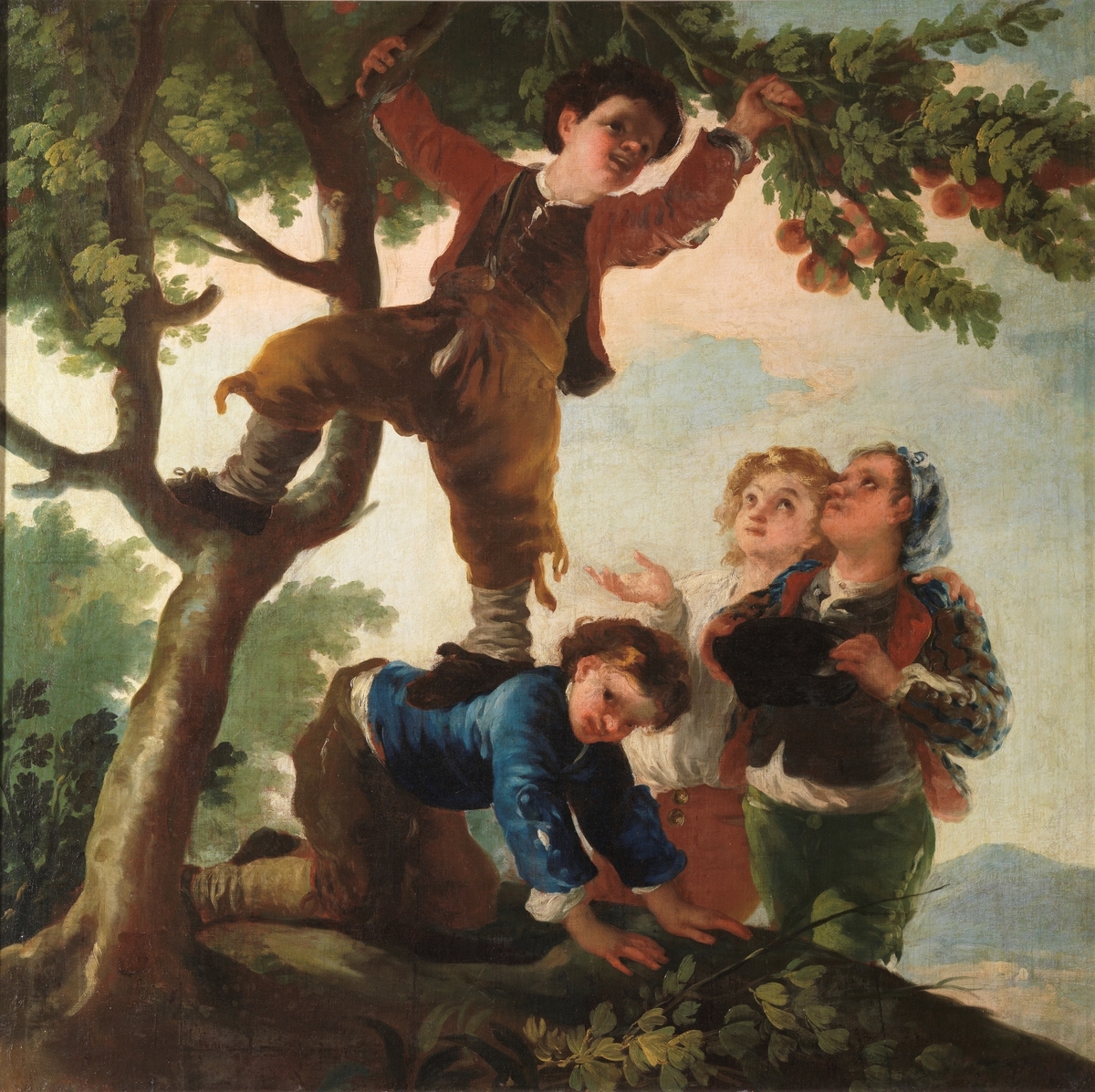
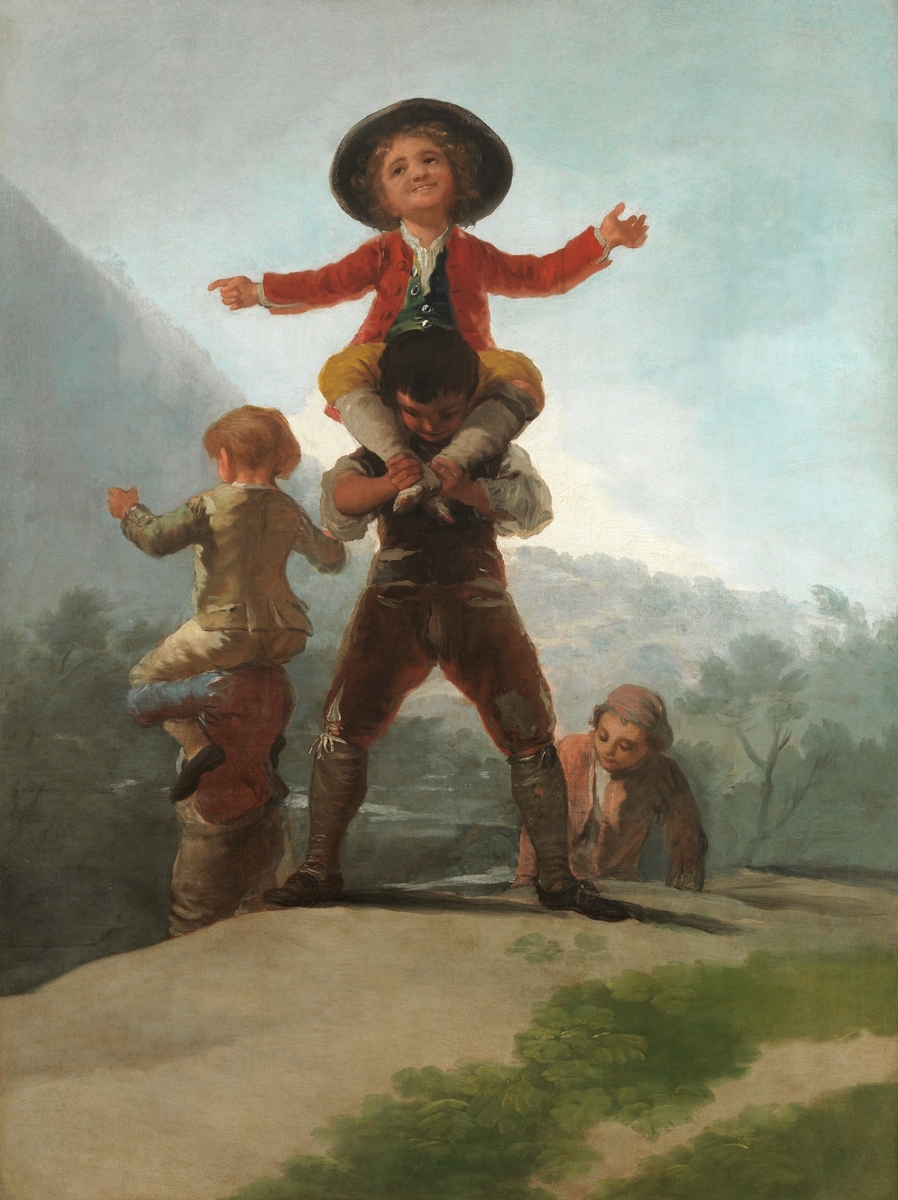
Look at the centre of this canvas. One boy is riding on another child's shoulders, and around them a group of boys is caught mid-game on a rocky ledge. This is Goya's subject: a game of horse and rider, the old children's game in which one player carries another like a rider on a mount. The work is also known by its Spanish title, Las gigantillas.
Goya painted it between 1791 and 1792, and it is described as a cartoon for tapestries, a design made to be woven rather than hung as a finished picture. That purpose matters. A tapestry design had to read clearly when translated into thread, so the figures and their action needed to carry across the whole surface.
The composition is built around the mounted pair. One child stands and bears the weight; the other sits above, lifted clear of the ground and made the tallest point in the group. Around them, other boys form a mount or crouch nearby, so the game spreads outward from the centre. The group fills the middle of the canvas and the rocky ledge gives them a place to play.
The riders are children, not soldiers or giants, and the picture keeps that scale plain. The child carried on the shoulders only appears large because he is raised above the others. That is the joke built into the game, and into the Spanish nickname Las gigantillas, the little giants. The title and the action agree: ordinary boys, briefly made tall.
The painting was made as a tapestry cartoon, a full-scale design from which weavers worked. Goya's cartoons were not autonomous gallery pictures in the way we see them now. Seeing the work this way changes the emphasis. We are looking at a working design for a woven scene of everyday play, not a private meditation or a portrait.
The supplied record does not explain why Goya chose this game, or what meaning he attached to it. Any claim about his intentions would go beyond the evidence here. What the picture does show is a scene of ordinary children absorbed in play. The raised rider, the supporting bodies and the rocky setting together make that game legible at a glance, which is what a tapestry design needed to do.
So the work is best understood through its action. A boy is lifted onto another's shoulders, and a circle of children turns that lift into a game. Goya gives the moment enough height and balance to hold the eye, while the rocky ledge keeps the scene grounded in a place children might actually play. The little giants are simply boys, made tall for a moment.
The story and its sources
Historical claims are linked to the records below. Close looking and interpretation are identified in the passage notes.
- Passage 1Documented historyWikimedia Commons: The Game of Horse and Rider
- Passage 2Documented historyWikimedia Commons: The Game of Horse and Rider
- Passage 3Close lookingWikimedia Commons: The Game of Horse and Rider
- Passage 4Close lookingWikimedia Commons: The Game of Horse and Rider
- Passage 5Documented historyWikimedia Commons: The Game of Horse and Rider
- Passage 6InterpretationWikimedia Commons: The Game of Horse and Rider
- Passage 7InterpretationWikimedia Commons: The Game of Horse and Rider
Details to notice
About 3 minutes to readCrouching boy watching
A fifth boy crouches low at the right edge of the rocky ledge, his face turned toward the central pair and his lowered posture contrasting with the rider's outstretched arms.
Boys forming a mount
At left, one boy climbs onto the back of another crouching companion, repeating the rider-and-horse hierarchy and showing the improvised rules of play.
Bearer's braced stance
The standing boy beneath the rider grips his companion's ankles and plants his boots wide apart on the rock, making the physical effort of the game visible.
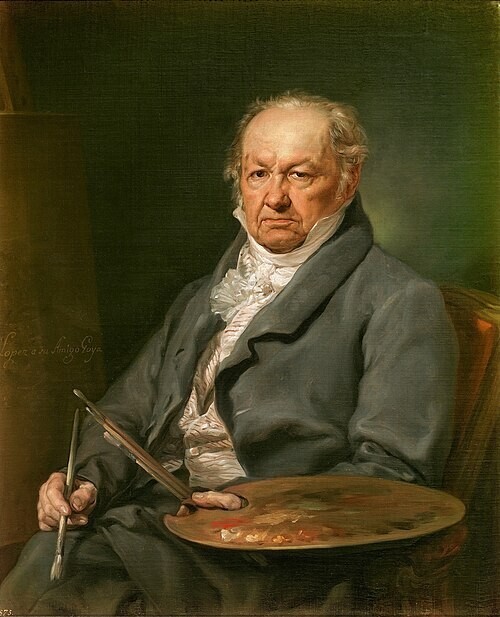
Artist portrait Image credit
Vicente López Portaña. Image source · Public domain
About the artist
Francisco de Goya
30 March 1746 to 16 April 1828
Goya was a Spanish painter and printmaker whose career extended from royal tapestry designs and court portraiture to images of war, repression and unsettling fantasy. Born in Fuendetodos, he trained in Zaragoza and Madrid and became First Painter to Charles IV in 1799. He spent his final years in Bordeaux.
- Born
- 30 March 1746
- Died
- 16 April 1828
- Nationality
- Spanish
- Birthplace
- Fuendetodos, Spain
- Died in
- Bordeaux, France
The research & record
Study the work.
Follow the evidence.
Find catalogue details, historical context, technical research and the literature behind this artwork.
The artwork record
Research catalogue
Catalogue information and detailed research, with references that link to the bibliography.
Updated .
Identity and catalogue
Link- Title
- The Game of Horse and Rider(Wikimedia Commons contributors, n.d.)
- Artist or attribution
- Francisco Goya(Wikimedia Commons contributors, n.d.)
- Object date
- 1791–1792(Wikimedia Commons contributors, n.d.)
- Medium and support
- Oil on canvas(Wikimedia Commons contributors, n.d.)
- Dimensions
- 137 × 104 cm(Wikimedia Commons contributors, n.d.)
- Current collection or location
- Museo del Prado, Madrid, Spain(Wikimedia Commons contributors, n.d.)
- Movement or period
- Rococo / Spanish painting
- Country or culture
- Spain
- Depicted subject
- A group of boys at play in a rocky landscape, one riding on another's shoulders in a game of horse and rider.(Wikimedia Commons contributors, n.d.)
- Title variants
- Las gigantillas; Playing at Giants
- Accession number
- P007112
- Support
- canvas
Read valuation records and their limitations
Catalogue identity
The painting is catalogued under the English title The Game of Horse and Rider, with the Spanish variant Las gigantillas also recorded for the same work. The entry identifies the artist as Francisco Goya, whose life dates are given as 1746 to 1828, and it assigns the picture to the interval between 1791 and 1792. That dating belongs to the object as catalogued; it is not the date of a later description, reproduction or catalogue entry. The recorded dimensions are 137 by 104 centimetres, which establishes the canvas as a substantial, full-scale composition rather than a small sketch. The supporting record also describes the work as a cartoon for tapestries, a cartón para tapices, which places its original function in the production of woven wall hangings.(Wikimedia Commons contributors, n.d., Title; Summary; Date; Dimensions; Description)
The painting is titled The Game of Horse and Rider, also known as Las gigantillas.(Wikimedia Commons contributors, n.d.)
The work is by Francisco Goya (1746–1828).(Wikimedia Commons contributors, n.d.)
The painting dates from between 1791 and 1792.(Wikimedia Commons contributors, n.d.)
The dimensions are 137 × 104 cm.(Wikimedia Commons contributors, n.d.)
Subject and iconography
LinkRead valuation records and their limitations
The recorded composition
Visual observation
The canvas presents a game of horse and rider: a boy rides on another child's shoulders, and the pair are the visual centre of the scene. Around them a group of boys plays on a rocky ledge, with some forming a mount and others crouching nearby. The action is legible as a single connected group rather than as isolated figures, which is the basic descriptive foundation for any further reading of the picture.(Wikimedia Commons contributors, n.d., Title; Title and description)
The subject belongs to the tradition of the children's game in which one player carries another as a mount, and the Spanish title Las gigantillas names that game in miniature form. Descriptions of the work record the figures as boys, so the raised rider reads as an ordinary child made tall by being lifted rather than as a monumental or martial figure. The composition's humour and its title depend on this scale relationship, which the description establishes without requiring any claim about the painter's intention.(Wikimedia Commons contributors, n.d., Title; Title and description)
The painting depicts a game of horse and rider, with a boy riding on another child's shoulders.(Wikimedia Commons contributors, n.d.)
The scene shows a group of boys playing on a rocky ledge, with one boy mounted on another's shoulders and others forming a mount or crouching nearby.(Wikimedia Commons contributors, n.d.)
Historical context
LinkRead valuation records and their limitations
The documented record
The object is recorded under the title The Game of Horse and Rider, also known as Las gigantillas, and is attributed to Francisco Goya (1746–1828). The supplied record dates it between 1791 and 1792, gives the medium as oil on canvas and the dimensions as 137 by 104 centimetres, and places it in the collection of the Museo del Prado, Madrid, under accession number P007112. Most consequentially for its historical setting, the record classifies the work as a cartoon for tapestries, cartones para tapices: a design produced within the tapestry-making process rather than as an independent gallery picture. That classification, rather than any recorded statement of intention, is the firmest evidence the archive holds about the circumstances in which the painting functioned.(Wikimedia Commons contributors, n.d., Description)
The classification as a tapestry cartoon has direct consequences for how the painted surface is understood. A cartoon was a working element of textile production, made to be translated into woven thread, so the composition had to remain legible when its figures and actions were carried across the whole surface by weavers. The record establishes the category of the object but supplies no further detail about the specific commission, the workshop, the destination of the resulting tapestry or the terms on which Goya was engaged. Within the limits of this evidence, the cartoon designation is the principal link between the painting's making and the social world of production it belonged to.(Wikimedia Commons contributors, n.d., Description)
What the canvas shows
Interpretation
Read together, the documented classification and the observed scene establish a working design for a woven image of children's play. The design requirement of legibility at the scale of woven reproduction gives a justified, though general, reason why the mounted pair occupies the centre and why the group's action reads at a glance across the surface. Beyond that functional connection, the evidence does not explain why Goya chose this game, what meaning he attached to it, or how patrons received the design. Those questions remain open in this archive, and the painting's secure identification as a Goya tapestry cartoon should not be taken to settle the history of its commissioning.(Wikimedia Commons contributors, n.d., Description; Title; Title and description)
The work is described as a cartoon for tapestries (cartones para tapices).(Wikimedia Commons contributors, n.d.)
Materials and technique
LinkRead valuation records and their limitations
Documented support and medium
The object recorded here is described as oil on canvas, and the same record supplies its dimensions as 137 by 104 centimetres, its date as between 1791 and 1792, its attribution to Francisco Goya (1746–1828), and its present location in the Museo del Prado, Madrid, under accession number P007112. The work is titled The Game of Horse and Rider and is also known by the Spanish title Las gigantillas. The same source classifies it as a cartoon for tapestries (cartones para tapices), a designation that belongs to the object's documentary description rather than to any technical analysis of its surface, and that carries consequences for how its materials and making are understood.(Wikimedia Commons contributors, n.d., Medium)
The support and medium are stated plainly in the record, but the record does not describe the canvas weave, the ground or preparation layer, the pigments, the binding medium beyond the general term oil, or any implement or working method used to lay in the paint. No technical examination is reported: there is no account of cross-sections, infrared imaging, raking light, pigment analysis or condition treatment. Claims about how the paint was applied, what the ground consists of, or what specific colourants were used would therefore exceed the supplied evidence, which establishes the medium and support as oil on canvas and nothing further about the material constitution of the work.(Wikimedia Commons contributors, n.d., Medium)
What the record does establish is the function the object was made to serve. Described as a tapestry cartoon, it belongs to a class of full-scale design from which weavers worked, rather than to a class of finished pictures made for display on a wall as paintings. That designation is the only documented statement about making that goes beyond the bare medium, and it locates the object within a workshop process that extended past the painted surface into weaving. The evidence does not describe the weaving itself, the workshop, the specific tapestry project, or the relationship between this canvas and any surviving woven version.(Wikimedia Commons contributors, n.d., Medium)
Subject and the demands of the design
Interpretation
The subject the design had to carry is recorded as a game of horse and rider, with a boy riding on another child's shoulders. The scene is described as a group of boys playing on a rocky ledge, one boy mounted on another's shoulders while others form a mount or crouch nearby. Read alongside the tapestry-cartoon classification, these observations suggest why legibility across the whole surface would matter: the action is distributed through a group rather than concentrated in a single figure, and the mounted pair at the centre is what makes the game recognisable at a glance. That reading connects the visible arrangement to the documented purpose of the object, but it remains an inference from description rather than a finding of technical examination.(Wikimedia Commons contributors, n.d., Title; Title and description; Medium)
The evidence does not explain why Goya chose this subject or what meaning he attached to it, and nothing in the record speaks to his intentions in treating the game. Any account of the painting's materials and technique must therefore stop at what the record documents: oil on canvas, of the stated dimensions, dated 1791 to 1792, attributed to Goya, and described as a tapestry cartoon now in the Prado. The object matters within a larger history of material culture precisely through that documented category, a painted design made to be translated into thread, while the details of its preparation and paint layers remain, on this evidence, unexamined.(Wikimedia Commons contributors, n.d., Medium)
The medium is oil on canvas.(Wikimedia Commons contributors, n.d.)
Collection and display
LinkRead valuation records and their limitations
Collection and display
The object is recorded in the collection of the Museo del Prado, Madrid, under accession number P007112. That single registration detail is the archival anchor for everything else the supplied record establishes about the work: it fixes the painting within a named public collection and gives a unique identifier by which the institution's own records could be located, even though the supplied evidence does not reproduce those institutional records or describe the circumstances of acquisition.(Wikimedia Commons contributors, n.d., Collection, Accession number)
The same record identifies the painting as The Game of Horse and Rider, also known as Las gigantillas, by Francisco Goya (1746 to 1828), dating it between 1791 and 1792. It is oil on canvas, measuring 137 by 104 cm, and is described as a cartoon for tapestries (cartones para tapices). These facts together place the work in a specific phase of Goya's career and in a specific class of object: a full-scale design made to be translated into woven thread rather than a picture conceived for a gallery wall. The description of the medium and dimensions also matters for how the object is now encountered, since a canvas of this size can be hung and viewed as a painting even though its original function was as a working design.(Wikimedia Commons contributors, n.d., Collection, Accession number)
The subject the record describes is a game of horse and rider: a boy rides on another child's shoulders, and the scene shows a group of boys playing on a rocky ledge, with one boy mounted on another's shoulders while others form a mount or crouch nearby. Because the evidence identifies the work as a tapestry cartoon, the visibility of that action across the whole surface can be understood in relation to its intended translation into thread, a purpose the record states but does not elaborate. What the record does not supply is any account of why Goya chose this game, what meaning he attached to it, or how the design was commissioned and used; those questions remain outside the evidence here.(Wikimedia Commons contributors, n.d., Collection, Accession number)
The work is in the collection of the Museo del Prado, Madrid, with accession number P007112.(Wikimedia Commons contributors, n.d.)
Documented values and qualified estimates
LinkRead valuation records and their limitations
The object and its documentation
Interpretation
The object under discussion is recorded as The Game of Horse and Rider, also known as Las gigantillas, an oil on canvas by Francisco Goya (1746–1828) dated between 1791 and 1792 and measuring 137 by 104 cm. It is held at the Museo del Prado, Madrid, under accession number P007112, and is described in the Commons record as a cartoon for tapestries (cartones para tapices). The record also links the file page to the Museo del Prado, identifying the painting's home collection. These are the identifying facts on which any assessment of the work's value or significance must rest: an authenticated, catalogued, museum-held painting of a specific type, period, medium and scale.(Wikimedia Commons contributors, n.d.)
Recorded values
The only supplied unit bearing directly on value is a model-generated working estimate dated 16 November 2026, which gives a bracket of US$20 million to US$50 million. Its stated methodology is a broad, conservative range derived from confirmed context rather than from market data: an authentic oil on canvas by Goya dated 1791 to 1792, 137 by 104 cm, part of the tapestry cartoon series, held at the Museo del Prado with accession P007112, and documented in the Gassier and Wilson catalogue raisonné as number 304. The catalogue raisonné reference is significant because it places the painting within the standard scholarly corpus of Goya's work, which is the kind of documentation that underwrites both insurance and art-historical treatment.(Wikimedia Commons contributors, n.d.)
The estimate's own qualifications are as important as the figure. It describes itself as an order-of-magnitude insurance consideration for a major Goya of this type and scale, widened to account for the rarity of comparable private-market transactions, and explicitly notes that the work is a museum-held, catalogued masterpiece in a national collection rather than a free-market object. No comparable sales or insurance records were consulted; the range is a judgment-based bracket for manual review only. It is not an official insurance value, appraisal, auction result or sale price, and actual coverage should be set by a qualified appraiser or insurer on the basis of physical inspection, condition, provenance and current market conditions. Any use of the figure should preserve that framing rather than presenting it as a market valuation.(Wikimedia Commons contributors, n.d.)
Read together, the two kinds of record describe different orders of value. The Commons record establishes the painting's identity, date, medium, dimensions, collection and status as a tapestry cartoon; the valuation unit converts those same confirmed attributes into a working insurance bracket while expressly refusing to treat them as sale evidence. The relationship is therefore one of derivation and dependence: the money range is not independent testimony about the painting's worth but a calculation that takes the documented object as its input. For research purposes the documentary facts carry the evidential weight, and the monetary range stands as a flagged, provisional estimate generated for internal review, not as an established fact about the work's price or coverage.(Wikimedia Commons contributors, n.d.)
Working estimate
Calculated working insurance estimate, not a sale price: Estimated value: US$20M to US$50M Recorded date: Working calculation, generated 2026-11-16. Methodology: Broad working range derived conservatively from confirmed context: an authentic oil on canvas by Francisco Goya dated 1791 to 1792, 137 x 104 cm, part of the tapestry cartoon series (cartones para tapices), held at the Museo del Prado with accession P007112 and documented in the Gassier and Wilson catalogue raisonne (no. 304). Because the work is a museum-held, catalogued masterpiece in a national collection rather than a free-market object, this range reflects an order-of-magnitude insurance consideration for a major Goya of this type and scale, widened to account for the rarity of comparable private-market transactions. No comparable sales or insurance records were consulted; the range is a judgment-based bracket for manual review only. Qualification: Model-generated working range for manual review only. Not an official insurance value, appraisal, auction result, or sale price. No comparable sales or private insurance records were used. Actual coverage should be set by a qualified appraiser or insurer based on physical inspection, condition, provenance, and current market conditions.(Wikimedia Commons contributors, n.d.)
Further reading
Books for a closer look
Paid links. As an Amazon Associate I earn from qualifying purchases.

Open Library Goya
Kodansha International
A Goya catalogue whose recorded subjects include catalogues raisonnés, Museo del Prado, Spanish painting and criticism and interpretation. Those subjects make it the most promising candidate for object-level or collection-grounded study of a Prado tapestry cartoon by Goya, though only the catalogue record is used here.
ISBN 0870110837

Open Library Francisco Goya
Counterpoint
A Goya monograph by Evan S. Connell with recorded subjects on Goya's life and criticism and interpretation. It is relevant through the named artist rather than through the painting's subject of boys at play, and no depiction-specific content is recorded.
ISBN 1582433070
Bibliography
Sources and further reading
References are arranged by author or organisation, with links to the original publications. Where no publication date is recorded, n.d. means no date.
Source notes updated .
No recorded sources match these filters. Reset the filters to see the full bibliography.
- 04
Book
Francisco Goya. Counterpoint.
A Goya monograph by Evan S. Connell with recorded subjects on Goya's life and criticism and interpretation. It is relevant through the named artist rather than through the painting's subject of boys at play, and no depiction-specific content is recorded.
- ISBN
- 1582433070
Citation text
- 02
Book
Goya. Kodansha International.
A Goya catalogue whose recorded subjects include catalogues raisonnés, Museo del Prado, Spanish painting and criticism and interpretation. Those subjects make it the most promising candidate for object-level or collection-grounded study of a Prado tapestry cartoon by Goya, though only the catalogue record is used here.
- ISBN
- 0870110837
Citation text
- 03
Book
Francisco Goya - the Paintings. Independently Published.
Recorded under Goya's name with the title Francisco Goya - the Paintings, indicating a focus on his painted oeuvre. That could encompass the Prado tapestry cartoons such as The Game of Horse and Rider, but the record supplies no subject headings confirming specific coverage.
- ISBN
- 9781521566466
Citation text
- 01
Secondary · About this artwork
Wikimedia Commons: The Game of Horse and Rider. File:Las gigantillas.jpg. Wikimedia Commons.
Commons file page supplying the object's title, artist, date, medium, dimensions, collection, accession number and tapestry-cartoon description, with a link to the Museo del Prado.
- Language
- en
Citation text
Art to live with
Bring this painting
home.
A piece of the archive, made yours. Explore The Game of Horse and Rider in a size and finish that fits your space.
Your text and annotations appear on these editions. Adding to cart saves that design for printing.
Combine this painting with your favourites01 / Find your edition
Made for you
Suggested from your location. Change it if you're sending elsewhere or using a VPN. Prices and delivery are shown in GBP.
4 products
Choose an edition to make it yours
12.7 × 17.8 cm / 5 × 7 in · Standard
12.7 × 17.8 cm / 5 × 7 in · Standard

5 × 7 in / 12.7 × 17.8 cm · Standard

5 × 7 in / 12.7 × 17.8 cm · Standard

5 × 7 in / 12.7 × 17.8 cm · Standard

5 × 7 in / 12.7 × 17.8 cm · Standard

5 × 7 in / 12.7 × 17.8 cm · Standard
Metal art sign
GBP 19.84
Delivery GBP 17.90 / Total GBP 37.74
A printed aluminium sign with rounded corners and mounting holes.
Fit and fill keep the painting’s proportions. Stretch changes them.
Move and zoom the painting on your metal art sign.
Made to order with your design
Printed aluminium · mounting holes included
US delivery only
20.3 × 25.4 cm / 8 × 10 in · White
20.3 × 25.4 cm / 8 × 10 in · White

8 × 10 in / 20.3 × 25.4 cm · White

8 × 10 in / 20.3 × 25.4 cm · White

8 × 10 in / 20.3 × 25.4 cm · White

8 × 10 in / 20.3 × 25.4 cm · White
Framed art print
GBP 34.51
- 1 framed print
- GBP 34.51
- Delivery to United States
- GBP 9.73
- Total
- GBP 44.24
A ready-to-hang wooden frame with a clear Perspex cover and a semi-gloss printed insert.
Delivery is quoted for all selected copies together.
Fit and fill keep the painting’s proportions. Stretch changes them.
Move and zoom the painting on your framed art print.
Made to order with your design
Wooden frame & protective clear front included
US delivery only
20.3 × 25.4 cm / 8 × 10 in · Standard
20.3 × 25.4 cm / 8 × 10 in · Standard

8 × 10 in / 20.3 × 25.4 cm · Standard

8 × 10 in / 20.3 × 25.4 cm · Standard

8 × 10 in / 20.3 × 25.4 cm · Standard

8 × 10 in / 20.3 × 25.4 cm · Standard

8 × 10 in / 20.3 × 25.4 cm · Standard
Matte art print
GBP 13.30
Delivery GBP 7.29 / Total GBP 20.59
An unframed matte poster with archival inks, ready for a frame of your choice.
Fit and fill keep the painting’s proportions. Stretch changes them.
Move and zoom the painting on your matte art print.
Made to order with your design
Unframed · frame it your way
US delivery only
22.9 × 27.9 cm / 9 × 11 in · Standard
22.9 × 27.9 cm / 9 × 11 in · Standard

9 × 11 in / 22.9 × 27.9 cm · Standard

9 × 11 in / 22.9 × 27.9 cm · Standard

9 × 11 in / 22.9 × 27.9 cm · Standard
Fine art poster
GBP 17.54
Delivery GBP 7.69 / Total GBP 25.23
A gallery paper print with a smooth art-paper surface. Choose a size that suits the painting.
Fit and fill keep the painting’s proportions. Stretch changes them.
Move and zoom the painting on your fine art poster.
Made to order with your design
Unframed · frame it your way
The 30 cm ruler is scaled alongside your selected print. Keep the painting’s proportions with a black background, or stretch it to fill. Frame width, material texture and screen colours are illustrative.
Keep exploring