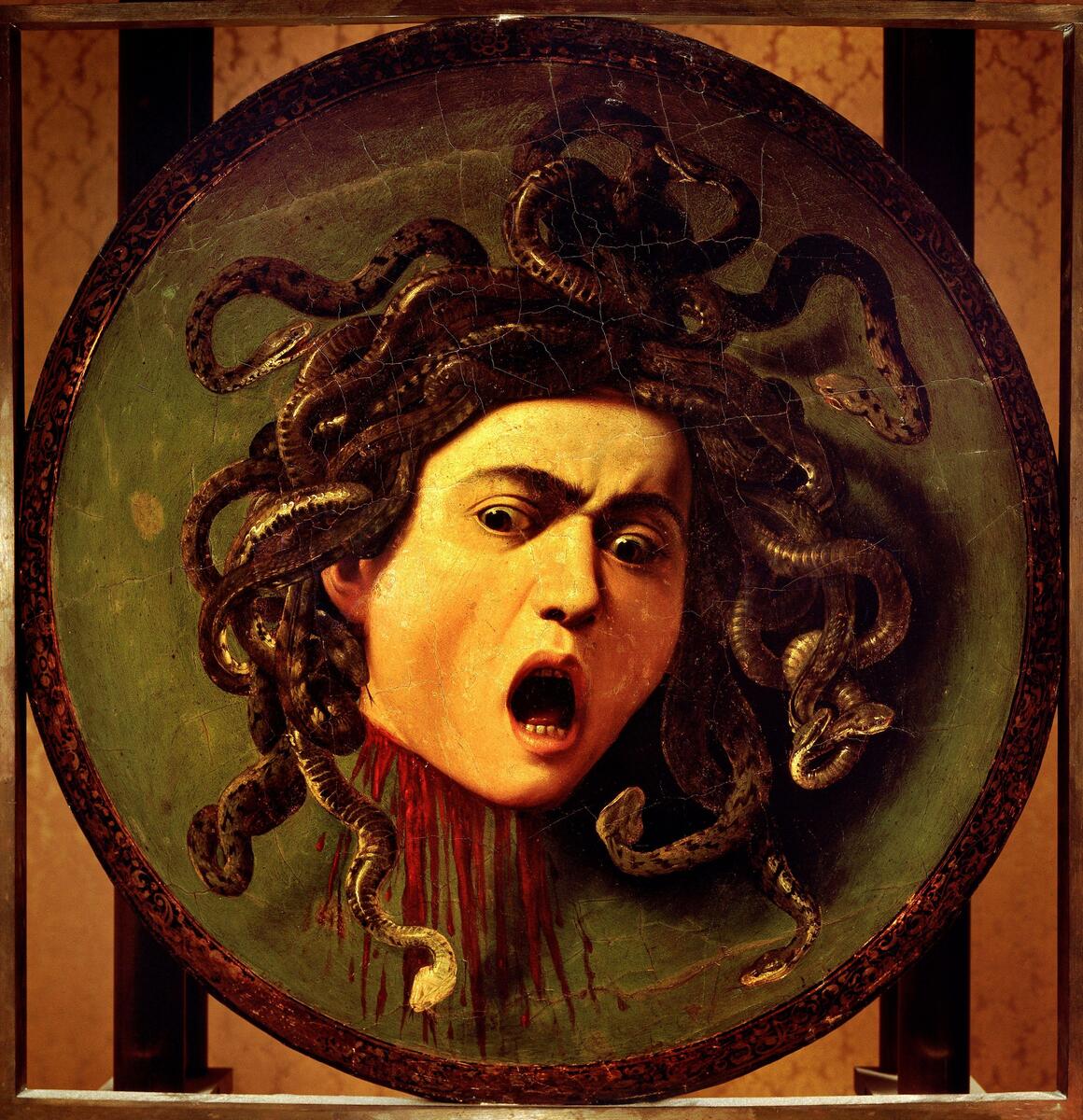
Caravaggio's Entombment of Christ shows the dead Christ being laid into the tomb by his followers. This docent-led visit explains the action, identifies the figures and the setting, and connects the composition to the Gospel of John.
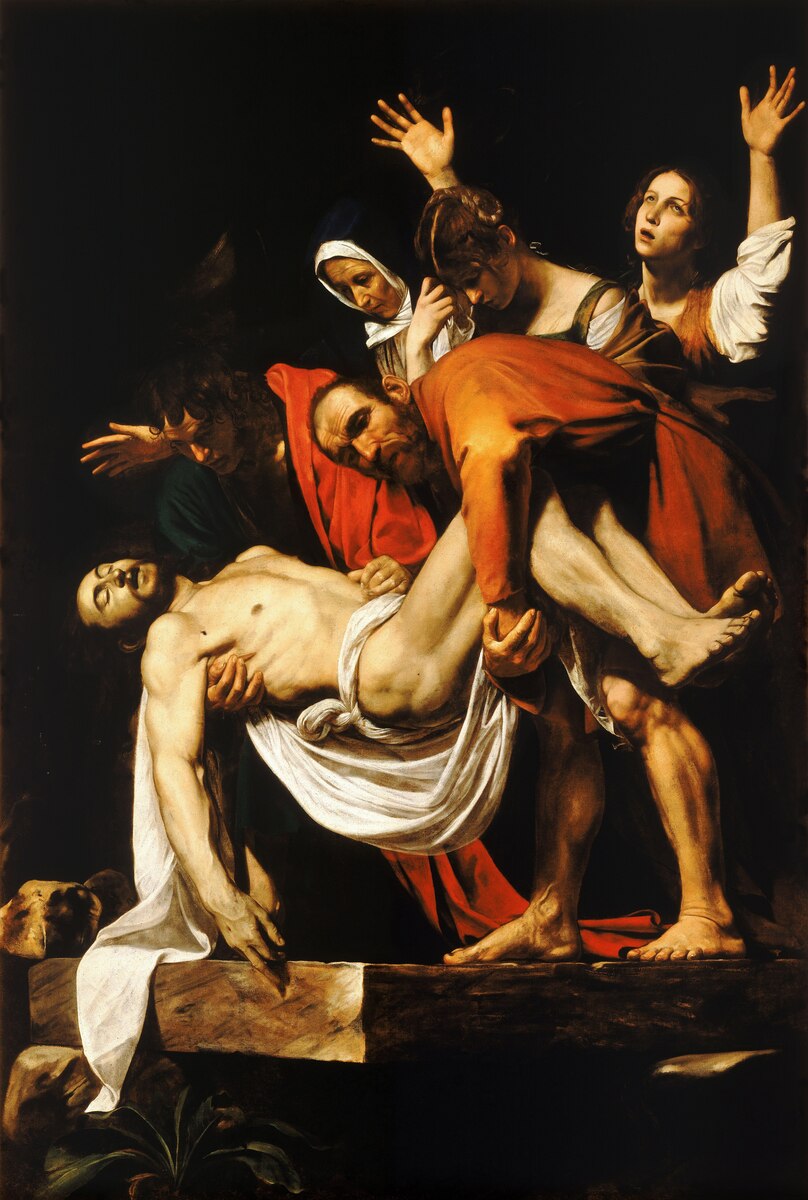
The young long-haired mourner at the upper centre, head bowed and face largely hidden, one hand lifted near the cheek and a bare shoulder with a green strap visible. This bowed head supplies the silent register of grief alongside the outcry of the other woman.
02
Stone slab, trailing linen and plant
The squared stone slab at the lower left on which the body is being set down, the long end of the white shroud falling over its edge, and a small sprouting plant at the lower corner, a discreet hint of the garden and the waiting tomb.
03
Veiled woman gazing at Christ
The older woman behind the body, head bound in a white veil or wimple, eyes lowered toward Christ's face. Her quiet, inward sorrow contrasts sharply with the raised-arm cry nearby; she is traditionally read as the Virgin Mary.
Your gallery guide
The Entombment of Christ by Caravaggio (c. 1602-1604)
Caravaggio's Entombment of Christ shows the dead Christ being laid into the tomb by his followers. This docent-led visit explains the action, identifies the figures and the setting, and connects the composition to the Gospel of John.
Editorial review by Artifact Archive automated publishing
Caravaggio's Entombment of Christ shows the dead Christ being laid into the tomb. Followers including Nicodemus, John the Apostle, Mary, Mary Jacobi, and Mary Magdalene gather around his body.
They are lowering him toward a dark stone slab. The painting captures the moment just before the stone is rolled across.
Your eye lands first on the pale body of Christ. It is stretched across the center of the canvas, held by several pairs of hands.
To the right, Mary Magdalene kneels with her head bowed. Behind her, Mary raises a hand to her cheek in grief. John the Apostle stands to the left, supporting Christ's shoulders.
The subject comes from the Gospel accounts of Christ's burial. Nicodemus and Joseph of Arimathea are often shown preparing the body, though Joseph is not named in the supplied record.
Caravaggio painted this around 1602 to 1604 for a chapel in Rome. It is a Baroque religious painting, made to inspire devotion.
Caravaggio's light does more than make the scene visible. It picks out Christ's body and the hands that hold it, while the background recedes into darkness.
This is a staging choice, not eyewitness reportage. The darkness focuses attention on the physical reality of the dead body and the sorrow of those around it.
The painting is not trying to show a moment from daily life. It is a devotional image, built to make the burial feel immediate and tangible.
The figures' downward gazes and the weight of Christ's body carry the meaning: this is a moment of grief, and a moment of transition from death to the tomb.
The story and its sources
Editorial review by Artifact Archive automated publishing.
Historical claims are linked to the records below. Close looking and interpretation are identified in the passage notes.
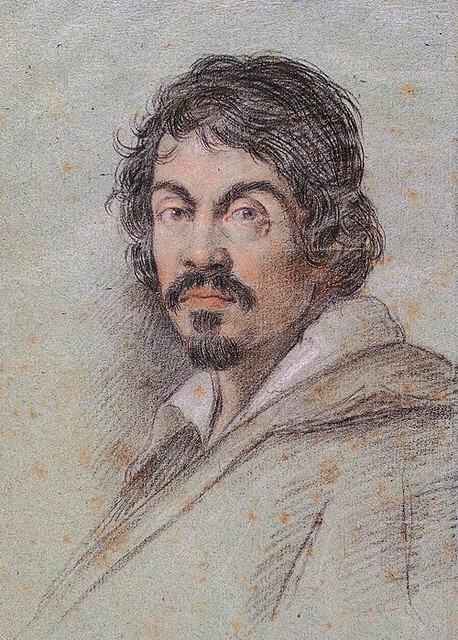
Caravaggio was an Italian painter whose dramatic lighting and direct treatment of religious subjects transformed European painting. Born Michelangelo Merisi, he moved to Rome in 1592 and gained major public commissions through Cardinal Francesco del Monte. His influence spread through artists who adapted his strong contrasts of light and shadow.
The painting depicts the entombment of Christ, showing his body being laid in the tomb by followers including Nicodemus, John the Apostle, Mary, Mary Jacobi, and Mary Magdalene.(Wikimedia Commons: The Entombment of Christ, n.d.)
Title variants
Deposizione; La Mise au tombeau; Polaganje Krista u grob; Положение во гроб (картина Караваджо); Die Grablegung Christi; O Sepultamento de Cristo; Sant Enterrament; 基督下葬; Nuėmimas nuo kryžiaus (Caravaggio); Polaganje Kristusa v grob (Caravaggio); キリストの埋葬; Закопот на Христос (Караваџо); graflegging van Christus; قبر المسيح (لوحه); Złożenie do grobu; Begravelsen av Kristus; Polaganje Krista u grob; İsa'nın Mezara Konması; Daykara va Krist (trutca ke Caravaggio); Santo Entierro; Kristi gravläggning; La Entombigo de Kristo
The object is a painting titled The Entombment of Christ, attributed to Caravaggio, and it is the same work indexed under the accession number MV.40386. Its catalogue identity is therefore twofold: a subject title drawn from the Gospel narrative of Christ's burial, and a museum identifier that fixes the canvas within a specific public collection. The medium is recorded as oil on canvas, and the support measures 300 by 203 centimeters, dimensions that place the work among the large altarpiece-scale canvases of its period rather than among small devotional panels. The painting's subject is the entombment of Christ, and the depicted people are named in the record as Jesus Christ, Nicodemus, John the Apostle, Mary, Mary Jacobi, and Mary Magdalene. These identifications matter for catalogue practice because they establish which figures the description treats as present at the burial and which named participants in the Gospel accounts, such as Joseph of Arimathea, are absent from the supplied record. The attribution to Caravaggio is recorded here as an attribution rather than as an unqualified statement of authorship, and the section preserves that qualification.(Wikimedia Commons: The Entombment of Christ, n.d., Summary)
The catalogue date for the painting is given as between 1602 and 1604. That is an object date, the period assigned to the making of the canvas, and it must be kept distinct from later catalogue dates such as the date of a museum record, a page revision or a photographic registration. The record consulted supplies no such later catalogue date, so the only date established here is the 1602 to 1604 range for the work itself. The range is also the basis for calling the painting an early seventeenth-century work, and any account of its place in Caravaggio's career depends on that dating rather than on the accession number, which identifies the object administratively but carries no chronological information in the supplied evidence.(Wikimedia Commons: The Entombment of Christ, n.d., Summary)
Beyond the bare catalogue fields, the work is characterised as a religious artwork in the Baroque style. That classification connects the title and subject to a broader category of devotional painting and to a stylistic period, and it is the kind of description that shapes how the object is grouped with other religious canvases of the same era. The record also states plainly that the artwork is a painting, a redundant-seeming field that nonetheless matters in cataloguing because it excludes prints, drawings, reproductions and photographs that might circulate under the same title. Taken together, the religious designation and the Baroque classification describe the work's function and idiom without asserting anything about its specific commission, patron or original location, none of which is established by the supplied evidence.(Wikimedia Commons: The Entombment of Christ, n.d., Summary)
The object under consideration is a painting titled The Entombment of Christ, attributed to Caravaggio and dated between 1602 and 1604. It is executed in oil on canvas and measures 300 by 203 centimeters. The work belongs to the collection of the Pinacoteca Vaticana in Vatican City, where it carries the accession number MV.40386. Its subject is the entombment of Christ, and the depicted figures include Jesus Christ, Nicodemus, John the Apostle, Mary, Mary Jacobi, and Mary Magdalene. The painting is a religious artwork in the Baroque style, and it is a painting in the straightforward sense of a two-dimensional picture rather than a sculpted or architectural object. These details establish the basic physical and institutional identity of the work before any question of its commissioning or social function is approached.(Wikimedia Commons: The Entombment of Christ, n.d., Summary)
The Entombment of Christ attributed to Caravaggio is executed in oil on canvas, a combination that the object record documents directly rather than inferring from appearance. The same record gives the painting's dimensions as 300 by 203 centimeters and places it in the collection of the Pinacoteca Vaticana, Vatican City, under accession number MV.40386. The work is dated between 1602 and 1604 and is described as a religious artwork in the Baroque style, a painting whose subject is the entombment of Christ and whose depicted figures include Jesus Christ, Nicodemus, John the Apostle, Mary, Mary Jacobi, and Mary Magdalene. These are the object-level facts on which any account of its making must rest: the medium and support are stated as oil on canvas, while the date range and the identification of the figures come from the same record and are cited here as that record's attribution rather than as independently confirmed technical findings.(Wikimedia Commons: The Entombment of Christ, n.d., Summary)
The Entombment of Christ is an oil painting on canvas measuring 300 by 203 centimeters, attributed to Caravaggio and dated between 1602 and 1604. It is a religious artwork in the Baroque style and depicts the entombment of Christ, with the depicted people including Jesus Christ, Nicodemus, John the Apostle, Mary, Mary Jacobi, and Mary Magdalene. The composition shows the dead Christ being laid into the tomb, with followers gathered around his body as he is lowered toward a dark stone slab, capturing the moment just before the stone is rolled across.(Wikimedia Commons: The Entombment of Christ, n.d., Summary)
Collection and display
The painting is in the collection of the Pinacoteca Vaticana, Vatican City. Its accession number is MV.40386. The work was painted around 1602 to 1604 for a chapel in Rome, where it served as a Baroque religious painting made to inspire devotion.(Wikimedia Commons: The Entombment of Christ, n.d., Summary)
Subject and composition
The subject derives from the Gospel accounts of Christ's burial. Nicodemus and Joseph of Arimathea are often shown preparing the body, though Joseph is not named in the supplied record. Caravaggio's treatment places the pale body of Christ stretched across the center of the canvas, held by several pairs of hands. To the right, Mary Magdalene kneels with her head bowed; behind her, Mary raises a hand to her cheek in grief; John the Apostle stands to the left, supporting Christ's shoulders.(Wikimedia Commons: The Entombment of Christ, n.d., Summary)
Devotional function and pictorial means
Caravaggio's light does more than make the scene visible: it picks out Christ's body and the hands that hold it while the background recedes into darkness. This staging choice, rather than eyewitness reportage, focuses attention on the physical reality of the dead body and the sorrow of those around it. The painting is not attempting to show a moment from daily life but is a devotional image built to make the burial feel immediate and tangible. The figures' downward gazes and the weight of Christ's body carry the meaning: this is a moment of grief and a moment of transition from death to the tomb.(Wikimedia Commons: The Entombment of Christ, n.d., Summary)
The object at the centre of this record is a securely identified Baroque religious painting, The Entombment of Christ, attributed to Caravaggio and dated c. 1602-1604. It is an oil on canvas measuring 300 by 203 cm, held in the Pinacoteca Vaticana in Vatican City under accession number MV.40386. The depicted subject is the entombment of Christ, and the figures recorded in the image are Jesus Christ, Nicodemus, John the Apostle, Mary, Mary Jacobi, and Mary Magdalene. These are the identification and collection data on which every other statement in this section depends: the attribution, the medium, the dimensions, the subject and the institutional home are not in question in the supplied record, though the date is given only as a range spanning roughly two years.(Wikimedia Commons: The Entombment of Christ, n.d.)
Within the larger history of art and material culture, the recorded profile is what gives the object its weight: a large-scale Baroque oil on canvas by Caravaggio, dated c. 1602-1604, measuring 300 x 203 cm, and held in a major institutional collection, the Pinacoteca Vaticana, under accession number MV.40386. It is this combination of confirmed context, securely identified authorship, exceptional prominence and museum custody that the valuation record treats as the relevant frame for understanding the work's standing. The painting is not presumed to be on the market, and the record gives no documented acquisition price, last sale, last auction result, or official insurance value.(Wikimedia Commons: The Entombment of Christ, n.d.)
The monetary record and its limits
The one monetary figure in the record is explicitly a working construction rather than a market or institutional fact. A calculated working insurance estimate records an estimated value of US$500M to US$2B, with a recorded date of 2026-10-16. The methodology is described as a broad, conservative order-of-magnitude range produced for insurance-review purposes only, derived from the confirmed context of the object's identification and collection data rather than from transactional evidence. It applies a very wide high-value bracket appropriate to a securely attributed, museum-held old master of exceptional prominence, and is intended to prompt manual review. The qualification is equally explicit: this is a model-generated working range for manual review, not an official insurance value, appraisal, auction result, or sale price; it is not based on comparable sales, private insurance records, or any official valuation; and actual insurance coverage, if any, would require professional appraisal and underwriting review. No exact monetary valuation should be inferred from the output. The source of these object details is a Wikimedia Commons page providing object details and an image, which carries the title, attribution, date range, medium, dimensions, collection, accession number, subject, depicted figures, religious classification and Baroque style designation, and which is recorded as partially consulted with open access.(Wikimedia Commons: The Entombment of Christ, n.d.)
Working estimate
Calculated working insurance estimate, not a sale price: Estimated value: US$500M to US$2B Recorded date: Working calculation, generated 2026-10-16. Methodology: The range is a broad, conservative order-of-magnitude working estimate for insurance-review purposes only. It is derived from the confirmed context that the object is a securely identified, large-scale Baroque oil on canvas by Caravaggio dated c. 1602-1604, measuring 300 x 203 cm, held in the Pinacoteca Vaticana under accession number MV.40386, a major institutional collection. Because no documented acquisition price, last sale, last auction result, or official insurance value is supplied, the calculation applies a very wide high-value bracket appropriate to a securely attributed, museum-held old master of exceptional prominence. The range reflects only the supplied identification and collection data and is intended to prompt manual review, not to serve as an appraisal or final insurance figure. Qualification: This is a model-generated working range for manual review, not an official insurance value, appraisal, auction result, or sale price. It is not based on comparable sales, private insurance records, or any official valuation. The artwork is held in the Pinacoteca Vaticana and is not presumed to be on the market. Actual insurance coverage, if any, would require professional appraisal and underwriting review. No exact monetary valuation should be inferred from this output.(Wikimedia Commons: The Entombment of Christ, n.d.)
Further reading
Books for a closer look
Paid links. As an Amazon Associate I earn from qualifying purchases.
Catalogue record lists Caravaggio as author and subjects covering catalogues raisonnes, Italian Painting, and criticism and interpretation, making it a direct artist-focused reference likely to treat his burial subjects.
A Caravaggio biography by Helen Langdon with subjects on the painter and Italian art, offering documented context for the artist though not object-specific.
Recorded subjects include Burial of Jesus Christ, Grablegung Christi, and Jesus Christ in art, indicating a study of entombment imagery in art. Closest subject match to the artwork's theme among candidates.
A Caravaggio biography by Helen Langdon with subjects on the painter and Italian art, offering documented context for the artist though not object-specific.
Michelangelo Merisi da Caravaggio (1999).Caravaggio. D. Kindersley.
Catalogue record lists Caravaggio as author and subjects covering catalogues raisonnes, Italian Painting, and criticism and interpretation, making it a direct artist-focused reference likely to treat his burial subjects.
Advertising supports the archive. These preferences control aggregate page counting, reading activity and ad-delivery diagnostics. They use no visitor tracking cookie.