The story About 5 minutes to read
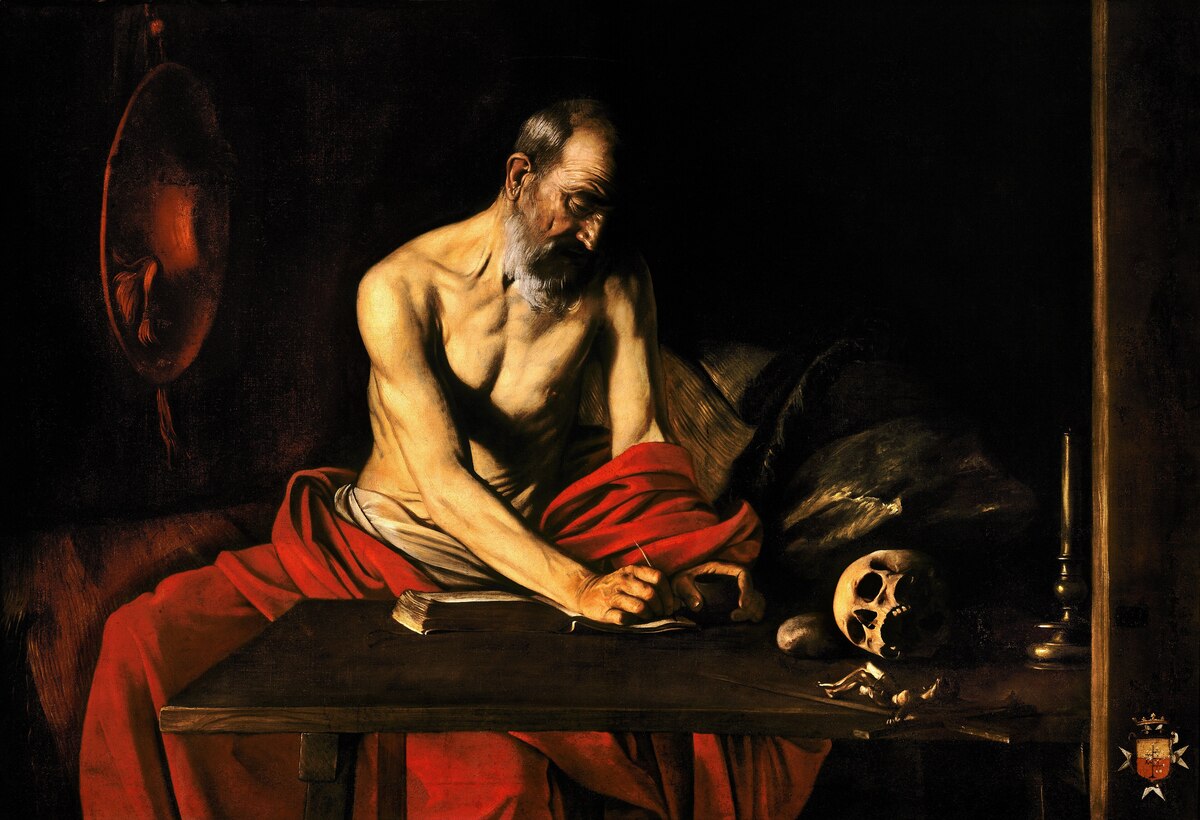
You are looking at Saint Jerome Writing, painted by Caravaggio around 1608. The figure is Jerome, the Church father and translator of the Bible, and the sources identify him here as a cardinal of the Church.
The scene shows him seated at a table, writing in a book. Before him lie a skull, a crucifix and a candlestick, the objects that anchor the picture's religious meaning.
Jerome's body occupies the centre of the canvas, but his gaze drops to the open book beneath his hand. He is not posing or addressing us; he is working.
The composition keeps the table edge low and close, so the skull, crucifix and candle press forward into our space. The dark ground around him holds almost no detail, which lets the lit figure carry all the attention.
The skull and the crucifix are traditional companions of Jerome in Christian art. They point to mortality and to the Passion, so the act of writing sits inside a larger meditation on death and salvation.
Caravaggio does not treat these objects as decorative props. Their nearness to the working saint makes the writing itself look like an act of devotion as much as scholarship.
The painting is executed in oil on canvas and measures roughly one and a half metres wide, a scale that would have given the figure real presence in a chapel or devotional setting.
It is dated around 1608, late in Caravaggio's short life, during the period when he was in Malta. He died in 1610.
The work belongs to the collection of St. John's Co-Cathedral in Valletta, Malta, and carries accession number 7895-7896 under Heritage Malta.
Its association with that collection is recorded in the institutional record supplied here; the physical painting is the object we are discussing, not the digital reproduction.
What makes this Jerome feel different from older images of the saint is the absence of a study or a lion, the usual sign of his scholarly and eremitic life.
Instead, Caravaggio gives us a bare table and a body bent to a book. The emphasis falls on the mental labour of translation itself, on a mind working in the dark.
Light enters from the upper left and catches Jerome's shoulder, cheek and hand, while the skull stays half in shadow. That uneven light ties the living scholar and the symbol of death into one visual argument.
His red robe is the strongest colour in the picture and the only large field of saturated tone. It signals his rank as a cardinal while everything around him is reduced to near-monochrome.
So the painting is not simply a portrait of a learned man. It shows Jerome at the moment when study becomes prayer, with mortality and the crucifix close at hand.
Caravaggio's tight framing and dramatic light turn a familiar saint into a figure alone with his book, and the objects on the table carry the meaning that the darkness leaves unspoken.