The Death of Socrates
Artist: Jacques-Louis David · 1787
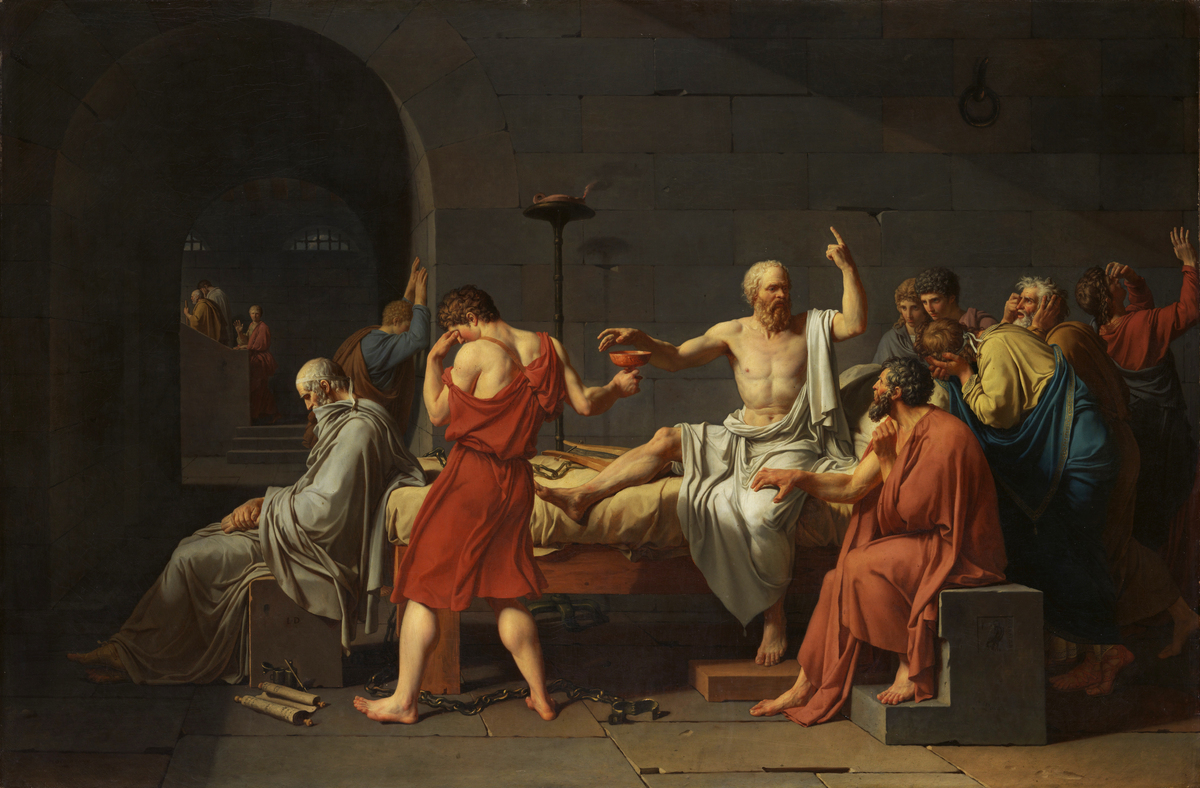
The Death of Socrates: high-resolution image
The highest-resolution file we hold, available without payment or an account.3,896 × 2,559 pixels.
Download highest-resolution imageThe complete story
The story About 4 minutes to read
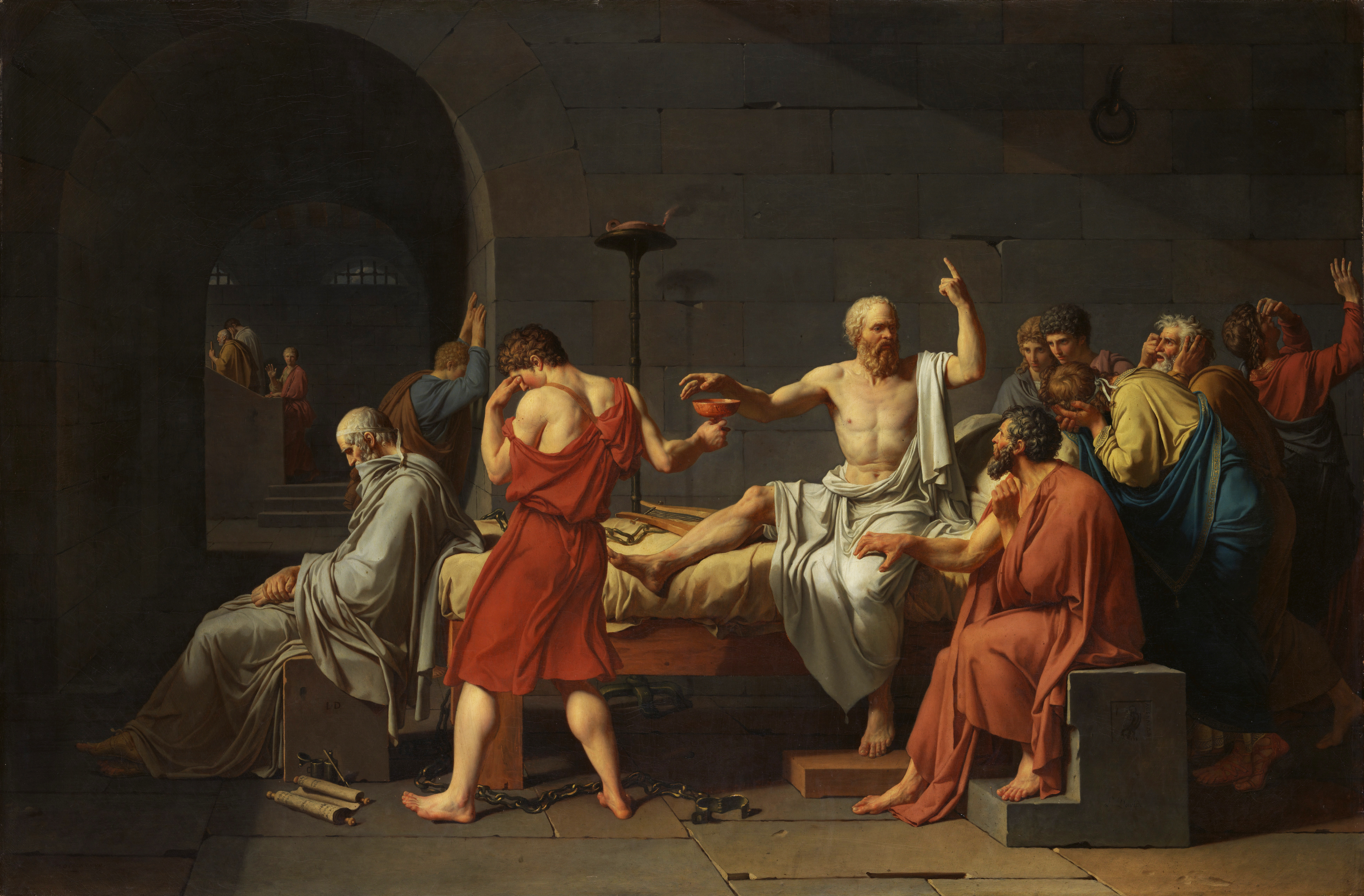
This is Jacques-Louis David's The Death of Socrates, painted in 1787. It shows the last moments of the Athenian philosopher Socrates, condemned to die and about to drink the poison hemlock. Even as death approaches, Socrates stays upright and calm. Around him, his disciples grieve. David painted this scene of ancient philosophy for a Paris audience on the eve of revolution.
Start with Socrates himself, seated on a bed in white robes. One hand reaches toward the cup; the other is raised in a teaching gesture. His body is firm and his expression steady while the men around him collapse into sorrow. The contrast is the engine of the picture. David gives us a teacher whose composure holds the whole room.
Now follow the cup. The servant who hands it to Socrates turns his face away and covers it with his hand. His grief is visible in his body rather than his face. He cannot watch what he is doing. That small refusal makes Socrates' own steadiness feel more deliberate.
David worked from Plato's account of Socrates' death, and he consulted Father Jean Adry, a scholar of Greek antiquity, about the circumstances. Curiously, the figure slumped at the foot of the bed is Plato, shown as an elderly man. At the time of Socrates' death, Plato was young. David chose the philosopher as an old man and set his grief into the scene.
The painting was commissioned in 1786 by Charles-Michel Trudaine de la Sablière. It appeared at the Paris Salon of 1787. Its reception was remarkable. The English painter Joshua Reynolds called it the greatest work of art since the Sistine Chapel and Raphael's Stanze. Thomas Jefferson, then American minister to France, judged it the best work at the Salon.
So the calm at the center is not simply a portrait of a brave man. It is a picture about how philosophy should meet death. Socrates teaches while his followers fall apart. The composition places him highest and most still. David asks us to admire restraint, and to see the grief around him as the human cost of that restraint.
David signed the painting twice, with his full name under Crito and his initials under Plato. Those small marks tie the artist to the scene of mourning and to the tradition of philosophy. The Death of Socrates is finally about a choice: to face death with a clear mind, and to leave that example to those who must watch.
The story and its sources
Historical claims are linked to the records below. Close looking and interpretation are identified in the passage notes.
- Passage 1Documented historyThe Death of SocratesWikipedia fallback: The Death of Socrates
- Passage 2Close lookingWikipedia fallback: The Death of Socrates
- Passage 3Close lookingWikipedia fallback: The Death of Socrates
- Passage 4Documented historyWikipedia fallback: The Death of Socrates
- Passage 5Documented historyWikipedia fallback: The Death of Socrates
- Passage 6InterpretationWikipedia fallback: The Death of Socrates
- Passage 7InterpretationWikipedia fallback: The Death of Socrates
Details to notice
About 3 minutes to readDiscarded chains and scroll
Broken shackles and a scroll on the stone floor at the foot of the bed, symbols of imprisonment and philosophical writing.
Archway with Xanthippe
Distant archway and stairs where a woman, traditionally Xanthippe, is led away, framed by the vaulted prison architecture.
Grieving followers
Cluster of disciples on the right gesturing in lament and turning away, expressing collective grief.
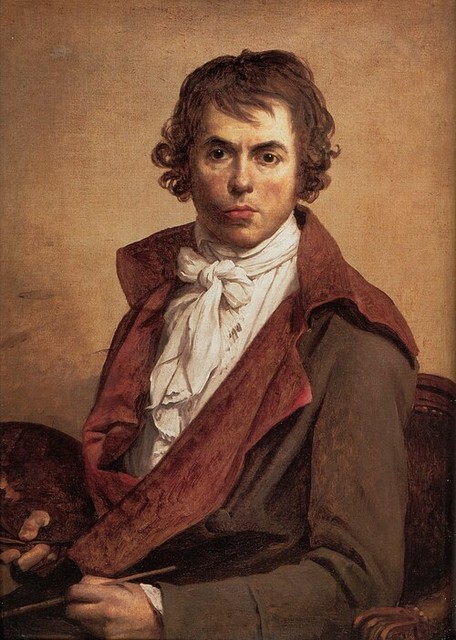
Artist portrait Image credit
Jacques-Louis David. Image source · Public domain
About the artist
Jacques-Louis David
1748 to 1825
Jacques-Louis David was a French painter (1748–1825). Their work is associated with Neoclassicism. Their recorded places of work include Brussels; Paris; Rome.
- Born
- 1748
- Died
- 1825
- Nationality
- France
- Birthplace
- Paris
- Died in
- Brussels
Biography sources
The research & record
Study the work.
Follow the evidence.
Find catalogue details, historical context, technical research and the literature behind this artwork.
The artwork record
Research catalogue
Catalogue information and detailed research, with references that link to the bibliography.
Updated .
Identity and catalogue
Link- Title
- The Death of Socrates
- Artist or attribution
- Jacques-Louis David
- Object date
- 1787
- Medium and support
- Oil on canvas
- Current collection or location
- Metropolitan Museum of Art, New York
- Movement or period
- Neoclassical
- Country or culture
- French
- Depicted subject
- The final moments of the Athenian philosopher Socrates, who drinks hemlock poison after his conviction. Socrates remains calm and teaches even as death approaches, while his disciples grieve around him.
- Dimensions
- Unknown
Read valuation records and their limitations
Title, attribution and date
The Metropolitan Museum of Art catalogues this painting under the title The Death of Socrates and attributes it to Jacques Louis David, dating it to 1787. That date belongs to the object's creation, established on the museum's authority, and it should be kept distinct from the much later dates attached to the work's documentation, publication and accession. The subject, the last moments of the Athenian philosopher Socrates before he drinks the poison hemlock, is named plainly in the title rather than in a descriptive subtitle, so the catalogue identity of the picture rests on the confrontation between a named historical individual and his death.(The Metropolitan Museum of Art, n.d.)
Jacques Louis David painted The Death of Socrates in 1787.(The Metropolitan Museum of Art, n.d.)
Subject and iconography
LinkRead valuation records and their limitations
The recorded composition
Visual observation
The visible action of The Death of Socrates is organized around a seated figure in white robes, upright on a bed, one hand extended toward the cup and the other raised in a gesture of teaching. He remains calm while the disciples around him grieve. The composition thus sets stillness and outward composure against surrounding distress, and the contrast is readable directly from pose and dress before any identification is attached to the figures. This is a description of what the evidence records in the picture, not an inference about the sitter's inner state.(Wikipedia fallback: The Death of Socrates, n.d.)
The cup and its bearer
The cup is the pivot of the action, and its handling carries much of the picture's emotional charge. The man who offers the cup looks away and covers his face with his hand, so that grief at his own role is expressed through the body rather than the countenance. Because he will not watch what he is doing, the seated figure's steadiness reads as deliberate rather than merely passive. The detail is small in scale but central to how the scene's meaning is staged.(Wikipedia fallback: The Death of Socrates, n.d.)
The figure of Plato
At the foot of the bed is a figure identified as Plato, depicted as an elderly man slumped and looking into his lap. The source account notes a qualification: historically Plato was a young man at the time of Socrates' death, so the aged figure is a departure from chronological fact rather than a portrait of the historical moment. The evidence records this as an observation about how the figure is shown and as a known discrepancy, and it does not supply a reason for the choice. The identification of this figure as Plato, and the role assigned to the aged figure within the scene of grief, remain attributed to the source account rather than established here.(Wikipedia fallback: The Death of Socrates, n.d.)
Interpretation
David's signature occurs twice: his full signature beneath the figure of Crito and his initials beneath Plato. The evidence states that each carries symbolic meaning but does not specify what that meaning is, so the double signing can be reported as a documented feature of the surface while its interpretation is left open. Read alongside the slump of the aged Plato and the composure of the central figure, the two marks sit at the poles of the scene, linking the artist's name to both the mourning witness and the philosophical tradition. That reading is an interpretive synthesis of documented details, not a statement of David's stated intent.(Wikipedia fallback: The Death of Socrates, n.d.)
Visual observation
Socrates is depicted in white robes, seated upright on a bed with one hand extended toward the cup and the other gesturing in teaching. He remains calm while surrounded by grieving disciples.(Wikipedia fallback: The Death of Socrates, n.d.)
The man handing the cup looks away with his face in his hand, expressing grief at his role.(Wikipedia fallback: The Death of Socrates, n.d.)
Plato is depicted as an elderly man slumped at the foot of the bed, looking into his lap, though historically he was a young man at Socrates' death.(Wikipedia fallback: The Death of Socrates, n.d.)
David's signature appears in two places: his full signature under Crito and his initials under Plato, each with symbolic meaning.(Wikipedia fallback: The Death of Socrates, n.d.)
Historical context
LinkRead valuation records and their limitations
Commission and the Paris Salon
The Death of Socrates was painted in 1787 and first shown at the Paris Salon of that same year. The commission behind it is recorded as having come in 1786 from Charles-Michel Trudaine de la Sablière, identified as the youngest son of Trudaine de Montigny. These two dates, the 1786 commission and the 1787 debut, frame the work's making and its entry into public view, and they establish that the picture was a commissioned venture for a named patron before it became a Salon exhibit. The evidence links the patron to a specific family line rather than describing the household more fully, so the social world around the commission can be named but not reconstructed in detail from these units alone.(Wikipedia fallback: The Death of Socrates, n.d.)
Visual observation
The records note that David consulted Father Jean Adry, described as a Hellenist scholar, on the circumstances of Socrates' death while the painting was in creation. This consultation places the work within a practice of antiquarian research: the artist sought scholarly guidance on the historical episode rather than relying only on a received literary image. The evidence does not preserve the content of Adry's advice, nor does it claim that his counsel determined the composition. What it establishes is the relationship between painter and scholar as part of the making of the picture, and that relationship bears on how the scene's details are treated, since the painting departs in at least one prominent respect from the historical chronology of the philosophers involved.(Wikipedia fallback: The Death of Socrates, n.d.)
Reception in 1787
The reception at the Salon of 1787 is documented through two notable witnesses. Joshua Reynolds is recorded as writing that The Death of Socrates was the greatest work of art since the Sistine Chapel and Raphael's Stanze in the Vatican, and Thomas Jefferson, then American minister to France, is recorded as judging it the best work at that Salon. These are contemporary or near-contemporary evaluations attributed to named individuals, one a leading English painter and the other an American diplomat in Paris, and they show the painting's standing among viewers of different national positions. They are testimonies to reputation, not technical descriptions of the canvas, and the evidence does not report the exact wording of Jefferson's judgment beyond its sense.(Wikipedia fallback: The Death of Socrates, n.d.)
Visual observation
The admiration recorded by Reynolds and Jefferson attaches to a composition whose central figure is described as Socrates in white robes, seated upright on a bed, one hand extended toward the cup and the other gesturing in teaching, calm amid grieving disciples. The man handing the cup is described as looking away with his face in his hand, expressing grief at his role. These are observations of the painted surface, and they connect the documentary record of reception to what viewers at the Salon would have seen: a contrast between the composure of the condemned philosopher and the distress of those around him. The evidence documents the praise without asserting that the formal contrast caused it, though the two accounts concern the same exhibited object.(Wikipedia fallback: The Death of Socrates, n.d.)
Figures and authorship
A significant departure from the historical situation is recorded in the identification of Plato. He is described as depicted as an elderly man slumped at the foot of the bed, looking into his lap, although historically he was a young man at the time of Socrates' death. The evidence presents this as an observation of the painting paired with the historical qualification, without explaining the reason for the choice. Set beside the consultation with Father Adry, the point shows that scholarly advice and pictorial invention coexisted: knowledge of the ancient circumstances did not oblige chronological accuracy in the figure of Plato. The discrepancy is thus part of the documented record of the work rather than an error to be resolved, and any account of the painting's intellectual program has to accommodate it.(Wikipedia fallback: The Death of Socrates, n.d.)
Interpretation
Taken together, the evidence supports a reading of the painting as a commissioned Salon work of 1787 whose making included consultation with a named Hellenist and whose public reception was recorded by Reynolds and Jefferson in strong terms. The documented circumstances are the 1786 commission from Charles-Michel Trudaine de la Sablière, the 1787 exhibition, the advice of Father Jean Adry, and the two signatures. What the evidence does not supply are the patron's reasons for the commission, the terms of the agreement, or an account of how the painting left the family; these remain outside the record given here. The object's importance for a larger history lies in the convergence of antiquarian research, a deliberately composed scene of philosophical calm and surrounding grief, and a reception that placed it among the admired works of its moment, while the discrepancies and silences in the surviving account remind us that reputation and documentation are not the same thing.(Wikipedia fallback: The Death of Socrates, n.d.)
The painting was created in 1787 and debuted at the Paris Salon of 1787.(Wikipedia fallback: The Death of Socrates, n.d.)
Joshua Reynolds wrote that The Death of Socrates was 'the greatest work of art since the Sistine Chapel and Raphael's Stanze in the Vatican.'(Wikipedia fallback: The Death of Socrates, n.d.)
Thomas Jefferson, American minister to France, wrote that the painting was the best work at the Salon of 1787.(Wikipedia fallback: The Death of Socrates, n.d.)
David consulted Father Jean Adry, a Hellenist scholar, on the circumstances of Socrates' death during the painting's creation.(Wikipedia fallback: The Death of Socrates, n.d.)
Provenance and ownership
LinkRead valuation records and their limitations
Documented Ownership and Transfer
The documented history of ownership for Jacques-Louis David's The Death of Socrates begins not with a dealer, a Salon jury, or an institutional purchase, but with a private commission. The painting was commissioned in 1786 by Charles-Michel Trudaine de la Sablière, the youngest son of Trudaine de Montigny. That single recorded fact places the work's origin within a specific named patron and an identifiable family context in ancien régime France, and it establishes that the picture was conceived as a commission before it entered the public sphere. The commission date of 1786 also runs slightly ahead of the work's completion and presentation: the painting was created in 1787 and debuted at the Paris Salon of 1787, so the interval between the 1786 commission and the 1787 Salon frames the period of execution and the moment the work moved from a private arrangement into public exhibition.(Wikipedia fallback: The Death of Socrates, n.d.)
The Unrecorded Interval
The surviving evidence establishes a substantial gap between the 1786 commission and the painting's arrival at the Metropolitan Museum of Art in 1931, where, according to the same account, it has remained. No intermediate owner, sale, bequest, or transfer is recorded in the supplied units for that long interval. The record should preserve that distinction carefully: the absence of documented transactions between the Trudaine commission and the 1931 museum transfer is an unrecorded interval, not proof that ownership was unchanged, and it is not the same as a proven change of ownership. What can be stated is the pair of documented endpoints, a private commission in 1786 and a museum holding from 1931 onward, with the connecting history left open by the evidence available. The 1931 date is itself part of the object's institutional biography, marking the transition from private possession into a public collection where the painting could be studied, reproduced, and interpreted by later audiences.(Wikipedia fallback: The Death of Socrates, n.d.)
The painting was commissioned in 1786 by Charles-Michel Trudaine de la Sablière, the youngest son of Trudaine de Montigny.(Wikipedia fallback: The Death of Socrates, n.d.)
Provenance timeline
- 1786
The painting was commissioned by Charles-Michel Trudaine de la Sablière, the youngest son of Trudaine de Montigny.(Wikipedia fallback: The Death of Socrates, n.d.)
- 1787
The painting was created and debuted at the Paris Salon of 1787, where Thomas Jefferson, American minister to France, wrote that it was the best work at the Salon.(Wikipedia fallback: The Death of Socrates, n.d.)
Collection and display
LinkRead valuation records and their limitations
From private commission to museum collection
The painting now known as The Death of Socrates entered the Metropolitan Museum of Art in 1931 and has remained there since. That single documented transfer date is the only later collection fact established by the supplied evidence; the account does not record intermediate owners, sale terms, dealers, or the circumstances under which the work left the family of its 1786 commissioner, Charles-Michel Trudaine de la Sablière. The 1931 arrival at the Metropolitan therefore marks the end of the documented collecting history in these materials.(Wikipedia fallback: The Death of Socrates, n.d.)
The picture as a constructed historical scene
Interpretation
Within a larger history of art and material culture, The Death of Socrates matters for what these documented facts jointly show: an ambitious salon painting of 1787, made on commission for a named patron, advised by a named scholar, praised by Reynolds and Jefferson, signed twice by its author, and eventually absorbed into a major public collection in 1931. Each of these anchors the object in a distinct institutional world, patronage, scholarship, exhibition, authorship, and the modern museum, and the surviving evidence connects them without filling every gap between them. The painting's history is accordingly best told as a sequence of documented attachments rather than as a continuous narrative, and the gaps, especially in provenance before 1931, remain part of the record this archive must preserve.(Wikipedia fallback: The Death of Socrates, n.d.)
The painting passed to the Metropolitan Museum of Art in 1931, where it has remained.(Wikipedia fallback: The Death of Socrates, n.d.)
Documented values and qualified estimates
LinkRead valuation records and their limitations
Recorded values
Interpretation
The recorded values attached to this object are documentary and institutional rather than market facts. The only value statement in the supplied evidence is a calculated working insurance estimate, generated on 2026-06-05, giving an estimated working range of US$80M to US$200M. Its own qualification is explicit: it is a model-generated reference range for manual review, not an official appraisal, insurance valuation, auction estimate or sale price, and its authors state that actual insurable value may differ materially depending on condition assessment, conservation records and current market conditions not available in the analysis. Any use of the figure in an art-historical account should therefore be treated as a working hypothesis about institutional-scale significance, not as a price.(Wikipedia fallback: The Death of Socrates, n.d.)
The range's stated methodology is itself a compact statement of why the painting is treated as canonical. The calculation lists six inputs: the artist Jacques-Louis David as a canonical Neoclassical master; the date 1787, with exhibition at the Paris Salon in the same year and historical acclaim as David's masterwork; oil on canvas at monumental history-painting scale; institutional status as held by the Metropolitan Museum of Art since 1931, described as among the world's most significant public collections; historical prominence, including Joshua Reynolds's description of the work as the greatest since the Sistine Chapel and an exhibition history extending from the 1791 Salon to an 1826 fundraiser for the Greek War of Independence; and provenance documented from private commission through multiple recorded owners to institutional custody. The range is described as reflecting upper-tier Old Master museum holdings with established historical significance and secure institutional location, adjusted conservatively below hypothetical auction scenarios because of museum status and restricted availability.(Wikipedia fallback: The Death of Socrates, n.d.)
Read closely, that methodology shows how valuation reasoning reuses the same evidence that supports the object's art-historical account: the 1786 commission by Charles-Michel Trudaine de la Sablière, the 1787 Paris Salon debut, Reynolds's comparison with the Sistine Chapel and Raphael's Stanze, Thomas Jefferson's judgement that it was the best work at the 1787 Salon, and the transfer to the Metropolitan Museum of Art in 1931. The 1791 Salon and 1826 Greek War of Independence fundraiser appear in the valuation record as exhibition history but are not otherwise documented in the supplied evidence, so they should be cited with that limitation. The value range is thus a downstream inference from reception and custody, not independent proof of either quality or price.(Wikipedia fallback: The Death of Socrates, n.d.)
Working estimate
Calculated working insurance estimate, not a sale price: Estimated working range: US$80M to US$200M Recorded date: Working calculation, generated 2026-06-05. Methodology: Conservative working range calculated for insurance review based on: (1) Artist: Jacques-Louis David, canonical Neoclassical master; (2) Date: 1787, exhibited Paris Salon same year, historically acclaimed as David's masterwork; (3) Medium and scale: Oil on canvas, monumental history painting; (4) Institutional status: Held by Metropolitan Museum of Art since 1931, among world's most significant public collections; (5) Historical prominence: Described by Joshua Reynolds as 'greatest work of art since the Sistine Chapel'; exhibition history includes 1791 Salon and 1826 Greek War of Independence fundraiser; (6) Provenance: Documented from private commission through multiple recorded owners to institutional custody. Range reflects upper-tier Old Master museum holdings with established historical significance and secure institutional location, adjusted conservatively below hypothetical auction scenarios given museum status and restricted availability. Qualification: This is a model-generated working insurance range for manual review only. It is not an official appraisal, insurance valuation, auction estimate, or sale price. This calculation uses public sources and institutional context to establish a conservative reference range and should be validated by qualified insurance appraisers, auction specialists, and museum experts before any insurance decision or claim. Actual insurable value may differ materially based on condition assessment, conservation records, and current market conditions not available in this analysis.(Wikipedia fallback: The Death of Socrates, n.d.)
Further reading
Books for a closer look
Paid links. As an Amazon Associate I earn from qualifying purchases.

Open Library Jacques-Louis David: empire to exile
Yale University Press
A catalogue of writings on David with subject headings on Classicism in art and on David himself, relevant to the artist and the neoclassical mode of The Death of Socrates. It is not an object-specific study of this painting, so its relevance is at the artist and movement level.
ISBN 0300104472
Bibliography
Sources and further reading
References are arranged by author or organisation, with links to the original publications. Where no publication date is recorded, n.d. means no date.
Source notes updated .
No recorded sources match these filters. Reset the filters to see the full bibliography.
- 03
Book
Jacques-Louis David: empire to exile. Yale University Press.
A catalogue of writings on David with subject headings on Classicism in art and on David himself, relevant to the artist and the neoclassical mode of The Death of Socrates. It is not an object-specific study of this painting, so its relevance is at the artist and movement level.
- ISBN
- 0300104472
Citation text
- 01
Official
Citation text
- 02
Secondary
Wikipedia fallback: The Death of Socrates (n.d.). Wikipedia.
Citation text
Art to live with
Bring this painting
home.
A piece of the archive, made yours. Explore The Death of Socrates in a size and finish that fits your space.
Your text and annotations appear on these editions. Adding to cart saves that design for printing.
Combine this painting with your favourites01 / Find your edition
Made for you
Suggested from your location. Change it if you're sending elsewhere or using a VPN. Prices and delivery are shown in GBP.
1 product
Choose an edition to make it yours
iPhone 12 Mini ? Glossy ? back view
iPhone 12 Mini · Glossy

iPhone 12 Mini ? Glossy ? back view

iPhone 12 Mini ? Glossy ? back view

iPhone 12 Mini ? Glossy ? back view
Tough phone case
GBP 16.40
Delivery GBP 4.25 / Total GBP 20.65
A two-layer phone case with a printed polycarbonate shell and a shock-absorbing inner liner.
Two layers with a shock-absorbing TPU liner
Case & print details
- Device
- Apple · iPhone 12 Mini
- Material
- Polycarbonate shell with a TPU inner liner
- Artwork
- Outer back and wrapped edges from one template
- Finish
- Glossy
- Version
- Standard version
- Printing
- Dye sublimation
- Print file
- 1,122 × 1,831 px · 95 × 155 mm · PNG · 300 dpi recommended
Rear outline and camera openings follow this variant's Printify template. Case depth and small hardware remain illustrative.
Supplier product detailsFit and fill keep the painting’s proportions. Stretch changes them.
Move and zoom the painting on your tough phone case.
Made to order with your design
Made to order
US delivery only
The 30 cm ruler is scaled alongside your selected print. Keep the painting’s proportions with a black background, or stretch it to fill. Frame width, material texture and screen colours are illustrative.
Keep exploring