Identity and catalogue
Link- Country or culture
- French
- Depicted subject
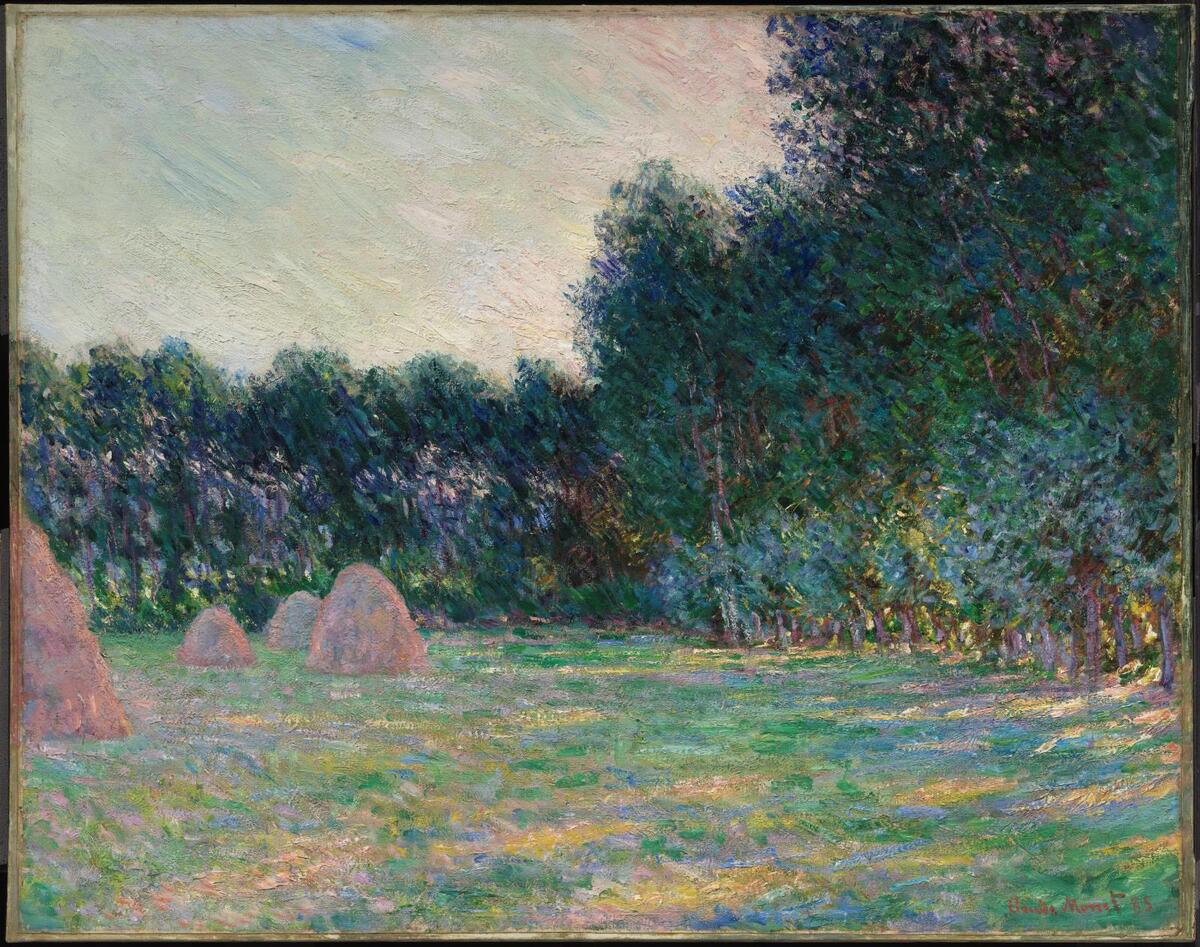
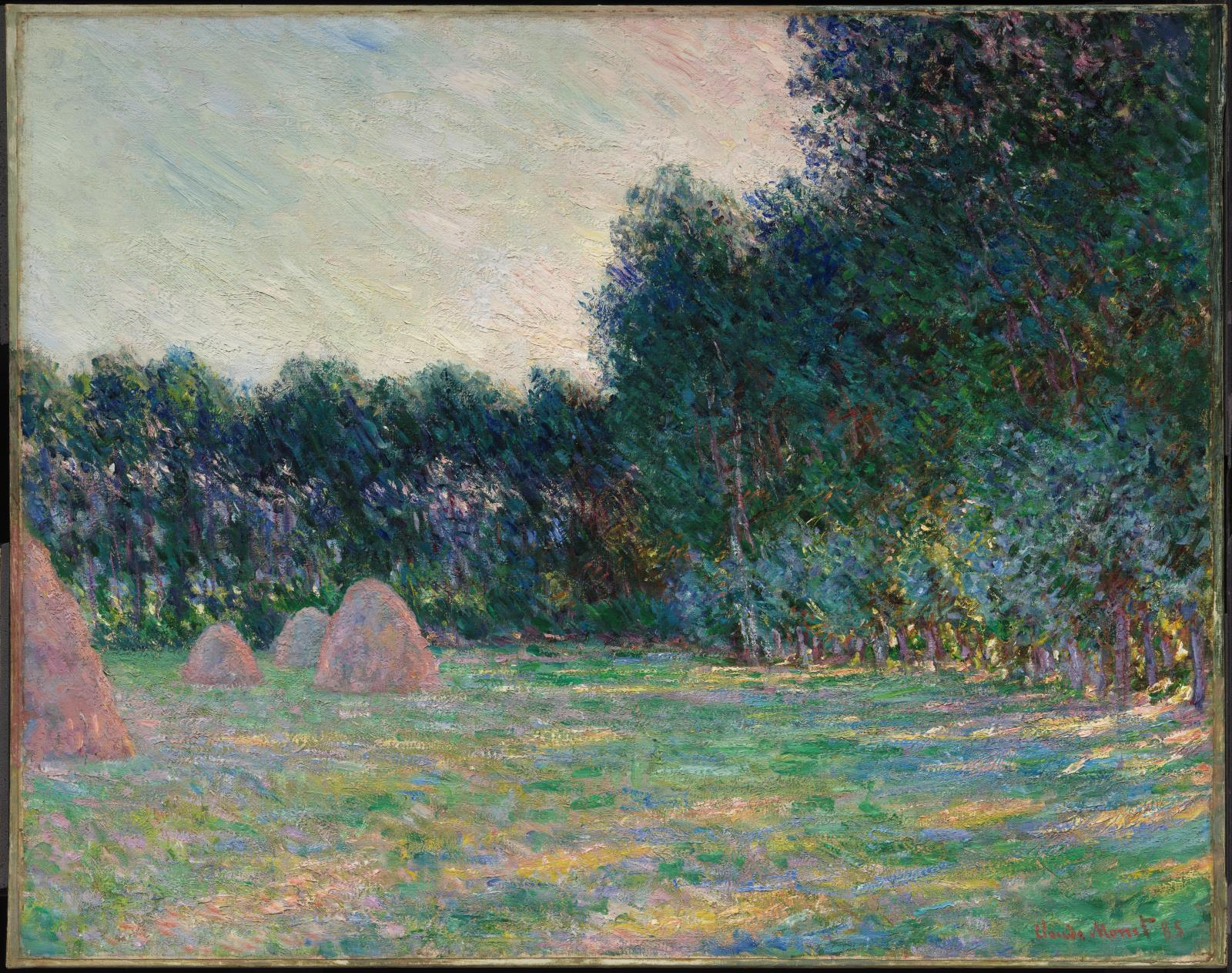
- A meadow near Giverny with rounded haystacks standing in the middle distance, painted in 1885. The work depicts a harvested field with haystacks as its identifying motif, framed by meadow grass in the foreground and a stand of trees along the right edge.(Wikimedia Commons: Haystacks, n.d.)
- Accession number
- 42.541
- Support
- Canvas
Catalogue identification
The object is catalogued as Meadow with Haystacks near Giverny, with the French title recorded as Prairie aux meules près de Giverny. Both titles are supplied by the same Wikimedia Commons record, which also carries the attribution to Claude Monet. The painting is dated 1885, and it is described as depicting a meadow with haystacks near Giverny, the village where Monet lived and worked. In this record the subject and the place name are fused into the title itself, so the catalogue entry already asserts a connection between what is shown and where it was made. The subject is given as a meadow with haystacks, and the setting is the village of Giverny rather than an unspecified field.(Wikimedia Commons: Haystacks, n.d., Summary section)
The summary section gives the dimensions as height 74 cm and width 93.5 cm, a landscape format wider than it is tall. The same source supports the medium as oil on canvas, and it places the painting in the collection of the Museum of Fine Arts, Boston, with accession number 42.541; the museum is recorded as located in Boston, Massachusetts, and its object ID for the work is 32851. A further catalogue reference is supplied: the work appears in the Monet catalogue raisonné as number 995. The source photograph of the painting is credited to the Museum of Fine Arts, Boston object page, which the record treats as indicating the museum holds the work. That credit concerns the photograph and the holding institution as reported; it is a documented collection location in this record rather than an independent confirmation of physical custody.(Wikimedia Commons: Haystacks, n.d., Summary section)
Object date and catalogue dates
Interpretation
The date 1885 belongs to the making of the painting, and the record distinguishes it from later documentation of the object. The Wikimedia Commons file page was uploaded on 3 June 2019 by user Maltaper, and the file carries a Creative Commons Attribution-Share Alike 4.0 International licence. The original image file is 1,600 by 1,263 pixels, 457 KB, in JPEG format. These are facts about the digital surrogate and its publication history, not about the canvas, and they should not be folded into the object's own chronology. The same distinction applies to the catalogue raisonné number 995 and to the accession number 42.541: they are identifiers assigned by later documentation systems, whereas 1885 is the date attached to the work's creation.(Wikimedia Commons: Haystacks, n.d., Summary section)
Grouping and series membership
Grouping is part of the catalogue record. Wikimedia Commons categorises the painting as a painting of meadows in Giverny by Claude Monet and as part of the group Haystacks by Claude Monet. The structured data on Wikidata marks the depicts value as Meadow with Haystacks near Giverny and Haystacks, and records the main subject as Meadow with Haystacks near Giverny. These are catalogue assignments made by the hosting platforms. They place the picture within a recurring subject in Monet's work, and they also show that the same object can carry both a singular title and a membership in a larger series, with the group label and the title overlapping in the structured data.(Wikimedia Commons: Haystacks, n.d., Categories section; Summary section)
Interpretation
The digital record has its own afterlife. The image file is used on Wikipedia pages listing paintings by Claude Monet in several languages, so the object circulates through list pages as well as through its own file page. This circulation is a fact about how the painting is encountered and indexed, and it reinforces the identification already given by the title, attribution, date, medium, dimensions, collection and catalogue number. The Wikimedia Commons file page provides the primary identification and catalogue details for the work, including title, artist, date, medium, dimensions, collection, accession number and catalogue raisonné reference, with the file crediting the Museum of Fine Arts, Boston as the source photograph. Read together, these units show a stable core of identification carried across a platform record, a museum object page and list pages in multiple languages.(Wikimedia Commons: Haystacks, n.d., Summary section)
Subject and iconography
LinkSubject and basic identification
Visual observation
The subject recorded for this canvas is a meadow with haystacks near Giverny, and the object is attributed to Claude Monet, a French painter and graphic artist born in Paris on 14 November 1840 and dead at Giverny on 5 December 1926. Giverny is the village where Monet lived and worked, and the same source describes the painting as depicting a meadow with haystacks near that village, so the setting named in the title is the place from which the motif is said to have been taken. The medium is oil on canvas. The work's period is identified as the Impressionism era, and it is dated 1885.(Wikimedia Commons: Haystacks, n.d., Summary section)
Interpretation
The structured metadata attached to the file records the depicts value as both Meadow with Haystacks near Giverny and Haystacks, and separately records the main subject as Meadow with Haystacks near Giverny. Read together with the prose identification of the primary subject as a meadow with haystacks near Giverny, these entries show a subject description that carries two levels at once: the specific field near Giverny, and the wider haystack motif. That double description matters for how the picture is grouped, because it is the point at which the individual canvas and the broader series meet in the record. It is a statement about cataloguing categories as much as about the painted surface, and the two structured values should not be collapsed into one another, since one names a place and the other names a type of subject.(Wikimedia Commons: Haystacks, n.d., Structured data section; Summary section)
What the visual evidence supports
Visual observation
The supplied record does not describe the internal arrangement of the composition, so what can be said about looking at this canvas is limited to what the evidence establishes about the subject: a meadow, haystacks, and a location near Giverny. The identification of the primary subject and of the depicts value rests on the same source, and it concerns what is represented rather than how the paint is handled, how the field is laid out, or where the stacks stand in relation to the horizon. Any account of depth, of a band of stacks in the middle distance, of trees at the right edge, or of foreground grass would go beyond the units supplied here, and the record should not be asked to carry claims it does not make.(Wikimedia Commons: Haystacks, n.d., Summary section; Structured data section)
The artist and the place of the work
Claude Monet, born in Paris on 14 November 1840 and dead at Giverny on 5 December 1926, is identified in the supplied record as a French painter and graphic artist. The same record describes his working life as peripatetic, listing Paris, Argenteuil, Vétheuil, Poissy, Giverny, Honfleur, Trouville, Amsterdam, Oegstgeest, Sassenheim, The Hague, Zaandam and London among the places where he worked. That list matters for reading Meadow with Haystacks near Giverny because it establishes Giverny as one station within a long itinerant career rather than as a fixed point of origin: by the date carried by this canvas, the artist had already moved through several of the other named locations. The painting's subject, a meadow with haystacks near Giverny, is described in the same summary as the village where Monet lived and worked, so the depicted field belongs to the immediate setting of his residence at the time rather than to a site visited in passing. The record further assigns Monet's work period to the Impressionism era, a period label that frames the picture within a recognised movement rather than serving as the artist's own statement of affiliation.(Wikimedia Commons: Haystacks, n.d., Summary section)
Cataloguing the object
The cataloguing of the painting on Wikimedia Commons places it in two overlapping groupings: as a painting of meadows in Giverny by Claude Monet, and as part of the group Haystacks by Claude Monet. These are catalogue categories rather than properties announced by the canvas, and the distinction is worth keeping. The first grouping ties the picture to a place, Giverny, and to a genre of landscape subject, the meadow. The second ties it to a recurring motif, the stack of harvested hay, that the record treats as a series-like group within Monet's output. The photographic source of the file is credited to the Museum of Fine Arts, Boston object page, which indicates that the museum holds the work; this is the point at which the object's documented institutional location and its digital catalogue record meet. Because the supplied evidence is a Commons file page rather than the museum's own documentation, the collection and its details rest on this derivative record, a qualification that should be retained alongside the facts themselves.(Wikimedia Commons: Haystacks, n.d., Categories section; Summary section)
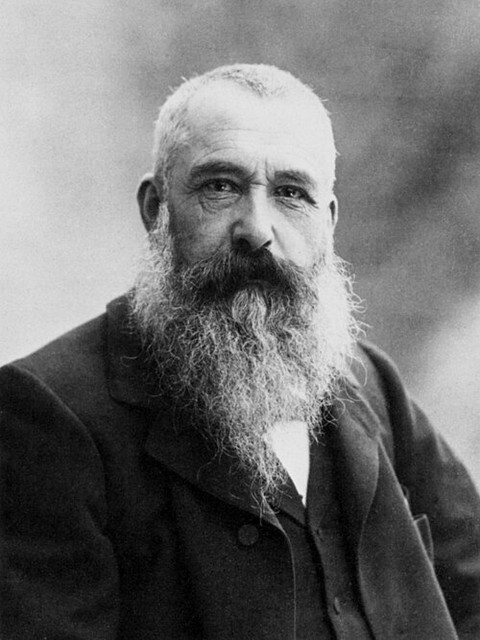
Claude Monet was a French painter and graphic artist, born 14 November 1840 in Paris and died 5 December 1926 in Giverny.(Wikimedia Commons: Haystacks, n.d.)
Monet worked in Paris, Argenteuil, Vétheuil, Poissy, Giverny, Honfleur, Trouville, Amsterdam, Oegstgeest, Sassenheim, The Hague, Zaandam and London.(Wikimedia Commons: Haystacks, n.d.)
The painting depicts a meadow with haystacks near Giverny, the village where Monet lived and worked.(Wikimedia Commons: Haystacks, n.d.)
Monet's work period is identified as the Impressionism era.(Wikimedia Commons: Haystacks, n.d.)
The painting is categorised on Wikimedia Commons as a painting of meadows in Giverny by Claude Monet, and as part of the group Haystacks by Claude Monet.(Wikimedia Commons: Haystacks, n.d.)
Materials and technique
LinkDocumented support and medium
The evidence supplied for this section establishes the physical constitution of the work in a single documented statement: the medium is oil on canvas. This entry, recorded in the summary section of the Wikimedia Commons record for the painting, is the only unit in the supplied evidence that addresses material support and medium directly. It identifies both a paint medium, oil, and a support, canvas, without specifying canvas weave, weight, tacking margins, ground or preparatory layer, priming colour, paint brand, palette, varnish, or any conservation treatment. The descriptive record therefore establishes what the object materially is at the level of medium and support, and leaves the finer material history unaddressed in the available evidence. The same record supplies the dimensions that accompany this medium: a height of 74 cm and a width of 93.5 cm. Those measurements situate the canvas among the horizontally oriented field paintings of its moment, and they are part of the object's documented physical identity rather than a visual inference from reproduction. No technical examination report, pigment analysis or imaging study is represented among the supplied units, so claims about how the paint was layered or which pigments were used cannot be made from this evidence.(Wikimedia Commons: Haystacks, n.d., Summary section)
Visual observation
What can be seen differs in kind from what the records document. The supplied observation that the primary subject of the painting is a meadow with haystacks near Giverny describes the depicted motif, and the structured data on Wikidata likewise marks the depicts value as Meadow with Haystacks near Giverny and Haystacks, with the main subject recorded as Meadow with Haystacks near Giverny. These are observations and structured catalogue entries about content; they tell us what the painting represents and how it is indexed, not how it was made. The distinction matters for a materials and technique section because the visible result, a meadow with haystacks, is the outcome of an oil on canvas procedure that the evidence names but does not describe. The inventory nature of the subject is itself part of the material history in a broader sense: a harvested field with stacked hay is a scene of agricultural labour and seasonal timing, and the painting's material existence as a portable oil on canvas is what allows that scene to circulate in a museum collection and in reproduction. The evidence supports the connection between the recorded medium and the recorded subject only at this level of generality; it does not license any claim about pigments chosen to render grass, hay or light.(Wikimedia Commons: Haystacks, n.d., Summary section; Structured data section)
Provenance and ownership
LinkCurrent Repository.
The documentary record for this painting places it in the collection of the Museum of Fine Arts, Boston, with accession number 42.541; the museum is located in Boston, Massachusetts, and its object ID for the work is 32851. The source photograph reproduced on Wikimedia Commons is credited to the Museum of Fine Arts, Boston object page, which is the basis for treating the museum as the holding institution. Chronologically this is the end point of the ownership information currently available: the evidence establishes a present repository and its identifiers, but supplies no earlier owner, dealer, sale or bequest, and no date of entry into the collection. In a provenance account this distinction matters, because an unrecorded interval before the museum's acquisition is not the same as a documented transfer, and nothing in the supplied units records one.(Wikimedia Commons: Haystacks, n.d., Summary section)
The object is titled Meadow with Haystacks near Giverny and is attributed to Claude Monet, with the French title Prairie aux meules près de Giverny. It is dated 1885 and executed in oil on canvas, measuring 74 cm in height by 93.5 cm in width. The work is referenced in the Monet catalogue raisonné as number 995, which is the standard scholarly instrument for identifying and distinguishing works within the artist's oeuvre. These identifications, the catalogue number above all, are what allow a specific canvas to be tracked across institutional records: the accession number, the museum object ID and the catalogue raisonné number are three separate handles on the same physical object, each issued by a different documenting body.(Wikimedia Commons: Haystacks, n.d., Summary section)
Reception and literature
LinkReproduction and Digital Circulation
The digital file that carries this painting into wide circulation has its own documented history, separate from the history of the canvas. The Wikimedia Commons file was uploaded on 3 June 2019 by user Maltaper. It is licensed under Creative Commons Attribution-Share Alike 4.0 International, and the original image file is 1,600 by 1,263 pixels, 457 KB, in JPEG format. The file is also used on Wikipedia pages listing paintings by Claude Monet in several languages. The licensing and upload record matter to reception because they define the conditions under which the image can be copied and reused, while the multi-language usage indicates that this particular photograph of the work circulates as an illustration within catalogue-style listings rather than only as a stand-alone entry. The file information establishes the technical parameters of the reproduction; it does not, by itself, document how the painting was received in its own time.(Wikimedia Commons: Haystacks, n.d., Licensing section; File history section; File information section; File usage on other wikis section)
Collection and display
LinkThe Museum of Fine Arts, Boston record
Meadow with Haystacks near Giverny, dated 1885 and painted in oil on canvas at 74 by 93.5 cm, is recorded in the collection of the Museum of Fine Arts, Boston under accession number 42.541; the museum's own object ID for the work is 32851, and the institution is located in Boston, Massachusetts. These are complementary identifiers rather than competing claims: the accession number is the registration the museum assigns to the object within its holdings, while the object ID is the internal record key for the same entry in the museum's documentation. The Wikimedia Commons file page that supplies them credits its source photograph of the painting to the Museum of Fine Arts, Boston object page, so the descriptive data and the museum's custody of the work arrive together in the same record. Because the source is a Wikimedia Commons file page consulted in part, the collection data should be treated as reported from the museum's object page rather than as a full catalogue entry verified against the museum's own files.(Wikimedia Commons: Haystacks, n.d., Summary section)
Documented values and qualified estimates
LinkObject record and identification
Interpretation
The supplied record identifies the painting as Meadow with Haystacks near Giverny, attributed to Claude Monet, with the French title Prairie aux meules près de Giverny. It is dated 1885, executed in oil on canvas, and measures 74 cm in height by 93.5 cm in width. The work is placed in the collection of the Museum of Fine Arts, Boston, Massachusetts, under accession number 42.541; the museum's own object ID for the work is 32851. The record further locates it in the Monet catalogue raisonné as number 995, and the source photograph of the painting is credited to the Museum of Fine Arts, Boston object page. Monet himself is identified as a French painter and graphic artist, born 14 November 1840 in Paris and died 5 December 1926 in Giverny, and his work period is given as the Impressionism era. The primary subject recorded for the painting is a meadow with haystacks near Giverny, the village where Monet lived and worked.(Wikimedia Commons: Haystacks, n.d.)
Subject, setting and visual structure
The painting's subject is a harvested meadow near Giverny with haystacks standing in the field, and the title derives from those stacks. Within the picture, the haystacks occupy the middle distance and read as a band across the field rather than as a single isolated object of study. A stand of trees runs along the right edge and closes the view on that side, while the foreground holds meadow grass, so that the composition moves the eye from the near ground upward to the stacks. The rounded forms of the stacks hold the middle of the picture; because they sit at a distance they read as part of a working landscape rather than as monuments. The meadow grass in front and the trees at the right keep the scene low and horizontal, asking the viewer to read a wide field rather than a dramatic event. These visual observations are recorded as features of the canvas rather than as documented facts about the artist's intention.(Wikimedia Commons: Haystacks, n.d.)
Catalogue grouping and reception metadata
The record also preserves how the painting has been grouped in cataloguing rather than by the painting itself. Wikimedia Commons categorises it as a painting of meadows in Giverny by Claude Monet and places it within the group Haystacks by Claude Monet; the structured data on Wikidata likewise marks the depicts value as Meadow with Haystacks near Giverny and Haystacks, and records the main subject as Meadow with Haystacks near Giverny. The Wikimedia Commons file page carries its own conditions of circulation: it is licensed under Creative Commons Attribution-Share Alike 4.0 International, was uploaded on 3 June 2019 by user Maltaper, and the original image file is 1,600 × 1,263 pixels, 457 KB, JPEG format. That image is used on Wikipedia pages listing paintings by Claude Monet in several languages. These are facts of documentation and grouping, not claims the painting announces about itself; they show that the field and its stacks belong to a recurring subject in Monet's work, and they situate the object within an accumulating body of catalogue and structured-data records.(Wikimedia Commons: Haystacks, n.d.)
Working insurance estimate and its limits
A separate working calculation records an estimated value for the painting of US$20M to US$60M, generated on 16 October 2026 and explicitly characterised as a conservative working insurance range derived from confirmed context: an authentic Claude Monet oil on canvas, dated 1885, 74 x 93.5 cm, in the collection of the Museum of Fine Arts, Boston (accession 42.541), with catalogue raisonné number 995. The methodology treats the work as a fully attributed Impressionist painting of the artist's mature Giverny period and applies a broad range bracket appropriate to major museum-quality Monet oils of this scale and date, scaled upward for institutional provenance and downward for uncertainty, because no official appraisal, insurance schedule, auction result, or comparable sale was supplied. The calculation is qualified in several ways: it is model-generated and for manual review only; it is not an official insurance value, appraisal, auction result, or sale price; it does not reflect access to private insurance records and claims no comparable sales; and actual insurance values require inspection, provenance review, condition assessment, and a qualified appraiser. The local system sets the price date to the generation date. The estimate therefore stands as an attributed, dated working figure with stated limits, not as a documented market or institutional valuation, and it should be read alongside the object record rather than as independent evidence of the painting's worth.(Wikimedia Commons: Haystacks, n.d.)
Movement and location range
The record of Monet's working life lists Paris, Argenteuil, Vétheuil, Poissy, Giverny, Honfleur, Trouville, Amsterdam, Oegstgeest, Sassenheim, The Hague, Zaandam and London among the places where he worked. Giverny was the setting for this particular field and the haystacks in it, and the painting's date of 1885 places it during the period when Monet was living and working in that village. The breadth of the place list is part of the object's documentary context rather than a description of this canvas, which remains tied to its Giverny subject.(Wikimedia Commons: Haystacks, n.d.)
Working estimate
Calculated working insurance estimate, not a sale price: Estimated value: US$20M to US$60M Recorded date: Working calculation, generated 2026-10-16. Methodology: Working insurance range derived conservatively from confirmed context: an authentic Claude Monet oil on canvas, dated 1885, 74 x 93.5 cm, in the collection of the Museum of Fine Arts, Boston (accession 42.541), with catalogue raisonne number 995. The calculation treats the work as a fully attributed Impressionist painting of the artist's mature Giverny period and applies a broad range bracket appropriate to major museum-quality Monet oils of this scale and date, scaled upward for institutional provenance and downward for uncertainty because no official appraisal, insurance schedule, auction result, or comparable sale was supplied. Values are presented as a wide working range for manual review only. Qualification: This is a model-generated working insurance range for manual review. It is not an official insurance value, appraisal, auction result, or sale price. It does not reflect access to private insurance records, and no comparable sales are claimed. Actual insurance values require inspection, provenance review, condition assessment, and a qualified appraiser. The local system sets the price date to the generation date.(Wikimedia Commons: Haystacks, n.d.)