Identity and catalogue
Link- Object date
- 1836
- Movement or period
- Nineteenth-century American landscape painting
- Country or culture
- United States
- Depicted subject
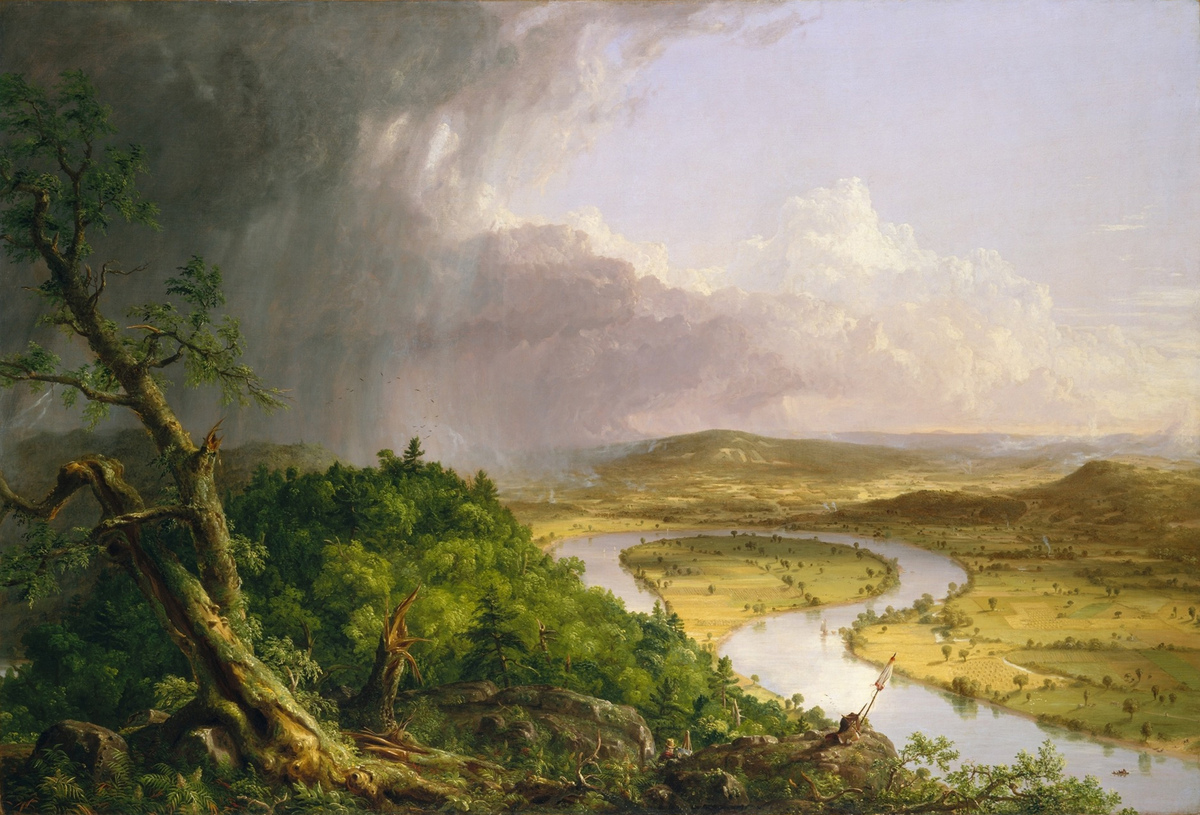
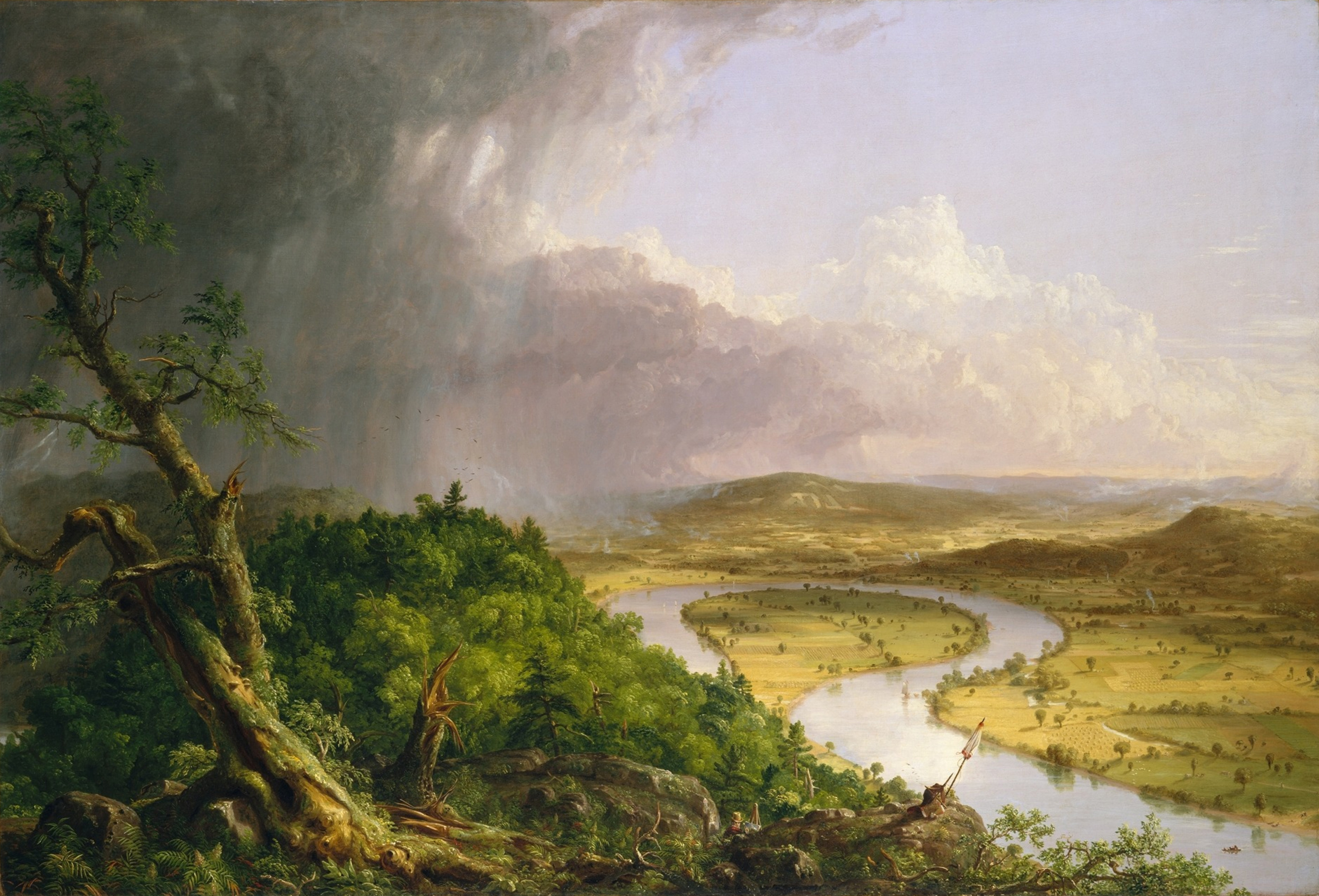
- A wide view from Mount Holyoke in Northampton, Massachusetts, seen just after a thunderstorm has passed. The canvas divides between an untamed, storm-darkened wilderness on the left and a sunlit, cultivated river valley on the right, with a tiny figure of the painter at his easel on the rocky foreground promontory.(Wikimedia Commons: The Oxbow, n.d.)
- Title variants
- The Oxbow; View from Mount Holyoke, Northampton, Massachusetts, after a Thunderstorm, The Oxbow; The Connecticut River near Northampton
- Accession number
- 08.228
- Support
- Canvas
Catalogue record and attribution
The painting carries the title View from Mount Holyoke, Northampton, Massachusetts, after a Thunderstorm, The Oxbow, and Thomas Cole is recorded as its painter, working in 1836. The full title is itself a record of conditions: it states that the view was taken after a thunderstorm and that the artist depicted the landscape from Mount Holyoke. The work is catalogued in the landscape genre, and it depicts the Connecticut River near Northampton, Massachusetts, as seen from that mountain. The canvas measures 130.8 cm high by 193 cm wide, dimensions that place it among large-scale landscape paintings rather than small studio sketches.(Wikimedia Commons: The Oxbow, n.d., File information, Summary; File information, Summary, Object type and Title; File information, Summary, Title)
The painting is titled View from Mount Holyoke, Northampton, Massachusetts, after a Thunderstorm, The Oxbow and was painted by Thomas Cole in 1836.(Wikimedia Commons: The Oxbow, n.d.)
Subject and iconography
LinkComposition and vantage point
Visual observation
The composition of Cole's 1836 canvas is organised as a view, and the surviving record of that view is precise about its parts. The scene shows a wilderness on one side and a cultivated valley on the other, with a tiny figure of the painter at his easel on a rocky foreground promontory and a lightning-struck tree rising along the left edge. Those elements together establish the picture's spatial logic: a foreground promontory from which the prospect opens, a division of the middle distance into two contrasting kinds of land, and a framing motif at the left. The full title records that the view is taken after a thunderstorm and that the artist depicted the landscape from Mount Holyoke, which means the two-part division is presented in the record as a specific place seen at a specific atmospheric moment rather than as a generalised landscape. The observation also locates the painter's own figure inside the scene he depicts, at the rocky edge from which the valley is surveyed, so that the act of looking is represented within the view itself. The title's reference to Mount Holyoke and to the aftermath of a thunderstorm supplies the vantage point and the weather that the visible composition is said to record. The work is an oil painting on canvas, which is the material basis on which these described features are carried. Thomas Cole, the painter named in the title record, was an American painter and illustrator, born 1 February 1801 in Bolton le Moors and died 11 February 1848, working in New York and Catskill. His dates and working places are part of the documented frame around the object, and they establish that the picture belongs to the career of a professional landscape painter active on both sides of the Atlantic world of his birth and his adopted country.(Wikimedia Commons: The Oxbow, n.d., File information, Summary; File information, Summary, Title; File information, Summary, Artist)
Interpretation
The iconographic weight of the scene rests on the contrast between the wilderness and the cultivated valley: the lightning-struck tree belongs to the wilderness side, while the river and its settled valley open toward the light, and the painter's small figure at his easel ties that comparison to the act of looking. In this reading the painting gives both raw nature and land shaped by human settlement their place in a single view, and the artist's position inside the landscape he records makes the moment of observation a subject of the picture rather than an invisible precondition of it. The storm that has just passed is legible in the tree, so the weather named in the title is not only an external circumstance but a visible mark within the composition. This is an interpretation of the visible structure rather than a claim about hidden codes, and it should be held as such: the contrast between the two halves and the presence of the painter are described features, while the meaning assigned to their pairing is a reading that the evidence supports but does not compel. The full title's record of the place and the weather, Mount Holyoke after a thunderstorm, is what allows the visible details to be connected to a documented occasion of depiction. The identity of the painter as Thomas Cole, an American painter and illustrator who worked in New York and Catskill, anchors the picture to a known artistic career without adding intentions that the record does not state.(Wikimedia Commons: The Oxbow, n.d., File information, Summary; File information, Summary, Title; File information, Summary, Artist)
Documented object and recorded view
Visual observation
The object's documented history as a museum work is separate from its painted content but relevant to how it can be studied. The painting is an oil on canvas, and its public domain status rests on the fact that Thomas Cole died in 1848 and the work was published before 1931. Those two facts, the medium and the copyright determination, are the record's account of the physical object and its legal condition, and they do not describe the image itself. The title's record of Mount Holyoke and the post-thunderstorm moment remains the principal evidence connecting the painted view to a named place and time, and it is the title, rather than any statement of the painter's intent, that carries that information. The description of the wilderness and cultivated valley, the painter at his easel, and the lightning-struck tree therefore stands as the observable content of the picture, while the place, the weather and the artist are supplied by the object's own documentation.(Wikimedia Commons: The Oxbow, n.d., File information, Summary; Licensing; File information, Summary, Title; File information, Summary, Artist)
The scene shows a wilderness on one side and a cultivated valley on the other, with a tiny figure of the painter at his easel on a rocky foreground promontory and a lightning-struck tree rising along the left edge.(Wikimedia Commons: The Oxbow, n.d.)
Documented Circumstances and Title
The object's documented title is its most compact statement of circumstance. The full title records that the view is taken after a thunderstorm and that the artist depicted the landscape from Mount Holyoke, so the recorded subject is not a generic prospect but a specified vantage point in western Massachusetts observed under specified recent weather. The painter is Thomas Cole, described in the record as an American painter and illustrator, born 1 February 1801 at Bolton le Moors and died 11 February 1848, who worked in New York and Catskill. Those working places matter to how the commission and later history of the canvas are usually framed: Cole's professional base was the New York art world and the village of Catskill on the Hudson, while the scene itself belongs to the Connecticut River valley. The title thus ties the picture to a place the artist did not inhabit but visited and recorded, and it preserves a meteorological event, the thunderstorm, as part of the subject rather than as mere anecdote.(Wikimedia Commons: The Oxbow, n.d., File information, Summary, Artist; File information, Summary, Title)
Visual observation
The scene as observed shows a wilderness on one side and a cultivated valley on the other, with a tiny figure of the painter at his easel on a rocky foreground promontory and a lightning-struck tree rising along the left edge. These are the visible particulars on which claims about the painting's social world must rest. The title's reference to Mount Holyoke supplies the standpoint, and the easel figure supplies an explicit representation of an artist at work inside the landscape being depicted. Because the record documents observation of these elements rather than the artist's motives, the pairing of wilderness and cultivation, and the placement of the painter's own small figure between them, should be described as visible structure. The storm named in the title is also visible in the lightning-struck tree, so that the weather event the title records has a painted counterpart in the scene rather than surviving only as a phrase in the caption.(Wikimedia Commons: The Oxbow, n.d., File information, Summary; File information, Summary, Title)
Limits of the Recorded Commission History
Interpretation
The documented title and biography frame the painting as a deliberate record of a specific place and moment, but the secure identification of artist, title and subject does not settle every question of commissioning history. The record confirms that Cole painted the landscape from Mount Holyoke and that the view is taken after a thunderstorm, and it confirms his working locations and dates; it does not supply a named patron, a commission contract, a studio price or the circumstances in which the canvas left the artist. The 1908 gift by Mrs. Russell Sage documents one later transfer of ownership, not the sequence of earlier ones. It is therefore possible to speak with confidence about who made the picture, where the artist worked, which mountain and river were depicted, what weather the title records and how the work reached the Metropolitan Museum, while leaving the immediate reasons for its making, the identity of a first owner or buyer and the intervals of its earlier provenance outside what these units establish. Reading the contrast between wilderness and cultivated valley as a commentary on American settlement is an interpretation that the visible structure invites, but the evidence here supports it as a reading of the composition rather than as a documented statement of the artist's intention or that of any patron.(Wikimedia Commons: The Oxbow, n.d., File information, Summary, Artist; File information, Summary, Title; File information, Object history)
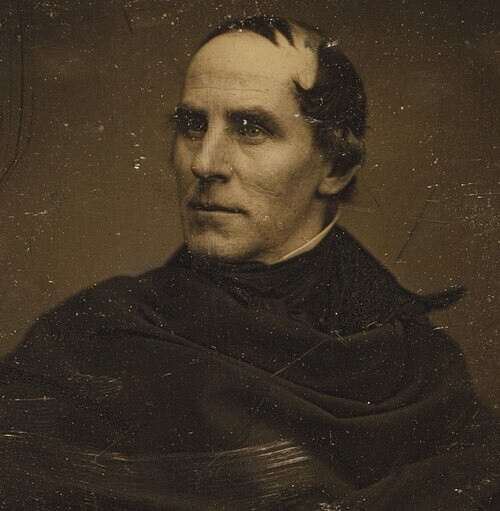
Thomas Cole was an American painter and illustrator, born 1 February 1801 in Bolton le Moors and died 11 February 1848, working in New York and Catskill.(Wikimedia Commons: The Oxbow, n.d.)
The painting’s full title records that the view is taken after a thunderstorm and that the artist depicted the landscape from Mount Holyoke.(Wikimedia Commons: The Oxbow, n.d.)
Provenance and ownership
LinkDocumented Transfer
The documented provenance of the painting begins with its entry into a public collection. In 1908 the work was given to the Metropolitan Museum of Art by Mrs. Russell Sage. That gift is the earliest ownership event recorded in the supplied evidence, and it is also the institutional moment that fixed the picture within a museum context. The evidence identifies the receiving institution as the Metropolitan Museum of Art, Manhattan, New York City, United States, where the canvas is held under accession number 08.228. The accession number is the object's identifying link to that 1908 transfer, so the gift and the registration number describe the same event rather than two separate transactions.(Wikimedia Commons: The Oxbow, n.d., File information, Object history)
The accession number 08.228 and the gift year 1908 belong together as the museum's own record of how the painting arrived. The evidence does not describe any purchase, auction, dealer, or intermediate owner between the painting's creation and Mrs. Russell Sage's gift; the record simply states that the work was given to the Metropolitan Museum of Art by Mrs. Russell Sage in 1908. Because no earlier owner is named in the supplied units, the interval before 1908 remains unrecorded rather than documented as a change of ownership. Treating that gap as an unrecorded interval is more accurate than treating it as a proven series of transfers.(Wikimedia Commons: The Oxbow, n.d., File information, Object history)
Provenance timeline
- 1908
The painting was given to the Metropolitan Museum of Art by Mrs. Russell Sage.(Wikimedia Commons: The Oxbow, n.d., File information, Object history)
Reception and literature
LinkThe Object and the Terms of Its Reception
Visual observation
The object now generally known as The Oxbow carries a title, View from Mount Holyoke, Northampton, Massachusetts, after a Thunderstorm, that is itself a record of the conditions and location of the view, and the file record describes the scene in corresponding terms: the Connecticut River near Northampton, Massachusetts, seen from Mount Holyoke, with wilderness on one side and a cultivated valley on the other, a tiny figure of the painter at his easel on a rocky foreground promontory, and a lightning-struck tree rising along the left edge. Because the full title preserves the place of the standpoint and the weather that followed the storm, the painting has been available to later viewers as both a landscape and a document of a particular vantage point and atmospheric moment. The same source identifies the medium as oil on canvas measuring 130.8 cm high by 193 cm wide, in the collection of the Metropolitan Museum of Art, Manhattan, New York City, with accession number 08.228, facts that establish the physical and institutional identity of the work independently of how it has been read. Thomas Cole is recorded as an American painter and illustrator, born 1 February 1801 in Bolton le Moors and died 11 February 1848, working in New York and Catskill; his death date and the date of publication place the painting in the public domain, a status that has governed how the image circulates. These details matter for reception because they set the terms on which the work could be encountered: a museum object with a fixed accession number and dimensions, reproduced and viewed in later contexts under a title that still names Mount Holyoke, Northampton and the thunderstorm.(Wikimedia Commons: The Oxbow, n.d., Licensing; File information, Summary, Artist; File information, Summary; File information, Summary, Title)
The painting reached the Metropolitan Museum of Art in 1908, given by Mrs. Russell Sage, a documented transfer that marks a decisive shift in the work's situation: from a picture whose early life is not described in the supplied record to a public museum holding with an accession number. That gift is the only institutional reception stage the evidence establishes, and it anchors later viewing in a specific act of donation by a named individual. Display within the museum, together with the public-domain status created by Cole's death in 1848 and publication before 1931, has made the canvas and its reproduction widely available to audiences who encounter it as an American landscape in a public collection rather than as a private possession. The object history and the licensing record thus describe two distinct channels of reception, one institutional and one legal, and neither should be conflated with the painting's original function as a view taken from Mount Holyoke after a thunderstorm.(Wikimedia Commons: The Oxbow, n.d., File information, Object history; Licensing; File information, Summary, Artist)
Reception and the Visible Evidence
The supplied account of the work's reception is deliberately narrow: the file record confirms the artist's biography, the title's topographical and meteorological information, the medium and dimensions, the 1908 gift by Mrs. Russell Sage, and the public-domain status, but it does not document exhibitions, contemporary reviews, imitations, literary responses or later artistic appropriations. Claims that the painting was admired and imitated in its own time, that biographers and writers later recast it, or that public events and changing display shaped its meanings cannot be verified from these units and are therefore left open. What the evidence does establish is that the painting has been continuously identified by a title that names Mount Holyoke, Northampton and the thunderstorm, and that it has been physically held and made available by a major public museum since 1908; those two conditions, a descriptive title and public custody, are the documented framework within which any further reception took place.(Wikimedia Commons: The Oxbow, n.d., File information, Summary, Title; File information, Object history; Licensing; File information, Summary, Artist)
Collection and display
LinkThe object in the Metropolitan Museum of Art
The painting is identified in the collection of the Metropolitan Museum of Art, Manhattan, New York City, United States, where it carries accession number 08.228. That accession number and the museum's location in Manhattan are the documented collection facts for the object, and they fix the work within a specific institutional holding rather than a private or unspecified one. Because the accession number is recorded alongside the collection, the object can be cited unambiguously in the museum's own terms, and the number itself is the primary piece of collection evidence that any further discussion of its display or provenance must begin from. The same record establishes that the work belongs to the landscape genre and depicts the Connecticut River near Northampton, Massachusetts, as viewed from Mount Holyoke, so the collection datum and the subject matter are documented together for the same object rather than for a generic mountain view.(Wikimedia Commons: The Oxbow, n.d., File information, Summary, Collection and Accession number)
The history of how the painting reached the Metropolitan Museum of Art is documented in a single, specific act: in 1908 the painting was given to the museum by Mrs. Russell Sage. The gift is the recorded means of entry into the collection, and it is the only donor and date the evidence supplies, so the account of the work's arrival should be kept to that transaction rather than expanded into a fuller chain of ownership, which the evidence does not provide. The accession number 08.228, with its 08 prefix, is consistent with that 1908 gift year, and the two facts together describe the same movement of the object into the museum. Because the evidence names Mrs. Russell Sage as the giver and 1908 as the year, the collection history of this painting is documented as a twentieth-century gift, and that is the limit of what can be asserted about its earlier whereabouts.(Wikimedia Commons: The Oxbow, n.d., File information, Summary, Collection and Accession number)
Title, medium and dimensions as collection data
The museum record for the object also supplies its full title, View from Mount Holyoke, Northampton, Massachusetts, after a Thunderstorm, The Oxbow, and attributes the work to Thomas Cole in 1836. The title carries two kinds of information that the collection data preserve together: the place from which the view was taken, Mount Holyoke, and the weather condition, after a thunderstorm, under which the landscape was depicted. The work is recorded as an oil painting on canvas measuring 130.8 cm high by 193 cm wide, so the medium and the physical scale are documented quantities for this object, not estimates. The title, attribution, date, medium and dimensions, together with the collection and accession number, constitute the object's documented identity in the museum record, and the painting is in the public domain because Thomas Cole died in 1848 and the work was published before 1931, a status that follows from the artist's death date and the publication history rather than from any later rights determination.(Wikimedia Commons: The Oxbow, n.d., File information, Summary, Collection and Accession number)
The artist the record names
The collection record identifies the painter as Thomas Cole, an American painter and illustrator, born 1 February 1801 in Bolton le Moors and died 11 February 1848, working in New York and Catskill. Those biographical dates and places are part of the same documentation that gives the painting its 1836 date and its Metropolitan Museum accession number, so the artist's identity and lifespan are attached to this specific canvas rather than supplied as general background. Cole's working locations in New York and Catskill are also recorded, which places the painter's professional activity in New York State during the period in which he produced this view of a New England river valley. The painting's date of 1836 falls within Cole's documented lifetime by more than a decade, and the object's public domain status follows directly from his death in 1848.(Wikimedia Commons: The Oxbow, n.d., File information, Summary, Collection and Accession number)
Visible structure and its documentation
The documented description of the scene records that it shows a wilderness on one side and a cultivated valley on the other, with a tiny figure of the painter at his easel on a rocky foreground promontory and a lightning-struck tree rising along the left edge. These are the visible elements the record establishes for the canvas, and they are described in spatial terms that can be checked against the object: a divided landscape, a small human figure at an easel in the rocky foreground, and a damaged tree at the left. The full title's notation that the view is taken after a thunderstorm ties the lightning-struck tree to a stated weather condition, so the tree's condition is documented in relation to the title rather than presented as an unexplained motif. The painter's presence at his easel within the scene is likewise documented as a feature of the image, placing the act of depicting inside the landscape that is depicted.(Wikimedia Commons: The Oxbow, n.d., File information, Summary, Collection and Accession number)
What the collection evidence supports and what it does not
Interpretation
Taken as a whole, the record supports a compact set of claims about this object: its title, its attribution to Thomas Cole and 1836 date, its oil-on-canvas medium, its dimensions of 130.8 by 193 cm, its Metropolitan Museum of Art collection and accession number 08.228, its 1908 gift by Mrs. Russell Sage, its landscape genre and Connecticut River near Northampton subject viewed from Mount Holyoke, its divided wilderness and cultivated valley composition with the painter at his easel and the lightning-struck tree, and its public domain status. The same record does not supply provenance before the 1908 gift, exhibition history, condition or treatment records, or the identity of any earlier owner, and those silences should be respected rather than filled. The evidence is described as only partially consulted, so even the facts listed here rest on a file record whose fuller contents were not examined; the collection account should therefore present these as documented statements from that record while leaving open what additional documentation may hold.(Wikimedia Commons: The Oxbow, n.d., File information, Summary, Collection and Accession number)
Documented values and qualified estimates
LinkIdentification and collection record
Interpretation
The object's full recorded title is View from Mount Holyoke, Northampton, Massachusetts, after a Thunderstorm, and it is also known as The Oxbow. The institutional record identifies it as an oil painting on canvas by Thomas Cole, dated 1836, measuring 130.8 cm high by 193 cm wide. It is held by the Metropolitan Museum of Art in Manhattan, New York City, under accession number 08.228. Cole is recorded as an American painter and illustrator, born 1 February 1801 at Bolton le Moors and died 11 February 1848, who worked in New York and Catskill. The work belongs to the landscape genre; its subject is the Connecticut River near Northampton, Massachusetts, seen from Mount Holyoke. The Commons record places the painting in the public domain on the grounds that Cole died in 1848 and the work was published before 1931, a copyright determination rather than a statement about the painting's making or market.(Wikimedia Commons: The Oxbow, n.d.)
Visual conventions and composition
The record describes the composition in terms that return repeatedly in accounts of the picture: wilderness on one side and a cultivated valley on the other, with a tiny figure of the painter at his easel on a rocky foreground promontory, and a lightning-struck tree rising along the left edge. The full title itself carries the location and the weather, recording that the view was taken after a thunderstorm and that the artist depicted the landscape from Mount Holyoke. The two small details in the foreground operate as anchors for reading the whole: the painter is placed inside the landscape he records, and the storm that has just passed has visibly marked the tree. On the canvas, the untamed storm-darkened wilderness lies to the left and the sunlit cultivated river valley opens to the right; the lightning-struck tree belongs to the wilderness side, while the river and its settled valley open toward the light.(Wikimedia Commons: The Oxbow, n.d.)
The contrast between the two halves of the canvas sets up a comparison between raw nature and land shaped by human settlement, giving both their place in a single view. The painter at his easel ties that comparison to the act of looking itself: he is small in the scale of the scene, yet he is the one who makes it visible. Reading the composition this way treats the visible structure as the painting's argument rather than as a hidden code, and treats the figure and the blasted tree as devices that connect the depicted terrain to the activity of depicting it.(Wikimedia Commons: The Oxbow, n.d.)
Recorded values and their qualifications
The object history recorded by the institution states that the painting was given to the Metropolitan Museum of Art in 1908 by Mrs. Russell Sage. That gift supports the work's long-term museum collection status, which in turn matters for how its value is discussed: the supplied record confirms the identification, the artist, the date, the medium, the dimensions, the accession number and the donor, but it contains no official insurance figure, appraisal, auction result or sale price. The work is widely regarded as a foundational American landscape painting of the nineteenth century, which supports a high market tier, but nothing in the supplied excerpts establishes a current monetary value.(Wikimedia Commons: The Oxbow, n.d.)
A model-generated working insurance estimate recorded 16 October 2026 places the object in a broad range of US$150M to US$400M. The methodology stated for that figure is a conservative working range calculated only from the supplied confirmed context and the institutional Wikimedia Commons record: the identification as Thomas Cole's The Oxbow, an 1836 oil on canvas of approximately 130.8 by 193 cm at the Metropolitan Museum of Art under accession number 08.228, the 1908 gift by Mrs. Russell Sage supporting long-term museum collection status, and the work's canonical standing as a foundational nineteenth-century American landscape. The stated qualification is explicit and should be retained: this is a model-generated working insurance range for manual review only, not an official insurance value, appraisal, auction result or sale price, and it does not rely on comparable sales, private insurance records or a valuation by the Metropolitan Museum of Art. The range is intentionally wide and conservative because the sources confirm context and identification but not a current monetary value, and the object is not treated as openly traded. Within a larger history of art and material culture, this asymmetry is itself informative: the painting's institutional, canonical and donor history is documented and stable, while its monetary valuation remains a provisional construction flagged for human review.(Wikimedia Commons: The Oxbow, n.d.)
Working estimate
Calculated working insurance estimate, not a sale price: Working insurance range: US$150M to US$400M Recorded date: Working calculation, generated 2026-10-16. Methodology: This is a broad, conservative working insurance range calculated only from the supplied confirmed context and the institutional Wikimedia Commons record. The painting is identified as Thomas Cole's The Oxbow, an 1836 oil on canvas, approximately 130.8 by 193 cm, held by the Metropolitan Museum of Art under accession number 08.228. The object history in the supplied record states it was given to the Met in 1908 by Mrs. Russell Sage, which supports long-term museum collection status. The work is widely regarded as a foundational American landscape painting of the nineteenth century, which supports a high market tier, but no official insurance figure, appraisal, auction result, or sale price is provided in the supplied excerpts. Because no verified comparable sales or private insurance records were supplied, the range is intentionally wide and conservative for manual review, reflecting the work's museum-quality status, canonical artist, early date, large scale, and institutional prominence without treating the painting as openly traded. Qualification: This is a model-generated working insurance range for manual review only. It is not an official insurance value, appraisal, auction result, or sale price. It does not rely on comparable sales, private insurance records, or a met museum valuation. The range is broad and conservative because the supplied sources confirm context and identification but not a current monetary value.(Wikimedia Commons: The Oxbow, n.d.)