The story About 5 minutes to read
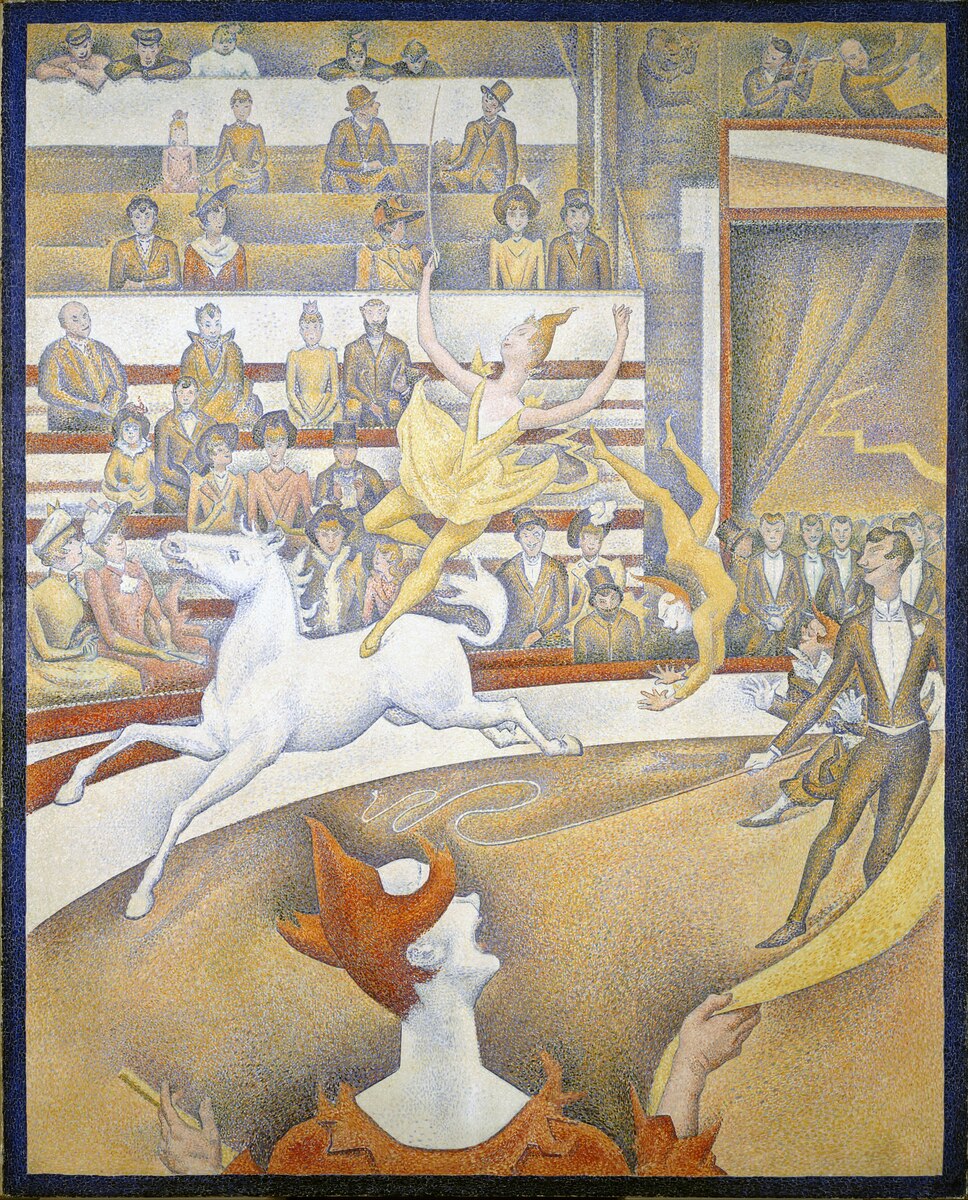
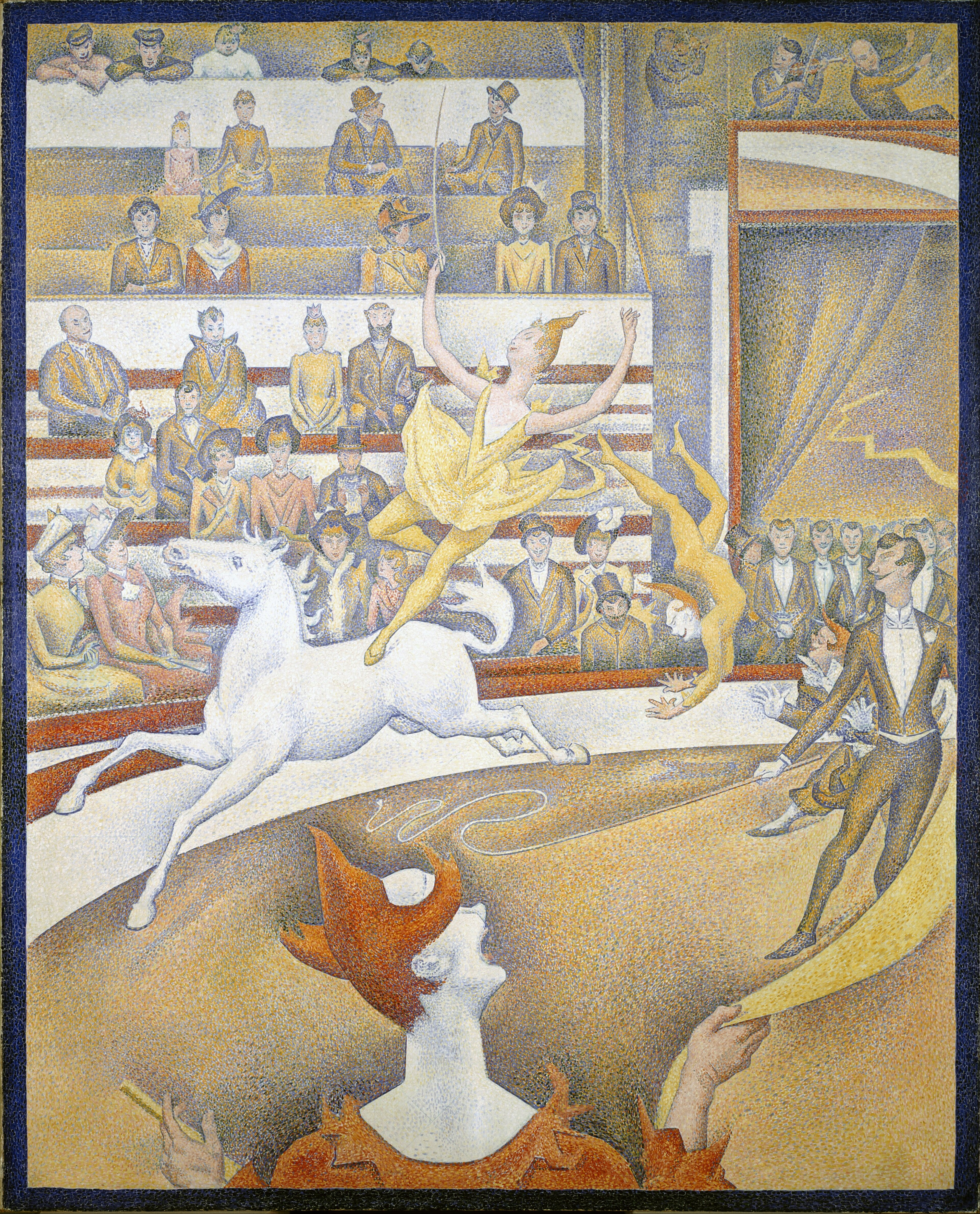
Seurat's The Circus is an oil painting of 1891. It shows a female acrobat standing on the back of a white horse as it gallops around the ring.
She wears a yellow tutu and bodice. One arm holds a whip raised; the other extends outward. In the foreground a clown stands with his back to us, and to the right a ringmaster in evening dress stretches out his hand.
Around the performance, the setting is alive. Tiered stands at the left hold rows of spectators, each hat and face reduced to dotted silhouettes.
Above them, in an orchestra box at the upper right, two musicians play violins. The circus is shown, in other words, as continuous performance and live sound, not a frozen spectacle.
Notice how the acrobat becomes the visual apex of the composition. Her poised, upward gesture directs your attention to the act itself, and the painting organises itself around her.
The white horse is mid-stride, legs extended, tail sweeping. Its pale body carries lilac and blue shadows against the warm ring floor. That is not how a horse looks in ordinary light. It is how Seurat makes movement visible on a still surface.
The clown in the foreground does more than amuse. Seen from the back, with white hair and a blank profile, he occupies the near edge of the scene and frames the ring.
This placement pulls us into the picture. We are behind him, looking into the same circle he faces, which makes the viewer a member of the audience rather than a detached observer.
The Circus is held in the collection of the Musée d'Orsay in Paris, with accession number 542. It entered that collection through the John Quinn bequest in 1924.
The painting is oil on canvas, dated 1891, and measures 1,850 millimetres high by 1,520 millimetres wide. Those facts belong to the object record and keep it distinct from the subject it depicts.
The ringmaster at the right wears a black tailcoat, white shirtfront and bow tie. He has a moustache and an outstretched hand, directing the performance while holding a long yellow ribbon or rein that curves across the ring.
His gesture and the curve of the ribbon tie the action together. The ring is not just a stage. It is a system of marks and gestures that the eye follows.
What makes this painting more than a circus picture is how it uses the dotted surface. The spectators' faces and hats are built from dots. The horse's shadows are built from dots.
Seurat's method makes the viewer's eye mix the colours and assemble the scene. So the painting is not only about a performance. It demonstrates how looking works, one small mark at a time.
So the work asks you to watch the circus and watch yourself watching it. The acrobat's balance, the clown's framing back, the ringmaster's outstretched hand: each is a cue in a carefully built visual machine.
Seurat gives us a ring of attention. The performance is the subject, and the painting is the act of seeing it come together.