Identity and catalogue
Link- Title
- The Card Players
- Artist or attribution
- Paul Cézanne
- Object date
- around 1892-96
- Medium and support
- oil on canvas
- Current collection or location
- The Courtauld Gallery, London
- Movement or period
- Post-Impressionism
- Country or culture
- France
- Depicted subject
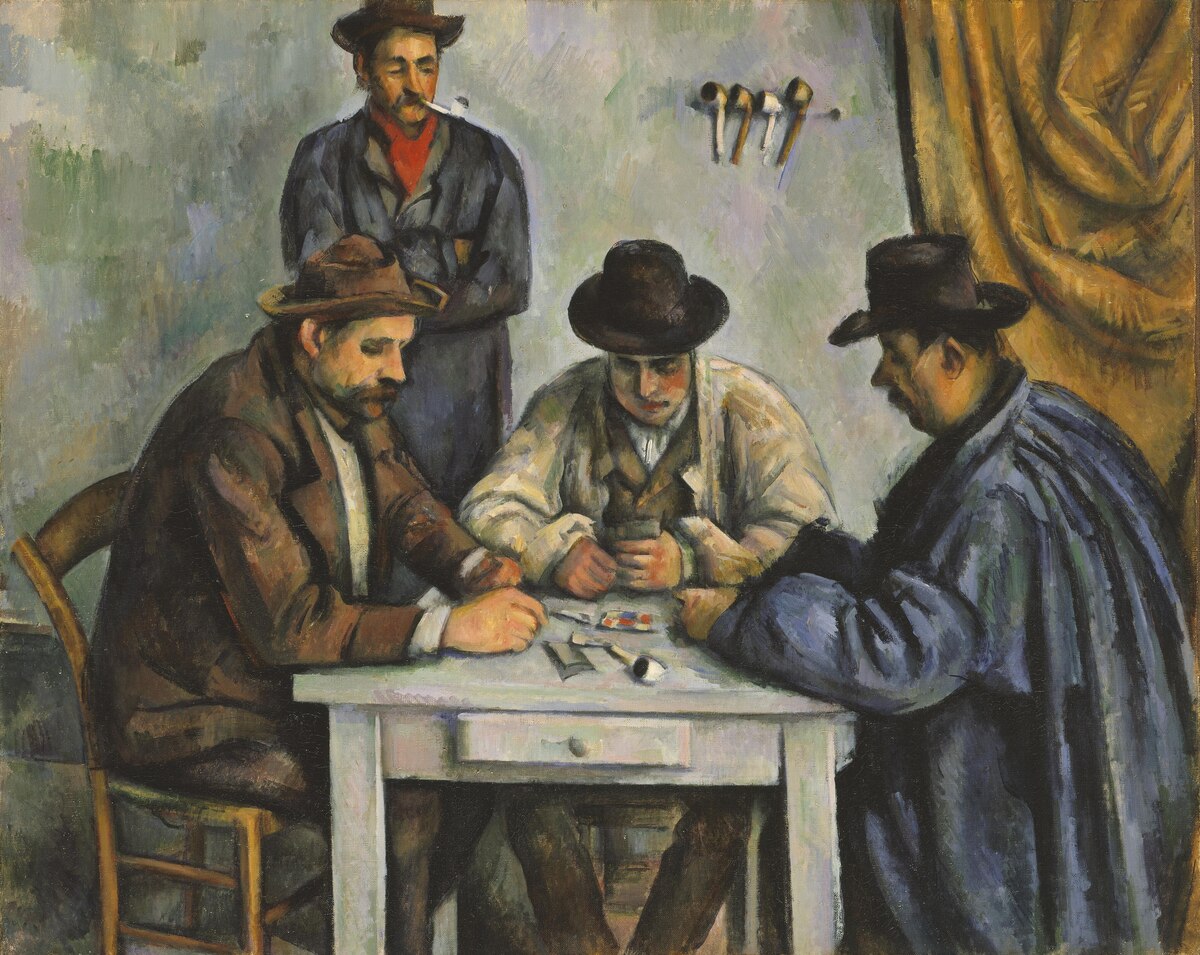
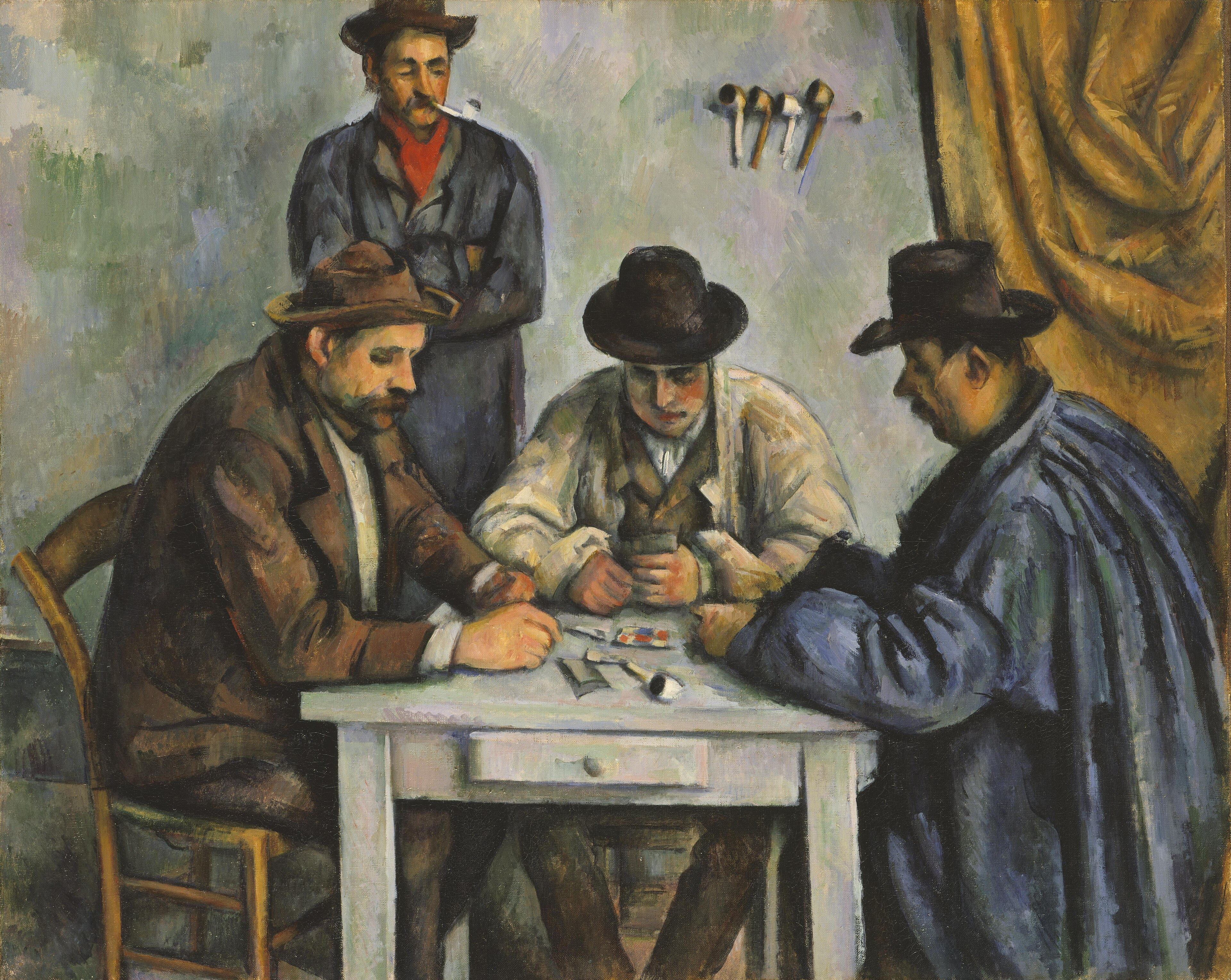
- Two farm workers seated across a table, absorbed in a card game, in an undefined setting.
- Title variants
- The Card Players; Les Joueurs de cartes
- Support
- canvas
- Dimensions
- Unknown
Catalogue identity at The Courtauld
The painting catalogued by The Courtauld Gallery as Paul Cézanne, The Card Players, around 1892-96, belongs to the Samuel Courtauld Trust in London, and the gallery records it as on display in the LVMH Great Room, Level 3. That institutional identification carries the qualities of a catalogue entry rather than a fixed determination: the title is a conventional subject title, the attribution is to Cézanne, and the date is given as a range with the qualifier "around". The object's identity is therefore anchored in a named holding and a named room, while its dating remains approximate, and the range should not be collapsed into a single year.(The Courtauld Gallery, n.d.)
A separate, related version of The Card Players is held by The Metropolitan Museum of Art. Its institutional record dates it between 1890 and 1892, specifies oil on canvas, gives the accession number 61.101.1, and states dimensions of 65.4 by 81.9 centimeters. The Met record, as supplied through the Wikimedia Commons file page, does not give an inscription, a signature, or a provenance interval for that canvas, so none should be assumed for it here. The two records differ in an important respect: the Met account assigns an earlier and narrower date range, 1890 to 1892, while the Courtauld account places its own canvas around 1892 to 1896. These are catalogue dates established by different institutions, not observations made on the same object, and they should not be merged into one chronology.(commons.wikimedia.org, n.d.)
Materials, support and recorded measurements
Both the Courtauld and Met canvases are oil paintings, and the one surviving measured account, for the Met picture, gives its support as canvas with dimensions of 65.4 by 81.9 centimeters, which should not be transferred to the Courtauld painting. No dimensions, inscriptions, signatures, or canvas stamps for the Courtauld canvas appear among the supplied records. The comparison that can safely be made is categorical rather than numerical: two related oil paintings, one measured and one not, each carrying its own institutional catalogue data. This asymmetry is a normal condition of object-level research and is worth stating plainly, since the Met's figure is often quoted as though it described the whole series.(commons.wikimedia.org, n.d.)(The Courtauld Gallery, n.d.)
The series and the dating of the two versions
Interpretation
Read together, the catalogue facts support a qualified synthesis about why this object matters in the history of art. The subject of card players was one Cézanne took up in the autumn of 1890 and pursued through five paintings in the 1890s, and the Courtauld canvas, dated around 1892-96, is one member of that group. The Met canvas, dated 1890 to 1892 and documented as oil on canvas at 65.4 by 81.9 centimeters, is another. What the record establishes with confidence is a sustained, multi-year project of repetition on a single theme; what it leaves open is the precise sequence and the exact intervals between the canvases. That combination of documented duration and uncertain chronology is characteristic of Cézanne's later working practice, and it is why this group of paintings is studied as a series rather than as individual, isolable works.(The Courtauld Gallery, n.d.)(commons.wikimedia.org, n.d.)
The Courtauld Gallery identifies this painting as Paul Cézanne, The Card Players, around 1892-96, The Courtauld, London (Samuel Courtauld Trust).(The Courtauld Gallery, n.d.)
The Metropolitan Museum of Art holds a related version of The Card Players, dated between 1890 and 1892, oil on canvas, accession number 61.101.1.(commons.wikimedia.org, n.d.)
Subject and iconography
LinkThe object and its place in the series
Visual observation
The Courtauld Gallery identifies this work as Paul Cézanne, The Card Players, around 1892-96, held in London as part of the Samuel Courtauld Trust. The institutional record places it within a sustained campaign of work: Cézanne became interested in depicting labourers playing cards in the autumn of 1890, and during the 1890s he completed five paintings of this subject. Treating this canvas as one of those five establishes the comparison that matters most for looking at it, because the series is not a set of repetitions but a sequence in which the scene is progressively reduced, and this version represents a late and severe point in that reduction. The Courtauld also states that the painting is on display in the LVMH Great Room, Level 3, which locates the object in a present-day hanging context, though the evidence supplied does not describe how it is installed or what it hangs beside.(The Courtauld Gallery, n.d.)
Composition and the undefined setting
In this painting the composition is refined down to two men seated across a table in undefined surroundings. The players face each other but are immersed in the ritual of the game. Those two observations are the foundation for everything else that can be said about the picture's visual structure: the setting is not merely sparse but absent, with no interior architecture, no furnishing beyond the table itself and no narrative incident to direct the eye away from the pair. The absence of a described room pushes the two figures forward as the primary subject. What the evidence supports is a compositional fact, not an interpretation of mood: the removal of surroundings concentrates attention on the table, the opposed orientation of the two bodies and the activity that holds them. Any further claim about how the emptiness functions, whether as timelessness, monumentality or psychological isolation, belongs to attributed curatorial reading rather than to observation, and the two registers should be kept apart.(The Courtauld Gallery, n.d.)
Attributed interpretation and its limits
Interpretation
The Courtauld's curatorial interpretation states that the figures are the human equivalents of the painter's views of Mount Saint Victoire: timeless, monumental and resolutely Provençal. This is an attributed reading advanced by the holding institution, not a statement the painting makes outright, and it should be reported as interpretation rather than as documented meaning. Its value for visual analysis is that it explains a structural decision. If the men are understood to carry the same weight as Cézanne's repeated paintings of the mountain, then the stripping away of detail in this canvas becomes legible as a means of making the pair feel fixed and enduring rather than as a loss of information. The comparison is instructive precisely because it is a comparison and not a pictorial quotation: the evidence supplied does not establish that Cézanne himself linked the card players to the mountain views, nor does it establish a date at which such a link was proposed, so the reading remains the institution's, offered as an account of what the composition does.(The Courtauld Gallery, n.d.)
The sitters and their documented identity
Visual observation
The identity of the sitters is documented in the supplied record: farm workers from the estate of Cézanne's father posed for the two figures. That detail changes how the picture's subject should be described. It establishes a direct connection between painter and models rather than an encounter with strangers observed in a public setting, and it gives the men a specific social and local position as labourers on a family property in Provence. The evidence does not supply the workers' names, the number of sittings, or the terms on which they posed, and those gaps should not be filled. What can be said is that the pairing of an undefined, emptied setting with figures drawn from a known estate produces a deliberate tension for the viewer: the surroundings are generalized while the people are not, so that the painting withholds place while retaining a documented social identity for the men at the table.(The Courtauld Gallery, n.d.)
Significance of the reduction
Interpretation
Read together, these units describe a canvas whose visible austerity is the product of a decade-long process of subtraction rather than a single compositional decision. The interest in labourers playing cards dates to the autumn of 1890; five paintings of the subject were completed across the 1890s; and this one reduces the scene to two men, a table and no discernible setting. The viewer looking at this version is therefore looking at a stage in a series, and the reduction is best understood as comparative: the elimination of incident and place is what distinguishes this picture within the group. The Courtauld's interpretation of the figures as monumental and resolutely Provençal, comparable to the Mount Saint Victoire views, is a framework offered by the institution to account for that austerity, and it remains an attribution rather than a documented intention. The result is a picture whose subject matter is modest, two farm workers from the painter's family estate playing cards, but whose handling turns that modest subject into an exercise in concentration, and whose significance within the wider history of the series lies in how much of the scene has been removed while the human encounter is retained.(The Courtauld Gallery, n.d.)
Visual observation
In this painting, the composition is refined down to two men seated across a table in undefined surroundings.(The Courtauld Gallery, n.d.)
The commission and the sequence
Cézanne became interested in depicting labourers playing cards in the autumn of 1890, and during the 1890s he completed five paintings of this subject. The Courtauld canvas is one of those five. The two statements together establish both a starting point for the theme, the autumn of 1890, and its extent across the decade, which means that the Courtauld picture was made neither as an isolated experiment nor as a unique statement, but within a sustained sequence in which the same motif was revisited repeatedly. Any account of this object's commission or function has to reckon with that serial character, since the artist's interest predates the painting by several years and outlasted it.(The Courtauld Gallery, n.d.)
Evidence, attribution and the limits of the account
Interpretation
Taken together, the evidence separates what can be seen from what is documented and from what is interpreted. The canvas shows two men at a table in an undefined space, facing one another and absorbed in play. The documents establish that Cézanne began the card player theme in autumn 1890, produced five paintings of it during the 1890s, and used farm workers from his father's estate as the models. The curatorial reading of the figures as monumental and Provençal belongs to the last category. The date range of around 1892 to 1896, the poses of known local workers, and the serial repetition of the motif together make the painting a document of a sustained working method rooted in a specific household and region, while the interpretation of what those figures signify remains a scholarly proposition rather than a recorded fact about the artist's intention.(The Courtauld Gallery, n.d.)
Cézanne became interested in depicting labourers playing cards in the autumn of 1890.(The Courtauld Gallery, n.d.)
During the 1890s, Cézanne completed five paintings of this subject.(The Courtauld Gallery, n.d.)
Provenance and ownership
LinkOwnership
The provenance record supplied for this painting is unusually thin in one respect and unusually specific in another. No document in the evidence units names a purchaser, an intermediate owner, a sale, a bequest, or a date of transfer. What the evidence does establish is the painting's present institutional identification: the Courtauld Gallery identifies the work as Paul Cézanne, The Card Players, around 1892-96, held at The Courtauld, London, under the Samuel Courtauld Trust. The trust name is the only custody information the record supplies, and it describes the current holding rather than the history of how the painting reached it. The interval between the painting's execution in the mid 1890s and its entry into the Courtauld's collection is therefore unrecorded in these units. That absence is a gap in documentation, not a proven change of ownership, and it should not be read as evidence that the work passed through no hands. The same object page also records the painting's display location, the LVMH Great Room on Level 3, a detail of current presentation rather than provenance.(The Courtauld Gallery, n.d.)
The identity of the figures is the one point of documented human connection in the record. The Courtauld states that the two men depicted were farm workers from the estate of Cézanne's father, and that they posed for the painter. This is a claim about the making of the picture rather than its ownership, but it has a bearing on provenance in the broader sense: it places the painting's origin in a specific social and familial network, the paternal estate in Provence, and it distinguishes the subject from an anonymous café scene observed among strangers. The evidence does not name the individuals, does not specify how they were recruited or when they sat, and does not indicate whether they or their families ever had any relation to the work after it was painted. The statement is attributed to the Courtauld's account, and the record supports it at the level of documented subject; it does not extend to questions of who the men were, what they received, or what became of the painting in the decades after it left the studio.(The Courtauld Gallery, n.d.)
Provenance timeline
- autumn of 1890
Cézanne became interested in depicting labourers playing cards.(The Courtauld Gallery, n.d.)
Interpretations and debates
LinkThe object and its identification
Interpretation
The Courtauld Gallery identifies this canvas as Paul Cézanne, The Card Players, around 1892-96, held in London as part of the Samuel Courtauld Trust. That identification and dating frame every reading that follows: the picture is a late work of the 1890s, and the institution's account of it is the basis for the subject, the medium of painting, and the interpretive claims attributed here to the curators. The gallery also states that the painting is on display in the LVMH Great Room, Level 3, which is the present circumstance of viewing rather than evidence about the making of the work.(The Courtauld Gallery, n.d.)
Visual reduction and its consequences
The Courtauld's reading holds that the players face each other but are immersed in the ritual of the game. The phrasing is careful: the two figures are directed toward one another, yet their absorption is in the activity rather than in each other as individuals. In a composition stripped of setting, this absorption becomes the principal human content of the picture. The gallery's formulation is an interpretation of what the arrangement expresses, not a record of the painter's stated intention, and it should be weighed as an attributed reading of the visible evidence rather than as documentation of Cézanne's private purpose.(The Courtauld Gallery, n.d.)
The sitters and their world
Farm workers from the estate of Cézanne's father posed for the two figures. This documented detail changes the status of the subject: the men are not anonymous types observed at a distance in a public house or café but individuals connected to the painter's family property and known to him. The gallery's statement therefore grounds the figures in a specific Provençal social world, and it supplies a biographical fact about the models that is independent of, and prior to, any symbolic reading of the pair. It also means that the reduction of the setting does not remove the figures from a real locale; it removes the anecdotal furniture while keeping the people.(The Courtauld Gallery, n.d.)
The curatorial reading
Curatorial interpretation states that the figures are the human equivalents of the painter's views of Mount Saint Victoire: timeless, monumental and resolutely Provençal. This is the Courtauld's comparison, explicitly attributed to the curators, and it links the card players to the landscape paintings Cézanne made repeatedly of the mountain near Aix. Read together with the documented fact that farm workers from the estate of Cézanne's father posed for the figures, the comparison gains its force: the men belong to the same Provençal territory as the mountain, and the curators present them as equally enduring subjects. The claim is an analogy offered by an institution, not a statement the painting makes outright, and it does not establish what Cézanne himself intended the figures to signify.(The Courtauld Gallery, n.d.)
Evidence, attribution and the limits of synthesis
The difference between accounts of this picture lies in how far interpretation is allowed to travel. The documented record establishes the painter's interest from autumn 1890, five paintings of the subject in the 1890s, the two farm workers from the father's estate as models, and the gallery's identification and dating; the curatorial reading adds the analogies with Mount Saint Victoire and with absorption in the ritual of the game. Weighing these together, the analogy with the mountain explains why the composition works as it does, since stripping away detail is precisely what makes the men read as fixed and enduring, but it remains an attributed interpretive frame. A responsible account keeps the models, the series and the reduced composition as documented or observed facts, and keeps totality of meaning, including the claim that the game is not really the point, as curatorial interpretation.(The Courtauld Gallery, n.d.)
Curatorial interpretation states that the figures are the human equivalents of the painter's views of Mount Saint Victoire: timeless, monumental and resolutely Provençal.(The Courtauld Gallery, n.d.)
Collection and display
LinkThe object and its display
The Courtauld Gallery identifies this canvas as Paul Cézanne, The Card Players, around 1892-96, held in The Courtauld, London, under the Samuel Courtauld Trust. The same institutional record states that the painting is on display in the LVMH Great Room, Level 3, so the work can be described both as an accessioned collection object and as a picture currently presented to visitors in a named, located gallery space. The date is given as an approximate range rather than a fixed year, which matters for how the work sits historically: it belongs to the middle years of Cézanne's sustained engagement with the card player subject, not to a single documented moment of completion. The institutional identification and the display information come from the same object record and carry the same kind of authority, namely a museum's published account of its own collection.(The Courtauld Gallery, n.d.)
The card player series
According to The Courtauld Gallery, Cézanne became interested in depicting labourers playing cards in the autumn of 1890, and during the 1890s he completed five paintings of this subject. That sequence is the frame within which this picture should be understood: it is one of five treatments, made across roughly a decade, rather than an isolated image. The Courtauld's account also specifies that in this painting the composition is refined down to two men seated across a table in undefined surroundings, the players facing each other while remaining immersed in the ritual of the game. The reduction is therefore a documented feature of the gallery's description, not merely a viewer's impression. The autumn 1890 starting point and the 1892-96 dating of this particular canvas together place the Courtauld picture within an extended working process in which the subject was repeatedly revisited and compressed.(The Courtauld Gallery, n.d.)
The Courtauld states that farm workers from the estate of Cézanne's father posed for the two figures. This is a specific claim about who the men were and about the painter's relationship to them: the models are identified through a family estate rather than as anonymous types, which ties the picture's making to a known social and propertied milieu in Provence. The gallery's account does not describe the setting of the encounter beyond the posing itself, and it does not date the sittings. What it establishes is that the figures were drawn from a labouring population connected to Cézanne's father's estate and that they served as models for this composition. That detail is central to the work's material and social history, since it locates the image in a network of local employment and acquaintance rather than in an imagined or purely literary scene.(The Courtauld Gallery, n.d.)
Curatorial interpretation
The Courtauld Gallery's curatorial interpretation states that the figures are the human equivalents of the painter's views of Mount Saint Victoire: timeless, monumental and resolutely Provençal. This reading is attributed to the institution and should be presented as an interpretation rather than as a property the painting declares. Its value is explanatory: it accounts for why the composition is so severely reduced, with the two players pushed forward and the surroundings left undefined, by aligning the men with the enduring landscape subjects Cézanne painted repeatedly. The gallery's description of the players as facing one another yet absorbed in the ritual of the game complements that reading, because absorption and frontality are exactly what remain once narrative and setting are removed. Taken together, the documented composition and the attributed interpretation suggest that the picture's significance lies less in the game as an event than in the figures as fixed, rooted inhabitants of a specific region, though that emphasis belongs to the curatorial account rather than to the object's own statement.(The Courtauld Gallery, n.d.)
Interpretation
For a larger history of art and material culture, the Courtauld record places a major modern painting in an unbroken line from Cézanne's Provençal subjects to its present public display. The gallery's dating, subject history, model identification and curatorial reading are all published institutional claims, each open to the qualifications that attach to museum attribution: the date is approximate, the series count is the gallery's own, and the Mount Saint Victoire comparison is explicitly interpretive. What the evidence supports is a picture made around 1892-96 as one of five card player compositions begun from an interest recorded in autumn 1890, using farm workers from the estate of Cézanne's father, refined to two facing figures in undefined surroundings, described as timeless, monumental and resolutely Provençal, and now on view in the LVMH Great Room, Level 3. The continuing research value of the object lies in that combination of documented making, attributed meaning and current public presentation.(The Courtauld Gallery, n.d.)
Documented values and qualified estimates
LinkDocumenting Value: Working Estimates and Their Limits
Interpretation
No confirmed sale price, auction result, or official insurance value for the painting appears in the supplied excerpts, and the record for the working insurance estimate states explicitly that no comparable sales are claimed and that no private insurance records were used. What exists instead is a calculated working estimate of US$80M to US$150M, recorded as a working calculation generated on 2026-10-16. The estimate describes itself as a broad, conservative working range produced for manual insurance review, not a market valuation, and it says its basis is confirmed context only: the identification of the work as Paul Cézanne's The Card Players, oil on canvas, around 1892 to 1896; its status as one of five paintings of the card-player subject completed in the 1890s; its holding by The Courtauld Gallery, London; and the existence of a related version at the Metropolitan Museum of Art. The range is said to reflect the artwork's status as a major Post-Impressionist painting, its prominent museum collection status, and its recognition as part of a celebrated series.(The Courtauld Gallery, n.d.)(commons.wikimedia.org, n.d.)
The estimate's own qualifications are as important as its figures. It is described as a model-generated working range for manual review only, and is not an official insurance value, appraisal, auction result, or sale price; the final insured value, it says, should be established by a qualified fine-art appraiser in consultation with the insurer and the owning institution. Because the range is explicitly a placeholder for professional review and because the same document denies any basis in comparable sales or private insurance records, it cannot be treated as documenting the painting's market worth, nor as evidence of any transaction involving the Courtauld canvas or its related Met version. It is best understood as a transparent methodological artifact: it records what a conservative manual-review calculation would look like when derived solely from the confirmed identification, series membership and collection context supplied by the two institutional records, and it marks the boundary between that calculation and an actual valuation.(The Courtauld Gallery, n.d.)(commons.wikimedia.org, n.d.)
Working estimate
Calculated working insurance estimate, not a sale price: Estimated value: US$80M to US$150M Recorded date: Working calculation, generated 2026-10-16. Methodology: This is a broad, conservative working range for manual insurance review, not a market valuation. It is based on confirmed context only: Paul Cezanne, The Card Players, oil on canvas, around 1892-96, one of five paintings of the card-player subject completed in the 1890s, held by The Courtauld Gallery, London, with a related version at the Metropolitan Museum of Art. The range reflects the artwork's status as a major Post-Impressionist painting, its prominent museum collection status, and its recognition as part of a celebrated series. No confirmed sale price, auction result, or official insurance value is available in the supplied excerpts, and no comparable sales are claimed. The range should be treated as a placeholder for professional review by a qualified fine-art appraiser and insurer. Qualification: This is a model-generated working range for manual review only. It is not an official insurance value, appraisal, auction result, or sale price. No comparable sales or private insurance records were used or claimed. The final insured value should be established by a qualified fine-art appraiser in consultation with the insurer and the owning institution.(The Courtauld Gallery, n.d.)(commons.wikimedia.org, n.d.)